📌 Quick Answer:
Employee termination in India requires 30–90 days’ notice, mandatory severance (15 days’ pay per year of service), a documented PIP for performance exits, and government approval for 300+ worker establishments. At-will termination does not exist in India. A non-compliant exit can trigger reinstatement + full back wages for up to 2 years. For a ₹1 lakh/month employee with 5 years of service, minimum exit cost is ₹9.34 lakh (~$10,275).
Termination disputes can take 6 months to 2 years to resolve, creating long-term legal and financial exposure for employers.
A mid-tenure employee can cost 30% to 50% of annual salary to exit, depending on tenure and statutory obligations.
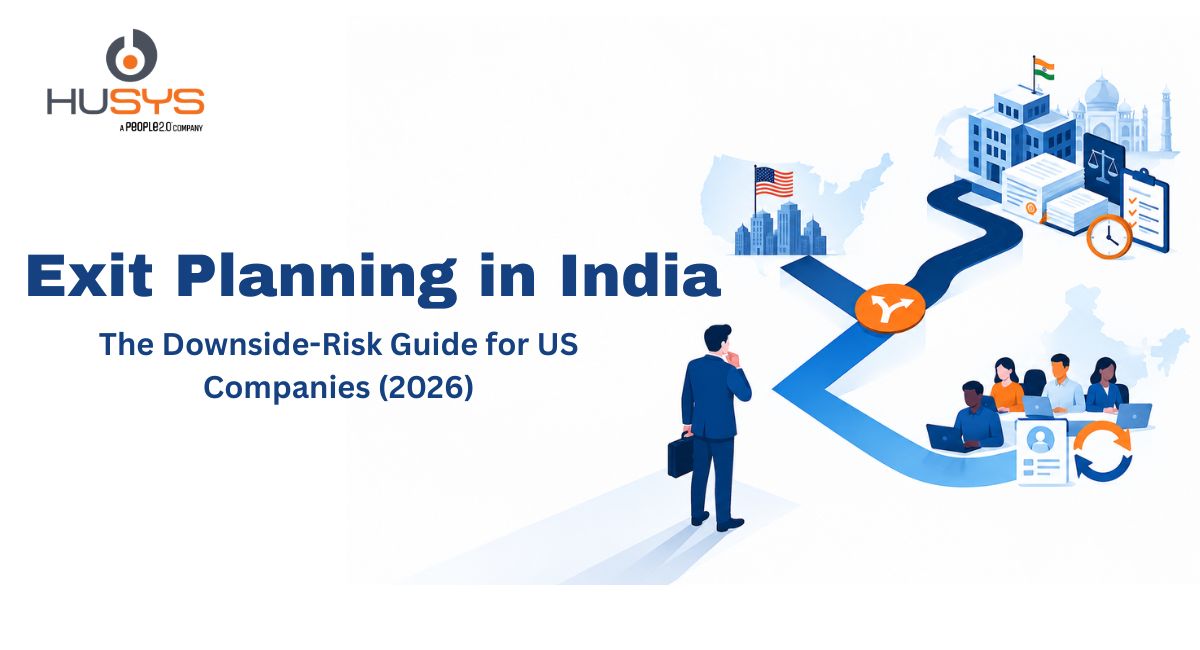
Employee termination in India is fundamentally different from the US.
Employee termination in India involves legal, financial, and procedural requirements that most US employers underestimate during workforce planning.
If you’re a US founder, CFO, or HR leader with employees in India, this guide covers exactly what applies to your situation, the legal framework, real timelines, severance math, failure scenarios, and how an Employer of Record (EOR) changes the risk equation entirely.
Based on Husys’ experience managing 50,000+ workers and supporting 5,000+ global companies across 28 states and 8 Union Territories, the #1 compliance issue US clients run into is not payroll, it's termination. Specifically: not understanding that India is not an at-will market before the exit conversation starts.
What is employee termination in India?
Employee termination in India refers to the formal process of ending employment while complying with labour laws, notice periods, and statutory payments.
Can you terminate an employee immediately in India?
No. Employee termination in India cannot be done instantly without following due process, including notice periods, documentation, and statutory payments.
TL;DR - India vs US Termination at a Glance
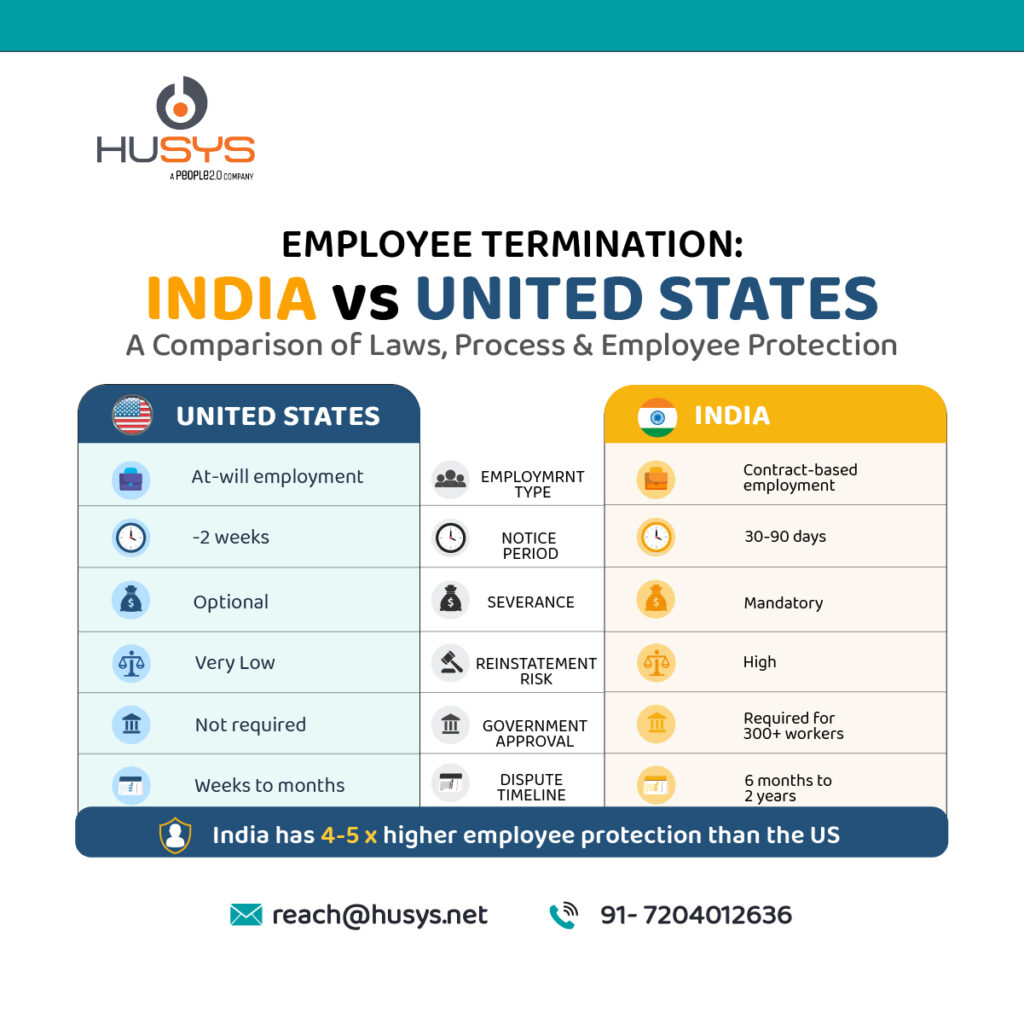
| Aspect | United States | India |
|---|---|---|
| Employment type | At-will (most states) | Contractual — valid cause required |
| At-will termination | ✅ Recognized | ❌ Does not exist |
| Severance required | ❌ Rare / optional | ✅ Mandatory after 1 year of service |
| Notice period | ~2 weeks (customary) | 1–3 months (legal requirement) |
| Payroll cycle | Bi-weekly | Monthly |
| Benefits | Optional | Statutory (PF, ESI, Gratuity) |
| Govt approval for mass exits | ❌ Not required | ✅ Required for 300+ workers |
| Reinstatement risk | ❌ Very low | ✅ High — courts are pro-employee |
| Dispute resolution timeline | Weeks to months | 6 months to 2 years |
| Final settlement deadline | State-specific | Within 2 working days of exit |
The gap between what US companies assume and what Indian law actually requires is the most expensive mistake we see, and it always surfaces at the worst moment.
Can you terminate an employee immediately in India?
No. Employee termination in India cannot be done instantly without following due process, including notice periods, documentation, and statutory payments.
In most cases, termination requires 30 to 90 days’ notice or payment in lieu, along with compliance under applicable labour laws.
Immediate termination without process can lead to reinstatement and back wage liability under Indian labour law.
Who Should Read This: Founders, CFOs & HR Leaders Managing India Teams
- Founders / CEOs at early-stage startups (0–50 employees) who need to exit a hire in India without triggering a legal dispute
- CFOs and finance leaders at mid-market companies (50–500) who need to understand the full financial exposure of an India exit
- HR / People leaders building a compliant India workforce lifecycle from hire to offboard
- General Counsel / Legal who need to understand India-specific employment law risk before advising on a restructuring
this guide is your pre-action read.
If you’re thinking, “We may need to exit someone in India soon and we’re not sure what the process looks like”
1. Employee Termination in India: Why It's High Risk
In the US, “at-will employment”means either party can end the relationship at any moment, for almost any reason, with minimal notice. As covered in detail in Section 3, India is the legal opposite — every employer-initiated exit triggers a specific procedural chain, mandatory payments, and in many cases, government oversight.
India’s Industrial Disputes Act, 1947 (IDA) – now consolidated under the Industrial Relations Code, 2020 (IR Code), effective November 21, 2025 – explicitly does not recognize at-will employment. Every employer-initiated exit requires:
- A valid, documented reason (performance, misconduct, or business restructuring)
- A specific procedural chain depending on exit type
- Statutory payments — severance, gratuity, notice pay, leave encashment — within mandated timelines
- Government notification in cases of mass retrenchment
Indian courts are consistently pro-employee. If an employer cannot prove valid grounds with documented evidence, courts can order the employee reinstated — with full back wages paid from the termination date to reinstatement. This has been upheld repeatedly, including in landmark rulings such as Workmen of Meenakshi Mills Ltd. v. Meenakshi Mills Ltd. (1992 SCR (1) 954) and Punjab Land Development and Reclamation Corporation Ltd. v. Presiding Officer (1990 AIR 684)
"We've seen US companies try to handle India exits the way they handle US exits, a conversation, a notice, and a final paycheck. In India, that approach often leads to formal disputes and financial exposure if not handled through a compliant process." — Husys Compliance Team
Understanding employee termination in India is critical before initiating any exit, as mistakes can lead to reinstatement, penalties, and prolonged disputes. This is why many US companies rely on an Employer of Record (EOR) to ensure termination processes are structured, documented, and legally defensible from day one.
Learn more about Employer of Record India: Complete Guide for US Companies
2. The Legal Framework: What Actually Governs Termination in India
India’s termination law is not a single statute; it’s a structured, layered system of central and state-level regulations that apply simultaneously. This isn’t unusual complexity; it’s a well-established framework that rewards preparation and penalises improvisation. US companies that understand it upfront navigate exits cleanly. Those that don’t, tend to find out at the worst possible moment.
These laws form the foundation of employee termination in India and must be followed regardless of company size or industry.
Central Laws That Apply to Every India Exit
| Law | What It Governs |
|---|---|
| Industrial Relations Code, 2020 (IR Code) | Retrenchment, layoffs, standing orders, dispute resolution, consolidates the IDA 1947 |
| Code on Wages, 2019 | Final wage settlement, 2-day payment deadline, wage definitions |
| Code on Social Security, 2020 | Gratuity (1 year for fixed-term; 5 years for permanent), PF, ESI payouts on exit |
| Payment of Gratuity Act, 1972 | Gratuity eligibility and calculation (still in force alongside new codes) |
| Maternity Benefit Act, 1961 | Prohibits termination during maternity leave |
| Shops & Establishments Acts | State-specific notice periods, termination procedures — see state links below |
State-Level Complexity: The Layer Most US Companies Miss
India has 28 states and 8 Union Territories, each with its own Shops & Establishments Act. What’s required in one state may differ meaningfully from another, and your US HR team is unlikely to know the difference. Here are the key state acts that apply to most US-backed tech and ops teams in India:
State-level labour laws in India vary significantly, and interpretation can differ across jurisdictions under the Industrial Relations Code, 2020 and state-specific Shops & Establishments Acts, as outlined by India’s Ministry of Labour & Employment.
For US companies, this makes employee termination in India difficult to manage without local compliance expertise. This is where many companies rely on an Employer of Record in India to handle state-level compliance, documentation, and termination processes consistently.
Learn more about how Husys handles termination for its clients →
The Most Misunderstood Concept: Workman vs. Non-Workman
The IR Code applies specifically to “workers” employees in manual, skilled, technical, operational, clerical, or supervisory roles earning under ₹18,000/month in supervisory capacity.
- Workers get the strongest protections: mandatory severance, LIFO-based retrenchment, reinstatement risk
- Non-workers (senior managers, executives) are governed primarily by their contracts and state laws
The classification trap: Most US companies assume they are hiring managerial staff with fewer protections, but misclassification is common and directly impacts termination risk and statutory obligations. A software engineer in Bangalore earning ₹80,000/month is very likely classified as a “worker” under Indian law.
Accurate classification is critical, which is why many companies use an Employer of Record (EOR) to ensure employees are categorized correctly from the start.
Key takeaway: Employee termination in India is governed by multiple laws, requiring documented process and statutory compliance at every step.
3. US At-Will vs. India's System: The Core Difference
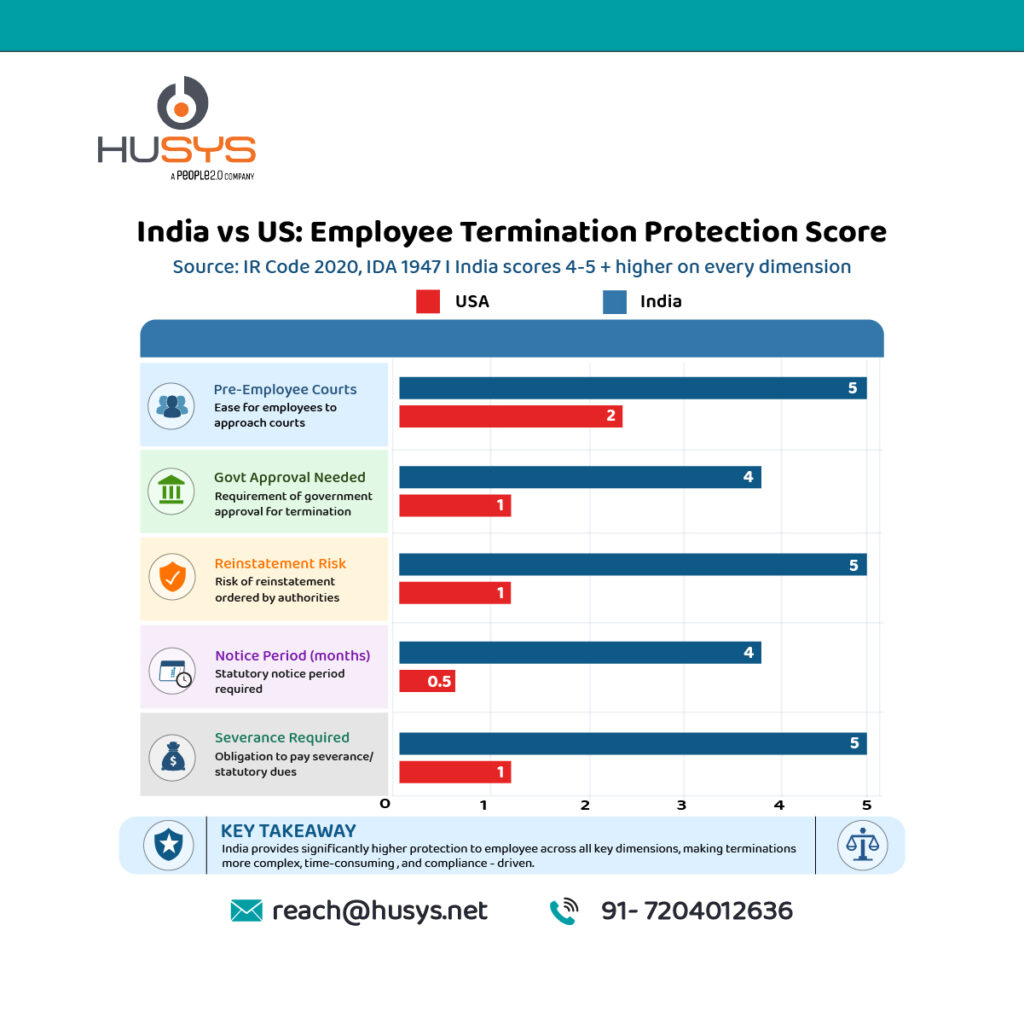
The gap isn’t just procedural, it’s philosophical. US employment law is built around employer flexibility. Indian employment law is built around employee job security.
If you’re a US founder or HR leader, you already know how quickly and cleanly a US exit can happen. India works on an entirely different logic. A performance exit with a 5-year employee requires documented PIPs, statutory notice, severance calculations, government notification if applicable, and a signed settlement, with a minimum 3–5 month runway before the employee’s last day.
In India, retrenchment = any employer-initiated termination for business reasons, not misconduct. It triggers specific payments and procedures whether you’re exiting 1 person or 100. This is not a “layoff” in the US sense, it’s a legally defined process with consequences for non-compliance.
This is the core reason employee termination in India carries significantly higher legal and financial risk for US companies than any comparable exit back home.
4. Types of Employee Termination in India (Ranked by Risk)
The 5 Types of Termination in India – What Each Requires
Type 1: Voluntary Resignation (Employee-Initiated)
Requirements:
- Written resignation
- Notice period per employment contract (typically 30–90 days)
- No statutory retrenchment compensation owed
- Gratuity, see eligibility rules below
- Leave encashment, final wages, settled within 2 working days of last day
US Equivalent: Standard voluntary quit with notice. Closest thing to a clean, no-drama exit in India.
Gratuity Eligibility at Resignation
Gratuity is governed under the Payment of Gratuity Act, 1972 and the Code on Social Security, 2020 (effective November 21, 2025). The eligibility threshold depends on the employee’s contract type:
| Employee Type | Minimum Service for Gratuity | Applicable Law |
|---|---|---|
| Permanent employee | 5 years continuous service | Payment of Gratuity Act, 1972 |
| Fixed-term contract employee | 1 year continuous service (pro-rata) | Code on Social Security, 2020 |
| Death or disablement | No minimum service required | Payment of Gratuity Act, 1972, Section 4 |
Important: The 1-year fixed-term gratuity rule applies only to employees who joined on or after November 21, 2025. It is not retrospective, as confirmed by the Ministry of Labour & Employment. Employees hired before that date under fixed-term contracts remain subject to the 5-year threshold unless their contract was renewed post-November 2025.
For US companies: Most India tech hires — engineers, analysts, ops staff — are on permanent contracts, which means the 5-year threshold applies. Budget accordingly. Fixed-term (FTC) hiring post-November 2025 triggers gratuity after just 12 months.
Type 2: Retrenchment (Employer-Initiated, Business Reasons)
This is the most legally complex exit type and the most common source of disputes for US companies.
Definition: Under Section 2(oo) of the Industrial Disputes Act, 1947, retrenchment means “the termination by the employer of the services of a workman for any reason whatsoever, otherwise than as a punishment inflicted by way of disciplinary action.” This covers role elimination, business restructuring, downsizing, and poor performance exits — any employer-initiated, non-disciplinary termination.
What this means in practice: If you’re ending someone’s employment for a business reason — not misconduct — it’s legally a retrenchment under Indian law. The procedural obligations follow automatically, whether you’re exiting 1 person or 100.
For workers with 240+ days (≈1 year) of continuous service, Section 25F of the Industrial Disputes Act, 1947 mandates the following:
- Notice: 1 month’s written notice to the employee stating reasons for retrenchment – or wages equivalent to 1 month in lieu of notice (for establishments under 300 workers; see 300+ rules below)
- Retrenchment compensation: 15 days’ average pay per completed year of continuous service, as mandated under Section 25F(b) of the IDA, 1947
- Government notification: Written notice to the appropriate government authority in the prescribed format before retrenchment is executed
- LIFO rule (Last In, First Out): The most recently hired employees must be retrenched first, as established under Section 25G of the IDA, 1947 – any deviation must be clearly documented and justified in writing
For establishments with 300+ workers: Under Section 25N of the Industrial Disputes Act, 1947 – now carried forward under Chapter VII of the Industrial Relations Code, 2020 – prior government approval is mandatory before any retrenchment can be executed, and the notice period is 3 months (not 1 month). Retrenchment carried out without this approval is void.
| Aspect | Retrenchment | Layoff |
|---|---|---|
| Nature | Permanent termination | Temporary inability to provide work |
| Trigger | Business/economic reasons | Factory closure, power failure, material shortage |
| Employment status | Ends | Continues |
| Compensation | Full severance + LIFO + govt notification | 50% basic wages + DA (up to 45 days/year) |
| Legal reference | Section 25F / 25N IDA 1947 | Section 25C IDA 1947 |
US companies restructuring India teams almost always mean retrenchment – permanent exits. Using “layoff” language in documentation when you mean permanent termination creates legal ambiguity that Indian courts consistently interpret in the employee’s favour.
Failure to comply with these statutory requirements can result in retrenchment being declared invalid, exposing the employer to reinstatement orders and back wage liabilities – as confirmed in Workmen of Meenakshi Mills Ltd. v. Meenakshi Mills Ltd. and upheld across subsequent Supreme Court rulings.
Indian courts can order the employee reinstated, with full back wages paid from the termination date to reinstatement.
Type 3: Dismissal for Misconduct (Disciplinary Exit)
India allows termination without severance, but only if a formal domestic inquiry is completed first.
Defined misconduct includes: Fraud, theft, wilful damage, bribery, unauthorized absence exceeding 10 days, wilful insubordination, sexual harassment.
The Domestic Inquiry Process (mandatory):
| Step | Action |
|---|---|
| 1 | Issue a charge sheet specifying each allegation |
| 2 | Appoint a neutral enquiry officer (internal or external) |
| 3 | Issue notice of enquiry — date, time, venue, officer name |
| 4 | Conduct enquiry per principles of natural justice — employee presents their case and can produce witnesses |
| 5 | Enquiry report prepared with findings and reasoning |
| 6 | Employer decides proportionate sanction (can include termination) |
Critical point: Skipping the domestic inquiry doesn’t make the dismissal faster, it makes it illegal. Indian courts will reinstate the employee and award back wages.
Type 4: Performance-Based Termination
Poor performance can be a valid ground for termination in India, but it must be supported by documented evidence and a structured process to withstand legal scrutiny.
What the employer must prove:
- Employee was informed of expectations in writing
- Regular written feedback was provided
- A PIP was issued and monitored (30–60 days minimum)
- Employee failed to improve, documented at each stage
What surprises US founders: In the US, a PIP is often a courtesy before an inevitable exit. In India, the PIP serves as the foundation of a legally defensible termination, as labour authorities and courts rely on documented evidence of fair opportunity and due process.
Failure to establish documented performance history and a structured PIP can result in termination being challenged as unlawful, with potential outcomes including reinstatement and back wages.
Type 5: Fixed-Term Contract (FTC) Expiry
- No notice required at natural expiry, the contract itself serves as termination notice
- No retrenchment compensation payable at FTC expiry
- Gratuity IS now payable after 1 year of continuous service (major change under Code on Social Security, 2020, previously required 5 years)
- Renewal creates risk: Multiple renewals may cause courts to treat the employee as permanent, triggering full IDA protections
A 1-year ₹80,000/month FTC engineer now costs approximately ₹46,154 in gratuity at exit, a cost most US hiring managers don’t budget for.
5. How Long Does Employee Termination Take in India?
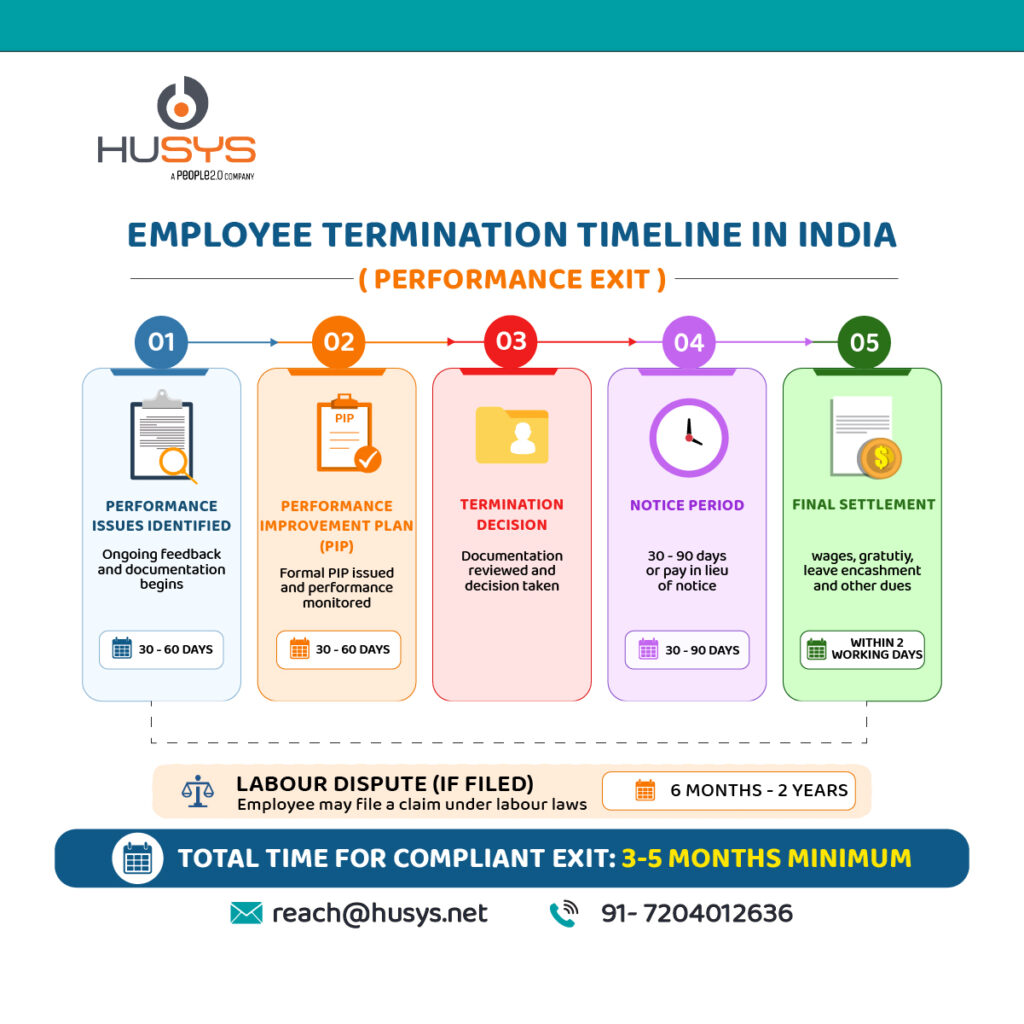
Employee termination in India takes a minimum of 3–5 months for a performance exit, 5–12 weeks for misconduct, and 5–7 months for mass retrenchment (300+ workers). No exit can be completed in days even immediate termination requires mandatory notice pay.
How this changes with an Employer of Record (EOR):
While statutory timelines (PIP, notice period, settlement) remain the same, an EOR ensures the process is executed correctly from day one. Documentation, notice handling, statutory calculations, and final settlement are managed without delays or compliance gaps significantly reducing the risk of disputes and rework.
Employee termination in India is not immediate and typically involves multiple stages that extend timelines significantly compared to the US.
Performance Exit Timeline
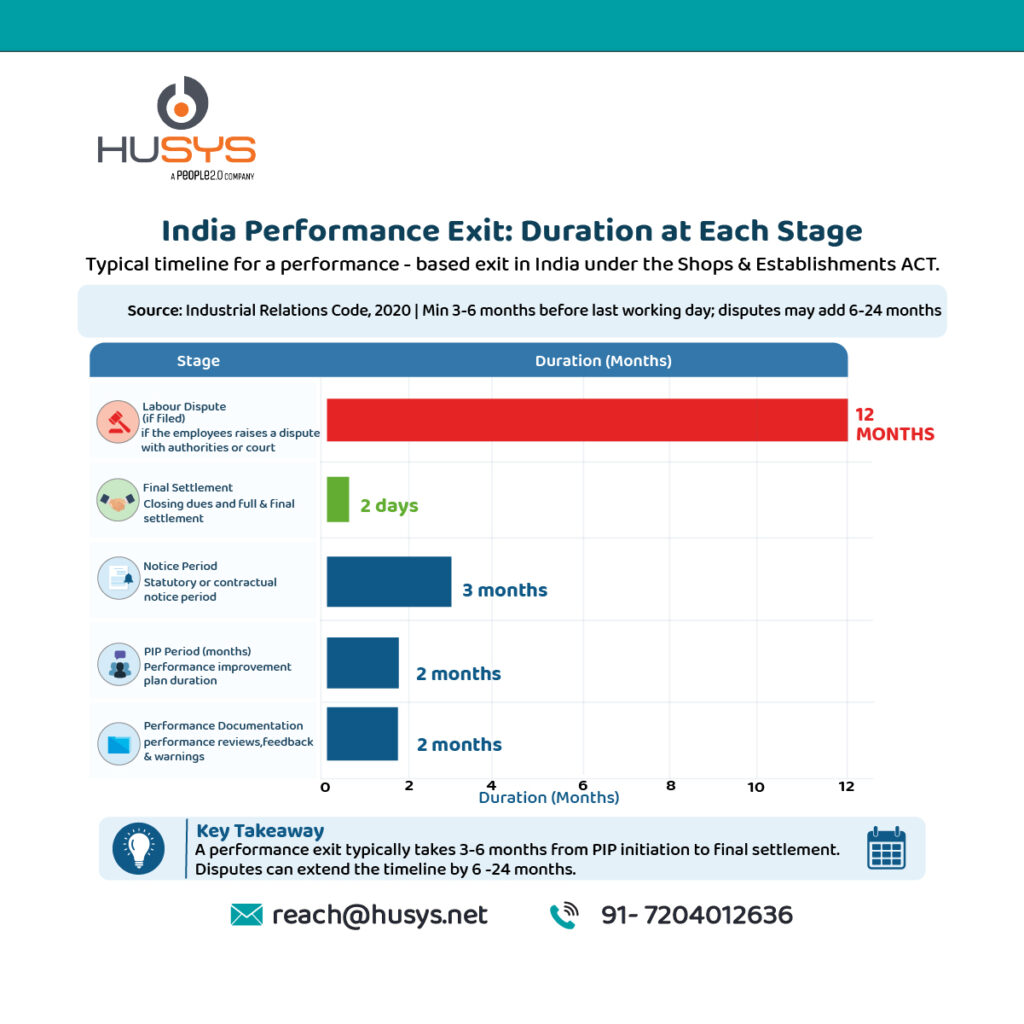
For US companies, the performance exit timeline is the most common, and most underestimated, part of managing employees in India. Unlike the US where a performance-based exit can happen in days, India requires a documented chain of events that begins long before any termination notice is issued. Every stage below is legally necessary, skipping or shortcutting any one of them is what turns a straightforward exit into a labour dispute.
| Stage | Minimum Duration |
|---|---|
| Performance documentation (feedback, written warnings) | 30–60 days (ongoing) |
| PIP issued and monitored | 30–60 days |
| Termination decision and notice issued | Day 1 |
| Notice period served (or paid in lieu) | 30–90 days |
| Final settlement (all statutory payments) | Within 2 working days of last day |
| Labour dispute (if filed) | 6 months – 2 years |
Total minimum for a compliant performance exit: 3–5 months before the employee’s last day.
Misconduct Exit Timeline
Misconduct exits move faster than performance exits, but only if the domestic inquiry process is executed correctly. The timeline below assumes the employer has a clear evidence trail, a neutral enquiry officer in place, and no delays in the employee’s response. Any procedural gap at any stage can invalidate the entire inquiry, restart the process, or expose the employer to reinstatement liability. Speed here is never worth cutting corners.
| Stage | Duration |
|---|---|
| Charge sheet issued | Day 1 |
| Preliminary fact-finding | 1–2 weeks |
| Domestic enquiry conducted | 2–8 weeks |
| Enquiry report and sanction decision | 1–2 weeks |
| Notice (or none, if misconduct proven) | Per contract |
| Final settlement | Within 2 working days |
Total for misconduct exit: 5–12 weeks minimum.
Mass Retrenchment (300+ Workers)
Mass retrenchment, defined as any retrenchment in an establishment with 300 or more workers, is the most time-intensive and government-supervised exit process in India. Unlike individual exits, you cannot serve a single notice and move on. The government approval stage alone takes 60–90 days, and notices can only be served after that approval is received. The table below reflects the minimum compliant timeline assuming no government delays, no employee objections, and a clean seniority list, any of which can extend the process further.
| Step | Timeline |
|---|---|
| Business case documentation | 2–4 weeks |
| Seniority list prepared | 1 week |
| Government approval application filed | Day 1 |
| Government approval received | 60–90 days |
| Notices served to employees | After approval |
| 3-month notice period begins | After notice served |
Total for compliant mass retrenchment: 5–7 months minimum.
How long does employee termination dispute resolution take in India?
Employee termination disputes in India typically take 6 months to 2 years to resolve, depending on the complexity of the case and the labour court process.
This means a single termination decision can remain a live legal and financial risk for up to 2 years, even after the employee has exited.
Employee Termination Risk Levels in India: What No One Maps Out Clearly
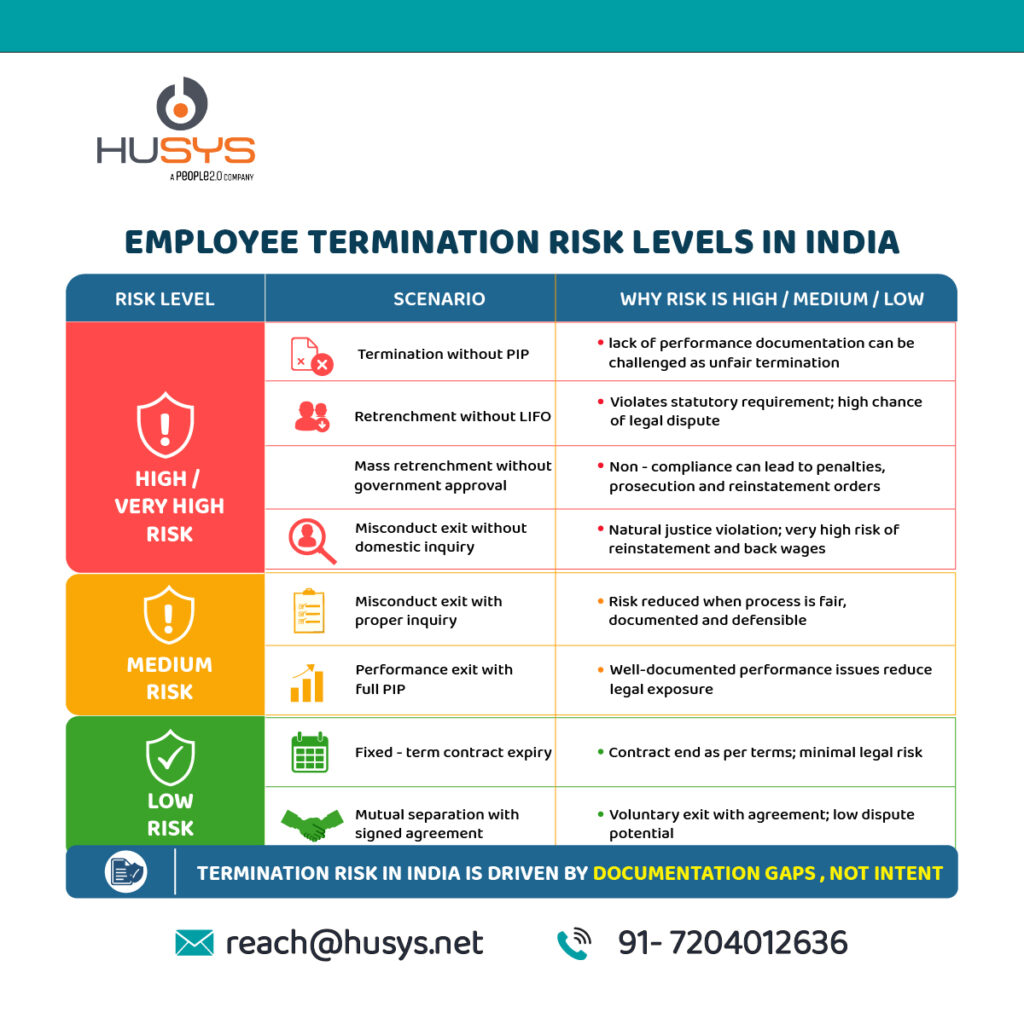
Most guides tell you what the law says. What they don’t give you is a consolidated view of where the actual risk concentrates, which exit scenarios are genuinely low-risk, which ones routinely end in labour court, and why.
This is that view. Based on the statutory framework of the Industrial Relations Code, 2020 and the Industrial Disputes Act, 1947, here’s how each termination scenario stacks up:
| Scenario | Risk Level | Why |
|---|---|---|
| Termination without PIP | Very High | No documented performance history, courts will side with the employee |
| Retrenchment without LIFO | High | Violates Section 25G, IDA 1947, retrenched worker can claim reinstatement |
| Mass retrenchment without govt approval | Very High | Void under Section 25N, IDA 1947 — carries fines up to ₹20L + imprisonment |
| Misconduct exit without domestic inquiry | High | Dismissal treated as illegal, reinstatement likely |
| Misconduct exit with full inquiry | Medium | Process must be legally valid, gaps still create risk |
| Performance exit with full PIP + retrenchment process | Medium-Low | Compliant process significantly reduces but doesn't eliminate dispute risk |
| Fixed-term contract natural expiry | Low | No notice or severance required (except gratuity after 1 year) |
| Mutual separation with signed release | Low | Signed full and final settlement agreement reduces future dispute risk significantly |
The pattern: Risk is almost never about intent, it’s about documentation. The employers who end up in labour court weren’t acting in bad faith. They just didn’t follow the procedural chain or didn’t document what they did.
Many of these risks originate from how the employee is classified at the time of hiring. A “contractor” who is functionally an employee carries the same termination risks as a permanent hire, sometimes more, because misclassification itself becomes a separate legal liability. This is why understanding the difference between contractor vs employee in India is critical before making any termination decision.
6. Severance Pay in India: The Complete Cost Picture
The cost of employee termination in India depends on tenure, salary, and the type of exit, making it essential to calculate total exposure before proceeding.
Employee termination costs in India are driven primarily by severance, notice pay, gratuity, and statutory obligations tied to tenure.
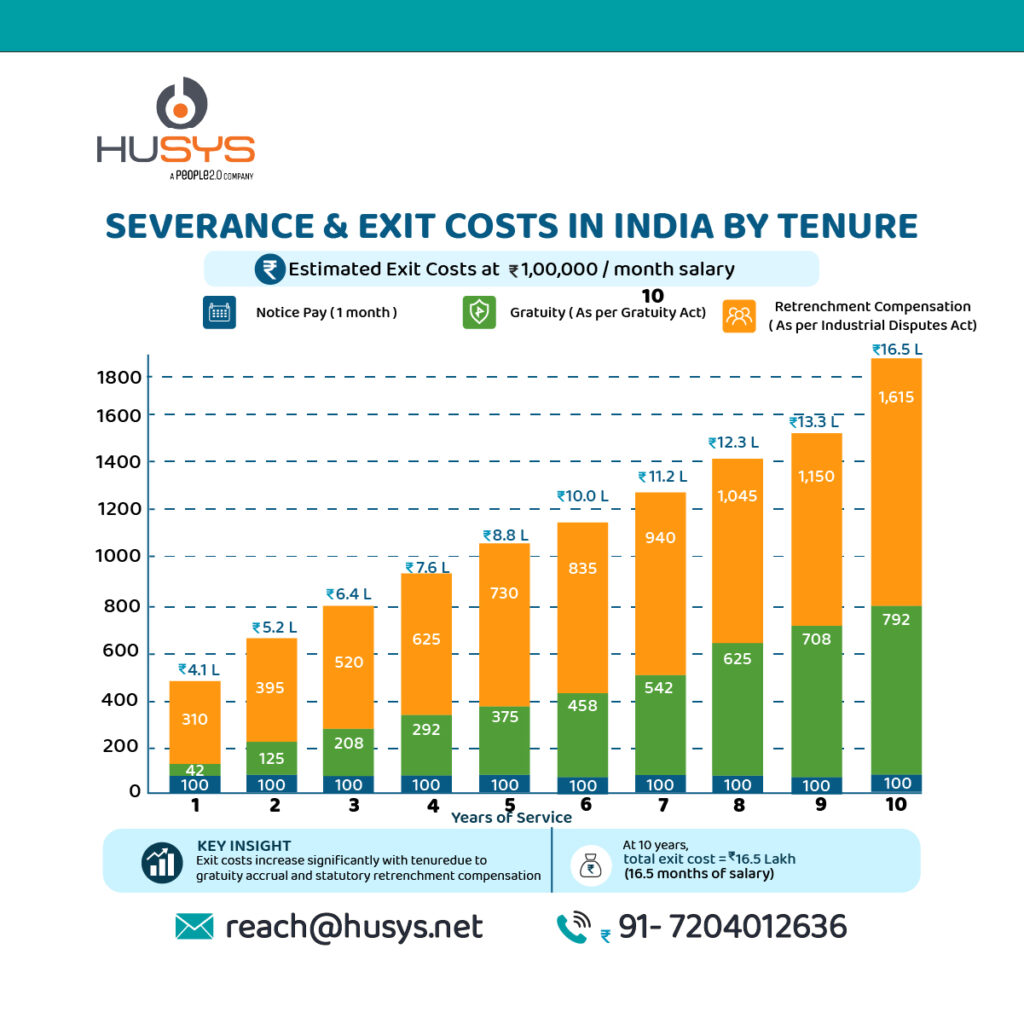
Every Statutory Payment at Exit
The following statutory payments are governed by the Industrial Disputes Act, 1947 and the Payment of Gratuity Act, 1972, which define the minimum financial obligations during employee termination in India.
| Payment | Who Receives It | Formula | When It's Due |
|---|---|---|---|
| Retrenchment Compensation | Workers with 1+ year service (business exit) | (15 days avg pay × years) ÷ 26 | On or before last day |
| Gratuity | All employees with 1+ year (new codes) | (15 ÷ 26) × last salary × years | Within 30 days of exit |
| Notice Pay / Pay in Lieu | All employees | 1–3 months salary | At termination |
| Leave Encashment | All employees | Unused earned leave × daily rate | At exit |
| Final Wages | All employees | Accrued wages to last day | Within 2 working days |
| Worker Re-Skilling Fund | Workers (retrenchment only) | 15 days last drawn wages | Deposited within 45 days |
These statutory obligations are non-negotiable and must be calculated accurately at the time of exit, which is why many companies rely on structured compliance support such as an Employer of Record in India.
Real Exit Cost Example
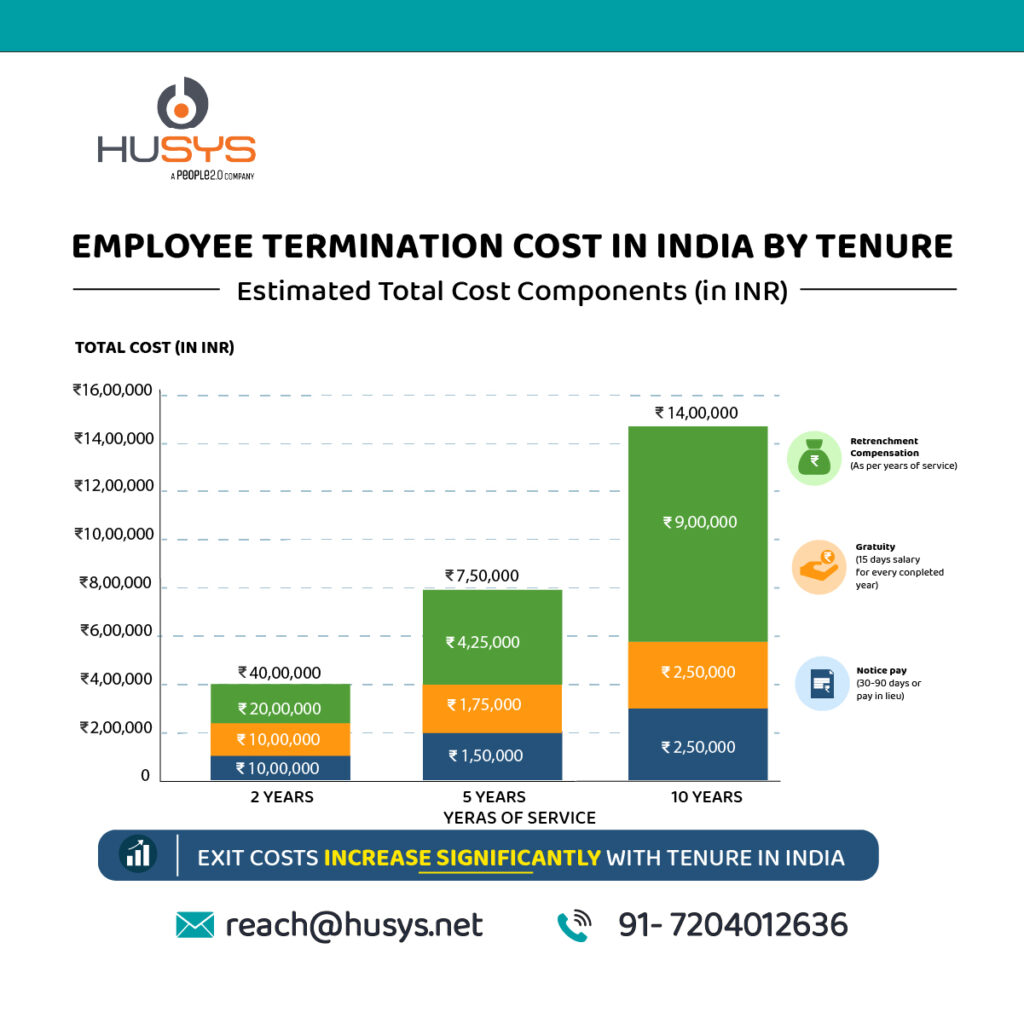
For a ₹1,00,000/month (~$1,100) software engineer with 5 years of service being retrenched:
| Component | Calculation | Amount |
|---|---|---|
| Retrenchment Compensation | (1,00,000 × 15 ÷ 26) × 5 | ₹2,88,462 |
| Gratuity | (1,00,000 × 15 ÷ 26) × 5 | ₹2,88,462 |
| Notice Pay (3 months) | 1,00,000 × 3 | ₹3,00,000 |
| Leave Encashment (15 days avg) | ~1 month | ₹1,00,000 |
| Re-Skilling Fund | 1,00,000 × 15 ÷ 26 | ₹57,692 |
| Total Minimum Exit Cost | ≈ ₹9,34,616 (~$10,275) |
For US CFOs: An India hire that looks like a $20,000/year cost becomes a $10,000+ exit cost for a 5-year employee, before any legal disputes. Factor this into India workforce planning from day one.
How Much Does Employee Termination Cost in India?
Employee termination in India typically costs 30% to 50% of annual salary for a mid-tenure employee, once you factor in severance, gratuity, notice pay, and leave encashment. For a ₹1,00,000/month employee with 5 years of service, the minimum compliant exit cost exceeds ₹9 lakh, before any legal disputes or additional settlements.
These costs are frequently underestimated at the hiring stage, which leads to unexpected financial exposure when companies need to restructure or exit employees in India.
See the full breakdown: How to Hire Employees in India: Essential US Guide .
If you’re building or scaling an India team, reviewing the hidden compliance costs of hiring in India before headcount decisions are made will save significantly more than it costs to find out later.
Every Statutory Payment at Exit
| Payment | Who Receives It | Formula | When It's Due |
|---|---|---|---|
| Retrenchment Compensation | Workers with 1+ year service (business exit) | (15 days avg pay × years) ÷ 26 | On or before last day |
| Gratuity | Permanent employees with 5+ years; Fixed-term with 1+ year | (15 ÷ 26) × last salary × years | Within 30 days of exit |
| Notice Pay / Pay in Lieu | All employees | 1–3 months salary | At termination |
| Leave Encashment | All employees | Unused earned leave × daily rate | At exit |
| Final Wages | All employees | Accrued wages to last day | Within 2 working days |
| Worker Re-Skilling Fund | Workers (retrenchment only) | 15 days last drawn wages | Deposited within 45 days |
Real Exit Cost Example
For a ₹1,00,000/month (~$1,100) software engineer with 5 years of service being retrenched:
| Component | Calculation | Amount |
|---|---|---|
| Retrenchment Compensation | (1,00,000 × 15 ÷ 26) × 5 | ₹2,88,462 |
| Gratuity | (1,00,000 × 15 ÷ 26) × 5 | ₹2,88,462 |
| Notice Pay (3 months) | 1,00,000 × 3 | ₹3,00,000 |
| Leave Encashment (15 days avg) | ~1 month | ₹1,00,000 |
| Re-Skilling Fund | 1,00,000 × 15 ÷ 26 | ₹57,692 |
| Total Minimum Exit Cost | ≈ ₹9,34,616 (~$10,275) |
For US CFOs: An India hire that looks like a $20,000/year cost becomes a $10,000+ exit cost for a 5-year employee, before any legal disputes. Termination costs are often underestimated at the hiring stage, which is why most companies benefit from reviewing the hidden compliance costs of hiring in India before scaling teams.
Tax Treatment of Termination Payments
| Component | Tax Treatment | Exemption Cap |
|---|---|---|
| Gratuity | Partially exempt | Up to ₹20 lakh (~$22,000) |
| Retrenchment Compensation | Partially exempt | Up to ₹5 lakh (~$5,500) |
| VRS Compensation | Exempt | Up to ₹5 lakh |
| Leave Encashment | Partially exempt | Applicable limits |
| Notice Pay | Fully taxable | None |
| Ex-gratia | Fully taxable | None |
Key distinction: Labour law determines what must be paid. Tax law determines how those payments are taxed. Both must be assessed in parallel, a payment that is mandatory under the IR Code may still carry full TDS liability under the Income Tax Act.
Can You Terminate an Employee Immediately in India?
No. Employee termination in India cannot be done instantly, not even with payment in lieu of notice.
Every exit requires:
- A documented reason communicated in writing
- A notice period served or explicitly compensated in lieu
- Statutory payments calculated and disbursed within mandated timelines
- Government notification where applicable
Immediate termination without following this process, regardless of how it’s framed, exposes the employer to reinstatement orders, full back wages from the termination date, and potential IR Code penalties. Indian courts do not accept speed or business urgency as justification for skipping statutory process.
If you’re evaluating how to structure a compliant exit without setting up a local legal team in India, understanding the full Employer of Record model in India and how it manages termination risk end-to-end is the most efficient place to start.
7. Common Failure Scenarios: Where US Companies Get It Wrong
Most employee termination issues in India arise from process gaps rather than intent, specifically when US companies apply domestic HR practices to Indian employment law without realising the two systems operate on entirely different logic.
The four scenarios below account for the majority of labour disputes Husys has seen US clients face. Before diving into each one, here’s a quick overview:
| # | Scenario | Core Mistake | Primary Risk |
|---|---|---|---|
| 1 | Performance exit without a PIP | No written documentation | Reinstatement + back wages |
| 2 | Downsizing without LIFO | Seniority rules ignored | Unlawful termination claim |
| 3 | Mismanaging the notice period | Garden leave not formalised | Dispute over valid notice |
| 4 | Terminating a protected employee | Protected status overlooked | Mandatory reinstatement |
Failure Scenario 1: Performance Exit Without a PIP
The situation: A US manager gives verbal feedback to a 2-year India hire who isn’t meeting expectations. HR issues a termination letter with 1 month’s notice and one month’s severance.
What happens: The employee files with the State Labour Commissioner. The employer cannot produce written warnings or PIP documentation. The Labour Court sides with the employee.
Legal outcome: Reinstatement order. Full back wages from termination date. Legal costs for both sides.
Total exposure: Original severance + 12–18 months back wages + legal fees ≈ 3–4× original severance.
How to avoid: Start documentation at the first performance conversation. Issue written feedback. Run a 30–60 day structured PIP before any employee termination decision in India. The PIP is not a courtesy, it is the legal foundation of the exit.
Failure Scenario 2: Downsizing Without Following LIFO
The situation: A company restructures and selects 3 employees for exit based on manager feedback, not seniority.
What happens: A retrenched worker with more tenure than a retained colleague files an unlawful termination claim under Section 25G of the IDA, 1947.
Legal outcome: Reinstatement with back wages for the higher-seniority worker.
How to avoid: Before any RIF, prepare a seniority-ranked list. Document specific business justifications for any LIFO deviation in writing. Build the redundancy business case at the Indian entity level, global restructuring rationale alone is not accepted by Indian courts.
Failure Scenario 3: Mismanaging the Notice Period
The situation: An employee is told to stop working immediately but is placed on “garden leave” — paid but not working.
Legal risk: “Payment in lieu of notice” must be explicitly stated and handled correctly in the termination letter. Poorly documented garden leave creates disputes about whether proper statutory notice was given, a gap that courts interpret in the employee’s favour.
How to avoid: State clearly in the termination letter whether the employee is serving the notice period actively or being paid in lieu. Settle all final wages within 2 working days of the last day as required under the Code on Wages, 2019.
Failure Scenario 4: Terminating a Protected Employee
The situation: An employer proceeds with a termination, even for valid performance reasons, without checking whether the employee falls under a legally protected category.
Legally protected categories - do not terminate during the protected period:
- Female employees on maternity leave (Maternity Benefit Act, 1961)
- Employees on sick leave receiving ESI benefits (Employees’ State Insurance Act, 1948)
- Employees with disabilities (Rights of Persons with Disabilities Act, 2016)
- Transgender employees (Transgender Persons (Protection of Rights) Act, 2019)
Attempting to terminate any of these employees during the protected period, regardless of the business reason, exposes the employer to mandatory reinstatement and severe legal liability. Always verify protected status before any employee termination in India is initiated.
Most risks in employee termination in India arise from process gaps rather than intent.
If you’re unsure whether your termination process is compliant, it’s worth reviewing your approach before taking action. Contact Us
In practice, most disputes we see are not due to intent, but due to missing documentation or incorrect process execution.
8. Employee Termination Disputes in India: What Happens Next
If you’ve reached this point after a termination has already been executed, this section is your roadmap. If you’re reading this before, it’s your reason to get the process right the first time.
When an employee believes their termination in India was unlawful, the escalation path is structured and well-used. Indian employees are aware of their rights, and the system is designed to make filing a dispute accessible. Here’s exactly how it unfolds:
Employee files grievance → Conciliation Officer (state labour dept) → Labour Court / Industrial Tribunal → High Court → Supreme Court (rare)
What Triggers Escalation
- No written reason provided for termination
- Severance not paid on time or calculated incorrectly
- Domestic inquiry not conducted for misconduct exits
- LIFO rule violated in retrenchment
- Protected category employee terminated during protected period
Timeline Reality
Most employee termination disputes in India take 6 months to 2 years to resolve, meaning a single termination decision can remain a live legal and financial liability long after the employee has exited. During any period where reinstatement is ordered by the court, the employer owes full back wages for the entire dispute duration, even if the employee was not working.
The burden of proof is always on the employer. Indian courts presume in favour of the employee when documentation is absent. “We had verbal conversations about performance” is not evidence, written records are the only thing that holds up.
Legal Notices: The Pre-Court Pressure Tactic
Before approaching a labour court, employees frequently issue a formal legal notice demanding reinstatement or enhanced compensation. This is a deliberate tactic — US companies unfamiliar with Indian employment law often settle at this stage for 3–6 months’ salary above statutory obligations, simply to avoid the uncertainty of a prolonged dispute.
The best defence against this is a clean, documented termination process — one that leaves no procedural gaps for a legal notice to exploit. This is precisely what a compliant Employer of Record in India is structured to deliver.
9. Penalties for Wrongful Employee Termination in India
Non-compliance during employee termination in India can result in financial penalties, legal action, and in severe cases, imprisonment.
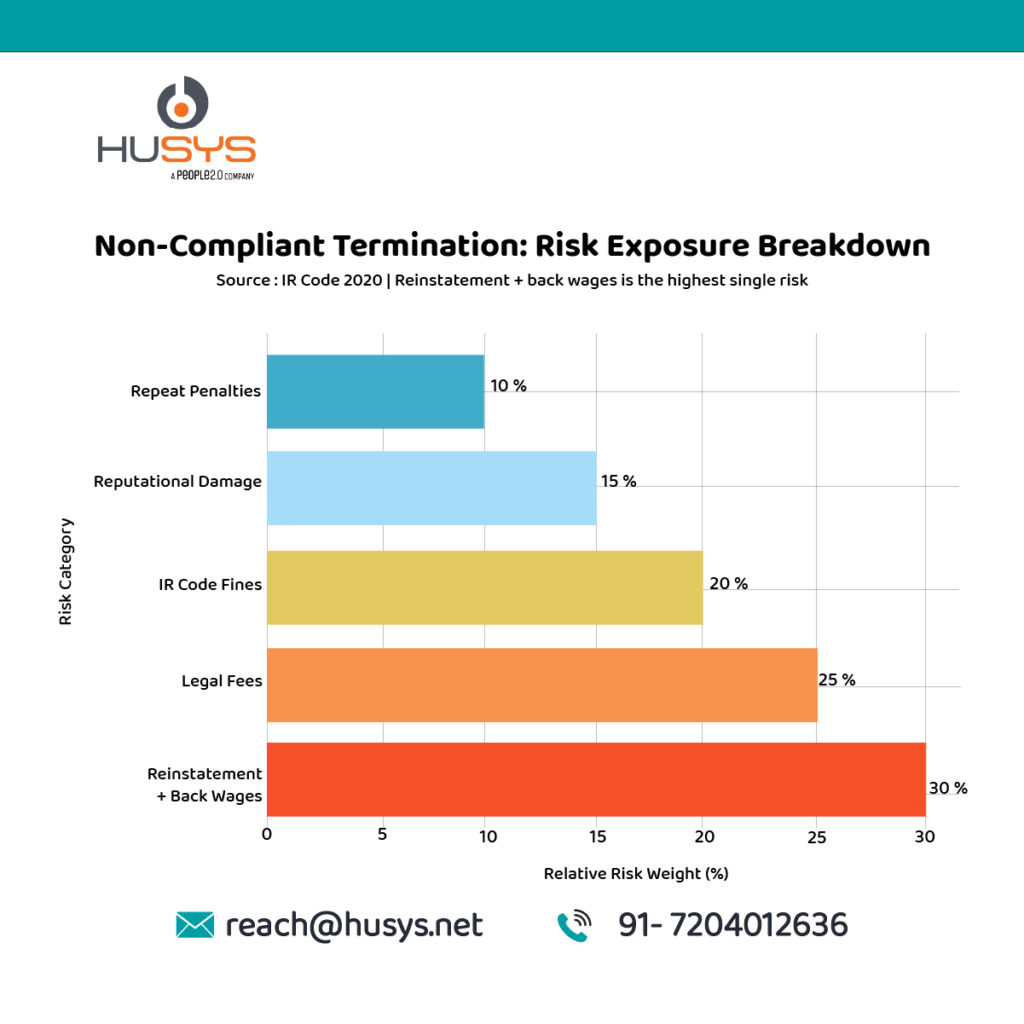
Penalties for non-compliance during employee termination in India are defined under the Industrial Relations Code, 2020, which prescribes financial penalties and legal consequences for improper retrenchment, delayed payments, and procedural violations.
These penalties are enforced by labour authorities and can escalate quickly if termination processes are not handled correctly.
To avoid such risks, many US companies use an Employer of Record in India to ensure compliance across documentation, payments, and statutory filings.
| Violation | Penalty Range |
|---|---|
| Retrenchment without prior govt permission (300+ workers) | ₹1L–₹10L; repeat: ₹5L–₹20L + up to 6 months imprisonment |
| General retrenchment violations | ₹50,000–₹2L; repeat: ₹1L–₹5L + up to 6 months imprisonment |
| Unfair labour practices | ₹10,000–₹2L; repeat: ₹50,000–₹5L + up to 3 months imprisonment |
| Failure to pay final wages within 2 days | Claims, enforcement action, financial penalties |
| Non-payment / delayed gratuity | 10% p.a. interest; criminal liability for wilful default |
| Misconduct inquiry not completed within 90 days (300+ workers) | Subsistence allowance mandatory; potential procedural invalidity |
Beyond fines: reinstatement orders with full back wages are the most damaging financial outcome. A wrongful termination that reaches tribunal can cost 3–5× the original statutory severance.
10. What Changed in 2025–2026: New Labour Codes & Termination
India’s four Labour Codes (effective November 21, 2025) consolidated 29 central laws.
These changes directly impact how employee termination in India is structured, timed, and financially calculated.
Here’s exactly what changed for employee termination:
| Provision | Before (IDA 1947) | After (IR Code 2020) |
|---|---|---|
| Govt approval threshold | 100 workers | 300 workers (more flexibility for mid-size companies) |
| "Worker" supervisory threshold | ₹10,000/month | ₹18,000/month |
| Re-skilling fund | Not applicable | Employer deposits 15 days wages within 45 days |
| Gratuity eligibility | 5 years continuous service | 1 year continuous service (all employees, including fixed-term) |
| Final settlement deadline | On termination | Within 2 working days for both termination AND resignation |
| Misconduct inquiry timeline | No set limit | 90 days max (300+ worker establishments) |
| Sales promotion employees | Not covered as "workmen" | Included as "workers" |
What this means for US companies: The threshold shift from 100 to 300 workers gives mid-size teams more flexibility. But the reduced gratuity eligibility (5 years → 1 year) means employees with just 12 months of service now trigger gratuity on exit — a cost that didn’t exist under older contracts.
11. Employee Termination in India via EOR: How It Works
What Is an Employer of Record, and Why Does It Change Termination Risk?
An Employer of Record (EOR) is a locally registered entity that becomes the legal employer of your India-based staff on paper, while you retain full day-to-day work direction and management. For employee termination in India, this distinction is critical.
When the legal employer is a compliant Indian entity with in-house HR and legal expertise, every exit, performance-based, misconduct-driven, or restructuring-related, is executed through a process built for Indian law. You don’t need to build that capability yourself, find a local lawyer at the last minute, or navigate a government approval process you’ve never seen before.
This is why an increasing number of US companies managing India teams choose to hire through an EOR rather than setting up their own Indian entity, especially when the workforce is under 50 people or when the India engagement is still being evaluated for long-term scale.
The risk equation: When you own the Indian entity, you own the termination risk. When you hire through a compliant EOR, that risk sits with them, managed by people who handle India exits every day.
How Husys Handles Employee Termination in India
Husys has operated as a PEO/EOR in India for 23+ years, supporting 5,000+ global companies across 28 states and 8 Union Territories. Termination compliance, not just onboarding, is where the depth of that experience shows.
Here's how a Husys-managed exit works, end to end:
Step 1 — Exit Classification
Before any communication goes out, we determine the exit type (performance, retrenchment, misconduct, or resignation), classify the employee as a worker or non-worker under the IR Code 2020, and check for protected category status (maternity, disability, ESI benefits).
Step 2 — Documentation Protocol
For performance exits: we ensure PIP documentation is legally compliant and defensible. For retrenchment: we prepare the business case, LIFO seniority list, and government notification. For misconduct: we manage the domestic inquiry end-to-end, including appointment of the enquiry officer and preparation of the enquiry report.
Step 3 — Notice Management
We issue the legally compliant termination letter, serve notice per applicable central and state law, and manage garden leave or payment in lieu arrangements, explicitly stated in writing, as required.
Step 4 — Final Settlement
We calculate and disburse all statutory entitlements, retrenchment compensation, gratuity, notice pay, leave encashment, re-skilling fund contribution, within legally mandated timelines.
Step 5 — Risk Containment
We manage any escalation to the Labour Commissioner or conciliation officer, represent the employer’s compliance position, and maintain all documentation required to defend against wrongful termination claims, for the full dispute window.
What This Looks Like in Practice
Scenario A — Performance exit, Bangalore, SaaS company (40 employees):
A US client needed to exit a 3-year software engineer for persistent underperformance. No PIP had been initiated. Husys stepped in, structured a 45-day compliant PIP, documented the outcome, and executed a clean retrenchment with full statutory settlement. No dispute filed.
Scenario B — Retrenchment, Hyderabad, FinTech startup (12 India employees):
Client needed to eliminate 4 roles due to funding change. Husys prepared the LIFO seniority list, filed the government notification, calculated retrenchment compensation and gratuity for each employee, and completed settlement within 2 working days of the last day. Total timeline: 9 weeks.
Scenario C — Misconduct exit, Mumbai, US logistics firm:
The employee had committed financial fraud. Husys managed the full domestic inquiry process, charge sheet, enquiry officer appointment, natural justice hearing, enquiry report, resulting in a legally valid dismissal with no severance liability. The employee’s subsequent legal notice was successfully defended.
EOR vs. DIY Termination: The Risk Comparison
Employee termination in India is not just an HR decision — it is a compliance-driven process with legal, financial, and procedural implications.
When you manage terminations through your own entity, every step — documentation, notice handling, statutory payments, and dispute management — sits entirely with your internal teams and local legal support. Any gap directly translates into risk.
Using an Employer of Record (EOR) changes how this risk is managed. The legal employer structure ensures that termination processes are executed in line with Indian labour laws, with documentation, timelines, and statutory obligations handled systematically.
The difference is not in what needs to be done — but in how consistently and defensibly it is executed.
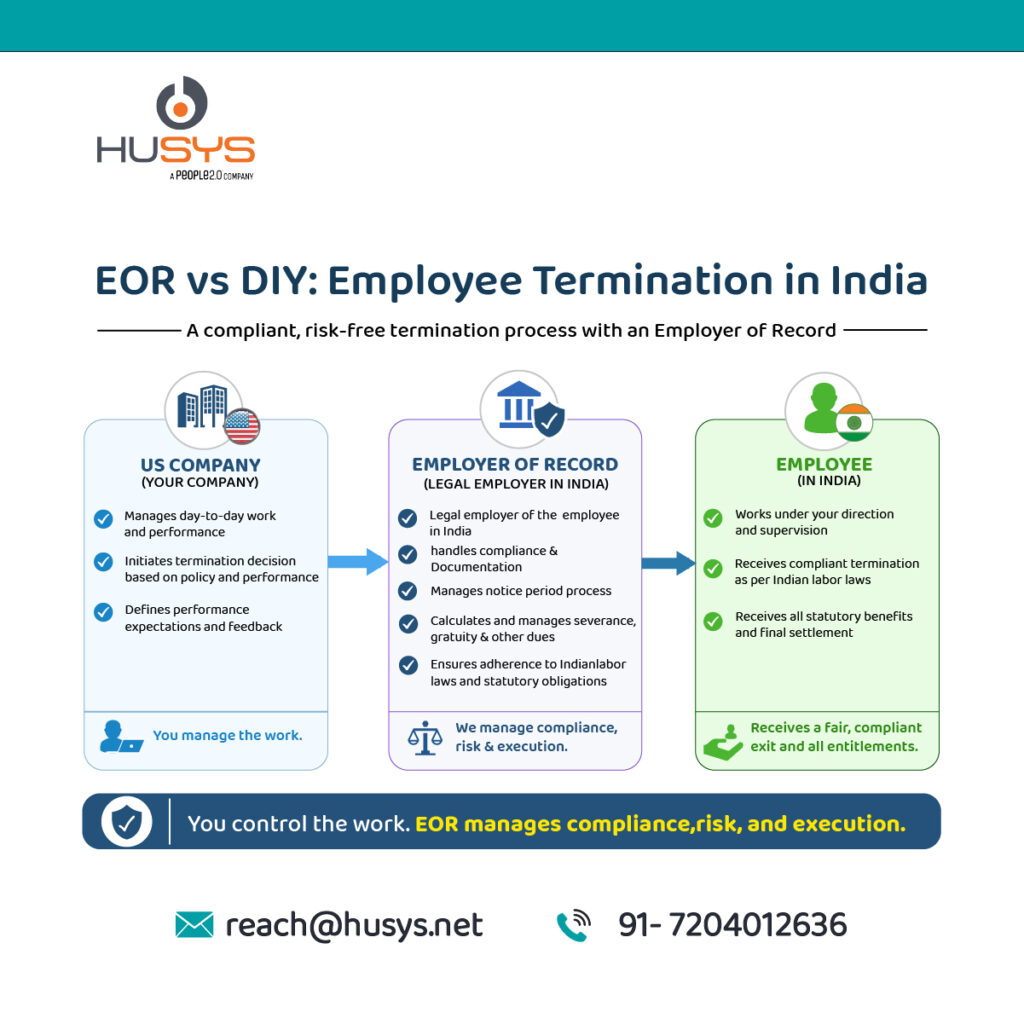
| Factor | DIY (Own Entity) | EOR (Husys) |
|---|---|---|
| Legal employer | US company's Indian entity | Husys |
| Termination liability | Falls on US entity | Managed by Husys |
| Documentation compliance | Your HR team's burden | Husys-handled |
| Dispute management | Your local legal team | In-house Husys legal |
| Government approval (if needed) | You navigate | Husys manages |
| State-level law compliance | You research | Husys — 28 states covered |
| Timeline to compliant exit | 3–6 months minimum | Husys-streamlined |
| Cost of mistakes | Reinstatement + back wages | Contained |
Most providers explain what Indian employment law says. Husys makes sure your specific exit is structured, documented, and executed so you never have to find out what happens when it isn’t.
12. Employee Termination Checklist for India (2026)
This checklist ensures that every step of employee termination in India is handled in a compliant and structured manner.
Pre-Termination
- [ ] Classify employee as workman or non-workman
- [ ] Check for protected category status (maternity, disability, ESI benefits)
- [ ] Determine exit type: performance, retrenchment, misconduct, or resignation
- [ ] Verify employment contract notice period requirements
- [ ] Review applicable state Shops & Establishments Act
Performance Exits
- [ ] Performance issues documented in writing (PIP completed)
- [ ] PIP duration: minimum 30 days
- [ ] Employee formally informed of failure to improve
Retrenchment Exits
- [ ] Business case prepared at Indian entity level
- [ ] LIFO seniority list prepared
- [ ] Deviations from LIFO documented with justification
- [ ] Government notification filed (if applicable)
- [ ] Prior approval obtained (if 300+ workers)
Misconduct Exits
- [ ] Charge sheet issued
- [ ] Domestic inquiry conducted (natural justice principles followed)
- [ ] Enquiry officer report prepared
- [ ] Proportionate punishment decided
At Termination
- [ ] Written termination letter issued (clear reason stated)
- [ ] Notice period served OR payment in lieu explicitly stated
- [ ] Retrenchment compensation calculated and paid
- [ ] Gratuity calculated and paid within 30 days
- [ ] Leave encashment paid at exit
- [ ] Final wages settled within 2 working days
- [ ] Reskilling fund contribution deposited within 45 days (if retrenchment)
- [ ] TDS deducted on applicable payments
- [ ] Form 16 / Form 130 issued
Post-Termination
- [ ] All documentation retained (minimum 3 years)
- [ ] Employee acknowledgment obtained on settlement
- [ ] Separation/release agreement executed (if applicable)
Planning to Terminate an Employee in India? Start Here.
Most risks in employee termination in India don’t come from bad intent, they come from gaps in documentation, classification errors, and missed statutory obligations that US companies simply didn’t know existed. By the time the gap surfaces, the employee has already filed.
The three steps below are where compliant exits start.
Next Steps for US Employers
Step 1 — Review Documentation and Classification
Before initiating any termination, verify:
- Is the employee classified correctly as worker or non-worker under the Industrial Relations Code, 2020?
- Are performance records, written warnings, and PIP documentation in place — or does that work need to start now?
- Does the employee fall under any protected category (maternity, disability, ESI sick leave, transgender)?
- What does the employment contract specify for notice period and termination terms?
Classification and documentation are the two variables that determine whether your exit will be clean or contested. Get these right first.
Step 2 — Validate Compliance and Cost Exposure
Once classification is confirmed, assess:
- Notice period obligation, 1 month or 3 months depending on establishment size
- Statutory payments due, retrenchment compensation, gratuity, leave encashment, re-skilling fund
- Government notification requirements, applicable for all retrenchments; prior approval for 300+ worker establishments
- Total exit cost, factor into budget before the termination letter is issued, not after
If the numbers or process requirements are unclear, reviewing the hidden compliance costs of hiring in India will give you the full financial picture before you act.
Step 3 — Choose the Right Execution Model
How you execute the exit matters as much as what you do. US companies managing India terminations typically fall into one of two models:
Own Entity: You manage documentation, notice, settlement, and any disputes through your Indian entity and local legal counsel. Higher control, higher internal burden, full liability exposure.
Employer of Record (EOR): The EOR is the legal employer. Termination procedures, documentation, government notifications, severance calculations, and dispute management all sit with the EOR, not with your US entity. You retain day-to-day work direction.
For companies without a dedicated India HR and legal function, the EOR model significantly reduces termination risk and execution time.
Understand how the Employer of Record model works in India →
Where a termination involves workforce reduction or role elimination, supporting exiting employees through a structured transition also matters, both for legal risk and employer reputation in the India market.
Ready to talk through a specific situation?
Whether you’re planning a single exit or a broader restructuring, our India compliance team can review your situation and tell you exactly what applies, before you take action.
Talk to a Husys India Compliance Expert →
For US companies, employee termination in India is not just an HR process — it is a compliance decision that directly impacts cost, risk, and long-term operations.
Frequently Asked Questions
What is employee termination in India?
Employee termination in India refers to the formal process of ending employment while complying with labour laws, notice periods, and statutory payments.
Q1: Can I terminate an employee in India without any cause?
No. Indian law requires valid, documented grounds for termination. At-will employment does not exist in India.
Q2: Can I do a same-day termination in India?
No. Even if you pay in lieu of notice, all statutory payments must be calculated and disbursed correctly. The process cannot be collapsed to a single day.
Q3: How much severance is required in India?
For workers with 1+ year of service: 15 days of average pay for every completed year of service, paid on or before the last working day, in addition to gratuity, notice pay, and leave encashment.
Q4: Can I terminate without severance if I give enough notice?
No. Notice pay and retrenchment compensation are separate obligations. Giving more notice does not eliminate severance.
Q5: What if the employee doesn't accept the termination?
The employee can file with a Labour Commissioner or approach a Labour Court. If the court finds the termination unlawful, it can order reinstatement with full back wages from the termination date.
Q6: Are post-employment non-compete clauses enforceable in India?
Generally, no. Post-termination non-compete clauses are unenforceable under Section 27 of the Indian Contract Act. Non-solicitation clauses may be enforceable if narrowly drafted. Non-compete clauses during employment are enforceable.
Q7: Does probation period mean easier termination in India?
Partially. The IDA's retrenchment compensation provisions don't apply to employees with less than 240 days of service. However, state Shops & Establishments Acts still apply, many require 1 month's notice even during probation after 3 months.
Q8: What's the safest way to exit a non-performing India employee?
Document from the first performance concern. Issue written feedback. Run a structured 30–60 day PIP. Follow the retrenchment procedure with statutory severance, or negotiate a mutual separation agreement with a full and final release clause.
Q9: Can a US company hire employees in India without a local entity?
Yes. Through a compliant Employer of Record (EOR) like Husys, a US company can hire India-based employees without setting up a legal entity. Husys becomes the legal employer, handling payroll, compliance, benefits, and terminations under Indian law.
Q10: What's the #1 thing Husys handles that US companies can't do themselves?
Termination compliance, ensuring exit procedures are legally defensible, all statutory payments are timed correctly, and any escalation to a labour authority is managed by in-house legal experts.