
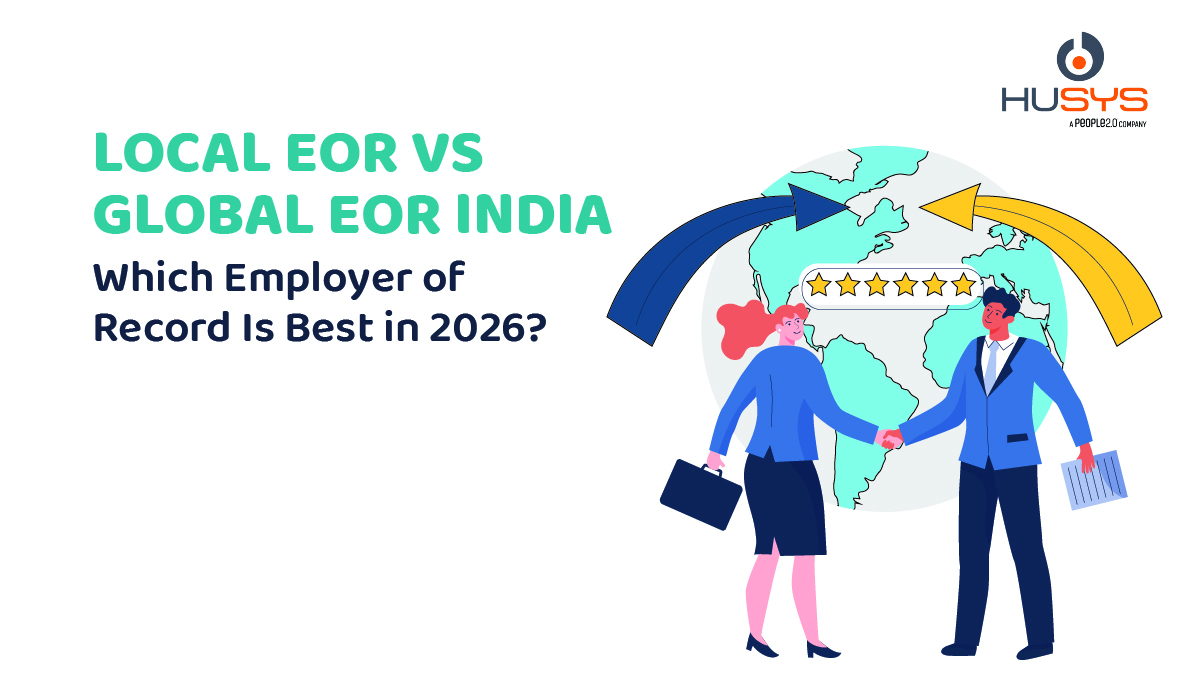
When US companies evaluate local EOR vs global EOR in India, the legal structure can look identical on paper. Both models manage employment contracts, payroll, and statutory compliance.
The difference appears in how these systems are built. Global EOR platforms optimize for multi-country coverage, while local India EOR providers are designed for deep compliance execution within one market.
Understanding where each model performs well and where each reaches its limits is essential before committing to an EOR partner for India hiring.
Local EOR providers are designed for deep operational coverage within a single market.
Their legal entity, their compliance infrastructure, their payroll workflows, and their statutory filing operations are built specifically around Indian employment law. The trade-off is obvious: you get deeper India execution, but no coverage anywhere else.
This guide breaks down how both models are actually built, where each one performs well, where each one hits its limits in the Indian context specifically, and what US companies choosing EOR India should evaluate before committing to either.
Who This Guide Is For
- US founders evaluating local EOR vs global EOR for India and want to understand what each model actually delivers before committing.
- Scaleups adding engineering, product, or operations headcount across multiple Indian states and starting to feel the limits of their current setup.
- CFOs and finance leads working through the global vs local payroll EOR India decision and need honest cost data before signing a contract at scale.
- Operators already running India payroll through an EOR who are questioning whether the compliance coverage is as deep as marketed.
If your company already has a registered India subsidiary with a dedicated local HR and payroll function, this guide covers familiar ground. This is written for US founders and operators working through the India EOR vs global EOR decision and want to make that call with a clear understanding of what each one actually delivers on the ground in India.
Global EOR | Local India EOR |
Best for companies hiring across many countries | Best for companies building a serious team in India |
Standardized global platform | Deep local compliance infrastructure |
Higher per-employee cost | Lower cost optimized for India salaries |
Partner networks in some markets | Direct in-country compliance teams |
Why India Is a Different Hiring Market Entirely
India’s employment compliance operates across multiple layers, including state labour laws, central statutory systems like PF and ESI, and regional labour authorities.
Most US founders assume payroll works the same way everywhere. In the US, there is federal compliance and then state-level variations. A payroll provider typically handles both within one system. Two layers, but still a single framework.
India’s compliance works very differently from the U.S. system. Instead of one federal framework with state variations, companies must navigate multiple state-level employment regimes simultaneously.
Indian employment compliance runs on 28 separate state-level frameworks simultaneously.
Each state has its own registration requirements, its own filing deadlines, and its own enforcement bodies. There is no central coordination between them. Complying in one state gives you zero standing in another.
Not sure which EOR model fits your India hiring plans?
The local vs global EOR decision looks very different at 5 employees versus 50. Talk to our India hiring specialists to understand which structure fits your headcount, timeline, and compliance needs.
The obligations you are actually managing
When you hire across even two Indian states, here is what you are tracking concurrently:
- Shops and Establishments Act: Each state requires its own registration. Every state also has its own renewal schedule. Hiring in Karnataka and Maharashtra means separate registrations, separate deadlines, and separate renewal processes.
- Professional Tax: This is a state tax on employees. The rates and filing schedules vary by state. Karnataka requires monthly filings, while some states require annual filings. Missing a deadline in one state leads to penalties even if you are fully compliant in another.
- Employee Provident Fund (PF): This is India’s retirement contribution system, similar to a 401(k) employer match. It is managed nationally through the EPFO but handled by regional offices. Each regional office has its own processing timelines and audit practices.
Managing these statutory requirements is one reason many companies rely on EOR providers rather than building local payroll operations from scratch.
See our guide to India payroll compliance for US companies.
- Employees’ State Insurance Corporation (ESI): ESI is a government health coverage program funded partly by employers. You can think of it as similar to an employer contribution toward employee health insurance. It has its own contribution rules and filing calendar, separate from PF. Whether it applies depends on employee count and salary thresholds.
- Labour Welfare Fund (LWF): This is a state-level employer welfare contribution. There is no direct US equivalent. The amount and filing frequency vary by state. Some states require monthly payments, others twice a year, and some states do not require it at all.
What this looks like for a real team
For a founder running a 15 to 30-person company, India hiring often starts with one or two engineers and grows faster than the compliance infrastructure can keep up. At that stage, most founders are focused on product and growth, not statutory filings.
Handing that entire compliance function to a local EOR like Husys means the founder never has to build that knowledge in-house. We regularly work with early-stage US companies at exactly this inflection point.
Why does this change the EOR conversation?
This is where the India EOR vs global EOR question stops being theoretical. Many global EOR platforms execute India compliance through local partners. The platform interface stays standardized, but the actual filings are often handled by external entities.
A local India EOR handles every state addition through its own in-house compliance team. No external partner. The same people managing your Karnataka filings manage your Maharashtra filings and know exactly what each state’s enforcement bodies look for.
Knowing when to use local EOR India versus a global platform is largely a headcount question. At one or two India hires, this difference is manageable either way. At 10 or 15 employees spread across three states, it becomes the operational question that determines whether your India payroll runs cleanly or becomes a recurring problem.
Running payroll across more than one Indian state?
Every new state introduces separate registrations, filings, and statutory deadlines. A local India EOR absorbs that complexity so your team can focus on hiring and operations.
How EOR Models Are Actually Built
Not all EOR providers operate the same way. The term “Employer of Record” describes a legal arrangement, not a delivery model. Two providers can both call themselves EORs, quote similar timelines, and cover the same statutory obligations on paper, while operating in fundamentally different ways underneath.
Understanding how each model is built is what makes the local vs global EOR choice legible. Without that, you are comparing marketing pages, not operations.
How global EOR platforms are built
A global employer of record in India operates as part of a larger multi-country platform. The core design principle is standardization. One contract framework, one payroll interface, one support workflow, regardless of whether you are hiring in India, Germany, or Brazil.
To make that work across 150 countries, global platforms typically operate through a combination of owned entities in major markets and partner networks in others. In practice, this means:
- In high-volume markets like the UK or Canada, the platform likely owns its legal entity and runs compliance in-house.
- In markets with lower hiring volume or higher compliance complexity, the platform works through a local partner who holds the employment entity and executes statutory filings on the platform’s behalf.
- The founder-facing experience stays consistent. The execution layer underneath varies by country and sometimes by state within a country.
This model has real advantages. If you are hiring across ten countries with two or three employees in each, a global platform gives you one vendor relationship, one invoice, and one place to manage everything. The standardization that creates depth trade-offs in India is exactly what makes the model efficient everywhere else.
Common Global EOR Platforms Used by US Companies
Several global EOR platforms operate in India, including:
- Deel
- Remote
- Velocity Global
- Papaya Global
- Rippling EOR
These platforms provide standardized global hiring infrastructure across dozens or hundreds of countries.
However, in markets like India, where employment law is highly localized and state-driven, many companies eventually evaluate whether a local EOR provider can offer deeper operational coverage.
How local EOR providers are built
A local employer of record in India is built around a deep operational infrastructure in one country. Everything, the legal entity, the compliance team, the payroll workflows, and the statutory filing operations, is designed specifically for that market.
In India specifically, a local EOR provider typically:
- Owns its legal entity directly across the states in which it operates, with no partner in the chain
- Employs in-house compliance specialists who manage PF, ESI, Professional Tax, and LWF filings at the state level
- Structures its payroll calendar around Indian wage law deadlines rather than a global standardized schedule
- Has direct relationships with statutory authorities, including EPFO regional offices and state labour departments
The trade-off is equally obvious. A local India EOR cannot help you hire in Singapore or the UK. If your hiring footprint expands beyond India, you need a second vendor.
Read More: How to Hire Employees in India: A US Company’s Decision Guide
The partner chain problem
Structural difference between global EOR partner networks and direct local India EOR compliance execution.
One structural difference worth understanding before you evaluate any EOR is how the compliance execution actually reaches the ground.
When a global platform covers India through a partner network, your compliance chain looks like this: you submit payroll inputs to the platform, the platform routes them to its India partner, and the partner executes the statutory filings. Three layers between your payroll data and the authority receiving the filing.
When something goes wrong at the partner level, whether a filing is delayed, a registration lapses, or a statutory notice arrives, the resolution path runs back through that same chain in reverse. The platform’s support team contacts the partner. The partner investigates. The answer comes back to you through the platform.
For a VP of Finance managing a 300-person global workforce across twelve countries, a global employer of record in India is entirely workable. India is one compliance stream among many, and the occasional delay is absorbed into a larger operational picture.
However, for a US founder whose entire offshore operation is 25 engineers in India, that same chain means your only compliance operation is running through a vendor relationship you have no visibility into. We built our model around eliminating that chain entirely, which is why every Husys client has a direct line to the compliance team managing their account.
Three layers between you and your India compliance. Is that acceptable?
Global EOR platforms route India filings through partners. Husys files directly. Ask us how that difference has played out for US companies switching from a global platform.
Local EOR vs Global EOR: At a Glance
Before we get into where each model hits its limits in India specifically, here is how the two structures compare across the dimensions that matter most for India hiring. This local EOR vs global EOR breakdown covers the factors US founders and finance leads ask about most before signing a contract.
Dimension | Global EOR | Local India EOR |
Legal Entity in India | Owned or partner-operated, depending on the market | Directly owned in-country |
Compliance Execution | Routed through the central system and local partners | Managed in-house at the state level |
Multi-State Coverage | Standardized across major hiring hubs | Direct registration and filing across all states |
Payroll Calendar | Global standardized schedule | Aligned to Indian wage law deadlines |
Pricing Per Employee Per Month | $499 to $599 | $99 (with Husys) |
Support Model | Ticket-based global support workflow | Dedicated in-country account manager |
Statutory Accountability | Escalated through the platform to the local partner | Direct interface with PF, ESI, and labour authorities |
Response to Statutory Notices | Routed through the partner chain | Handled in-house by the local compliance team |
Geographic Coverage Beyond India | 150 or more countries | India only, or via partner network |
Best Fit | Companies hiring across multiple countries at low to moderate India headcount | Companies where India is a primary or growing hiring market |
For a CFO managing a 20-person India engineering team, a global EOR at $599 per employee runs $11,980 per month, $143,760 per year.
The same team on Husys, an India-native EOR that has been running payroll here since 2002, costs $1,980 per month, $23,760 per year. That is $120,000 in annual savings on vendor fees alone, capital that could cover three additional hires at mid-level Indian salary bands or extend the runway by a meaningful margin.
Paying global EOR pricing for an India team?
Global platforms often charge $499–$599 per employee per month. Husys runs India payroll at a flat $99 per employee with no onboarding fees, deposits, or FX markups.
When a Global EOR Actually Makes Sense
A global employer of record can be the right solution in several situations.
- Hiring small teams across many countries simultaneously
- When India’s headcount is under 5 employees
- When HR operations are centralized in a single global platform
- When payroll standardization across markets matters more than local optimization
For companies running teams across 10 or more countries, the operational simplicity of a global platform often outweighs the trade-offs in individual markets.
However, when India becomes a primary hiring location, the depth of a local EOR becomes more relevant.
Where Global EOR Models Hit Their Limits in India
The comparison table in the previous section shows the structural differences between global and local EOR models. This section explains where those differences translate into operational problems for US companies hiring in India at scale.
The India EOR vs global EOR question becomes concrete here, in day-to-day payroll operations and compliance execution. These are the five pressure points that US companies choosing EOR India at scale consistently run into.
1. Payroll Corrections Are Not Free or Fast
Indian payroll is not static. Variable pay, reimbursements, salary revisions, and mid-cycle corrections are routine as teams grow. Every change needs to be reflected accurately before the deposit goes out, because salaries are legally required to be paid by the 7th of each month.
Global EOR platforms are built around approval-gated payroll flows. Changes before approval are technically manageable within the system. But users have reported being charged $400 to correct a payroll entry before it cleared the approval stage, with no prior warning that the fee existed.
For an engineering manager at a US scaleup running a 40-person India team, where incremental payroll changes happen every cycle, that fee structure creates unpredictable monthly costs that compound directly with headcount.
Your India EOR vendor is taking a bigger cut than your AWS bill.
At $599 per employee, global EOR fees on a 50-person India team exceed what most Series A companies spend on cloud infrastructure. Husys charges $99 flat
2. Multi-State Compliance Depth Beyond Major Hubs
Global EOR platforms document compliance coverage across India. What that coverage looks like in practice varies significantly depending on which state you are hiring in.
Bengaluru, Hyderabad, and Pune are high-volume hiring markets. Global platforms have well-established operations there. But India has 28 states and 6 Union Territories, and compliance requirements in Coimbatore, Kochi, or Ahmedabad are not the same as in Bengaluru.
When your hiring footprint extends beyond Tier 1 cities, the depth of a global platform’s partner network in those locations becomes a real operational question. A local employer of record in India manages registrations, filings, and renewals across all states through its own in-house teams rather than routing through partners with variable coverage depth.
If you’re evaluating vendors, see our comparison of top EOR providers in India.
3. Support That Matches Indian Payroll Timelines
India runs on hard statutory deadlines. Salaries out by the 7th. PF contributions due by the 15th. ESI filings on their own calendar. Miss any of these, and you face penalties, and your employees will notice before you do.
When something breaks in a payroll cycle, a ticket queue with a 48-hour first response window does not match the timeline you are working against. You need someone who knows the account, knows the state, and can resolve the issue within the same business day.
Global platforms market 24/7 support and India EOR compliance expertise as part of their offering. The gap between that promise and actual experience is one of the most consistently documented friction points among US founders who have scaled India teams past the initial handful of hires.
A founder managing a 12-person India team shared that a termination they initiated went into a platform review queue instead of being processed immediately. When they followed up, they were asked to submit a screen recording. By that point, the employee had not been paid for over two weeks because payroll was stuck in a processing state.
That is not a support quality problem. It is a structural one. A platform built for 150 countries cannot give every market the same operational attention that a provider built specifically for that market can.
4. The Global vs Local Payroll EOR India Cost Problem
Global EOR platforms price India the same way they price Germany or Canada. $499 to $599 per employee per month. That fee structure is defensible when you are paying someone $150,000 a year in San Francisco.
Indian salary levels are a different equation entirely. A senior engineer in Bengaluru makes about $24,000 annually. Even at the higher end, a global EOR fee of $599 per employee represents more than 25% of their total annual compensation.
At scale, the pricing difference compounds quickly. A 50-person India team on a global EOR at $599 per employee costs over $350,000 per year in vendor fees alone. The same 50 employees on Husys costs $4,950 per month, $59,400 per year. That is $300,000 in annual EOR fees that could be redirected toward headcount, product, or runway.
No payroll correction fees. No surprises mid-cycle.
Husys charges a flat $99 per employee per month. Variable pay, salary revisions, and mid-cycle corrections are handled without additional charges.
What to Look For When Choosing a Local Employer of Record In India
Not every provider that calls itself a local India EOR operates with the same depth. The term describes a legal arrangement, not a quality standard. Here is what actually separates a well-built local India EOR from one that looks the part on a website but runs into the same structural problems as a global platform.
1. Direct Entity Ownership Across States
The first question to ask any India EOR provider is simple: Do you own your legal entity in India, or do you operate through a partner?
A provider that owns its entity directly is the legal employer of record with full accountability for statutory filings, payroll deposits, and compliance obligations. A provider operating through a partner introduces the same chain problem we covered earlier, just with a local brand on the front end.
Follow up by asking which states they cover through their own entity and which they cover through partners. A provider with direct entity coverage across all 28 states and 6 Union Territories operates differently from one that owns its entity in Bengaluru and routes everything else through third parties.
2. In-House Compliance Team, Not a Partner Network
Entity ownership and compliance execution are separate questions. A provider can own its India entity and still outsource the actual statutory filing work to external compliance firms.
Ask specifically whether PF, ESI, Professional Tax, and LWF filings are handled by in-house teams or external partners. The answer determines who is accountable when a filing is delayed, a notice arrives, or a registration lapses. An in-house team has institutional memory of your account. An external partner does not.
3. Onboarding Speed
Hiring velocity matters. When you have an offer accepted, every day between acceptance and payroll start is a day your candidate is still technically available to a competing offer.
Onboarding timelines vary significantly across providers. Some complete onboarding in under 8 working hours. Others take 3 to 5 business days. For a US scaleup hiring aggressively in India, that difference compounds across every hire you make in a year.
Ask for the actual onboarding timeline, not the marketed one. Ask what the process looks like specifically, what documents are required, and what causes delays.
4. Dedicated Account Management
India payroll is not a set-and-forget operation. Variable pay, salary revisions, reimbursements, new state registrations, and mid-cycle corrections are routine. When something needs resolving, you need a named person who knows your account, not a ticket queue.
Ask whether you get a dedicated account manager or a shared support pool. Ask what the escalation path looks like when a payroll issue needs same-day resolution. The answer tells you a lot about how the provider is actually structured versus how it is marketed.
5. Pricing Transparency
India EOR pricing has more variables than the headline per-employee rate suggests. Security deposits, onboarding fees, offboarding fees, payroll correction charges, and currency conversion markups all affect the real cost of the engagement.
A provider charging $99 per employee per month with no security deposit, no onboarding fee, and zero FX markup is structurally cheaper than one charging $199 with a two-month salary deposit requirement and conversion markups built into every invoice.
Get the full fee structure in writing before you sign. Ask specifically about payroll correction fees, because those are the charges that tend to appear mid-engagement without prior disclosure.
Read More: Minimum Wages in India (2026): A Guide for US Companies hiring in India
6. Track Record Through Indian Labour Law Changes
Indian labour law has gone through significant structural changes over the past decade. The rollout of the Codes on Wages, the new PF wage definition rules, GST implementation, and multiple rounds of state-level legislative updates all required real-time adaptation from EOR providers operating on the ground.
A provider that has been operating in India through those changes has institutional knowledge that a provider founded in 2020 simply has not had the opportunity to build. Ask how long they have been operating in India and what major compliance transitions they have managed for active clients.
Husys has been running payroll in India since 2002, through every significant labour law transition of the past two decades. At 20 employees, their flat $99 per employee pricing means an annual EOR cost of $23,760 compared to $143,760 with a global platform at $599 per employee. That $120,000 difference is the compliance depth premium you are not paying.
7. Security Certifications
India EOR compliance expertise covers more than just filings. For US companies with data governance requirements or enterprise security posture, ask whether the provider holds ISO 27001 certification. This is not standard across India EOR providers and is directly relevant to how your employee data is handled, stored, and protected.
SOC 2 is the more common certification among SaaS-first global platforms. ISO 27001 is the relevant standard for an India-based operator handling sensitive payroll and employment data on behalf of US companies.
Read More: Top EOR Providers in India (2026 Guide)
Husys: The Best EOR for India-Focused US Companies
Husys has operated payroll in India since 2002, longer than most platforms, positioning itself as a global employer of record in India today. Over the years, it has managed major regulatory shifts, including the Codes on Wages rollout, PF wage definition changes, GST implementation, and repeated state-level law updates.
These were not changes studied after the fact. Husys handled them for active clients as they happened. That experience is what makes Husys an India-first EOR provider in the truest sense, not a global platform that added India to its list of covered countries.
Here’s why Husys is the best local employer of record in India:
1. Direct entity ownership across all 28 states and 6 Union Territories
Husys owns its legal entity directly across the full country. There is no partner network routing your Karnataka filings through one firm and your Maharashtra filings through another. The same in-house compliance team manages registrations, renewals, and statutory filings across every state you hire in.
For a US founder hiring across Bengaluru, Pune, and Hyderabad simultaneously, that means one compliance operation with direct accountability, not three partner relationships with variable depth.
2. Onboarding in under 8 working hours
Husys gets employees onto payroll in under 8 working hours. For a scale-up hiring aggressively in India, that speed compounds across every hire in a pipeline. A candidate who accepts an offer on Monday is on payroll before the end of the day Tuesday.
3. Flat $99 per employee per month
No security deposits. No onboarding fees. No offboarding fees. No currency conversion markups. In our experience, hidden fees are the most common reason US companies end up paying significantly more than the headline rate they signed up for.
For a CFO at a US company with 30 India employees, Husys costs $2,970 per month, $35,640 per year. A global EOR at $599 per employee costs $17,970 per month, $215,640 per year. That is $180,000 in annual EOR fees on the same 30 people doing the same work. At 50 employees, the gap reaches $300,000 per year.
4. A dedicated account manager on every account
Every Husys client gets a named point of contact with in-house knowledge of Indian employment law. When a payroll correction needs to happen before the 7th, when a statutory notice arrives from a PF regional office, or when a new state registration needs to be set up ahead of a hire, there is a person to call who knows the account and can resolve it directly.
5. Proactive misclassification monitoring
Husys monitors invoicing and employment structure proactively to catch classification risks before they become a regulatory problem. For US companies managing a mix of full-time employees and contractors in India, this is the kind of oversight that prevents a statutory notice from being the first signal that something was structured incorrectly.
6. ISO 9001 and ISO 27001 certification
ISO 27001 is directly relevant for US companies with data governance requirements or enterprise security posture. Your employee payroll data, employment contracts, and statutory filings are handled under a certified data security framework.
7. Global reach beyond India
For US companies that later expand beyond India, Husys provides access to EOR services in 150 or more countries through its integration with People2.0. You do not need a second vendor if hiring moves to Singapore, the UK, or Latin America.
Who Husys Is the Right Fit For
As an India-first EOR provider with 23 years of ground-level compliance experience, Husys is not the right answer for every situation. If you are hiring one or two people in India as a minor test market alongside ten other countries, a global platform that covers everything under one dashboard is a reasonable choice.
For US companies asking which is the best EOR for India when building a serious team, Husys is built for exactly these scenarios:
- Founders hiring 5 or more employees in India who need compliance that runs on the ground, not through a partner chain
- Engineering and product teams scaling across multiple Indian states, where payroll accuracy and onboarding speed directly affect hiring velocity
- Finance and legal teams at Series A and beyond who need documented compliance trails, ISO certified vendor security, and a named account owner they can call.
- Companies that have already used a global EOR and have hit support delays, unexpected fees, or compliance gaps specific to India
Ready to see Husys in action
We onboard India employees in under 8 working hours, manage compliance across all 28 states in-house, and charge a flat $99 per employee with no hidden fees.
Quick Decision Framework: Local vs Global EOR
Choose a global EOR if:
- Hiring across multiple countries simultaneously
- India headcount under 5 employees
- Centralized HR operations matter more than local optimization
Choose a local India EOR if:
- India is a core engineering or operations hub
- Hiring across multiple Indian states
- Scaling to 10+ employees
Conclusion
The choice between a local EOR and a global EOR ultimately depends on how central India is to your hiring strategy.
Global EOR platforms work well for companies hiring across many countries simultaneously. But when India becomes a primary engineering or operations hub, the operational depth of a local provider becomes significantly more important.
Husys is built specifically for companies hiring in India, with direct entity coverage across all 28 states, in-house compliance teams, and transparent $99 per employee pricing.
If you’re evaluating EOR options for India, our team can walk you through the operational and compliance differences based on your hiring plans.
Companies switching from global platforms often reduce their India EOR costs by up to 80%.
Husys onboards in under 8 hours, covers all 28 states in-house, and charges $99 flat.
Frequently Asked Questions
1. What is the difference between a local and global EOR in India?
The core local EOR vs global EOR distinction is structural. A global EOR covers many countries through one standardized platform, using a mix of owned entities and partner networks. A local India EOR is built specifically around Indian employment law, with its own entity and in-house compliance teams. One optimizes for breadth, the other for depth.
2. When should a US company choose a local employer of record in India over a global one?
When India is a primary hiring market rather than a minor test location, and if you are scaling past 5 to 10 employees, hiring across multiple Indian states, or building a core engineering or operations team in India, a local EOR is structured for that complexity in a way a global platform is not.
3. How does multi-state hiring in India affect EOR complexity?
Every Indian state has its own Shops and Establishments registration, Professional Tax rates, and Labour Welfare Fund rules. Hiring across Karnataka and Maharashtra means running two separate compliance operations simultaneously. Each new state adds another. A local India EOR manages this through its own in-house teams. A global EOR typically routes it through partners.
4. Can a global EOR handle India compliance as effectively as a local one?
The India EOR vs global EOR compliance gap is small at one or two hires in major cities like Bengaluru or Hyderabad. As headcount grows and hiring spreads across states, the gap widens. Global platforms apply standardized compliance frameworks adapted for India. Local EOR providers like Husys build their entire operation around Indian compliance from the ground up.
5. What is the risk of using a global employer of record in India with a partner network?
When your EOR routes India compliance through a partner, you have no direct visibility into who is filing your returns, managing your registrations, or responding to statutory notices. If something goes wrong, the issue moves back through that chain. Response times slow down, responsibility becomes unclear, and statutory deadlines continue to run while the problem is being escalated.
6. How do I evaluate India EOR compliance expertise in a provider?
Ask three questions. Do they own their India entity directly or operate through a partner? Do they have in-house compliance teams managing PF, ESI, and Professional Tax filings at the state level? And how long have they been operating in India? The answers tell you whether you have genuine local depth or a global platform adapted for the market.
7. Why is Husys considered the best EOR for India by US companies?
Husys charges a flat $99 per employee per month with no security deposits, no onboarding fees, no offboarding fees, and no currency conversion markups. That includes full statutory compliance across PF, ESI, Professional Tax, LWF, and Gratuity, a dedicated account manager on every account, and 23 years of ground-level India compliance experience.
8. How fast can Husys onboard an employee in India?
Husys completes onboarding in under 8 working hours. A candidate who accepts an offer on Monday is on payroll before the end of the day Tuesday. For scaleups hiring aggressively in India, that speed compounds across every hire in a pipeline.
9. What happens if my EOR misses a statutory deadline in India?
Late PF deposits attract interest at 12% per annum plus potential penalties of up to 25% of arrears. ESI late deposits carry similar consequences. Professional Tax non-compliance triggers state-level penalties that compound over time. Beyond the financial cost, employees notice late salary payments before you do.
10. Does Husys cover hiring outside India?
Yes. As an India-first EOR provider, Husys is built specifically for India, but through its integration with People2.0, it provides access to EOR services in 150 or more countries. If your hiring later expands to Singapore, the UK, or Latin America, you do not need a separate vendor.