
How to Hire in India Without H-1B: The Complete Guide to a Faster, Compliant Hiring Solution

How to hire in India without H-1B using a faster, compliant hiring solution

Author Bio

Husys India Compliance Team

Husys India EOR Payroll & Compliance Experts is the in-house team supporting Employer of Record (EOR) payroll operations and statutory compliance for US companies hiring in India. With 250+ years of collective compliance experience, the team has supported 50,000+ contractors to date and helps 5,000+ clients run compliant workforce operations across India.

Editorial note: This content is reviewed internally by payroll and compliance specialists and reflects standard statutory practices in India. For case-specific guidance, consult a qualified professional.

Reviewed by: [V.P Growth]
Last Reviewed: July 2026

Facebook
X.com
LinkedIn
Email
WhatsApp

Hiring through H-1B can take 12–18 months and still depend on a lottery.

Hiring in India removes that dependency. You can build your team in weeks, without setting up an entity or waiting on visa approvals.

Hire in India Without H-1B when you need access to Indian talent without tying your hiring plan to US visa timelines or an H-1B lottery.

Here’s what most founders get wrong about hiring Indian talent:Comparison of hiring Indian talent via H-1B visa vs Employer of Record (EOR), showing timeline, cost, and compliance differences
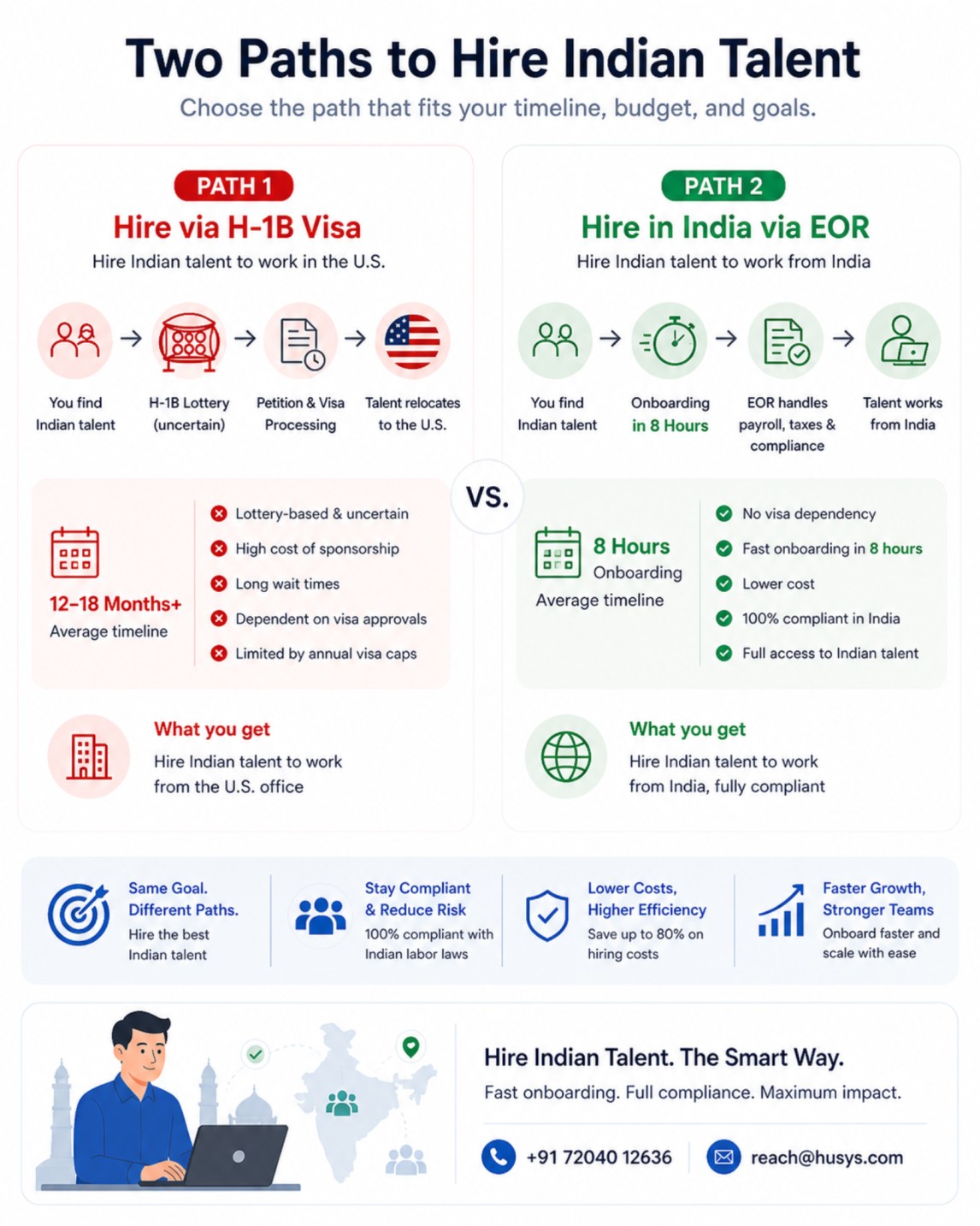
H-1B vs EOR: Same goal—hiring Indian talent. Very different timelines, costs, and control.

👉 Skip the H-1B wait. Build your India team in days, not months.

US companies do this using an Employer of Record (EOR), which handles payroll, taxes, and compliance under Indian law.

This guide breaks down how it works, what it costs, and how to choose the right hiring model.

Who this guide is for

Before you hire in India, you need to understand one key shift:
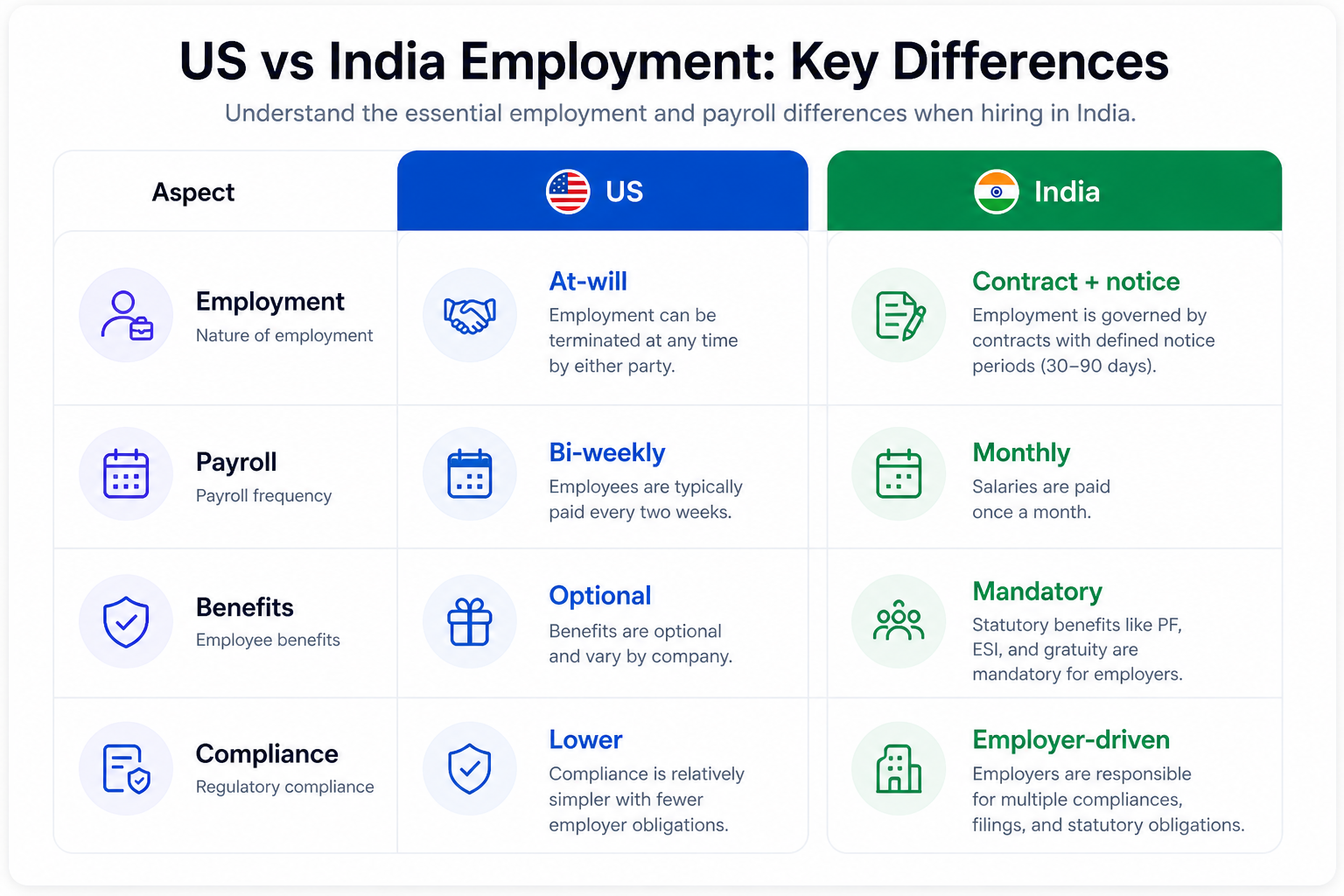
US vs India employment comparison showing differences in payroll, benefits, compliance, and contracts

Hiring in India isn’t a cheaper version of the US, it’s a different system entirely.

This guide is written for US-based founders, CFOs, and HR or legal leaders who are evaluating how to hire in India without relying on the H-1B visa.

It is most relevant for teams between 10 and 200 employees that are actively building engineering or product teams.

If you’re exploring Hire in India Without H-1B, this guide walks through the available hiring models, their costs, compliance requirements, and the trade-offs involved.

Aspect

US

India

Employment

At-will

Contract + notice (30–90 days)

Payroll

Bi-weekly

Monthly

Benefits

Optional

Mandatory (PF, ESI, gratuity)

Compliance

Lower

Employer-driven

This guide translates these differences so you can make hiring decisions with clarity.

Still deciding between an Employer of Record and setting up your own legal entity?

Read our EOR vs Entity India: What US Founders Need to Know in 2026 to understand the differences in setup time, compliance, costs, and long-term scalability before choosing your hiring model.

How US Companies Hire in India Without H-1B

US companies looking to Hire in India Without H-1B can use several hiring models, including an Employer of Record (EOR), contractors, offshoring, and outsourcing.

The right option depends on how much control, compliance support, and long-term stability the business needs.

TL;DR

  1. Skip H-1B Uncertainty: Hiring in India removes visa dependency, allowing onboarding in weeks.
  2. Achieve 80%+ Cost Savings: A $900K US team costs just $50K–$100K in India.
  3. No Entity Needed: An EOR handles payroll, taxes, and compliance while you manage the employee.
  4. Avoid Misclassification Risk: Contractors can be reclassified, leading to backdated PF, taxes, and penalties.
  5. Mandatory India Payroll: Components like PF and TDS are required, and the employer is responsible for their calculation, deposit, and filing.
  6. EOR is the Best Fit: Ideal for securing full-time employees without setting up an entity or taking on compliance risk.

Why US Founders Are Skipping H-1B and Hiring in India Instead

For US companies, H-1B has become harder to plan and control due to low odds and uncertainty. Recent surveys show 34% of tech professionals expect companies to hire more in India in 2026.

1. H-1B Visa Challenges

The difference between H-1B hiring and hiring in India comes down to speed, control, and access to talent.

Factor

H-1B Hiring

Hiring in India (EOR)

Timeline

12–18 months

2–4 weeks

Dependency

Lottery-based

Business-driven

Approval risk

High

None

Talent access

Limited by visa caps

Full access

H-1B hiring is constrained by policy and timelines. Hiring in India is driven by business need.

For companies evaluating how to Hire in India Without H-1B, the next decision is choosing the right employment model for the team you want to build.

2. Massive Cost Savings

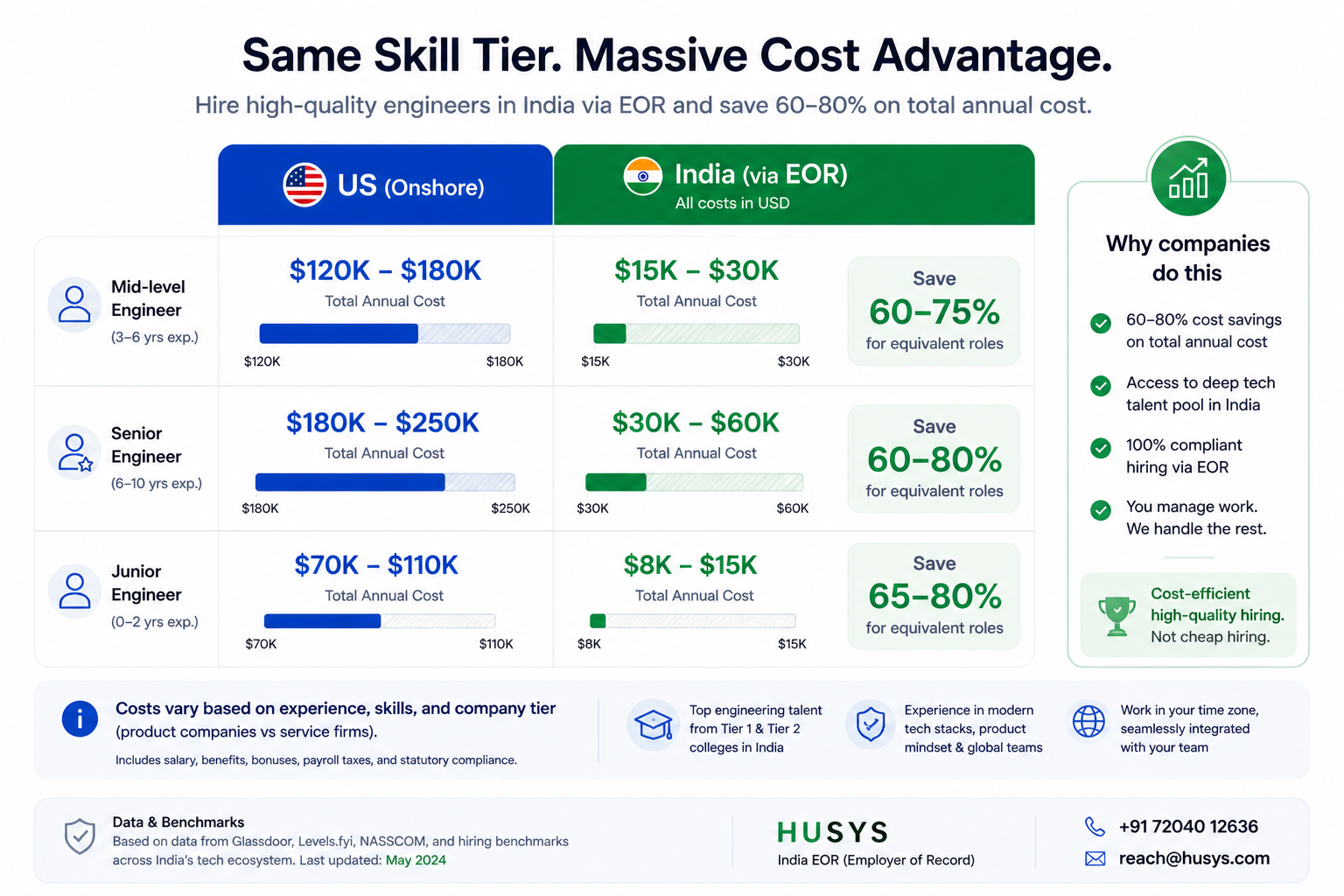
The cost difference between hiring in the US and India is significant, even at small team sizes.

Here’s where the decision becomes obvious:Diagram showing how Employer of Record (EOR) works for hiring employees in India including payroll, compliance, and management responsibilities
Team Size

US Cost

India Cost

1 Engineer

$142K–$251K(Glassdoor)

$10K–$20K

5 Engineers

~$940K

$50K–$100K

This represents a 75–80% reduction in engineering costs.

3. India’s Talent Advantage

India’s tech workforce is large and growing, with ~5.8 million professionals in 2025, as per NASSCOM estimates.

The ecosystem is scaling rapidly, with the IT sector reaching ~$282 billion in FY25, according to government data.

Companies like Google, Amazon, and Microsoft are expanding teams in India, with H-1B constraints pushing more hiring into the market.

4. Lower Employee Turnover

India’s IT sector maintains attrition rates of 13-15% in 2026, significantly below the US tech industry’s 20-25% average amid fierce talent competition.

India’s IT attrition is ~13–15%, compared to ~20–25% in the US.

Lower turnover reduces hiring costs and improves team continuity.

Four Ways to Hire in India Without an Entity or H-1B

One of the most practical ways to Hire in India Without H-1B is through an Employer of Record, particularly when you want full-time employees without immediately establishing an Indian entity.

1. Hiring Through an EOR (Employer of Record)

An Employer of Record (EOR) legally employs your team in India, handling payroll, taxes, and compliance while you retain full control over day-to-day work.

The cost structure is simple:

Component

Cost

Salary (per engineer)

$10K–$20K annually

EOR fee

From $99/month

Total (4 engineers)

~$85K/year

4 engineers: ~$80,000 (salary) + ~$4,800 (EOR fees) = ~$85,000/year

Compared to ~$420,000 in the US, this reduces annual burn by $300K+

EOR covers:

  • Employment contracts aligned with Indian law
  • Payroll and salary disbursement
  • Statutory contributions (PF, taxes)
  • Compliance and filings
  • Onboarding and exit processes

2. Hiring Independent Contractors

Here’s where most companies get into trouble:
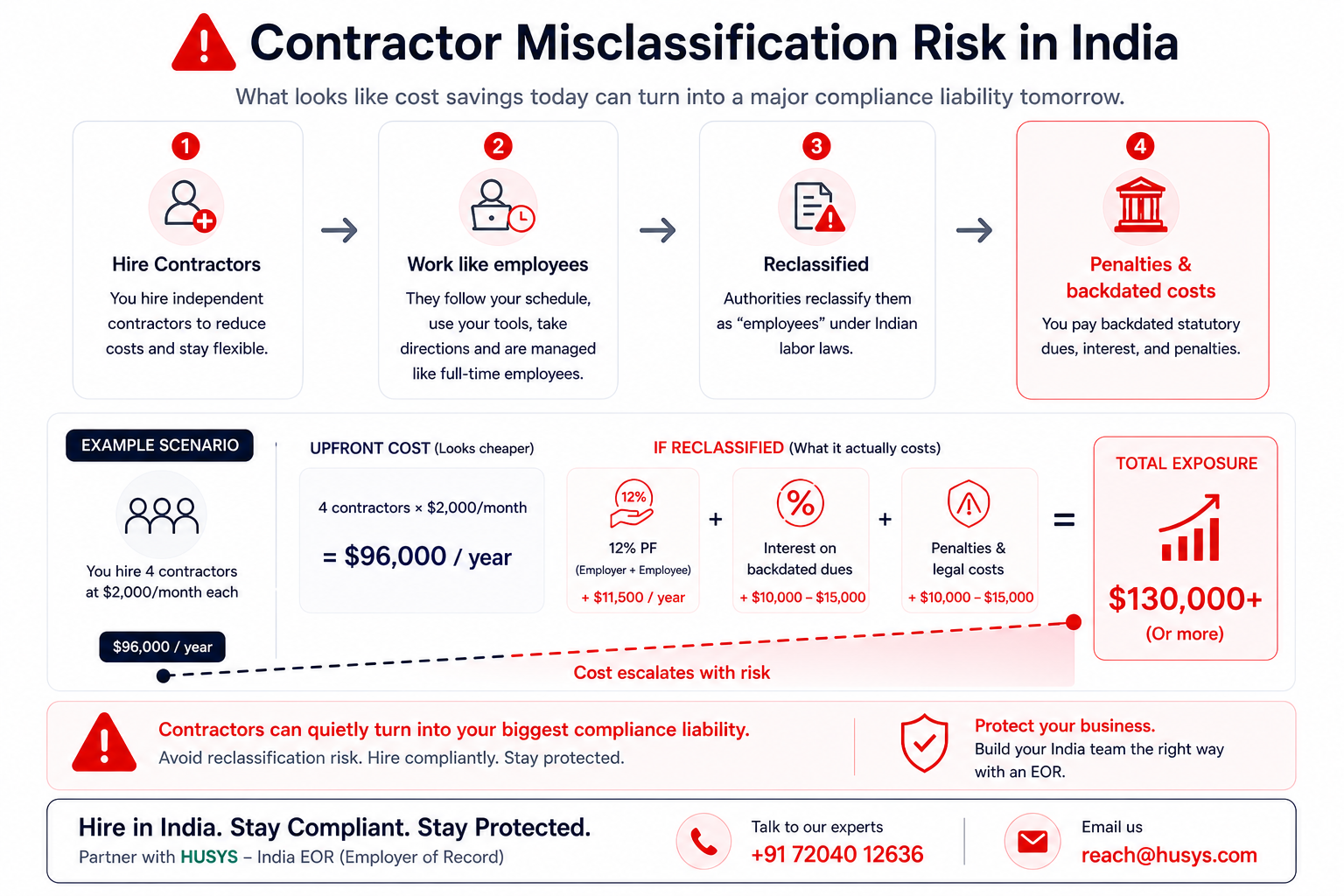
Contractor misclassification risk in India showing penalties, PF contributions, and increased cost exposure.

Hiring contractors means paying for services without an employment relationship, bypassing payroll, benefits, and statutory contributions.

In India, if the engagement resembles full-time employment (fixed hours, exclusivity, direct management), it can be reclassified.

⚠️ Reclassification Risk (Example)

4 contractors × $2,000/month = $96,000/year

If reclassified:

  • 12% PF → +$11,500/year
  • Interest + penalties

👉 Total exposure: $130,000+ in 2–3 years

3. Offshoring to India 

Offshoring means building your India team through a local partner who hires and manages employees on your behalf.

Here’s the hidden cost mostOffshoring cost breakdown showing salary vs partner margin and how margin increases with team size.
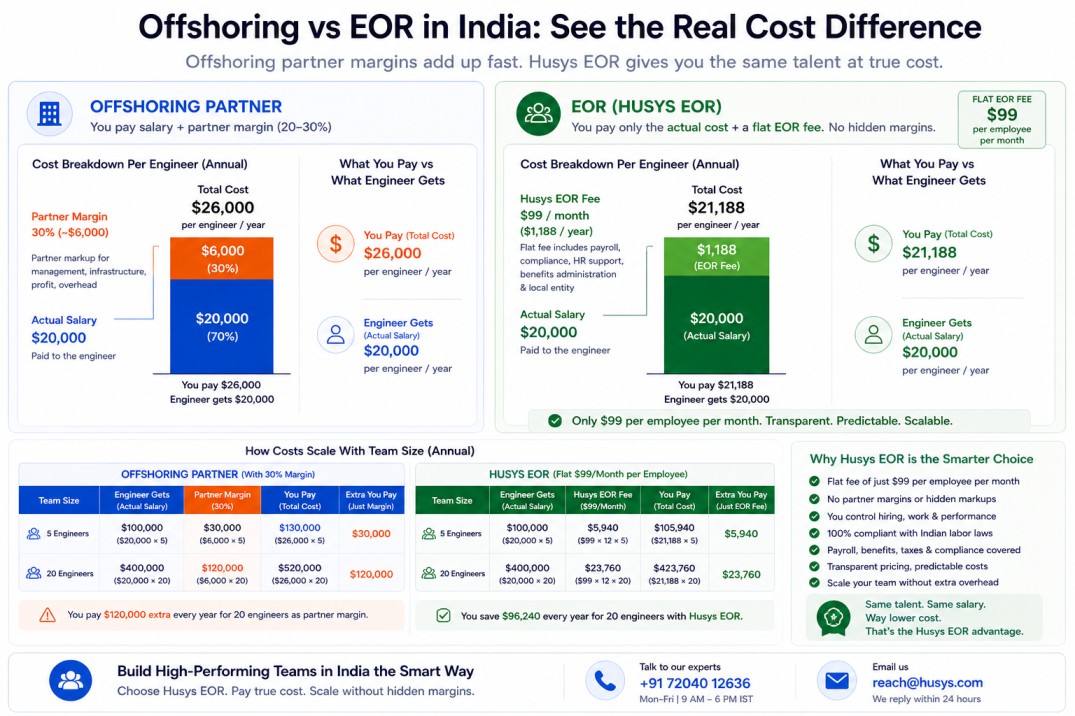
The cost structure includes a partner margin:

Component

Cost

Salary (per engineer)

~$20,000 annually

Partner margin

~30%

Total (4 engineers)

~$104,000/year

Cost Breakdown at Scale

Offshoring partners typically charge a ~30% margin on top of engineer salaries.

Example:

  • 4 engineers × $20,000 salary = $80,000
  • Partner margin (30%) = $24,000
  • Total cost = $104,000/year

At scale:

  • Margin per engineer: $6,000/year (30% of $20,000)
  • 5 engineers → $30,000/year in margin
  • 20 engineers → $120,000/year in margin

This margin scales directly with headcount, increasing cost without improving output.

You get a managed team, but hiring quality, retention, and day-to-day execution depend on the partner.

If you’re evaluating different ways to build your India team, our Hire Employees in India Without an Entity: Ultimate EOR vs PEO vs AOR Guide explains which hiring model is best based on your business goals, compliance needs, and expansion plans.

Best suited if you want a managed team without handling hiring or operations directly.

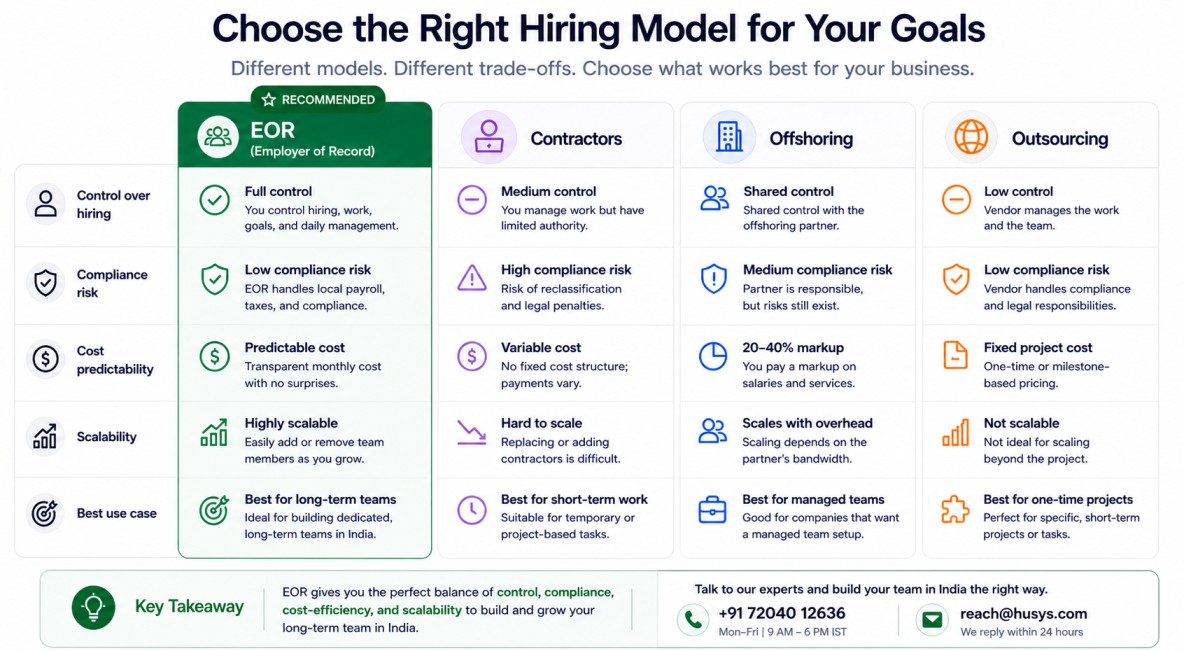
4. Outsourcing to an Indian VendorComparison of EOR, contractors, offshoring, and outsourcing hiring models based on control, cost, compliance, and scalability.

Outsourcing means hiring a vendor to deliver a defined outcome, not individual engineers. The vendor owns hiring, team management, and delivery.

Example:

  • Project cost (MVP build): $50,000
  • Includes: team, management, delivery

If scope changes:

  • Additional features → change requests
  • Costs increase based on revised scope

What you get

  • No hiring or payroll responsibility
  • Vendor manages execution end-to-end
  • Clear cost if scope is fixed 

You don’t control who works on the project. Teams can change, and knowledge stays with the vendor.

Clearly defined projects like MVPs or one-time builds—not long-term product teams.

Choose the right hiring model for your team

Compare EOR, contractors, and offshoring based on your team size, budget, and control needs. Get a clear recommendation before you commit.

EOR vs Contractors vs Offshoring vs Outsourcing: How to Choose the Right Model?

Each model changes what you pay for, how much control you have, and how stable the setup is over time.

Factor

EOR

Contractors

Offshoring

Outsourcing

What you’re paying for

Full-time employees

Individual services

Team + partner layer

Project outcome

Fees/markup

From $99 per employee/month

No platform fee (pay contractor rate)

20–40% partner margin

Included in fixed project cost

Cost visibility

Clear monthly per employee

Depends on hours worked

Monthly per team (with markup)

Clear at the project level

Cost behavior over time

Stable, scales linearly

Fluctuates with usage

Margin scales with team size

Changes with scope revisions

Upfront cost

None

None

None (if via partner)

None

Control over hiring

Full control

You choose, limited structure

Shared with partner

No control

Control over day-to-day work

Full

Medium

Medium

Low

Team continuity

High

Low to Medium

Medium

Low

Retention predictability

High

Low

Medium

Vendor-dependent

Compliance risk

Low

High (PF 12% + penalties if reclassified)

Medium

Low

IP ownership

Clear (employment)

Contract-dependent

Partner-dependent

Contract-dependent

Time to start

~8 hours (with Husys)

Immediate

~2–6 weeks

Immediate to short

Scalability

Easy to add hires

Hard to scale cleanly

Scales with added overhead

Not designed for scaling

Best use case

Building a long-term team

Short-term work

Growing a larger India presence

Defined builds, MVPs

For most US companies building long-term teams in India, EOR provides the best balance of speed, control, and compliance.

Which Hiring Model Should You Choose?

  • Choose EOR if you want full-time employees without setting up an entity
  • Choose contractors if the work is short-term and clearly defined
  • Choose offshoring if you want a managed team with less operational involvement
  • Choose outsourcing if you are buying delivery, not building a team

For most US companies building long-term engineering teams, EOR is the most stable and scalable option.

See what your hiring model will actually cost

Estimate monthly cost, compliance exposure, and long-term overhead based on your hiring model and team size.

How to Hire an Engineer in India Through an EOR: Step by Step

If you’ve been hiring through H-1B, this will feel very different,no lottery, no petitions, no waiting. Hiring moves at your pace.

Here’s what the process looks like when you Hire in India Without H-1B through an EOR.

Here’s how simple the process actually is:
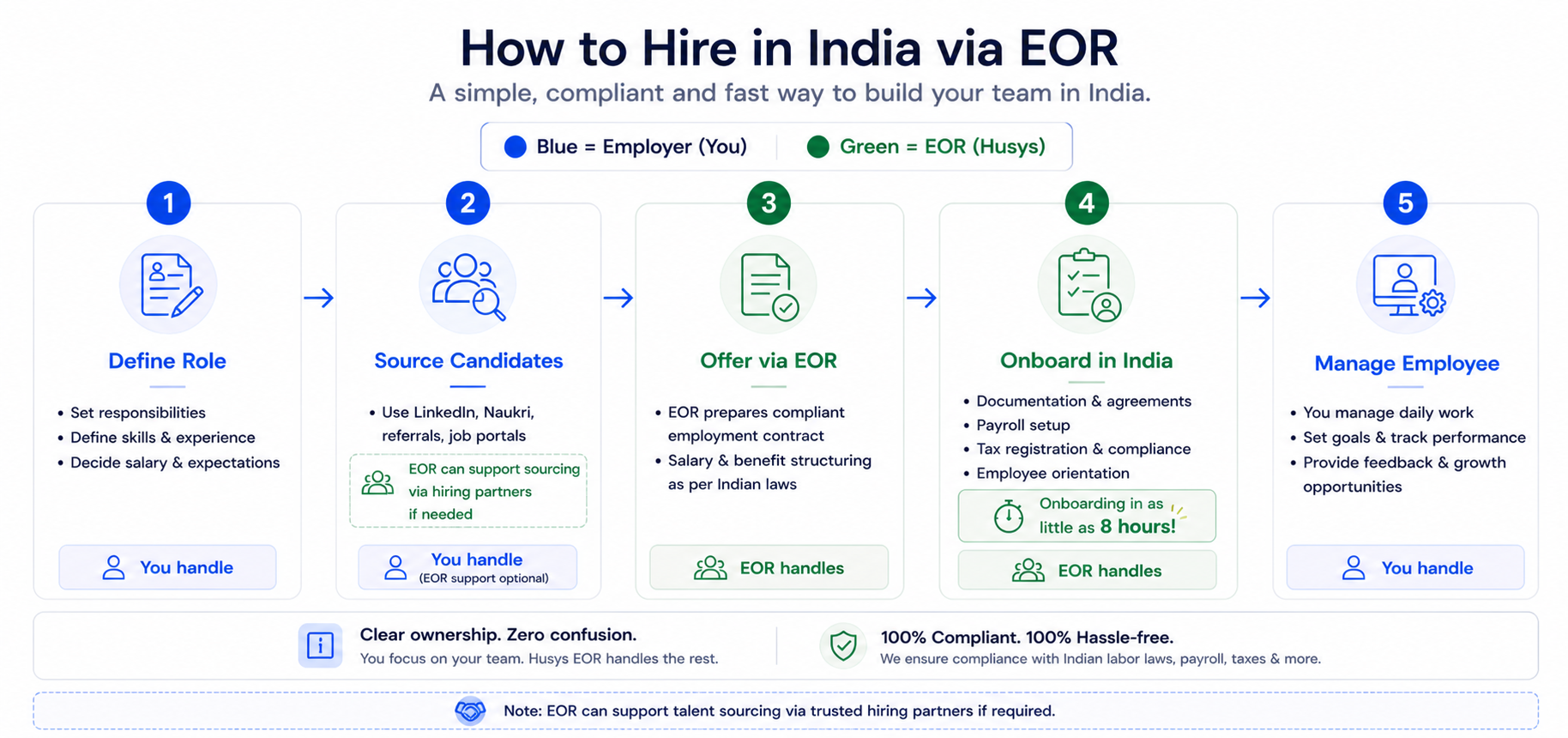
Step by step process of hiring employees in India using Employer of Record including onboarding, payroll, and compliance

  1. Define the role and compensation
    Start with responsibilities, seniority, and expected outcomes.
    Benchmark for India—lower salaries, but structured with statutory benefits, notice periods, and local norms.

Your EOR helps validate ranges to keep the offer competitive and compliant.

  1. Source and evaluate candidates

You can hire through your own pipeline, referrals, or job platforms—the EOR doesn’t handle sourcing unless you opt in.

In India, Naukri, LinkedIn, and Indeed are the primary channels, with Naukri strongest for mid to senior roles. One key factor is notice periods, typically 30–90 days, which can impact timelines.

The interview process remains fully in your control, just like US hiring. Once you select a candidate, you move directly to the offer stage—no visa dependency or delays.

  1. Finalize the offer through the EOR

Instead of issuing an offer letter directly, connect with your EOR, who will prepare the employment contract in line with Indian labor laws, covering salary structure, statutory components (PF), leave, notice period, and compliance.

You review and approve the terms before it is shared with the candidate.

  1. Onboard the employee

Once the candidate accepts, Husys handles onboarding—documentation, payroll, tax registration, and statutory setup.

The employee is legally employed by Husys but works as part of your team.

Onboarding can be completed in as little as 8 working hours, depending on documentation.

  1. Manage the employee day to day

You assign work, run performance reviews, and manage output. The EOR handles payroll, compliance, and local HR processes. 

What is different than H-1B hiring

With H-1B, hiring is tied to a lottery and can take months before the employee can start. With an EOR, hiring moves at your pace. Once you find the right candidate, onboarding can be completed in weeks or less if the candidate is immediately available. 

This gives you access to a broader talent pool without immigration constraints.

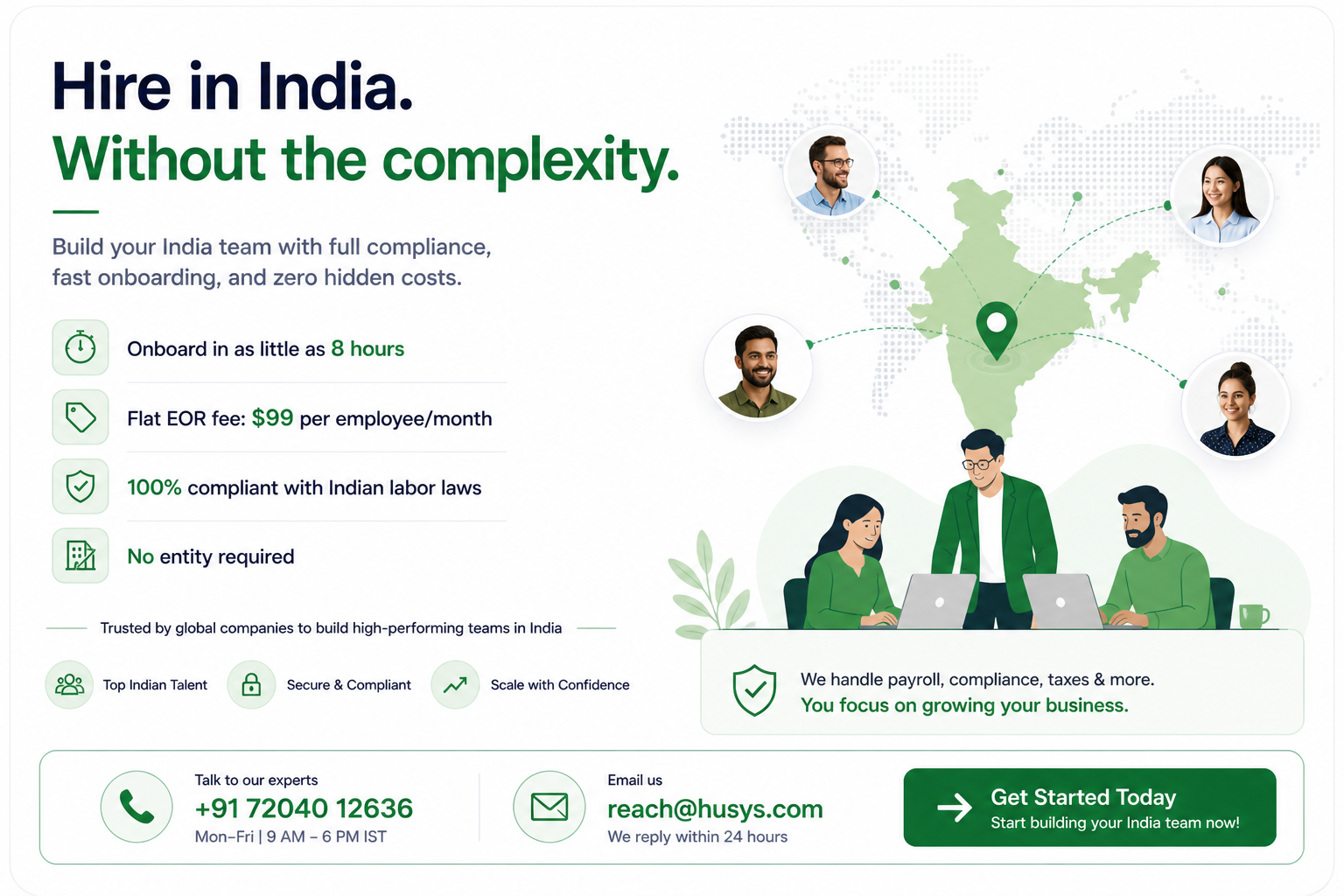
Build your India team faster, compliantly, and without hidden costs.Call to action for hiring employees in India via EOR with benefits like fast onboarding, compliance, and transparent pricing
H1-B Visa timelines slowing down your hiring plan?

Remove the dependency and move forward with a compliant setup that lets the employee start working sooner.

How Payroll, Taxes, and Compliance Work When Hiring in India

In India, payroll is compliance-driven. Employers are responsible for calculating, deducting, depositing, and filing statutory components every month.

Payroll is only one part of compliance. To understand the latest employment regulations affecting foreign employers, read India Labour Codes 2026: What US Companies Must Know Before Hiring.

1. What Actually Gets Added to Salary Cost (H3)

Table 1: Statutory Components

Hiring in India includes mandatory statutory components that directly impact total employment cost.

Component

Employer

Employee

Notes

PF

12%

12%

Mandatory retirement contribution

ESI

3.25%

0.75%

Applies up to ₹21,000 salary

Gratuity

~4.8%

Paid after 5 years

TDS

Yes

Income tax deduction

Table 2: CTC vs Take-Home

Compensation in India is structured differently and is quoted as Cost to Company (CTC).

Term

Meaning

CTC

Total employer cost

Take-home

Salary after PF + TDS

Gratuity

Included in CTC, not paid monthly

CTC is your total cost. Take-home is what the employee actually receives.

Before finalizing your compensation structure, explore our Employer of Record India: Complete Guide to Hiring, Payroll & Compliance to better understand statutory costs, payroll obligations, and employer responsibilities in India.

2. Taxes in India: How TDS Works in Practice (H3)

In India, employers are responsible for deducting and depositing income tax through TDS (Tax Deducted at Source).

How TDS works

Estimate income → apply tax slabs → spread across 12 months → deduct monthly → deposit

Employer responsibilities

  • Accurate tax calculation
  • Monthly deduction
  • Deposit by the 7th of next month
  • Quarterly TDS filings
  • Issue Form 16 annually

If done incorrectly

  • 1% monthly interest (not deducted)
  • 1.5% monthly interest (deducted but not deposited)
  • Penalty up to 100% of TDS amount
  • Late filing fee: ₹200/day

Errors in TDS create direct financial liability for the employer.

In one case, delayed TDS deposits led to fines exceeding ₹25,00,000 and legal action against company officers, showing how compliance failures can escalate quickly.An additional ₹60,000 (~$638) fine was imposed on the officer personally.

This was despite the tax already being deducted, showing that delays in deposit can lead to both financial penalties and criminal prosecution.

3. Compliance Beyond Payroll: What You Still Need to Handle (H3)

Hiring in India requires compliance beyond payroll, covering employment structure, documentation, and local regulations.

Area

Requirement

Employment contract

Must define salary, role, and notice period

Notice period

Typically 30–90 days, enforceable

Leave tracking

Earned, sick leave, and holidays must be tracked

Record maintenance

Salary, PF, TDS, and attendance records required

State laws

Rules vary by employee location

Payroll consistency

Must match statutory filings

Gaps in compliance can lead to disputes, audit exposure, and backdated liabilities with penalties.

Need a compliant payroll setup for India?

One mistake in PF or TDS can create months of liability. Shift the hire to Husys and remove that risk before your first payroll.

Common Mistakes US Founders Make When Hiring in India Instead of H-1B

Most issues come from applying US assumptions to a system that works differently.

  • Treating employees like contractors: Hiring full-time roles as contractors to avoid payroll. If the relationship resembles employment, it can be reclassified—triggering backdated PF, taxes, interest, and penalties. Unsure whether you should engage talent as employees or through an Employer of Record? Read Hire Employees in India Without an Entity: Ultimate EOR vs PEO vs AOR Guide to understand the compliance implications of each hiring model.
  • Ignoring salary structuring: Offering a lump sum without compliant breakdowns. This impacts PF calculation, tax treatment, and payroll consistency.
  • Assuming benefits are optional: Skipping PF or gratuity. These are statutory and expected in most full-time roles.
  • Missing monthly deadlines: Delays in TDS or PF deposits lead to interest from the due date and additional penalties.
  • Not accounting for notice periods: Applying US timelines. In India, 30–90 day notice periods impact hiring and exits.
  • Running payroll without local expertise: Using generic tools or ad-hoc processes without compliance knowledge. Errors compound and surface during audits.

Conclusion

Hiring through H-1B limits how fast you can build a team. The process is tied to a lottery, fixed timelines, and delayed start dates.

Hiring in India through an EOR removes that dependency.

You can access a large talent pool, hire within weeks, and run a full-time team without setting up a local entity. The EOR becomes the legal employer in India and handles payroll, taxes, statutory contributions, and compliance while you manage the employee’s work as part of your team.

Planning to scale beyond your first hire?

Our Employer of Record India: Complete Guide to Hiring, Payroll & Compliance explains everything you need to know about hiring employees in India without setting up a local entity.

Hire in India without delays or compliance risk

Build your India team with contracts, payroll, and compliance handled from day one.

Frequently Asked Questions (FAQs)

Who owns the IP when I hire through an EOR in India?

IP ownership is defined in the employment contract. In a properly structured EOR setup, all work created by the employee is assigned to your company.


What happens if I want to terminate an employee in India?

Termination must follow the notice period and terms defined in the employment contract. Immediate termination is not standard unless there is misconduct.


Can I offer bonuses or stock options to India-based employees?

Yes. Bonuses are common and can be structured into compensation. Stock options can also be offered, but require proper documentation and tax consideration.


What happens if payroll or tax filings are missed?
You may be required to pay backdated dues with interest and penalties. This applies to PF, TDS, and other statutory components depending on the issue.


What is the biggest risk if I try to manage India hiring without structure?
The main risk is not the upfront cost, but backdated liabilities. Errors in classification, payroll, or tax handling can compound over time with interest and penalties.

How does Husys ensure compliance for US companies hiring in India?
Husys manages payroll, statutory deductions, filings, and employment contracts in line with Indian labor laws, reducing compliance risk for US employers.

Can Husys help if I have already hired contractors in India?
Yes. Husys can transition contractors into a compliant EOR setup, helping reduce misclassification risk going forward.

What level of control do I have over employees hired through Husys EOR?
You retain full control over hiring, role definition, and day-to-day work. Husys handles the employment and compliance layer in the background. 

Table of Contents

Husys EOR - A People2.0 Company

EOR $99/per month

Empowering Your Workforce Journey with Trusted Insights

Find the latest industry trends, expert blogs, insightful case studies, and essential tools. Whether you’re expanding your team locally or globally, we’ve got the information you need to make informed decisions and stay ahead of the curve.

Let's Help You!

Please Share Your Details And Get Connected

When do US teams use EOR for India?