Husys India EOR Payroll & Compliance Experts is the in-house team supporting Employer of Record (EOR) payroll operations and statutory compliance for US companies hiring in India. With 250+ years of collective compliance experience, the team has supported 50,000+ contractors to date and helps 5,000+ clients run compliant workforce operations across India.
Editorial note: This content is reviewed internally by payroll and compliance specialists and reflects standard statutory practices in India. For case-specific guidance, consult a qualified professional.
Facebook
X.com
LinkedIn
Email
WhatsApp
Quick Answer: What Does It Really Cost to Hire in India?
For a US company, the true cost of hiring an employee in India is more than the advertised salary.
A $2,000/month employee can have an illustrative employer cost of $2,305/month when employer EPF, gratuity provision, insurance and a $99 Husys EOR fee are included. Actual costs vary by salary structure, employee eligibility, state and statutory ceilings.
For planning purposes, the article estimates that total employment cost can run 25–30% above gross salary, depending on the hiring structure and applicable costs.
For US companies hiring in India, the main cost components are:
Salary — the employee’s gross compensation.
Statutory costs — including applicable EPF and gratuity obligations.
Benefits & insurance — depending on the employee and benefits structure.
Payroll & compliance — recurring administration and statutory filings.
Hiring model costs — EOR fees or the cost of operating your own Indian entity.
One-time costs — entity setup, equipment and onboarding can increase first-year spend.
EOR vs. entity:
For smaller India teams, an EOR can avoid the upfront entity setup and ongoing compliance infrastructure.
The article estimates that an India entity typically starts becoming financially attractive around 20–25 employees, although the right point depends on the company’s hiring volume and operating requirements.
Bottom line:
Don’t budget India hiring from salary alone.
Budget for salary + statutory obligations + benefits + compliance/payroll + hiring-model costs to understand the number that actually reaches your P&L.
Hiring a $2,000/month engineer in India actually costs $2,302/month.
Cost
Monthly
Gross salary
$2,000
Employer EPF
$120*
Gratuity provision
$48*
Employer-paid health insurance
$35*
Husys EOR fee
$99
Illustrative total
$2,305
Illustrative example. Actual statutory costs vary based on employee eligibility, wage structure, state, and applicable statutory ceilings. Professional tax is generally an employee deduction/remittance rather than an employer benefit cost, so it should not be presented as a universal employer contribution.
If you are a US founder or CFO looking at India, the headline numbers look simple.
A software engineer in San Francisco might cost you $140,000 a year.
In India, you see $30,000 to $50,000, and the math feels obvious.
But understanding the real cost of hiring employees in India takes more than reading an offer letter.
Salary is only the first number, and it is rarely the biggest one.
On top of base pay, there are mandatory employer contributions, monthly payroll obligations, compliance filings that cannot slip, recruitment and sourcing costs, equipment, software access, and onboarding time.
If that employee leaves within a year, you absorb the full replacement cost and start again.
The true cost of hiring employees in India is always higher than what the contract says.
True employer cost snapshot
Base salary: $30,000
Actual employer cost: $36,000 to $45,000
Real overhead: 20% to 50% above salary
That additional cost comes from:
Statutory contributions
Payroll administration
Compliance overhead
Equipment and software
Realistic attrition buffers
This is why the number on the offer letter is never the number that hits your P&L.
That range shifts further depending on how you hire, who carries compliance responsibility, and whether infrastructure costs sit inside your own entity or get handled through a third-party model.
Hire Indian Talent at a Fraction of US Cost without the Compliance Headache
Skip entity setup and go from offer to onboarded in 8 hours. Join 50,000+ companies hiring smarter with Husys.
This guide walks through the full India employment cost breakdown, so your forecast reflects reality from day one.
We quantify statutory employer costs in USD, walk through the operational overhead most teams overlook, and show how total employer cost changes depending on your hiring structure.
We also map these numbers against team size so you can see which model makes financial sense at each stage.
This guide is for US founders, CFOs, and finance or operations leaders who need clean numbers before approving India headcount.
Whether you are evaluating the hiring cost in India for US companies at the team level or just trying to sanity-check a single offer, this is the breakdown you need.
It is relevant if you are:
Building a distributed engineering or product team in India
Expanding sales or support capacity to improve margins
Evaluating whether to set up an India entity or use an EOR
Pressure-testing the true cost of hiring employees in India before presenting a board-level plan
Responsible for forecasting international payroll and compliance exposure
If you already know India is strategically attractive but need to understand the financial structure behind the move, this guide is built for you.
It focuses on what affects your budget, your forecast accuracy, and your operational load once the hiring decision is made.
What Does It Cost to Hire an Employee in India?
The cost of hiring employees in India depends on more than the salary offered to the employee; a realistic employer budget also needs to account for applicable statutory costs, benefits, hiring expenses and employment infrastructure.
India offers some of the most competitive salaries in the world for skilled talent, and we see this firsthand every week when US founders come to us with an offer letter number and ask us to sanity-check it.
What they quickly realise is that what you pay an employee and what you actually spend as an employer are two very different figures.
Before you finalize any budget, you need both, and this guide walks you through exactly how to get there.
Base Salary Benchmarks by Role
Salaries in India vary significantly by role, experience level, city, company type and the skills required.
For US companies, the most useful starting point is to understand the local market salary for the role you want to hire, rather than applying one average “India salary” to every employee.
For companies planning their first India hires, understanding the right hiring structure is just as important as benchmarking salary; this guide to hiring employees in India explains the available models and the practical steps involved.
For that reason, the cost of hiring employees in India should be modelled from the market salary for the specific role rather than from a single India-wide salary assumption.
The figures below are gross annual base-salary ranges, sourced from Glassdoor India and converted to USD for easier comparison by US readers.
Important: These figures represent gross base salary, not the fully loaded cost to the employer. A US company hiring in India should separately budget for applicable statutory employer costs, benefits, recruitment, equipment, onboarding and the cost of its employment model.
How Do India Salaries Compare With the US?
The salary difference is one reason India is attractive to US companies building distributed teams.
For context, the U.S. Bureau of Labor Statistics reports a median annual wage of $131,450 for software developers, quality assurance analysts and testers in its latest Occupational Outlook Handbook data.
That provides useful context for the India software-engineering ranges above.
However, a US company should avoid treating this as a simple “US salary vs. India salary” calculation.
The more meaningful comparison is:
US fully loaded employment cost
vs.
India fully loaded employment cost
A US employee’s cost can include employer payroll taxes, healthcare, retirement contributions, workers’ compensation and other employment costs.
An India employee’s cost can include employer statutory contributions, benefits, recruiting, equipment and the cost of the employment structure.
So the salary difference is only the first layer of the cost comparison.
Why India Salary Benchmarks Vary by City
Compensation also varies significantly between India’s major technology hubs and other locations.
Bengaluru, Hyderabad, Pune, Chennai, Mumbai and Delhi NCR tend to have stronger competition for experienced technology talent and can therefore command higher salaries.
Lower-cost locations may offer salary advantages, but the lowest salary is not necessarily the lowest total hiring cost.
A US company should also consider:
Availability of candidates with the required skills
Competition from local and multinational employers
Recruiting time
Candidate quality
Experience working with US teams
Time-zone overlap
Expected retention
For specialized or senior roles, paying a market-competitive salary in a major talent hub can be more economical than saving on salary but taking significantly longer to fill the position.
Experience Bands (India Context)
To avoid confusion with US job titles, we define experience by years worked in the role:
1 to 3 years: Early-career professional. May include professionals who are still developing independent capabilities and require some mentoring.
4 to 6 years: Mid-level professional. Typically able to deliver independently and own projects with limited supervision.
7 to 9 years: Senior individual contributor. Typically capable of owning complex projects, mentoring colleagues and providing technical or functional leadership.
These experience bands are useful for US employers because titles such as Senior Engineer, Lead, Manager and Director are not standardized across companies.
When comparing an India candidate with a US role, look beyond the title and compare:
Years of relevant experience
Scope of responsibility
Technical or functional depth
Level of autonomy
Project ownership
People-management responsibility
Domain expertise
The Key Takeaway for US Employers
India can offer a significant salary advantage for many roles, particularly in technology, engineering, support and other knowledge-work functions.
But salary is not the same as employer cost.
When building an India hiring budget, compare six layers:
Market salary — what you need to pay to attract the right candidate.
Employer statutory costs — applicable EPF, gratuity and other employer obligations.
Benefits — health insurance and other market-expected benefits.
Hiring costs — recruitment, sourcing and background verification.
Employment infrastructure — EOR fees or the cost of operating your own India entity.
Fully loaded cost — the complete cost of employing and supporting the employee.
That is the number a US CFO should compare with the cost of hiring the equivalent capability in the United States.
That fully loaded figure is the number a US CFO should use when comparing the cost of hiring employees in India with the cost of hiring the equivalent capability in the United States.
Mandatory Statutory Contributions in India
If you have only ever hired in the US, the way Indian compensation and payroll are structured will feel unfamiliar at first.
In the US, employers typically think about base salary, FICA payroll taxes, 401(k) contributions, health insurance, and other employee benefits. India has a different employment framework, with statutory contributions, tax withholding, and state-specific requirements that need to be considered separately.
The first thing a US employer needs to understand is that employee salary, employer cost, and employee take-home pay are three different numbers.
Indian employment obligations can become particularly important when an employee exits, which is why US employers should understand employee termination requirements in India before budgeting the full cost of an India hire.
This distinction becomes particularly important when a US company hires in India without establishing its own local entity, because an Employer of Record in India can take responsibility for employment administration, payroll and applicable local compliance.
This distinction is essential when calculating the cost of hiring employees in India because employee deductions should not automatically be treated as additional employer costs.
A typical Indian compensation structure may include Basic Salary, House Rent Allowance (HRA), Leave Travel Allowance (LTA), Special Allowance, statutory contributions, and other benefits.
For a US company, the important question is not simply:
“What is the employee’s salary?”
It is:
“Which amounts are an additional employer cost, which amounts are employee deductions, and which benefits or obligations need to be budgeted separately?”
India Payroll vs. US Payroll: What Changes for a US Employer?
US concept
Closest India concept
What a US employer should know
Social Security + Medicare / FICA
EPF and other statutory programs
Useful as a high-level comparison, but the systems are not legally equivalent
401(k)
EPF
EPF is a statutory retirement savings framework; it is not simply India’s version of a 401(k)
State payroll obligations
State-specific labour and payroll requirements
Indian employers may have state-specific registrations, deductions and remittances
W-2
Form 16
Form 16 is an annual salary and TDS certificate issued to the employee
At-will employment
No direct equivalent
Indian employment terms, notice requirements and applicable labour rules need to be considered
Health insurance
Group medical insurance
Private health insurance is commonly offered as a market benefit, but is not universally mandatory for professional employees
Payroll tax withholding
TDS
Employers calculate, deduct and remit income tax from employee compensation
US subsidiary
Indian private limited company / subsidiary
Creates local employer, tax, accounting, payroll and compliance responsibilities
EOR
No direct domestic US equivalent
An EOR becomes the local legal employer while the client typically retains day-to-day direction of the employee
The comparison is useful, but it is important not to assume that Indian employment laws are simply the US system with different names.
How Indian Salary Components Work
A typical Indian salary may include
Basic Salary,
House Rent Allowance,
Leave Travel Allowance,
Special Allowance and
other compensation components.
The treatment of these components matters because India’s Labour Codes now use a statutory definition of “wages” for employment-related calculations.
Under the Labour Codes, if specified allowances and benefits exceed 50% of total remuneration, the excess amount is added back into wages for statutory purposes. This means US employers should not assume they can simply reduce Basic Salary and move the remaining compensation into allowances to minimize statutory obligations.
Do not use a fixed “Basic Salary = 50% of gross salary” rule when modelling India employment costs. The applicable wage definition and compensation structure should be evaluated for the specific employee and role.
1. Basic Salary
Basic Salary is a core component of Indian compensation and is used in calculating certain statutory benefits and contributions.
It is important because contributions such as EPF and certain statutory benefits can depend on the applicable wage base.
A higher statutory wage base can therefore increase the employer’s cost.
2. House Rent Allowance (HRA)
House Rent Allowance (HRA) is a common component of Indian compensation and can provide tax benefits to eligible employees who meet the applicable conditions.
For the employer, HRA is generally part of the employee’s agreed compensation rather than an additional cost on top of the gross salary.
3. Leave Travel Allowance (LTA)
Leave Travel Allowance (LTA) may be included in an employee’s compensation and can provide tax benefits when the applicable conditions are met.
It generally does not represent an additional employer cost beyond the compensation already agreed with the employee.
4. Special Allowance
Special Allowance is commonly used as a compensation component to make up the difference between Basic Salary and other salary components.
Its treatment for statutory purposes depends on the applicable wage rules and the nature of the payment. US employers should therefore avoid assuming that every allowance is automatically excluded from the statutory wage base.
4. Employee Provident Fund (EPF)
Employee Provident Fund (EPF) is a statutory retirement savings system.
For a US employer, Social Security is a useful high-level comparison, but EPF is not legally or structurally equivalent to US Social Security or a 401(k).
Where EPF applies, the standard contribution rate is generally 12% of applicable EPF wages for the employee and 12% for the employer, subject to statutory rules and wage ceilings.
EPFO currently states that contributions are generally calculated up to the statutory wage ceiling of ₹15,000 per month, although employees and employers can contribute on higher wages in certain circumstances under the applicable EPF rules.
Employee EPF contribution: deducted from the employee’s compensation
Employer EPF contribution: an additional employer employment cost
The employer contribution should therefore not automatically be calculated as 12% of the employee’s entire gross salary.
The applicable wage base, employee eligibility and contribution arrangement need to be considered when calculating the actual cost.
5. Gratuity
Gratuity is a statutory employment benefit that can become payable when an employee meets the applicable eligibility requirements.
For budgeting purposes, employers commonly make a provision for the future gratuity obligation rather than treating it as an ordinary monthly cash payment.
The Ministry of Labour’s 2026 Labour Code FAQs confirm that the revised definition of wages applies to gratuity from November 21, 2025, when the Labour Codes came into effect.
Professional Tax is a state-level employment tax, and the applicable rules and rates vary by state.
Where it applies, the employer generally deducts Professional Tax from the employee’s salary and remits it to the relevant state authority.
This distinction is important for US employers:
Professional Tax is generally an employee deduction/remittance rather than an additional employer-paid payroll cost.
The employer may have the administrative responsibility to calculate, deduct and remit the amount, but that does not mean it should automatically be added again to the employer’s employment cost.
For example, if Professional Tax is deducted from an employee’s salary, the employer is generally remitting money withheld from the employee rather than paying an additional amount on top of the employee’s compensation.
Keeping these three numbers separate prevents both over-budgeting and under-budgeting.
What Does This Mean for Your India Hiring Budget?
There is no single percentage that accurately represents the employer cost for every employee in India.
Your recurring employment cost depends on:
Gross salary and compensation structure
Applicable EPF rules and wage ceiling
Gratuity obligation
State-specific requirements
Employer-funded benefits
Health insurance
Hiring model
EOR or entity-related administration
For planning purposes, separate your calculation into three layers:
Compensation
Gross salary, bonuses and agreed benefits.
Employer statutory and benefit costs
Employer EPF, applicable statutory obligations, gratuity provision and employer-funded benefits.
Employment infrastructure
EOR fees or the payroll, accounting, compliance and HR infrastructure required to operate your own India entity.
This approach gives a US finance team a more reliable forecast than applying a blanket percentage to salary.
Example: $2,000/Month India Hire
Let’s use a mid-level software engineer with a $2,000 monthly gross salary as an illustrative example.
For this example, the cost of hiring employees in India is calculated by separating gross salary from employer statutory costs, benefits and the EOR service fee.
Component
Monthly Cost
Gross Salary
$2,000
Employer EPF Contribution*
$120
Gratuity Provision*
$48
Employer-paid Health Insurance*
$35
EOR Fee (Husys)
$99
Illustrative Employer Cost
$2,302
*Illustrative assumptions only. Actual statutory costs can vary based on the employee’s wage structure, EPF eligibility, applicable wage ceilings, state, benefits and employment arrangement.
Important: Employee EPF, Professional Tax and TDS may be deducted from the employee’s compensation and remitted by the employer where applicable. They should not automatically be added again as employer-paid costs.
In this example, the recurring employer cost is approximately 15% above the $2,000 gross salary, before recruitment, equipment, software, onboarding, attrition and other workforce costs.
That distinction matters because recurring employment cost is not the same as fully loaded workforce cost.
The sections that follow will add those additional costs so you can build a realistic India hiring budget.
Trusted Employment Infrastructure Built Specifically for India by Husys
Husys operates one of the most established employer infrastructure platforms in India, designed to help global companies hire compliantly without building their own entity.
We manage employment, payroll, statutory compliance, and HR administration entirely within our own India-based infrastructure.
This allows companies to access India’s talent market without the cost, delay, and administrative overhead of setting up a legal entity.
You retain full control over your team. Husys handles the employment and compliance layer.
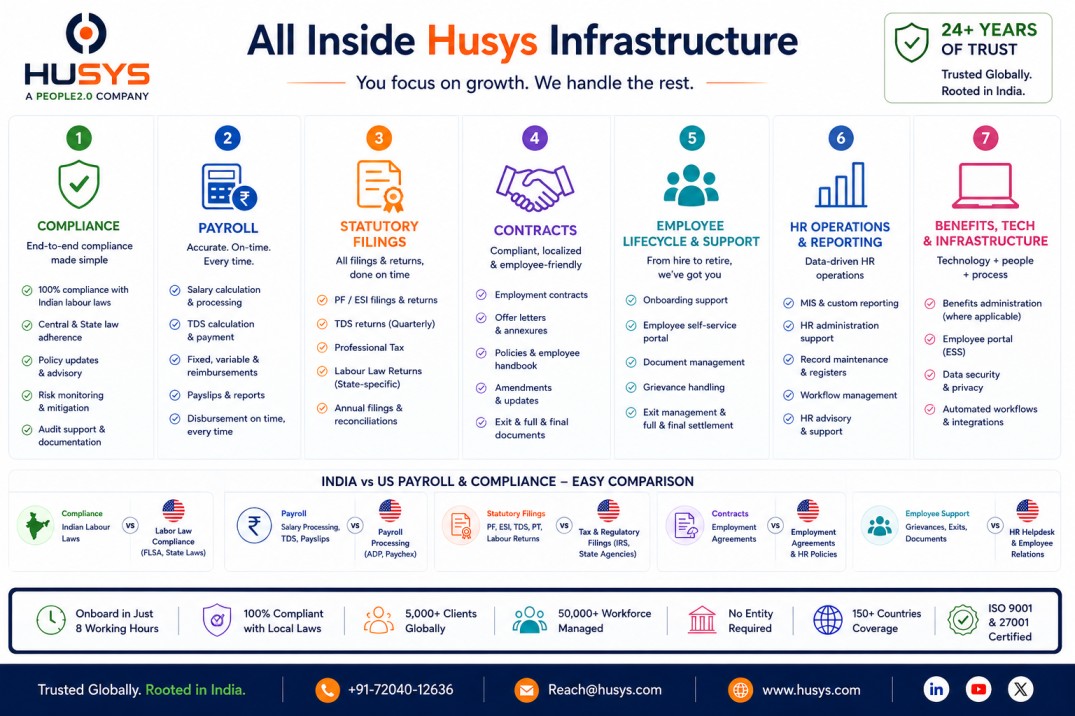
Husys provides end-to-end India EOR infrastructure covering payroll, statutory compliance, employment contracts, employee lifecycle support, HR operations and reporting.
Hidden Costs of Hiring in India That US Founders Overlook
Statutory contributions are non-negotiable, but they are not the whole story. And this is where most first-time India budgets quietly fall apart.
When US companies come to us mid-year with an India P&L that is underperforming expectations, we almost always find the same culprits: recruitment spend that was not modelled, attrition that hit earlier than expected, or compliance overhead that nobody budgeted for.
Here’s a complete view of the cost of hiring employees in India, including benefits and the workforce costs that can sit outside the headline salary.
Recruitment and Sourcing Costs
Onboarding, Equipment, and Setup Costs
Attrition and Rehiring Costs
Compliance and Administrative Overhead
1. Recruitment and Sourcing Costs
India has deep talent, but abundant and easy to hire are not the same thing.
As a US company with no India presence yet, you are competing against names candidates already know and trust, with managers in the same timezone and a career ladder they can already see.
That brand gap is real, and until you close it, your sourcing costs will reflect it.
If you do not model these costs upfront, your estimate of the cost of hiring employees in India will not hold under real market conditions.
Here are the costs I’m talking about:
Job board postings
Platform
Cost per Posting
Naukri.com
$20 to $600
LinkedIn India
$100 to $600
Indeed India
Free to $200
Specialized tech boards
$50 to $300
Most roles need 3 to 5 postings before you close.
Recruitment agency fees
The standard in India is 8.33% of annual salary, which is one month of their package.
For specialized or senior roles, agencies charge 15 to 25%.
On a $2,000/month engineer, you are looking at $2,000 to $6,000 per hire, due within 30 days of joining, not after probation.
Background verification
Every legitimate company does this. Education, employment history, criminal checks, and address verification together run $10 to $50 per candidate.
Internal time cost
Technical assessments, interviews, and coordination across time zones.
Budget 20 to 40 hours of your team’s time per successful hire.
That is the time your engineers and managers are not spending on actual work.
Did You Know?
Husys provides talent acquisition support through trusted recruitment partners in India to help you hire faster and reduce agency dependency. Learn More
2. Onboarding, Equipment, and Setup Costs
Once you close a hire, getting them set up and productive is straightforward.
The items below are one-time costs per hire and the kind of thing any well-run distributed team plans for in advance.
Item
Cost
Laptop and peripherals
$700 to $1,900
Software licenses and tools
$50 to $300/month
IT setup and access provisioning
$100 to $200
Formal training (if applicable)
$500 to $2,000
Onboarding Support: Husys provides laptops and tech peripherals as an add-on for India hires to simplify setup and reduce onboarding delays.
Eliminate Compliance, Payroll, and Hiring Overhead Instantly
Avoid incorporation delays, recurring filings, and unpredictable sourcing costs. Move from offer to fully compliant onboarding without setting up your own entity in just 8 hours.
Even at 16%, attrition can significantly increase your total hiring cost in India.
This means in a five-person team in India, you should expect at least one resignation within a year.
What does that actually cost?
Recruitment and agency fees again
Equipment and access setup again
60 to 90 days of reduced team output
Knowledge and context that walked out the door
For a $2,000 per month engineer, one attrition event typically costs $8,000 to $14,000 when you factor in recruitment, onboarding, and reduced output.
This cost should be built into your annual hiring model.
Attrition increases direct hiring costs. However, in India’s tightly networked talent market, workforce changes are quickly visible to future candidates and hiring partners.
How exits are structured can influence your employer brand and your ability to hire competitively in the same market.
Brand Reputation Protection with Husys:
Husys provides structured outplacement services to help manage exits/layoffs responsibly and prevent negative brand impact.
4. Compliance and Administrative Overhead
Running payroll and staying compliant in India involves a set of recurring obligations that most US founders do not fully appreciate until they are already in it.
This is one of the most underestimated components of the india payroll cost for employers, and it compounds every year you operate without the right structure in place.
Most of the US founders we work with come in assuming India compliance looks something like US payroll taxes.
A few deductions, a quarterly filing, and you are done.
It does not work that way.
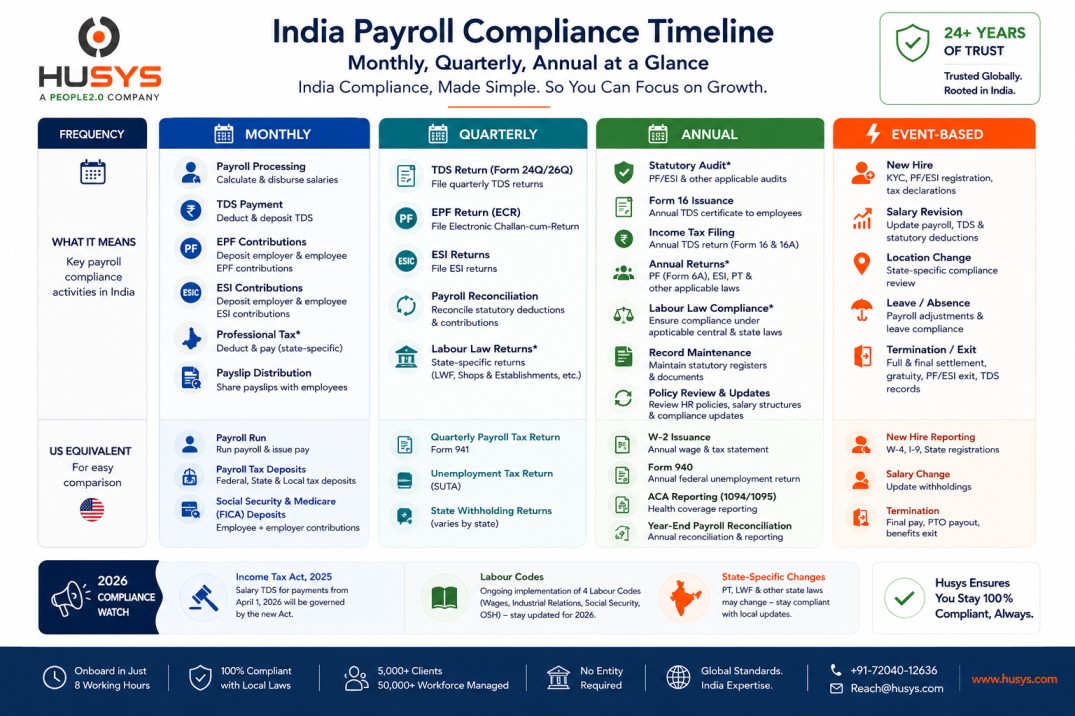
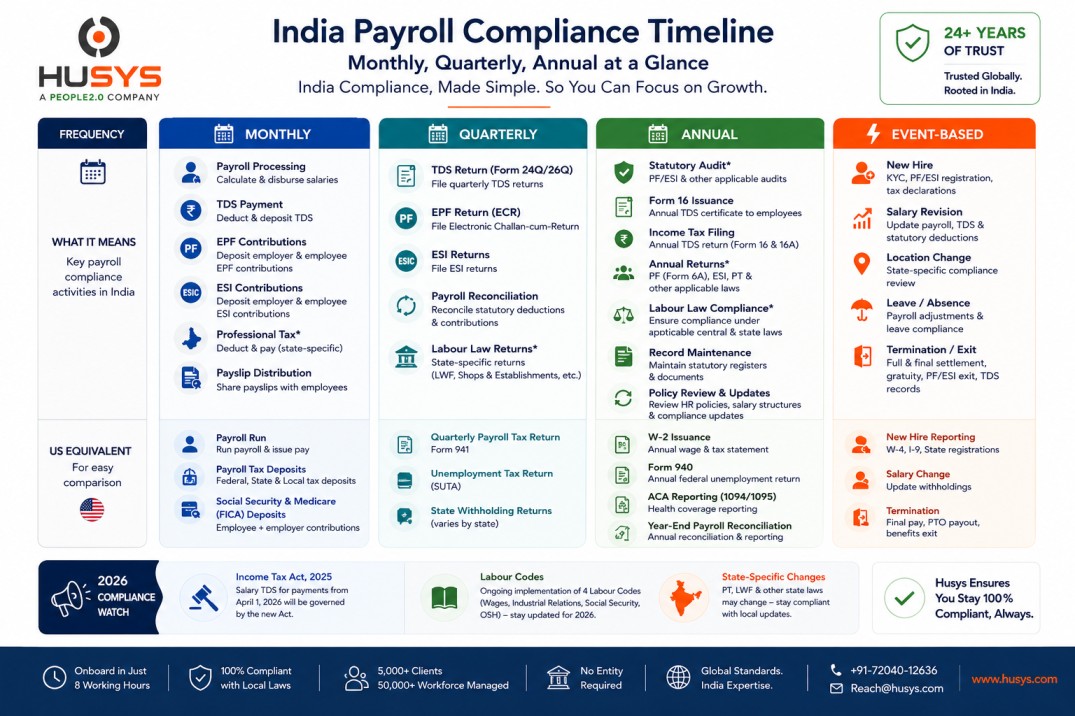
If you run your own entity, you are managing monthly
India Payroll Compliance Timeline 2026: A practical view of monthly, quarterly, annual and event-based payroll and employment compliance for US companies hiring in India.
Managing all of this through a local CA (Chartered Accountant) firm or a dedicated finance hire costs $300 to $800 per month for a small team.
That line item almost never appears in a founder’s first India budget draft. We have seen teams discover it months after their first hire.
These obligations compound quietly. Most US companies building India teams for the first time are not warned about the annual increment cycle until they are already in year two of a budget that no longer holds.
Here is what the cost of hiring employees in India looks like once you are past the first hire.
Ongoing Costs That Grow Every Year
1. Annual salary increments
The EY Future of Pay 2026 Report projects average annual salary increments in India at 9.1%, with high performers receiving above-market increases.
Salary increases are structured and recurring:
A 9.1% increment on a $1,500 monthly salary adds approximately $136 per month
That equals $1,638 per year per employee
Across a 10-person team, this increases annual payroll by roughly $16,380
Increment cycles compound over time and should be built into multi-year hiring forecasts.
2. Performance bonuses
As per the same EY Future of Pay 2026 Report, average variable pay in India increased to 16.1% of fixed salary in 2025, up from 14.8% in 2024.
Pay differentiation has widened:
Top performers receive 120% to 150% of target payouts
Average performers receive 60% to 80% of target payouts
In some cases, top talent earns up to 1.6x more through targeted rewards
Nearly 45% to 50% of organizations are shifting toward skill-based pay frameworks. Emerging technology roles such as AI and machine learning can command skill premiums of up to 40%.
On a $24,000 annual salary, a 16.1% variable component equals approximately $3,864 per year.
3. Health insurance beyond statutory
Under the Employees’ State Insurance (ESI) scheme, establishments with 10 or more employees must register and contribute to the social security fund for workers earning up to ₹21,000 per month, providing statutory medical and social benefits.
Most professional roles hired by US companies exceed this wage threshold and are not covered by ESI. In these cases, offering health insurance is not legally mandated, but private group health plans are standard in the market.
Group health coverage typically costs $300 to $1,000 per employee per year, depending on plan design and city.
On a 10-person team, that translates to $3,000 to $10,000 in annual health benefit costs for roles outside ESI eligibility.
Additional benefits the market expects
Benefit
Typical Range
Work from home allowance
$50 to $150/month
Internet reimbursement
$20 to $50/month
Learning and development
$200 to $800/year
Wellness programs
$100 to $400/year
Together, these add $100 to $250 per employee per month.
What Most Cost Breakdowns Don't Tell You: The Tax and Compliance Burden Behind Every Rupee
Almost every benefit you offer in India is taxable in the employee’s hands, and that creates a monthly compliance obligation you have to stay on top of.
Every month, your employees need to submit proof of the allowances they claimed, internet bills, rent receipts, medical invoices, and so on.
Your payroll manager collects those, verifies them, and files them with the Indian tax authorities.
If that does not happen on time or gets done incorrectly, the tax exemption on those benefits lapses, and your employee takes home less than what their offer letter said.
To give you a sense of the workload, running payroll for just 10 employees in India typically needs 2 to 3 dedicated people managing it every month.
This is also worth keeping in mind if you are evaluating EOR or payroll platforms to manage your India team.
A lot of them market themselves as fully automated and make it sound like compliance just runs itself.
What they are usually describing is the internal part, generating payslips, calculating deductions, that kind of thing.
The actual filing of statutory documents with Indian government authorities is a different story. That still gets handed off to a local payroll firm and done manually.
Different Hiring Models in India and What Each One Costs
Every cost discussed so far, statutory contributions, recruitment fees, and compliance overhead, assumes you already have a legal structure in place to employ someone in India.
The cost of hiring employees in India changes substantially depending on which employment model you choose, and selecting the wrong structure at the wrong stage can materially increase your total cost.
If you are comparing these structures before making your first hire, this EOR vs Entity vs Contractor comparison for India provides a detailed comparison of cost, setup time, compliance responsibility and the operational trade-offs between each model.
There are three options.
1. Hidden Costs in Setting Up Your Own Legal Entity in India
Everything we handle on your behalf through an EOR becomes your direct responsibility:
payroll,
filings,
audits,
contracts, and
every compliance obligation that comes with it.
One-time setup costs
Item
Cost
Company registration
$10,000 to $15,000
Legal fees and documentation
$3,000 to $5,000
Registered office address
$1,000 to $3,000
Bank account setup and deposits
$2,000+
Total to get started
$16,000 to $25,000
Timeline to hire your first employee after starting this process: 3 to 6 months.
Annual operating costs once you are live
Item
Annual Cost
Statutory audits and compliance
$8,000 to $12,000
Accounting and bookkeeping
$6,000 to $10,000
Legal retainer for labour law
$4,000 to $8,000
Payroll software
$6,000 to $12,000
Total annual overhead
$25,000 to $40,000
That $25,000 to $40,000 is what you spend before paying a single employee.
At 15 or more employees, the per-head cost of this overhead starts to make financial sense. Below that, you are paying for infrastructure you do not yet need.
When Setting up an Entity this makes sense to absorb such costs:
You are committed to India for the long term, you are hiring 15 or more people, and you want full control over HR, payroll, and employment terms.
For companies entering India for the first time, the decision should be based not only on per-employee cost but also on the right India market-entry strategy, including setup time, compliance responsibility and how quickly the team needs to become operational.
2. Hidden costs in Employer of Record
An EOR is a locally registered company in India that legally employs your workers on your behalf. You control the work.
The right choice ultimately depends on whether you are testing the Indian market or building a long-term local operation, which is why EOR vs entity in India should be evaluated against your expected hiring scale, operating model and expansion timeline.
They own the employment contract, run monthly payroll, file statutory returns, and handle every compliance obligation that comes with being a legal employer in India. You pay a flat monthly fee and never touch any of it.
This is the model we built Husys around, specifically for US companies that want India’s talent market without India’s compliance burden. In fact, 26% of our clients are US-based companies.
For US companies evaluating providers, it is also worth understanding how a local India EOR compares with a global EOR, particularly when local compliance depth, payroll execution and operating costs are part of the decision.
What India-based EOR services cost
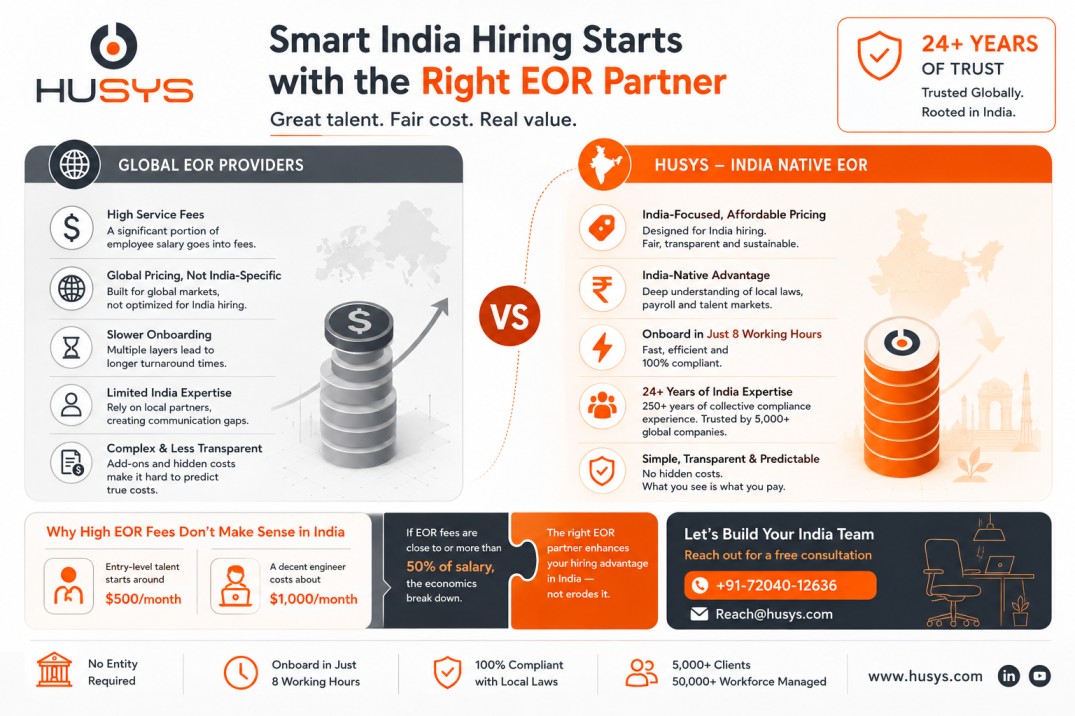
Husys remains the most affordable and experienced EOR provider with $99/employee/month, approx 80% cheaper compared to local and global EOR service providers.
Own legal entity in India with deep local compliance knowledge
Fully inclusive, payroll, statutory filings, contracts, and HR admin
No hidden per-transaction or forex fees
Husys Highlights
Trusted by 5,000+ companies globally
24+ years operating in India
500,000+ employees managed
Clients across US, UK, EU, APAC
What global EOR platforms charge
International platforms like Deel or Remote: $499 to $699 per employee per month
Built for multi-country hiring across dozens of markets
If India is your only market, you are paying for infrastructure you will never use
Same underlying employment structure, significantly higher price tag
Where Global EOR Fees Actually Come From
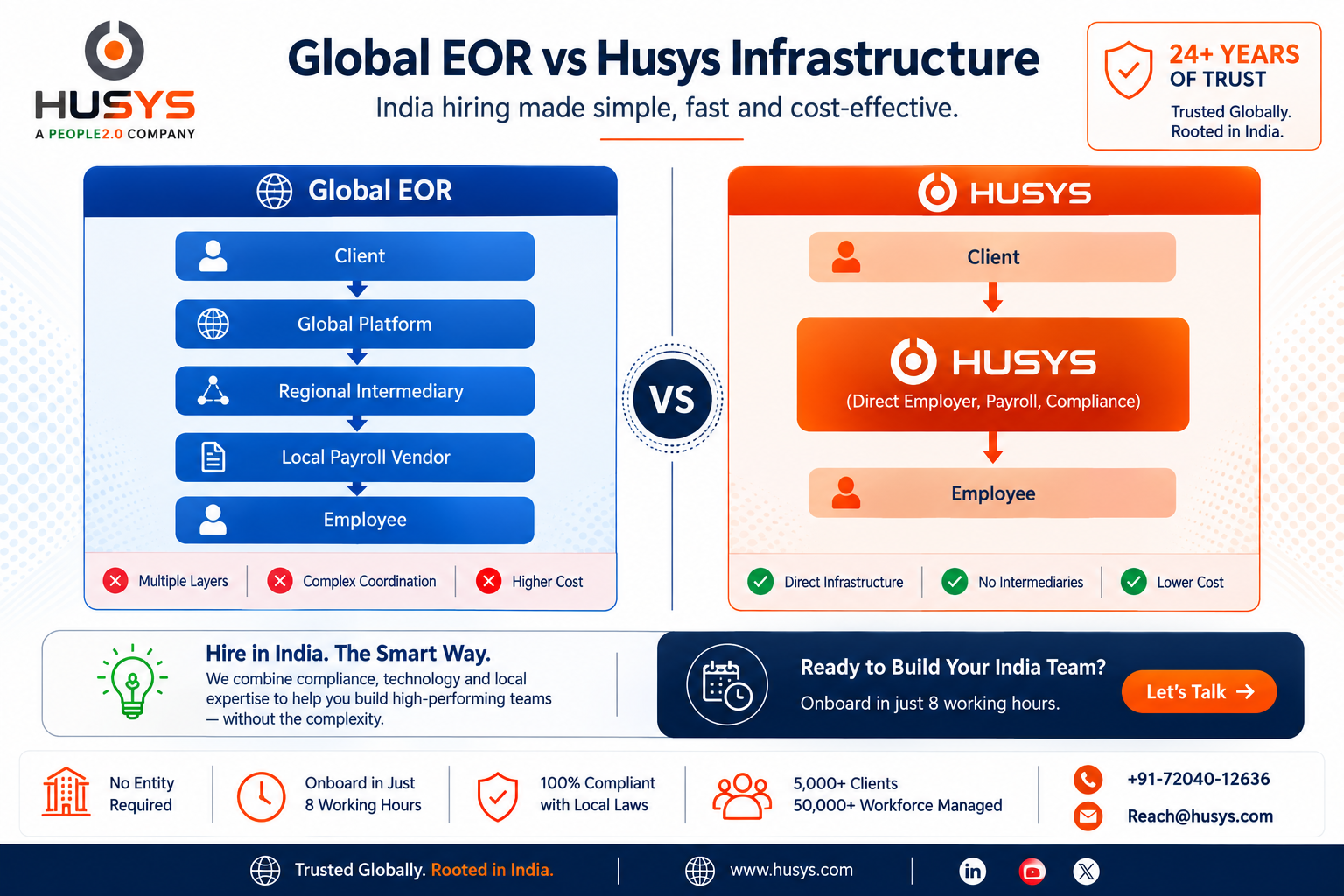
When you pay $499 to $699 per employee per month, you are paying for multiple infrastructure layers:
global platform overhead • regional operational layers • local payroll vendor fees • intermediary compliance providers
Each layer adds margin.
Global EOR vs India-native EOR: How India-focused EOR infrastructure can align payroll, compliance, onboarding and service economics with the realities of hiring in India.
Husys eliminates these intermediary layers by operating directly as the legal employer, payroll operator, and compliance handler in India.
This removes unnecessary markups and keeps costs aligned with actual employment infrastructure, not platform overhead.
Costs to know before you sign
Some global EOR providers also charge additional fees:
Item
Cost
Onboarding fee
$0 to $500 per employee
Security deposit
1 month salary + 1 month fee (refundable)
Currency conversion
3 to 5% if not actively managed
Early termination
$300 to $1,000
With Husys, you don’t have to pay a single additional charge.
What your actual monthly bill looks like
For this example, the cost of hiring employees in India through Husys EOR is illustrated below using a $2,000 monthly gross salary and a $99 monthly EOR service fee:
Component
Monthly Cost
Gross salary
$2,000
Employer EPF contribution
$120
Gratuity provision
$48
Employer-paid health insurance
$35
EOR fee
$99
Illustrative employer cost
$2,302
You get compliant payroll, statutory administration and employment infrastructure without setting up your own India entity. Employee-side deductions such as Professional Tax, where applicable, are withheld and remitted rather than added again to employer cost.
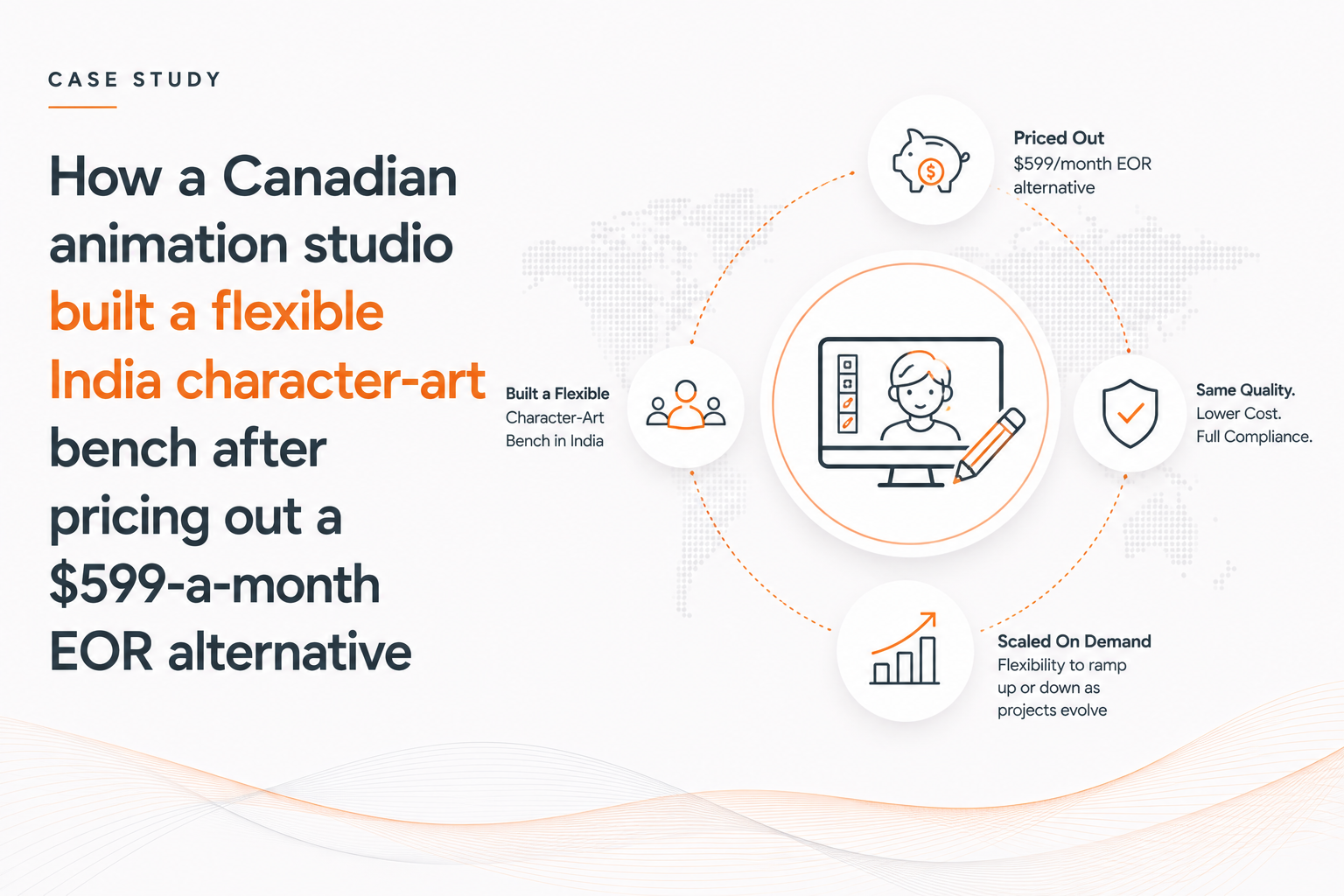
Now compare that to EOR platforms charging $599 per employee per month.
That is not a fee; that is roughly what a full engineer in India earns in a month. You would essentially be paying for an extra headcount just to employ the one you already hired.
Across a 10-person team, that difference adds up to $60,000 a yeargoing purely toward platform fees.
Setting up your own entity is not cheaper either.
Fixed annual compliance costs alone can exceed $25,000 before a single salary is paid.
For teams under 20 people, EOR through Husys will almost always cost less in Year 1 and every year after it, @Just $99/employee/month
When the EOR route makes sense:
You are hiring fewer than 20 people, you need to move fast, or you want to test the India market without committing to an entity.
The EOR vs entity cost in India calculus consistently favors EOR at early headcount.
With Husys, your first employee can be onboarded and operational within 8 hours of finalising the offer. If you are trying to close a candidate who has three other offers on the table, speed decides if they’ll join you or your competitor.
Why Husys Costs Less Than Global EOR Providers (And Why That Matters to Your Budget)
Most global EOR providers charge $499 to $699 per employee per month in India.
Husys charges $99.
This difference is not a pricing strategy. It is an infrastructure difference.
Global EOR providers operate through multiple layers: a global platform, regional legal intermediaries, and local payroll vendors. Each layer adds margin, operational delay, and cost.
Husys operates differently.
We run a fully India-native employment infrastructure. There are no intermediary payroll vendors, no third-party compliance chains, and no external legal layers between you and your employee.
This structure eliminates unnecessary markups and reduces both cost and operational friction.
Here is exactly what makes that possible:
1. India-Native Legal and Payroll Infrastructure
Husys is directly registered and operating in India as a legal employer. Payroll, statutory filings, and compliance are handled internally, not outsourced to third parties.
This removes intermediary vendor fees that global EOR platforms pass on to you.
2. Direct EPF and Statutory Registration (No Third-Party Compliance Layers)
Every statutory obligation in India, including EPF, professional tax, and labour law compliance, is handled through Husys’ own registrations.
There are no external compliance intermediaries involved.
This reduces:
vendor markups
compliance delays
administrative overhead
And ensures statutory filings are completed faster and more reliably.
No Intermediary Payroll Vendors or Aggregators
Many global platforms rely on local payroll providers to actually execute payroll and compliance.
This creates a multi-layer chain:
Platform → Regional partner → Local payroll vendor → Employee
Each layer adds cost, delay, and risk.
Husys operates payroll directly through its own infrastructure.
This eliminates unnecessary operational layers and keeps costs predictable.
Faster Onboarding Because Infrastructure Already Exists
Since Husys already maintains a fully operational employer infrastructure inside India, there is no dependency on external legal setup or third-party onboarding processes.
Employees can be onboarded as soon as the offer terms are finalized.
This allows companies to move from offer acceptance to compliant onboarding in as little as 8 hours.
Global platforms that rely on partner chains often require additional coordination time, which slows hiring and increases operational friction.
Why This Matters Financially
At $99 per employee per month, Husys reduces EOR overhead by up to 80% compared to global providers charging $499 to $699.
For a 10-person team, this difference alone saves:
$48,000 to $72,000 per year.
That is equivalent to funding an additional full-time hire in India.
Why Global EORs won’t make sense for India?
Most Global EORs charge $499-$699, which is a decent median salary of midrange engineer, who make up approx 70% of the hires by US companies, when you charge $599 pm to a salary of $599 pm, you end up paying equal amount of salary unlike $599 pm for a $10k in US.
India is a different, your EOR costs should be a small proportion of your hire not equivalent to the salary.
Husys understands Indian dynamics very well, and thus $99 is the flat fee without any additional or hidden charges in termination fee, deposit fee, platform fee, any no. of hire without any min or max quota just flat $99. Learn More about our clients
Global EOR vs Husys India EOR: A visual comparison of multi-layer EOR infrastructure with a direct India-focused employment, payroll and compliance model.
3. Hidden Costs in Hiring Indian Contractors
Contractors look cheaper on paper because you skip statutory contributions entirely. The reality is more complicated.
What contractors actually cost
Skilled contractors in India charge $15 to $35/hour.
At full-time engagement, that is $2,400 to $5,600/month, compared to $1,500 to $2,500 for an equivalent full-time employee.
Contractors price in their own tax burden, benefits, and lack of job security.
You end up paying more per hour for less commitment.
The misclassification risk
If Indian tax authorities determine your contractor is functionally an employee, which they assess based on working hours, equipment use, and degree of direction, you are liable for all statutory contributions you should have been making, plus penalties, going back up to three years.
When this makes sense:
Hiring contractors makes sense for short-term projects under six months, specialized one-off work, or situations where the person genuinely works independently toward a defined output.
What they are not suited for is anything that looks like a full-time ongoing role, because that is exactly the profile Indian tax authorities examine when assessing misclassification.
Quick Cost Comparison: All 3 Hiring Models
This table gives you an honest India employment cost breakdown across all three structures.
Total Cost of Hiring in India by Team Size:
What to Choose at Each Stage
The hiring model that works for 3 employees breaks down at 15.
The one that saves you money at 20 costs you money at 5.
Understanding the cost of hiring in India at each team size is what makes the difference between a model that scales and one that quietly erodes your margins.
Here is what the numbers look like at each stage.
1 to 5 Employees: Why EOR Is the Right Call
Setting up an entity at this stage costs $16,000 to $25,000 upfront and takes 3 to 6 months before you can make your first hire.
We have spoken to US founders who started that process, watched a key candidate accept another offer during the wait, and then questioned the whole India strategy.
That is an avoidable situation.
EOR gets you operational in days with zero setup cost.
Your per-employee fee is fixed, compliance is fully handled, and if your India plans change, you exit without unwinding a legal entity or writing off incorporation fees.
At this stage, the EOR vs entity cost india comparison is not even close, and the operational headroom you preserve is worth as much as the dollar savings.
EOR vs Entity: 3-person mid-level engineering team
Component
EOR
Own Entity
Setup cost
$0
$16,000–$25,000
Gross salaries (3 × $2,000)
$6,000/month
$6,000/month
Statutory contributions (3 × $171)
$513/month
$513/month
Health insurance (3 × $35)
$105/month
$105/month
Compliance and admin
Included
$1,167–$1,833/month
CA firm retainer
$0
$333–$667/month
Payroll software
$0
$500–$1,000/month
EOR fees (3 × $99)
$297/month
$0
Monthly total
$6,915
$8,618–$10,118
Annual total
$82,980
$103,416–$121,416
Year 1 total (inc. setup)
$82,980
$119,416–$146,416
At 3 employees, EOR saves $36,000-$63,000 in Year 1. At this stage, you are paying full entity infrastructure cost for a team that does not justify it yet.
6 to 15 Employees: The Decision Point Most Founders Get Wrong
Most founders either set up an entity too early and spend $25,000 before they need to, or stay on EOR too long and overpay once the team grows.
Running a real EOR vs entity cost comparison for India at your actual headcount is the only way to know which side of that line you are on.
Here is what the numbers look like at 10 employees.
EOR vs Entity: 10-person team
Component
EOR
Own Entity
Setup cost
$0
$16,000–$25,000
Monthly salaries
$18,000/month
$18,000/month
Statutory contributions (10 × $170)
$1,700/month
$1,700/month
Health insurance (10 × $35)
$350/month
$350/month
Compliance and admin
Included
$1,167–$1,833/month
CA firm retainer
$0
$333–$667/month
Payroll software
$0
$500–$1,000/month
EOR fees (10 × $99)
$990/month
$0
Monthly total
$21,040
$22,050–$23,550
Annual total
$252,480
$264,600–$282,600
Year 1 total (inc. setup)
$252,480
$280,600–$307,600
At 10 employees, EOR still saves $28,000–$55,000 in Year 1.
Break-even has not arrived yet.
Thus, it’s a good idea to start your entity paperwork when you are approaching 22 to 25 people and are confident the team is stable and growing.
20+ Employees: When Your Own Entity Pays Off
At 20 employees, you are approaching the point where the EOR vs entity cost comparison starts to shift.
The fixed overhead of running your own entity, compliance, audits, and payroll administration, does not grow linearly the way EOR fees do.
Every employee you add costs you another $99/month on EOR.
Your entity overhead largely stays flat.
EOR vs Entity: 20-person team
Component
EOR
Own Entity
EOR fees (20 × $99)
$1,980/month
$0
Health insurance (20 × $35)
$700/month
$700/month
Compliance and admin
Included
$1,167–$1,833/month
CA firm retainer
$0
$333–$667/month
Payroll software
$0
$500–$1,000/month
Monthly overhead
$2,680
$2,700–$4,200
Annual overhead
$32,160
$32,400–$50,400
At 20 employees, the models are near break-even. Entity is only $240–$18,240 more annually, and that gap closes with every hire you add.
At 30 employees, the gap reduces:
Component
EOR
Own Entity
EOR fees (30 × $99)
$2,970/month
$0
Health insurance (30 × $35)
$1,050/month
$1,050/month
Compliance and admin
Included
$1,167–$1,833/month
CA firm retainer
$0
$333–$667/month
Payroll software
$0
$500–$1,000/month
Monthly overhead
$4,020
$3,050–$4,550
Annual overhead
$48,240
$36,600–$54,600
Annual savings with the entity
—
$0–$11,640
At 30 employees, entity overhead is finally lower than EOR fees at the low end. Every hire beyond this point widens that gap further, since compliance costs stay largely flat while EOR fees keep climbing at $99/head.
Ideally, this is what we recommend our clients:
Stage
Model
Action
Hire 1 to 15
EOR
Start here
Hire 16 to 22
EOR
Begin entity paperwork in parallel
Hire 23 to 25
Both
Transition payroll gradually
Hire 30+
Own entity
Full transition complete
Start With EOR. Transition When the Numbers Make Sense.
Avoid premature entity costs and scale with a structured transition plan based on your actual headcount growth.
How to Calculate Your True Employer Cost in India (Free Calculator)
The number most founders quote is the gross salary.
The number your CFO needs is the cost of hiring employees in India after accounting for statutory contributions, compliance overhead, benefits and the hiring model used.
The formula below gives you a working baseline, and the example that follows shows what it looks like for a specific hire so you can sanity-check your own numbers.
The Formula
Total Monthly Employer Cost = Gross Salary + Applicable Employer Statutory Costs + Employer-Funded Benefits + Hiring Model Fee
Employer statutory costs and benefits vary by employee, wage structure, eligibility and applicable state requirements.
They should therefore be calculated individually rather than applied as a blanket percentage to every employee.
These are non-negotiable regardless of which hiring model you choose.
In the illustrative $2,000 salary example above, the recurring employer cost is $2,302 with the stated assumptions, or approximately 15.1% above gross salary. Fully loaded workforce cost can be higher once recruitment, equipment, onboarding, productivity ramp time and other workforce costs are included.
Calculate Your Exact Employer Cost in India
Most founders underestimate the real cost of hiring in India because they only look at gross salary.
Your actual employer cost includes statutory contributions, mandatory benefits, insurance, and the infrastructure required to stay compliant.
Use the calculator below to see your true monthly and annual employer cost.
You will get a complete breakdown of:
Statutory contributions
Insurance costs
Compliance overhead
EOR vs entity cost comparison
Total employer cost per employee
This shows you the exact number that impacts your P&L.
No rough estimates. No hidden assumptions. Just a clear employer cost calculation based on salary and team size.
Assumptions:
EPF is capped at 12% of the ₹15,000 wage ceiling for salaries above that threshold.
ESI applies to employees earning below ₹21,000/month gross (shown as $0 for higher salaries).
Gratuity is calculated at 4.81% of the basic salary per year.
Basic salary assumed at 50% of gross CTC.
Health insurance is $22 to $35/month by city tier.
EOR fee: $99/month (Husys).
Exchange rate: 1 USD = 90 INR.
What This Number Does Not Include?
The calculator gives you the recurring employer cost.
It does not account for:
One-time setup costs if you go the entity route ($$16,000-$25,000),
Equipment and laptop provisioning ($500–$1,200 per hire), or
The productivity ramp period in the first 60-90 days.
Add 10–15% to your first-year budget to cover these.
The cost of hiring developers in India, in particular, tends to run higher than average when you factor in competitive recruitment fees and higher attrition buffers for technical roles.
Stop Guessing What India Hiring Costs You
Put in your team size and target salary to get a complete cost breakdown, including statutory contributions, admin overhead, and hiring model fees, all in one place.
The cost of hiring employees in India remains one of the most compelling advantages available to US companies building distributed teams today.
A mid-level engineer costs 75 to 80% less than their US equivalent, the talent pool is deep, and the statutory framework is predictable once you understand it.
What we have seen consistently is that US companies make better India hiring decisions when they understand the full cost of hiring employees in India, not just the number on the offer letter.
The true cost of hiring in India is manageable.
What makes it unmanageable is underestimating the compliance layer, the attrition buffer, or the hiring model overhead, and then absorbing those surprises mid-year.
We built Husys to remove that uncertainty. At $99 per employee per month, our EOR covers payroll, statutory filings, employment contracts, and HR administration with no additional fees and no hidden charges.
As your team grows past 20 to 25 people, transitioning to your own entity begins to make financial sense, and the groundwork you lay during the EOR phase makes that transition significantly easier.
Skip the Entity. Hire Compliantly in as Little as 8 Hours
While others spend months setting up an entity, your team could already be up and running in less than 8 hours.
What is the true cost of hiring an employee in India beyond the base salary?
The cost of hiring employees in India is higher than gross salary once applicable employer statutory costs, employer-funded benefits and the selected employment model are included. In the illustrative $2,000 monthly salary example used in this guide, the recurring employer cost is $2,302 including EPF, gratuity provision, health insurance and a $99 EOR fee. Recruitment, equipment, onboarding, productivity ramp time and other workforce costs would be additional.
2. What are the mandatory statutory contributions an employer must pay in India?
Employer obligations in India depend on the employee’s compensation structure, eligibility, applicable wage ceilings and state requirements. Common employer-side costs can include EPF, gratuity provisions and applicable employer-funded benefits, while deductions such as Professional Tax and employee EPF may be withheld and remitted through payroll rather than treated as additional employer expense.
These obligations apply regardless of whether you hire through your own entity or through an EOR.
Why do US companies typically pay more per hour for Indian contractors than for full-time employees?
Contractors in India price their own tax liability, benefits, and employment risk into their rate. A skilled contractor charging $20 to $35 per hour is effectively self-insuring against everything a full-time employee gets covered for.
At full-time hours, that puts their monthly cost above what an equivalent permanent hire would cost, with less institutional commitment on their end.
What is the difference between ESI and a group health insurance plan in India, and which one applies to your hires?
ESI, the Employees’ State Insurance scheme, only covers employees earning below roughly $250 per month gross.
Most of the roles US companies hire for fall well above that threshold, which means ESI does not apply, and a private group health plan becomes the expected standard. Group plans run $110 to $330 per employee per year, depending on coverage tier and city.
At what team size does setting up an India entity make more financial sense than using an EOR?
The break-even point typically falls between 20 and 25 employees. Below that threshold, entity setup and annual compliance overhead of $25,000 to $40,000 far outweigh EOR fees.
Most US companies find it practical to begin entity paperwork when the team is approaching 15 people.
What are the risks of hiring Indian contractors instead of full-time employees?
If Indian tax authorities determine that a contractor functions like a full-time employee, you become liable for all unpaid statutory contributions going back up to three years.
Contractors also tend to charge more per month than equivalent full-time hires because they factor in their own tax burden.
Is India a viable hiring market for non-technical roles like marketing, operations, or customer support?
Yes, and it is often underutilised for these functions. The salary benchmarks for marketing managers, operations leads, and customer support roles are significantly lower than those for engineering, and the talent pool for English-language roles is deep.
Several of the US companies we work with started by hiring engineering and expanded to ops and support once they saw how the model performed.
What does Husys include in its $99 per employee per month EOR fee?
The Husys EOR fee covers monthly payroll processing, EPF and gratuity filings, employment contracts, professional tax remittances, and group health insurance administration.
There are no onboarding fees, no hidden per-transaction charges, and no currency conversion markups added on top of the flat monthly rate.
How quickly can a US company hire its first employee in India through Husys compared to setting up its own entity?
Setting up a private limited company in India takes 3 to 6 months and costs between $16,000 and $25,000 before a single hire is made.
With Husys, your first employee can be onboarded and operational within 8 hours of finalising the offer.
Does Husys help US companies transition from EOR to their own India entity as the team scales?
Yes. Husys supports a structured transition when your headcount reaches the point where running your own entity makes financial sense.
The compliance groundwork laid during the EOR phase makes that shift significantly smoother than starting an entity from scratch without any prior India payroll infrastructure.
Empowering Your Workforce Journey with Trusted Insights
Find the latest industry trends, expert blogs, insightful case studies, and essential tools. Whether you’re expanding your team locally or globally, we’ve got the information you need to make informed decisions and stay ahead of the curve.