
India Contractor Misclassification: Risks, Penalties & EOR Guide for US Companies 

india contractor misclassification

Author Bio

Husys India Compliance Team

Husys India EOR Payroll & Compliance Experts is the in-house team supporting Employer of Record (EOR) payroll operations and statutory compliance for US companies hiring in India. With 250+ years of collective compliance experience, the team has supported 50,000+ contractors to date and helps 5,000+ clients run compliant workforce operations across India.

Editorial note: This content is reviewed internally by payroll and compliance specialists and reflects standard statutory practices in India. For case-specific guidance, consult a qualified professional.

Facebook
X.com
LinkedIn
Email
WhatsApp

Quick answer:

If a contractor in India is actually working like an employee, the risk can go well beyond simply changing the contract.

A company may face:

  • Retroactive PF and ESI contributions, potentially including both employer and employee shares.
  • 12% annual interest under Section 7Q.
  • Damages under Section 14B.
  • Gratuity exposure where applicable, including situations involving longer-term employment.
  • Potential criminal liability in cases of willful non-compliance.
  • Historical exposure, liabilities may relate back to the start of the relationship rather than the date the issue is discovered.

The clearest risk signal? A contractor who works full-time, exclusively, and under the company’s direction for an extended period, particularly beyond 12 months.

India contractor misclassification occurs when a worker engaged as an independent contractor is, in practice, functioning like an employee. 

The issue is not that an employee is “misclassified as an employee.” It is that a worker engaged as a contractor may, in practice, be functioning like an employee, creating contractor misclassification risk.

For US companies, the risk can extend beyond the contractor agreement to potential PF, ESI, gratuity, tax and other employment-related obligations.

The practical solution is to assess how the relationship actually operates, separate genuinely independent contractors from employee-like relationships, assess any historical exposure, and choose the appropriate structure going forward.

For companies that need compliant employment without establishing an India entity, an EOR can provide a practical path to transition employee-like contractors into employment.

India contractor misclassification is a risk that can arise when a worker engaged as an independent contractor operates in practice like an employee. 

If you’re a US company paying contractors in India who work full-time, exclusively for you, under your management and using your systems, the relationship deserves a classification review. The label “contractor” does not by itself determine employment status.

This isn’t a theoretical compliance risk. It’s one of the most common, and most expensive, mistakes US companies make when they start hiring in India through invoices instead of payroll.

And unlike a lot of compliance issues that stay dormant until someone asks about them, misclassification in India tends to surface on its own: through an EPFO data match, a disgruntled contractor’s complaint, a labour department inspection, or a tax audit that asks one simple question, why does this “vendor” look exactly like an employee?

Most guides on this topic explain what misclassification is. This one is about what happens after you get caught, what it costs, and why the exposure compounds the longer you wait, including a 5-minute self-check below to find out if this is already your problem, not just a risk to plan around.
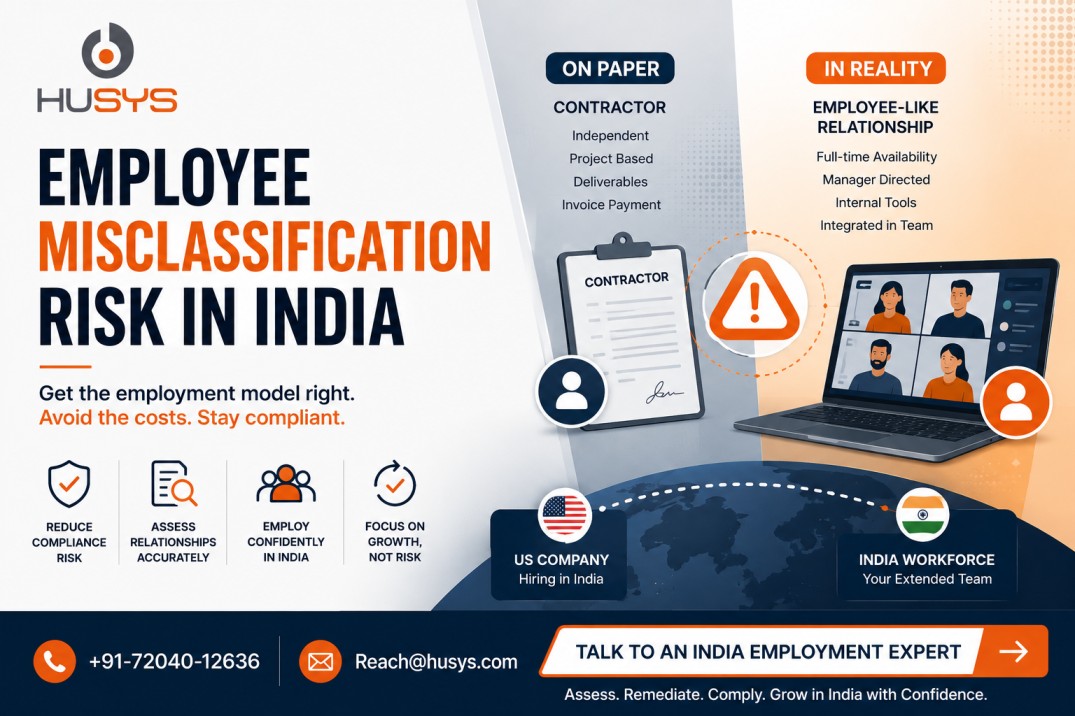
Employee misclassification risk in India when a contractor relationship resembles employment

Why This Keeps Happening

Hiring a contractor in India feels low-risk. No entity, no payroll registrations, no PF or ESI filings, no fixed employment cost, no notice period. You sign an agreement, you pay an invoice, you’re done, or so it looks.

The problem is that Indian law doesn’t care what your contract is titled. It cares about what the working relationship actually looks like day to day. And most “contractor” arrangements that US companies set up in India, a person working 40+ hours a week, exclusively for one client, on that client’s Slack, reporting to that client’s manager, following that client’s processes, for a year or more, look nothing like a genuine independent contractor relationship once a regulator or a court examines the facts.

That gap between the paperwork and the reality is exactly where misclassification liability lives.
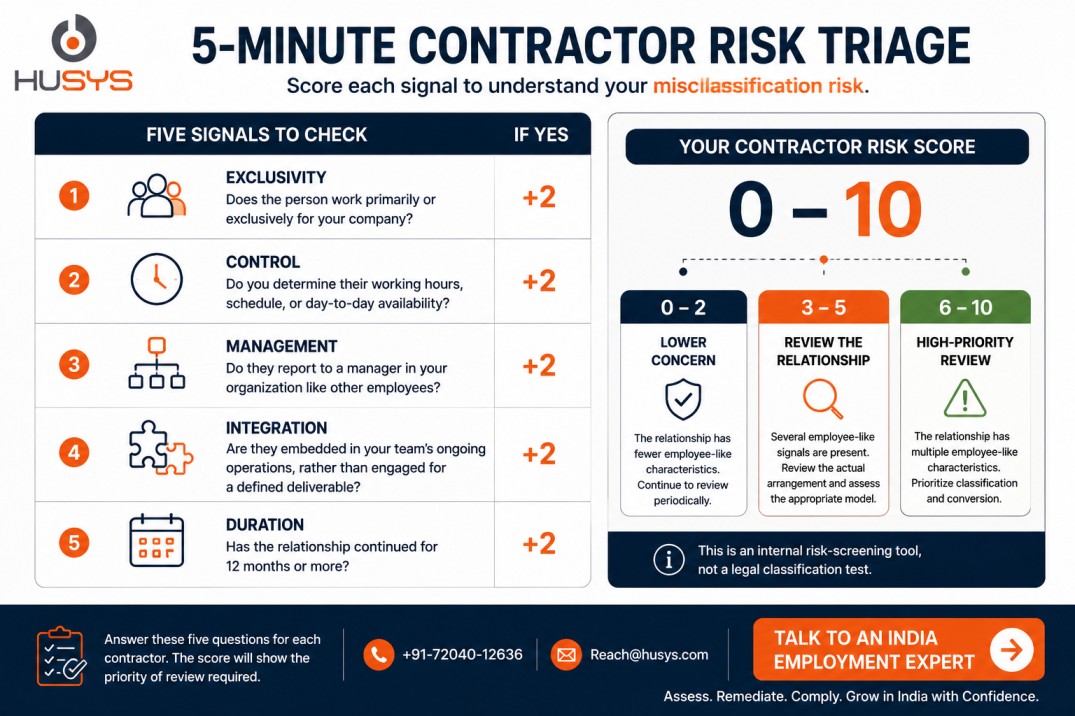
5-Minute Contractor Risk Triage

Five-minute contractor risk triage for employee misclassification risk in Indi
A quick screen for employee-like signals in an India contractor relationship.

Before you read another word about penalties, it’s worth finding out whether this applies to you.

Answer yes/no for each India-based contractor you’re currently paying:

  1. Have they worked exclusively for your company for the last 6+ months, with no other declared clients?
  2. Do they follow fixed working hours or attend recurring team meetings/standups on your schedule?
  3. Do they report to one of your managers the way an employee would, rather than delivering against an independent scope of work?
  4. Has the engagement been renewed or extended past its original end date at least once?
  5. Do they use your company email domain, internal tools, or Slack/Teams workspace as their primary way of working?
  6. Would losing this “contractor” tomorrow disrupt your team the same way losing an employee would?
  7. Have you ever referred to them internally, in an org chart, deck, or intro, as part of your “team” rather than a vendor?

Scoring:

  • 0–1 “yes” answers, Low risk. The relationship looks like a genuine contractor engagement. Worth a light annual review, nothing urgent.
  • 2–4 “yes” answers, Medium risk. Enough employee-like signals that a labour authority or the contractor themselves could plausibly argue misclassification. This is worth a structured review now, before the relationship runs longer.
  • 5–7 “yes” answers, High risk. This isn’t a contractor with some grey areas, it’s an unregistered employment relationship. Backdated liability is already accruing under Section 7Q interest from month one of the engagement. Treat this as time-sensitive.

If you scored Medium or High on even one person, the cost breakdown below isn’t hypothetical, it’s your current exposure, running on a clock you didn’t set.
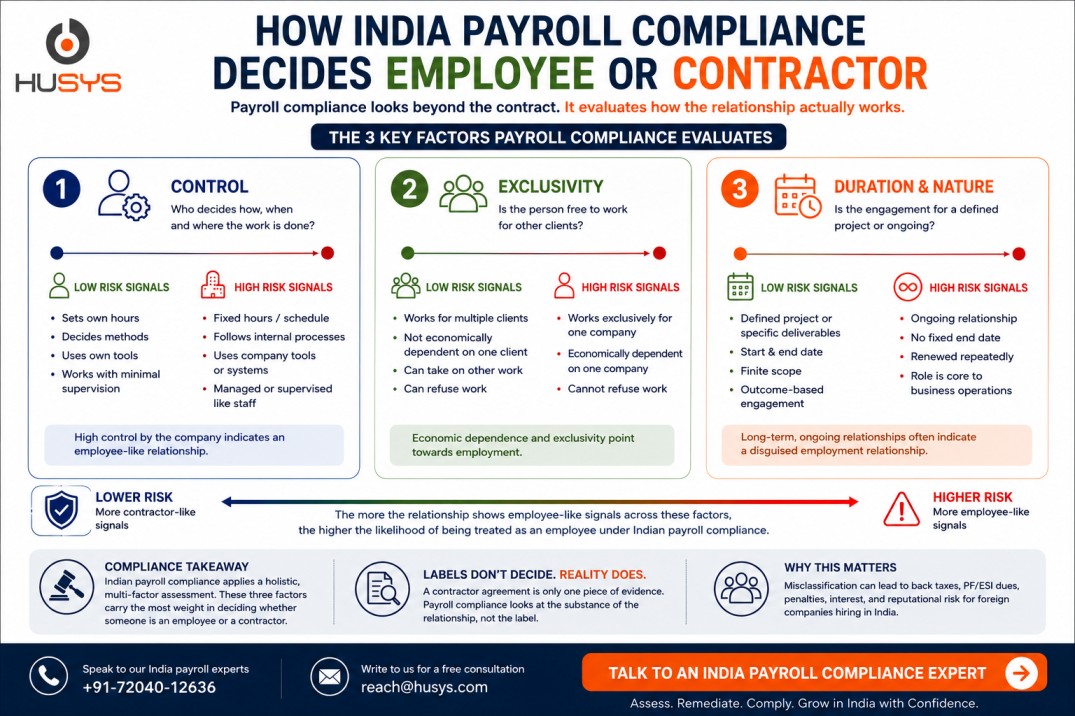
How Indian Law Actually Decides Who's an Employee

Control exclusivity and duration framework for employee classification in India
Control, exclusivity and duration are key signals when assessing whether a contractor relationship resembles employment.


There is no single checklist that determines every contractor-versus-employee relationship in India. Courts assess the substance of the relationship using multiple factors, including control, integration and the overall circumstances of the engagement. 


The control test. The original and still-relevant question: does the company control not just what work gets done, but how it gets done, hours, methods, tools, reporting lines?


The Supreme Court’s ruling in Silver Jubilee Tailoring House v. Chief Inspector of Shops and Establishments remains a foundational reference here: even where a worker had flexibility, the employer’s right to direct and reject the work was enough to establish an employment relationship.


The integration test.

Indian courts, principally the Supreme Court and High Courts, along with EPFO authorities and labour tribunals, have long recognised that control alone breaks down for skilled, professional work; you can’t “supervise” a developer’s code line by line the way you’d supervise a tailor. So the integration (or organisation) test asks a different question: is this person’s work an integral, ongoing part of your core business, or are they delivering a discrete, external service?

A “contractor” who’s the sole engineer on your India product team, showing up to every sprint standup for two years, is integrated into your business in every way that matters, regardless of what the invoice says.


The economic reality / multiple-factor test.

More recent Supreme Court rulings (including a 2025 judgment revisiting employer-employee tests under industrial law) have confirmed that courts now apply a holistic, multi-factor test,  who appoints, who pays, who can terminate, who bears the economic risk, how exclusive and how long the relationship runs, ather than leaning on any single factor.


Courts have also been explicit that they will pierce through a “sham” contractor arrangement designed to disguise what is functionally an employment relationship.


In practice, three signals matter most for foreign-company hiring in India:


Signal

Contractor-like

Employee-like (red flag)

Control

Sets own hours/methods, delivers a defined output

Fixed hours, reports to a manager, follows internal SOPs

Exclusivity

Serves multiple clients concurrently

Works solely for one company, full-time

Duration

Project-based, defined scope and end date

Open-ended, renewed indefinitely, 1+ years


If your India “contractor” checks the right-hand column across all three, you are not managing contractor risk, you are managing employee-misclassification risk with a delay timer on it.


The India Contractor Risk Heatmap

Not every contractor relationship carries the same level of risk. The more an engagement moves from independent, project-based work toward a full-time, integrated role, the more closely it deserves to be reviewed.

Lower-risk signals

  • Project-based engagement
  • Defined deliverables and scope
  • Worker determines how the work is performed
  • Multiple clients or customers
  • Clear end date or limited engagement
  • Payment tied primarily to agreed services or deliverables

Higher-risk signals

  • Works exclusively for your company
  • Works full-time or on your required schedule
  • Reports directly to your managers
  • Uses your internal systems, tools, and processes
  • Performs an ongoing role within your core team
  • Receives work and instructions in the same way as employees
  • Relationship continues indefinitely or is repeatedly renewed
The closer the relationship moves toward the right-hand side, the more important it is to assess whether the contractor model still reflects the reality of the engagement.

This is not a standalone legal test. It is a practical way for US employers to identify relationships that deserve a closer classification review.

Why Experience Matters in India Employment

India employment compliance is not just about knowing the law. It is about applying the right process repeatedly across different states, employee situations and lifecycle events.


After 24+ years operating in the India employment market, Husys has built standardized processes around the areas where US employers most often encounter operational difficulty: employment setup, statutory compliance, payroll, state-level requirements, employee changes and exits.


The difference is not simply having an India expert available when something goes wrong. It is having a defined operating process for preventing the same problem from occurring repeatedly.

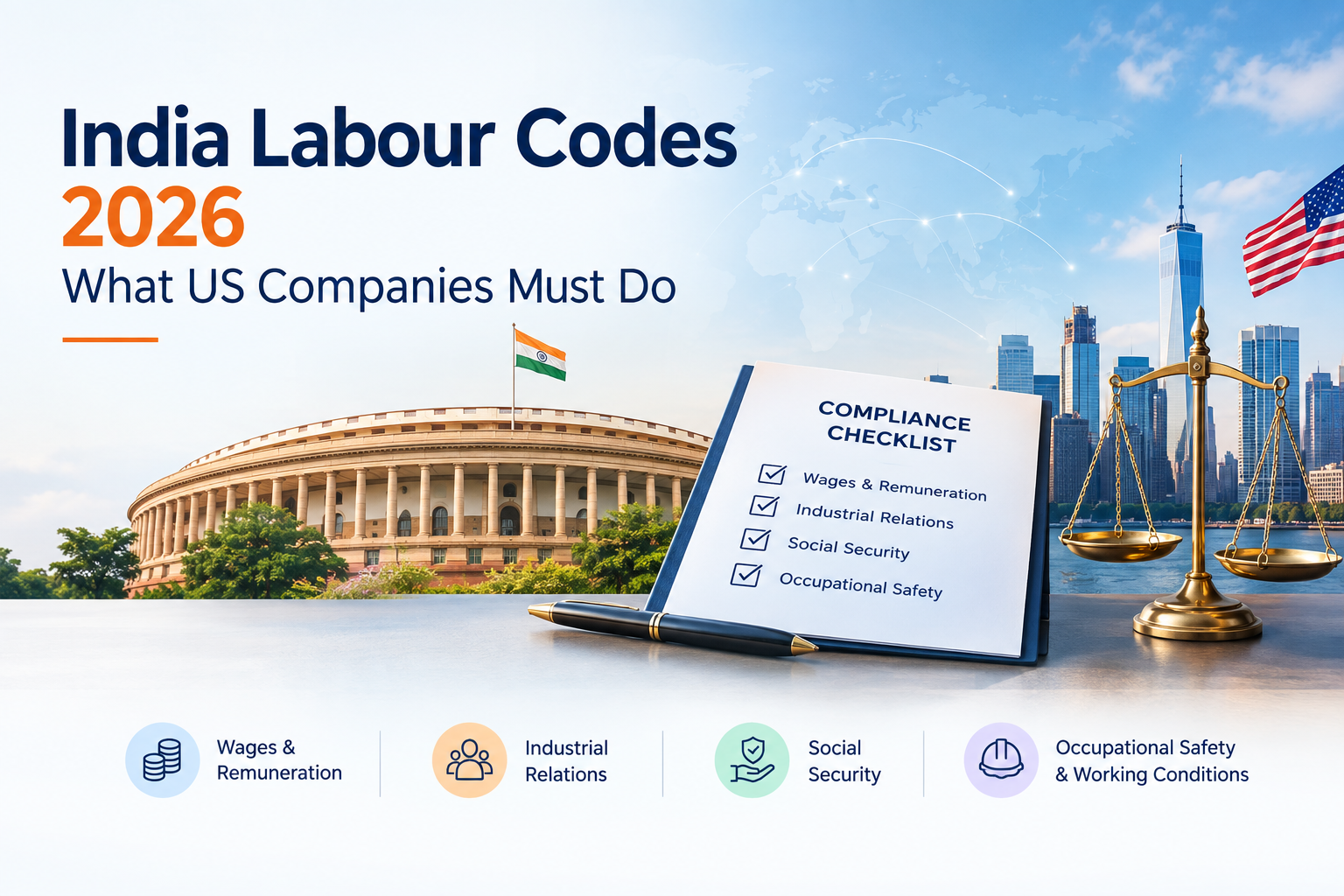
The 2026 backdrop: the four Labour Codes are now live

This risk picture didn’t get simpler this year. India’s four


  1. Labour Codes,
  2. Wages,
  3. Industrial Relations,
  4. Social Security, and Occupational Safety, Health & Working Conditions were notified as effective on 21 November 2025,


replacing 29 legacy central labour laws, with central rules finalised in May 2026 and state-level rules rolling out through 2026. Two things matter for foreign employers specifically: the Codes formally extend social security coverage toward gig and platform workers, and the “50% wages” rule changes how PF, gratuity, and leave encashment get computed off a redefined wage base.


In simple Words: The 2026 framework makes it particularly important for employers to keep worker classification, wage treatment and social-security compliance aligned with the actual employment relationship.


For a deeper look at how this plays out specifically in contractor arrangements, see our full [contractor vs. employee cost comparison]

How Misclassification Actually Gets Discovered

Under Section 7A of the Employees’ Provident Funds and Miscellaneous Provisions Act, EPFO officers can conduct inquiries to determine whether the Act applies to an establishment and to determine amounts due under the Act.


The inquiry process can involve examining relevant records and questioning employers, contractors, and persons who are or have been employees. An EPFO adjudication order illustrates the use of records relating to contractors, employees, wages and statutory dues in a Section 7A inquiry.

EPFO also provides a Principal Employer facility for maintaining contractor and contract-worker information and monitoring contractor EPF compliance.


What this means for a US employer: paying someone through a contractor invoice does not make the underlying workforce relationship invisible.


If an EPFO inquiry occurs, the records surrounding the engagement can become relevant.


2. ESIC inspection: authorities can examine employment and wage records

The ESI Act provides another direct compliance mechanism.

Under Sections 44 and 45, employers must submit prescribed returns and maintain required records. 


Social Security Officers can require information, enter relevant premises, examine accounts, books and other documents relating to employment and payment of wages, and question employers or people they have reasonable cause to believe are or were employees.


Where required returns, particulars, registers or records have not been maintained or an officer is prevented from carrying out an inspection, Section 45A allows ESIC to determine contributions on the basis of information available to it, subject to the statutory process and an opportunity to be heard.


What this means: the question can move beyond “What does the contract call this person?”

to

“What records show about how this person was actually engaged and paid?”

3. Labour inspection: inspections can be random, risk-based or complaint-based

The Ministry of Labour’s Shram Suvidha Portal provides a system for reporting inspections, submitting returns and interacting with enforcement agencies. The Ministry has also described a transparent labour-inspection system using computerized selection based on predetermined criteria, with serious matters covered through mandatory inspections and complaint-based inspections determined after examination of data and evidence.

The Ministry also describes Shram Suvidha as supporting the integration and monitoring of labour-enforcement information across agencies including EPFO and ESIC.

What this means: a company should not assume that a contractor relationship will only be examined if someone specifically complains about that individual.

4. A worker dispute can put the relationship under scrutiny

A dispute involving a worker can also bring the actual working relationship into focus. Once the nature of the relationship is questioned, evidence such as the person’s role, supervision, working arrangements, payment records, duration and degree of integration can become relevant to determining whether the arrangement was genuinely independent.

This is why an employer should preserve and review the full factual record, rather than relying only on the contractor agreement.

How Do Indian Authorities Identify Employee or Contractor Misclassification?

In practical terms, the process can look like this:

Returns / records / contractor information

Inspection, inquiry, complaint or compliance review

Authority requests employment, wage and contractor records

Actual working relationship is examined

Authority determines whether statutory obligations apply and what contributions or compliance action may follow

The key risk is not that an authority sees the word “contractor.” It is that the records available to the authority show a relationship that operates like employment.
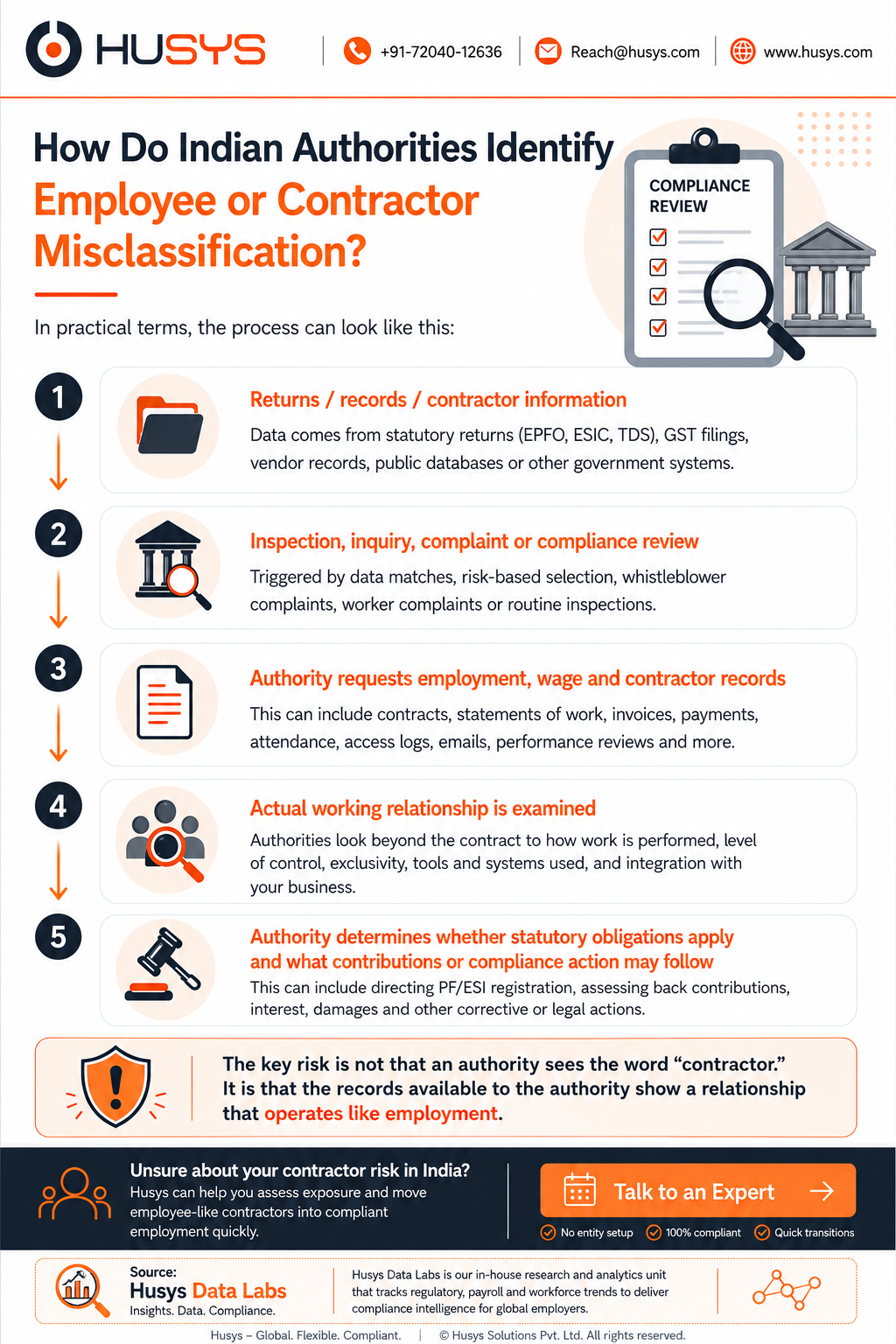
How Indian authorities identify employee or contractor misclassification in India
How Indian authorities identify employee or contractor misclassification through records, compliance reviews, and examination of the actual working relationship.


For a US company, that is why contractor classification should be reviewed based on how the person actually works, how the relationship is documented, and who controls the employment obligations—not simply how the person is paid.

How Husys Builds Compliance Into the Operating Process

The objective is to make compliance part of the operating model, not a response to an inspection, dispute, or audit.


With standardized workflows and support from in-house legal, compliance, and HR technology teams, Husys integrates employment documentation, payroll, statutory requirements, employee changes, and exits into the day-to-day employment lifecycle. This creates a repeatable process for managing compliance as the workforce grows, rather than relying on individual memory or one-time checks.


In practice, that means:

Employment setup → Documentation → Payroll & statutory compliance → Employee changes → Termination → Compliance review

Each stage follows defined processes supported by the in-house legal and compliance team and HR technology.
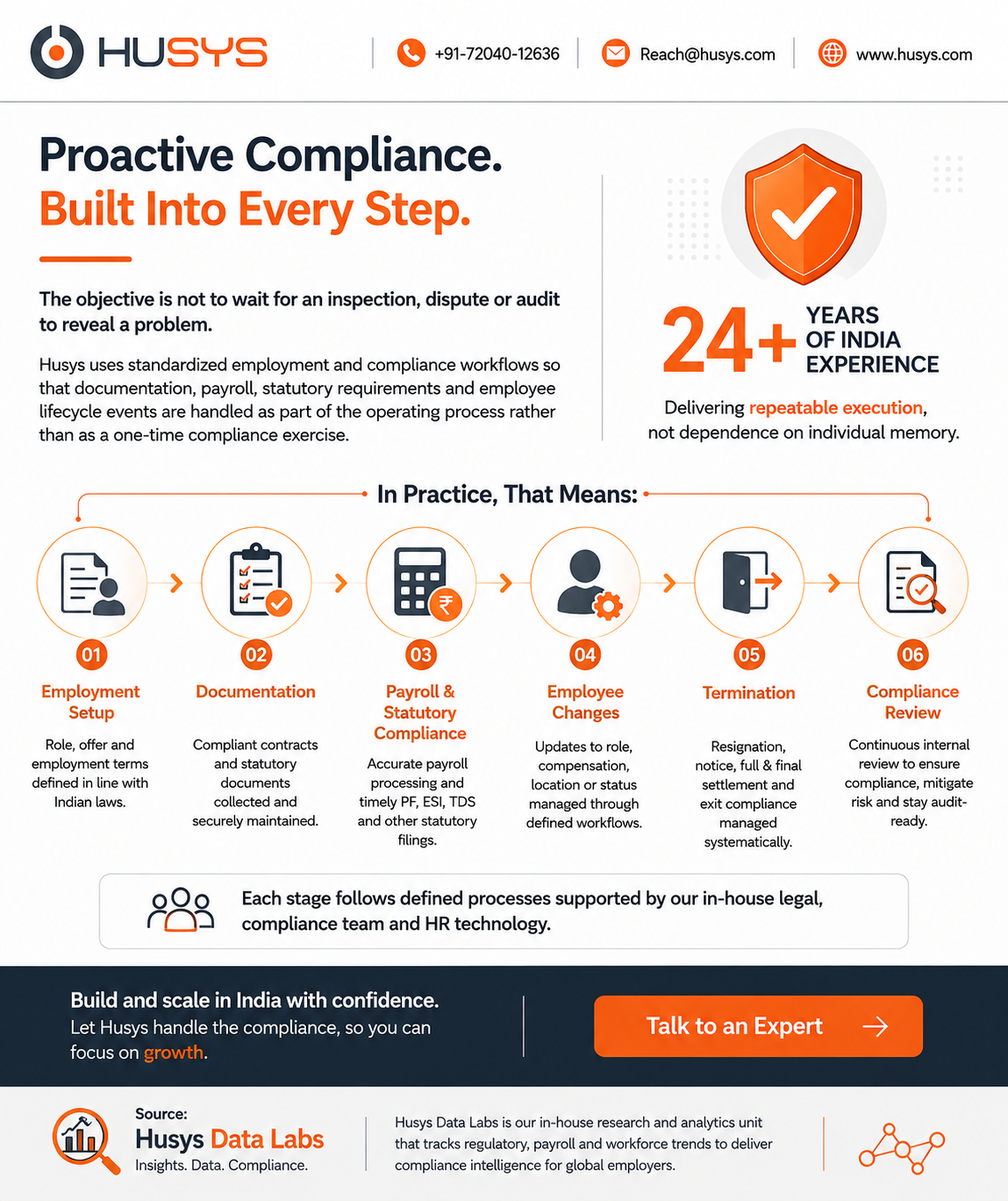
Standardized employment and compliance workflow for managing employees in India
Proactive India employment compliance built into every stage of the employee lifecycle.


That is what 24+ years of India experience is intended to deliver: not dependence on individual memory, but repeatable execution.
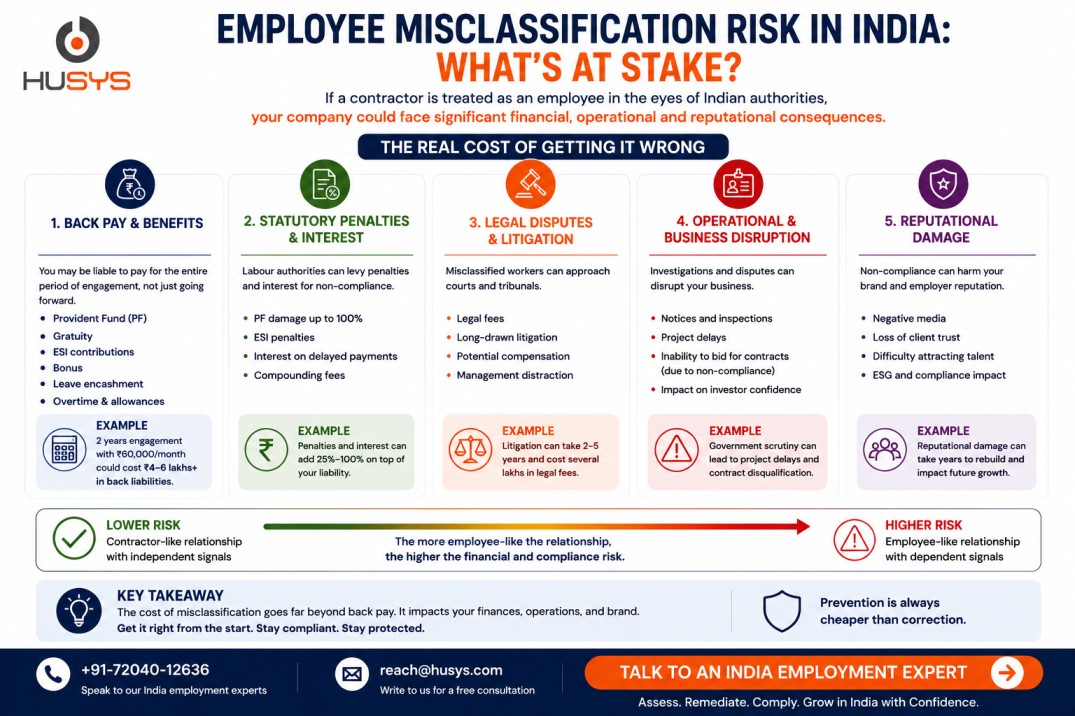
What It Actually Costs: The 12-Month Exposure

Employee misclassification risk in India including back pay, penalties, legal disputes and business disruption
The cost of employee misclassification goes beyond back pay, it can create wider financial, legal, and operational exposure.

This is where most comparison content stays vague. Here’s what a reclassification finding actually triggers, layered on top of each other — not instead of each other:

  1. Back-payment of PF contributions, both shares, for the full engagement period.
    • If a “contractor” is reclassified as an employee, the employer owes provident fund contributions retroactively, typically 12% of wages from the employer and 12% from the employee side, both of which EPFO can recover from the employer if the worker’s share was never withheld.
    • For a person paid the equivalent of ₹80,000/month over 24 months, that’s a retroactive PF principal liability alone in the range of ₹3.8–4.6 lakh, before a single penalty is added.
  1. Statutory interest under Section 7Q, 12% per annum, simple interest, from the date each contribution was originally due. This isn’t negotiable or capped by intent; it runs automatically on the full arrears for the entire default period.
  1. Damages under Section 14B. Historically these ranged from 5% to 25% of the arrears depending on how long the default ran (capped at 100% of arrears in extreme cases); a June 2024 EPFO reform simplified this to a flat 1% per month of the overdue amount, still a meaningful multiplier when arrears have been accruing for one, two, or three years across an entire misclassified “contractor” bench, not just one person.
  1. ESI back-contributions, if the worker’s salary falls within the ESI wage threshold, another retroactive employer + employee liability, plus its own interest and damages regime.
  1. Gratuity liability, if the relationship has run five years or more, payable in full as a lump sum the moment the relationship is deemed employment.
  1. Professional tax and TDS shortfalls, the difference between what should have been withheld under salary provisions versus what was actually withheld (or not withheld) under a professional-fees invoice structure.
  1. Leave and benefits claims under the Shops & Establishments Act, retroactive paid leave, and in contested terminations, wrongful termination claims that a genuine contractor could never have brought. These differ from state to state, sharing a few links here Telangana, Delhi, Karnataka, Maharashtra
  1. Potential prosecution. Willful non-compliance under the PF and ESI Acts carries criminal liability exposure for company officers, not just financial penalties.

Add these up across even a small India “contractor” bench, five or six people paid this way for two years, and you’re not looking at a compliance footnote.

You’re looking at a liability that can run into the tens of lakhs per person, discovered all at once, with interest that’s been compounding the entire time you didn’t know it existed.

That’s the piece worth sitting with: Potential historical exposure may relate to the earlier period of the relationship, depending on the applicable law, facts and statutory requirements. 

 A contractor arrangement that’s been “working fine” for three years isn’t three years of risk avoided, it’s three years of liability that’s been quietly accruing interest, waiting for a trigger.
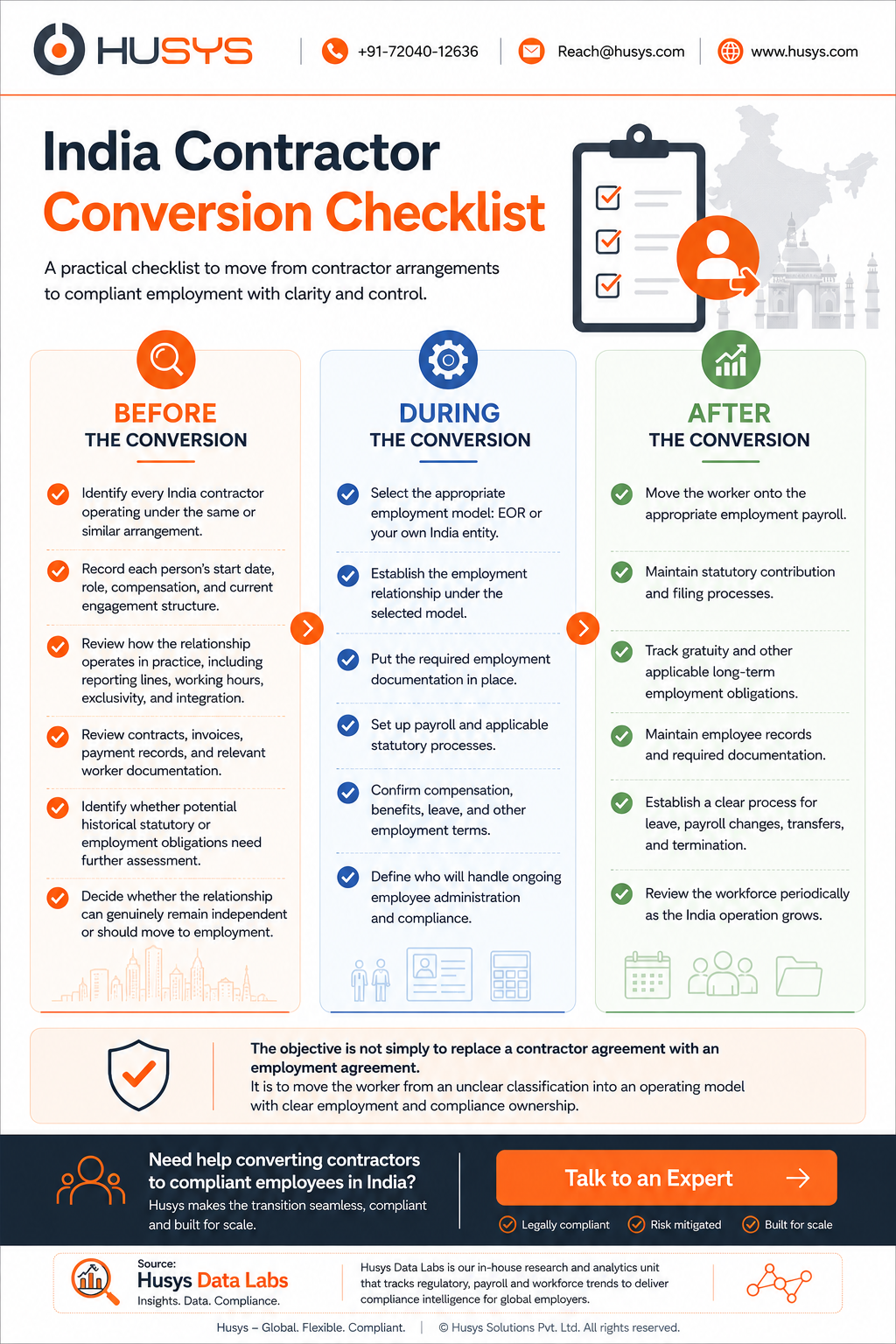
What Are the Steps to Convert a Contractor to an Employee in India?

Checklist for converting a contractor to an employee in India
How to convert a contractor to an employee in India with a structured before, during, and after conversion checklist.

If a contractor relationship needs to change, the transition should be managed as an operating process, not just a contract change.

Before the conversion

  • Identify every India contractor operating under the same or similar arrangement.
  • Record each person’s start date, role, compensation, and current engagement structure.
  • Review how the relationship operates in practice, including reporting lines, working hours, exclusivity, and integration.
  • Review contracts, invoices, payment records, and relevant worker documentation.
  • Identify whether potential historical statutory or employment obligations need further assessment.
  • Decide whether the relationship can genuinely remain independent or should move to employment.

During the conversion

  • Select the appropriate employment model: EOR or your own India entity.
  • Establish the employment relationship under the selected model.
  • Put the required employment documentation in place.
  • Set up payroll and applicable statutory processes.
  • Confirm compensation, benefits, leave, and other employment terms.
  • Define who will handle ongoing employee administration and compliance.

After the conversion

  • Move the worker onto the appropriate employment payroll.
  • Maintain statutory contribution and filing processes.
  • Track gratuity and other applicable long-term employment obligations.
  • Maintain employee records and required documentation.
  • Establish a clear process for leave, payroll changes, transfers, and termination.
  • Review the workforce periodically as the India operation grows.

The objective is not simply to replace a contractor agreement with an employment agreement. It is to move the worker from an unclear classification into an operating model with clear employment and compliance ownership.

For US companies that need to fix the structure without setting up an India entity, an EOR is often the safest next step: it puts the worker into compliant employment while giving you a clear operating model and a dedicated partner for ongoing India employment administration. 

Identified an misclassified employee? 

A Conversion Should Not Depend on One Person's Checklist

For a single contractor, conversion may look straightforward. For ten, fifty or one hundred contractors, consistency becomes the real challenge which is why it helps to see how one portfolio company moved 18 contractor arrangements onto compliant employment across two markets under a single standardised process.


A standardized conversion process helps ensure that each worker moves through the same core checkpoints:

Worker assessment → Documentation → Employment structure → Statutory setup → Payroll activation → Employee communication → Ongoing compliance


The value of an established EOR is therefore not only the legal-employer structure. It is the operating infrastructure behind the transition.

Contractor vs. Employee vs. EOR: Who Actually Owns the Risk?

An EOR changes the legal employment structure and assumes the employment administration and statutory responsibilities within the agreed scope. It does not automatically erase historical exposure.

Once you know the contractor relationship needs attention, the next question is not simply

“Which model is cheapest?”

It is:

“Who will own the employment relationship, statutory compliance, and ongoing India employment decisions?”


Genuine Contractor

Own India Entity

Employer of Record (EOR)

Legal relationship

Independent service relationship

Your India company employs the worker

EOR employs the worker

Who manages the worker day to day?

Your business, within the limits of genuine independence

Your business

Your business

Who employs the worker?

No employment relationship intended

Your India entity

EOR

Who runs employment payroll and statutory administration?

Not applicable as employee payroll

Your team / providers

EOR

Who owns ongoing employment compliance?

Your business must ensure the relationship remains genuinely independent

Your India entity

EOR, within the agreed scope

Best fit

Genuine independent work

Large or strategic India operation

Small or growing India team needing compliant employment without its own entity

Main trade-off

Independence must remain real

More setup, infrastructure and ongoing administration

EOR fees and reliance on an external employment partner

The practical distinction

A contractor model works only when the relationship itself remains genuinely independent.


An India entity gives you direct control over the employment relationship but also means your company owns the infrastructure and employment compliance required to operate it.

An EOR creates a different operating model: the worker becomes an employee of the EOR, while your company continues directing the person’s day-to-day work within the agreed arrangement  the structure behind our EOR in India for SaaS and product companies.


That distinction matters because an EOR isn’t simply a faster payroll solution. It changes who sits between your US company and the Indian employment relationship.


Think of the choice this way

Want an independent service provider?
→ Contractor

Want to build and own a permanent India operation?
→ India entity

Want the person to work as part of your team without establishing your own India entity?
→ EOR

The right model depends on both the reality of the worker’s role today and where your India operation is going next.

Who Should Own India Contractor Classification Risk?

Contractor classification can fall between HR, Finance, Legal, and Tax. That is exactly how these arrangements can continue for years without anyone taking ownership of the underlying risk.

The answer isn’t to make one department responsible for everything. It is to give each function a clear role in the decision.

Function

Primary responsibility

HR / People

Understand how the worker operates day to day and assess the appropriate workforce structure.

Finance

Quantify potential historical exposure and understand the financial impact of changing the structure.

Legal

Assess classification and employment-law implications and advise on remediation.

Tax

Review relevant withholding and statutory tax considerations.

Leadership

Decide whether the business should use contractors, an EOR, or establish its own India operation.

The key is having one decision owner

The biggest risk is not that HR, Finance, Legal, and Tax see the issue differently. It’s that everyone assumes someone else is handling it.

For a US company, assign one person to coordinate the review, bring the relevant functions together, and drive the decision from assessment → remediation → ongoing compliance.

If the company does not have India employment expertise in-house, an experienced EOR or India employment partner can help coordinate the operational side of that transition.

Don’t let an India contractor remain “someone else’s problem.” Give the issue an owner before the contractor arrangement becomes a larger employment liability.

When Does an EOR Make More Sense Than Setting Up an India Entity?

For a US company hiring in India, the decision isn’t simply about whether you need an employment structure. It’s about how much of an India operation you are ready to build and own.

Use the India Expansion Test

You are testing the India market or building a small team
→ EOR may be the more practical starting point.

You can employ the team compliantly without first building your own Indian employment infrastructure.

You have a growing team but aren’t ready to operate an India entity
→ EOR can provide a bridge while you validate the size and permanence of the operation.

India is becoming a significant, permanent business operation
→ Evaluate whether establishing your own India entity now makes strategic sense.

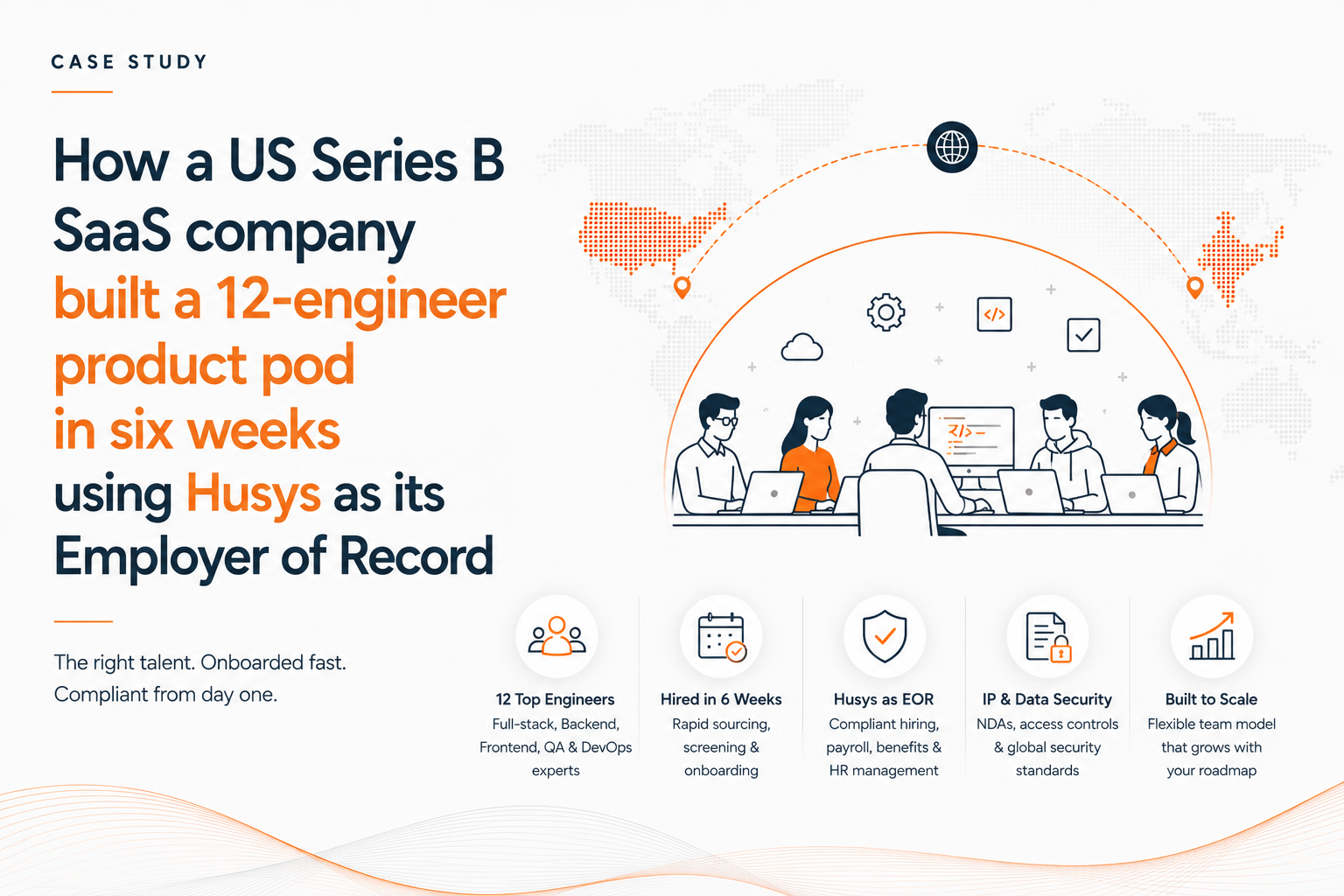
An entity gives you direct ownership of the employment infrastructure, but also means taking on the registrations, payroll, statutory compliance, HR administration, and ongoing employment responsibilities that come with operating in India  the calculation behind a Series B SaaS company that chose EOR over an India entity for a 12-engineer team.

The decision isn’t just about headcount

Consider four questions:

How many people do you expect to hire?
A small team may not justify building the infrastructure required for direct employment.

How permanent is your India operation?
If you’re still testing the market, flexibility may matter more than owning the employment structure.

How much operational infrastructure do you want to own?
An entity gives you control, but it also gives you responsibility.

How quickly do you need to move?
If hiring needs to happen now, an EOR can provide an employment structure without waiting for entity setup.

Think of an EOR as an operating option, not necessarily a permanent destination. It can allow a US company to employ its India team compliantly while it determines whether building its own India infrastructure is justified.

For companies that eventually build a substantial India operation, the EOR model can also provide a transition point while the business evaluates whether an entity is the right long-term structure.

The Clearest Red Flag: The Long-Term Single-Client Contractor

A contractor who has worked full-time and exclusively for your company for an extended period deserves a closer look not because duration alone determines employment status, but because duration, exclusivity, control, and integration can reinforce one another.

Use the 4-Signal Check

The 4-Indicator Check 

  1. Exclusivity
    Does this person work primarily or exclusively for your company?
  2. Control
    Do your managers determine when, where, or how the person works?
  3. Integration
    Is the person embedded in your team, systems, meetings, processes, and ongoing operations?
  4. Continuity
    Has the relationship continued indefinitely, with repeated renewals rather than a defined project end?

What the indicators tells you

Then avoid “1–2 signals / 3 signals / 4 signals,” which could imply a legal test. Instead:

  • Fewer indicators → Lower-priority review
  • Several indicators → Review the relationship
  • All four indicators → High-priority assessment

The important question isn’t “How long have they been a contractor?” 

It’s “Has the way they work evolved into an employee relationship?”

A contractor who has worked full-time or exclusively for one company for an extended period deserves closer review, particularly when combined with control, integration and ongoing responsibilities. 

From Risk Signals to a Repeatable Review

A risk framework is useful only if someone knows what to do with the result.

At Husys, contractor and employment questions are approached through a structured operating process: identify the engagement pattern, review the underlying documentation, assess the employment model, determine the appropriate compliance path, and establish the correct structure going forward.

The goal is to turn a subjective “this contractor feels like an employee” concern into a documented decision.

What Should You Do With an India Contractor Who Looks Like an Employee?

Once you’ve identified the exposure, the answer isn’t automatically to convert every contractor. The right path depends on whether the relationship can genuinely remain independent and how important India is to your long-term business plans.

Use this decision guide

Your situation

Most practical path

Why

The worker is genuinely independent, project-based, and serves multiple clients

Keep the contractor model

There may be no need to change a relationship that is genuinely independent.

The relationship has some employee-like characteristics, but the work can genuinely be redesigned

Restructure the contractor relationship

Change the actual working model—not just the contract—to restore independence.

The person is already functioning as a full-time member of your team and you want them to continue that way

Employer of Record (EOR)

Move the relationship into compliant employment without first establishing your own India entity.

You’re building a substantial, permanent India operation

Consider an India entity

Direct employment may make more sense when India becomes a long-term strategic operation.

The relationship has already existed for years and historical exposure may exist

Remediation + employment transition

Changing the structure going forward does not automatically resolve potential historical liabilities.

The key question

Don’t ask:

“How do we make this contractor arrangement safer on paper?”

Ask:

“What employment structure matches how this person actually works—and makes sense for where our India operation is going?”

For many US companies with a small or growing India team, an EOR can provide the middle path: the worker can continue working as part of the business while the EOR becomes the legal employer and manages the ongoing employment and statutory administration.

If India is becoming a permanent strategic operation with a larger workforce, establishing your own entity may eventually become the better long-term model.

The objective is not simply to change the contract. It is to move from an unclear employment structure to an operating model with clear ownership of the employment and compliance obligations.

For companies that want the relationship to continue without re-litigating it every time a labour code changes or a state notifies new rules, the EOR path is the one that actually closes the exposure rather than just documenting it better.

From Decision to Execution: The Husys Operating Model

Choosing the right employment model is only the first decision. The bigger challenge is executing it correctly after the decision is made.

Husys approaches India employment through a standardized lifecycle:

Stage

Operating focus

1. Assess

Understand the worker, engagement and business requirement

2. Structure

Select contractor, EOR or entity model

3. Document

Put the appropriate employment terms and records in place

4. Onboard

Complete employee and statutory setup

5. Operate

Run payroll, HR administration and employee lifecycle processes

6. Comply

Manage applicable statutory and state-level requirements

7. Exit

Handle notice, documentation and final settlement correctly

8. Review

Maintain ongoing process and compliance controls

This is the practical difference between having access to India employment expertise and having an India employment operating system.

India Contractor Misclassification: Historical Exposure and Future Compliance

One distinction is important when fixing an India contractor relationship: solving the employment structure going forward does not automatically resolve potential obligations from the past.

Think about the problem in three stages:

PAST → Assess the historical exposure

Review how the relationship operated during the contractor period, including the length of the engagement, compensation, working arrangement, and employee-like characteristics. If the relationship may have been misclassified, determine what historical statutory or employment-related obligations could apply.

TODAY → Correct the employment structure

Decide whether the relationship should remain genuinely independent, be restructured, or move into compliant employment through an EOR or your own India entity.

FUTURE → Establish clear compliance ownership

Once the appropriate employment structure is in place, ensure payroll, statutory contributions, employee documentation, leave, gratuity tracking, and other ongoing obligations have a clear owner.

Converting a contractor to compliant employment addresses the future operating structure. It does not, by itself, determine or erase potential obligations from the earlier contractor period.

For a US company, separating these two questions makes the remediation process much clearer: What exposure may already exist? And what structure should we use from here?

Experience Turns Remediation Into a Process

A mature India employment operation should not treat every compliance issue as a new problem requiring a new solution.

The objective is to identify the issue, apply a defined remediation process, document the decision, and prevent the same issue from recurring elsewhere in the workforce.

That is where standardized SOPs, compliance teams, technology and accumulated India experience become operationally important.

5 Mistakes to Avoid When Fixing an India Contractor Relationship

Once you identify a potentially misclassified contractor, the instinct may be to fix the paperwork quickly. That can be the wrong first move. The goal is to correct the working relationship, not simply make the documents look cleaner.

1. Don’t just rewrite the contractor agreement

Changing the title, adding an “independent contractor” clause, or inserting more contractor-friendly language does not change how the person actually works.

If the worker still works full-time under your direction, reports to your managers, and performs an ongoing role within your business, the underlying classification question remains.

2. Don’t assume changing the payment method fixes the problem

Moving from one invoice structure to another—or changing how payments are described—doesn’t by itself make an employee-like relationship independent.

Classification follows the substance of the relationship, not simply the payment mechanism.

3. Don’t abruptly terminate the contractor just to eliminate future exposure

Ending the relationship may stop future exposure, but it does not necessarily eliminate obligations that may have accumulated during the engagement.

It can also create a separate dispute if the individual believes they were functioning as an employee.

4. Don’t assume conversion automatically erases historical exposure

Moving a contractor onto compliant employment going forward can address the future operating structure.

It does not automatically answer whether there are historical PF, ESI, gratuity, tax, or other employment-related obligations from the earlier period.

Treat historical remediation and future compliance as two separate questions.

5. Don’t wait for a complaint or inspection to decide what to do

If the relationship already looks employee-like, waiting doesn’t make the classification question disappear. It can simply give the relationship more time to continue and potentially increase the period that needs to be reviewed.

The safest remediation strategy is not “make the contractor agreement stronger.” It is “make the employment structure match the reality of the work.”

Why US companies use Husys for India employment

Husys brings 24+ years of experience in the India market, with employment operations across 28 states and 8 union territories and an in-house legal and compliance team supporting India employment requirements. Its HRIS platform supports end-to-end HR operations and employee self-service.

From Contractor Risk to a Compliant India Workforce

If your India workforce has grown through contractor arrangements, fixing the problem doesn’t have to mean stopping your India operation. The goal is to move from an unclear employment structure to one with clear ownership and predictable compliance.

The Mess → Model Framework

THE MESS

Contractors engaged informally

Employee-like working relationships

Unclear employment and compliance ownership

Historical exposure accumulates

Company waits for a complaint, audit, or other trigger

THE MODEL

  1. Assess
    Identify which contractor relationships are genuinely independent and which have employee-like characteristics.

  1. Contain
    Stop adding new exposure while the existing workforce is being reviewed.

  1. Correct
    Address relationships that should no longer operate as independent contractor arrangements.

  1. Choose the right model
    Use a genuine contractor structure where independence is real, an EOR where compliant employment is needed without an India entity, or your own India entity when the operation warrants direct ownership.

  1. Operate
    Establish clear ownership of payroll, statutory compliance, employee administration, and ongoing workforce obligations.

The end goal isn’t simply to stop using contractors. It’s to move your India workforce into an employment model that matches how your people actually work and gives your company a clear owner for ongoing compliance.

For many US companies with a small or growing India team, an EOR can be the safest next step when employee-like relationships need to be corrected without the time and infrastructure required to establish an India entity.

24+ Years of India Experience, Turned Into an Operating System

24+ years of India experience is valuable only when that experience is built into the way work gets done.

Husys has operated in the India employment market for more than 24 years. That experience is reflected in standardized employment workflows, an in-house legal and compliance capability, state-level operational coverage and technology-supported HR operations.

The objective is simple: US companies should not have to learn India’s employment system by making mistakes themselves.

24+ Years

28 States + 6 UTs

8,000+ Employees

450+ Active Clients

ISO 9001 + ISO 27001

India employment experience

India-wide coverage

Workforce managed

Current client base

Process & security standards

The Difference Is Not Just India Expertise

It is what 24+ years of India expertise has been turned into:

Experience → SOPs → Standardized execution → Technology → Compliance oversight → Repeatable outcomes

Ready to Move Out of Contractor Risk?

If your India contractors are functioning more like employees than independent service providers, don’t wait for the relationship to become a compliance problem.

If your India contractors are functioning more like employees than independent service providers, Husys can help you assess the relationship and transition individuals or entire contractor populations into compliant employment through an EOR—without requiring you to establish your own India entity.

Frequently Asked Questions

1. What are the penalties for misclassifying an employee as a contractor in India?

There is no single “misclassification penalty.” The financial exposure depends on which employment and social-security obligations apply and the period involved. Potential exposure can include unpaid provident fund contributions, interest, damages, ESI contributions where applicable, gratuity and other statutory or tax-related obligations. For EPF, Section 7Q provides for interest at 12% per annum on amounts due from the employer, while EPFO states that the rate of damages for defaults was rationalised to 1% per month for each month of default from June 14, 2024. An EPFO proceeding can also determine dues for earlier periods; EPFO's current e-proceedings dashboard separately identifies cases involving assessment of dues for prior years, as well as penal damages and interest. The exact exposure should therefore be assessed case by case rather than treated as a fixed penalty.

2. How does India decide if someone is a contractor or an employee?

There is no safe classification based solely on the label used in the contract. The assessment generally looks at the substance of the relationship, including factors such as the degree of control and supervision, how integrated the person is into the organisation, the nature of the work, the terms of engagement, and the overall circumstances of the relationship. For a US employer, the practical question is: Does this person actually operate as an independent business, or do they function as part of your workforce? The contract is evidence, but the way the relationship operates in practice matters.

3. Is a long-term contractor in India automatically an employee?

No. Duration alone does not automatically determine employment status. However, a contractor who works full-time or exclusively for one company for an extended period deserves closer review particularly when combined with company control, ongoing responsibilities, direct reporting and integration into the company's operations. A long relationship is therefore best treated as a risk-review trigger, not an automatic reclassification rule.

4. Can a US company keep using contractors in India long term?

Yes, if the relationship genuinely remains an independent contractor arrangement. The issue is not simply how many months or years the person has been engaged. The greater concern arises when the contractor becomes economically and operationally indistinguishable from an employee for example, working exclusively for the company, following company-controlled schedules, reporting to internal managers and performing an ongoing role within the organisation. If those characteristics describe the relationship, the company should reassess whether contracting remains the appropriate model.

5. How can I audit my India contractors for misclassification?

Start with the actual working relationship rather than the contractor agreement.

For each contractor, review:

  • Start date and length of engagement
  • Exclusivity and other clients
  • Working hours and schedule
  • Who controls how the work is performed
  • Reporting and management structure
  • Job responsibilities
  • Integration into internal teams
  • Company systems and tools used
  • Leave and attendance practices
  • Payment and invoicing history
  • Whether the engagement is project-based or ongoing

Then classify each relationship as lower-priority review, needs assessment, or high-priority assessment.

This gives HR, Finance and Legal a common factual record before deciding whether to retain, restructure or convert the relationship.

6. How can India contractor misclassification be discovered?

It can come to light through statutory inspections, compliance inquiries, employment and wage records, contractor information, or a worker dispute. For example, EPFO's statutory inquiry framework allows examination of relevant records in determining applicability and dues, while ESIC officers have powers to require information and inspect accounts, books and employment/wage records. The labour-enforcement system also includes inspection and complaint mechanisms. The important point is that the contractor agreement is only one piece of evidence. The underlying records can show how the relationship actually operated.

7. What records should a US company review when assessing an India contractor?

At minimum, review:

  • Contractor agreement and amendments
  • Invoices and payment records
  • Start date and renewal history
  • Scope of work
  • Working hours and availability requirements
  • Reporting lines
  • Internal communications showing supervision or instructions
  • Leave and attendance records
  • Access to company systems
  • Organisational charts
  • Performance-management records
  • Evidence of other clients, where relevant
  • Any benefits or employee-like arrangements provided

The objective is to compare what the contract says with how the relationship actually works.

8. Does converting a contractor to an EOR fix historical liability?

Not automatically. Moving the worker into compliant employment through an EOR can establish the appropriate employment structure from the conversion date forward. It does not by itself determine whether obligations may have existed during the earlier contractor period. Treat the two issues separately: Past: assess potential historical exposure. Present: correct the employment structure. Future: establish clear ownership of ongoing employment compliance. This distinction is particularly important when a contractor has been working for the company for several years.

Does an Employer of Record remove misclassification risk?

An EOR can remove the contractor-classification issue for the worker once the person is genuinely employed through the EOR, because the relationship is no longer structured as an independent contractor engagement.

The EOR becomes the employer for the employment relationship and handles the applicable employment administration within the agreed scope.

However, an EOR does not automatically erase historical contractor exposure that may relate to the period before conversion.

That is why a proper transition should consider both historical exposure and future employment compliance.

When should a US company use an EOR instead of setting up an India entity?

An EOR is often a practical option when a company:

  • Has a small or growing India team
  • Needs to employ people compliantly without establishing its own entity
  • Wants to move employee-like contractors into employment
  • Is still testing or expanding its India operation
  • Does not want to build its own India payroll and employment infrastructure yet

An India entity may make more strategic sense when India has become a substantial, permanent operation and the company wants direct ownership of the employment infrastructure.

The decision should therefore consider headcount, permanence, speed, operational control and willingness to own ongoing compliance, not headcount alone.

Can an EOR convert multiple India contractors at once?

Yes. A company can assess its contractor population and transition multiple workers into an employment structure rather than treating every conversion as an isolated case.

For a larger contractor population, the process should typically begin with a workforce audit, followed by historical exposure assessment, employment-model selection and a coordinated conversion plan.

This is particularly useful when several contractors were hired under the same US-company process and may have similar working arrangements.

Who is responsible for compliance when an employee is hired through an EOR?

The EOR is the legal employer and generally takes responsibility for the employment administration and statutory compliance obligations assigned to it under the EOR arrangement.

The client company still manages the worker’s day-to-day business activities and remains responsible for obligations that sit outside the EOR’s agreed scope.

For this reason, a US company should understand exactly what the EOR assumes, what the client retains, and how historical issues are handled before conversion.

What happens if a contractor has already worked for my company for several years?

Don’t assume that the length of the relationship alone determines the outcome.

Instead, review the entire period and assess whether the person was genuinely independent throughout the engagement. Longer relationships can deserve greater scrutiny when combined with exclusivity, company control, direct reporting and integration.

If the relationship appears employee-like, separate the review into:

historical exposurefuture employment structureongoing compliance ownership.

Should I terminate a risky contractor immediately?

Not necessarily.

Abrupt termination may stop future exposure, but it does not automatically resolve potential obligations arising from the previous relationship. It can also create a separate employment or contractual dispute depending on the circumstances.

The better first step is usually to contain further exposure, document the actual relationship, obtain appropriate legal/tax advice, and determine the appropriate remediation path.

Is changing the contractor agreement enough?

No.

Changing the wording of the agreement without changing the way the relationship operates does not solve the underlying problem.

If the person continues to work full-time under your management, follow your schedules, report through your organisation and perform an ongoing employee-like role, simply adding stronger “independent contractor” language does not make the relationship genuinely independent.

The operating model has to match the paperwork.

Do India’s 2026 Labour Codes change contractor classification?

India’s four Labour Codes—the Code on Wages, Industrial Relations Code, Code on Social Security, and Occupational Safety, Health and Working Conditions Code—were brought into effect from 21 November 2025. The Ministry of Labour’s current Labour Codes page also lists the 2026 Central Rules and related FAQs.

The Code on Social Security also expressly addresses social-security coverage for categories including gig and platform workers.

For employers, the practical takeaway is not that every contractor is suddenly an employee. It is that India’s employment and social-security framework is evolving, making it increasingly important to keep the classification, payroll and statutory treatment aligned with the actual workforce relationship.

Does the 2026 tax-law change affect contractor payments?

Yes, the tax framework also changed from April 1, 2026.

The Income Tax Department states that payments or credits on or before March 31, 2026 continue under the Income-tax Act, 1961, while payments or credits from April 1, 2026 are governed by the Income-tax Act, 2025. The Department also confirms that salary TDS for the new tax year is governed by Section 392 of the new Act, while specified non-salary TDS provisions are consolidated under Section 393.

That makes it particularly important for companies reviewing contractor arrangements in 2026 to distinguish employment classification from the applicable TDS treatment for the payment period.

What is the safest next step if my India contractors already look like employees?

If the workers genuinely function as part of your team and you don’t want to establish an India entity, moving them into compliant employment through an EOR is often the most practical next step.

Before conversion, however, assess any potential historical exposure separately. The goal is not simply to change the payment mechanism—it is to establish a clear employment relationship and clear ownership of ongoing India employment compliance.


This article provides general information and is not legal, tax or employment-law advice. Classification and historical exposure should be assessed based on the specific facts of each engagement.

Table of Contents

Husys EOR - A People2.0 Company

EOR $99/per month

Empowering Your Workforce Journey with Trusted Insights

Find the latest industry trends, expert blogs, insightful case studies, and essential tools. Whether you’re expanding your team locally or globally, we’ve got the information you need to make informed decisions and stay ahead of the curve.
  • Blogs
  • Case Studies
  • Client Stories
  • People Talks

Let's Help You!

Please Share Your Details And Get Connected

When do US teams use EOR for India?