Exit planning in India is not something you do when things go wrong. It is a structural decision you make on day one, because the model you use to enter a wholly owned subsidiary, a branch office, contractors, or an Employer of Record India arrangement determines whether leaving takes six weeks or three years.
India entry decisions rarely feel expensive on Day 1. The trouble starts when the India plan changes: a hiring plan gets paused, a 20-person team becomes 200, a business unit is shut down, an acquisition changes the structure, or the company decides after a year that India is not the market it expected.
That is when companies discover something they did not model when they entered:
Entering India and exiting India are not mirror images.
Under India’s Companies Act, 2013 and the Insolvency and Bankruptcy Code, 2016, a company with no liabilities and no employees can be removed from the register in a matter of months. A company with active employees, unresolved tax assessments and repatriable capital cannot. The employees have to go first, and Indian law makes that a paid, notified, statutory process not an at-will one.
That single asymmetry is what most US teams miss. Statutory dues still have to be settled. Registrations still have to be closed. Tax and corporate obligations may continue. Capital may need to be repatriated. And an Indian entity can keep creating compliance work long after the last employee has left.
We see versions of this problem repeatedly: companies spend significant time deciding how quickly they can hire in India, but much less time asking what they would have to unwind if the strategy changed six, twelve or thirty-six months later.
So before choosing an Indian subsidiary, branch, contractor model or Employer of Record (EOR), ask a more useful question than “How do we enter India?”
If our India strategy changes tomorrow, how difficult will it be to unwind what we create today?
The answer can materially change which structure makes sense. An EOR may be a more reversible way to build an initial India workforce when the business does not yet need its own Indian legal entity. But an EOR is not automatically the right answer: companies that need to conduct regulated activities, hold assets, contract or operate commercially through an Indian entity may need a different structure.
This guide gives you the real timelines, the statutory severance math in dollars, and a decision framework you can use before you sign anything.
The safest India-entry decision is not the one that assumes the plan will never change. It is the one that has tested what happens when it does.
What does exit planning in India actually cost and take? The numbers up front
1,223 India-incorporated subsidiaries of foreign parent companies closed their place of business in India over the five financial years to March 2026 against 9,977 new registrations. Roughly one closure for every eight openings. (Ministry of Corporate Affairs, reply to Lok Sabha Starred Question No. 216, answered 3 August 2026 https://sansad.in/getFile/lsapps/loksabhaquestions/annex/188/AS216_iLszC3.pdf)
403 days the average time taken to submit a final report across 1,634 completed voluntary liquidations in India. That is before the tribunal’s dissolution order. (Insolvency and Bankruptcy Board of India, Status Note on Voluntary Liquidation Process, as on 31 January 2025 https://ibbi.gov.in/uploads/meetings/9b244278fce2b60052b8fdbb410ef025.pdf)
45% of open voluntary liquidations had been running more than a year; 28% more than two. (Same source.)
2 working days the deadline to settle all wages owed to a departing employee under Section 17(2) of the Code on Wages, 2019, in force since 21 November 2025. This is an employee-level settlement requirement, not a corporate-closure timeline.
~38% of one year’s salary the statutory minimum cost of exiting a single six-year India employee on a $20,000 package, before legal fees. Modelled below.
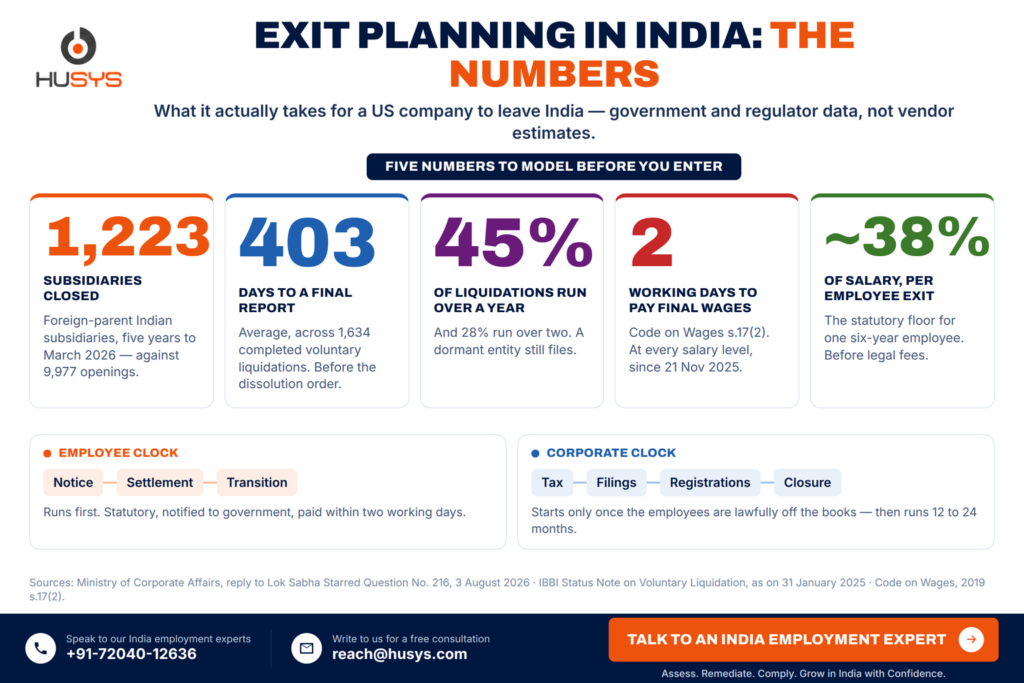
Figure: The five numbers that decide what an India exit costs and how long it takes and the two clocks they run on.
One caveat on the liquidation figures: they describe a specific route, not the standard time to close every Indian company. An eligible inactive company using the statutory strike-off mechanism is a different case, while an operating subsidiary with employees, liabilities, assets, tax positions or unresolved obligations may require a more involved wind-down.
Who is this India exit guide for?
This guide is for US companies planning, operating or reassessing an India workforce and deciding which structure gives them the right balance of speed, control, compliance and reversibility: founders and CEOs deciding how to enter without creating unnecessary structural commitments; CFOs evaluating cost, compliance tail and liabilities; General Counsel assessing employment, corporate, tax and regulatory exposure; HR and People leaders planning a workforce and its eventual restructuring; and technology leaders building India engineering, product, cybersecurity or shared-service teams.
It is especially useful for a company asking: “If our India strategy changes, how difficult will it be to unwind what we are creating today?”
How long does exit planning in India actually take, and what does it cost?
Short answer: there is no single timeline or cost for exiting India. An eligible company using the strike-off route may have a much shorter closure process than a company requiring voluntary liquidation, while employee exit costs and ongoing corporate liabilities are separate workstreams running on their own clocks.
For a US company, the critical question is therefore not “How long does it take to close an Indian company?” but “Which exit route applies to the Indian structure we have created?” India exit costs and timelines are determined by the structure you enter with, the exit route available to that structure, the condition of the entity at the point of exit, and the employee and statutory obligations that remain outstanding. That is why exit planning in India belongs in the India-entry decision itself, not in a crisis meeting three years later.
How does closing a business in India differ from closing one in the US?
In the US, closing a subsidiary is close to a clerical exercise. You give notice where the WARN Act applies, run a final payroll, file a certificate of dissolution and wind down the bank account. Absent a state mini-WARN statute, there is no federal requirement to pay severance at all.
The federal Worker Adjustment and Retraining Notification (WARN) Act, 29 U.S.C. §§ 2101–2109, generally requires covered employers to give at least 60 days’ advance written notice on a qualifying plant closing or mass layoff, subject to the Act’s definitions, thresholds and exceptions and it is not triggered by every workforce reduction. One point US teams miss: “plant closing” is a defined WARN concept, not a reference to manufacturing, so a SaaS, cybersecurity or professional-services business can fall within it. The U.S. Department of Labor’s WARN Act Compliance Assistance carries the federal guidance and the underlying regulations.
India inverts this. There is no at-will employment. Severance is a statutory formula, not a negotiation. Terminations are notified to the government. And the corporate wind-up cannot begin in earnest until the employment relationships are lawfully closed and every liability is extinguished.
Since 21 November 2025, the four Labour Codes the Code on Wages, 2019; Industrial Relations Code, 2020; Code on Social Security, 2020; and Occupational Safety, Health and Working Conditions Code, 2020 form the central framework for the areas they cover. The Ministry of Labour & Employment’s Additional FAQs on Labour Codes, dated 16 March 2026, provides current government clarification on wage calculation, gratuity, ESI coverage, fixed-term employment, contract labour and employee coverage.
But the Indian position is not one universal termination rule. The applicable requirements change with the nature of the establishment, employee classification, length of service, workforce size, type of termination, applicable statutory threshold and the relevant state framework. The Ministry’s March 2026 FAQ, for example, distinguishes between employees and workers for particular provisions, and states that some requirements depend on whether the Central or State Government is the appropriate government.
Example. A US cybersecurity company employing 25 software professionals through an Indian subsidiary cannot assume that closing its US business unit determines how those Indian employees should be exited. It would need to assess the employees’ contracts and classification, statutory wages and dues, gratuity and social-security position, and whether the circumstances of the closure trigger retrenchment or other statutory requirements in India.
The corporate entity is a separate workstream. A company satisfying the statutory conditions for strike-off may use the Section 248 framework under the Companies Act, 2013; a solvent company requiring formal liquidation may fall within the Insolvency and Bankruptcy Code, 2016 and the IBBI Voluntary Liquidation Process Regulations. The route depends on the company’s legal and financial circumstances, not simply on the decision to stop operating.
Example. Two US technology companies, each with 10 employees in India. Company A operates through an Indian private limited subsidiary, holds local registrations, leases office space and has outstanding Indian contracts and liabilities its exit requires employee closure plus a separate corporate, tax, regulatory and liability wind-down. Company B has 10 India-based employees but no equivalent Indian corporate structure its employee obligations still have to be settled correctly, but it has no Indian subsidiary to strike off or liquidate.
The difference is therefore not simply “US versus India.” It is which legal and employment obligations are created by the structure the US company chooses when it enters.
Why your exit cost is set at entry
Your exit cost and timeline are set by choices you make at entry, when exit is the last thing on anyone’s mind:
- Entity or no entity. A wholly owned subsidiary is a permanent legal object with its own tax file, audit obligation and annual filings. An Employer of Record India engagement is a contract with a notice period.
- Headcount and tenure. Gratuity vests at five years for permanent staff. Retrenchment compensation accrues per completed year. Every month you employ someone, your exit cost rises.
- What the India team actually does. A team that writes code creates a different tax posture than a team that closes deals. That difference decides whether you have a permanent establishment problem on the way out.
- Whether you ever generated revenue in India. Selling into India through your own entity creates GST registration, corporate tax assessments and customer contracts all of which have to be unwound before the register will let you go.
How often do US companies actually leave India?
More often than the press coverage suggests, and far more quietly.
The Ministry of Corporate Affairs published fresh figures in August 2026 answering a Lok Sabha question on the closure of foreign business offices. As of 30 July 2026, 3,313 foreign companies (branch, liaison and project offices registered under Section 380 of the Companies Act, 2013) and 19,881 India-incorporated companies with a foreign holding company were carrying on business in India.
The closure figures are the interesting part.
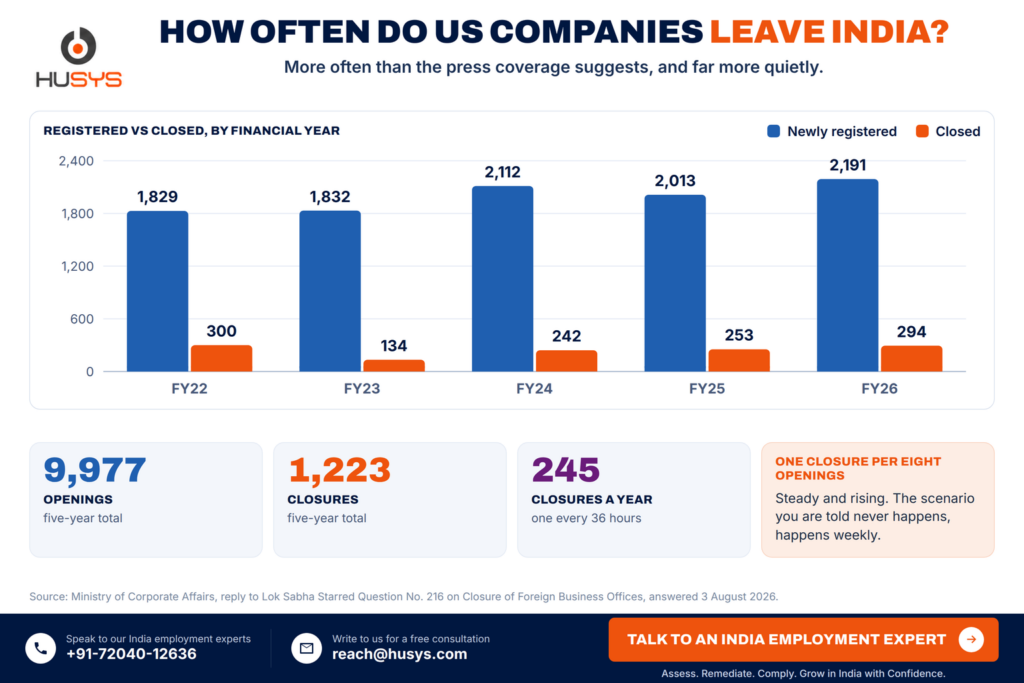
Figure: Closures are steady and rising: 1,223 foreign-parent Indian subsidiaries closed their place of business over the five financial years to March 2026.
Financial year | Foreign-parent subsidiaries newly registered | Subsidiaries that closed their place of business |
FY2021-22 | 1,829 | 300 |
FY2022-23 | 1,832 | 134 |
FY2023-24 | 2,112 | 242 |
FY2024-25 | 2,013 | 253 |
FY2025-26 | 2,191 | 294 |
Five-year total | 9,977 | 1,223 |
Two things stand out.
First, closures are steady and rising, not exceptional. Roughly 245 foreign-owned Indian subsidiaries wind down every year one every 36 hours. This is a normal feature of a healthy market, not a scandal, but it means the scenario you are told never happens, happens weekly.
Second, the branch, liaison and project office numbers run negative. Over the same five years, 352 foreign companies registered a place of business under Section 380 while 382 closed one. If you were considering a branch office as your “lighter” India entry, note that more of them are being shut than opened.
Set against that, the entry case for India has never been stronger. The Nasscom–Zinnov India GCC Landscape Report 2026 counts 2,117 Global Capability Centres across 3,728 units in India, employing 2.36 million people and generating $98.4 billion in revenue in FY26, with 506 Forbes Global 2000 companies represented. India works. It just does not work for everyone, and the ones for whom it does not still have to leave.
Understanding hiring in India risks for US companies is not pessimism. It is the discipline you already apply to a lease term or a vendor contract: you read the termination clause before you sign.
How can a US company close its Indian subsidiary?
There is no single answer to how to close a company in India. There are four routes, and which one is available to you is decided by facts you cannot change once you are in the situation.
The appropriate route depends on what the Indian company owns, whether it is still operating, whether it is solvent, and whether its statutory obligations can be cleared. Before choosing, assess the company across four areas: operations (is the business still active?), assets and liabilities (what does it still own or owe?), solvency (can it meet its obligations?) and statutory position (does it meet the conditions for the proposed route?).
Which exit route applies?
India operation status | Exit route to evaluate |
The business still has commercial value customers, contracts, assets or an operating team. | Sell or transfer |
The company has stopped operating and meets the statutory conditions for removal from the register. | Strike-off |
The company is solvent but has assets, liabilities, contracts or other matters requiring a formal wind-down. | Voluntary liquidation |
The company is insolvent or does not meet the conditions for a voluntary exit. | Formal insolvency or winding-up process |
These are not interchangeable. The condition of the company determines which route is available and appropriate and three points are worth making before the detail.
Selling is not failing. If the operation has continuing value customers, employees, intellectual property, contracts or assets another buyer wants transferring the business, assets or shares may preserve value that a liquidation would destroy. A US SaaS company discontinuing its India operation may find another technology company wants the team.
Strike-off is not a liability escape hatch. Outstanding obligations have to be addressed before you can even determine whether the route is available. It suits the case where a subsidiary was incorporated for a planned expansion that was discontinued before significant operating activity accumulated not the case where you want to walk away from unresolved claims.
Insolvency changes the analysis entirely. An Indian subsidiary with material unpaid liabilities that cannot meet its obligations is a fundamentally different problem from a solvent subsidiary whose US parent has simply decided to discontinue its India strategy. In the first case you are no longer choosing the route.
The four routes side by side
Route | Legal basis | Who it is actually available to | Realistic timeline | The catch |
1. Sell the entity (share transfer) | Companies Act, 2013 s.56; FEMA, 1999 pricing and reporting rules | Anyone with a buyer. Usually the fastest genuine exit. | 2–6 months if a buyer exists | You need a buyer. Most sub-scale India subsidiaries have none. Valuation certificate, FC-TRS filing and sectoral FDI caps apply. |
2. Strike off (voluntary removal from the register) | Companies Act, 2013 s.248(2); Companies (Removal of Names) Rules, 2016; Form STK-2 | Only companies that have extinguished all liabilities and have either failed to commence business within a year of incorporation, or have not carried on business for the two immediately preceding financial years | Processing has fallen sharply the Ministry told Parliament in November 2024 that average processing under C-PACE had come down to 70–90 days from over six months | The two-year dormancy requirement is the trap. You cannot trade on Monday and file STK-2 on Tuesday. Section 249 also bars the application if, in the previous three months, you changed the company name, shifted the registered office between states, disposed of property for gain, or did anything other than wind down. |
3. Voluntary liquidation | Insolvency and Bankruptcy Code, 2016 s.59; IBBI (Voluntary Liquidation Process) Regulations, 2017 | Solvent companies with assets to realise, creditors to pay, or capital to repatriate the standard route for a real operating subsidiary | 403 days average to final report, historically, plus the wait for a dissolution order | Requires a declaration of solvency, a registered insolvency professional, public claim invitation, and a National Company Law Tribunal dissolution order at the end. |
4. Compulsory winding up | Companies Act, 2013 Ch. XX; IBC insolvency provisions | Insolvent companies, or those dragged in by creditors | Years | You are no longer driving. Avoid. |
A 2026 change worth knowing. The Insolvency and Bankruptcy Code (Amendment) Act, 2026 received Presidential assent on 6 April 2026, and the Ministry of Corporate Affairs brought most of its provisions into force on 26 May 2026 (S.O. 2625(E)). Among other things, it prescribes that voluntary liquidation must be completed within one year. That is a genuine improvement over the historical average. It is also, notably, still a year.
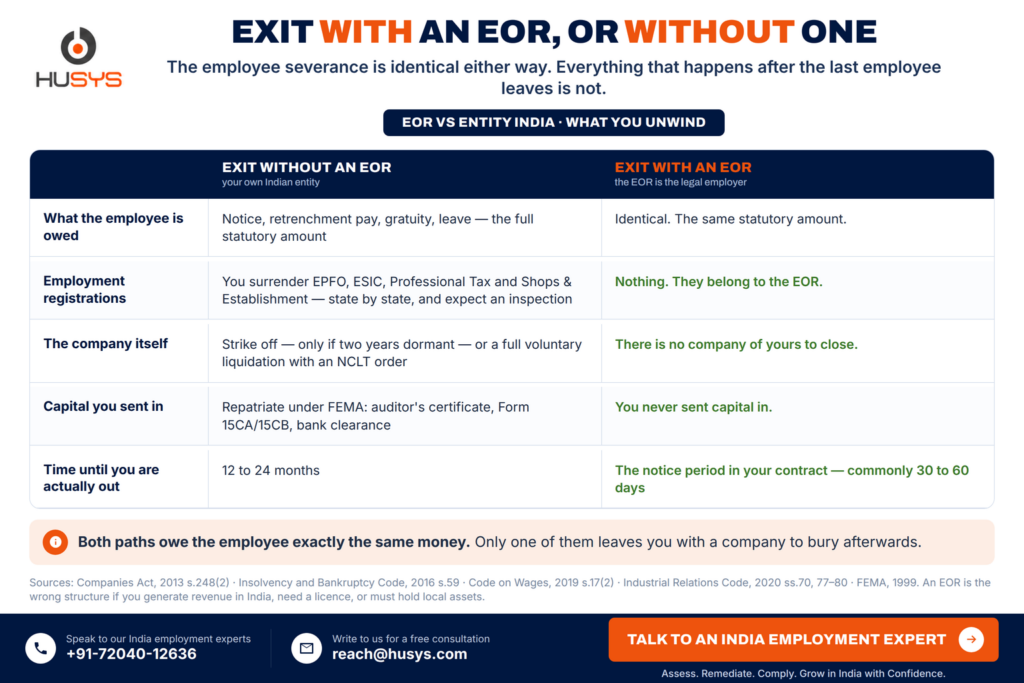
Figure: The employee severance is identical either way. Everything that happens after the last employee leaves is not.
The decision is not simply “Which closure form should we file?”
For a US company, the more important question is: which exit route will actually be open to us on the day we decide to leave and did our entry structure put it out of reach?
Choosing the wrong route creates cost, delay and legal exposure, but more often the route is chosen for you. A company that has traded in the last two financial years cannot strike off, however clean its balance sheet. A company with unresolved liabilities cannot declare solvency. Those facts are set in motion at entry.
That is why exit planning should begin with the entry structure. A US company that knows whether it is establishing a long-term Indian subsidiary, testing the market, building a captive team or simply hiring employees for an India-based function can make a better decision about how much corporate infrastructure it actually needs on day one.
Why is the 90-day closure figure misleading?
Short answer: because it measures only the Registrar’s processing time for a company that is already dormant, debt-free and employee-free. Getting to that state is the actual project. For a company that genuinely operated, the honest planning assumption has been 18 to 24 months from board decision to dissolution certificate and the clock only starts once the employees are lawfully off the books.
Ask a service provider how to close a company in India and you will be shown the C-PACE strike-off route and a 90-day number. That number is real, and it reflects genuine reform the Centre for Processing Accelerated Corporate Exit was set up by the Ministry of Corporate Affairs in March 2023 specifically to centralise and speed up strike-offs. But it measures only the last mile: the time the Registrar takes to process a complete application from a company that is already dormant, debt-free and employee-free.
Getting to that state is the actual project. If the company has employees, the workforce has to be unwound separately, and those obligations can begin before the corporate closure process is complete.
For a company that genuinely operated hired people, signed contracts, invoiced, filed GST the honest route is voluntary liquidation. Here is what the regulator’s own data says about how long that takes.
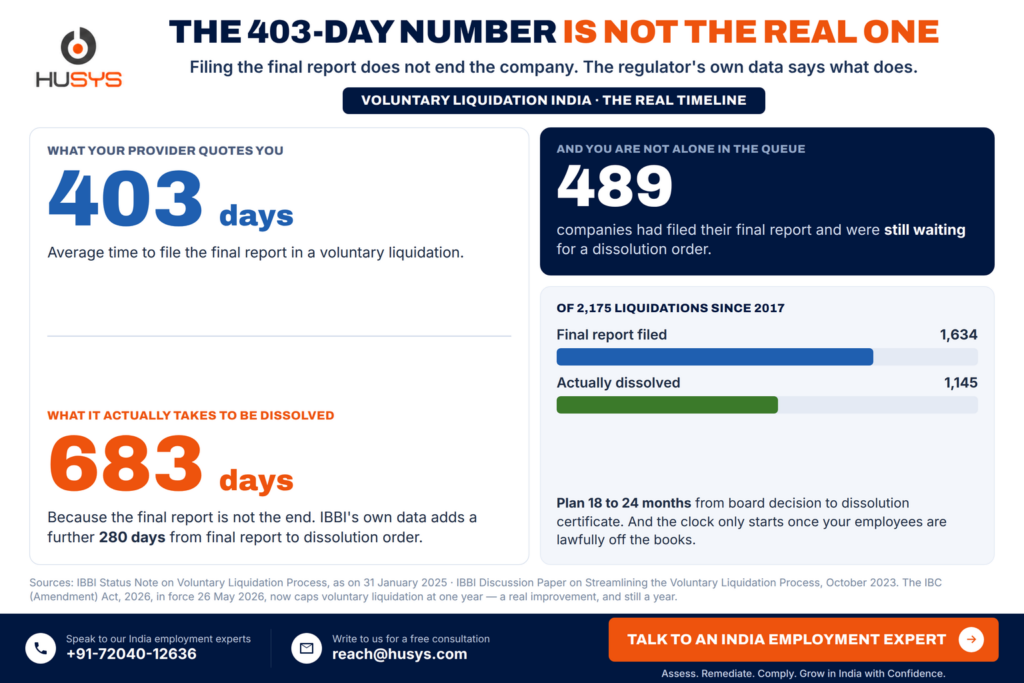
Figure: The 403-day figure is the one you are quoted. 683 days is what the regulator’s own data says it takes to actually be dissolved.
As at 31 January 2025, of 2,175 voluntary liquidations initiated since 2017:
- 1,634 had reached a final report, taking 403 days on average
- 1,145 had actually been dissolved
- 489 had filed a final report but were still waiting for a dissolution order
- 498 were still running of which 141 had been open more than two years and another 84 for one to two years
That gap between “final report submitted” (1,634) and “dissolved” (1,145) is what catches finance teams out. IBBI’s own 2023 discussion paper on streamlining the process noted that the average time from final report to dissolution order was a further 280 days.
So the honest planning assumption for a real operating subsidiary, historically, has been 18 to 24 months from board decision to dissolution certificate with the new statutory one-year ceiling now pushing that down. And the clock on that process only starts once your India employees are lawfully off the books.
Which brings us to the part of exit planning in India that almost nobody writes about.
What does the employee side of an India exit involve?
This is where US assumptions break hardest, and where common mistakes US companies make hiring in India turn into real money.
India’s four Labour Codes came into force on 21 November 2025, replacing 29 central labour statutes. The Central Rules that operationalise them were notified on 8 May 2026. State rules are still being notified on different timelines, which means for now the precise obligation depends partly on which state your employee sits in. That patchwork is itself a risk factor in exit planning in India.
Four things changed that directly affect what it costs you to leave.
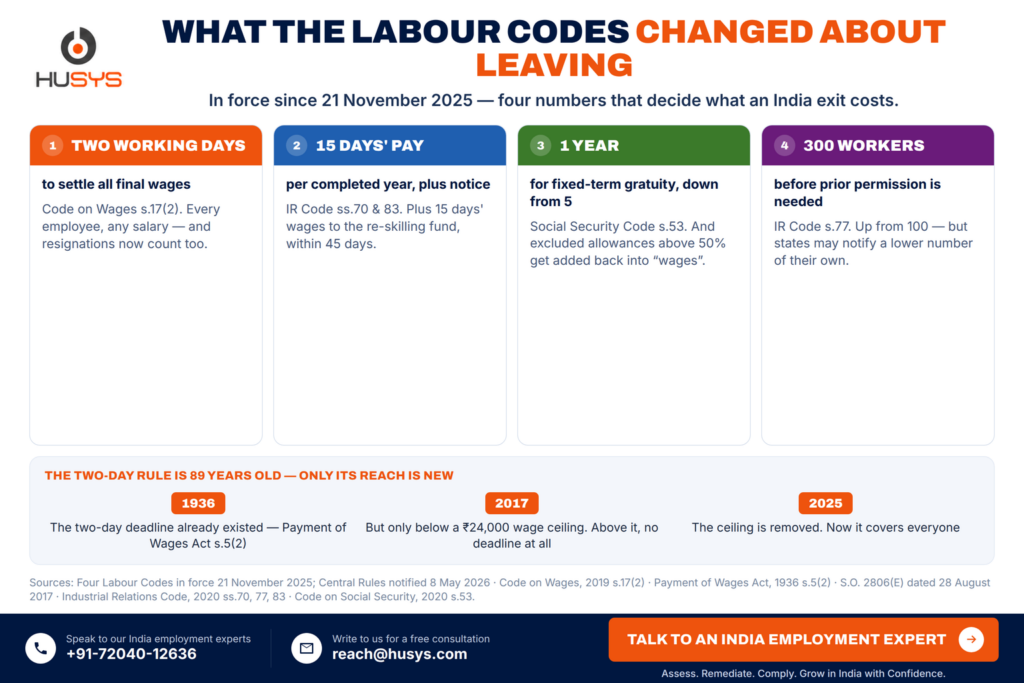
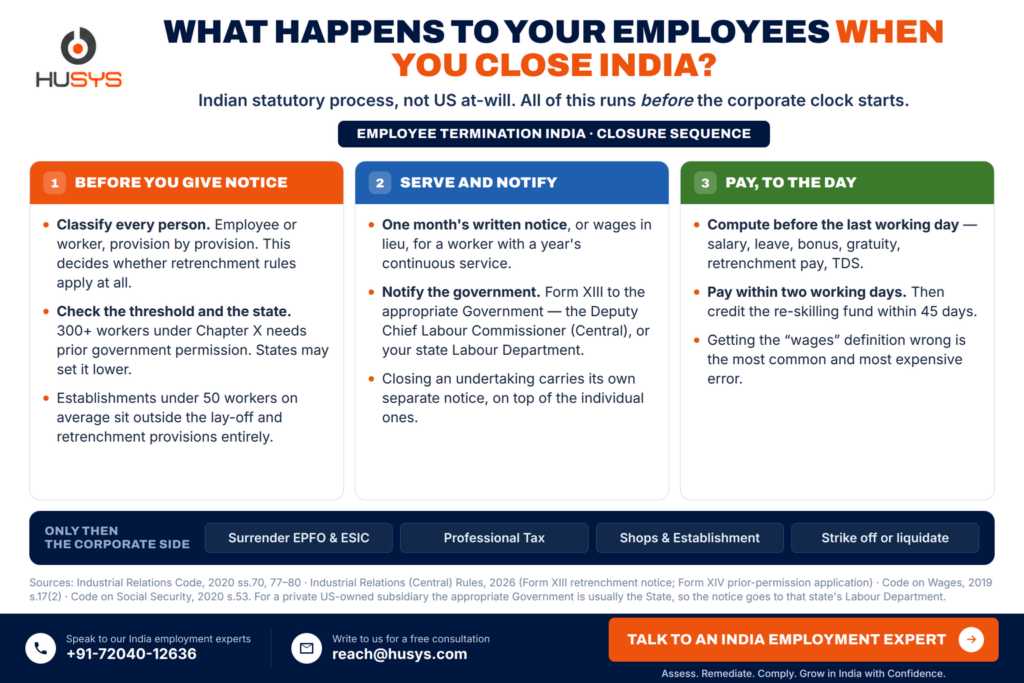
Figure: Four numbers that decide what an India exit costs and why the two-day settlement rule is 89 years old, not new.
1. The two-working-day settlement rule
Under Section 17(2) of the Code on Wages, 2019, where an employee is removed, dismissed, retrenched, resigns, or becomes unemployed because the establishment closed, all wages payable must be paid within two working days.
What actually changed, and when. The two-working-day deadline itself is not new. Section 5(2) of the Payment of Wages Act, 1936 has required that “where the employment of any person is terminated by or on behalf of the employer, the wages earned by him shall be paid before the expiry of the second working day from the day on which his employment is terminated.” That rule is 89 years old.
What was new on 21 November 2025 is who it covers. The 1936 Act applied only to employees drawing wages up to a ceiling. That ceiling was ₹18,000 a month until the Ministry of Labour & Employment raised it to ₹24,000 by notification S.O. 2806(E) dated 28 August 2017 the same notification that superseded the earlier ₹6,500 limit. Above the ceiling, no statutory settlement deadline applied at all: final settlement ran on the employment contract and company policy, and Indian market practice settled on 30 to 45 days, with 45 to 60 days common in larger organisations.
Section 17(2) of the Code on Wages, 2019 removed the ceiling. Every employee, at any salary, now falls inside the two-working-day deadline. It also widened the trigger: the 1936 provision applied where employment was “terminated by or on behalf of the employer,” which meant resignations were outside it. Section 17(2) expressly covers resignation as well as removal, dismissal, retrenchment and unemployment caused by closure.
Why it changed. The Code on Wages, 2019 consolidated four statutes the Payment of Wages Act, 1936, the Minimum Wages Act, 1948, the Payment of Bonus Act, 1965 and the Equal Remuneration Act, 1976 and one of the stated objectives of that consolidation was universal coverage: extending wage protections that had historically been limited by wage ceilings and scheduled-employment lists to the whole workforce. The settlement deadline was one of the provisions carried across and universalised rather than invented.
What this means for a US employer. The senior India employees whose exits are most expensive to get wrong the ones on ₹30 lakh and up, who sat outside the 1936 Act entirely are the ones who moved from a contractual 30-to-45-day settlement window to a hard two-working-day statutory deadline. If your India offboarding process was built around the old norm, it was built for the population the rule never covered.
For a US finance team, that is an operational shock. You cannot run an India closure on your usual next-payroll-cycle rhythm. Final settlements unpaid salary, leave encashment, pro-rata bonus, reimbursements must be computed before the last working day, not after.
When a US company closes its India operation, employee exits must be handled separately from the corporate closure. The company may have obligations relating to final wages, notice or notice pay, retrenchment compensation, gratuity, social-security contributions and statutory notifications, depending on the employee, establishment and circumstances of termination.
2. Retrenchment is a formula, not a negotiation
For workers covered by the general retrenchment provisions of Section 70 of the Industrial Relations Code, 2020, retrenchment after at least one year of continuous service generally requires:
- One month’s written notice, or wages in lieu
- Compensation equal to 15 days’ average pay for every completed year of continuous service (any part-year over six months counts as a full year)
- Notice to the appropriate Government in the prescribed manner
And under Section 83, the employer must additionally contribute 15 days’ wages per retrenched worker to a worker re-skilling fund, credited within 45 days of the retrenchment. This sits on top of retrenchment compensation, not inside it a line most spreadsheets miss.
Who exactly do you notify, and at what headcount?
Short answer: written notice of retrenchment goes to the appropriate Government in every case, at any headcount on Form XIII under the Industrial Relations (Central) Rules, 2026, to the concerned Deputy Chief Labour Commissioner (Central) where the Central Government is the appropriate Government. Prior permission is a separate, additional requirement, and that is the one that starts at 300 workers.
Three distinctions matter, because they are routinely collapsed into one:
- Notification is universal. Section 70 requires that notice “in such manner as may be prescribed is served on the appropriate Government or such authority as may be specified.” There is no headcount threshold on this. It applies to a single retrenchment.
- Permission starts at 300. Only establishments covered by Chapter X those with 300 or more workers need prior permission before lay-off, retrenchment or closure. Those applications use Form XIV, and a closure application must be filed at least 90 days before the closure takes effect, with a review application available within 30 days.
- Below 50 workers, the regime largely falls away. The lay-off and retrenchment provisions do not apply to industrial establishments with fewer than 50 workers on average per working day, or to seasonal establishments.
Which department, in practice. It depends on who the “appropriate Government” is. For establishments in the Central sphere railways, mines, oil fields, major ports, banking and insurance companies, and bodies under central statutes it is the Ministry of Labour & Employment, and the gazette notification of 8 May 2026 delegates the Chapter X powers under Sections 78, 79 and 80 to officers of Joint Secretary rank and above holding the industrial relations portfolio. For a typical US-owned private subsidiary running an IT, product or shared-services team, the appropriate Government is the State, so the notice and any permission application go to that state’s Labour Department usually the Labour Commissioner or a Deputy or Assistant Labour Commissioner specified in that state’s own Industrial Relations Rules.
That last point is the practical trap for a multi-state India team: the authority, the form and sometimes the threshold are all state-specific, so a company employing in Karnataka, Maharashtra and Telangana is dealing with three sets of filings, not one. Confirm the specified authority for each state you employ in before you serve a single notice.
3. Gratuity is now cheaper to trigger and more expensive to pay
Under Section 53 of the Code on Social Security, 2020, gratuity is payable at 15 days’ wages per completed year after five years of continuous service with the five-year condition waived on death, disablement, or expiry of a fixed-term contract. Fixed-term employees now qualify on a pro-rata basis after one year, down from five.
Separately, the Code on Wages uses a common definition of “wages” across the four Labour Codes. Where excluded allowances and benefits exceed 50% of total remuneration, the excess is added back into wages for statutory calculations. Because gratuity and retrenchment compensation are both computed on “wages”, Indian salary structures that historically set basic pay at 30–40% of CTC have to be re-based which can increase the wage base used for gratuity and retrenchment compensation materially, for the same headline salary. The size of that effect depends on the individual employee’s compensation structure, so it needs to be modelled per head rather than assumed across the payroll.
4. The 300-worker threshold
For industrial establishments covered by Chapter X of the Industrial Relations Code including factories, mines and plantations those with 300 or more workers require prior government permission for lay-off, retrenchment or closure (Section 77, Industrial Relations Code, 2020).
The history behind that number. The predecessor provision sat in Chapter V-B of the Industrial Disputes Act, 1947. Chapter V-B did not exist in the original 1947 Act it was inserted by the Industrial Disputes (Amendment) Act, 1976, and as introduced it applied the prior-permission requirement at 300 or more workmen. The Industrial Disputes (Amendment) Act, 1982 then cut the threshold to 100, and that change took effect in 1984. So the 100-worker threshold that US employers may have read about in older India guides was in force for roughly 41 years, from 1984 until the Industrial Relations Code replaced it on 21 November 2025.
Read that way, Section 77 is not a new liberalisation so much as a restoration of the 1976 position. That matters for exit planning because most India entry guidance written before November 2025 and a good deal written since still quotes 100.
But note two things: states can notify a lower threshold for their jurisdiction, and closure of an undertaking carries its own separate notice obligation to the government. A company employing across several states cannot assume one number applies everywhere.
The trap: your engineer may legally be a “worker”
Here is the misconception that costs the most.
US employers instinctively sort staff into “exempt professional” and “non-exempt”. Indian law does not use that axis. Under Section 2(zr) of the Industrial Relations Code, 2020, a “worker” is a statutory classification covering people employed to do manual, unskilled, skilled, technical, operational, clerical or supervisory work. The exclusions are narrow: people employed mainly in a managerial or administrative capacity, and people in a supervisory capacity earning above ₹18,000 per month.
Read that carefully. The ₹18,000 ceiling applies only to supervisory roles. It does not exempt a highly paid individual contributor doing technical work. A senior software engineer in Bengaluru on ₹40 lakh a year, with no direct reports and no managerial authority, may well fall inside the definition of “worker” and therefore inside the retrenchment notice, compensation and re-skilling fund regime.
US teams routinely assume none of that applies to a modern engineering org. It is one of the most consequential India expansion mistakes US companies make, and it usually surfaces on the way out, when it is too late to restructure the role.
A person called a Software Engineer, Technical Lead or Engineering Manager cannot be classified for labour-law purposes from the job title alone. The assessment has to look at what each person actually does, the authority they exercise, their supervisory responsibilities, their remuneration and the statutory definition applicable to the provision being considered. See the Ministry of Labour & Employment’s Compliance Handbook for Employers under the Four Labour Codes.
Worked example. A US technology company is closing a 40-person India engineering team. Its US HR system classifies 32 people as software engineers, five as technical leads and three as engineering managers. That internal hierarchy does not, by itself, answer the Indian legal question. On assessment, the three engineering managers may fall inside the managerial exclusion; the five technical leads turn on whether their supervisory authority is real or nominal; and the 32 engineers, however well paid, are doing technical work and may all be workers. The difference between assuming three of forty are protected and finding that thirty-seven are is the difference between a $30,000 severance provision and one several times that.
This is where a standardised India exit assessment matters. Before calculating termination costs or issuing notices, the employer should assess each affected employee against the applicable statutory classification rather than applying one rule to the entire engineering team.
Legal note. This is a genuinely contested area, and worker classification is provision-specific. The Codes do not define “manager” or “supervisor”, and India’s Parliamentary Standing Committee flagged exactly that gap. The applicable Industrial Relations Code provisions, exclusions and relevant rules should be reviewed for the facts of the particular establishment and termination. Take advice on your specific roles rather than assuming either way.
→ Read next: if you are relying on contractors to avoid all of this, the classification test is the same one and it is applied to substance, not paperwork. Contractor vs Employee in India: where the line actually falls.
What happens to employees when a US company closes its India operation?
Short answer: they are exited under Indian statutory process, not US at-will practice. Depending on classification and circumstances, that means written notice or notice pay, retrenchment compensation, a worker re-skilling fund contribution, gratuity, leave encashment and any contractual dues with all wages settled within two working days, and notice served on the appropriate Government. Employee exit runs before and separately from the corporate closure, and the corporate clock does not start until it is finished.
In sequence, for an establishment closing an India operation:
Classify every affected person. Employee or worker, and against which provision. This determines whether the retrenchment regime in Section 70 of the Industrial Relations Code applies at all, and it changes the cost per head materially. Do this before you commit to a budget or a date.
Check the threshold and the state. If the establishment is covered by Chapter X of the Industrial Relations Code and employs 300 or more workers, prior government permission is required before lay-off, retrenchment or closure under Section 77. States can notify a lower threshold, so this is checked per state, not once.
Serve the correct notice. One month’s written notice, or wages in lieu, for a worker with at least one year of continuous service. Closure of an undertaking carries its own separate notice obligation to the government, additional to the individual notices.
Notify the appropriate Government in the prescribed manner. Whether that is the Central or the State Government depends on the establishment, and the Ministry’s March 2026 FAQ addresses the distinction.
Compute each settlement before the last working day. Unpaid salary, leave encashment, pro-rata bonus, reimbursements, retrenchment compensation, gratuity where payable, and TDS. Getting the “wages” definition wrong is the most common error, and it flows through both the gratuity and the retrenchment numbers.
Pay within two working days of the last working day, under Section 17(2) of the Code on Wages, 2019. This applies at every salary level.
Credit the re-skilling fund 15 days’ wages per retrenched worker under Section 83 of the Industrial Relations Code, within 45 days of the retrenchment.
Figure: The three phases of an India employee exit on closure classification, notification, and payment to the day.
Only then does the corporate side of exit planning in India begin: surrendering EPFO, ESIC, Professional Tax and Shops & Establishment registrations, and choosing a closure route for the entity itself.
Two points US teams consistently get wrong. First, closing the US business unit does not determine how the Indian employees are exited the Indian analysis is separate and runs on Indian facts. Second, the employees’ departure is not the end of the company’s obligations; it is the precondition for starting them.
If the workforce is employed through an Employer of Record rather than your own Indian entity, steps 1 to 7 still happen and cost the same statutory money. What changes is who executes them and whether a corporate closure follows. That comparison is below.
→ Read next: a lawful exit and a decent one are not the same thing. If the team you are releasing is one you would rehire, structured transition support changes what your remaining India employees and the market take from it. Outplacement Services.
How much does it cost to exit one India employee and a whole team?
Short answer: roughly $7,564 for a single six-year employee on a $20,000 package, which is about 38% of annual salary, or 4.5 months of pay. That is a statutory floor, per head, and it scales linearly: five people is about $38,000, fifteen is about $113,000, forty is about $303,000 before a single legal fee, and running alongside 12 to 24 months of entity compliance.
Here is an illustrative exit-cost model for a single employee on a ₹18.8 lakh (~$20,000) package with six years’ service, in a worker-category role.
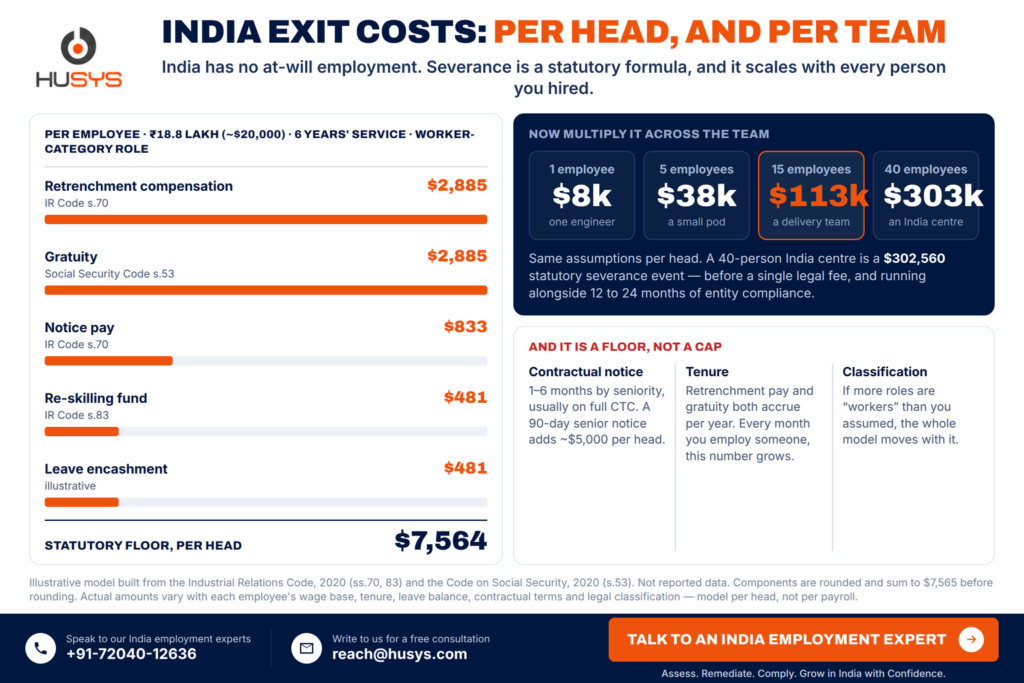
Figure: The statutory floor per employee, and what it becomes across a 5, 15 or 40-person India team.
Component | Basis | Amount (USD) |
Notice pay | One month’s wages in lieu IR Code s.70 | $833 |
Retrenchment compensation | 15 days’ average pay × 6 completed years IR Code s.70 | $2,885 |
Worker re-skilling fund | 15 days’ last-drawn wages IR Code s.83 | $481 |
Gratuity | (15 ÷ 26) × monthly wages × 6 years Social Security Code s.53 | $2,885 |
Leave encashment | 15 unused earned-leave days (illustrative) | $481 |
Illustrative statutory floor | $7,564 |
That is roughly 38% of one year’s salary about 4.5 months of pay for one person, and it is a floor, not a ceiling. It excludes:
- Contractual notice. The employment contract may create notice or notice-pay obligations beyond the statutory amounts illustrated above. Indian market practice runs about 1 month for junior roles, 2 months at mid-level, 3 months for senior staff and 3–6 months for CXOs, and it is usually calculated on full CTC rather than on statutory wages. A 90-day senior notice period alone adds roughly $5,000 on this package.
- Legal fees and dispute risk. Husys’s own operating experience is that a recurring compliance issue when a client terminates an India employee is a mismatch between what the offer letter promised and what the employee actually receives. Disputes are cheap to prevent at drafting and expensive to lose at exit.
- The parallel cost of winding up the entity itself. Statutory audit, ROC filings, transfer pricing certification, FEMA reporting and professional fees continue for every month the entity exists.
Now multiply the illustrative model. Fifteen employees on similar assumptions would represent approximately $113,000 in employee exit costs, before legal fees or the cost of winding up the entity and running alongside 12 to 24 months of continuing entity compliance cost. The actual amount will vary with each employee’s wage base, tenure, leave balance, contractual terms and legal classification.
CTA highest-intent moment. If that number is bigger than the one in your India model, the gap is worth an hour. Book a 30-minute India entry-and-exit risk review and we will model your severance exposure per head against your actual roles and contracts.
The cost of leaving is bigger than the cost of terminating employees
Employee settlements are only one part of an India exit. If you operate through your own Indian entity, the company may also have to unwind corporate registrations, tax and accounting obligations, statutory filings, banking arrangements, assets and liabilities, and the entity itself.
That creates two different exit calculations:
Employee exit cost = notice / compensation + gratuity + leave + other employee dues
Corporate exit cost = employee exit + compliance during wind-down + professional fees + tax and filing closure + asset and liability resolution + corporate closure
This distinction matters because an employee exit can be completed while the Indian company is still carrying obligations. The last employee leaving is not necessarily the same thing as the company exiting India.
The entity keeps costing money after you decide to leave
This is the second thing that surprises US finance teams. Deciding to close does not stop the meter.
Until the day the company is struck off or dissolved, an India-incorporated subsidiary continues to owe:
- Statutory audit and annual ROC filings (AOC-4, MGT-7, DIR-3 KYC)
- Income tax return filing, and TDS returns if there is any payment activity
- FEMA reporting including the annual Foreign Liabilities and Assets (FLA) return, due each 15 July, which is required of any company that has ever received foreign investment, even after that investment has been repatriated
- Form 3CEB / transfer pricing certification where there are international transactions with the parent
- Nil returns to EPFO even at zero headcount
Outsourced compliance for a foreign-owned Indian subsidiary is commonly quoted by India compliance providers in the ₹3–8 lakh per year (roughly $3,200–$8,500) range for ROC filings, income tax, TDS, FEMA, GST and basic labour filings directional, and worth benchmarking against your own quotes. Over an 18-month wind-down that is a five-figure line item for an entity that has stopped doing anything.
And PF and ESI registrations cannot simply be cancelled. They can only be surrendered on permanent closure, typically after final returns, a “no employee” certificate, proof that all employee accounts have been settled, and commonly an inspection.
→ Read next: this compliance tail is the line item most India business cases omit entirely, not just at exit but throughout. The Hidden Compliance Costs of Hiring in India.
What is the difference between exiting with an EOR and exiting without one?
Short answer: the employee severance is identical. Everything after the last employee leaves is not. Without an EOR you surrender the employment registrations, close or liquidate the company, repatriate capital under FEMA, keep filing until dissolution, and carry director liability that survives it. With an EOR none of that exists in your name, and the exit is the notice period in your agreement.
This is the comparison that should drive the entry decision, because the two structures create fundamentally different exit obligations and it is the single most useful table in any exit planning in India exercise.
Both paths owe the employee the same statutory money. An Employer of Record India arrangement does not make severance disappear, and any provider who implies otherwise is misleading you. What it removes is the corporate exit the entity, the register, the tax file, the repatriation, and the 12-to-24-month tail.
Side by side: the same decision, two paths
Phase | With your own India entity | With an Employer of Record |
Day 0 the decision | Board approval; engage Indian counsel, a company secretary, a chartered accountant and (for liquidation) a registered insolvency professional. | Board decision; review the EOR agreement, including its notice and termination provisions. |
Notify the workforce | You are the legal employer. You draft the notices, calculate each settlement, serve statutory notice on the appropriate Government, and carry the dispute risk. | The EOR is the legal employer and manages the employment-side process notices in the correct statutory form, settlements computed per state, government notifications filed under the applicable requirements and the agreement. |
Settle employee dues | The same statutory amounts, but you must fund and disburse within two working days per Code on Wages s.17(2), with correct gratuity, leave encashment, re-skilling fund contribution and TDS. Getting the wage definition wrong is the most common error. | The same employee-level statutory obligations apply; the EOR manages the calculation and payment process. You transfer one figure. |
Close employment registrations | Surrender EPFO and ESIC codes: final ECR, “no employee” certificate, evidence of settlements and expect an inspection. Professional Tax and Shops & Establishment registrations close separately, state by state. | Employment registrations are held and managed by the EOR and stay open for its other clients. |
Close the corporate entity | Choose and complete the appropriate exit route strike-off only if you qualify (two years dormant, liabilities extinguished), otherwise voluntary liquidation with a solvency declaration, an insolvency professional, public claim invitation and an NCLT dissolution order. | No Indian subsidiary belonging to your US company needs to be struck off or liquidated. |
Repatriate capital | FEMA compliance, an auditor’s certificate, Form 15CA/15CB, confirmation of no pending proceedings, and AD Category-I bank clearance. | No subsidiary capital account exists in your company’s name to unwind. |
Ongoing filings during wind-down | ROC annual filings, statutory audit, income tax return, FLA return, Form 3CEB and nil EPFO returns continue every year until the entity is formally closed. | Your obligations continue according to the EOR agreement; the EOR manages its own entity-level registrations and filings. |
Realistic exit workload | Employee settlement + registration closure + corporate exit. Historically 12–24 months; voluntary liquidation is now capped at one year under the IBC Amendment Act, 2026. | Primarily the contractual termination process and employee transition commonly the 30–60 day notice period in the agreement rather than liquidation of your own Indian entity. |
Residual exposure | Corporate, tax and other liabilities may remain after employees leave and must be resolved before the entity can be fully closed. Director liability survives dissolution under Section 250 of the Companies Act, 2013, and tax assessments can be reopened. | Contractually defined and bounded. Exposure depends on the employment arrangement, the EOR agreement and the activities your company continues to conduct in India. |
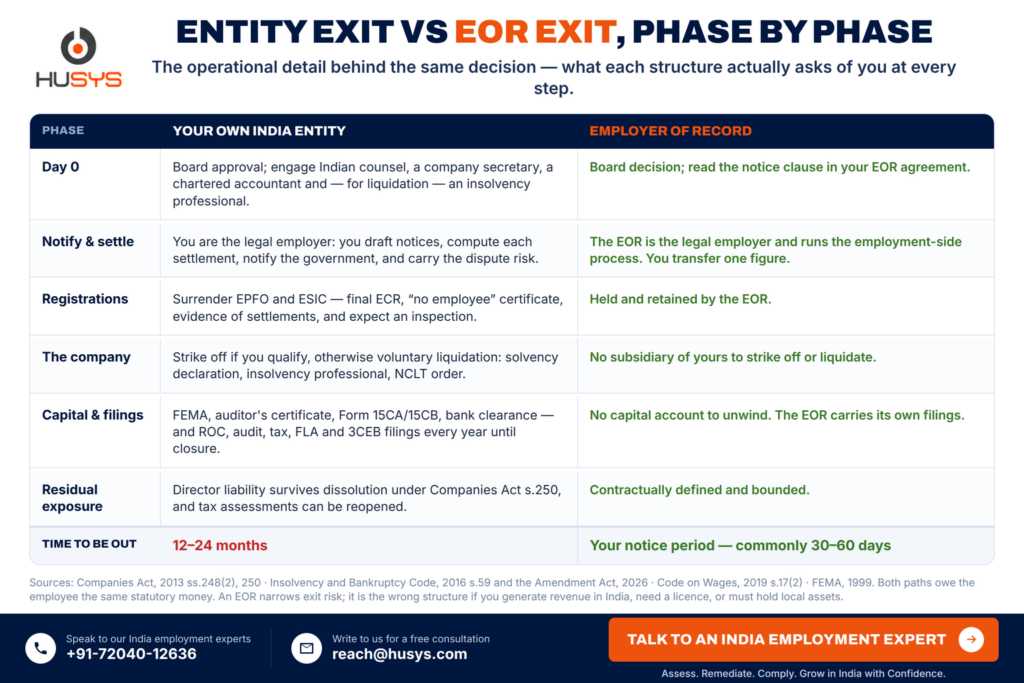
Figure: The operational detail behind the same decision what each structure asks of you at every phase.
What the difference actually buys you
The employee obligation does not disappear with an EOR. What changes is the corporate workstream attached to the employment relationship.
- You avoid a liquidation process whose historical average time to final report was 403 days. No liquidation, no dissolution order, no 489-case queue waiting on the tribunal.
- You avoid the statutory two-year non-operation condition for the strike-off route. Section 248(2) requires that the company has not carried on business for two preceding financial years. That requirement simply does not arise if there is no company.
- You skip the compliance tail. At ₹3–8 lakh a year, eliminating 18 months of filings on a shell entity is a $5,000–$13,000 saving on its own for a business that has already decided it doesn’t want to be in India.
- You may reduce one category of fixed-place PE exposure. Under Article 5 of the US–India Double Taxation Avoidance Agreement, a fixed place of business through which an enterprise is carried on can create a taxable presence. A wound-down subsidiary that had an office and staff gives a tax officer something to assess. An EOR arrangement changes the employment and premises position but it does not determine permanent establishment by itself. The US parent still needs to assess where its business is actually conducted and what India-based personnel actually do, including any dependent-agent risk.
The difference in workstreams you have to close
Exit workstream | Own India entity | EOR |
Employee termination, transition and final settlements | Your team + advisers | EOR manages the employment-side process |
Payroll and statutory employment closure | Your entity / advisers | EOR |
Employment registrations | Your entity surrenders them | EOR’s registrations, retained |
Tax and accounting closure | Your entity / advisers | Your own obligations still apply |
Corporate filings during wind-down | Your entity / advisers | No client-owned entity to wind down |
Assets and liabilities | Your entity | Depends on your own business activities |
Capital / banking unwind | Your entity | No client-owned subsidiary capital structure |
Strike-off / liquidation and final closure | Your company + advisers | Not required for a client-owned Indian subsidiary |
An EOR does not eliminate the employee exit. It can eliminate an entire second layer of corporate wind-down from the US company’s exit project.
The honest caveat
An EOR narrows exit risk. It does not eliminate India risk, and it does not cover every situation. See “When is an EOR the wrong answer?” below that section is deliberately unflattering, because a partner who won’t tell you when their product doesn’t fit is not a partner.
CTA comparison moment. Not sure which column you are in? Book a 30-minute India entry-and-exit risk review. No pitch including the cases where the answer is an entity.
At what headcount does an Indian entity become cheaper than an EOR?
Short answer: there isn’t one. The break-even moves with headcount, duration, business activity and how reversible you need the structure to be and the cheaper structure is not the one with the lower monthly fee, it is the one whose total obligations match what you actually need to do in India. Model cost to enter, cost to operate and cost to exit separately.
It is tempting to ask, “At what employee count does an Indian subsidiary become cheaper than an EOR?” That is the wrong first question. The real comparison is:
EOR cost = EOR fees × employees × duration
Entity cost = setup + recurring compliance + payroll + accounting + audit + tax + governance + management time + eventual exit exposure
The break-even point changes with headcount, duration, business activity and how reversible the company needs the structure to be. A 30-person team that only needs employment infrastructure produces a different answer from a 10-person team that needs to contract with Indian customers, hold licences, own local assets or operate as a permanent local business.
Most India-entry comparisons focus on the cost of getting started. Model three separate costs instead.
Cost stage | With your own Indian entity | With an EOR |
Cost to enter | Setup, registrations, professional fees and initial employment setup | EOR onboarding and employment setup |
Cost to operate | Payroll, compliance, accounting, tax, audit, governance and administration | EOR fees and applicable employment costs |
Cost to exit | Employee settlements, continuing compliance during wind-down, professional fees, asset and liability resolution, and corporate closure | Employee obligations + contractual EOR offboarding |
The comparison should be made across the entire expected lifecycle, not by comparing an EOR’s monthly fee with the incorporation cost of a subsidiary. A structure that looks cheaper to enter can become more expensive to operate, manage or exit.
That also reframes what an EOR fee is. With your own entity you separately incur incorporation and corporate setup; ongoing accounting, tax and statutory compliance; payroll and employment administration; professional advisers; corporate governance and filings; and eventual wind-down and closure. With an EOR you pay for an employment infrastructure that already exists and is already operated. So the right question is not “Is the EOR fee higher than incorporation?” It is “What does that fee replace, and what obligations remain outside it?”
The cheaper structure is not necessarily the one with the lower monthly fee. It is the one whose total obligations make sense for what you actually need to do in India.
When is an EOR the right answer, the expensive one, and the wrong one?
When an EOR is the safer bet
An EOR is worth evaluating when the India strategy is still being tested and the company primarily needs employment infrastructure rather than a full Indian operating entity. The case is stronger when India hiring is the primary requirement; the expected long-term size of the operation is still uncertain; the company does not need to contract or invoice Indian customers through its own entity; no substantial local assets or regulated licences are required; and the company wants the ability to scale down without creating a separate corporate closure project.
In that situation, the EOR fee is not simply a payroll expense. It is the price of keeping the corporate structure reversible while you test the India thesis.
When an EOR becomes the expensive choice
The same logic works in reverse. An EOR becomes the less suitable structure when India has become a permanent operating centre; the company needs to enter commercial contracts or invoice locally; Indian licences or registrations are required in the company’s own name; the operation needs to own material local assets; the workforce is large and stable enough that a direct operating structure makes commercial sense; or the company needs direct control over the Indian entity and its operations.
At that point the question changes from “How do we avoid setting up an entity?” to “Why are we continuing to pay for a structure designed for reversibility?”
What an EOR changes, and what it doesn’t
An EOR does not make employee exit obligations disappear. Notice or notice pay, applicable retrenchment obligations, gratuity, leave settlement and other contractual or statutory dues still have to be addressed. What changes is the corporate layer.
An EOR does not eliminate | An EOR can avoid for the US company |
Employee notice / notice pay | Closing a client-owned Indian subsidiary |
Applicable retrenchment obligations | Client-owned ROC wind-down |
Gratuity where applicable | Client-owned entity-level audit and filing obligations |
Leave settlement | Subsidiary dissolution process |
Contractual obligations | Client-owned subsidiary capital unwind |
Applicable tax and regulatory considerations | A separate corporate closure project |
An EOR is not a way to make employee obligations disappear. It is a way to avoid creating a separate corporate entity you may later have to dismantle.
When an EOR is the wrong answer
An honest exit strategy India conversation has to include the cases where the flexible model doesn’t apply. If the business needs an Indian legal entity to conduct its core activities, hold assets, obtain licences, sign regulated contracts or build a substantial permanent operation, evaluate an entity instead. There are four such situations.
- India is becoming a revenue-generating operation. If the operation will contract with customers, invoice revenue or collect local payments, an EOR is not a substitute for an entity. Revenue-generating activity in India needs an entity, GST registration and a corporate tax presence. Husys’s own position is explicit: when a company is directly selling or directly generating income in India, an EOR is not the appropriate model. Trying to use one anyway is how you create the permanent establishment problem you were trying to avoid. Example: a US SaaS company hires 15 engineers through an EOR, then two years later begins selling directly to Indian customers and wants an India-based commercial organisation. The original structure is no longer the right operating model, and continuing with it simply because the employment arrangement works is the mistake.
- The business needs an Indian licence, registration or regulated presence. Some activities require the business itself not merely its employees to hold a licence, approval or authorisation, and most public-sector procurement requires a locally incorporated bidder. Example: putting employees on an EOR does not create the eligibility a US company needs to bid on an Indian government tender. The question is not “Can an EOR employ these people?” but “Can the business legally perform the activity it wants to perform through the proposed structure?”
- India is becoming a substantial, permanent operating centre. An EOR is practical for an initial team or a defined expansion phase. If you are building a 500-person captive with a ten-year horizon, both the per-head economics and the strategic case for owning your entity change. The right sequence is often EOR first, entity later, once the thesis is proven not entity first on the assumption that it will be. Example: a company that starts with 20 engineers and grows to 200 across engineering, finance, HR and operations, with dedicated facilities and India-specific leadership, is no longer asking how to employ a team. It is asking what structure supports the business it has built. There is no universal headcount threshold here: the assessment should weigh activities, control, assets, contracts, regulatory requirements, commercial model and expected permanence.
- The India operation needs to own or hold assets locally. Real estate, plant, locally owned IP registrations and capitalised infrastructure all need an owner. An EOR employs people; it does not hold your balance sheet.
The practical test. Before choosing an EOR, ask: “What does the India operation need to own, sign, licence, sell, regulate or legally perform in its own name?” If the answer requires an Indian legal entity, an EOR should not be presented as a substitute. An EOR solves an employment and workforce administration problem. It does not automatically solve a corporate, commercial, licensing or regulatory presence problem.
If you are in one of those four situations, the correct advice is to set up properly and plan the exit deliberately which is a different article, and one we would rather write honestly than sell around. For any US company, the right structure can change as the India operation changes: EOR, subsidiary and other structures are operating choices to be reassessed against the business model, not permanent labels attached to the India strategy on day one.
What does the US parent actually need India to do?
Before deciding on an Indian subsidiary, separate what the US parent needs to accomplish from what it needs to own locally. For some companies the requirement is “We need to employ people in India.” For others it is “We need an Indian business that can contract, invoice, hold assets, obtain licences and operate commercially.” Those are fundamentally different requirements.
If the US company needs to… | The structural question |
Hire and manage an India-based workforce | Do we need our own Indian entity, or primarily an employment structure? |
Build a long-term commercial operation | What corporate infrastructure does the India business require? |
Contract with Indian customers | Does the contracting activity require an Indian entity? |
Hold local assets or obtain licences | Can those activities legally and commercially sit outside our own entity? |
Test an India talent strategy | How much corporate commitment do we actually need today? |
Don’t establish an Indian entity simply because you need Indian employees. Establish one when the business activities you need to perform in India require the infrastructure of an Indian entity.
What does it cost if your India thesis is wrong?
A US company entering India is making a bet. The plan may be to hire 10 people, then 50, then build a larger operation. But the structure should also be tested against the possibility that the plan does not work.
The Cost-of-Being-Wrong Test. Before committing to an Indian entity, ask: if our India plan is wrong 12 months from now, which structure leaves us with the smaller problem? Test it against the five scenarios that actually happen.
If the India plan… | Own India entity | EOR |
Hiring stops earlier than expected | The entity remains, with its compliance and corporate obligations, whether or not you hire again. | Workforce activity can stop without a client-owned subsidiary remaining behind. |
The team is cut by 50% | Statutory retrenchment rules engage: one month’s notice or wages in lieu, 15 days’ pay per completed year, the re-skilling fund contribution and written notice to the appropriate Government. Entity obligations continue in parallel. | The same statutory obligations apply, but the EOR files the notices and runs the settlement, and no entity obligations run alongside. |
India never reaches planned scale | You still own the Indian corporate structure, and still have to maintain or close it. | You can reassess or wind down the EOR relationship without liquidating your own subsidiary. |
The strategy changes significantly | Workforce changes sit alongside continuing entity obligations. | Workforce changes are managed within the EOR relationship, subject to the agreement and applicable law. |
You leave India completely | Employee exit, then the separate corporate closure process. | Employee transition and settlements, then contractual EOR offboarding. |
The point is not that an EOR makes every scenario effortless. It is that the structure determines how much of the exit remains with the US company after the workforce decision has been made. So the important question is not only “What will India cost us if the plan succeeds?” but “What will India cost us if the plan changes?”
Then ask the version of the question that cuts through everything: what still exists after the last employee leaves? If the answer includes an Indian entity, registrations, contracts, assets, liabilities or continuing statutory obligations, those items belong in the entry decision not just the exit plan.
This does not mean an EOR is automatically the better structure. It means comparing the downside of each, not only the upside. The cheapest way to enter India is not always the cheapest way to discover that your original India plan was wrong.
Which India exit costs do entry models leave out?
Short answer: two, and neither appears on an adviser’s invoice the management time to coordinate a wind-down across six or seven workstreams in another time zone, and the institutional memory to know what has to be coordinated at all. Both are real costs, and both are borne by the same small group of people who are also running the business.
Two categories reliably fall out of the model: the management time to coordinate an exit, and the institutional memory required to know what has to be coordinated in the first place.
Management time. With your own Indian entity, a wind-down requires coordination across US and India finance, HR and payroll, legal, tax and accounting advisers, a company secretary or corporate adviser, and banking and other local service providers. Each workstream is manageable on its own. The cost appears when someone in the US has to coordinate all of them, across a time zone, until the entity is actually closed. The real cost of an exit is not just what you pay advisers it is the management time required to make all the advisers, filings and internal teams move together.
Institutional memory. If the person who set up and manages your India operation leaves, can someone else explain which employees are covered by which employment arrangements, which registrations and advisers are involved, what obligations remain with the Indian entity, what contracts, assets and liabilities need resolving, and what has to happen if the company scales down or exits? With your own entity, that knowledge sits scattered across internal teams and external advisers which is why reconstructing it later is a project in itself: see how one company reassembled its India employment records into a diligence-ready package under a fundraise deadline. A structure is more resilient when the India strategy does not depend on one person remembering how everything works.
Who ends up owning which obligations?
The practical difference between an Indian entity and an EOR is not who runs payroll. It is who becomes responsible for the infrastructure created around the workforce, and who has to dismantle it.
At exit, who handles… | Own India entity | EOR |
Being the legal employer | Your Indian entity | The EOR |
Employee transition and notices | Your HR + legal team | The EOR manages the employment-side process |
Employee settlements and calculations | Your organisation / advisers | The EOR manages the calculation and payment |
Employment registrations | Your entity surrenders them | Held and retained by the EOR |
Tax and financial closure | Your finance team + advisers | Your own obligations still apply |
Entity-level filings during wind-down | Your company / advisers | The EOR manages its own |
Owning the Indian corporate entity | Your company | No client-owned entity |
Winding down that entity | Your company | Nothing to wind down |
Final coordination of the whole project | Your internal teams and advisers | Primarily your EOR relationship team |
Your own business activities in India | Your company | Your company |
The right question is not “Which structure is easier to set up?” It is “Which obligations are we prepared to own if our India strategy changes?”
Your exit should be executable, not theoretical
Before entering India, you should be able to answer five questions without starting a new research project:
- Who is the legal employer of each India employee?
- What employee obligations arise if we reduce or terminate the workforce?
- What corporate obligations remain after the last employee leaves?
- Who is responsible for completing each part of the wind-down?
- What will we still be paying until the structure is fully closed?
If those answers depend on finding the right person, reconstructing old decisions or discovering obligations only when the exit begins, the structure was never exit-ready. Exit readiness is not a document you create when you decide to leave. It is a property of the structure you choose when you enter.
Is the exit finished when the last employee leaves?
Short answer: no. An India exit runs on two separate clocks, and the corporate one keeps running after the employee one stops. With your own entity, the legal entity, tax and accounting obligations, statutory filings, registrations, bank accounts, assets, liabilities and contracts all survive the workforce. With an EOR there is no client-owned subsidiary sitting behind the team, so the sequence ends with contractual offboarding.
One of the easiest mistakes in exit planning in India is to treat the last employee’s departure as the end of the operation. It isn’t. An India exit runs on two separate clocks:
Employee clock: notice / termination → final settlement → employee transition
Corporate clock: tax and accounting closure → statutory filings → registration closure → asset and liability resolution → corporate closure
With an Indian subsidiary, both clocks run together and the corporate clock continues long after the employee clock has stopped. What is still alive after your last India employee leaves may include the legal entity, tax and accounting obligations, statutory filings, registrations, bank accounts, assets and liabilities, and contracts.
With an EOR, employee obligations still have to be completed correctly and contractual obligations settled, but there is no client-owned Indian subsidiary sitting behind the workforce. The sequence is narrower: employee transition → applicable settlements → EOR offboarding → end of the relationship. And the commercial exit should be as transparent as the operational one: Husys does not charge a separate termination fee; where the $99 offboarding charge applies, it is a straightforward fee covering the offboarding process. See pricing.
That distinction matters most when India is a talent or delivery location rather than a separate commercial business. If the workforce is the reason you entered India, don’t create a corporate structure that survives the workforce unless the business actually needs it to.
When comparing structures, don’t ask only “How long does it take to exit our employees?” Ask “How long until we have no India structure left to manage?”
→ Read next: what this looks like when it works: a client scaled a team up and back down again without a termination-fee event or a corporate wind-down. Scaling a team up and down without termination fees.
How should the India structure change across the lifecycle?
Short answer: it should be reassessed at each stage rather than chosen once. Obligations differ at enter, hire, scale, reduce and exit and the structure you pick at entry follows you through all five. Define the commercial, regulatory, scale, operational and control triggers that would make you change structures before you enter, not when you have outgrown the one you have.
A US company should evaluate its India structure across the full lifecycle: ENTER → HIRE → SCALE → REDUCE → EXIT. The obligations change at each stage.
Stage | Own India entity | EOR | The question to ask at this stage |
Enter | Establish the Indian corporate structure | Establish the employment relationship through the EOR | What do we actually need in India? |
Hire | The Indian entity employs the workforce | The EOR employs the workforce | Employment infrastructure, or a full operating entity? |
Scale | Workforce and corporate infrastructure both grow | Workforce infrastructure scales with the team | Has our commercial or regulatory requirement changed? |
Reduce | Employee obligations + continuing entity obligations | Employee obligations + EOR contractual process | What obligations remain if we cut the team? |
Exit | Employee settlement + corporate wind-down + closure | Employee transition + settlement + EOR offboarding | What remains after the last employee leaves? |
The structure you choose at entry follows you through every later stage. Don’t optimise only for the first hire.
Decide the trigger before you need to change structures
Choosing an India structure is not a one-time decision. The right structure at 10 employees may not be the right one at 100, and an India strategy typically moves through Test → Validate → Scale → Operate. So the question is not “EOR or subsidiary forever?” but “What structure fits the stage we are at today, and what would make us reconsider it?”
Define those triggers before you enter:
- Commercial trigger: India requires local customer contracts or invoicing, or becomes a material revenue market.
- Regulatory trigger: the business needs a licence or registration that requires its own Indian entity.
- Scale trigger: the workforce or operating complexity changes the economics.
- Operational trigger: India becomes a permanent operating centre rather than a hiring market.
- Control trigger: the business needs direct ownership of local assets, contracts or operations.
A trigger does not mean “incorporate now.” It means the structure should be reassessed against what the India operation now needs. A good structure is not one you never change. It is one that gives you a clear reason, and a clear point, at which to change it.
Does the India entry decision change with company stage?
Short answer: yes, but not because of headcount. What changes is what the India operation has to be able to do. A five-person regulated operation may need an entity; a 30-person engineering team may not. Stage, activity and expected permanence matter alongside size, and there is no employee count at which a subsidiary automatically becomes the right answer.
A 30-person startup hiring its first five people in India should not approach India the same way as a company building a 300-person captive centre. There is no universal employee count at which an Indian subsidiary becomes the right answer stage, activity and expected permanence matter alongside headcount.
US company profile | Typical India requirement | What to evaluate first | The real decision |
Seed / Series A 1–5 India hires | First engineers, designers, product or support hires | Is India primarily a talent strategy? If so, prioritise reversibility before building corporate infrastructure. | Can we test the talent strategy without unnecessary corporate commitment? |
Series A / early B 5–15 employees | A defined product, engineering or operations pod | Will the team stay employment-focused, or is India becoming an operating business? | Is this still an employment requirement? |
Series B / C 15–50 employees | Dedicated India function or growing delivery centre | Model the full lifecycle cost; test whether commercial activity, scale, control or permanence justifies an entity. | Has India become permanent enough to own the infrastructure? |
SMB 50–200 globally, early India expansion | Small India team supporting the US business | Don’t let global company size decide the India structure. Ask what the India operation must do. | Do we have the management bandwidth to run an entity properly? |
Established 50+ India employees | Permanent India operating centre | Compare ongoing EOR economics against the benefits and obligations of owning the entity. | Does scale and activity justify direct ownership? |
Any size, regulated or revenue-generating activity | Local contracting, licences, assets | Entity capability is the constraint, not headcount. | Do we need an Indian entity to legally perform what we do? |
A five-person regulated operation may need an entity. A 30-person engineering team may not. A 100-person permanent India centre may have a strong reason to own its infrastructure. Headcount is a signal, not the decision.
Seed and Series A: your first five India hires
This is where most US startups decide too early. The first question is not “Should we incorporate an Indian subsidiary?” but “Have we proven that we need a permanent Indian operating structure?”
Take a company with 5–15 total employees, its first 1–5 India hires say three engineers, a product designer and a QA engineer no Indian customers, no need to invoice locally, no licences or substantial assets. The immediate requirement is employment infrastructure, not a second corporate headquarters. Before incorporating, answer: are these five hires the start of a permanent India centre or an experiment? What happens if you hire five rather than fifty, or double the team in 12 months, or funding changes and hiring stops? What remains to close if you exit? And who inside the US company will own Indian compliance and corporate administration?
Your first five India hires should not automatically determine the corporate structure for your next fifty.
Series B: when the India question changes
By Series B the decision is no longer whether you can hire five people. It is whether India is becoming a durable operating capability 20–40 employees, dedicated engineering or product leadership, India-specific management, continued hiring plans, long-term office requirements, local vendors.
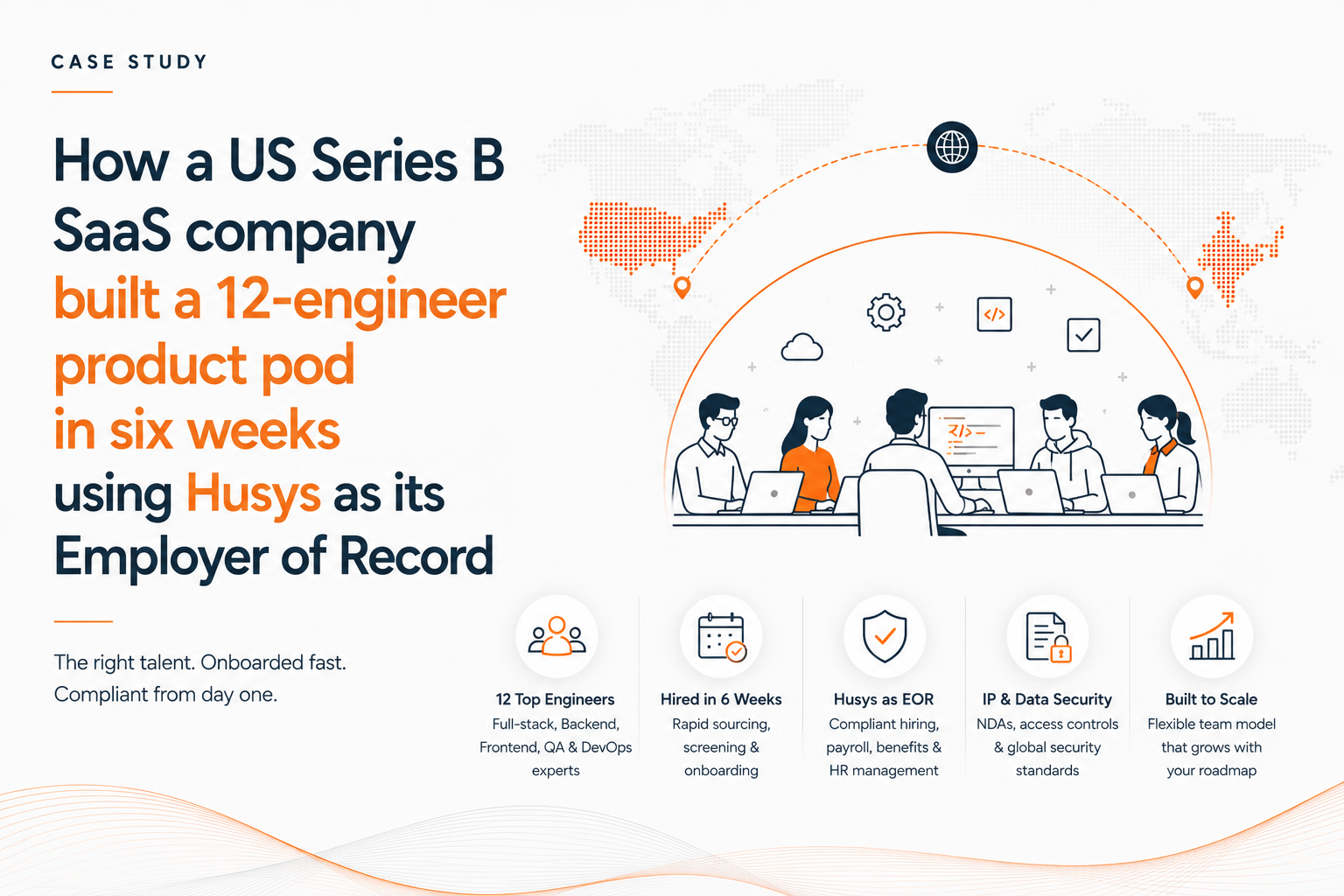
At this point the question is not “Is an EOR still possible?” It is “What does the business now need its India operation to own, control or legally perform?” If the answer remains employing and managing talent, an EOR may still fit the conclusion reached by a Series B SaaS company that kept its 12-engineer India team on EOR rather than incorporating. If it includes commercial contracting, regulated activity, local assets or a permanent corporate presence, the case for an entity strengthens. The trigger should be the business requirement not the headcount.
The 50–200 employee SMB: management bandwidth is the real constraint
A US SMB may have a CFO, an HR lead and outside counsel but not a dedicated India finance, HR, tax and corporate team. With 5–20 India employees supporting the US business, evaluate five things separately: what the India team must actually do; who will own payroll, compliance, employment issues, local advisers and corporate administration; whether you are building a long-term centre or testing; what obligations remain if you cut the team by 50%; and whether the operation needs to contract, invoice, hold assets or obtain licences in its own name.
The answer may be an EOR but reach it because of your operating requirements, not because “SMBs should use EOR.” For a lean company, the hidden cost of an India subsidiary is the management infrastructure needed to run it properly.
→ Read next: the mistakes at this stage are predictable and mostly avoidable. India Expansion Checklist for US Companies: mistakes to avoid.
What does an India exit look like from the chair you sit in?
Short answer: different in every seat. The founder’s constraint is attention, the CFO’s is forecastability, the General Counsel’s is what a wind-down reveals, and the CTO’s is that the reason they chose a hiring geography can be invalidated inside a fiscal year. Four scenarios below.
Abstract frameworks don’t get budget approved. Here is what this looks like from four specific chairs.
The YC-backed founder, 14 people, pre-Series A
You are: a founder out of a Y Combinator batch who raised a $3M seed and needs three engineers in Bengaluru because the same three people in San Francisco cost your entire runway. Your board wants global talent. Your lawyer quoted $8,000 to incorporate an Indian subsidiary and mentioned something about a resident director.
How it normally goes. You incorporate. You discover Section 149(3) of the Companies Act, 2013 requires at least one director who stays in India for 182 days or more during the financial year so you appoint a nominee or promote your first hire into a statutory office, adding a permanent governance requirement. You register for PF, ESI and Professional Tax. You appoint an auditor. You start filing.
Eighteen months later the product pivots and the India team isn’t the right team any more. You now have three employees with statutory obligations to settle, a director who has to formally resign, an audit obligation, and a corporate wind-down whose available route depends on the company’s statutory eligibility including a two-year dormancy condition before the fastest route is even open to you. Your seed-stage CFO-by-necessity is now managing an Indian corporate wind-down.
How it goes with an EOR. Three engineers onboarded as employees of the EOR’s Indian entity Husys benchmarks onboarding at 8 working hours once documents are in. No Indian directorship, no audit, no ROC calendar, no PF code in your name. If the pivot happens, you serve contractual notice, fund the statutory settlements, and you are out inside the notice period. Your exit is a line item, not a project. The founder’s actual scarce resource is attention, and the entity path creates an ongoing compliance-coordination burden that does not disappear simply because the team is small.
The CFO of a Series B drone-tech company, 90 people
You are: VP Finance or CFO at a hardware-plus-software company that just raised $22M. You need an India team for firmware, ground-control software and 24/7 flight-operations support. The board wants a three-year cost model you can defend in a diligence room.
How it normally goes. Entity setup, then a cost stack you cannot forecast cleanly: statutory audit fees that scale with turnover, transfer pricing certification once intercompany transactions cross ₹1 crore, GST registration if you invoice locally, a corporate tax rate of 35% plus surcharge and cess for a foreign company or 22% (≈25.17% effective) for a domestic subsidiary electing the concessional regime under Section 115BAA, plus FEMA reporting. Every one has a variable component. The three-year model has error bars wide enough to make a board member uncomfortable.
How it goes with an EOR. The people cost is salary plus statutory employer contributions plus a flat $99 per employee per month service fee, with no setup fee, no minimums and no volume gate. For context, SelectSoftwareReviews puts typical global EOR fixed fees at $300–$1,000 per employee per month, with platform providers commonly around $500. Against a $500 benchmark that is roughly 80% less on the service-fee line about $48,000 a year across a 10-person India team and it is the one line in the model with zero variance.
The exit math is what the board actually cares about. Ask the diligence-room question “if the India programme is cancelled at month 30, what is the wind-down cost and how long does it take?” and the entity answer is a range with an 18-month tail. The EOR answer is statutory severance plus one notice period. You can put that on a slide.
The General Counsel of a Series C fintech, 260 people
You are: first in-house counsel. Your India ops team handles reconciliation and customer support, touching financial data. You have to sign off on an India structure and then defend it to auditors, regulators and an acquirer.
Your actual fear is not the exit. It is what the exit reveals. A wind-down is when unresolved positions crystallise: whether contractors were really contractors, whether the India team’s activity created a permanent establishment, whether termination clauses were enforceable, whether employee data was handled per the Digital Personal Data Protection Act, 2023.
How it normally goes. The subsidiary is dissolved, and two years later a reassessment notice arrives. Under Section 250 of the Companies Act, 2013, the liability of every director and officer who exercised management powers continues after dissolution and may be enforced as if the company had not been dissolved. Striking off the company does not strike off the exposure.
How it goes with an EOR. The employment relationship, payroll records, statutory filings and termination documentation sit with a provider whose job is to keep them audit-ready as in the case of a Series C security platform that built its India team under DPDP-compliant contracts from day one, with access-control and IP clauses written in before the first hire, not after. Husys runs internal and external audits quarterly and holds ISO 9001 and ISO 27001 certification which matters less as a badge than as evidence that the record you will need in year three exists in retrievable form. On permanent establishment specifically, Husys monitors client invoices and deliverables against the activity being performed, which is the practical way to catch a role drifting from “builds product” toward “closes deals” before a tax officer does.
What you still own: the DAPE question. If your India-based staff habitually negotiate or conclude contracts on behalf of the US parent, dependent-agent permanent establishment risk follows the conduct, not the employment paperwork. No EOR structure fixes that. Keep contracting authority at the parent.
The CTO of a 40-person AI company
You are: deciding between sponsoring an H-1B for a researcher and building a research pod in Bengaluru.
The relevant fact is volatility, not cost. Presidential Proclamation 10973, issued 19 September 2025, imposed a $100,000 fee on certain new H-1B petitions. On 8 June 2026 the US District Court for the District of Massachusetts vacated it as an unlawful tax; on 24 July 2026 the First Circuit declined to stay that ruling pending appeal, so the fee is not currently enforceable. Other suits are pending and the proclamation carries its own September 2026 sunset. (Verify current status before relying on this it has moved several times.)
The lesson isn’t “hire in India instead of sponsoring.” It is that the reason you chose a hiring geography can be invalidated by events outside your control, in either direction, inside a single fiscal year. If US immigration policy can reverse twice in ten months, your India strategy should be built to reverse too. Commit to an entity because the India plan looks permanent, and you can end up locked into a structure designed for a world that lasted nine months. With an EOR, if the calculus flips you unwind inside a notice period rather than a liquidation. The technical work is identical. Only the reversibility differs.
→ Read next: the CTO’s decision above turns on a number, not a principle. Put your own salary and headcount into it: H-1B Alternative Cost Calculator.
🔗 Internal link: The True Cost of Hiring Employees in India · India Expansion Checklist: Mistakes to Avoid
Which US employment terms do not translate to India?
Short answer: almost all of the ones that matter. There is no at-will employment, severance is statutory rather than discretionary, the final paycheck is due in two working days rather than at the next payday, gratuity has no US equivalent, notice periods of 30 to 90 days are contractual and enforced, and director liability survives dissolution instead of being extinguished by it.
Every term below means something different from what a US reader assumes.
Concept | United States | India |
Employment basis | At-will in 49 states | Contractual. No at-will doctrine. |
Severance on termination | No federal requirement. NJ is an outlier, requiring one week per year of service under its mini-WARN statute | Statutory: 15 days’ average pay per completed year for workers, plus notice, plus re-skilling fund contribution |
Advance notice of layoff | WARN Act: 60 days, employers with 100+ employees | 1 month for individual retrenchment; prior government permission at 300+ workers |
Final paycheck | Varies by state; often next scheduled payday | 2 working days, at every salary level Code on Wages s.17(2) |
Retirement benefit | 401(k), voluntary | Provident Fund (PF), mandatory employer contribution |
Health coverage | Employer-sponsored, optional | ESI for employees under the wage ceiling, statutory |
Long-service payment | None | Gratuity, statutory, vests at 5 years (1 year for fixed-term) |
Notice period | Two weeks, customary | 30–90 days contractual, commonly enforced |
Closing a subsidiary | Certificate of dissolution; weeks to months | Strike-off (2 years dormant) or liquidation (403-day historical average, now capped at 1 year) |
Post-closure liability | Generally extinguished | Director and officer liability survives dissolution Companies Act s.250 |
Payroll cycle | Bi-weekly | Monthly |
How do you test an India structure for reversibility before you commit?
Short answer: score the structure against ten questions before the first hire exit speed, severance exposure per head, role classification, permanent-establishment conduct, offer-letter accuracy, run-rate to dissolution, thesis testing, succession, residual contracts, and whether you can separate employee obligations from entity obligations. Ten out of ten means you have optionality. Six or fewer means you are carrying an exit you cannot cost or schedule. It is a reversibility test, not a headcount test.
The strongest India-entry structure is not the one that is easiest to launch. It is the one that gives the company a clear, workable path to scale, restructure or exit if the business changes.
Factor | More reversible → EOR may fit | Less reversible → Entity may fit |
India strategy | Testing / uncertain | Proven / permanent |
Business activity | Primarily hiring | Operating commercially |
Indian customers | No local contracting needed | Local contracting/invoicing needed |
Licences | Not required | Required |
Local assets | Minimal | Material |
Workforce | Small / being tested | Large / stable |
Expected duration | Uncertain | Long-term |
Need to scale down | High | Low |
The more your India operation requires its own commercial, regulatory or asset-holding infrastructure, the less an employment-only structure solves. That is why the exit decision should be tested at Day 0, before the first employee is hired.
What questions belong on a Day-0 reversibility scorecard?
Short answer: the ten below. Score one point for each honest “yes”. Every “no” is exit cost you are pre-committing to, and the right-hand column tells you what that particular “no” will cost you.
# | Question | If the answer is no |
1 | Can we exit this structure inside 90 days? | You are accepting a wind-down project, not a wind-down decision. |
2 | Do we know our all-in severance exposure per head, today? | Build the model now. It only grows. |
3 | Have we classified every India role against the IR Code “worker” definition? | Your severance estimate is probably low. |
4 | Does any India-based person negotiate or conclude contracts for the US parent? | You have a dependent-agent PE question regardless of employment structure. |
5 | Are our India offer letters and our actual practice identical? | This is the single most common source of termination disputes. Fix it before you need it. |
6 | If we stop operating tomorrow, what is our monthly run-rate until dissolution? | Budget 12–24 months of it. |
7 | Have we tested the India thesis before committing capital to an entity? | Test with a reversible structure first. |
8 | Does our exit plan survive the CFO or GC leaving? | Write it down. Institutional memory is not a plan. |
9 | If we decided to leave India in 12 months, do we know which contracts, registrations, assets and liabilities would remain? | You cannot price the exit, only guess at it. |
10 | Can we say which obligations belong to the employees and which belong to the Indian entity? | The two clocks will surprise you. Separate them now. |
Score 10/10 and you have optionality. Score 5/10 and you have a commitment you haven’t priced.
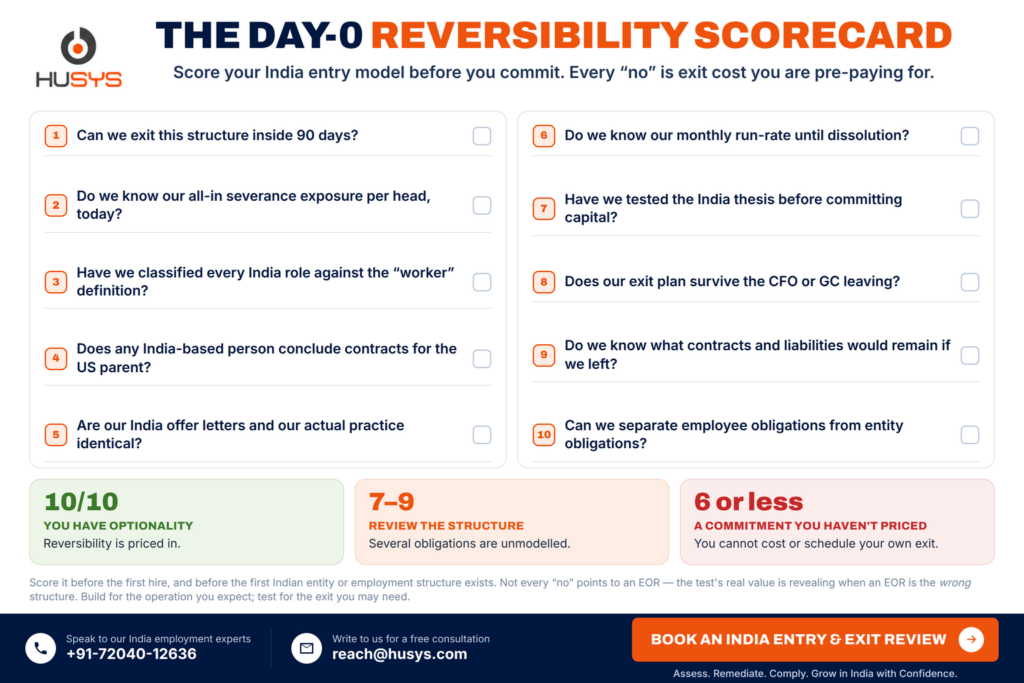
Figure: Score the structure before the first hire. Every “no” is exit cost you are pre-committing to.
Does a low score mean we should use an EOR?
Short answer: no. A company does not need every answer to point toward an EOR. In fact, the value of the test is that it can reveal when an EOR is not the appropriate structure. The objective is to identify the obligations created by the proposed India operating model before those obligations become expensive to unwind. The decision runs as a chain:
Entry structure → employment obligations → corporate obligations → ongoing compliance → scale/restructure options → exit path
If the company cannot explain each step before entering India, it does not yet have an India operating structure. It has an India entry plan with unanswered liabilities.
The Husys operating principle: build for the operation you expect, test for the exit you may need. That does not mean planning to fail in India. It means recognising that an India strategy can change through hiring plans, a restructuring, an acquisition, a change in business model or a decision to exit. The structure chosen on Day 0 determines how much flexibility you have when it does.
CTA decision moment. Scored below 7? Download the India Exit Cost Worksheet and model the gap before you sign anything.
What do US companies most often get wrong about leaving India?
Short answer: nine things, and they cluster. Contractors are assumed to be outside the regime; strike-off is assumed to be available; a dormant entity is assumed to be free; dissolution is assumed to end liability; and the two-day settlement rule and the 300-worker threshold are both assumed to be new. Each of those assumptions is wrong, and each one surfaces on the way out.
“We’ll just use contractors, so none of this applies.” Misclassification is the most expensive shortcut in India. A contractor who works fixed hours, uses your systems, reports to your manager and has no other clients is an employee in substance and reclassification brings backdated PF, ESI, gratuity, retrenchment rights and penalties, usually surfacing precisely when you try to end the relationship. Contractor overuse is one of the most reliable predictors of a painful India exit.
“We’ll strike the company off it’s 90 days.” Only if you have extinguished all liabilities and have not carried on business for the two preceding financial years. Section 249 additionally bars the application if, within the previous three months, you changed the company’s name, shifted the registered office between states, disposed of property for gain, or engaged in any activity beyond winding up.
“The entity is dormant, so it costs nothing.” Statutory audit, ROC filings, income tax returns, the annual FLA return and nil EPFO returns all continue. Non-filing of annual returns for three consecutive years disqualifies directors for five years under Section 164(2) which then affects their ability to sit on any Indian board.
“Dissolution ends our liability.” Section 250 of the Companies Act, 2013 provides that the liability of every director, officer and member continues after dissolution and may be enforced as if the company had not been dissolved.
“Our EOR handles compliance, so PE risk is handled.” Employment-based PE risk shifts. Conduct-based risk does not. If India staff habitually conclude contracts for the parent, dependent-agent PE exposure remains, whoever signs their payslip.
“Notice periods are just a formality.” India routinely enforces 60–90 day notice on both sides. Build it into every timeline hiring and exit.
“The two-working-day settlement rule is brand new, so we have time to adjust.” The deadline dates from Section 5(2) of the Payment of Wages Act, 1936. What changed on 21 November 2025 is that the wage ceiling limiting it was removed, so it now applies to your most senior and most expensive India exits too. There is no transition period.
“The 300-worker permission threshold is a new liberalisation.” It is a restoration of the 1976 position. See the history below the threshold section and note that states can notify a lower number for their own jurisdiction.
“The Labour Codes are still on paper.” They came into force on 21 November 2025. Central Rules followed on 8 May 2026. State rules are landing on staggered timelines, which means a multi-state India team may currently face different obligations in Mumbai and Chennai. Track the states you actually employ in.
Five red flags that should make you pause before incorporating: you are still testing whether India will work; your immediate requirement is hiring rather than operating a local business; you cannot yet estimate long-term India headcount or duration; you have not modelled the cost of reducing the team or closing the operation; nobody internally owns the eventual corporate wind-down. None of these automatically means an EOR is right. They mean the case for a permanent corporate structure deserves another look.
Exit planning in India: frequently asked questions
- Can a US company close its Indian subsidiary quickly?
Sometimes but only if it qualifies for the applicable route and has satisfied the conditions. Strike-off under Section 248(2) requires no liabilities, no employees and no business carried on for two preceding financial years; the Ministry of Corporate Affairs told Parliament in November 2024 that average C-PACE processing had fallen to 70–90 days for eligible applications. A company that cannot use strike-off may need a formal liquidation or another closure process, with the timeline depending on its assets, liabilities, employees and outstanding statutory obligations.
2. Do we have to pay severance in India?
Yes, for workers. Under Section 70 of the Industrial Relations Code, 2020, retrenchment requires one month’s notice or wages in lieu, plus 15 days’ average pay for every completed year of continuous service, plus a 15-day wage contribution to the worker re-skilling fund under Section 83. Gratuity is separate and additional. Unlike the US, this is not discretionary.
3. How long does it take to close a company in India?
Strike-off: roughly 70–90 days of processing, but only after you qualify. Voluntary liquidation historically averaged 403 days to final report, plus the wait for a dissolution order. The IBC Amendment Act, 2026, in force from 26 May 2026, introduces a one-year statutory limit for completing voluntary liquidation but that is not a guaranteed end-to-end exit date, because dissolution and other outstanding obligations still affect the overall unwind. For a genuinely operating entity, plan 12–24 months end to end, and start the clock only after employees are lawfully off the books.
4. What happens to our employees if we close the India entity?
Employee exits are handled separately from the corporate closure. Depending on the employee’s legal classification, the reason for termination, the applicable law and the circumstances of the closure, obligations can include notice or notice pay, retrenchment compensation, gratuity, leave encashment and other statutory or contractual dues. All wages owed must be paid within two working days of the last working day under Section 17(2) of the Code on Wages, 2019. For workers covered by the applicable retrenchment provisions, additional Industrial Relations Code requirements apply, and establishments meeting the applicable 300-worker threshold need prior government permission before closure.
5.When exactly does the two-working-day settlement deadline apply, and what was the rule before?
It applies to every employee at any salary level, on removal, dismissal, retrenchment, resignation, or unemployment caused by the establishment closing, under Section 17(2) of the Code on Wages, 2019, in force since 21 November 2025. Before that, Section 5(2) of the Payment of Wages Act, 1936 imposed the same two-working-day deadline but only for employees under that Act’s wage ceiling ₹24,000 a month from 28 August 2017, and ₹18,000 before that and only where the employer terminated the employment, not where the employee resigned. Above the ceiling, settlement ran on contract and policy, and market practice was 30 to 45 days. The deadline is old; its universal coverage is new.
6. Is the 300-worker permission threshold a new rule?
It is a restoration. Chapter V-B of the Industrial Disputes Act, 1947 was inserted by the 1976 amendment at a 300-workman threshold, reduced to 100 by the 1982 amendment with effect from 1984, and Section 77 of the Industrial Relations Code, 2020 returned it to 300 from 21 November 2025. The 100 threshold stood for roughly 41 years, which is why older India guidance still quotes it. States can notify a lower threshold for their own jurisdiction.
7. Is exiting easier with an Employer of Record than with our own entity?
The severance owed to employees is identical. What differs is everything else: no company to strike off, no liquidation, no dissolution order, no capital to repatriate under FEMA, and no residual director liability under Section 250. In practice the corporate wind-down work is largely avoided, and the exit becomes the notice period in your service agreement commonly 30 to 60 days rather than a 12-to-24-month corporate process. The workforce transition and contractual termination still have to be completed under the agreement and applicable law.
Can we just stop filing and let the company lapse? No. Non-filing triggers registrar action, and directors of companies that fail to file annual returns for three consecutive financial years are disqualified for five years under Section 164(2) of the Companies Act, 2013. That disqualification follows the individual to every other Indian board they sit on.
8. Do we still owe anything after the company is dissolved?
Potentially. Section 250 of the Companies Act, 2013 preserves the liability of directors, officers and members after dissolution, enforceable as if the company still existed. Tax assessments can also be reopened.
9. How do we get our capital back out of India?
Repatriation of winding-up proceeds runs through an AD Category-I bank and requires FEMA compliance, an auditor’s certificate confirming the winding up complies with applicable law and that no proceedings are pending, Form 15CA/15CB, and evidence that tax obligations are settled. It is a documented process, not an automatic transfer, and one of the more common causes of delay.
10.Are our India software engineers “workers” under Indian labour law?
Possibly yes. Section 2(zr) of the Industrial Relations Code, 2020 includes technical work in the definition of “worker”. The exclusions cover people employed mainly in a managerial or administrative capacity, and supervisory staff earning more than ₹18,000 a month that wage ceiling applies only to supervisory roles, not to well-paid individual contributors. Take advice on your specific roles; the Codes do not define “manager” or “supervisor”, and Parliament’s own Standing Committee flagged that gap.
11. Does using an EOR eliminate permanent establishment risk in India?
It reduces it substantially by removing the employment relationship and the fixed place of business from your name, but it does not eliminate conduct-based risk. If India-based personnel habitually negotiate or conclude contracts on behalf of the US parent, dependent-agent PE exposure under Article 5 of the US–India tax treaty remains, regardless of who employs them on paper.
12. What is the corporate tax rate for a foreign company in India?
The base rate for foreign companies was reduced from 40% to 35% by the Finance (No. 2) Act, 2024, with surcharge of 0/2/5% depending on income and a 4% health and education cess on top. A domestic subsidiary electing the concessional regime under Section 115BAA pays 22% base, roughly 25.17% effective.
13. What should we do differently if we’re entering India right now?
Price the exit before you sign the entry. Model your all-in severance per head, classify every role against the “worker” definition, keep contracting authority with the US parent, and use a reversible structure until the India thesis is proven. Reversibility is cheap to buy at the start and expensive to retrofit.
Bottom line: what should exit planning in India change about your entry decision?
Decide your India operating structure with the exit path in mind. That is what exit planning in India means in practice: not a wind-down runbook, but an entry constraint. An Indian subsidiary may provide the legal and commercial infrastructure a substantial operation needs, but it also creates corporate, employment, tax and compliance obligations that must eventually be closed. An EOR can simplify the employment and corporate wind-down for companies whose India activity does not require their own entity but it does not eliminate employee obligations, or every India-related tax and regulatory consideration.
The right question is not “Is an EOR better than an Indian entity?” It is:
“What does our India operation need to do today, and what will we have to unwind if that strategy changes tomorrow?”
The Exit-Before-Entry Framework. Before incorporating in India, work through the decision in this order:
Business activity → workforce required → employment model → statutory obligations → does the activity require an Indian entity? → ongoing compliance burden → reversibility requirement → exit exposure → choose the structure
The point is to avoid starting with “Should we set up an Indian subsidiary or use an EOR?” Start with what the India operation actually needs to do. If the requirement is primarily to employ people while the strategy is being tested, a reversible employment structure deserves consideration. If the operation needs its own commercial, regulatory or asset-holding infrastructure, an entity may be necessary regardless of the workforce model. The structure should follow the business requirement not the other way around.
For a US company, that decision should be made before the first hire, not when the exit begins.
So what should you actually do before entering India?
Short answer: price the exit before you sign the entry. Model all-in severance per head, classify every India role against the “worker” definition, keep contracting authority with the US parent, and use a reversible structure until the India thesis is proven. That work takes an afternoon at the start and is close to impossible to retrofit at month 30.
Competitors will tell you how to exit India. The more useful question the whole point of exit planning in India is why exit difficulty should shape how you enter.
The data supports a fairly narrow conclusion. Around 245 foreign-owned Indian subsidiaries wind down each year. A formal corporate wind-down can extend well beyond a year historical voluntary-liquidation data shows an average of 403 days to final report, with the applicable route and the company’s condition determining the actual timeline, although the statutory framework is now designed to compress some of that. Employee exits carry significant statutory and contractual costs, roughly 38% of annual salary as a floor and more in practice.
None of that is a reason to avoid India 2,117 Global Capability Centres and 2.36 million people say otherwise. It is a reason to enter India in a shape you can leave.
If you’re evaluating India expansion now, the single highest-leverage thing you can do is model the downside before you commit the capital. That takes an afternoon at the start and is nearly impossible to unwind at month 30.
Talk to someone who has run both paths. Husys has operated in the India PEO and EOR market for 24+ years, currently supports 450 active clients and 8,000+ employees across all 28 states and 6 union territories, and when clients with their own entity decide to leave helps close the company and its registrations. Average client tenure is over four years, which mostly means our clients don’t need the exit plan. They just wanted one before they started.
Book a 30-minute India entry-and-exit risk review. No pitch. We’ll model your severance exposure, classify your roles against the Labour Codes, and tell you honestly whether an entity or an EOR fits your situation including the cases where it’s an entity.