
When evaluating an Employer of Record (EOR) for India compliance, US companies should ask five things: which Indian entity is the legal employer, which PF, ESI and tax registrations that entity holds, which states it can legally employ in, how it handles termination and exit, and who carries liability if a filing is missed. Then verify each answer on Indian government portals rather than treating a confident response as proof.
The important distinction is between asking and verifying. An EOR can tell you it is compliant; you should also be able to see what evidence supports that answer. Registration details, statutory records, employment documentation and contractual responsibilities give you a basis for checking the structure before you sign.
This India EOR compliance guide is written for US companies evaluating an Employer of Record for employees in India. It gives you the questions to ask, the evidence to request, the warning signs to look for, the government sources you can use to verify key claims yourself, and a weighted scorecard, a copy-paste due-diligence email and a two-week evaluation plan you can run today.
Key takeaways
|
Three regulatory changes that reshaped the questions in 2026
Three regulatory developments between November 2025 and September 2026 reshaped India EOR compliance this year, and they changed what to ask an EOR provider for India compliance.
A provider should be able to explain which changes are relevant to your employees, locations, payroll and employment processes, and how each is being handled in practice.
1) The four Labour Codes came into force on 21 November 2025. (As of September 2026, in force but with rules still being notified.) The Code on Wages, 2019, the Industrial Relations Code, 2020, the Code on Social Security, 2020 and the Occupational Safety, Health and Working Conditions Code, 2020 replaced 29 central labour Acts, including the Payment of Gratuity Act, 1972, the Maternity Benefit Act, 1961, the Payment of Bonus Act, 1965 and the Industrial Disputes Act, 1947 (Press Information Bureau, 21 November 2025). Those Acts are repealed. Ask: “Which provisions are you applying today, and which are you waiting on?” If a provider’s contract or FAQ still cites “the Payment of Gratuity Act, 1972” as live authority in 2026, its documentation has not been updated in ten months.
2) Implementation is still moving. The Codes are in force, but the rules and guidance that operationalise them still require attention to the relevant state and employment situation. The Ministry of Labour & Employment was still issuing clarificatory FAQs on the Codes as late as 16 March 2026.
Labour is a concurrent subject in India, so central provisions and state-level rules both matter. The practical question for a buyer is not simply whether the Codes are “in force,” but which provisions and applicable state requirements the provider is applying to your employees today, which remain subject to further notification, and how the provider will communicate material changes.
Ask: “How will you tell us when a rule changes for our employees?”
3) India replaced its income tax statute. The Income-tax Act, 2025 and the Income-tax Rules, 2026 took effect on 1 April 2026. For payroll this is not cosmetic: salary withholding moved from section 192 to section 392, the quarterly withholding statement moved from Form 24Q to Form 138, and the annual salary tax certificate your India employees receive moved from Form 16 to Form 130 (Income Tax Department, Form No. 138).
Ask: “Which form numbers are you filing on?”
It is a thirty-second question with a binary answer, and it tells you whether their payroll engine was updated in April 2026 or not.
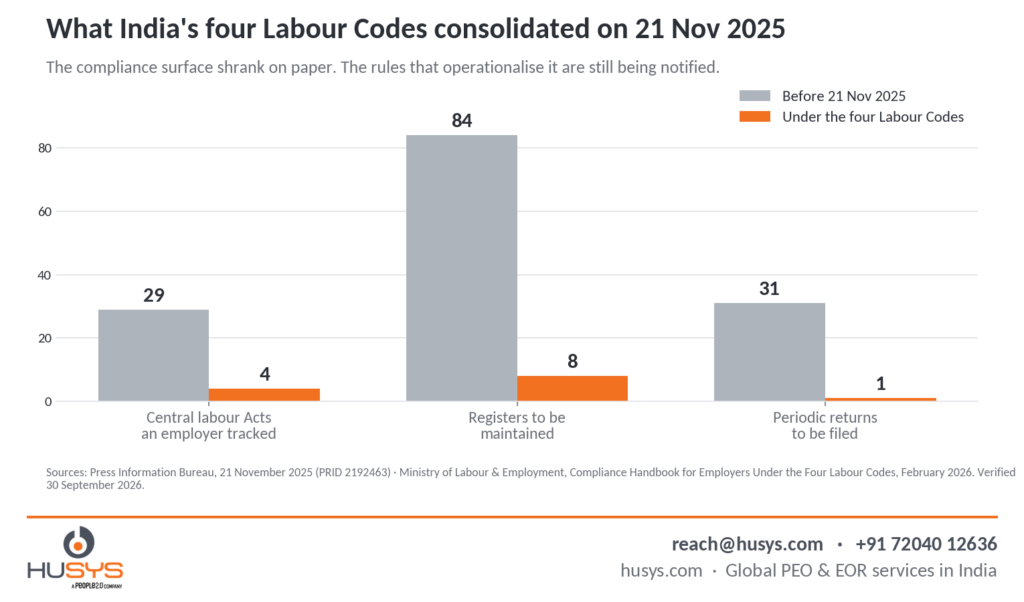
29 central Acts became 4 Codes; 84 registers became 8; 31 returns became 1. The compliance surface shrank on paper, the rules that operationalise it are still being notified. Sources: Press Information Bureau, 21 November 2025; Ministry of Labour & Employment, Compliance Handbook for Employers Under the Four Labour Codes, February 2026.
For the full breakdown of what the Labour Codes changed, see our guide to India’s four Labour Codes
What does India EOR compliance actually cover?
Most US buyers arrive with a mental model borrowed from a domestic payroll vendor: the provider calculates pay, withholds tax, files something quarterly, and sends a year-end form. An India EOR covers a much broader employment and compliance lifecycle, including statutory registrations, payroll, labour-law requirements, benefits administration, termination and record-keeping.
What is an Employer of Record (EOR) in India? An Employer of Record in India is the legal employer of your workers. The employment contract is between the EOR’s Indian entity and the employee. The EOR is the entity named on the Provident Fund registration, the one that appears on the employee’s payslip, the one a labour inspector visits, and the one a labour court summons. In practical terms: you direct the employee’s work under the commercial arrangement, while the EOR carries the employment relationship and the statutory employer obligations. |
“India compliance” covers, at minimum:
- Statutory social security, Provident Fund (PF) and Employees’ State Insurance (ESI) registration, monthly remittance, and return filing.
- Payroll tax withholding, monthly deposit of salary tax deducted at source (TDS), quarterly statements, annual certificates.
- State-level obligations, Professional Tax in the states that levy it, plus registration under the relevant Shops & Establishments legislation for each location you hire in.
- Labour law compliance, appointment letters, working hours, leave, holidays, minimum wages, bonus, gratuity.
- Statutory benefits administration, maternity benefit, and the Internal Committee required under India’s workplace sexual harassment (POSH) law.
- Termination law, notice, cause, statutory severance, and full-and-final settlement.
- Data protection, obligations under India’s Digital Personal Data Protection framework.
- Record-keeping, statutory registers and returns, consolidated under the Codes to eight registers and a single electronic return.
It is not:
- A substitute for tax advice on Permanent Establishment. An EOR changes who legally employs your people. It does not, on its own, determine whether your company has created a taxable presence in India. More on this below.
- A way to keep contractors as contractors. If the working relationship looks like employment, calling it something else is the exposure, not the fix.
- Appropriate when you are selling into India. If your India team is generating India-sourced revenue, securing orders, or concluding contracts, you are in different territory and you need Indian tax counsel before you need an EOR.
An EOR changes who employs your people. It does not, on its own, decide whether you have a taxable presence in India.
For the full explainer on how an EOR works, see our India EOR guide.
EOR vs your own Indian entity
Almost everything in what to ask an EOR provider for India compliance comes back to this comparison, and it is rarely written down honestly.
Here is the same job, putting one compliant employee on the ground in India, executed two ways.
The normal route: your own Indian entity
You incorporate a private limited company, usually a wholly-owned subsidiary.
India has made this genuinely easier: the SPICe+ form bundles eleven services into one filing, name reservation, incorporation, director identification, PAN, TAN, EPFO registration, ESIC registration, Professional Tax registration in Maharashtra, Karnataka and West Bengal, a mandatory bank account, GST allotment, and Shops & Establishment registration in Delhi (Ministry of Corporate Affairs).
The filings are fast. The surrounding work is not. For a US parent, the calendar is consumed by apostilling and translating parent-company documents, bank know-your-customer processes, and inbound capital reporting to the Reserve Bank of India.
Then the entity exists, and now it is permanent.
You have a statutory audit every year regardless of turnover, annual Registrar of Companies filings, corporate tax returns, GST returns, transfer pricing certification on every transaction with the US parent, and an annual Foreign Liabilities and Assets return and follow regulatory guidelines if you are operating in industries such as Insurance, Finance, Food, Healthcare.
You have created a legal person that costs money to keep alive and costs money to wind down. And you still have to solve payroll compliance separately.
India | US equivalent | Who issues it | Notes |
Name reservation (RUN / SPICe+ Part A) | Name availability check and optional name reservation | State Secretary of State (e.g., Delaware Division of Corporations) | Optional in most states, since you can file formation documents directly. If you trade under a different name, file a DBA / assumed name. |
Incorporation (SPICe+, MCA/ROC) | Certificate/Articles of Incorporation (C-Corp) or Articles of Organization (LLC) | State Secretary of State | You must appoint a registered agent in the state. To operate in other states, you also need foreign qualification in each one. |
Director identification (DIN) | No equivalent | n/a | Directors and officers don’t need ID numbers. They’re listed in the state annual report / statement of information. Federal beneficial ownership (BOI) reporting to FinCEN now applies only to foreign-formed companies (US companies were exempted in 2025). |
PAN | EIN (Employer Identification Number) | IRS (Form SS-4, free online) | Needed to open a bank account, hire, and file taxes. |
TAN | No separate number, the EIN covers it | IRS | The same EIN is used for payroll withholding. Deposits go through EFTPS and returns on Forms 941/940. |
EPFO (provident fund) | Social Security & Medicare (FICA), with no separate registration | IRS / SSA via the EIN | 401(k) plans are voluntary. Some states (e.g., California, Illinois, Oregon) require employers without a plan to sign up for a state retirement program. |
ESIC (state insurance) | State Unemployment Insurance (SUI) registration, plus workers’ compensation insurance | State workforce agency; private or state insurer | Some states also require state disability / paid family leave (CA, NY, NJ, RI, HI and others). The ACA employer mandate applies at 50+ full-time staff. Federal unemployment tax (FUTA) is paid under the EIN. |
Professional Tax (Maharashtra, Karnataka, West Bengal) | State income tax withholding registration in each state where employees work, plus local taxes where they apply | State Department of Revenue (CA uses the EDD); cities/counties | The closest match to PT is Pennsylvania’s Local Services Tax, a flat annual per-employee levy. Local taxes also apply in NYC and many Ohio cities. States with no income tax (e.g., TX, FL, WA) need no withholding registration. |
Mandatory bank account | Business bank account | Any US bank | Not legally required, but needed in practice. Banks ask for the EIN, formation documents and bylaws/operating agreement. There’s no minimum paid-up capital. |
GST | Sales tax permit / seller’s permit | Each state where you have nexus | There’s no federal VAT/GST. Economic nexus thresholds apply after the Wayfair ruling. Many services are exempt, and five states have no statewide sales tax (AK, DE, MT, NH, OR). |
Shops & Establishment (Delhi) | Local business license / business tax registration | City or county (e.g., LA Business Tax Registration Certificate, DC Basic Business License) | Some businesses also need zoning clearance or a certificate of occupancy, and certain industries need state licenses. |
The EOR route
The provider’s Indian entity already exists, is already registered with the Employees’ Provident Fund Organisation and the Employees’ State Insurance Corporation, already has a tax deduction account number, and already runs a monthly statutory calendar.
Your employee is onboarded onto an existing compliance machine rather than a new one built for them.
You get a single per-employee cost instead of an entity’s fixed overhead.
When you stop hiring in India, you stop paying; there is no company to wind down.
The honest trade-off: you do not control the legal employer. You are dependent on someone else’s compliance discipline. That dependency is precisely why the vetting questions below matter, and why “how do I verify this myself” is the most important section of this article.
Side by side: your own India entity vs an EOR
Dimension | Your own Indian entity | EOR route |
|---|---|---|
Legal employer | Your subsidiary (you control it) | The provider’s Indian entity (you depend on it) |
Time to first hire | Weeks to months (apostille, KYC, RBI reporting) | Days, onto existing registrations |
Fixed overhead | Statutory audit, RoC filings, corporate tax, GST, transfer pricing, FLA return, regardless of headcount | None; a single per-employee fee |
Cost shape | Fixed cost you amortise across headcount | Variable cost that scales with hires |
Exit | Wind-down cost and time | Stop hiring, stop paying, nothing to wind down |
Best fit | You are building an India operating business or generating India revenue | You are hiring talent to serve your home-market business |
There is no universally correct column. There is a correct column for your situation, and the provider who tells you honestly when the left column is better is the one worth trusting on everything else. For a full cost model of both routes, see our EOR vs subsidiary comparison.
The statutory cost stack a good provider must be able to show you
Before the questions, the arithmetic, because EOR India compliance checklist conversations tend to skip it, and because a provider who cannot explain this to you should not be running your payroll.
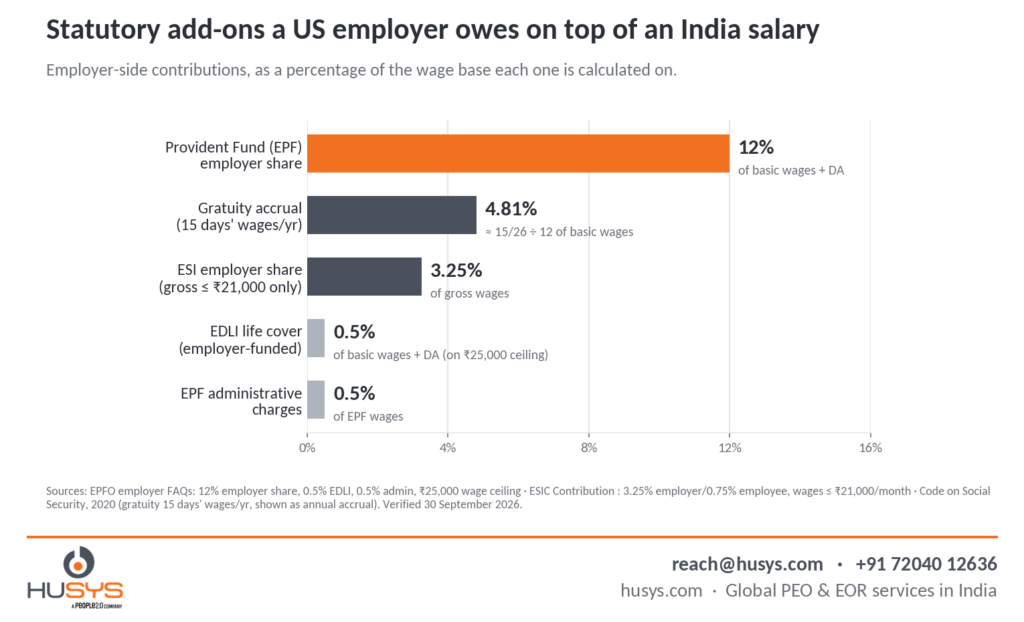
Numbers a good provider must be able to show you
Item | Current rate / ceiling | Ask | Red flag |
|---|---|---|---|
Provident Fund (PF) | 12% employee + 12% employer on basic + DA; statutory wage ceiling ₹25000/month. Balances earned 8.25% for FY 2025-26. | Which wage base do you use, and does the ₹25,000 ceiling apply? | The same answer for every salary regardless of structure |
ESI | 3.25% employer + 0.75% employee, for employees earning ₹21,000/month or less (gross). Coverage expanded to 713 districts as of 10 Nov 2025. | Is this employee above or below the ESI threshold? | Quoting ESI on every hire, it does not apply above the threshold |
Gratuity | 15 days’ wages per completed year; payable after 5 years (1 year for fixed-term). Accrues from day one. | Whose books hold the accrued gratuity liability? | Treating it as an exit-day expense only |
Statutory bonus | 8.33%-20% of wages; eligibility ceiling ₹21,000/month, calculation ceiling ₹7,000/month or minimum wage, whichever is higher (notified August 2026, retrospective to 21 Nov 2025). | How is bonus calculated for this salary band? | No awareness of the August 2026 ceilings |
Professional Tax | State levy in around 20 states and union territories; not levied in Delhi, Haryana, Uttar Pradesh or Rajasthan. | Is PT payable in my employee’s state? | “It’s the same everywhere” |
What happens above the ESI threshold?
ESI is a government-run health plan, workers’ compensation and short-term disability insurance combined into one payroll contribution.
Once an employee earns more than ₹21,000/month, ESI stops applying, and group medical insurance (GMC) takes its place. No law requires it, but most employers make enrollment compulsory under company policy, so employees usually can’t opt out.
The employer negotiates the premium and coverage (sum insured, dependants, maternity, pre-existing conditions) with an insurer or broker. In many companies, that cost is then recovered from the employee, either as a monthly payslip deduction or by including it in CTC.
Add-ons such as parents’ cover or top-ups are usually optional and deducted on top.
Why this matters for US employers: insurance is often the line item that makes the “in-hand” salary lower than candidates expect. Decide upfront whether you’ll absorb the premium as an employer benefit or recover it from salary, and state it in the offer letter. Candidates compare in-hand pay, and an unexplained deduction is a common source of early attrition and disputes.
Gratuity: What’s the US Equivalent?
There isn’t one. The closest comparison is a statutory loyalty bonus, owed by law, paid as a lump sum when an employee leaves after long service. Unlike US severance, it isn’t negotiated and doesn’t depend on why the employee is leaving. Resignation, retirement, layoff, death or disablement all trigger it once the service condition is met.
Minimum Service by Employee Category
Employee category | Minimum continuous service |
Permanent employees (private sector, including IT/ITES, SaaS, manufacturing, retail) | 5 years |
Fixed-term employees | 1 year (pro-rata) |
Working journalists | 3 years |
Death or disablement (any category) | No minimum |
How It Should Work (The Law)
- Formula: last drawn wages × 15/26 × completed years of service. A final year with more than 6 months counts as a full year.
- Wages: basic + DA. Under the new labour codes, if allowances exceed 50% of total pay, the excess is added back to the wage base.
- Payment: within 30 days of becoming payable. Late payment attracts interest.
What It Costs: Worked Examples
(At ₹96 = $1, rate as of 1 October 2026)
Scenario | Monthly basic | Monthly accrual (4.81%) | Gratuity at exit |
Fixed-term, 1 year | ₹50,000 ($521) | ₹2,404 ($25) | ₹28,846 ($300) |
Permanent, 6 years | ₹50,000 ($521) | ₹2,404 ($25) | ₹1,73,077 ($1,803) |
Senior tech hire, 8 years | ₹1,00,000 ($1,042) | ₹4,808 ($50) | ₹4,61,538 ($4,808) |
How It Works in Reality
Many Indian employers quote gratuity as part of CTC without explaining it. The employee sees a CTC figure in the offer letter, but the gratuity portion never appears in monthly in-hand pay, and it’s only paid if they complete the qualifying service. When this isn’t spelled out, it becomes one of the most common sources of offer-letter confusion and exit disputes.
Gratuity also builds up as a liability from day one, even though it’s paid years later. Treating it only as an exit-day expense is a common mistake: a long-serving employee’s exit can trigger a large payout in a single month.
Tax on Gratuity
- For private-sector employees, gratuity is tax-free up to the lowest of: the actual amount received, the formula amount, or ₹20 lakh (about $20,833), a lifetime cap across all employers.
- Anything above that is taxed as salary at the employee’s slab rate, and the employer deducts TDS at payout.
How Husys Handles Gratuity
At Husys, we guide employers strictly by statutory rules. Gratuity terms (eligibility, how it’s calculated and how it sits within CTC) are stated clearly in the offer letter issued to the employee on the client’s behalf, and again in the service agreement between Husys and the client. The employee knows what they’re entitled to and when, the client knows the liability they’re building, and nothing comes as a surprise at exit. With 24+ years in India and ISO 9001 and 27001 certification, Husys manages these obligations for 450+ active clients through our in-house legal and compliance team.
Hiring in India? Get Gratuity Right from the Offer Letter.
Talk to Husys about compliant India hiring with clear CTC structures, statutory benefits handled end to end, and onboarding within 8 working hours.
A note on the wage definition. Under the Code on Wages, if the excluded allowance components exceed 50% of total remuneration, the excess is added back into “wages” for statutory calculation. In practice, salary structures engineered to keep “basic” artificially low, historically common in India, no longer reduce PF and gratuity exposure. Ask your provider how they have restructured compensation in response. If the answer is “we haven’t,” their cost model and yours are both wrong. (This is the test behind Q7 below.)
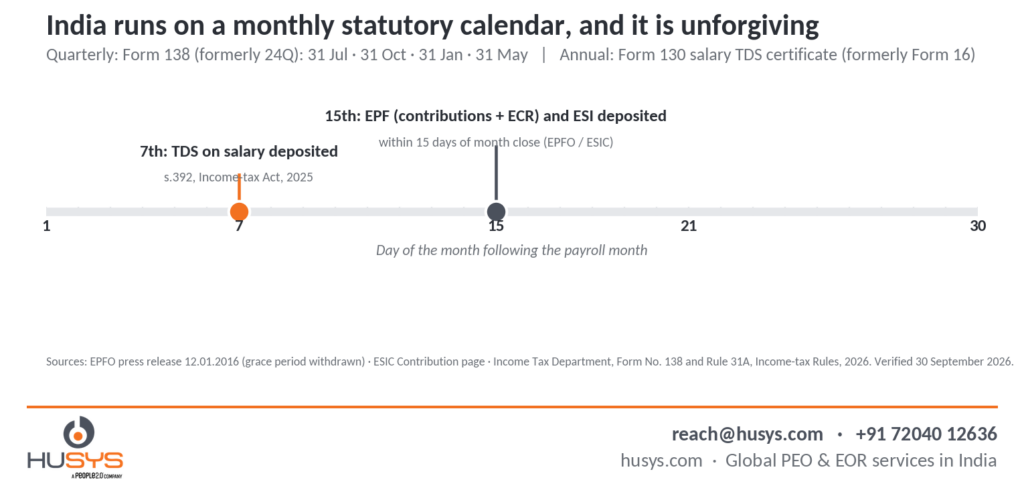
Illustrative only, confirm with your compliance team. On a sample ₹20,00,000 (≈$21,053) salary with basic at 50%, employer statutory add-ons run to roughly $1,787/year before any ESI or bonus (both excluded above their thresholds). Assumptions shown in the image; ₹95 = $1 (September 2026). Use this as the shape of a “good answer” to Q4, not a quote.
Ask for their monthly statutory calendar
The deadline list below is not payroll trivia, it is a test. A provider who can recite this calendar and name the day they need your inputs has a real monthly process. One who cannot has no calendar. In our experience, the biggest adjustment for US buyers is that Indian payroll is monthly, not bi-weekly, and it is bounded by hard statutory deadlines:
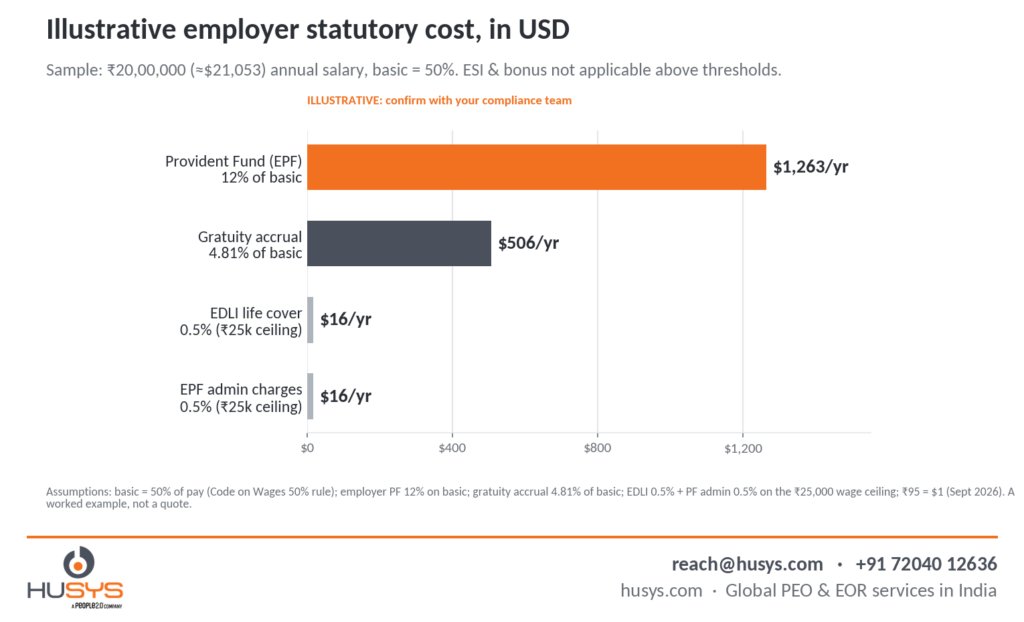
Salary TDS by the 7th; PF (with the ECR) and ESI within 15 days of month close; Form 138 quarterly (31 Jul / 31 Oct / 31 Jan / 31 May); Form 130 annually after 31 March. Sources: EPFO press release, 12 January 2016 (grace period withdrawn); ESIC Contribution; Income Tax Department, Rule 31A.
The test to run “On what day do you need our payroll approval to meet the 7th (TDS) and 15th (PF/ESI) deadlines, and what happens if we are late?” A provider who cannot name a cut-off day has no calendar, and the penalties for a missed PF remittance or a late TDS deposit fall on the employing entity, which is them, not you. |
How Husys Manages the Calendar
For US companies hiring in India, the hard part isn’t knowing the dates. It’s tracking them across multiple states, each with its own Professional Tax and Labour Welfare Fund rules. Husys operates across 28 states and 6 union territories, and our in-house legal and compliance team handles every filing, deposit and return on time. With quarterly internal and external audits, compliance issues are caught early, not discovered during an audit.
Stay Compliant in India Without Tracking a Single Deadline
Husys takes care of PF, ESI, Professional Tax, TDS and labour law compliance end to end, backed by 24+ years of India expertise and ISO 9001 and 27001 certification.
What should your company decide before hiring through an EOR?
Before you ask an EOR provider for a proposal, define the facts that will determine the employment structure, statutory costs and responsibilities. This gives you a consistent basis for comparing providers and prevents important assumptions from being buried in the proposal. Before the first hire, confirm:
- Where will the employee physically work?
What we see at Husys: 96% of employees in our EOR portfolio work remotely, 3%in hybrid arrangements and 1% are office-based. What to confirm: the employee’s actual work location before onboarding, because state-specific employment requirements can affect registrations, leave, holidays and other statutory obligations.
- What role and employment arrangement are you hiring for?
What we see at Husys: 92% of our EOR hires are full-time employees, with technology and professional roles representing a significant share of the portfolio. What to confirm: the role, employment type and expected start date before asking the EOR to structure the employment.
- What compensation structure are you proposing?
What we see at Husys: a standard $99 per-employee-per-month EOR service fee, separate from the employee’s salary, statutory employer costs, taxes, benefits and any other agreed employment expenses. What to confirm: the proposed compensation structure so the EOR can calculate the total employment cost accurately, including any pass-through charges.
- Who will provide and approve payroll inputs?
What we see at Husys: clients typically provide and approve employee-level payroll inputs such as salary changes, bonuses, incentives and leave information, while the EOR processes payroll and statutory obligations. What to confirm: who owns each input and the monthly payroll cut-off before the first payroll.
- Which benefits are statutory and which are company-provided?
What we see at Husys: clients commonly separate statutory employment benefits from additional benefits such as private medical insurance, allowances and equipment. What to confirm: which benefits are legally required, which are included in the EOR fee, and which are additional client-provided benefits.
- Who owns business and employment decisions?
What we see at Husys: clients generally make business decisions around hiring, work allocation, performance and termination, while the EOR executes the employment-related processes as the legal employer. What to confirm: these decision boundaries before onboarding, so responsibilities are clear when an employee’s circumstances change.
- Has the role been reviewed for PE or other tax considerations?
What we see at Husys: PE and related tax questions are typically reviewed based on the employee’s actual activities, authority and relationship with the US business rather than simply the fact that an EOR is being used. What to confirm: have your tax advisers review any role where the employee will have customer-facing, revenue-generating or decision-making responsibilities.
Source: Husys Data Labs, internal EOR client data. Data points should be read in the context of the underlying client population and reporting period.
Once these points are clear, use the evaluation criteria and 17-question scorecard below to test whether the EOR can support your specific hiring model rather than simply describing its general capabilities.
The 17-question India EOR compliance scorecard
The scorecard groups 17 questions into six categories, entity, statutory payroll, Labour Code and state readiness, termination and exit, liability/data/PE, and IP and service model. This India EOR compliance scorecard is the operative list: use it to test whether a provider can explain its structure, processes, coverage, exit procedures, data obligations and contractual liability. For each question, ask the provider to explain its position and identify the evidence you can independently verify.
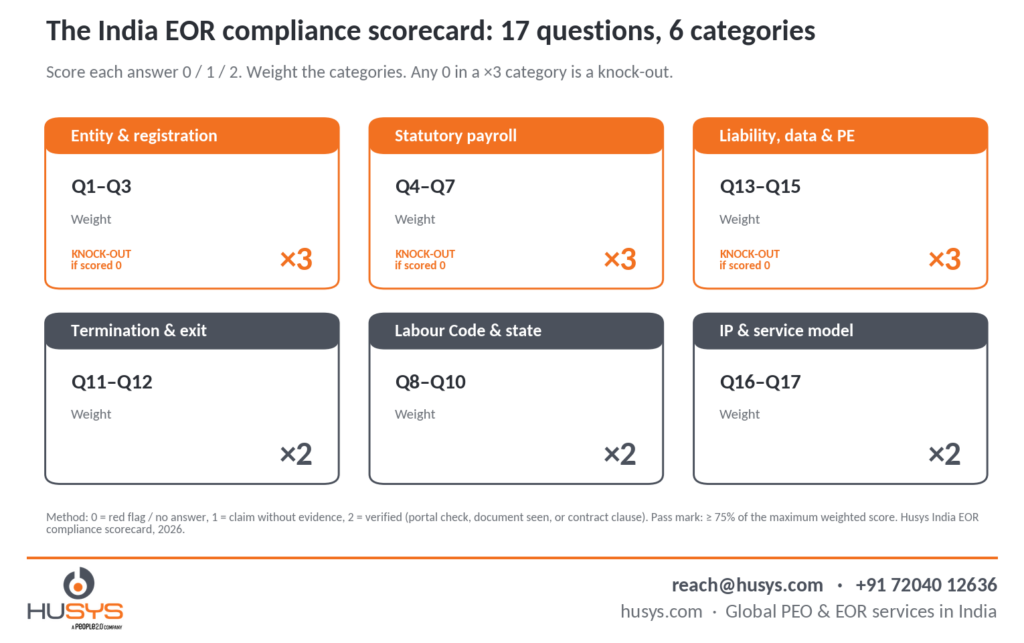
Six categories, three of them knock-outs. Score each answer 0 / 1 / 2, weight the categories, and treat any 0 in entity, payroll or liability as an automatic fail. The scoring method is explained under “How to score the answers” below.
The 17-question India EOR compliance scorecard
# | Question to ask | Evidence to check |
|---|---|---|
A. Entity & registration, does the employer legally exist? (weight ×3, knock-out) | ||
Q1 | Which Indian entity will legally employ my staff, and what is your relationship with it? | Legal name, CIN, incorporation date; the same entity on the contract and payroll records |
Q2 | What are your EPFO code, ESIC code, CIN, GSTIN and TAN? | The numbers in writing, within a day; checkable on government portals |
Q3 | Which states can you employ in, specifically the state where my candidate lives? | A named list plus the state’s Shops & Establishments and Professional Tax position |
B. Statutory contributions & payroll, is the money going where it should? (weight ×3, knock-out) | ||
Q4 | Walk me through the employer-side statutory cost for this salary, line by line. | A written calculation separating statutory costs, accrued liabilities, state levies and provider fees |
Q5 | What PF wage base do you use, and how do you apply the ₹25,000 ceiling? | The wage base per employee and the basis for the treatment |
Q6 | Under which section and on which forms are you filing salary withholding this year? | “Section 392; Form 138 quarterly; Form 130 annually”, not the pre-2026 numbers |
Q7 | How did the Code on Wages 50% definition change your salary structures and employer cost? | A worked example showing PF/gratuity exposure recalculated |
Q8 | How do you invoice us, and what do we pay besides the fee? | A written fee schedule: currency, FX rate and any markup, deposits/prefunding, off-cycle fees, payment terms |
C. Labour Code & state readiness, are they tracking a moving target? (weight ×2) | ||
Q9 | Which Code provisions are you treating as operative today, and which are you waiting on? | A nuanced answer that separates central from state rules and names open items |
Q10 | Are you issuing appointment letters to every employee, and what is in them? | A redacted template with the particulars required under the Codes |
Q11 | Who is your in-house compliance capability, employees or an outsourced retainer? | Named in-house roles, an audit cadence, and how regulatory change reaches your account |
D. Termination, exit & continuity, what happens when it goes wrong? (weight ×2) | ||
Q12 | Describe your termination process: notice, severance, and full-and-final settlement timeline. | The termination clause, a process document, and a sample F&F calculation |
Q13 | If I move to my own entity or another provider, what happens to gratuity, PF and tenure? | A documented transition process and who holds the accrued gratuity liability |
E. Data, liability & tax exposure, where does the risk sit? (weight ×3, knock-out) | ||
Q14 | How do you handle employee personal data under the DPDP framework, and what is your security posture? | DPDP Act/Rules awareness, certifications (ISO 27001, SOC 2), data residency, breach-notice timeline |
Q15 | What does the contract say about compliance liability, indemnity and audit rights? | A specific indemnity clause, an audit/evidence right, and named service levels |
Q16 | Does using your EOR eliminate my Permanent Establishment risk in India? | “It reduces it, does not eliminate it, and depends on what your people do” |
F. IP & service model, who owns the work, and who does it? (weight ×2) | ||
Q17 | How does IP created by my employees assign from the EOR to my company, and who actually delivers the service? | An IP-assignment clause (EOR→client) and clarity on in-house vs subcontracted delivery |
For each answer, look for three things: a direct answer to the question you asked (not a redirect to a capability statement), evidence that can be verified (registration numbers, sample documents, calculations, contract clauses), and any red flag in how the provider responds. The detailed blocks below give the “why it matters,” the good answer and the red flag for each question.
A. Entity and registration
Q1. Which Indian entity will legally employ my staff? Why it matters: the entity that employs your people is the one carrying every statutory obligation, so you need to know exactly who it is. A good answer sounds like: “The employing entity is [legal name]. Here is its corporate identity number and date of incorporation. Your employees’ contracts name that entity, and the same entity appears on the payroll and statutory records. If we use a group company or partner, we will explain the relationship and the contractual structure.”
Red flag: the EOR provider cannot clearly identify the legal employer, its Indian registrations, or the relationship between the provider and the entity employing your people.
Your staff are employed by Husys Consulting Limited, our Indian operating entity. The employment contract, payslips and statutory records (PF, ESI and TDS) all name Husys Consulting Limited, and we share its corporate identity number (CIN) and date of incorporation on request, so you can verify the entity yourself on the MCA portal. |
Q2. What are your EPFO, ESIC, CIN, GSTIN and TAN numbers? Why it matters:every one of these numbers is independently checkable, which makes this the single highest-yield question in the list. A good answer sounds like: the numbers, in an email, within a day. Red flag: reluctance, a redirect to a sales call, or codes that belong to a differently-named entity than the one in your draft contract. See the verification section for how to check each one. At Husys: we treat Husys Consulting Limited’s registration details as confidential, so rather than publishing them on this page we share them with prospects directly and prefer to walk you through them on a video call, where you can verify each one against the government portals in real time. Get in touch to view Husys Consulting Limited’s details. |
Q3. Can you employ someone in the state where my candidate lives? Why it matters: India is 28 states and 8 union territories, and Shops & Establishments rules, Professional Tax and notice protections all differ by state. A good answer sounds like: a named list of states, and a specific statement about your state, its Shops & Establishments registration status and its Professional Tax position. Red flag: “We cover all of India, it’s the same everywhere.” It is not the same everywhere. At Husys: Husys Consulting Limited operates across all 28 Indian states and 8 union territories, and we apply the Shops & Establishments registration, Professional Tax and notice rules specific to your candidate’s state. Tell us where your candidate is based and we will confirm the state-specific position before onboarding. |
B. Statutory contributions and payroll
Q4. What is the employer-side statutory cost for this salary, line by line? Why it matters: a blended percentage hides whether the provider actually understands the wage bases, ceilings and eligibility rules that drive your cost. A good answer sounds like: “Here is the written calculation for this employee. We have separated statutory employer contributions, accrued statutory liabilities, state-level levies and our own service fees, shown the salary structure and wage base for each item, and flagged which items depend on eligibility or state rules.” (The illustrative USD chart above is the shape to expect.) Red flag: a single blended percentage with no calculation, no salary-structure assumptions, and no distinction between statutory costs and provider fees. At Husys: every Husys quote comes with a written, per-employee calculation that keeps statutory contributions, accrued liabilities, state levies and our service fee separate, and the same terms appear in the employee’s offer letter and the client agreement. |
Q5. What PF wage base do you use, and how do you apply the ₹25,000 ceiling? Why it matters: the PF wage base determines a large part of employer cost, and it should reflect each employee’s actual structure. A good answer sounds like: “We determine the PF base from the employee’s wage structure and applicable PF rules. We will show whether contributions are calculated up to the ₹25,000 statutory ceiling or on a higher wage base, explain the basis, and apply the same approach consistently within an employee category.” Red flag: the EOR provider cannot explain the wage base, gives the same answer for every employee, or cannot show how the payroll reflects the stated policy. How Husys handles it: Husys sets each employee’s PF wage base by the Code on Social Security definition: basic + DA + retaining allowance, with allowances above 50% of total pay added back. We state in writing whether contributions are capped at the revised ₹25,000 ceiling or made on the full wage, and apply that policy consistently in payroll and the offer letter. |
Q6. Which section and forms are you filing salary withholding on this year? Why it matters: the 2026 form numbers are a fast, binary test of whether the provider’s payroll engine was actually updated. A good answer sounds like: “Section 392 of the Income-tax Act, 2025. Quarterly statements on Form 138. Annual certificates on Form 130.” Red flag: “Section 192, Form 24Q, Form 16.” Those were correct until 31 March 2026. It may be shorthand, so ask the EOR provider to confirm what its system actually files, because a payroll engine not updated in April 2026 is a live problem. How Husys handles it: Husys payroll on the Husys HRIS platform was updated for the Income-tax Act 2025 from 1 April 2026. We deduct salary TDS under Section 392, file quarterly statements on Form 138 and issue annual certificates on Form 130, and we can show clients the filed forms on request. Contact Us. |
Q7. How did the Code on Wages 50% definition change your salary structures and cost? Why it matters: the 50% rule raised PF and gratuity exposure for allowance-heavy structures, and a provider who missed it has a wrong cost model. A good answer sounds like: a direct explanation of the 50% rule, an acknowledgement that PF and gratuity exposure rose for allowance-heavy structures, and a worked example. Red flag: no awareness that anything changed. How Husys handles it: Husys applies the labour codes’ 50% wage rule to every salary structure, recalculates the PF and gratuity wage base where allowances exceed half of total pay, and shows the revised base and its cost impact in each client’s written cost breakdown. |
Q8. How do you invoice us, and what do we pay besides the fee? Why it matters: for a US finance team the real cost often sits in FX markup and deposits, not the headline fee, and no competitor checklist asks this. A good answer sounds like: a written fee schedule covering invoice currency (USD or INR), which exchange rate is used and any markup on it, any security deposit or payroll prefunding and when it is returned, fees for off-cycle payroll, amendments, bonuses and exit, and payment terms. Red flag: “it’s all included” with no written fee schedule, or an exchange rate the provider sets itself. How Husys handles it: Every Husys client receives a written fee schedule in the service agreement. It sets out the invoice currency, the exchange rate source and any markup, deposit or prefunding terms and when they’re returned, and charges for off-cycle payroll, amendments, bonuses and exits, with no hidden charges and no minimums. Husys has a flat fee of $99. Contact us Now. |
C. Labour Code and state-level readiness
Q9. Which Code provisions are operative today, and which are you waiting on? Why it matters: the Codes are in force but the rules are still being notified, so certainty is a warning sign, not a strength. A good answer sounds like: a nuanced answer that distinguishes central rules from state rules, names the states where rules are settled and where they are not, and is comfortable saying “that one is still open.” Red flag: “Everything is fully implemented, we’re 100% compliant.” Nobody is fully compliant with rules that have not been notified yet. How Husys handles it: Husys prepares for every statutory change well before its deadline. Each client gets a detailed email explaining the change, and any added cost is notified well in advance, implemented with the client’s sign-off, and communicated to affected employees. Unlike EOR service fees, statutory costs can’t be negotiated: once a law applies, it has to be implemented, because skipping it means non-compliance. |
Q10. Are you issuing appointment letters to every employee, and what is in them? Why it matters: issuing appointment letters to all employees is an express obligation under the Compliance Handbook, not a formality. A good answer sounds like: yes, as required under the Codes, with the specified particulars, and an offer to show you a redacted template. Red flag: treating the appointment letter as optional paperwork. How Husys handles it: Every employee hired through Husys receives a formal appointment letter on the client’s behalf, as required under the Labour Codes. It sets out the required particulars, including designation, wages, statutory benefits and terms of employment, and its terms match the Husys–client service agreement. Clients can request a redacted sample template before onboarding. |
Q11. Is your compliance capability in-house, or an outsourced retainer? Why it matters: regulatory change in India is constant, and someone has to own tracking it for your account. A good answer sounds like: named in-house roles, an audit cadence, and a description of how regulatory change reaches your account. Red flag: compliance described as a software feature. a software feature. How Husys handles it: Regulatory tracking at Husys is owned by our in-house team of qualified legal and compliance experts, not by software. Every account is reviewed through quarterly internal and external audits, and every regulatory change reaches clients as a detailed email explaining what changed, what it costs and what happens next. |
D. Termination, exit and continuity
Q12. What is your termination process, notice, severance and final settlement? Why it matters: Indian termination is not at-will, and this is where most disputes and most avoidable cost arise. A good answer sounds like: an explanation of how the EOR provider determines the applicable notice and termination requirements from the contract, central provisions and state requirements, how it handles statutory payments due at exit (gratuity, leave encashment), and the expected full-and-final timeline. Evidence to request: the termination clause, a process document, and a sample F&F calculation. Red flag: describing Indian employment as “at-will,” or a provider that cannot show how its process changes with the employee’s contract, location or circumstances. How Husys handles it: Indian employment isn’t at-will, so Husys sets exit terms upfront. Notice periods, termination conditions and exit dues are agreed with the client to statutory requirements and written into both the client agreement and the employee’s appointment letter. At exit, Husys notifies both parties and settles full-and-final dues by law: wages within two working days, gratuity within 30 days. |
Q13. If I switch entity or provider, what happens to gratuity, PF and tenure? Why it matters: the answer is much harder to get when you are leaving, so ask it before you sign. A good answer sounds like: a documented transition process, a clear statement of who holds the accrued gratuity liability and how it transfers, and an explanation of how PF accounts follow the employee via their Universal Account Number. Red flag: no stated process. How Husys handles it: Exit and transition terms are agreed before you sign, as part of the client agreement. If you move employees to your own entity or another provider, Husys documents the handover. Accrued gratuity is either paid out or transferred with service continuity, as the agreement sets out. PF moves with each employee through their UAN, with no break in their account. |
E. Data, liability and tax exposure
Q14. How do you handle employee data under DPDP, and what is your security posture? Why it matters: your IT and procurement teams will send a security questionnaire before signing, and data handling is a late-stage deal blocker. A good answer sounds like: reference to the Digital Personal Data Protection Act, 2023 and the DPDP Rules, 2025 (notified 14 November 2025), an understanding of the phased eighteen-month compliance period, consent notices, breach notification, and a named data protection contact. On security, expect: ISO 27001 and SOC 2 Type II certifications; where employee data is stored and whether it leaves India; who can access payroll and ID data; encryption and access logging; a breach-notice timeline to the client; a list of subprocessors; and willingness to complete your security questionnaire. Red flag: “We’re GDPR-compliant.” GDPR compliance is not DPDP compliance. Note the DPDP framework provides for significant financial penalties, up to ₹250 crore, for failure to maintain reasonable security safeguards. How Husys handles it: Husys is ISO 9001 and ISO 27001 certified and handles employee data under the Digital Personal Data Protection Act, 2023 and the DPDP Rules, 2025, including consent notices and breach notification within the phased compliance timeline. We complete client security questionnaires as standard and share details on data storage, access controls and subprocessors on request. |
Q15. What does the contract say about liability, indemnity and audit rights? Why it matters: the contract is where every verbal assurance becomes enforceable, or does not. A good answer sounds like: a specific indemnity for statutory penalties arising from the provider’s error, a right for you to audit or receive evidence of filings, and named service levels. Red flag: a verbal assurance in place of a clause. “We guarantee 100% compliance” in a sales deck is not an indemnity. How Husys handles it: Every Husys commitment is written into the client agreement, not left as a verbal promise. That includes indemnity for statutory penalties caused by a Husys error, the client’s right to receive evidence of filings and contributions, and defined service levels for payroll, compliance and onboarding. Quarterly internal and external audits back those commitments. |
A compliance guarantee in a sales deck is not an indemnity.
Q16. Does using your EOR eliminate my Permanent Establishment risk in India? Why it matters: a provider’s answer to this question tells you whether it understands tax risk or is overselling. A good answer sounds like: “It reduces it. It does not eliminate it, and the answer depends on what your people actually do.” Red flag: any answer that treats the EOR structure itself as an automatic PE exemption. See the PE section below. How Husys handles it: Husys is clear that an EOR reduces Permanent Establishment risk but doesn’t remove it, because the risk depends on what your India team actually does. We monitor client activities and the deliverables behind each invoice to keep the arrangement within safe limits. If your team will sell directly or generate revenue in India, we tell you upfront that an EOR isn’t the right structure. |
F. IP and service model
Q17. How does my employees’ IP assign to me, and who actually delivers the service? Why it matters: under the Copyright Act, 1957 (section 17(c)) the employer is first owner of work made in the course of employment “in the absence of any agreement to the contrary”, and here the employer is the EOR, so the onward assignment to you matters. Have your legal team check patents and trade secrets separately. A good answer sounds like: a clear IP-assignment chain from employee to EOR to your company, confidentiality terms, and a straight answer on whether the EOR delivers the service in-house or subcontracts it. Red flag: no written IP assignment to your company, or vagueness about who actually runs payroll and compliance. How Husys handles it: IP ownership is written into the contracts. The employee’s appointment letter assigns work created in the course of employment to Husys, and the client agreement assigns it onward to your company, both with confidentiality terms. Husys runs EOR, payroll and compliance in-house, so there’s no subcontractor in the chain. Only hiring support is sometimes delivered with partners. |
How to score the answers: the weighted rubric
Asking the right questions is only the first step. Two providers can give similar answers while offering very different levels of evidence, operational ownership and contractual protection. Turning answers into a comparable, defensible record is what a rubric does, and it is the kind of structured, quotable content a board or a diligence process can lean on.
First, classify each answer:
- Verified, a registration checked on a government portal, a document seen, or a clause in the contract. (Score 2.)
- Needs evidence, a plausible claim with nothing yet to check it against. (Score 1.)
- Red flag, a red-flag answer, or no answer. (Score 0.)
Then weight and total:
- Score every question 0 / 1 / 2 on the scale above.
- Weight the categories: Entity & registration ×3, Statutory payroll ×3, Liability/data/PE ×3, Termination & exit ×2, Labour Code & state readiness ×2, IP & service ×2.
- Apply the knock-outs: any 0 in entity, payroll or liability rules the provider out, whatever the total.
- Pass mark: at least 75% of the maximum weighted score.
- Compare providers side by side in one table, and note how long each took to send evidence. Slow evidence is itself a signal.
Take the scorecard with you Download the 17-question scorecard with these weights built in, plus the due-diligence email template: Get the India EOR scorecard (spreadsheet) |
What the experts are saying
India’s labour and tax framework is in active transition, so it is worth checking your provider’s answers against how specialist advisers are reading the same changes. A few authoritative perspectives:
- On implementation risk, the Ministry of Labour & Employment continued issuing clarificatory FAQs into 2026, and firms including Nishith Desai Associates, Cyril Amarchand Mangaldas and PwC India have published detailed employer guidance stressing that central and state rules are still being framed, the exact point Q9 tests.
- On Permanent Establishment, KPMG reported that the Delhi High Court held in December 2025 that physical presence of employees in India is required to constitute a service PE, rejecting a “virtual service PE” theory, directly relevant to Q16.
Watch and cite: video explainers on India’s Labour Codes and EOR
These videos are useful background and citation material. Before quoting any of them, confirm the speaker’s credentials and pull the exact line with its timestamp (see the note that follows the list).
- Labour Codes Explained: What Changes for Workers & Employers? (Drishti IAS English). A plain-English overview of what the four Labour Codes change; good for the “what changed in 2026” context. Suggested byte: the point on 29 central Acts consolidating into 4 Codes.
- New Labour Codes 2025 Explained: PF, Gratuity, Wages & ESIC. Payroll-focused; supports Q5 and Q7 (PF wage base and the Code on Wages 50% rule).
- India’s Labour Codes: Key Changes and Implications. A key-changes summary; supports Q9 (which provisions are operative versus pending).
- New Indian Labour Codes: wages, rights and benefits explained. A wages-and-benefits explainer for the statutory-cost context.
- Employer of Record (EOR) Explained: What It Is and How It Works. A general EOR concept explainer, useful top-of-funnel background.
- Ministry of Labour & Employment, official YouTube channel. The government source, the highest-trust option; search the channel for its specific Labour Codes videos.
[PLACEHOLDER: verify each video’s channel and the speaker’s credentials before citing, and, to complete the E-E-A-T test, open the relevant section, note the timestamp, copy the exact line from the transcript, and attribute it as “According to [Name, role] on [channel], at [mm:ss], ‘…'”. See the EEAT test plan for the method.]
How do I verify an EOR provider’s registrations in India?
Knowing what to ask an EOR provider for India compliance is half the job. The other half is judging the evidence behind the answer. Indian regulators publish the registers, use them to test the provider’s answers rather than treating a confident response as proof. Follow these five steps, each on the named portal.
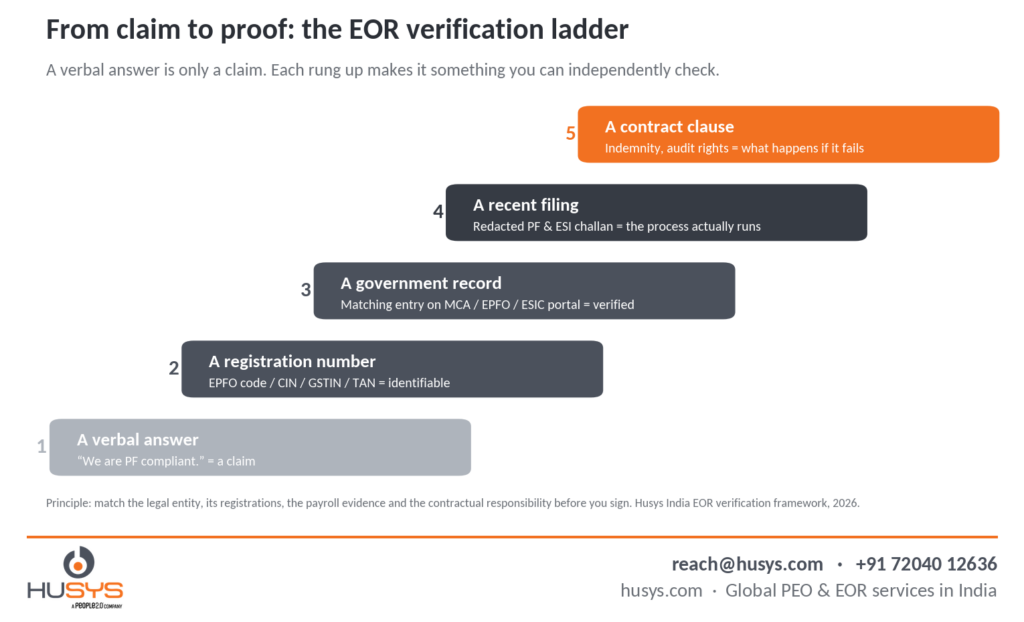
A verbal answer is a claim; a registration number makes it identifiable; a government record verifies it; a recent filing proves the process runs; the contract decides what happens if it fails.
- Verify the legal employer on the MCA portal. Check the company name, CIN, incorporation date and active status on the Ministry of Corporate Affairs company master data. Make sure the entity named in your agreement is the entity you are actually relying on.
- Verify the PF registration on the EPFO Establishment Search. Check the provider’s EPFO establishment code against the legal entity; the search is public and needs no login.
- Verify ESIC, GSTIN and TAN. Check the ESIC employer registration, GSTIN and TAN where applicable, and confirm each corresponds to the legal entity the provider named.
- Reconcile the evidence. Ask for a redacted recent PF challan and ESI challan and check that the employer details and registration numbers align with what you already verified.
- Ask what is contractual. For liability, indemnity, termination and audit rights, the service agreement is the evidence, do not rely on a sales call where the contract says something different.
A verbal answer is a claim; a registration number makes it identifiable; a government record verifies it; a recent filing proves the process runs; the contract decides what happens if it fails.
A practical pre-signing evidence request: a redacted recent PF challan (where PF applies); a redacted recent ESI challan (where ESI applies); the EPFO establishment code and ESIC employer registration; the legal employer’s CIN and registered name; the GSTIN and TAN; a sample employment agreement and payslip showing the employing entity; and the contract provisions covering compliance responsibility, indemnity and audit rights. You do not need confidential employee data, the purpose is to establish that the entity, registrations, payroll records and contractual commitments line up.
The principle is simple: do not treat a registration number, document or verbal assurance as proof in isolation. Match the legal entity, its registrations, the payroll evidence and the contractual responsibility before you sign.
US vs India: what to clarify with your provider
Familiar US employment concepts are a useful starting point, but they are not direct equivalents. Use the right-hand column as a prompt for questions, not as a substitute for Indian law or your employment agreement.
Five differences that change what you ask your EOR
Concept | United States | India | So ask your EOR… |
|---|---|---|---|
Termination | At-will in 49 states (Montana is the exception, under its Wrongful Discharge from Employment Act) | Notice + reasonable cause; not at-will, even in probation | “How do you determine the notice and cause for my employee’s state?” |
Severance / exit pay | Discretionary; often none | Retrenchment compensation of 15 days’ average pay per completed year (Industrial Relations Code, 2020, s.70); gratuity after 5 years (1 for fixed-term) | “Show me a sample full-and-final settlement calculation.” |
Payroll cycle | Typically bi-weekly | Monthly, with hard statutory deadlines (7th, 15th) | “What day do you need our approval to hit the deadlines?” |
Year-end tax form | Form W-2 | Form 130 (formerly Form 16), issued after 31 March | “Which forms are you filing on this year?” (Form 138 / Form 130) |
State rules & benefits | Federal floor + state variation | Professional Tax in ~20 states/UTs; 26 weeks’ paid maternity + creche at 50+ employees; POSH Internal Committee at 10+ employees | “Which state rules apply where my candidate lives?” |
Sources: Montana State University summary of the Wrongful Discharge from Employment Act; Industrial Relations Code, 2020 (s.70); Ministry of Labour Compliance Handbook, February 2026 (maternity benefit and creche under the Code on Social Security, confirm the page number); POSH Act, 2013 (s.4 requires an Internal Committee; s.6 sends complaints from workplaces under 10 employees to the district Local Committee); LKS employment-law guide for the states that levy Professional Tax.
A quick salary reality check Talent depth, not just cost, is the draw, but the cost gap is real. US software developers had a median wage of about $135,980 (US Bureau of Labor Statistics, May 2025), while an experienced full-stack developer in India averaged about ₹22,70,640, roughly $23,900 (PayScale, updated May 2026; ₹95 = $1). |
Permanent Establishment: what an EOR can and cannot address
An EOR can change the employment structure, but it does not by itself determine whether your US company has a Permanent Establishment (PE) in India. The PE analysis depends on the facts of your business, the activities carried out in India and the applicable tax treaty. Under Article 5 of the India-US Double Taxation Avoidance Agreement, a PE generally concerns a taxable presence arising from specified business activities or arrangements.
Two treaty tests matter most:
- Service PE, furnishing services in India can create a PE where activities continue for more than 90 days in any twelve-month period, or where services are rendered for a related enterprise. The 90-day threshold does not protect a US parent whose Indian team is servicing the parent.
- Dependent-agent PE, a PE arises where someone habitually exercises authority to conclude contracts on your behalf, or habitually secures orders in India wholly or almost wholly for your enterprise. The order-securing limb catches commercial activity well short of signing anything.
What to ask instead of “does this eliminate PE risk”: “Given that my India team will be doing [X], what is your view on my PE exposure, and what do you do operationally to keep it low?” A provider with real depth will describe monitoring the scope of work and the deliverables invoiced, at Husys, for example, we review each invoice and the client’s activities against the deliverables for that invoice, and will tell you when to bring in Indian tax counsel.
Where an EOR genuinely helps: your employees are employed by an independent Indian entity, not by your foreign parent operating in-country. For a cost-centre engineering, research or support team whose output is consumed by the US business and which has no India-facing customers, that materially strengthens your position. (Note the Delhi High Court held in December 2025 that physical presence is required for a service PE, rejecting a “virtual service PE” theory, KPMG, 9 December 2025.) Where it does not help: if your India team sells, negotiates, secures orders or concludes contracts, Article 5 engages regardless of whose payroll they sit on. Structure does not cure function.
Structure does not cure function. An EOR reduces PE risk; what your team actually does decides it.
And the honest boundary: if your company is directly selling or generating income in India, an EOR is not the right structure. That is a genuine limit, not a sales objection. For the full treaty analysis, see our Permanent Establishment risk guide.
What should different US roles ask an India EOR provider?
What to ask an EOR provider for India compliance changes depending on whose desk the decision lands on. Below, four roles we see regularly, the way the job normally gets done, and the way it gets done through an EOR.
The seed-stage founder, accelerator-backed SaaS, 11-50 people
The job: you have found one exceptional engineer in Pune, eighteen months of runway, and a board that wants velocity, not a corporate structure chart. It normally happens one of two ways: you engage them as a contractor because it is fast, and six months later they are working your hours, on your systems, to your direction, exclusively, which is the fact pattern that makes a contractor an employee in substance; or you incorporate a subsidiary and spend founder-hours on apostilles, bank KYC and auditor appointment instead of on product. With an EOR, the employee is onboarded onto an existing Indian entity’s registrations, your India hiring line is one number multiplied by headcount, and if the hire does not work out there is no entity left over.
Ask specifically: “What is your all-in monthly cost for one employee in Maharashtra, including every statutory contribution, with nothing added later?”
The CFO of a growing cybersecurity company, Series A/B, 51-200 people
The job: you are building an engineering and threat-research team in India while your capital sits in product and certification, and the board wants the India line forecastable to the dollar. Model an Indian subsidiary and you discover the cost is not the salaries, it is the fixed overhead that exists whether you hire two people or twenty: statutory audit regardless of turnover, Registrar of Companies filings, corporate tax, GST returns, transfer pricing certification on every parent transaction, an annual Foreign Liabilities and Assets return. Then a statutory change lands mid-year, a new wage definition, a retrospective bonus notification, and your forecast moves. With an EOR the variable cost is the salary, with no entity overhead to amortise across a small headcount and no wind-down cost if the programme changes.
Ask specifically: “Which statutory costs are inside your fee and which are passed through at cost? Show me a full-year model at 5, 15 and 40 heads.” Then ask what happened to their clients’ costs when the Code on Wages redefined “wages”, the answer tells you whether they absorb regulatory change or forward it.
The CTO or Head of Engineering, Series B, 50-250 people, evaluating India against US visa sponsorship
The job: you need senior engineers, and US visa sponsorship has become expensive and unpredictable.
A necessary caveat on the H-1B position (as of 25 September 2026, verify before you rely on any number): a $100,000 payment tied to certain new H-1B petitions was imposed by presidential proclamation in September 2025; a federal district court vacated it in June 2026, and in July 2026 the First Circuit declined to stay that ruling pending appeal, leaving the fee unenforceable. Reporting indicates the proclamation was subsequently extended through September 2027, while the fee remains blocked by court order (DiRaimondo & Schroeder, 21 September 2026). A separate proposed rule would impose a fee of $103,265 per cap-subject petition; it is a proposal only. The planning point is not the amount, it is that a hiring strategy whose unit economics depend on an actively litigated federal policy has a variance problem. |
With an EOR you hire the engineer where they are. India’s technology industry employs roughly six million people and added about 135,000 net new jobs in FY26, on industry revenue of $315 billion (NASSCOM Strategic Review 2026), the depth is real, particularly in backend, platform and embedded work. Onboarding runs in working hours rather than immigration cycles; Husys onboards within 8 working hours once the contract is approved and the employee’s documents are in.
Ask specifically: “What is your median time from signed contract to compliant first day, measured across your last fifty onboardings, and what causes the exceptions?” A useful answer distinguishes provider-side processing time from client-side dependencies such as contract approval and employee document submission.
The VP of People or CHRO, Series B to D SaaS, 50-500 people
The job: you own the employee lifecycle in a country whose leave, holiday and termination norms you have never had to learn, and you will be blamed if a termination goes wrong. Applied US-style, the offer letter is written in US terms, probation is treated as at-will (it is not), and a performance exit handled the California way becomes a dispute, usually because the employee was promised something in the offer letter the company later declines to honour, or because “at-will” was assumed where notice and reasonable cause were required. With an EOR the contract is drafted to Indian law from the start, notice and severance are stated correctly, the statutory leave and holiday calendar is applied by state, the POSH Internal Committee exists, and the exit runs through a documented full-and-final settlement including gratuity and leave encashment.
Ask specifically: “Show me a redacted employment contract and a redacted full-and-final settlement statement.” Two documents tell you more about operational competence than any reference call.
Also test the employee experience India hires leave when payroll or support is poor, so ask: when do employees receive salary and payslips each month? Who do they contact with questions, in which language and hours? What self-service portal do they get for payslips, leave and tax declarations? How are appraisals and salary revisions processed? Ask for one reference call with a current employee on the provider’s payroll, not only a client reference. In our experience, appraisals and termination timing are the issues clients discover too late. “ApHusys includes an employee self-service portal and end-to-end HR operations.“ |
The General Counsel or Head of Legal, Series C+, 200-1,000 people
The job: sign off on an arrangement in a jurisdiction you do not practise in, without creating an exposure that surfaces in a diligence process three years from now. Legal review often focuses on the service agreement and misses the employment layer underneath, which is where misclassification, PE and data-protection exposure actually live. With an EOR you get documentary evidence rather than assurances: entity registration, statutory numbers you can verify on government portals, filing evidence, an audit cadence, certifications, a named indemnity, and a PE position that is appropriately hedged rather than absolute.
Ask specifically: “Give me the indemnity clause, your audit cadence with dates, your certifications, and your written position on PE for a team doing [your actual scope].” If all four arrive without friction, you are dealing with an operator; if any requires escalation, you have learned something.
What your investors or acquirer will ask For Series B+ and pre-exit companies, India employment items surface in diligence: contractors who are employees in substance (misclassification); PE exposure from India staff who sell or sign; unfunded gratuity and leave-encashment liabilities; the IP-assignment chain from employee to EOR to company; statutory filing history and any open notices; and data-protection terms. Ask the EOR for a “diligence pack” you can hand to investors, it moves the decision from vendor choice to board-level risk, which is how a GC or CFO frames it. |
The due-diligence email you can send every provider
Copy, paste, fill the brackets, and send it to every shortlisted provider. Asking for written answers with evidence attached is itself a test, and how fast each provider replies is a signal.
Subject: India EOR due diligence, [Company] Hi [Name], before we proceed, please reply in writing to the questions below and attach the evidence listed.
Thanks, [Name] |
Contract clauses to insist on
The contract is where every answer becomes enforceable. Have your legal counsel review the following (this is guidance, not legal advice):
- Indemnity for statutory penalties, interest and claims caused by the provider’s error, with no low cap.
- Audit and evidence rights, monthly PF/ESI/TDS proof on request.
- IP assignment from the EOR to you, plus confidentiality.
- Data-processing terms under DPDP, with breach-notice timelines.
- Service levels for payroll accuracy and response times, with remedies.
- Disclosure of any partner or subcontracted entity.
- Exit and transition, notice, handover of records, and treatment of accrued gratuity and PF.
- Fee-change rules, so statutory changes are passed through at cost, not marked up.
Already have a provider? What to ask before you switch
If you are switching EOR, often the highest-intent situation, the questions shift to continuity. Ask the new provider:
- How do you move employees across without a break in service (new contracts, same tenure and terms)?
- How are PF accounts carried over via the UAN, and who files the transfer?
- Who pays out or transfers the accrued gratuity, and how is it recorded?
- How long does a switch take, and what do you need from our current provider?
- What notice does our current contract require?
The “what-if” questions that reveal real experience
Capability statements are cheap. Ask the provider to walk you through real scenarios, step by step, with timelines, this is where terminations and edge cases (the source of most issues) surface:
- An employee resigns mid-notice and wants early release.
- An employee goes on maternity leave in month 4.
- A labour inspector’s notice arrives.
- A terminated employee files a claim for more than the offer letter promised.
- The EOR itself hits financial trouble, where is our salary prefunding held, and what is the continuity plan?
Why the lowest quote often costs more
Quotes differ on what is in the fee. Compare providers on an all-in yearly cost per employee, not the headline monthly fee.
Where the real cost of an EOR hides
Cost item | Where it hides | What to ask |
|---|---|---|
Monthly fee | The headline number | Is this per employee, all-in? |
FX conversion | A markup on the exchange rate | Which rate, and what is your margin on it? |
Security deposit / prefunding | Cash tied up, sometimes months | How much, and when is it returned? |
Setup & exit fees | Onboarding and offboarding line items | Are these charged, and how much? |
Off-cycle & amendment fees | Bonuses, corrections, contract changes | What triggers an extra charge? |
Background checks, visa, hiring | Often excluded from the EOR fee | What is bundled and what is extra? |
Statutory cost pass-through | A margin added on top of statutory cost | Are statutory costs passed at cost or marked up? |
Fixing a compliance error | Penalties, interest, disputes | What does your indemnity cover? |
Risks, edge cases and misconceptions
These India EOR compliance assumptions survive a vendor evaluation and then fail in month four.
“An EOR is a payroll vendor.” No. A payroll vendor calculates and disburses. An EOR is the legal employer, named on the employment contract, the Provident Fund registration and the tax filings, and answerable to a labour authority. The compliance surface is an order of magnitude larger.
“A compliance guarantee in the deck protects us.” Treat a compliance commitment as enforceable protection only when the obligation, scope, exclusions and remedy are set out in the contract. Ask which compliance failures the indemnity covers, what losses are included or excluded, and whether any liability cap applies.
“We can use an EOR to sell into India.” An EOR does not by itself determine whether your US company has a Permanent Establishment. If India-based personnel habitually conclude contracts, exercise authority on behalf of the US company, or carry out activities within the PE provisions, the tax analysis must be reviewed separately. Ask the EOR to identify the activities that may create PE exposure and have your tax adviser review the structure.
“We’ll start with contractors and convert later.” The compliance exposure is not set by the contract label, it depends on the substance of the working relationship. Exclusive, directed, full-time work on your systems and your hours can create an employment relationship regardless of the paperwork, and converting later does not remove exposure for the earlier period. See our misclassification risk checklist.
“The cheapest quote is the like-for-like quote.” Quotes often differ on what is inside the fee, visa, background checks, hiring and exit costs are frequently extra. Compare an all-in yearly cost per employee, not the monthly fee (see the table above).
Three quick corrections on the payroll and HR mechanics, covered in depth on our payroll and termination pages:
- “ESI covers our engineers.” Check monthly wages against the ESI threshold first; above it, private medical insurance is a separate, non-statutory cost.
- “Gratuity is a future problem.” For eligible employees it accrues from day one (one year for fixed-term); account for it during employment, not at exit.
- “Probation means we can let someone go easily.” Probation shortens notice; it does not create at-will employment. Termination still requires cause and process.
What this looks like at Husys
The principles above are how we approach India EOR compliance at Husys. We have operated as a PEO and EOR in India for 24+ years, against the incorporation date on the MCA portal, since this article tells readers to verify it], and our corporate details can be independently checked through the MCA company master data portal. We manage 8,000+ employees” / “50,000+ workers managed to date across 28 states and 6 union territories”, and our operating model is built around an Indian employing entity that can onboard within 8 working hours once the employment contract is approved and the employee’s documents are submitted.
Some numbers our clients ask about: 5,000+ clients served to date; 450+ current active clients; 100+ country-specific global clients; 50,000+ workers managed; 9+ client segments; average client tenure not less than 4 years]. Pricing is predictable with multiple models, with no hidden charges and no minimums; visa, background verification and hiring services sit outside the EOR fee. On PE, we monitor each invoice and the client’s activities against the deliverables for that invoice.
And if the facts of your proposed India operation point toward a different structure, because of the activities your team will perform, we will tell you that before you sign.
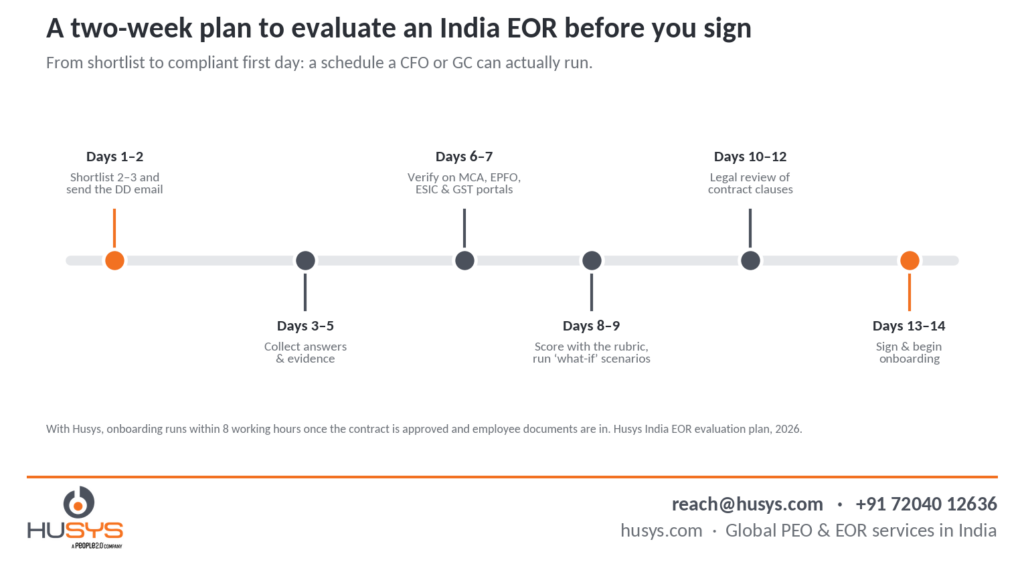
Your two-week plan to evaluate an India EOR
Urgency is the most common buying trigger we see, so here is a schedule you can actually run, from shortlist to a compliant first day.
Lorem ipsum dolor sit amet, consectetur adipiscing elit. Ut elit tellus, luctus nec ullamcorper mattis, pulvinar dapibus leo.
Days 1-2 shortlist and send the DD email · 3-5 collect answers and evidence · 6-7 verify on MCA, EPFO, ESIC and GST · 8-9 score with the rubric and run “what-if” scenarios · 10-12 legal review of contract clauses · 13-14 sign and onboard. With Husys, onboarding runs within 8 working hours once the contract is approved and documents are in.
Before you sign
If you are working out how to choose an EOR provider in India and want a second opinion on a shortlist, or the statutory cost of a specific role in a specific state before you commit to a number, talking to an India EOR compliance specialist early is cheaper than correcting a structure later. That is true whether or not the conversation is with us.
Two ways to use this article right now:
|
Frequently asked questions
What documents should a compliant EOR provide on request?
At minimum: the certificate of incorporation and CIN, EPFO establishment code, ESIC employer code, GSTIN, TAN, a sample employment contract, a sample payslip, a redacted recent PF and ESI challan, ISO certificates if claimed, and the indemnity and audit clauses from the proposed contract. A provider that files monthly has these to hand.
How do I verify an EOR’s PF and ESI registration?
Ask for the provider’s EPFO establishment code and ESIC employer code, then check them against the legal entity named in your contract on the EPFO Establishment Search (public, no login) and ESIC’s employer search. Confirm the establishment name matches, then request a redacted recent PF challan as evidence the process actually runs.
Are India’s new Labour Codes fully in effect?
The four Labour Codes came into force on 21 November 2025, replacing 29 central Acts. The central and state rules that operationalise them are still being notified, and the labour ministry was issuing clarificatory FAQs as recently as March 2026. In force, but still in transition, so ask a provider to separate operative provisions from pending ones.
What happens if my EOR gets India compliance wrong?
Practically, the exposure is statutory penalties and interest, employee disputes, and problems surfacing in an audit or diligence process. Contractually, your protection depends on the indemnity, liability and audit clauses in the EOR agreement, so review those before signing rather than treating compliance as an afterthought.
What is Permanent Establishment risk, and does an EOR protect me from it?
A Permanent Establishment is a taxable presence in India under Article 5 of the India-US tax treaty. An EOR reduces the risk, because employees are employed by an independent Indian entity rather than your foreign parent, but it does not eliminate it. Where your team secures orders or concludes contracts, the dependent-agent limb engages regardless of payroll structure.
How much does an EOR in India cost?
Providers charge either a flat per-employee fee or a percentage of payroll. When comparing prices, ask which statutory costs are included, which are passed through, how salary structures affect statutory contributions, and what charges apply outside the headline fee, then compare an all-in yearly cost per employee, not the monthly number.
Does my EOR need its own Indian entity, or can it use a partner?
Both models exist. The important question is which entity will actually employ your people and hold the statutory registrations. If a partner is involved, ask who your contractual counterparty is, who the legal employer is, and which entity’s registration numbers appear on the employment records.
Do employees hired through an EOR get the same statutory benefits as direct hires?
Yes. Provident Fund, ESI where applicable, gratuity, statutory bonus, maternity benefit, leave and holidays are statutory entitlements attached to employment, not to employer identity. Non-statutory benefits such as private medical insurance depend on what you and the provider agree.
How often should an EOR update me on Indian regulatory changes?
There is no statutory frequency, but a good provider communicates proactively whenever a change affects your employees, not only at renewal. Ask how regulatory change reaches your account, who owns tracking it, and for a recent example of a change they flagged to clients, such as the Code on Wages 50% rule or the August 2026 bonus notification.
How long should EOR due diligence take?
About two weeks is realistic: two days to shortlist and send a due-diligence request, a few days to collect written answers and evidence, one to two days to verify registrations on government portals, and time for a legal review of the contract. How quickly a provider returns evidence is itself a signal of operational discipline.
What should I do if a provider refuses to share registration numbers?
Treat it as a red flag and pause. EPFO, ESIC, CIN, GSTIN and TAN details are routinely shared and independently checkable, so reluctance usually means the numbers belong to a different entity, or the process is not what is being described. Ask why in writing before proceeding.
Can I audit my EOR after signing?
Only if the contract says so. Insist on an audit-and-evidence right that lets you request monthly PF, ESI and TDS proof and review filing records. Without a clause, you are relying on goodwill, so make audit rights, evidence on request and service levels explicit terms of the agreement.