
What this guide covers What PF is and who owes it; the 12% plus 12% math and the new 50% wage rule; the ₹25,000 ceiling and what it costs at 1, 20 and 50 employees; monthly filing; expats and the US–India gap; the 2026 penalty rules; entity vs. EOR vs. contractor; a 10 point readiness check; misconceptions; and FAQs. Every statutory point links to the government source it comes from. |
What changed in 2026 (quick timeline)
Changelog: this page was updated on [publish date], 2026 for the ₹25,000 ceiling, the flat 1% per month damages rule, the 50% wage rule and the PM-VBRY hiring incentive. |
The official rulebook, linked up front
Most PF articles paraphrase the rules without linking them, which is partly why the web is so noisy on this topic. So here is the primary rulebook in one place, newest first. Read these alongside the guide; everything below is our plain English explanation of what they say.
Primary government sources (bookmark these)
Where a government page is hard to read, we add a professional explainer as secondary reading and say so. |
Provident fund in India is the country’s mandatory, employer matched retirement contribution; think of it as a compulsory 401(k). As a US employer you, or your employer of record (EOR), deduct 12% from each covered employee, add a matching 12%, register with EPFO and file every month. It is simple to understand; it is hard to execute perfectly, month after month, as a foreign company. This guide covers what EPFO requires of the provident fund in India in 2026, what it costs after the ₹25,000 ceiling and the new 50% wage rule, how it is filed, what a late payment now costs, and why an EOR is the lower risk path for most US companies. |
If you are a CFO modelling India headcount, a founder who needs an engineer live this week, or a General Counsel signing off on compliance, this is written for you. The stakes are asymmetric: the admin saving from running PF loosely is small, while the downside (interest, damages, prosecution and Permanent Establishment exposure) is large. We translate every India term into a US reference point and link each statutory claim to its source. Dollar figures use ₹96.5 to the US dollar (October 2026); refresh the rate at publish.
What is PF, and why should a US employer care?
The provident fund in India, or PF (Provident Fund), is a government run retirement savings scheme most Indian employers must pay into. The employee contributes 12% of wages and the employer matches it. It is run by EPFO, a statutory body under the Ministry of Labour & Employment. |
The acronyms, in plain English, each with its US equivalent:
- EPF (Employees’ Provident Fund): the retirement pot itself. US analogy: the 401(k) account.
- EPFO: the government body that runs it. US analogy: a federal plan administrator, but mandatory.
- EPS (Employees’ Pension Scheme): a slice of the employer share that funds a small lifelong pension. US analogy: a mini Social Security pension.
- EDLI (Employees’ Deposit Linked Insurance): employer paid life cover tied to the PF account, up to ₹7 lakh (about $7,250). US analogy: employer paid group term life.
- UAN (Universal Account Number): a permanent ID that follows the employee across jobs. US analogy: a portable, SSN linked plan ID.
- ECR (Electronic Challan cum Return): the monthly filing plus payment you submit to EPFO. US analogy: your monthly payroll tax deposit and return, combined.
The 2026 context that changes the answer Two shifts matter. First, PF now sits under the consolidating Code on Social Security, 2020 (in force since 21 November 2025), which also brings the 50% wage rule we explain below. Second, EPFO 3.0 is digitising claims and contributions. The practical takeaway for a foreign employer: the rules are tightening and getting more automated, not looser, so approximate compliance is the wrong bet. |
Who has to pay PF in India?
Any establishment with 20 or more employees must register with EPFO and run the provident fund in India; smaller establishments can register voluntarily. Separately, an employee is mandatorily covered if their PF wages are at or below the ceiling, now ₹25,000. These are two different thresholds, and US readers routinely conflate them. |
The establishment threshold (20 or more staff) decides whether the employer is in the system at all. The wage ceiling (₹25,000) decides who is automatically covered and caps the base for statutory minimums.
A nuance most guides skip: who can opt out A first time joiner whose PF wages are above the ceiling (now ₹25,000) and who was never a PF member before can legally opt out, by filing a Form 11 declaration. That is common for senior hires. But anyone who is already a PF member must continue. Note the higher ₹25,000 ceiling pulls more people back into mandatory coverage than the old ₹15,000 line did. |
What if you have no Indian entity? If you have no Indian entity, you cannot register an establishment with EPFO yourself, so there is no way to run PF on your own. You have two honest options: incorporate an Indian entity and become the registered employer (slow, with corporate tax and GST exposure), or hire through an employer of record India that already holds the EPFO registration and adds your person to its existing establishment. There is no compliant “just pay them as a contractor” shortcut for full time employment; that is misclassification, covered later. |
How much is PF? The 12% plus 12% math.
The EPF contribution rate is 12% from the employee and 12% from the employer. The employer’s 12% splits into 8.33% to EPS (pension) and 3.67% to EPF. On top, the employer pays EDLI 0.5% and admin charges 0.5% (minimum ₹500 per month per establishment), so the all-in employer PF contribution in India is about 13% of PF wages. Contributions are on “PF wages”, basic salary plus dearness allowance, not total CTC. |
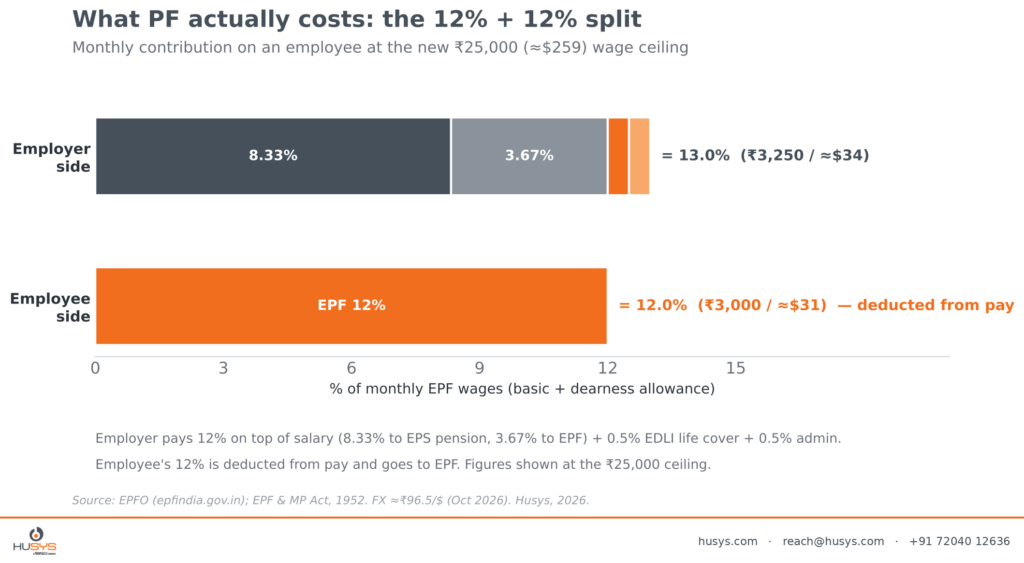
The ₹500 admin minimum matters for very small India teams: at one or two employees, the 0.5% admin charge is effectively a flat ₹500 floor, not a trivial percentage.
What does PF cost on a ₹25,000 salary?
Take an employee with PF wages of ₹25,000 a month (about $259):
- Employee deduction: 12% equals ₹3,000 (about $31), taken from pay.
- Employer share: 12% equals ₹3,000 (8.33% EPS equals ₹2,082.50; 3.67% EPF equals ₹917.50), plus EDLI 0.5% (₹125) and admin 0.5% (₹125).
- All in employer statutory cost: about ₹3,250 a month (about $34) on top of salary.
What about salaries above the ceiling?
If you contribute on full basic above ₹25,000, the EPS portion stays capped at 8.33% of ₹25,000, which is ₹2,082.50; the rest of the employer’s 12% then goes to EPF, not EPS. That split is the source of most “why doesn’t the math match” confusion. EPS contributions also stop once the employee turns 58.
The 50% wage rule: why your PF base may be higher than “basic”
Under the Code on Social Security, 2020, “wages” (basic plus DA) must be at least 50% of total pay. If allowances exceed 50%, the excess is added back into wages for PF. So a low basic, high allowance structure no longer shrinks your PF bill the way it used to. | ||
On a ₹1,00,000 salary | Old low basic structure | After the 50% wage rule |
Basic + DA (PF base) | ₹20,000 (~$207) | ₹50,000 (~$518) |
Allowances | ₹80,000 (~$829) | ₹50,000 (~$518) |
Employer PF (12%) | ₹2,400 (~$25) / month | ₹6,000 (~$62) / month |
Extra employer cost | (baseline) | about ₹43,200 (~$448) / employee / year |
For US employers with senior India hires on allowance heavy packages, this is a real, under budgeted increase. Model PF on at least half of total pay, not on an artificially low basic. (Implementation is rolling out through 2026; confirm your state’s position with the compliance team.)
The CTC trap, and the tax surprises on big PF
Two things US employers get wrong on the offer
|
A positive you can use: the PM-VBRY hiring incentive
Not all 2026 news is cost. Under PM-VBRY (the Employment Linked Incentive), the government pays employers up to ₹3,000 per month, for two years, for each additional EPFO registered hire (sustained at least six months), for jobs created between 1 August 2025 and 31 July 2027, for salaries up to ₹1 lakh. Small employers must add at least two staff, larger ones at least five. Whether EOR employed staff qualify depends on how the registration is held, so confirm eligibility before you count on it.
What did the ₹25,000 wage ceiling change, and what does it cost?
The EPF wage ceiling ₹25,000 is new. The monthly PF wage ceiling rose from ₹15,000 to ₹25,000, via Gazette S.O. 5109(E), effective 17 September 2026, the first change in nearly a decade. If you budget India headcount, recalculate now; the provident fund in India just got more expensive at the top end. |
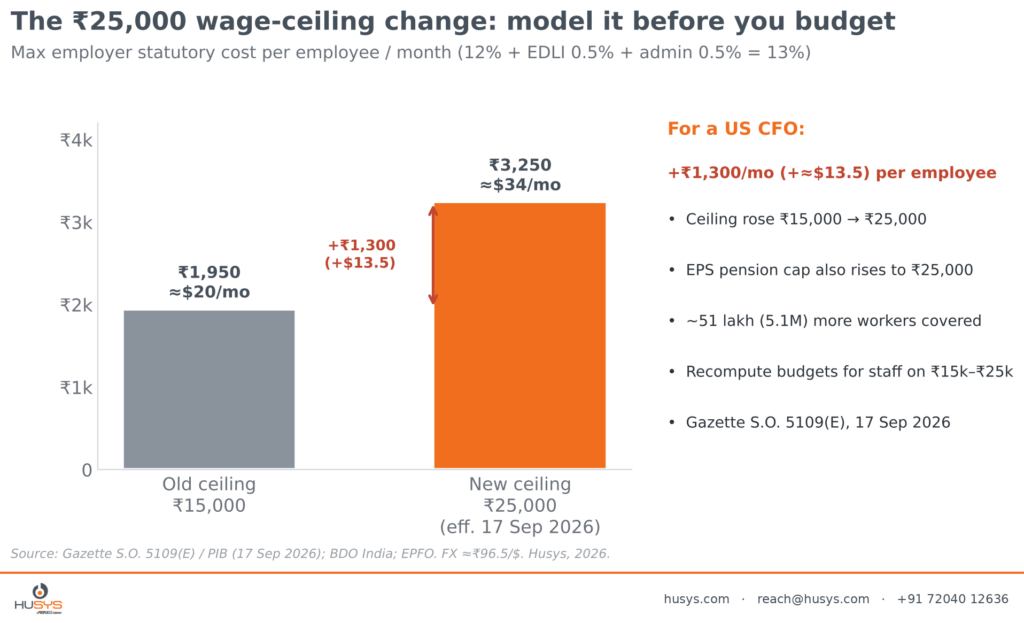
Here is the employer statutory cost (all in, about 13%, employees at or above the ceiling) at the three headcounts that matter: 1 (a single EOR hire, covered from day one because the EOR’s establishment is already registered), 20 (the own entity registration threshold) and 50 (scale).
Employer PF cost | Old ceiling ₹15,000 | New ceiling ₹25,000 | Increase |
|---|---|---|---|
Per employee / month | ₹1,950 ($20) | ₹3,250 ($34) | +₹1,300 ($13.5) |
Per employee / year | ₹23,400 ($242) | ₹39,000 ($404) | +₹15,600 ($162) |
20 employees / year | ₹4.68 L ($4,850) | ₹7.80 L ($8,083) | +₹3.12 L ($3,233) |
50 employees / year | ₹11.70 L ($12,124) | ₹19.50 L ($20,207) | +₹7.80 L ($8,083) |
Assumes all PF wages at or above the ceiling and EPS capped. Excludes the ₹500 per month admin minimum and any voluntary full basic contributions. International workers have no ceiling, so their cost is higher. Dollar figures use ₹96.5 to the US dollar (October 2026); refresh the rate at publish.
Nobody is saying this: the ceiling quietly breaks existing offer letters Check your offer letters this month. If an offer says PF is “capped at the statutory ceiling” or states a fixed PF amount (for example ₹1,800 a month), the employer share, and possibly the employee deduction, now rises automatically on wages up to ₹25,000.
That means either higher cost for you or lower take home for the employee, and neither is what was promised. Re issue salary structures for anyone with PF wages between ₹15,000 and ₹25,000, and tell the employee about the take home change before the next payroll. |
A nuance on the pension (EPS) cap The EPS (pension) cap also moved to ₹25,000, aligned with the new EPF ceiling, so a larger slice of the employer’s 8.33% now feeds the pension.
Confirm the exact per employee pension effect against the EPFO notification for your salary bands. |
How is PF filed each month?
Each month, running the provident fund in India means you deduct the employee’s 12%, add the employer share, file the ECR (Electronic Challan cum Return) and deposit by the 15th of the following month.
One time, up front: register the establishment and generate a UAN for each employee. Miss the 15th and penalties begin immediately. |
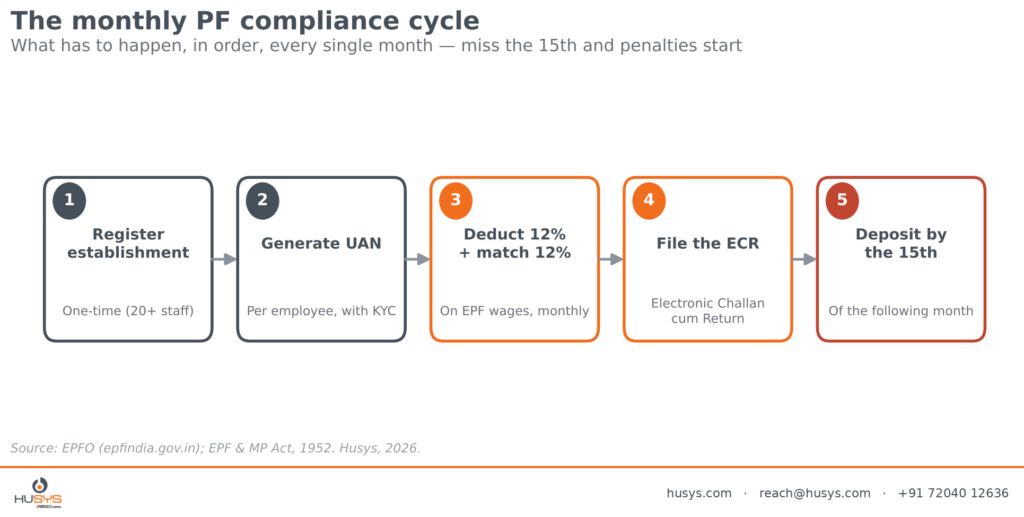
The same calendar in responsibility terms, who does what, with which document, by when:
Step | What happens | Document | Timing |
|---|---|---|---|
Register establishment | Enrol the employer with EPFO (one time, at 20+ staff) | Establishment registration | Before first filing |
Generate UAN | Create a UAN per employee; complete KYC (Aadhaar, PAN, bank) | UAN + KYC | At onboarding |
Deduct & match | Withhold 12% from pay; add the roughly 13% employer share | Payroll register | Each pay run |
File the ECR | Submit the Electronic Challan cum Return to EPFO | ECR | Monthly |
Deposit | Pay the challan to EPFO | Bank challan | By the 15th of the next month |
What trips up foreign employers specifically?
- KYC and UAN linkage: Aadhaar based KYC for new hires can stall activation if details do not match, a common cause of a first month filing scramble.
- Contractor liability as principal employer: if your vendor’s staff are not PF compliant, the liability can flow up to you as the principal employer under Section 8A.
- Draft contract delays: in our experience onboarding India hires for US companies, the biggest slowdown is the client’s approval of the draft employment contract, not the government process.
How to verify your EOR actually deposits PF (a five minute monthly check) Do not take “we’re compliant” on trust. Two checks take five minutes a month. First, ask your EOR or vendor for the monthly ECR and the paid challan (the TRRN number) for your employees. Second, ask one or two employees to log in to the EPFO member portal and confirm the month’s credit shows in their UAN passbook. If a vendor defaults, the employee loses retirement savings and, under Section 8A, liability can flow back to you as the principal employer. A good EOR shares the ECR and challan proof with every invoice. |
Do US companies owe PF on expats? International workers and the US–India gap
Foreign nationals working in India are covered by PF from day one, with no wage ceiling; contributions are 12% plus 12% on full salary, not the ₹25,000 cap that applies to Indian staff. There is no minimum stay. (Source: EPFO; see also the Delhi High Court ruling below.) |
Now the point most content on the provident fund in India misses. The United States has no Social Security Agreement (SSA), or totalization treaty, with India. India has SSAs with around 20 countries; the US is not one. The consequences are concrete:
- A US employee seconded to India can face double social security contributions, paying into both US Social Security and Indian PF on the same salary, with no offset.
- It works in reverse too. An Indian employee sent to the US while staying on Indian payroll keeps paying PF and also owes US FICA. With no agreement there is no certificate of coverage to exempt either side, so budget for both.
- Without SSA coverage, an international worker’s PF corpus is generally locked until age 58, so it cannot simply be withdrawn on leaving India.
Show the number: a US expat on $120,000 On a $120,000 salary, PF runs on the full amount with no ceiling. That is roughly $14,400 a year in employer PF plus about $14,400 a year deducted from the employee, all locked until age 58. For a global mobility team, that is the real cost of a secondment, and it is the number to model before the hire. Flag for your US tax advisor: a US citizen’s Indian PF account is generally reportable on FBAR and Form 8938, and the US tax treatment of employer contributions and growth is not straightforward. Raise it early. |
Fresh 2026 case law: the Delhi High Court ruling On 4 November 2025, the Delhi High Court (the SpiceJet and LG Electronics cases) upheld mandatory PF for international workers on full salary with no ceiling, calling them a “distinct class.” A conflicting Karnataka High Court ruling (Stone Hill Education Foundation) went the other way, so the issue is likely headed to the Supreme Court. The practical read today: budget for full salary PF on India based foreign staff and watch this space. (Delhi High Court, SpiceJet and LG Electronics, 2025; tracked on Husys’s India legislative updates.) |
A good answer vs. a red flag Ask any provider: “How do you handle PF for a US national we second to India, given there’s no US–India SSA?” A good answer explains the double contribution exposure, the age 58 lock and the FBAR flag, and models the dollar cost before you hire. A red flag is “we’ll handle it” without naming the SSA gap. |
What happens if you miss a PF payment? Penalties in 2026
A late or missed provident fund in India payment now triggers flat damages of 1% of the arrears per month (12% a year) under Section 14B, whatever the length of delay, plus 12% a year interest under Section 7Q. It can escalate to prosecution. This replaced the old 5 to 25% sliding slabs on 15 June 2024. (Source: EPFO.) |
Two things to note. Damages start from the first day of delay, not after a grace period: a deposit made on the 18th instead of the 15th attracts both damages and interest. And 100% of the arrears is the cap on damages.
A worked example On a ₹10 lakh monthly PF remittance, a three month delay costs roughly ₹30,000 in damages plus ₹30,000 in interest. (Damages equal 1% times 3 months times ₹10 lakh; interest equals 12% a year, divided by 12, times 3 months, times ₹10 lakh.) |
Legacy disputes: EPFO’s Vishwas 2026 settlement window If you have older damages disputes (defaults before 14 June 2024), EPFO’s one time Vishwas 2026 scheme offers a settlement route at concessional rates, open from 29 June to 28 December 2026. The 7Q interest still has to be paid in full, and you sign a no appeal undertaking. (See EPFO.) |
PF dues surface in due diligence PF arrears do not disappear. They come up in funding rounds, M&A and audits, when an investor or acquirer checks EPFO filings against payroll. Unpaid dues, interest and damages become a liability the buyer inherits, usually handled through an indemnity, escrow or a price cut. Clean monthly ECRs and challans are the cheapest diligence prep you will ever do. |
The Permanent Establishment (PE) link Running PF through your own India activity means you are operating in India, which can enlarge your Permanent Establishment footprint and create corporate tax exposure for the US parent. An employer of record helps keep that activity off your books, provided your India staff do not conclude contracts or sell on the parent’s behalf; if they do, PE exposure can still arise. An EOR reduces PE risk, it does not remove it. Read more: Permanent Establishment risk, entity and EOR. |
A good answer vs. a red flag: “who’s liable?” Ask: “If a PF filing is missed, who carries the 7Q interest and 14B damages, and can you show me the audit trail?” A good answer names itself as the registered employer, points to monthly ECR receipts and paid challans, and puts the liability in the contract. A red flag is “we’re fully compliant” with nothing to show. For a plain-English rundown of India labour liability, see Husys’s India legislative updates for US companies. |
Entity, EOR, or contractor: which way should you run PF?
There are three ways to run the provident fund in India as a US company: set up your own Indian entity, use an employer of record (EOR), or (riskily) use contractors. They differ sharply on who holds PF liability, hiring speed, cost predictability and risk. |
Route | Who holds PF liability | Speed | Cost shape | Risk |
|---|---|---|---|---|
Own Indian entity | You, as registered employer | Weeks to months | Variable: entity + payroll + compliance staff + audit | You carry interest, damages, prosecution and PE risk |
Employer of Record (EOR) | The EOR, as legal employer | Same week | Flat per employee fee | Operational compliance sits with the EOR |
Contractors | Ambiguous, often you on reclassification | Fast initially | Looks low up front | Misclassification: back dues, penalties, PE risk |
When an EOR is not the right fit
An EOR is not always the answer. When a US company is directly selling or directly generating revenue in India, an EOR structure is usually not appropriate; you likely need your own entity. Saying so is simply accurate, and it is what a credible provider should tell you.
How does PF work with an EOR vs. doing it yourself?
Normally (own entity), you incorporate, register with EPFO, build payroll and file every month, carrying all the risk. With an employer of record India, the EOR is already registered, onboards your hire in as little as 8 working hours, runs the deduction, ECR and deposit, and carries the operational compliance burden, for a flat per employee fee. Same compliant outcome, very different risk and speed. |
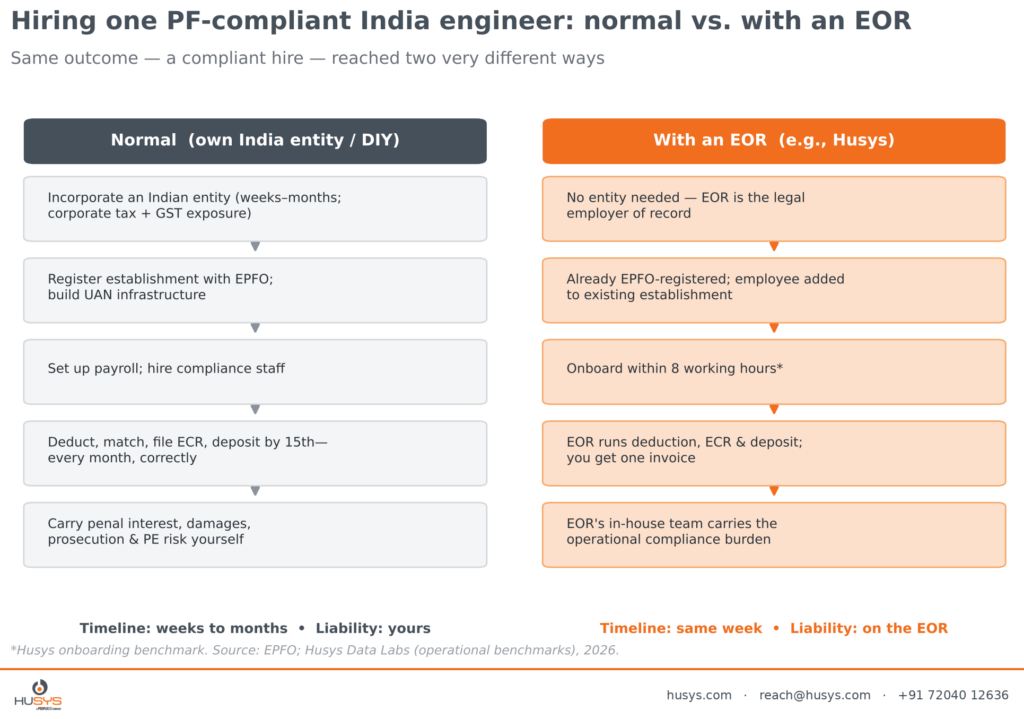
PF lifecycle step | Normally (own entity / DIY) | With an EOR (e.g., Husys) |
|---|---|---|
Legal employer | Incorporate an Indian entity (weeks to months; corporate tax plus GST exposure) | The EOR is the legal employer of record; no entity needed |
EPFO registration | Register the establishment yourself; build UAN infrastructure | Already registered; your hire joins the existing establishment |
Onboarding speed | Payroll and PF setup can take weeks; delays risk losing the candidate | Onboarding within 8 working hours (Husys benchmark) |
Monthly filing | Your team deducts, matches, files the ECR, deposits by the 15th | The EOR runs deduction, ECR filing and deposit; you get one invoice |
Compliance risk | You carry interest, damages, prosecution and PE risk directly | The EOR’s in house compliance team carries the operational burden |
Cost predictability | Entity, payroll, compliance staff and audit: variable, hard to forecast | Flat $99 per employee per month; no hidden setup fees, no minimums |
Exit | Winding down the entity and registrations is slow and costly | Offboard the employee; there is no entity to dissolve |
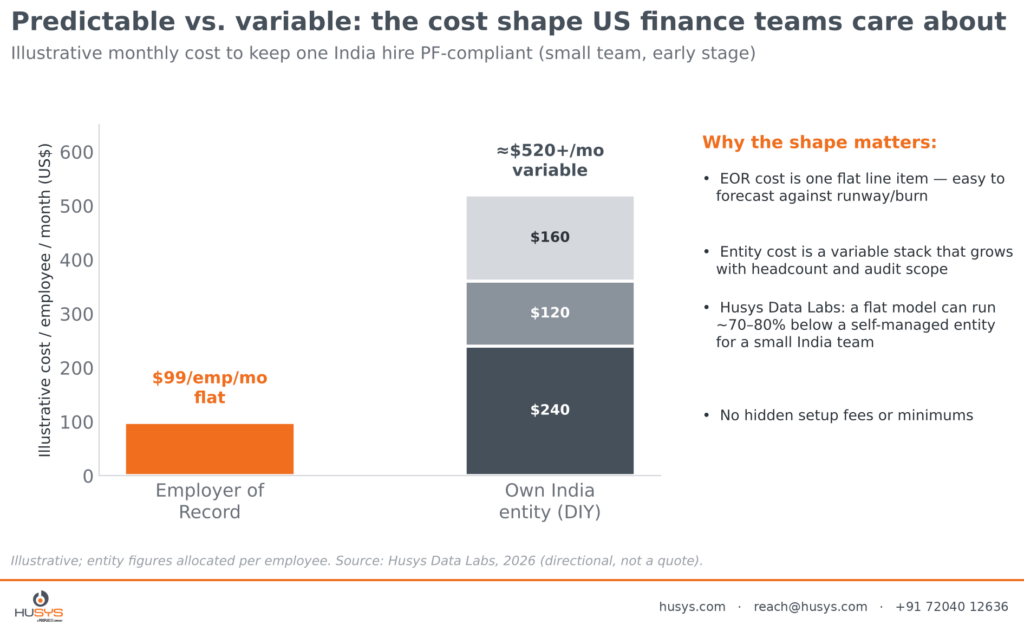
The entity bars above are illustrative, allocated per employee for a small early stage India team: roughly $240 for compliance staff time, $120 for payroll and filing software and operations, and $160 for entity upkeep, audit and tax filings. The 70 to 80% figure is directional, based on Husys Data Labs comparing a flat per employee model against the loaded cost of a self managed entity (team size, cost items and period available on request); treat it as a ballpark, not a quote.
What does this mean for your role?
For a YC incubated founder (Seed, 5 to 20 people) You have just been incubated and need a senior India engineer live this week. Standing up an entity to run PF is not realistic on that timeline. An EOR makes your first compliant India hire a same week decision at a flat $99 per employee per month, so you protect the runway and do not become an accidental compliance expert while you are trying to ship. |
For the CFO of a growing drone tech startup (Series A to B) You are modelling burn against a hardware roadmap, and unpredictable PF or entity costs wreck the forecast. A flat per employee EOR cost turns India headcount into a single, predictable line item, and the tail risk sits with a 23 year India specialist, not your two person finance team. |
For a General Counsel (growth stage SaaS) You need to sign off that there is no misclassification or Permanent Establishment exposure. An EOR that holds the EPFO registration and files the ECR gives you a documented, auditable compliance trail, instead of a DIY process you would have to defend in diligence. |

PF in India vs. a US 401(k): what’s different?
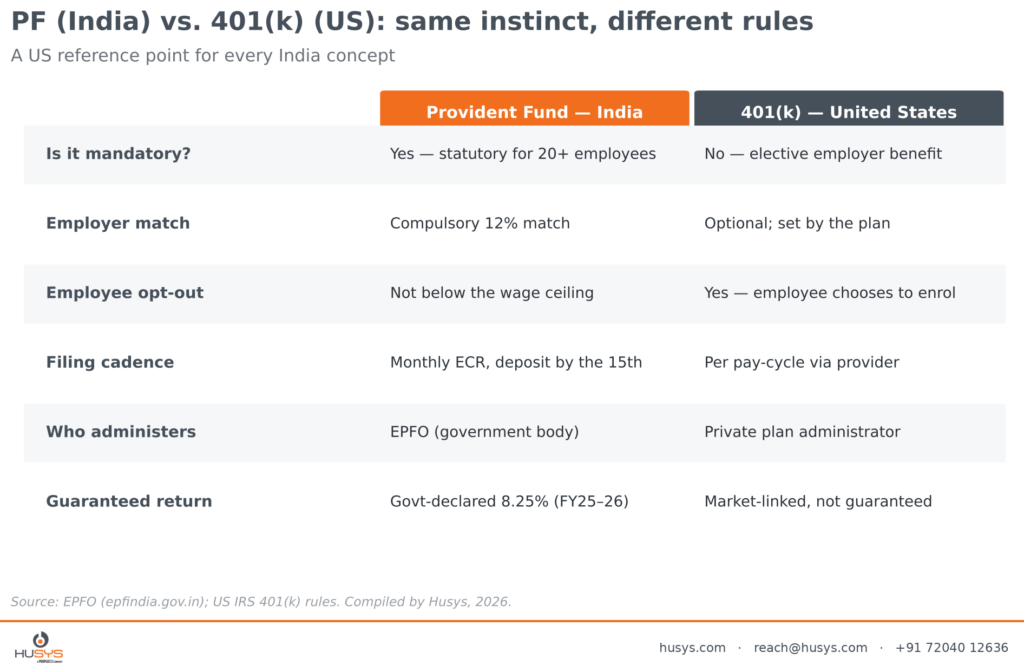
Dimension | Provident Fund (India) | 401(k) (United States) |
|---|---|---|
Mandatory? | Yes, statutory for establishments with 20+ employees | No, elective employer benefit |
Employer match | Compulsory 12% (no opt out below the ceiling) | Optional; set by the plan |
Contribution base | PF wages (basic + DA, at least 50% of pay), capped at ₹25,000 | Elective % of pay, up to IRS limits |
Filing | Monthly ECR; deposit by the 15th | Per pay cycle via provider |
Administered by | EPFO (government body) | Private plan administrator |
Return | Government declared 8.25% (FY 2025–26) | Market linked, not guaranteed |
The Husys PF Readiness Check: 10 questions before you hire in India
Run this provident fund in India readiness check before your first India hire, or before your next payroll if you already have a team. If you answer “no” or “not sure” to any of these, fix it before money moves.
☐ Confirmed whether you cross the 20 employee establishment threshold, or will register voluntarily. ☐ Chosen your route: own Indian entity, employer of record, or (with eyes open) contractors. ☐ Budgeted the roughly 13% all in employer PF cost, recomputed for the ₹25,000 ceiling. ☐ Tested your salary structure against the 50% wage rule (Code on Social Security). ☐ Re checked offer letters and salary structures for the ₹25,000 ceiling change. ☐ Decided whether employer PF sits inside or on top of the CTC you quote, and said so in the offer. ☐ Set up UAN and KYC (Aadhaar, PAN, bank) for every covered hire. ☐ Calendared the monthly ECR filing and the 15th of next month deposit. ☐ Getting monthly ECR and challan proof from your EOR or vendor, and spot checking UAN passbooks. ☐ Checked eligibility for the PM-VBRY hiring incentive on new hires. |
What do US employers get wrong about PF?
“Can I just put everyone on contract and skip PF?”
No, not for people doing full time employee work. If the relationship looks like employment (you direct their hours, tools and tasks), calling them a contractor is misclassification. The exposure includes back dated PF dues, interest, damages and potential PE risk. It is the most expensive “shortcut” in India hiring.
“Does the ₹25,000 cap limit my total liability?”
Only for statutory minimums on domestic staff. The ceiling caps the PF base for resident employees, but it does not cap contributions for international workers (no ceiling at all), and many employers voluntarily contribute above the cap.
“Is PF optional for high earners?”
Only for the right ones. A first time joiner above the ceiling who was never a PF member can opt out via Form 11; that is common for senior hires. But anyone already a PF member must continue, and the higher ₹25,000 ceiling pulls more people into mandatory coverage. Verify each case against EPFO rules.
“Interns and trainees don’t need PF.”
Usually false. Only apprentices engaged under the Apprentices Act, 1961 (or your standing orders) are excluded. A “trainee” or “intern” on your payroll who is paid wages is generally an employee for PF. Labelling someone a trainee does not exempt them; confirm with compliance, especially for fixed term trainees.
Source: https://indiankanoon.org/doc/192256/
“What happens to PF when an employee exits?”
On any exit, PF for the final month must still be deposited, and you cannot hold back the employee’s PF balance to recover unserved notice pay or other dues. PF settlement is separate from the full and final; notice disputes are settled through salary and F&F, not the PF account. Ask departing employees to link their UAN to the next employer or file a claim through the EPFO portal, since employer KYC approval delays are a common cause of stuck claims.
What happens to PF when an employee exits?”
Termination and final settlement is the single most common compliance flashpoint we see with US clients, and the PF side is where it usually goes wrong. Two rules keep you clean:
- On any exit, PF for the final month must still be deposited, and the employer cannot hold back the employee’s PF balance to recover unserved notice pay or other dues. PF settlement is separate from the full-and-final (F&F), notice-pay disputes are settled through salary and F&F, not the PF account.
- Ask departing employees to link their UAN to the next employer, or file a withdrawal/transfer claim through the EPFO member portal. Employer KYC approval delays are a common cause of stuck claims, so approve KYC promptly on exit.
Related reading: Exit Planning in India
How Husys has fixed PF problems for US clients (scenarios we commonly see)
These are the patterns we see most often with incoming US clients. They are representative scenarios, not named case studies; we can share anonymised, client approved specifics on request.
Migration clean up A US company moving from another provider or from contractors, where an onboarding audit finds unfiled ECRs or the wrong PF wage base. The fix is to regularise filings, correct the wage base (often under the 50% rule) and, where there are legacy damages, assess the Vishwas 2026 route before EPFO raises it. |
Expat modelled before the hire A growth stage client seconding a US national to India. Modelling full salary PF (no ceiling), the age 58 lock and the FBAR flag before the offer avoided a six figure surprise and a renegotiation. |
The ₹25,000 ceiling re modelled For clients with staff earning between ₹15,000 and ₹25,000, re issuing salary structures and updating offer letters before the September 2026 payroll kept take home promises intact and the budget honest. |
Husys Data Labs (ask ops to fill with real figures)
Fill these with real, verifiable numbers from ops before publishing; original data is exactly what AI answer engines cite. |
What this looks like at Husys
Husys (a People2.0 company) runs the full provident fund in India lifecycle for US clients; it holds the EPFO registration, files the ECR, manages UAN and PF end to end, with 23+ years in India, 450+ active clients, 8,000+ employees managed, ISO 9001 and ISO 27001 certification, onboarding within 8 working hours and a flat $99 per employee per month (no hidden setup fees or minimums). Its in-house legal and compliance team covers 28 states and 6 union territories. Where an EOR is not the right fit, for example when you are directly generating revenue in India, Husys will say so and help you weigh an entity instead. Learn more about Husys. |
What do the experts and official sources say?
Beyond the government portals, a few credible sources are worth your time. We cite primary sources first, then professional authorities, and when we quote a video we attribute the speaker by name, role and timestamp so you can check it yourself.
Worth watching and reading
|
The bottom line The provident fund in India is simple to understand and unforgiving to execute as a foreign company. Whether you run PF through your own entity or an EOR, the obligations do not change: 12% plus 12%, a base of at least half of pay, the new ₹25,000 ceiling, full salary contributions for expats and a monthly ECR by the 15th. What changes is who carries the risk. For most US employers, an EOR turns PF into a predictable, audited, same week decision instead of a standing liability. |
Frequently asked questions
Is PF (Provident Fund) mandatory in India?
Yes. PF is mandatory for establishments with 20 or more employees, and for covered employees it is compulsory with no opt out below the ₹25,000 wage ceiling. Smaller establishments may register voluntarily. (Source: EPFO.)
Do foreign or US companies have to pay PF in India?
Yes, if you employ people in India through an Indian establishment (your own entity or an employer of record). PF applies to the employment itself, regardless of where the parent company is based.
Can a US company contribute to PF without setting up an Indian entity?
Yes, through an employer of record (EOR) that is the legal employer and already holds the EPFO registration. You hire the person; the EOR runs PF. No Indian entity required.
How much is the employer’s PF contribution in India?
12% of PF wages (8.33% to EPS, 3.67% to EPF), plus 0.5% EDLI and 0.5% admin (minimum ₹500 a month), about 13% all in, on wages up to the ₹25,000 ceiling. (Source: EPFO.)
What is the EPF wage ceiling now, and what changed in 2026?
It rose from ₹15,000 to ₹25,000, via Gazette S.O. 5109(E), effective 17 September 2026, the first change in nearly a decade. (Source: Ministry of Labour.)
Do I have to pay PF on salaries above the ₹25,000 ceiling?
For domestic staff, the statutory minimum is calculated on the ₹25,000 ceiling; contributing above it is voluntary. For international workers there is no ceiling; it is 12% plus 12% on full salary.
What counts as “wages” for PF under the 50% rule?
Under the Code on Social Security, 2020, wages (basic plus DA) must be at least 50% of total pay. If allowances exceed 50%, the excess is added back to the PF base, so a low basic structure no longer reduces PF the way it used to. (Source: Code on Social Security, 2020.)
Does the US have a social security agreement with India?
No. The US has no Social Security Agreement (totalization treaty) with India, so seconded staff can face double contributions and PF locked until age 58. (Context: EPFO.)
What happens if an employer misses or is late on PF payments?
Damages of 1% of the arrears per month (12% a year) under Section 14B, plus 12% a year interest under Section 7Q, from the first day of delay, and potential prosecution. This flat rate replaced the old 5 to 25% slabs on 15 June 2024. (Source: EPFO.)
How is PF different from a US 401(k)?
PF is mandatory, with a compulsory employer match and a government declared return (8.25% for FY 2025–26); a 401(k) is elective, with optional matching and market linked returns.
Who is liable for PF, the US parent, the Indian entity, or the EOR?
Whoever is the registered employer. With your own entity, that entity (and by extension you) is liable; with an EOR, the EOR is the legal employer and carries the operational compliance burden. Get it in writing.
How does an Employer of Record handle PF compliance in India?
The EOR holds the EPFO registration, generates UANs, deducts and matches each month, files the ECR, deposits by the 15th and maintains the audit trail, so you hire in days without building any of it.
Talk to a compliance expert
If you are evaluating hiring in India, a short conversation with a compliance expert early can prevent costly PF and payroll mistakes. Talk to the Husys team. reach@husys.com · +91 72040 12636 · husys.com |