
Key takeaways
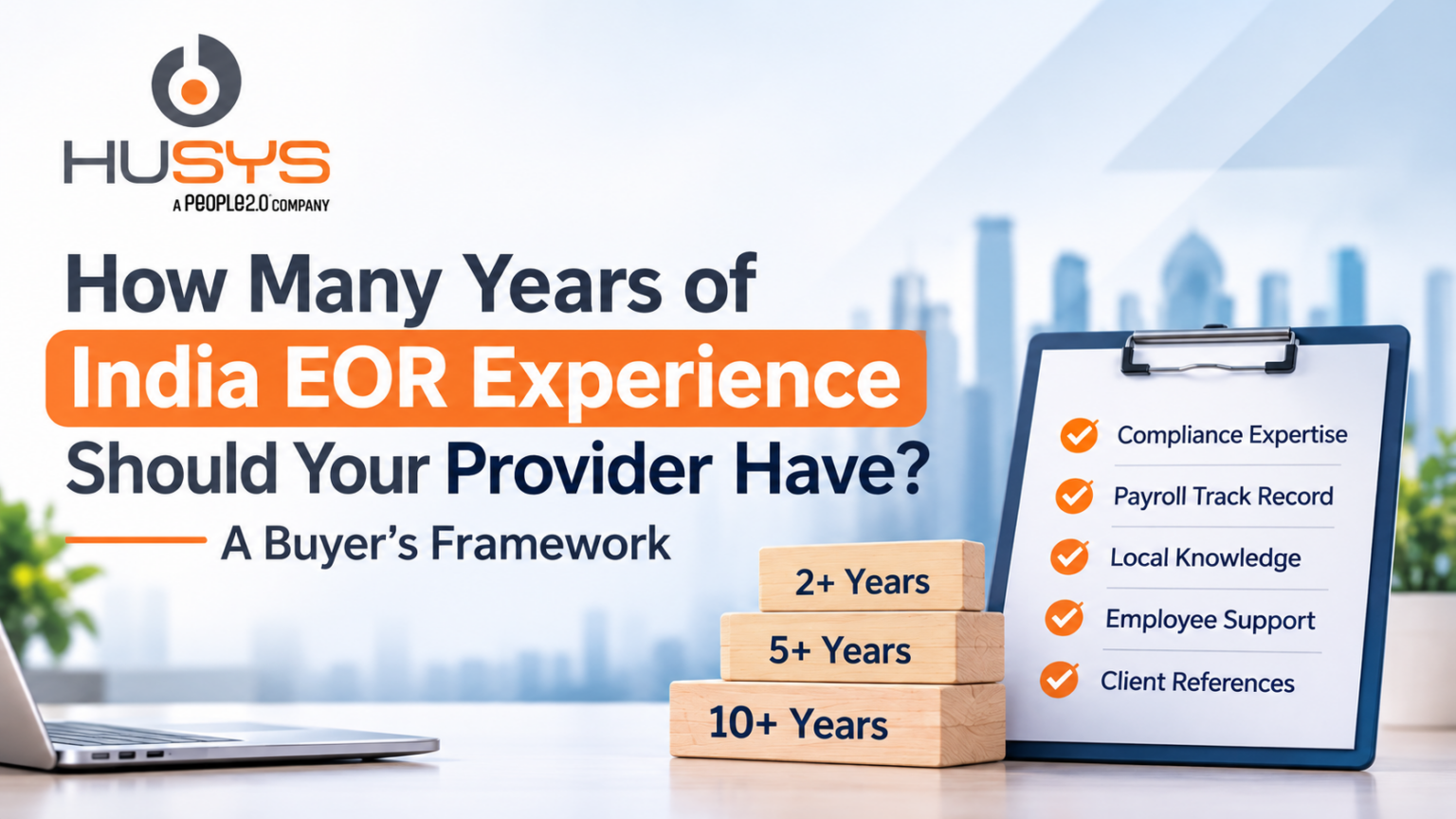
not by the age of the global brand on the website. For most US employers the practical floor is five years, because three unrelated Indian statutes independently converge on a five-year horizon. Below that, a provider is not non-compliant; it is simply untested on the obligations that bite latest.
What our market review found: the median EOR provider’s brand is 6.6 years old, but its Indian entity is only 3.3. 44% of providers have an Indian entity younger than five years, 72% employ in India through a partner rather than their own entity, and the median provider has just 3.5 years of filed audited accounts.
That floor then scales with your risk. The right India EOR experience threshold for one pilot hire in one state is not the threshold for fifty engineers across four states holding your core IP.
Your situation | Minimum India entity age | Why this threshold |
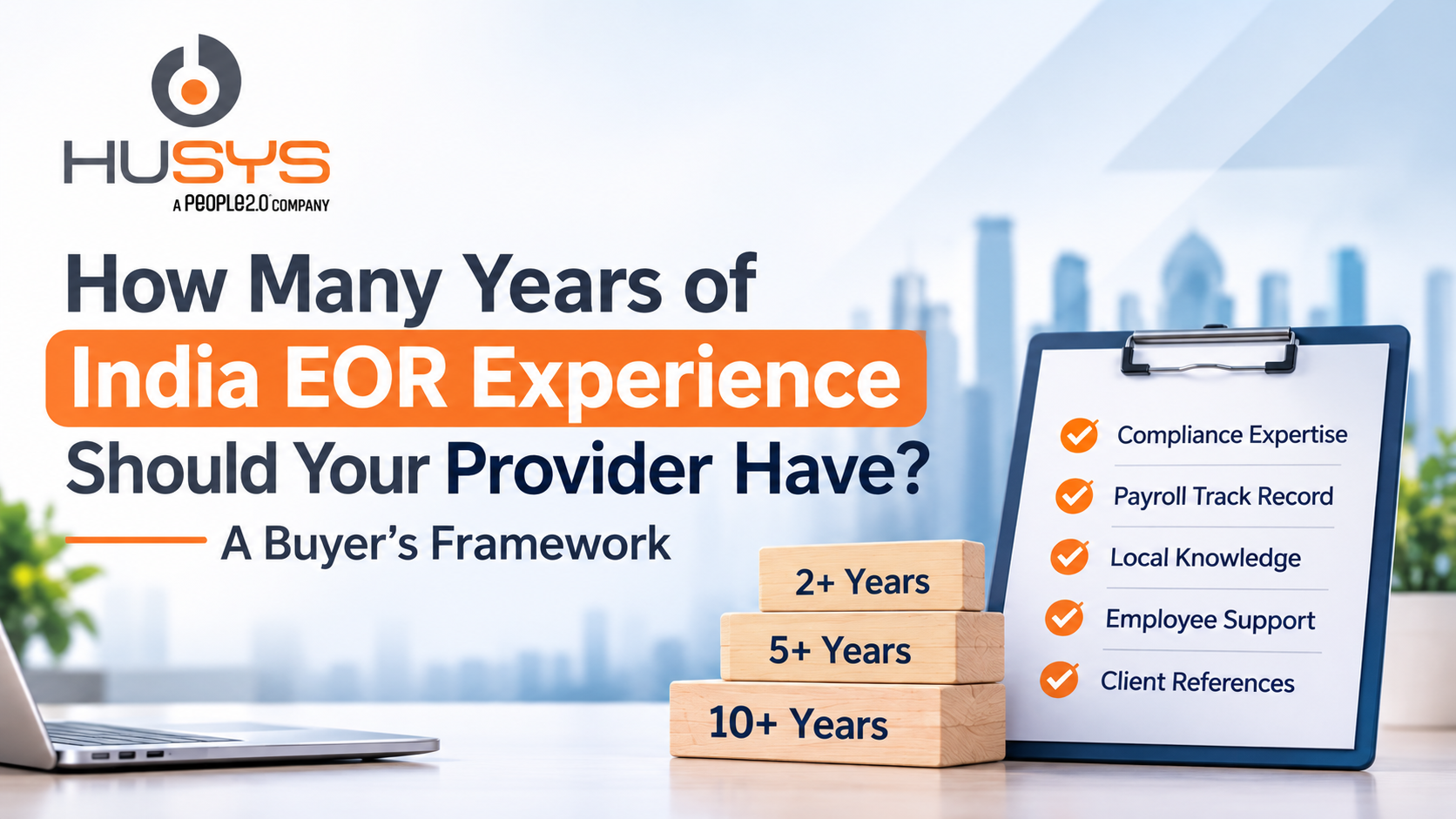
Tier 0 – Pilot hire. 1–3 people, one state, non-regulated, under 12 months | 3+ years | You will probably exit before gratuity vests |
Tier 1 – First real team. 5–25 people, 2–3 states, multi-year horizon | 5+ years | Gratuity vests at five years; the statutory assessment window is five years |
Tier 2 – Scaled team. 25–100 people, multi-state, IP-holding or R&D roles | 7–10 years | The provider must have run payroll through at least one statutory transition |
Tier 3 – Regulated or enterprise. 100+ people, BFSI, fintech, pharma, enterprise procurement | 10+ years, across 2+ regime changes | Your own regulator’s scrutiny extends to your vendor |
The rest of this guide shows you how to verify any claim about India EOR experience against public records in about twenty minutes, for free and what to do with the answer.
India EOR experience, defined
What India EOR experience is: the age and operating history of the Indian legal entity that signs your contract and holds the provident fund, ESI and Shops & Establishments registrations your employees depend on.
What India EOR experience is not: the founding year of the global group, the number of countries the provider covers, or its total headcount. Those describe a brand. They do not describe the employer of record.
Related terms used below: CIN, the 21-character Corporate Identity Number every Indian company carries, with its year of incorporation built into it; signing entity, the company whose name appears on your service agreement; continuity of service, the unbroken employment record that gratuity, leave accrual and maternity benefit all depend on; gratuity, India’s statutory long-service payout, which vests at five years.
New to this? Start with our pillar guide to employer of record in India, then come back here to vet a shortlist.
Who this is for: US-based Founders, CFOs, CHROs, COOs and General Counsel who are evaluating India EOR experience while hiring through an employer of record, with no in-house Indian labour-law expertise. We assume you know US payroll, at-will employment and 401(k). We assume you do not know what section 53 of the Code on Social Security, 2020 does to your cost base at year five.
Why India EOR experience is a compliance variable, not a vanity metric
Every EOR evaluation checklist on the internet has a line item called “track record” or “experience.” India EOR experience is always on the list, almost always the last bullet, never weighted and never defined. We went looking for a single published page that tells a buyer how many years of India EOR experience to require. There isn’t one.
That matters more in India than almost anywhere else, for a reason that has nothing to do with vendor quality and everything to do with how Indian employment law is built.
In the US, the obligations attached to an employee are mostly immediate and mostly flat. You run payroll, you withhold, you file quarterly, and the relationship is at-will. In India, several of the heaviest obligations do not arrive until years into the employment relationship:
- Gratuity does not vest until five years of continuous service (Code on Social Security, 2020, s.53, carrying forward the Payment of Gratuity Act, 1972).
- Provident Fund and ESI assessments see our deep-dive on provident fund in India for US employers can be initiated up to five years back, and the provider needs filings to show for that window.
- Statutory records must survive five years from the date of the last entry before they can be destroyed.
- Leave accrual, maternity-benefit qualification and notice-period entitlements all compound with tenure.
- Here is the same point as a timeline, and it is the clearest way to see why India EOR experience is measured in years rather than countries. Almost nothing in year one tells you much about a provider. Year five tells you most of what you need to know.
When | What lands on the employer |
Year 1 | Probation ends and notice terms start to bite. Leave accrual begins. Provident fund and ESI have been running since month one. |
Years 2–3 | Leave carry-forward and encashment build up. Maternity-benefit qualification comes into play — 80 days worked in the 12 months before the expected delivery date, now under section 60(2) of the Code on Social Security, 2020. |
Year 4 | You are now inside the five-year provident fund and ESI assessment window, and inside the five-year record-retention cycle. |
Year 5 | Gratuity vests. The first full retention cycle completes. The provider either has the history or it does not. |
Year 6+ | All of the above repeats, and gratuity now accrues for every leaver rather than being a future problem. |
A provider with eighteen months of India EOR experience has never had to settle any of these. Not because it is careless because the clock has not run yet. This is the core of India EOR experience as a buying criterion: you are not measuring competence, you are measuring which obligations the provider has actually been forced to discharge.
The other half of the argument is less comfortable. An EOR is the legal employer of your India staff. If the provider stops existing, your employment relationships, your statutory filings and your employees’ continuity of service all stop with it. That makes India EOR experience a survival-probability question too, and we have data on that later in this guide.
The Four Clocks: which “age” is your EOR actually quoting?
Here is the single most useful thing in this guide, and the reason India EOR experience is so easy to overstate. Every employer of record has four different ages, and they are usually years apart. Providers quote whichever one is largest
this is truly amazing …. mere foundational thought me b yah level ka point nahi aaya… awesome
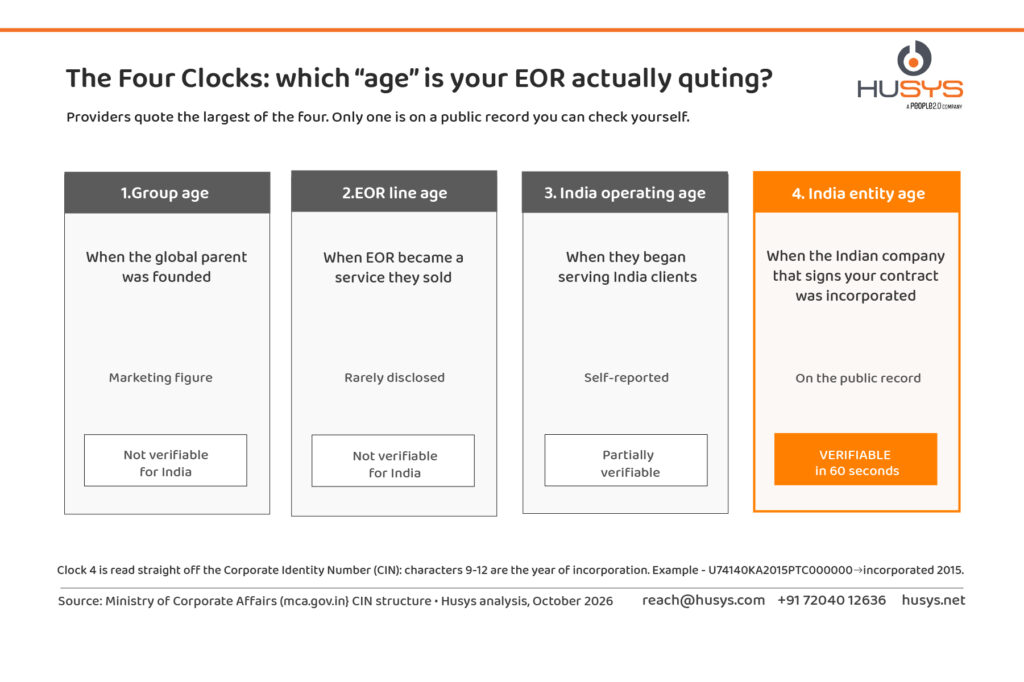
Clock | What it measures | Typical use | Can you verify it? |
1 · Group age | When the global parent company was founded | The headline number on the website | No — not for India |
2 · EOR line age | When employer of record became a service they actually sold | Rarely disclosed at all | No |
3 · India operating age | When they began serving clients in India | “We’ve been in India for years” | Partially — ask for evidence |
4 · India entity age | When the Indian company that signs your contract was incorporated | Almost never volunteered | Yes — in about 60 seconds |
A twenty-five-year-old parent company with a two-year-old Indian subsidiary is not a twenty-five-year India EOR. When you are assessing India EOR experience, that is not a trick question or an accusation it is an extremely common and entirely legitimate corporate structure. The problem is only that the second number is the one that governs your statutory exposure, and the first number is the one on the homepage.
The gap is measurable. In our review of EOR providers serving US companies in India, the median provider’s brand was twice as old as its Indian entity: 6.6 years against 3.3. And 72% of them do not employ in India through their own entity at all, but through a partner.
What this means for you: when a provider quotes its India EOR experience as “X years,” your next question is always the same four words “in which Indian entity?”
Why Clock 4 is the India EOR experience that counts
Whoever signs your service agreement is the entity that:
- holds the Provident Fund establishment code your employees’ contributions flow into;
- holds the ESI employer code;
- holds the Shops & Establishments registration in each state you hire in;
- carries the gratuity liability as it accrues;
- has to answer an inquiry officer if something was filed wrongly four years ago;
- and either exists, or does not exist, when you need to offboard someone in 2031.
Clocks 1 to 3 do none of that. Only Clock 4 is India EOR experience in the sense that matters to your liability.
How to verify India EOR experience in 60 seconds
Verifying India EOR experience is the part no competitor publishes, and it costs nothing. To be clear about the two timings this guide gives for checking India EOR experience: the CIN check below takes about 60 seconds and settles the single most important question — how old is the entity that will sign your contract. The full eight-record check later in the guide takes about 20 minutes and settles the rest.
Every company registered in India has a 21-character Corporate Identity Number (CIN), issued by the Ministry of Corporate Affairs. Characters 9 to 12 of the CIN are the year of incorporation. The year is literally embedded in the identifier.
How to read a CIN:
Position | What it is | Example |
1 | Listing status — L (listed) or U (unlisted) | U |
2–6 | Industry classification code | 74140 |
7–8 | State or union territory of registration | KA (Karnataka) |
9–12 | Year of incorporation | `2015` |
13–15 | Company type (PTC, PLC, OPC…) | PTC |
16–21 | Registrar of Companies registration number | 000000 |
So U74140KA2015PTC000000 is an unlisted private company registered in Karnataka and incorporated in 2015.
Do this before your next vendor call:
- Ask the provider for the full legal name and CIN of the Indian entity that will be the employer of record on your contract. Not the group. The signing entity.
- Read characters 9–12. That is your real number.
- Cross-check the claimed India EOR experience against the public record. Search the same name on the Ministry of Corporate Affairs portal under MCA Services → Find CIN. Confirm the entity’s status reads Active, not Struck Off or Under Liquidation.
- While you are there, check how many years of filed annual returns and audited financials exist. A company that has filed three or more consecutive years of accounts is a materially different proposition from one that has filed one.
If a provider will not give you the CIN of the signing entity, that is itself the answer. It takes them five seconds to send and it is a public record.
Six red flags, in 30 seconds
If you only have time for one pass at a provider’s India EOR experience, these are the answers that should slow you down.
They will not give you the CIN of the signing entity.
They quote group age when you asked about India.
“We cover all of India” with no state list and no registration dates.
No client reference who has been through a termination.
“Gratuity is handled as per the Act” a restatement of the law, not a description of their practice.
No written continuity or records-handover plan.
None of these is proof of anything on its own. Two or more together is a pattern.
A note on fairness. Plenty of excellent providers have a young Indian entity because they restructured, because the group acquired a local business, or because they genuinely entered recently. The CIN does not tell you they are bad. It tells you which of the four clocks of India EOR experience you are actually buying, so you can price the risk honestly instead of guessing.
Why five years is the floor, not a round number
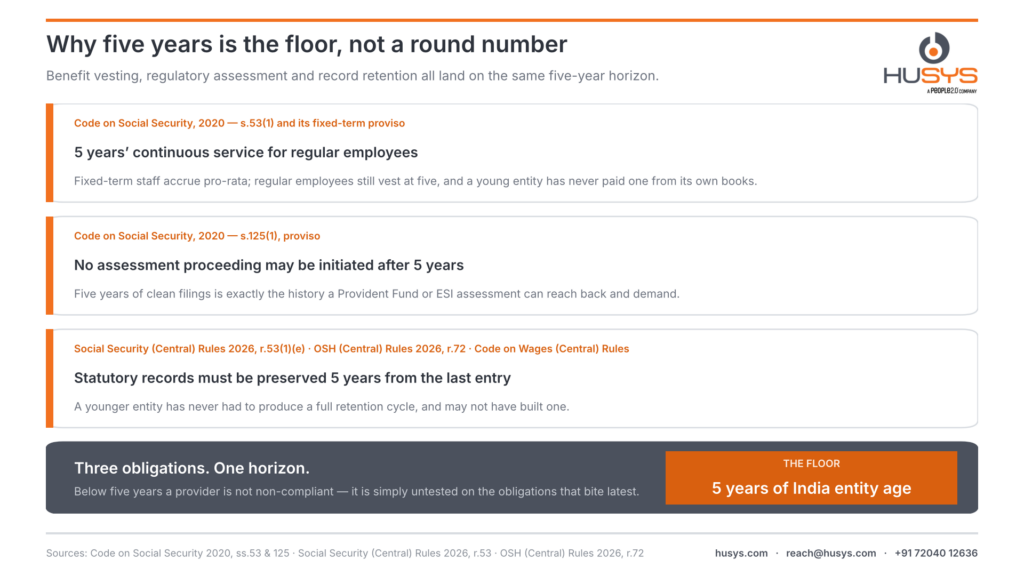
Five is not a focus-group number, and it is not a marketing threshold invented to flatter long-established providers. Three separate strands of Indian employment law benefit vesting, regulatory assessment and record retention independently land on the same five-year horizon.
CONSISTENCY: The heading says ’60 seconds’ while the short answer and meta description say ’20 minutes’. Add a line clarifying that the CIN check takes 60 seconds and the full eight-record check about 20 minutes, so readers don’t see a contradiction.
1. Gratuity vests at five years
A drafting note first, because most content on this topic is now out of date: the Payment of Gratuity Act, 1972 was subsumed into the [Code on Social Security, 2020](https://labour.gov.in/) when the labour codes commenced on 21 November 2025. The rule survived the consolidation intact.
Under section 53 of the Code, an employee becomes entitled to gratuity after five years of continuous service (except on death or disablement). It is calculated at 15 days’ wages for each completed year on the last drawn salary, with a 26-day month as the divisor, and the ceiling remains ₹20 lakh — about US$21,300 at ₹94 to the dollar (rate of 6 November 2026). That ceiling is the amount notified by S.O. 1420(E) of 29 March 2018, carried forward under section 53(3), which the central government may raise by fresh notification.
One thing has changed underneath the formula, though, and it is the part most US employers miss. Under the labour codes, “wages” as defined in section 2(88) of the Code on Social Security, 2020 must amount to at least half of an employee’s total remuneration; where the excluded allowances exceed that half, the excess is added back into wages. The Ministry has confirmed both that this revised definition governs gratuity with effect from 21 November 2025 (Additional FAQs, Sl. No. 6) and that any component falling outside section 2(88) is excluded from the calculation (Sl. No. 13). Gratuity is calculated on that statutory wage base, not on whatever a salary structure happens to label “basic”. For the India salary structures US companies typically inherit a small basic with a large allowance stack on top that lifts the gratuity base, and with it the accrual the employer has to carry. A provider that priced your headcount on the old basic-plus-dearness-allowance practice has under-provisioned for it. Ask yours which base it accrues on, and get the answer in writing.
The one change: fixed-term employees become eligible on a pro-rata basis without the five-year qualifying period. The Government’s own announcement described this as “gratuity eligibility after just one year, instead of five” (Press Information Bureau, 21 November 2025). That headline applies only to fixed-term employees, and the Ministry of Labour & Employment has since said so in terms. Its Additional FAQs on Labour Codes (as on 16 March 2026) answer the question directly at Sl. No. 14: “Fixed Term Employee (FTE) will be eligible for gratuity if he/she renders service under the contract for a period of one year (from start of contract).” Sl. No. 19 repeats it for an eleven-month engagement, and Sl. No. 16 restates the five-year rule for contract labour engaged through a contractor. Nothing in that document gives a regular or permanent employee gratuity before five years. If a provider or a blog tells you gratuity now vests at one year across the board, that is the fixed-term rule misapplied — and it is the single most common error in circulation on this subject.
Read that carefully, because it is the whole point: for the permanent India employees most US companies hire through an EOR, the five-year clock is still the clock.
Here is what the absence of India EOR experience costs, in a figure a CFO can hold in their head. Take a senior engineer on ₹30 lakh total cost to company, with basic pay of roughly ₹15 lakh a year, or ₹1,25,000 a month. If they leave after exactly five years, gratuity on that wage base is 15 ÷ 26 × ₹1,25,000 × 5, which is about ₹3.6 lakh — roughly US$3,840 at ₹94 to the dollar. At ten years it is about ₹7.2 lakh, or roughly US$7,670. Note that this is calculated on a wage base of ₹1,25,000 a month, which here is exactly half of total cost to company; on a structure with a smaller basic the statutory 50% floor would push the base, and the payout, higher. Next to the salary it is not a large number. It is a certain number, it lands in one payment at exit, and it has to have been accrued month by month for five years before it does. That accrual is the thing a young provider has never had to carry.
An EOR whose Indian entity is less than five years old has, by definition, never paid a regular employee’s gratuity claim out of its own books. It has never funded the accrual through a complete vesting cycle, never computed a final settlement with a vested gratuity line in it, and never had that computation challenged.
For comparison, this is what a settled gratuity record looks like at scale. Husys settled 330 gratuity claims in 2025 and has disbursed 683k+ [[PRE-PUBLISH: confirm whether this is INR or USD and restate]] in gratuity to date, including 60k+ in 2026 so far. 11% of our clients’ employees have reached five years of continuous service with us, the point at which gratuity vests.
2. The social-security assessment window is now exactly five years
This one changed in your favour, and almost nobody has updated for it.
Under the old regime, Section 7A of the Employees’ Provident Funds and Miscellaneous Provisions Act, 1952 carried no limitation period at all — which is why EPFO was criticised for roving inquiries “ranging from 5 to 20 years”, and why its own Guidelines for Initiation of Inquiries under Section 7A, dated 14 February 2020 had to rein them in. Cyril Amarchand Mangaldas noted at the time that inquiries beyond roughly five years, absent evidence of prolonged default, “would be legally untenable.”
The Code on Social Security, 2020 closed the gap with a hard statutory bar. Section 125(1) — which replaces both Section 7A of the EPF Act and Section 45A of the ESI Act — provides:
“Provided that no proceeding under this sub-section shall be initiated after the expiry of the period of five years from the date on which the dispute referred to in clause (a) is alleged to have been arisen or, as the case may be, the amount referred to in clause (b) is alleged to have been due from an employer.”
One precision point, because the two statutes were not in the same position before. Section 7A of the EPF Act had no limitation at all. Section 45A of the ESI Act already capped the period you could be assessed for at five years — what section 125(1) adds there is a bar on starting the proceeding at all. So the look-back window is now precisely five years, for Provident Fund and ESI alike — and that is not a technicality. It is the exact history a provider has to be able to produce. A provider with eighteen months of filings has eighteen months of history against a five-year window, which is not a defence; it is a gap.
3. Statutory records must survive five years
Under the ESI (General) Regulations, 1950 (Reg. 32 and Reg. 102-A), an employer must preserve ESI registers and records for five years from the date of the last entry.
The Central Rules notified on 8 May 2026 brought the rest of the statute book into line. Registers and records under the Occupational Safety, Health and Working Conditions (Central) Rules, 2026, Rule 72 must be preserved for five years from the date of the last entry, and the Code on Wages Central Rules set the same horizon. All four sets of Central Rules were notified that day under separate numbers — G.S.R. 342(E) for Industrial Relations, 343(E) for Wages, 344(E) for Social Security and 345(E) for OSH — and the OSH text is published on the Ministry of Labour site at pdf for anyone who wants to read Rule 72 themselves. The cleanest single citation for records is now Rule 53(1)(e) of the Social Security (Central) Rules, 2026, which requires originals kept five calendar years from the last entry. The old three-year retention periods under the Payment of Wages Rules, 1937 and the Contract Labour Central Rules, 1971 are now history.
An entity younger than its own retention obligation has never had to produce a full cycle on demand — and may not have built the archive discipline to do it.
Three obligations. One horizon. Gratuity vests at five years. Assessments reach back five years. Records must survive five years.
That is why the floor for India EOR experience is five years, and why it is defensible in front of your own auditors.
How much India EOR experience you actually need, by risk tier
A single threshold would be lazy. The right level of India EOR experience scales with four things:
- how many people,
- how many states,
- how regulated your sector is, and
- how long the employment relationship has to survive.
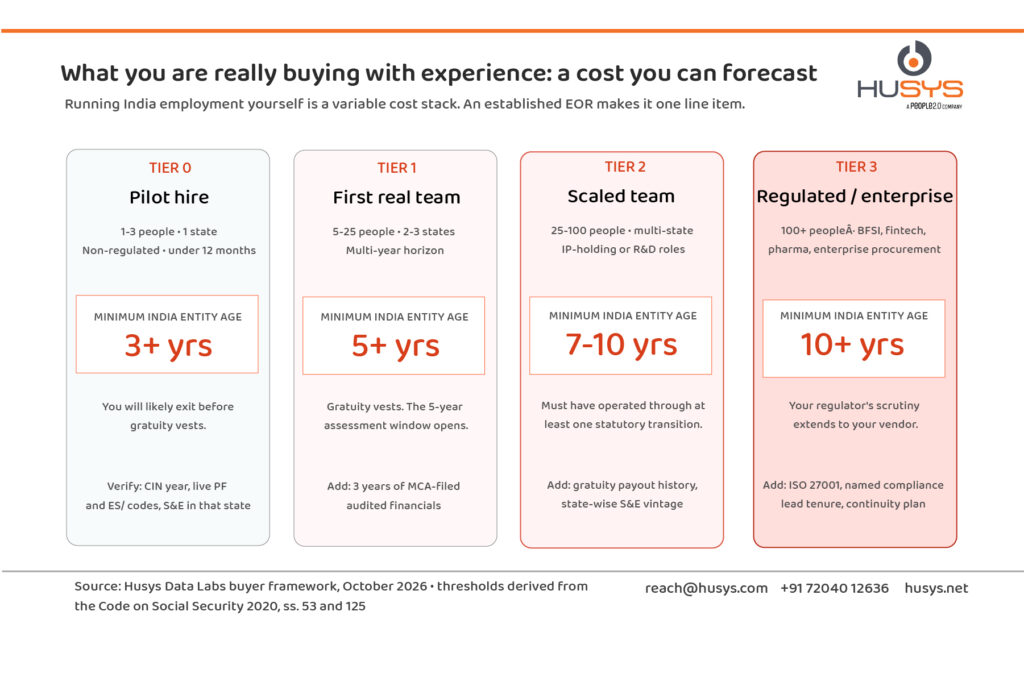
Tier 0 — Pilot hire · 3+ years
You are: 1–3 people, one state, non-regulated sector, horizon under twelve months. A contractor conversion, a first sales hire, a single engineer.
Why 3 years of India EOR experience: you will almost certainly exit the relationship before gratuity vests, so the heaviest long-tail obligation never reaches you. What you still need from India EOR experience at this tier is live registrations and a real filing history.
Verify:
- CIN year of incorporation
- live PF and ESI codes
- Shops & Establishments registration in that specific state.
Tier 1 — First real team · 5+ years
You are: 5–25 people across two or three states, multi-year horizon. This is where most US SaaS and services companies actually sit.
Why 5 years of India EOR experience: gratuity vests inside your horizon, and the five-year social-security assessment window under section 125 of the Code on Social Security, 2020 covers the whole of it. You are now dependent on a provider having done this before, not just set it up.
Verify: everything above, plus three or more years of MCA-filed audited financials.
Tier 2 — Scaled team · 7–10 years
You are: 25–100 people, multi-state, roles that hold IP or sit in R&D.
Why 7–10 years of India EOR experience: India changed its employment law architecture in this window, so India EOR experience here has to span a regime, not just a decade. You want a provider that has actually operated a payroll across at least one statutory transition, not one that has only ever known the current regime.
Verify:
- everything above,
- plus evidence of gratuity payouts actually made, and
- state-by-state Shops & Establishments registration dates in every state you hire in.
Tier 3 — Regulated or enterprise · 10+ years, across 2+ regime changes
You are: 100+ people, or any headcount in BFSI, fintech, pharma, or a sector where your own regulator audits your vendor chain.
Why 10+: your compliance obligations are inherited by your vendor. Enterprise procurement will test India EOR experience directly: it will ask for audited financials, insurance, certifications and a continuity plan, and each needs to have existed long enough to mean something.
Verify:
- everything above,
- plus ISO 27001 and ISO 9001 certification,
- DPDP readiness,
- the tenure of the named compliance lead, and
- a written business-continuity and data-handover plan.
The regulatory scar-tissue test: India EOR experience measured in regime changes
Here is a sharper way to think about India EOR experience than counting years: count regime changes. Two providers can both claim a decade and have lived through completely different decades.
India EOR experience is not time served. It is the number of statutory transitions a provider has actually run a payroll across — because that is where institutional memory is made, and it is the only kind of India EOR experience you cannot hire in a quarter.
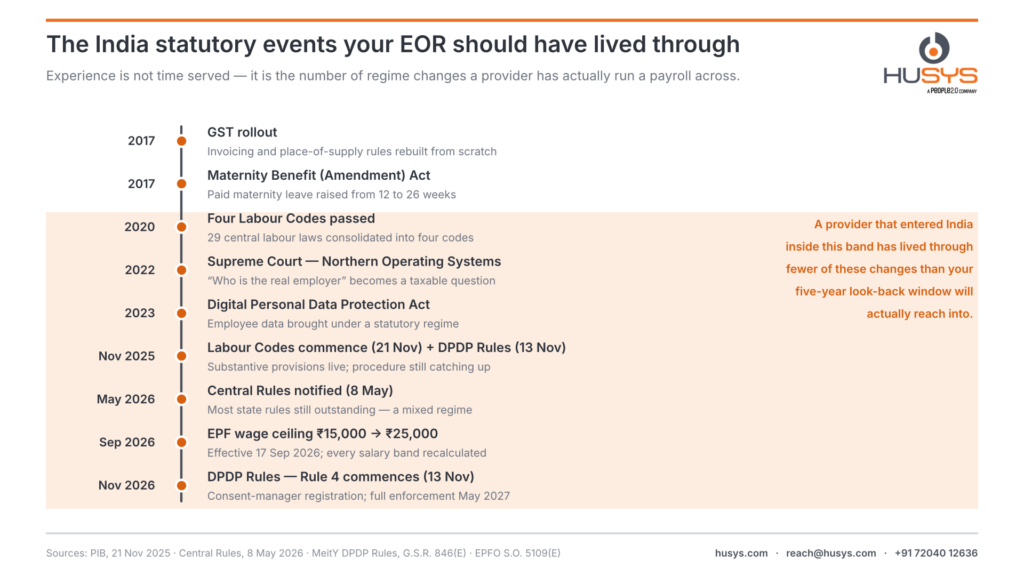
When | What changed | Why a provider needed to live through it |
2017 | GST rollout | Invoicing and place-of-supply logic rebuilt from scratch |
2017 | Maternity Benefit (Amendment) Act | Paid maternity leave raised from 12 to 26 weeks |
2019–20 | Four Labour Codes passed | 29 central labour laws consolidated into four codes |
2022 | Supreme Court — Northern Operating Systems | “Who is the real employer” became a taxable question |
2023 | Digital Personal Data Protection Act | Employee data brought under a statutory regime |
13 Nov 2025 | DPDP Rules notified (G.S.R. 846(E)) | |
21 Nov 2025 | Four Labour Codes commence | The codes took effect, rationalising 29 central labour laws |
8 May 2026 | Central Rules notified under all four codes | Most state rules still outstanding |
17 Sep 2026 | (Gazette S.O. 5109(E)) | Every salary band recalculated |
The point most buyers miss
India is, right now, running two regimes at once – we unpack this in our India labour codes 2026 guide for US companies. The substantive provisions of the four labour codes are in force from 21 November 2025, but the procedural framework is still settling. The Central Rules landed on 8 May 2026, but the states have been slow behind them. As at early November 2026 only around six states and union territories have notified final rules under all four codes, with roughly six more part-way there; the large commercial states US companies actually hire in Maharashtra, Karnataka, Tamil Nadu still have drafts only, so their existing registrations, forms and procedures continue to govern. Check the current state-by-state position before you rely on any of this: it is moving every few weeks, and that is precisely the point.
Khaitan & Co put it plainly in their published briefing: the substantive provisions of all four codes are in effect while “the procedural framework is still evolving.”
Be precise about what India EOR experience does and does not mean here. The labour codes only commenced on 21 November 2025, so a provider that started in 2021 did run payroll under the old rules. The real test is different: a provider whose Indian entity is less than five years old has never filed through a complete five-year look-back window and most of that window still sits under the pre-code regime. If an assessment reaches back into 2022, your provider needs to know the law as it stood in 2022, not only the law as it stands today.
Take the last row as the worked example, because it is the one with a price tag attached and the clearest test of whether a provider’s India EOR experience is current rather than historical. When the EPF wage ceiling rose from ₹15,000 to ₹25,000 on 17 September 2026, the employer’s statutory outgo moved from 13% of ₹15,000 to 13% of ₹25,000 that is 12% provident fund, plus 0.5% EDLI life cover, plus 0.5% administration charges. In rupees, ₹1,950 a month becomes ₹3,250: an extra ₹1,300 per employee per month, or ₹15,600 a year, about US$166. The maximum pension (EPS) contribution rose with it, from ₹1,250 to ₹2,083 a month, while the central government’s own 1.16% share stayed pegged to ₹15,000. For an employee newly brought into coverage by the higher ceiling, the employer picks up the full 13% rather than the difference. The notification is S.O. 5109(E), and the Ministry of Labour’s announcement for the primary record. Two details that get missed: the EDLI life-cover cap rises with it, from ₹75 to ₹125 a month, and administration charges carry a ₹500 monthly minimum per establishment, which bites hardest at small headcounts. Note also that none of this touched ESI — that wage ceiling remains ₹21,000.
Three further things have moved since, and a provider’s answer on any of them tells you whether its compliance function is live or historical. The Digital Personal Data Protection Rules hit their next milestone on 13 November 2026, when consent-manager registration under Rule 4 commences, ahead of full enforcement and penalties in May 2027. The National Social Security Board for gig and platform workers was notified on 30 October 2026 by S.O. 5884(E), putting administrative machinery behind the Code’s gig-worker provisions. And ESIC’s amnesty scheme, which lets employers settle legacy assessments without damages, now runs only to 31 December 2026 — which matters if you are inheriting an India payroll with history attached to it.
At Husys, every statutory change in this timeline has been implemented from the effective date the government announced. The most recent example is the EPF wage ceiling: we were live with the new rules from 17 September 2026, and 100% of the payslips we issue already reflect the new EPF deductions.
The base rate nobody puts in a vendor deck
Set India aside for a moment. There is a blunt statistical reason to care about vendor age in any country and it is the argument for India EOR experience that has nothing to do with Indian law at all
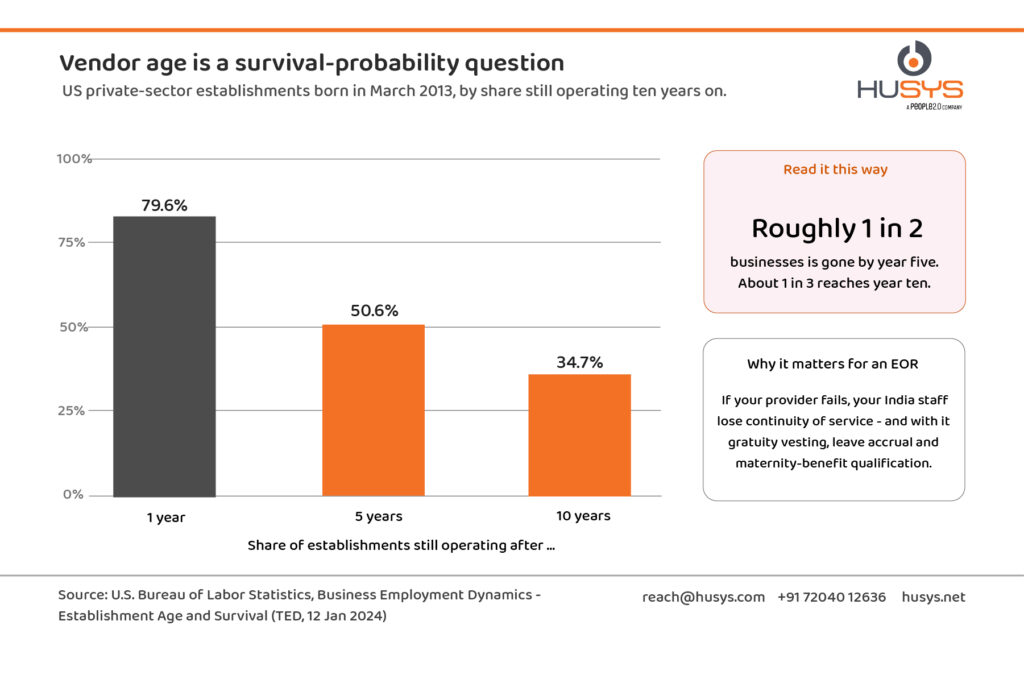
The US Bureau of Labor Statistics tracks every private-sector establishment from birth. Of those born in March 2013:
- 6% were still operating after 1 year
- 6% were still operating after 5 years
- 7% were still operating after 10 years
(BLS, Business Employment Dynamics Establishment Age and Survival, 12 January 2024)
Roughly one business in two is gone by year five. About one in three makes it to year ten.
That is US data, and it is worth saying so plainly, because the provider you are assessing is an Indian company. The Indian picture is no more comfortable. Of roughly 31.24 lakh companies ever registered in India, only about 21.0 lakh were active in the Ministry of Corporate Affairs master data of July 2026 — close to a third of everything ever registered is no longer trading, with 8.93 lakh already struck off and another 27,194 in the process. And the Registrar strikes companies off at scale: 1,85,350 companies were struck off under section 248 of the Companies Act, 2013 in the five years to July 2025, including 15,837 in FY2024-25 alone (Lok Sabha Unstarred Question No. 87, answered 1 December 2025). Two datasets, two countries, the same conclusion: India EOR experience is a risk variable, not a vanity line.
For most vendors, that is an inconvenience – you migrate and move on. For an employer of record, it is different in kind, because the provider is the legal employer.
If it fails:
- your India employees’ continuity of service breaks, which can reset gratuity vesting;
- leave accrual and maternity-benefit qualification may restart;
- somebody has to hold and produce statutory records that still have years left to run;
- and you have to re-paper every employment contract while people are already anxious.
Meanwhile the EOR category itself is expanding fast. One industry estimate puts the global market at USD 7.45 billion in 2026, roughly doubling to USD 15.89 billion by 2035, with Asia Pacific the fastest-growing region (Custom Market Insights, January 2026 – a commercial market-research estimate, not an official statistic, so treat it as directional). Fast-growing categories attract new entrants. Most of them are good. Some of them will not be there in 2031. The base rate is why India EOR experience is worth twenty minutes of your time.
Checking India EOR experience: how it happens normally vs. how it should
This is the gap between a procurement process and a verification process — and it is where most India EOR experience claims survive unchecked.
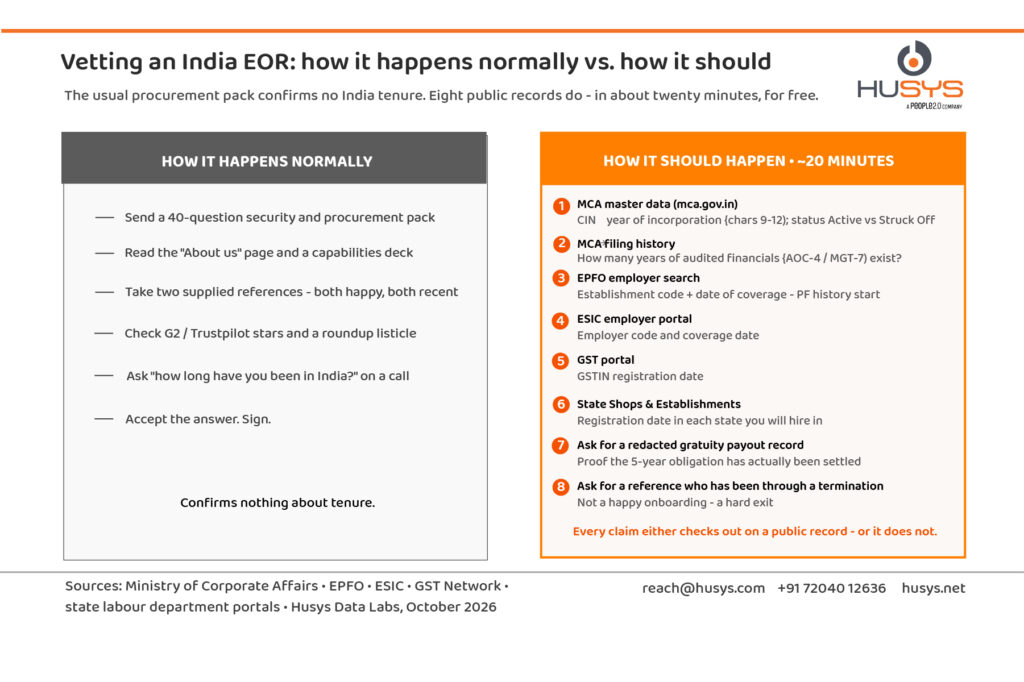
How it happens normally
- Send a 40-question security and procurement questionnaire.
- Read the “About us” page and a capabilities deck.
- Take the two references the provider supplies — both happy, both recent.
- Check star ratings and a vendor roundup listicle.
- Ask “how long have you been in India?” on a call.
- Accept the answer. Sign.
Every step there is reasonable. None of them confirms a single year of India EOR experience. The questionnaire asks about controls, not age. The references were chosen. The roundup was written by someone with no access to the provider’s filings.
How it should happen — about twenty minutes, all free
# | Where to look | What it proves |
1 | CIN → year of incorporation (chars 9–12); status Active vs Struck Off | |
2 | MCA filing history | How many years of audited financials (AOC-4 / MGT-7) actually exist |
3 | PF establishment code and date of coverage — when PF history began | |
4 | Employer code and coverage date | |
5 | GSTIN registration date | |
6 | State labour department portal | Shops & Establishments registration date in each state you will hire in |
7 | Ask the provider | A redacted gratuity payout record — proof the five-year obligation has been settled in practice |
8 | Ask the provider | A reference who has been through a termination, not a happy onboarding |
Items 1 to 6 are public records, so India EOR experience stops being a claim and becomes a fact. The provider cannot curate them. Items 7 and 8 are the two requests that separate a confident operator from a nervous one. Item 8 is the one we would push hardest on, because termination clauses are the single most common compliance issue we see — and the one where India EOR experience is hardest to fake. Exits go wrong in two ways, and both are foreseeable: the employee asks for more than the offer letter promised, or the client declines to honour a term the offer letter already committed to. A provider that has handled both will tell you so plainly. A provider that has not will tell you terminations are straightforward.
Why item 6 matters more than it looks. India does not have one employment law. The Shops & Establishments Act is a state statute, and registration is per state, with its own dated certificate. A provider can be twenty years old in Karnataka and three weeks old in Haryana. If you are hiring in Gurugram, the Karnataka vintage is irrelevant to you.
Five states, five different answers — which is why India EOR experience has to be checked state by state, not nationally. These are the hiring hubs US companies ask about most often, and the rules differ in ways that change what you should ask for — three of the five changed within the last twelve months, so treat any older compliance article with suspicion.
State | Act | Register within | Renewal | Portal |
Karnataka | Karnataka Shops and Commercial Establishments Act, 1961 (amended 2026) | 30 days for the employer to apply (s.4); since 4 September 2026 the authority must decide within 7 days (s.4(3A)) | None — valid until the establishment closes (changed 4 September 2026) | ekarmika.karnataka.gov.in |
Maharashtra | Maharashtra Shops and Establishments (Regulation of Employment and Conditions of Service) Act, 2017 | 60 days, at 10+ workers; below 10 it is an online intimation | Yes — the employer chooses a term up to 10 years and renews at least 30 days before expiry | lms.mahaonline.gov.in |
Telangana | Telangana Shops and Establishments Act, 1988 | 30 days | Yes — an annual fee is due by 1 December each year | labour.telangana.gov.in |
Haryana | Punjab Shops and Commercial Establishments Act, 1958 (amended 2025) | 30 days under the 1958 Act; registration now applies at 20+ workers, with an online intimation below that | None — valid until amended or cancelled | hrylabour.gov.in |
Tamil Nadu | Tamil Nadu Shops and Establishments Act, 1947 (amendments in force 2 July 2024) | Six months, at 10+ workers | None | labour.tn.gov.in |
The four questions — and what good and weak answers sound like
These four build on the broader list in our guide to what to ask an EOR provider about India compliance. Ask these four questions in order and you will have tested India EOR experience from every angle that matters to your liability. For each, we have given you why it matters, the fact behind it with a source, and the part a vendor cannot fake: what a confident answer actually sounds like.
Question 1: “Which Indian entity will be the employer of record, and what is its CIN?”
Why it matters to you: the signing entity carries every statutory liability attached to your staff. Its age is the only one of the four clocks that is on a public record.
The fact: the CIN’s characters 9–12 are the year of incorporation, and the entity’s status is searchable free on the MCA portal.
A good answer sounds like: the full legal name and CIN, unprompted, plus an explanation of the group structure if the signing entity is younger than the brand. “The signing entity is X Private Limited, CIN U74140KA2001PTC0XXXXX, incorporated 2001. It is the same entity that holds our PF and ESI codes.”
A weak answer sounds like: “We’ve been in business since 1998” with no entity named, or a promise to “send that over later.”
Question 2: “How many gratuity claims has this entity actually settled?”
Why it matters to you: gratuity is the obligation that arrives last and is most often under-provisioned. A provider that has settled gratuity has, necessarily, also run a five-year employment relationship end to end.
The fact: gratuity vests at five years of continuous service under section 53 of the Code on Social Security, 2020 (carrying forward the Payment of Gratuity Act, 1972), at 15 days’ wages per completed year, capped at ₹20 lakh.
A good answer sounds like: a number, a description of how the accrual is funded and held, and an offer of a redacted settlement record. “Several hundred, over two decades. We accrue monthly and the liability sits on our balance sheet – here’s a redacted final settlement showing the gratuity line.”
A weak answer sounds like: “Gratuity is handled as per the Act.” That is a restatement of the law, not an answer about their practice.
Question 3: “In which states do you hold a Shops & Establishments registration, and from what date?”
Why it matters to you: employing someone in a state where the provider is not registered creates a compliance gap from day one, and state-level variation is the single most under-appreciated feature of Indian employment law for US buyers.
The fact: Shops & Establishments Acts are state legislation, administered by state labour departments, with per-state registration and per-state record-keeping rules.
A good answer sounds like: a state-by-state list with registration dates, and candour about what happens next. If they would need a fresh registration, they say so and give you the lead time “We’re registered in 22 states; for Assam we’d register before your start date, which takes about two weeks.” If they are already registered everywhere you need, the answer is just as specific, and they offer the evidence “We hold live registrations across all 28 states and 6 union territories; here are the certificates and registration dates for the three states you’re hiring in, so no new registration is needed.” Either answer is good. A provider who cannot produce dates for your states is the problem; one who needs two weeks to register is not.
A weak answer sounds like: “We cover all of India.”
Question 4: “What happens to my employees if your entity stops operating?”
Why it matters to you: roughly half of US businesses do not reach year five. Your provider is the legal employer; its continuity is your employees’ continuity of service.
The fact: BLS establishment survival data gives 50.6% at five years and 34.7% at ten.
A good answer sounds like: a documented handover plan, named record custody, a stated transition window, and honesty that continuity of service is the thing at risk. “Records are held for the statutory retention period regardless; here’s our transition SOP and the notice period in the MSA.”
A weak answer sounds like: “That won’t happen.”
What India EOR experience actually buys you: normally vs. with an EOR
Underneath the vetting question is a simpler one why use an employer of record at all? Here is the same task, run both ways.
Good place to add a Husys experience point. Termination clauses are the compliance issue we see most often. Exits go wrong when the employee asks for more than the offer letter promised, or the client won’t honour terms the letter committed to.
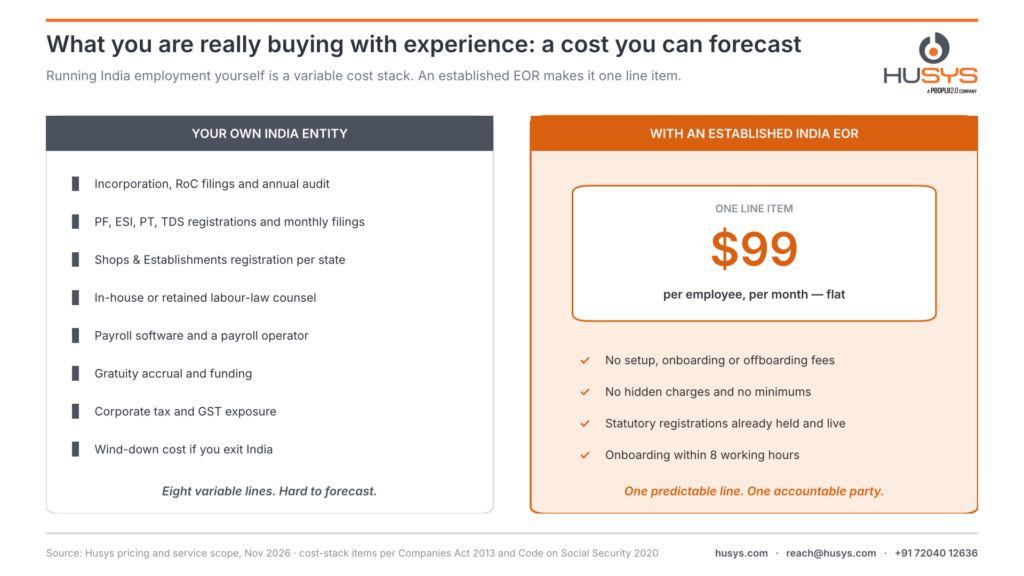
The task: hire one senior engineer in Bengaluru, compliantly, and keep them employed for four years.
For the full mechanics, see how to hire employees in India.
Step | How it happens normally (your own India entity) | How it happens with an established EOR |
Legal employer | Incorporate an Indian subsidiary — weeks to months, plus corporate tax and GST exposure | The EOR is the legal employer; no entity needed |
Registrations | Obtain PF, ESI, Professional Tax, TDS and state Shops & Establishments registrations yourself | Already held, already live, already aged |
Time to first hire | Payroll and statutory setup before anyone can start | Onboarding within 8 working hours (Husys benchmark) |
Monthly run | Your team deducts, matches, files and deposits — correctly — every month | The EOR runs deduction, filing and deposit; you get one invoice |
Gratuity | You accrue and fund it; you discover the mechanics at year five | Accrued and funded by a provider that has settled it before |
State expansion | New state = new registration, new rules, new deadlines | Provider’s existing state registrations apply |
Statutory change | You interpret the labour codes yourself, or retain counsel | In-house legal and compliance team absorbs it |
Cost shape | Entity + payroll staff + counsel + audit = variable, hard to forecast | Flat $99 per employee, per month, no setup fee, no minimums |
Exit | Winding down an entity and its registrations is slow and costly | Offboard the employee; no entity to dissolve |
That right-hand column is where India EOR experience pays for itself. Tenure is not a nice-to-have attached to the service, it is the service. Every line in the right-hand column is only true if the provider has actually done it before. A provider’s registrations are only “already aged” if the entity is aged. Its gratuity practice is only proven if gratuity has been paid.
Role scenarios: what this looks like for your job
First, the number underneath all of these scenarios, because India EOR experience is bought alongside a salary, not instead of one. On Levels.fyi’s own submissions, a senior software engineer in the United States has median total compensation of about US$255,000 (21,818 submissions, as at 6 November 2026), against about ₹55.9 lakh roughly US$59,400 at ₹94 to the dollar for the same seniority in Greater Bengaluru (4,787 submissions, as at 6 November 2026). That Bengaluru figure is the top of the Indian market, because that dataset skews to global capability centres and funded product companies; AmbitionBox, which covers the whole market including IT services, puts senior software engineers in India in a ₹5.4 lakh to ₹27 lakh band (that page was last updated in February 2025, so treat it as a shape rather than a current figure). Use whichever bracket matches the calibre you are hiring. The point survives either way: the gap is large, and the compliance layer barely moves it. At $99 per employee per month, an EOR costs $1,188 a year on a hire whose salary is measured in tens of thousands.
You are a YC-incubated founder, Seed stage, 8 people. You need a senior India engineer live this week and your board wants runway, not a subsidiary. Standing up an Indian entity to run Provident Fund is not a realistic use of your next six weeks. An established EOR makes the first compliant India hire a same-week decision at a flat $99 per employee per month and because you will likely re-evaluate inside twelve months, Tier 0 applies: a three-year-plus entity with live PF and ESI codes in your hiring state is enough. Spend the twenty minutes on the CIN check, not on incorporation.
You are the CFO of a growing drone-tech startup, Series A–B. You are modelling burn against a hardware roadmap, and unpredictable entity and compliance costs wreck a forecast. An EOR converts India headcount into a single, predictable line item. But at 20–30 heads over three years you sit in Tier 1 of the framework above (first real team, 5+ years of India entity age), not Tier 0 (pilot hire, 3+ years): gratuity will vest inside your horizon, so ask for three years of MCA-filed financials and evidence of actual gratuity settlements. The flat per-employee cost is only forecastable if the provider is still there to invoice it.
You are the General Counsel of a growth-stage SaaS company. You have to sign off that there is no misclassification and no Permanent Establishment exposure. An EOR that holds its own PF and ESI registrations in its own aged entity gives you a documented, auditable compliance trail instead of a DIY process you would have to defend. Ask Question 1 and Question 4 yourself — the CIN and the continuity plan are the two artefacts you will want in the file.
You are a CHRO at a mid-market IT services firm, moving 40 people between providers. Your exposure is continuity of service. Switching providers can break the five-year gratuity clock for employees mid-way through it. Before you migrate, get written confirmation of how prior service will be recognised, and check the receiving entity’s age: if it is younger than the tenure of the people you are moving, it has never administered a service record that long.
We see this every month. Our clients have moved 1,258 employees to Husys from other EOR providers, so recognising prior service is a routine part of our onboarding, not an exception.
You are Head of Procurement at an enterprise. You need the vendor file to survive an audit. That means audited financials, insurance with a retroactive date that reaches back far enough to cover prior acts, ISO 27001, a named compliance owner, and a continuity plan. Tier 3 exists because your regulator’s scrutiny does not stop at your own perimeter.
US → India translation
If you only know US employment, these are the assumptions that break and the reason India EOR experience is not interchangeable with experience in any other market.
Concept | In the US | In India |
Employment | At-will; terminate with notice or none | Contractual; statutory notice periods apply |
Retirement contribution | 401(k) – elective, employee-driven | Provident Fund – mandatory and employer-matched |
Long-service payout | Nothing statutory | Gratuity — statutory, vests at 5 years |
Payroll cycle | Bi-weekly or semi-monthly | Monthly |
Employment law | Federal floor + state overlay | Central codes + state-by-state Shops & Establishments Acts |
Health cover | Optional employer benefit | ESI – statutory below the wage threshold |
Records | Retain per IRS/DOL schedules | Five years from the date of the last entry, across ESI, wages and OSH registers |
The practical upshot: India’s heaviest employer obligations are time-based, and the US’s are not. That single asymmetry is why India EOR experience carries more weight than tenure would in most other markets. That is why “how many years” is a different question in India than it would be for your European or Latin American EOR.
When years don’t matter — and when an EOR is the wrong answer
We would rather you trust this guide than agree with all of it, so here are the honest limits of India EOR experience as a test.
India EOR experience is a proxy, not the thing itself. A four-year-old India entity with a named in-house compliance lead, ISO 27001, clean filings and genuine state coverage can be a better choice than a twenty-year-old generalist with outsourced compliance and one registration. Tenure raises the prior probability that the hard things have been done; it does not prove it. That is why this guide gives you eight records to check rather than one number to trust, the records are the evidence, the years are only the prior.
So how much should India EOR experience count against everything else? Here is the weighting we would defend. Score each provider 1–5 on each line, multiply by the weight, and compare totals. It will not make the decision for you, but it will stop one loud factor — usually price — from quietly making it for you.
What you are scoring | Weight | What a 5 out of 5 looks like |
India entity age and filing history | 25% | Ten or more years on the MCA register, status Active, with an unbroken run of filed audited accounts |
In-house legal and compliance team | 20% | A named compliance lead with years in post, not an outsourced retainer you never meet |
State coverage where you are actually hiring | 20% | Live registrations, with dates, in every state on your hiring plan — produced on request, not promised |
Proof of practice | 15% | Gratuity settlements actually made, plus a client reference who has been through a termination |
Continuity plan and insurance | 10% | A written records-handover plan, and professional indemnity whose retroactive date reaches back far enough |
Price and platform | 10% | All-in cost stated, exclusions named, and nothing in the contract you only discover at exit |
A young entity inside an old group can be fine — if the group demonstrably stands behind it contractually, and the entity holds its own registrations. Ask to see the indemnity and the parent guarantee, not just the org chart.
Some situations need more than age. If your India team holds core IP, the age of the entity matters less than the IP-assignment clauses, confidentiality terms and access controls in the employment contracts.
And an EOR is not always the right structure at all. If your company is directly selling into India or generating revenue in India, an EOR is not the appropriate vehicle: you likely need your own Indian entity, and you should take tax advice on Permanent Establishment exposure. Under Article 5(2)(l) of the India–US tax treaty, a service PE can arise on either of two limbs: services furnished through employees in India for more than 90 days in any twelve-month period, or services performed in India for a related enterprise, with no day threshold at all. That second limb is the one US buyers miss: sending your own people to work for your own Indian subsidiary can put you in scope from day one. This is also where India EOR experience earns its fee operationally rather than contractually. At Husys we monitor permanent-establishment exposure invoice by invoice: every invoice is matched against the client activities and deliverables it covers, so the commercial record and the employment record stay consistent if a tax officer ever asks to see both. Separately, the Supreme Court’s 2022 decision in [CCE v. Northern Operating Systems](https://www.livelaw.in/top-stories/supreme-court-overseas-companies-seconded-employees-manpower-services-indian-counterpart-pay-service-tax-200034) made “who is the real employer” a question with tax consequences in secondment arrangements, which is exactly why the structure of your arrangement, and the substance behind it, matters more than the label on it.
At sustained scale broadly past 100 people with a long horizon your own entity usually becomes the better economics. A good EOR will tell you that and help you transition. It is a reasonable thing to ask them about on the first call.
What India employment specialists are saying right now
For E-E-A-T and for your own sanity check, three sources worth your time none of them vendors.
Khaitan & Co India’s New Labour Codes: How Employers Should Prepare Themselves for the New Regime (YouTube, 4 June 2026). Employment partners Anshul Prakash and Vinay Joy make the point that matters most to a US buyer: the four codes replace 29 central labour laws, and while “the substantive provisions of all four codes are in effect,” “the procedural framework [is] still evolving.” They also tell employers to check whether their pay structures meet the 50% wage-component threshold. Watch it at https://www.youtube.com/watch?v=pnffvJNsKwg
EY India Insights The future of Global Capability Centers in India: Policy shifts (25 March 2026; full transcript published). Ritika Loganey Gupta, GCC Tax Leader and Partner at EY India, frames the question every US buyer should start with: “The first decision point should be whether the GCC is looking at scalability, capability, or both.” She adds that “there should be complete alignment between tax, operations and contracts” — precisely the alignment an EOR either gives you or quietly breaks. She is joined by EY India tax partners Vijay Iyer and Nikhil Suri.
ACC — India’s New Labor Codes: Essential Compliance and Risk Mitigation for U.S. Multinationals (Association of Corporate Counsel, recorded 28 January 2026). Khaitan & Co partners present to US in-house counsel on contractor oversight, risk allocation and the exposure created by uneven state-level adoption. If you are the General Counsel in this decision, this one was recorded for you.
Context worth having: India now hosts roughly 2,117 Global Capability Centres employing about 2.36 million people, generating USD 98.4 billion in revenue by the end of FY2026 (Nasscom–Zinnov India GCC Landscape, May 2026). You are not an outlier for hiring here. You are late to a very large party – which is all the more reason the vendor market has new entrants in it.
Risks, edge cases and misconceptions
“A big global brand means a long India history.” Not necessarily. Global EOR platforms genuinely win on breadth — one dashboard, one contract, a hundred countries, and that is a real advantage if India is one of twelve markets. The question is only which entity employs your India staff and how old it is. Ask; do not assume either way.
“Our provider says they’re ISO certified, so compliance is covered.” ISO 9001 and ISO 27001 are quality-management and information-security standards. They are meaningful signals about process discipline and data handling. They say nothing about whether a PF challan was filed on the 15th.
“We’ll just use contractors until we’re bigger.” See our breakdown of contractor vs employee classification in India. Misclassification is the most common and most expensive India mistake US companies make, and the labour codes have sharpened the definitions rather than softened them. If the person works set hours, uses your systems and reports to your manager, the label on the contract is not what decides it.
“If something goes wrong, the provider is liable, not us.” Contractually, often yes. Practically, your India team still stops getting paid, your records still have to be produced, and your own auditors still ask you about it. Indemnity is a remedy, not a shield.
“We can switch providers easily if it doesn’t work out.” Switching is operationally straightforward and legally delicate. The thing to protect is employees’ continuity of service: get the recognition of prior service in writing before you migrate, not after.
“We’ll deal with appraisals and exits later.” These are the two things US clients most often discover too late, and both are things India EOR experience is supposed to pre-empt. Appraisal cycles and termination mechanics in India are set by the employment contract and by statute, not by custom — and leave and holiday entitlements surprise US employers more than any other rule. Settle how appraisals, notice periods and exits will work before your first hire starts, not in the quarter you need them.
“India EOR experience means they’ll be slower and more expensive.” This is the one we would push back on hardest. Aged registrations are what make fast onboarding possible — a provider that already holds the state registration does not have to go get it. India EOR experience and speed are complements, not trade-offs.
The India EOR experience checklist
Copy this into your vendor file. If you can tick every box, your India EOR experience diligence is done and defensible. Nothing on this list costs anything but time.
Identity and age — the India EOR experience baseline
☐ Full legal name of the Indian signing entity obtained
☐ CIN obtained; characters 9–12 read as the year of incorporation
☐ MCA status confirmed as Active
☐ Number of years of filed audited financials recorded
☐ Group structure understood — which of the four clocks is being quoted
Statutory footing
☐ PF establishment code and date of coverage verified
☐ ESI employer code and coverage date verified
☐ GSTIN and registration date verified
☐ Shops & Establishments registration confirmed for every state you will hire in, with dates
☐ Professional Tax registration confirmed where applicable
Proof of practice — India EOR experience actually exercised, not just registered
☐ Gratuity settlements actually made — number and a redacted sample
☐ A client reference who has been through a termination
☐ A client reference who has been through a state expansion
☐ Named in-house compliance lead, and how long they have been in post
Continuity and risk
☐ Written business-continuity and record-handover plan
☐ Professional indemnity insurance, with its retroactive date
☐ ISO 9001 / ISO 27001 status
☐ DPDP Act readiness for employee data
☐ Recognition-of-prior-service terms if you are migrating staff in
Commercials
☐ All-in per-employee cost, with what is excluded named explicitly
☐ Setup fees, security deposit, minimums and lock-in — confirmed in writing
☐ Notice period and exit terms
What to put in the contract
The checklist above tells you what to verify about a provider’s India EOR experience. This tells you what to actually sign. Each clause below maps to a risk this guide has already described, and General Counsel will want all seven.
Recognition of prior service. If you are migrating staff in, state in writing that prior continuous service is recognised for gratuity, leave accrual and notice. Without it, the five-year clock restarts and your people lose the years they have already served.
Records handover on exit. Name who holds provident fund, ESI and payroll records after the agreement ends, in what format, and for how long. The statutory retention period runs five years from the last entry whether or not your contract is still live.
Continuity notice period. A minimum notice the provider must give before ceasing to serve you long enough for you to re-paper employment contracts without a break in employment.
Indemnity, and who stands behind it. An indemnity from a two-year-old subsidiary is worth what that subsidiary is worth. If the group is the real counterparty, ask for a parent guarantee.
Professional indemnity insurance and its retroactive date. Claims-made policies do not cover acts before the retroactive date. Ask for the date, not just the certificate.
Termination process and cost allocation. Who runs the exit, who computes the final settlement, who pays statutory dues, and what happens if the employee disputes the computation.
State coverage warranty. A warranty that the provider holds, and will maintain, registrations in every state where your employees sit with the obligation to register before a new state goes live.
What this looks like at Husys
Husys has operated as a PEO/EOR in India for 24+ years, and through the People2.0 network supports employment in 150+ countries via 65 owned entities. In India we hold our own Indian entity and employ your staff directly our PF, ESI, Professional Tax and state Shops & Establishments registrations are ours, not a partner’s. We have served 5,000+ companies, managed 50,000+ workers, and currently support 450+ active clients and 8,000+ active employees. Our average client tenure is more than four years, which matters here for a specific reason: it means most of our clients’ employees reach the five-year gratuity point while they are still with us, so the obligation this guide tells you to test for is one we settle routinely rather than one we have only read about. We operate across 28 states and 6 union territories, are ISO 9001 and ISO 27001 certified, run internal and external audits quarterly, and onboard employees within 8 working hours at a flat $99 per employee, per month with no hidden charges and no minimums.
Our client tenure, in numbers: 36% of our clients have been with Husys for 6+ years, 22% for 4+ years and 18% for 2+ years, with the rest at 1+ years. 8% have been with us for more than 10 years. Our oldest Shops & Establishments registration dates from 2005, which you can check against the state record yourself.
Our own four clocks of India EOR experience, since this guide says to check them. Husys began operating in India in 2002. The Indian entity that signs your contract is Husys Consulting Limited, CIN U74140TG2005PLC047222, incorporated on 24 August 2005 at the Registrar of Companies, Hyderabad, and Active on the MCA register. Read characters 9 to 12 and you get 2005: that is 21 years of filed Indian entity history behind a 24-year operating record. It is exactly the kind of gap this guide tells you to ask about, which is why we publish both numbers instead of only the larger one. Our oldest Shops & Establishments registration dates from 2005, and you can check that against the state record yourself.
One client, in outline. For context on how often this pattern comes up: our clients have moved 1,258 employees to Husys from other EOR providers, and recognising their prior service for gratuity, leave and notice is a standard step in that onboarding.
That is what 24 years of India EOR experience looks like when it is written down on a public record rather than asserted on a homepage. You do not have to take our CIN on trust — it is above, and it is checkable in 60 seconds. We would encourage you to run the twenty-minute check in this guide on us, and on everyone else you are considering.
Frequently asked questions
How many years of India EOR experience should a provider have?
For most US employers the practical floor is five years, measured as the age of the Indian entity that signs your contract because gratuity vests at five years (Code on Social Security, 2020, s.53), social-security assessments can be initiated up to five years back (s.125), and statutory records must be retained for five years from the last entry. Raise it to 7–10 years for multi-state teams of 25+, and 10+ years for regulated sectors or enterprise procurement.
How do I verify India EOR experience, how long has the provider actually operated in India?
Ask for the CIN of the Indian entity that will sign your contract, that entity’s age is the only India EOR experience figure on a public record. Characters 9–12 are the year of incorporation. Confirm the entity’s status is Active on the MCA portal, then check its PF and ESI coverage dates and its Shops & Establishments registration dates in your hiring states.
What is the difference between a provider’s global tenure and its India tenure?
Global tenure is the age of the parent company. India EOR experience is the age of the Indian entity that holds the statutory registrations and carries the liability for your employees. They are frequently decades apart. Only the second one governs your exposure.
Does it matter if my EOR is new to India?
India EOR experience matters in proportion to your risk. For a single pilot hire on a short horizon, a younger provider with live registrations can be fine. For a multi-year team, a younger entity has never discharged the obligations that arrive late, gratuity above all.
Can a new EOR handle gratuity in India?
It can accrue and administer it. What it cannot have is a track record of settling it, because gratuity does not vest until five years of continuous service under section 53 of the Code on Social Security, 2020 (carrying forward the Payment of Gratuity Act, 1972). Ask how the liability is funded and held, not just whether it is “handled as per the Act.”
Is gratuity now payable after one year in India?
Only for fixed-term employees. The Ministry of Labour & Employment’s Additional FAQs on Labour Codes (as on 16 March 2026) state at Sl. No. 14 that a fixed-term employee is eligible for gratuity after one year from the start of the contract, and Sl. No. 19 confirms that an eleven-month engagement does not qualify. For regular and permanent employees — which is what most US companies hire through an EOR — section 53 of the Code on Social Security, 2020 still requires five years of continuous service, waived only on death or disablement. The widely repeated claim that gratuity now vests at one year for everyone is the fixed-term rule misapplied.
What happens to my employees if my EOR goes out of business?
Your employees’ continuity of service is at risk, which can affect gratuity vesting, leave accrual and maternity-benefit qualification, and someone must still hold statutory records for their retention period. Ask for a written continuity and record-handover plan before you sign.
How do I check an EOR’s date of incorporation in India?
Search the entity name on the Ministry of Corporate Affairs portal under MCA Services → Find CIN. The master data shows the CIN and company status; characters 9–12 of the CIN give the year of incorporation.
Is using an EOR legal in India?
Yes. Engaging an employer of record is a lawful way for a foreign company to employ staff in India without its own entity, provided the EOR is a properly registered Indian employer meeting its statutory obligations. It is not appropriate where the foreign company is directly selling or generating revenue in India.
What India registrations should an EOR be able to show me?
At minimum: a CIN with Active status, a Provident Fund establishment code, an ESI employer code, a GSTIN, a TAN for TDS, and a Shops & Establishments registration in every state where it will employ your staff, each with its date.
Should I choose a global EOR platform or an India specialist?
Our comparison of India EOR providers for 2026 sets out the provider types side by side. If India is one of many markets and you want a single vendor and dashboard, a global platform’s breadth is a genuine advantage. If India is your main or only hiring market, or you are hiring across multiple Indian states, depth on state-level compliance usually matters more. Both are defensible; the question is which problem you actually have.
Did India’s labour laws change recently?
Yes. India’s four labour codes were brought into force on 21 November 2025, rationalising 29 central labour laws, and the Central Rules were notified on 8 May 2026. Most states had not yet notified their own rules, so existing state law continues to govern procedural compliance in the interim.
How long does it take to onboard an employee through an India EOR?
With a provider whose registrations are already live, onboarding can complete within hours — Husys onboards within 8 working hours. Where it slows down is almost always client-side: approving the draft employment contract, and the employee returning their documents.
Across the providers we reviewed, the median onboarding time was 4 days; Husys onboards within 8 working hours. When onboarding does slow down, 72% of delays come from waiting for the employee’s documents and 28% from back-and-forth with the client on clarifications and contract-drafting inputs.
Can I switch EOR providers without resetting gratuity?
Yes, but only if it is written down — and this is one of the places India EOR experience shows up most directly. Gratuity vests on five years of continuous service, so everything turns on whether the incoming provider formally recognises prior service. Get that recognition in writing before you migrate, not after. Our clients have moved 1,258 employees to Husys from other EOR providers, so recognising prior service is a routine part of our onboarding rather than an exception.
Does an EOR remove Permanent Establishment risk?
It removes one route to it and does not remove the concept, which is why India EOR experience matters more here than the structure alone. Using an EOR means you do not need your own Indian entity to employ people, which closes off the fixed-place-of-business route to a PE. It does not override Article 5(2)(l) of the India–US treaty, under which furnishing services in India for more than 90 days in any twelve-month period, or performing services for a related enterprise with no day threshold at all, can still create a service PE. If you are generating revenue in India, take tax advice rather than relying on the structure alone.
What notice period applies when terminating through an EOR?
The notice period written into the employment contract, read against the applicable state Shops & Establishments Act — reading those two together correctly is exactly what India EOR experience buys you and the Industrial Relations Code — typically 30 to 90 days for the roles US companies hire through an EOR. There is no at-will termination in India. In our own data this is where exits go wrong most often, and almost always because the offer letter and the client’s expectations had drifted apart long before anyone tested them.
Talk it through before you sign
If you are evaluating India EOR experience across a shortlist, a short conversation with someone who has run the compliance side in India for 24+ years will save you more than it costs — usually before you have signed anything.
Talk to a Husys India compliance expert →
Or run the twenty-minute check in this guide first. Either way, ask for the CIN.