Husys India EOR Payroll & Compliance Experts is the in-house team supporting Employer of Record (EOR) payroll operations and statutory compliance for US companies hiring in India. With 250+ years of collective compliance experience, the team has supported 50,000+ contractors to date and helps 5,000+ clients run compliant workforce operations across India.
Editorial note: This content is reviewed internally by payroll and compliance specialists and reflects standard statutory practices in India. For case-specific guidance, consult a qualified professional.
Facebook
X.com
LinkedIn
Email
WhatsApp
📌 Quick Answer:
An Employer of Record (EOR) legally employs workers on your behalf in another country handling payroll, taxes & compliance while you control day-to-day work. US companies can hire in India or 150+ countries in 8 working hours, zero entity setup, for $99/employee/month. Global EOR market = $9.17B by 2033.
Employer of Record (EOR) solutions are helping companies hire global talent without setting up a legal entity, especially when expanding into India. For companies exploring this model, an Employer of Record in India simplifies hiring, payroll, and compliance from day one.
Why this matters: Setting up legal entities abroad drains 6–12 months and $50K+ per country. EOR providers let you hire internationally in days, without the legal overhead, compliance risk, or infrastructure cost.
Who should read this: US founders, CFOs, and HR leaders expanding teams globally. If you’re hiring across borders or testing new markets, this guide shows you how Husys simplifies international employment across 150+ countries with zero entity setup.
Planning to hire globally without setting up an entity?
Explore how an Employer of Record can help you onboard talent faster, stay compliant, and reduce operational overhead.
TLDR: What You Need to Know
The global EOR market is projected to reach $9.17 billion by 2033, growing at 7% annually (Business Research Insights).
Why?
Because 75% of employers worldwide struggle to fill roles locally (ManpowerGroup), and traditional expansion takes too long and costs too much.
What’s changing:
Companies with flexible work models grew revenue 21% vs. 5% for office-mandate firms between 2020–2022 (People Manager)
36% of US employees prefer fully remote work (Backlinko)
Setting up a legal entity abroad costs $50K+ and takes 6–12 months
EOR onboarding happens in 8 working hours at $99/employee/month with providers like Husys
The shift: From “Where can we hire?” to “Who’s the best person for this role, anywhere?”
Employer of Record solutions are becoming the fastest way for companies to scale global teams without entity setup.
Employer of Record (EOR) enables companies to hire and manage global teams across countries without setting up local entities
The Real Cost of Local Talent Shortages
The Numbers Don’t Lie
We’ve analyzed hiring data across 28 US states and 150+ countries.
This is where Employer of Record models give companies a competitive advantage in accessing global talent faster.
We recently helped a cybersecurity firm in Austin hire three senior engineers. They spent four months searching locally, competing with Apple, Tesla, and Oracle for the same 200 candidates. Within two weeks of opening their search globally, they found qualified engineers in Bangalore, Krakow, and Bucharest, all with specialized certifications their local candidates lacked.
According toStack Overflow’s 2024 Developer Survey, India produces 1.5 million engineering graduates annually, compared to 200K in the US. Poland’s government-backed tech education programs have created 300K+ developers specializing in fintech and gaming.
Cost Arbitrage That Actually Works
Let’s compare real numbers from our client base:
Role
US Salary (Tier 1 City)
India Equivalent
Annual Savings
Senior Full-Stack Developer
$140K
$55K
$85K (61%)
DevOps Engineer
$130K
$48K
$82K (63%)
Product Manager
$150K
$65K
$85K (57%)
Customer Success Manager
$85K
$35K
$50K (59%)
Source: Husys client data, 2024–2025
The math: Hire three senior engineers in India for the cost of one in San Francisco. Same quality, different cost structure.
Time Zones Become Your Advantage
One of our SaaS clients runs a “follow-the-sun” support model:
US team (9am–5pm EST): Handles North American customers
India team (9am–5pm IST / 10:30pm–6:30am EST): Resolves overnight tickets, ships code
Europe team (9am–5pm CET): Bridges the gap
Result: 24/7 coverage with zero night shifts, 40% faster issue resolution, 99.2% uptime SLA.
A Harvard Business Review study found that distributed teams with proper time zone coverage are 13% more productive than co-located teams.
Why Borderless Hiring Isn't Optional Anymore
Employer of Record solutions make this shift possible without legal or operational complexity.
The Pandemic Changed Everything (Permanently)
Before 2020: Remote work was a “perk” After 2020: Remote work is the baseline expectation
GitLab’s Remote Work Report 2024 found that 86% of tech workers would leave a job that required full-time office presence. The talent you want expects location flexibility.
We’ve onboarded 5,000+ companies over 24 years. Here are the top misconceptions we hear:
Myth 1: “Communication will be impossible” Reality: India has 125 million English speakers, more than the UK and Australia combined (Ethnologue). We’ve found communication quality depends more on hiring practices than geography.
Myth 2: “Time zones will kill productivity” Reality: Overlap matters more than alignment. A 4-hour overlap between US and India teams is enough for daily standups and critical decisions. Asynchronous work (documented in tools like Notion, Linear, or Slack) handles the rest.
Myth 3: “Quality will suffer” Reality: India’s IT/ITES sector generates $282 billion annually (NASSCOM), serving 80% of Fortune 500 companies. The talent exists, you just need the right hiring and management systems.
Myth 4: “It’s only about cost savings” Reality: Cost is a benefit, not the reason. Our clients expand globally to access specialized skills (AI/ML, blockchain, cybersecurity), scale faster, and reduce single-point-of-failure risk.
Scenario: A US SaaS company hires a developer in India as a “contractor” to avoid entity setup.
What happens:
Indian tax authorities classify the relationship as employment (not contracting)
Company owes back taxes, penalties, and interest (up to 200% of unpaid amounts)
Developer files a labor dispute for unpaid benefits (PF, ESI, gratuity)
Company faces Permanent Establishment (PE) risk, triggering corporate tax liability in India
Cost of non-compliance: $50K–$200K in penalties, legal fees, and back payments.
EOR solution: EOR solution: We handle employment classification, tax withholding, statutory benefits (including compliance with minimum wages in India), and PE risk mitigation, so you stay compliant from day one.
What Is an Employer of Record (EOR)?
The Numbers Behind EOR Market Growth
An Employer of Record (EOR) acts as the legal employer for your international workforce, handling compliance, payroll, and employment contracts while you manage day-to-day operations.
The Simple Definition
An Employer of Record (EOR) is the legal employer of your international team members. They handle all employment administration, compliance, and payroll—while you manage the day-to-day work, performance, and culture.
What We Handle (So You Don’t Have To)
EOR Responsibility
What This Means
Why It Matters
Legal employment
We’re the employer on paper
No entity setup required
Employment contracts
Compliant with local labor law
Protects you from disputes
Payroll processing
Salary, taxes, deductions
Paid in local currency, on time
Statutory benefits
PF, ESI, gratuity (India)
Legally required, automatically included
Tax compliance
Withholding, filing, remittance
Zero tax authority issues
HR administration
Leave tracking, documentation
Reduces your admin burden
Termination management
Notice periods, severance, offboarding
Legally compliant exits
What You Still Control
Who you hire (we don’t recruit, we employ)
Day-to-day work (assignments, deadlines, priorities)
US (California):AB5 law reclassified thousands of contractors as employees
Cost of getting it wrong:
Misclassification penalties: $50K–$200K per case
Back taxes and benefits: 2–5 years of unpaid amounts
Legal fees: $25K–$100K in disputes
Reputational damage: Public labor violations hurt recruiting and sales
EOR value: We absorb this risk. If there’s a compliance issue, we’re liable, “not you”.
How EORs Eliminate Expansion Friction
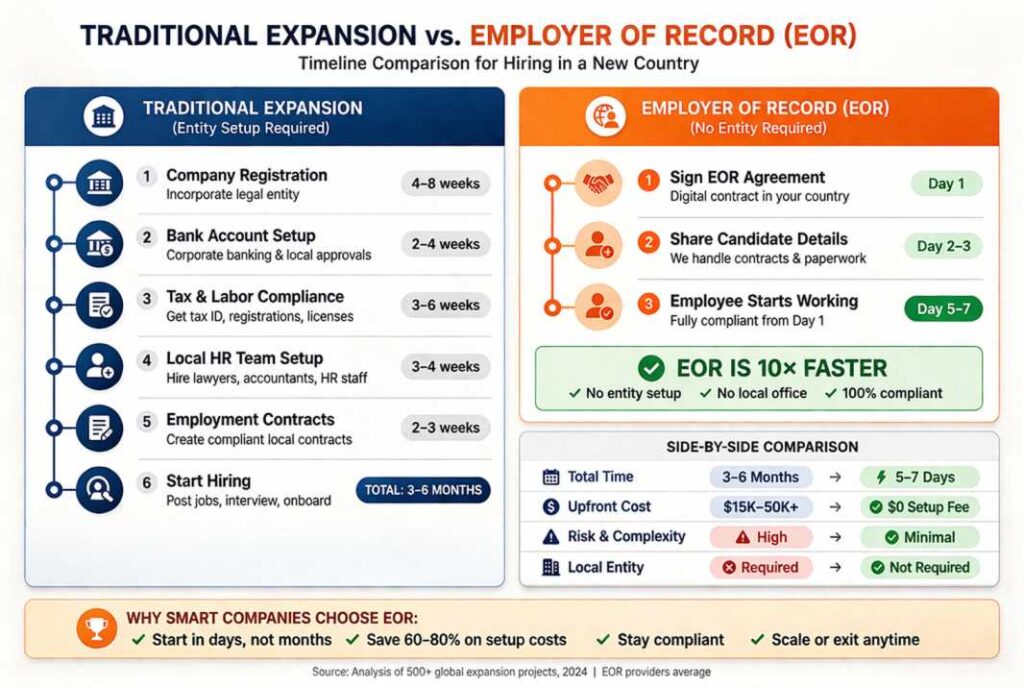
Traditional expansion vs Employer of Record (EOR) timeline comparison showing how companies can hire globally in days instead of months without setting up a legal entity.
Employer of Record providers remove the delays and costs associated with traditional expansion.
The Traditional Expansion Timeline (What You Avoid)
Phase
Timeline
Cost
Complexity
1. Market research
1–2 months
$10K–$25K
Consultant fees, travel
2. Legal entity setup
3–6 months
$15K–$40K
Registration, legal fees
3. Bank account opening
1–3 months
$2K–$5K
Documentation, compliance
4. Payroll system setup
1–2 months
$5K–$15K
Software, integration
5. HR policy creation
1–2 months
$5K–$10K
Legal review, localization
6. Benefits administration
1–2 months
$3K–$8K
Provider contracts
7. Tax registration
1–2 months
$2K–$5K
Filings, compliance
Total
6–12 months
$50K–$100K
High
With Husys EOR:
Timeline: 8 working hours to first hire
Cost: $99/employee/month (no setup fees)
Complexity: Single contract, single invoice
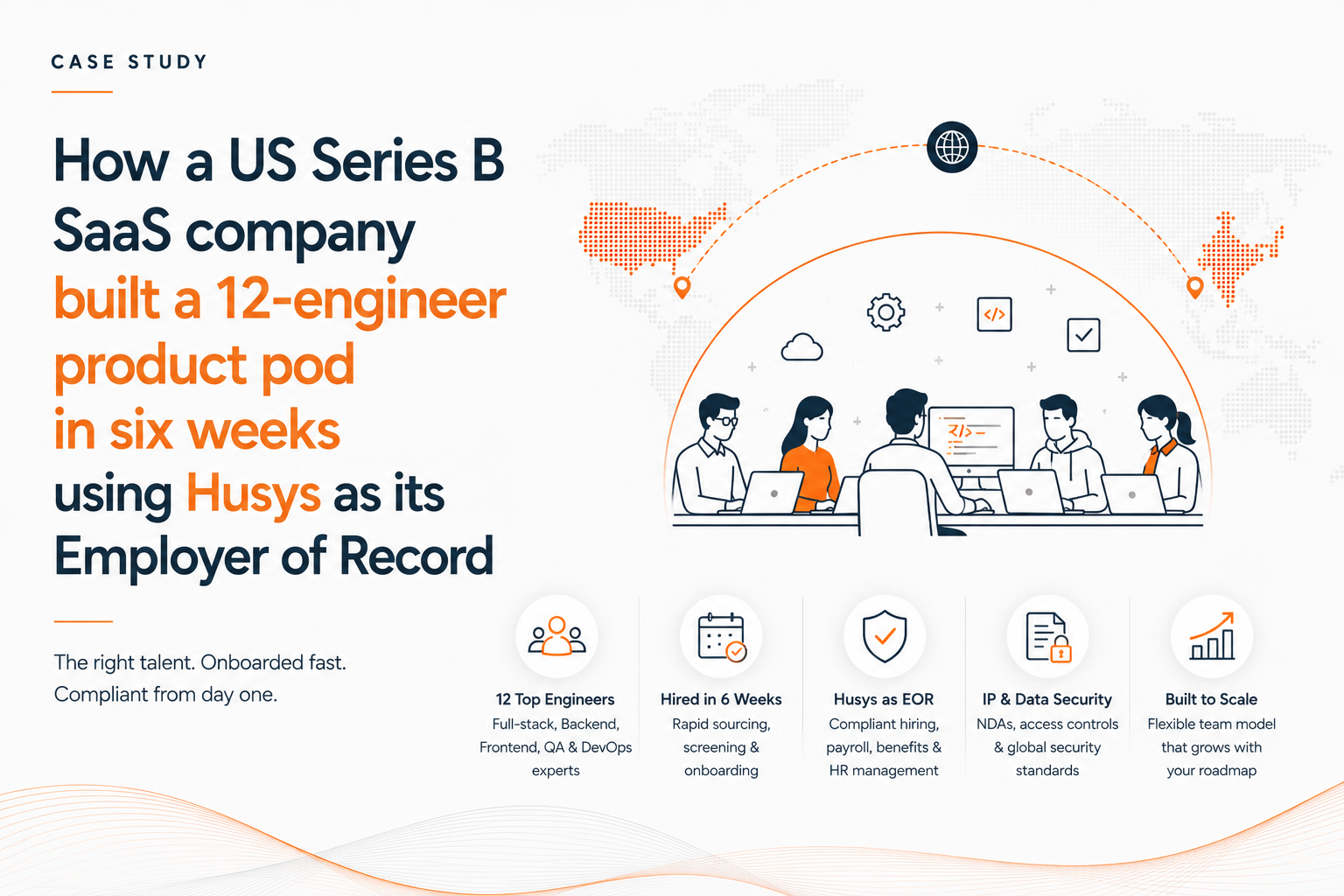
Real Client Example: SaaS Company Scaling to India
Background:
Series B SaaS company (80 employees, US-based)
Needed 10 engineers and 5 customer success managers in India
7 Powerful Ways Employer of Record Helps You Hire Global Talent
The 7 Non-Negotiables
Hire without setting up an entity
Reduce hiring costs by 40–60%
Stay compliant across countries
Onboard employees in days, not months
Access global talent pools instantly
Eliminate payroll and HR complexity
Scale teams across multiple countries easily
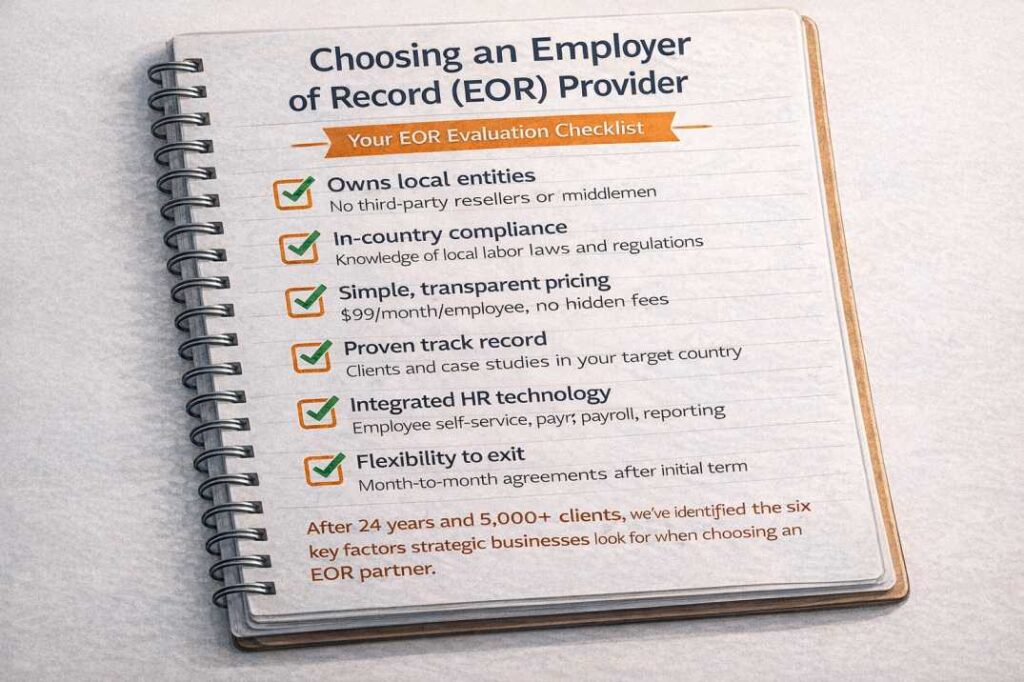
After 24 years and 5,000+ clients, we’ve identified what separates functional EORs from strategic partners.
Employer of Record (EOR) provider checklist highlighting key factors to evaluate before choosing a global hiring partner
If you’re comparing options, reviewing the top EOR providers in India can help you evaluate the right partner based on your business needs.
1. Direct Entity Ownership (Not Resellers)
Why it matters: Many EOR providers are resellers—they partner with local firms and add a markup. This creates:
Slower response times (multiple parties involved)
Higher costs (layered fees)
Compliance gaps (unclear responsibility)
Husys difference: We own 65 direct entities across 150+ countries via global partnership with People2.0. When you hire in India, you’re working with our Indian entity, not a third-party partner.
How to verify:
Ask: “Do you own your entities or partner with local providers?”
Request: Entity registration documents for your target country
2. In-Country Compliance Expertise
Why it matters: Labor laws change constantly. In India alone, we track:
4 major labor codes (Wages, Social Security, Industrial Relations, OSH)
28 state-level variations (each state has unique rules)
Husys difference: We have in-house legal and compliance teams in every major market. They monitor regulatory changes and update our systems automatically.
How to verify:
Ask: “How do you stay current with labor law changes?”
Request: Examples of recent regulatory updates they’ve implemented
3. Technology That Actually Works
Why it matters: You’ll use the EOR platform daily. Bad UX = wasted time.
Must-have features:
Feature
Why You Need It
Husys HRIS Platform
Employee self-service
Reduces HR tickets by 60%
✅ Payslips, tax docs, leave requests
Real-time payroll visibility
Budget tracking, forecasting
✅ Live dashboard, cost breakdowns
Compliance alerts
Avoid missed deadlines
✅ Automated reminders, document tracking
Integration APIs
Connect to HRIS, accounting
✅ Integrates with QuickBooks, Xero, BambooHR
Multi-currency reporting
Consolidated financials
✅ USD + local currency views
How to verify:
Request: Platform demo (not a sales deck, actual product walkthrough)
Ask: “What integrations do you support?”
4. Transparent, Predictable Pricing
Why it matters: Hidden fees destroy budget planning.
Blockchain: Pune and Hyderabad are global blockchain hubs
Cybersecurity: Delhi NCR produces 25% of global cybersecurity talent
Our experience: Clients come for cost, stay for quality. A senior engineer in Bangalore often has more specialized experience than a generalist in San Francisco.
“Communication will be a nightmare”
Reality: India has the 2nd largest English-speaking population globally (Ethnologue). Most tech professionals are educated in English-medium schools and work with US clients daily.
What actually matters:
Hiring for communication skills (not just technical skills)
Clear documentation (write down decisions, use tools like Notion)
Asynchronous workflows (don’t require real-time responses for everything)
Our hiring process: We screen for English proficiency, written communication, and cultural fit, not just coding ability.
“Time zones will kill productivity”
Reality: A 9.5-hour time difference (US East Coast ↔ India) creates a 4-hour overlap (9am–1pm EST = 6:30pm–10:30pm IST).
Afternoon (US) / Night (India): Async work, code reviews, documentation
Night (US) / Morning (India): Bug fixes, deployments, customer support
Result: 24/7 productivity without night shifts.
“Compliance is too complicated”
Reality: India has complex labor laws, but that’s why EORs exist.
What we handle:
Compliance Area
What It Involves
Penalty for Non-Compliance
Provident Fund (PF)
12% employee + 12% employer contribution
₹1 lakh ($1,200) fine + back payments
ESI (health insurance)
0.75% employee + 3.25% employer
₹10K–₹25K ($120–$300) fine
Professional Tax
State-level payroll tax
₹5K–₹10K ($60–$120) fine
TDS (tax withholding)
Monthly tax deduction and filing
200% penalty + interest
Gratuity
4.81% of salary (paid at termination)
Legal disputes, back payments
Husys solution: We’re ISO 9001 and 27001 certified. Our compliance team handles all filings, payments, and audits, so you never think about it.
“We’ll just hire contractors to avoid this”
Reality: Indian tax authorities are cracking down on misclassification. If your “contractor” works like an employee (fixed hours, single client, ongoing relationship), they’re legally an employee.
Cost of misclassification:
Back taxes: 2–5 years of unpaid PF, ESI, TDS
Penalties: Up to 200% of unpaid amounts
Legal fees: $25K–$100K in disputes
Reputational damage: Public labor violations
EOR solution: We classify employees correctly from day one, so you avoid this risk entirely.
India's Trade & Tax Landscape: 2026 Updates for US Companies
Recent developments:
Policy
What It Means
Impact on US Companies
US-India Trade Deal (2024)
Reduced tariffs on tech services
Easier cross-border contracts
Cloud Services Tax Holiday
0% GST on cloud infrastructure (2024–2026)
Lower operational costs
Startup India Tax Exemption
3-year corporate tax holiday for startups
Savings if you establish an entity
Why this doesn’t replace EOR:
Even with tax incentives, setting up an entity requires:
6–12 months (registration, bank accounts, compliance setup)
EOR advantage: You get the talent and cost savings without the entity setup. If you scale to 100+ employees and want to establish an entity later, we help you transition.
How to Hire in India: Step-by-Step
Phase 1: Define Your Needs (Week 1)
Identify roles and skills (be specific—”React developer” vs. “full-stack engineer”)
Result: 90% retention after 6 months (vs. 60% industry average).
Overcommunicate expectations (then repeat)
What’s obvious to you isn’t obvious to someone in a different country and culture.
Be explicit about:
Working hours: “We need 4 hours of overlap (9am–1pm EST)”
Response times: “Slack messages within 2 hours during overlap”
Meeting norms: “Cameras on, come prepared with updates”
Decision-making: “You own this, don’t wait for approval”
Our clients’ rule: If you’ve said it once, say it three more times.
Plan for the long term (retention > hiring)
Hiring is expensive. Retention is profitable.
How our top clients retain Indian talent:
Competitive compensation: Review salaries annually against local market rates
Career progression: Clear paths from junior → senior → lead roles
Professional development: Training budgets, conference access, certification support
Recognition: Public wins, team shoutouts, performance bonuses
Inclusion: Invite to company offsites, all-hands meetings, strategic planning
The data: Companies that invest in retention see 25% higher productivity and 40% lower hiring costs over 3 years.
How to Get Started with EOR in India: Your Next Step
The global talent war isn’t slowing down. 75% of employers can’t fill roles locally, and the companies winning are the ones who’ve stopped limiting themselves to geography.
What we’ve covered:
EOR solutions eliminate 6–12 months of entity setup and $50K–$100K in costs
India offers 1.5M engineering graduates annually at 40–60% cost savings
Compliance risk, payroll complexity, and HR overhead disappear with the right partner
Companies with distributed teams grew revenue 21% vs. 5% for office-only firms
The question isn’t whether to expand globally, it’s how fast you can move.
Husys has spent 24+ years building the infrastructure to make international hiring as simple as hiring locally.
We’ve onboarded 5,000+ companies, managed teams across 150+ countries, and eliminated the friction that stops most companies from accessing global talent.
Employer of Record solutions are no longer optional, they are becoming essential for companies competing globally.
Ready to hire global talent without delays or compliance risks?
With Husys, you can onboard employees in days, without setting up an entity, managing local laws, or handling payroll complexity.
Book a consultation: 30-minute call to understand your hiring needs
Get a custom proposal: Tailored to your team size, locations, and timeline
Hire your first employee: Onboarded in 8 working hours
The talent you need exists. The infrastructure to hire them compliantly exists. The only question is: are you ready to compete globally?
Start building your international team today. Get in touch with Husys and turn global expansion from a 12-month project into an 8-hour process.
Frequently Asked Questions — Employer of Record (EOR)
What is the difference between EOR and PEO?
An EOR acts as the sole legal employer in a new country — no entity required.
A PEO co-employs workers alongside your existing entity, requiring you to already
have a legal presence in that country. EOR = zero setup; PEO = entity needed first.
How much does an EOR cost in India?
Husys charges $99/employee/month with zero setup, deposit, or termination fees.
Global providers like Deel ($599/mo) and Remote ($699/mo) charge 5–7× more for
India-specific hiring due to partner network markups.
How long does EOR onboarding take in India?
With Husys, the first employee can be onboarded in 8 working hours after offer
acceptance. This compares to 6–12 months for direct entity setup in India.
Is EOR legal in India?
Yes. EOR is fully legal in India. Husys is incorporated in India and acts as the
official employer under Indian labour law — managing PF, ESI, TDS, gratuity, and all
statutory requirements across all 28 states.
What is the difference between India-specialist EOR vs global EOR?
India-specialist EORs like Husys (since 2001) have direct entities, in-house
compliance teams, and 25+ years of on-ground India experience. Global EORs (Deel,
Remote, Rippling) manage India through partner networks — adding cost, slower response
times, and unclear accountability for India-specific issues.
Empowering Your Workforce Journey with Trusted Insights
Find the latest industry trends, expert blogs, insightful case studies, and essential tools. Whether you’re expanding your team locally or globally, we’ve got the information you need to make informed decisions and stay ahead of the curve.