Husys India EOR Payroll & Compliance Experts is the in-house team supporting Employer of Record (EOR) payroll operations and statutory compliance for US companies hiring in India. With 250+ years of collective compliance experience, the team has supported 50,000+ contractors to date and helps 5,000+ clients run compliant workforce operations across India.
Editorial note: This content is reviewed internally by payroll and compliance specialists and reflects standard statutory practices in India. For case-specific guidance, consult a qualified professional.
Facebook
X.com
LinkedIn
Email
WhatsApp
Table of Contents
Hire employees in India without entity is now one of the fastest ways for US companies to build cost-effective global teams.
Whether you’re evaluating anEmployer of Record in India, comparing PEO vs EOR in India, or exploring contractor models like AOR, choosing the right hiring structure directly impacts your speed, compliance risk, and long-term costs.
This guide breaks down exactly how US companies can hire in India without an entity, compare all available models, and choose the right approach based on your growth stage.
Many companies today prefer to hire employees in India without entity setup to avoid delays and compliance overhead.
TLDR: Executive Summary
The Opportunity: India is one of the fastest-growing talent markets globally, with projected GDP growth of 6.4% and a Net Employment Outlook of 42%. For US companies, this translates into 60–70% lower hiring costs and access to a highly skilled workforce.
The Challenge: Hiring employees in India is not straightforward. Companies must navigate 28 state-specific labor laws, statutory requirements like PF, ESIC, and gratuity, and avoid risks like contractor misclassification and Permanent Establishment (PE).
The Solution: Hire employees in India without setting up an entity. Compare EOR vs PEO vs AOR, costs, compliance, and the best hiring model for US companies.
Employer of Record (EOR) – best for full-time employees with full compliance
Professional Employer Organization (PEO) – shared employment model
Agent of Record (AOR) – for contractors and project-based work
For long-term scale (100+ employees), setting up a legal entity becomes viable.
Bottom Line: If you want to hire in India quickly and compliantly, EOR or PEO is the fastest path. If you’re scaling long-term, consider a hybrid approach (EOR → entity).
Hire Employees in India Without an Entity: Complete Guide
Quick Answers for US Companies Hiring in India (2026)
What is the best way to hire employees in India in 2026?
The fastest and most compliant way for US companies to hire employees in India is through an Employer of Record (EOR) or Professional Employer Organization (PEO). These models allow you to hire full-time employees legally without setting up a company in India.
Can US companies hire employees in India without setting up an entity?
Yes. US companies can legally hire in India without opening a local entity by using:
EOR (Employer of Record) for full-time employees
PEO (co-employment model)
AOR (Agent of Record) for contractors
These solutions handle payroll, taxes, and compliance with Indian labor laws.
What is the difference between PEO, EOR, and AOR?
PEO: Shared employment responsibility between your company and provider
EOR: Provider becomes the legal employer and assumes full compliance liability
AOR: Used for managing independent contractors, not full-time employees
Is it legal to hire contractors in India?
Yes, but only for genuine project-based work. If contractors are treated like full-time employees, companies risk misclassification penalties, back payments, and legal disputes under Indian labor laws.
How long does it take to hire employees in India?
EOR / PEO: 3–7 business days
Entity setup: 2–6 months
Why This Guide Matters to Your Business
Most US Companies Choose the Wrong Hiring Model in India
Most US companies entering India don’t fail because of talent, they fail because of the hiring structure they choose.
The wrong hiring model doesn’t just slow you down, it creates legal and financial exposure that compounds over time.
👉 The biggest mistake isn’t the vendor you pick, it’s the hiring model you choose.
The common mistakes are predictable:
Hiring contractors for long-term roles to save costs → leading to misclassification risk
Delaying hiring for months while setting up an entity → losing top candidates
Underestimating compliance complexity → resulting in penalties and legal exposure
What looks like a cost-saving decision early on often becomes an expensive mistake later.
The reality is simple: Choosing the right hiring model in India is not about saving money upfront, it’s about aligning speed, compliance, and long-term scalability.
In most cases:
EOR is the safest and fastest starting point
PEO works well for flexible scaling with shared responsibility
AOR should only be used for true project-based work
Entity setup makes sense only when you are scaling beyond 100+ employees
This guide will help you avoid these mistakes and choose the right model based on your actual business needs.
Who should read this:
Founders exploring India as a first international market
CFOs evaluating cost structures and compliance risks
HR/People leaders tasked with building distributed teams
Legal/Ops executives responsible for international expansion strategy
If you’re a US-based company considering India for engineering, customer support, product development, or back-office operations, you’re facing a critical decision: How do we hire there without getting buried in legal complexity?
This isn’t just about choosing a vendor. It’s about selecting an employment infrastructure that matches your:
Speed requirements (days vs. months)
Risk tolerance (shared vs. transferred liability)
Growth trajectory (5 people vs. 500)
Control preferences (operational flexibility vs. legal simplicity)
We’ve structured this guide to give you the strategic context, compliance reality, and decision framework you need,backed by data, not marketing fluff.
India is no longer just an outsourcing destination, it has become a strategic talent hub for US companies looking to scale engineering, operations, and support teams globally.
What has changed in recent years is not just cost, but capability.
India now offers:
A talent pool of over 5 million tech professionals
Strong depth in software engineering, AI, and enterprise systems
High English proficiency and global work experience
At the same time, hiring in India is fundamentally different from the US.
Unlike the at-will employment model, India operates under a structured labor system with statutory requirements such as provident fund (PF), employee state insurance (ESIC), gratuity, and state-specific regulations.
For US companies, this creates a dual reality:
👉 Access to world-class, cost-efficient talent 👉 Combined with a complex compliance and legal environment
Bottom line: India offers massive opportunity, but only if hiring is structured correctly from day one.
Larger talent pool (especially for niche tech skills)
Time zone overlap with US West Coast (partial)
Compared to Latin America:
Deeper bench strength in enterprise software and cloud infrastructure
More mature startup ecosystem
English as primary business language
India’s employment laws require compliance with frameworks such as provident fund (PF), employee state insurance (ESIC), and gratuity regulations as defined by theMinistry of Labour & Employment, Government of India.
👉 Many global companies today prefer to hire employees in India without entity setup to reduce compliance risk and hiring delays.
The Compliance Reality: Why "Just Hire" Doesn't Work
Unlike the US at-will employment model, India operates under a protective labor framework designed to favor employees. Here’s what catches US companies off guard:
State-Level Variation:
Example: Notice Period Requirements
– Karnataka (Bangalore): 30-90 days standard
– Maharashtra (Mumbai): 30-60 days standard
– Tamil Nadu (Chennai): 30 days minimum
– Haryana (Gurgaon): 60-90 days common
Each state has different Shops & Establishment Acts governing working hours, overtime, and leave policies.
Here’s what this means:
You can’t treat India hiring like the US, compliance structure must be built before you hire.
Statutory Compliance Checklist (Mandatory for all employers):
Requirement
What It Covers
Penalty for Non-Compliance
PF (Provident Fund)
Retirement savings (12% employer + 12% employee)
₹5,000/month + interest ($60 USD)
ESIC (Health Insurance)
Medical coverage for employees earning <₹21,000/month
₹10,000 fine + imprisonment up to 3 years
Professional Tax
State-level employment tax
Varies by state; ₹2,000-10,000
Gratuity
Severance payment after 5 years of service
Legal liability + damages
TDS (Tax Deduction at Source)
Income tax withholding
Interest + penalties up to 200% of tax due
Real Cost Example:
US Company hires developer in Bangalore at ₹15,00,000/year ($18,000 USD)
Direct Salary: ₹15,00,000 ($18,000)
PF Contribution (12%): ₹1,80,000 ($2,160)
ESIC (3.25%): ₹48,750 ($585)
Gratuity Accrual: ₹57,692 ($692)
Professional Tax: ₹2,500 ($30)
Admin/Compliance: Variable
Total Employer Cost: ₹17,88,942 ($21,467)
Effective Loading: 19.3% above base salary
In simple terms:
Your actual cost of hiring in India is always higher than base salary due to statutory contributions and compliance overhead.
India’s cost advantage is also driven by lower cost of living and wage benchmarks compared to the US, as reflected in global salary data from platforms like Numbeo and World Bank reports.
What is PE? If your activities in India create a “fixed place of business” or “dependent agent” relationship, Indian tax authorities can claim you have a taxable presence,subjecting your global revenue to Indian corporate tax (up to 25.17%).
Common PE Triggers:
Employees signing contracts on your behalf
Regular client-facing activities from India
Decision-making authority residing in India
Office space or fixed infrastructure
How PEO/EOR Mitigates This:
By maintaining the legal employer relationship, PEO/EOR providers create a buffer between your company and Indian tax jurisdiction.
Your Indian team works for the PEO/EOR entity, not directly for your US company.
Expert Insight:
“We’ve seen US companies receive PE notices 18-24 months after starting ‘casual’ hiring in India.
By that point, the back-tax liability can run into hundreds of thousands of dollars.
Prevention through proper structuring is exponentially cheaper than remediation.”, Compliance Director, Big 4 Accounting Firm
Bottom line:
You get similar quality talent at significantly lower cost, but only if your hiring structure is compliant.
US vs India developer hiring cost comparison with key reasons behind 60–70% savings.
The Four Pathways to Hiring in India
Professional Employer Organization (PEO): The Co-Employment Model
What Is PEO?
A co-employment arrangement where:
You (the client) retain control over day-to-day work, performance management, and business decisions
The PEO becomes the legal employer of record for compliance, payroll, benefits, and statutory filings
Think of it as “employment infrastructure as a service”,you get the team, the PEO handles the paperwork.
How PEO Works in Practice
agement Setup (1-2 days)
You sign a client service agreement with the PEO
PEO provides employment contract templates compliant with Indian law
Employee Onboarding (3-5 days)
Candidate accepts offer
PEO issues employment contract (PEO is the legal employer)
Employee completes KYC documentation (Aadhaar, PAN, bank details)
PEO registers employee for PF, ESIC, and other statutory benefits
Ongoing Operations
You manage daily work, projects, and performance
PEO processes monthly payroll with statutory deductions
PEO files all compliance returns (PF, ESIC, TDS, professional tax)
PEO handles leave management, reimbursements, and benefits administration
Termination/Exit (30-90 days depending on notice period)
You decide to end the engagement
PEO manages notice period, final settlement, and statutory clearances
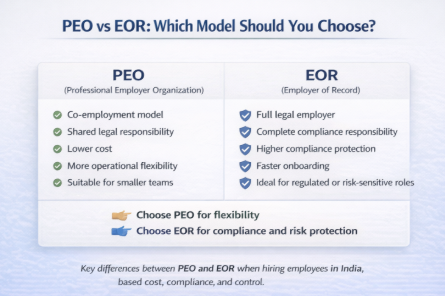
PEO vs EOR in India: Which Is Better?
When PEO Makes Sense
Ideal For:
Early-stage startups (0-50 employees) testing India market
Rapid Scaling: Company going from 0 to 50 employees in 6 months
EOR Cost Structure
Husys EOR Pricing:
$99 per employee/month (same as PEO)
Includes full legal liability transfer
No setup fees
HRIS platform included
Why Same Price as PEO? At Husys, we’ve standardized pricing because our infrastructure handles both models efficiently. The value difference is in liability transfer, not operational cost.
EOR ensures proper employee vs. contractor classification
Maintains employment records proving employer-employee relationship
Defends against labor department audits
Permanent Establishment Risk
Creates legal separation between your US entity and India operations
EOR entity is the employer, not your company
Reduces tax authority scrutiny
IP Protection
Employment contracts include IP assignment clauses
Enforceable under Indian Copyright Act and Patents Act
Confidentiality agreements backed by EOR’s legal standing
Termination Disputes
EOR handles wrongful termination claims
Manages labor court proceedings if disputes arise
Provides legal defense (included in service)
When EOR Is Not the Right Fit
EOR may not be the best option if:
You are planning to build a large team in India (100+ employees) long-term
You require full branding and control over employment contracts
You are ready to invest in setting up a legal entity in India
You want to optimize long-term costs at scale
In these scenarios, setting up your own entity becomes more cost-effective.
Agent of Record (AOR): The Contractor Solution
What Is AOR?
An AOR facilitates independent contractor relationships in India without creating an employment relationship. This is for project-based work, freelancers, and gig engagements.
Indian labor law uses a “control test” to determine employment status. If you exercise significant control, authorities may reclassify contractors as employees,triggering back-payment of:
PF contributions (12% employer share)
ESIC contributions (3.25% employer share)
Gratuity liability
Notice period compensation
Penalties and interest
Red Flags That Trigger Reclassification:
Contractor Behavior
Risk Level
Why It’s Risky
Works exclusively for you
High
Indicates economic dependence
Uses your email domain
High
Suggests employment relationship
Works fixed hours (9-5)
Medium
Implies control over work schedule
Receives benefits (health insurance)
High
Characteristic of employment
Long-term engagement (2+ years)
High
Suggests permanent relationship
Reports to your managers
Medium
Indicates supervision/control
How AOR Prevents Misclassification:
Proper Contract Structure
Clearly defines scope of work (not job description)
Specifies deliverables (not hours worked)
Allows contractor to work for others
No exclusivity clauses
Payment Structure
Invoice-based (not salary)
Project milestones (not monthly salary)
Contractor responsible for own taxes
Work Relationship
Contractor controls how work is done
No fixed working hours
No company email or equipment
No performance reviews (only deliverable acceptance)
Needed 8 content writers for 6-month localization project
Budget: $30K total
No plans for full-time India team
AOR Solution:
Engaged 8 freelance writers through AOR
Each writer contracted for specific deliverables (product descriptions, blog posts)
AOR handled contracts, payments, and tax compliance
Project completed on time, on budget
Outcome:
Zero misclassification risk
Clean exit after project completion
No ongoing compliance obligations
Company later returned to hire full-time team via EOR
AOR Limitations
What AOR Doesn’t Solve:
Long-term workforce needs: If you need someone for 2+ years, they should be an employee
High-control situations: If you need to manage daily work, use EOR
Benefits expectations: Contractors don’t receive PF, health insurance, or paid leave
Exclusive relationships: If contractor works only for you, reclassification risk increases
When AOR Is Not the Right Fit
AOR should be avoided if:
The role is long-term (2+ years)
You need full-time control over working hours and performance
The contractor works exclusively for your company
The role resembles a full-time employee position
In such cases, using EOR or PEO is a safer and more compliant approach.
India’s rise as a global hiring hub is driven by talent availability, cost efficiency, and regulatory evolution, as explained in this2026 India expansion guide for US companies.
Entity Setup: The Long-Term Play
What Is Entity Setup?
Establishing your own legal entity in India,typically a Private Limited Company,giving you complete control over operations, branding, and employment.
When Entity Setup Makes Sense
Ideal For:
Large-scale operations (100+ employees)
Long-term market commitment (5+ years)
Revenue generation in India (selling to Indian customers)
Brand presence requirements (office, signage, local identity)
👉 For most companies hiring under 50 employees, EOR or PEO is the most cost-effective option.
Cost of Hiring Employees in India vs US
Total Cost of Ownership: 3-Year Comparison
Let’s break down what it actually costs to hire and maintain a 25-person team in India across all four models.
Assumptions:
25 full-time employees
Average salary: ₹15,00,000/year ($18,000 USD)
3-year commitment
Bangalore location
Cost Component
PEO
EOR
AOR (N/A)
Entity
Setup Cost
$0
$0
,
$6,500
Year 1 Service Fees
$29,700
$29,700
,
$0
Year 1 Compliance/Admin
$0
$0
,
$20,000
Year 2-3 Service Fees
$59,400
$59,400
,
$0
Year 2-3 Compliance/Admin
$0
$0
,
$40,000
Internal HR Team
$0
$0
,
$180,000
3-Year Total
$89,100
$89,100
,
$246,500
Per Employee/Year
$1,188
$1,188
,
$3,287
Key Insight: For teams under 75 employees with a 3-5 year horizon, PEO/EOR delivers 60-70% cost savings compared to entity setup,while eliminating setup delays and compliance burden.
Compliance Deep Dive: What US Companies Miss
The Top 5 Compliance Mistakes (And How to Avoid Them)
Misclassifying Employees as Contractors
The Mistake: Hiring full-time workers as “contractors” to avoid employment obligations.
The Consequence:
Back-payment of PF, ESIC, and gratuity (with interest)
Penalties up to ₹10,000 + imprisonment
Reputational damage and employee lawsuits
How to Avoid: Use AOR only for genuine project-based work. For ongoing roles, use PEO/EOR.
Ignoring State-Specific Labor Laws
The Mistake: Assuming one employment contract works across all Indian states.
The Consequence:
Non-compliance with Shops & Establishment Acts
Incorrect notice periods and leave policies
Professional tax penalties
How to Avoid: Partner with a provider (like Husys) with operations in all 28 states and 6 union territories.
Failing to Register for Statutory Benefits
The Mistake: Not registering employees for PF, ESIC, or professional tax.
The Consequence:
Immediate penalties and interest charges
Employee complaints to labor authorities
Potential business shutdown orders
How to Avoid: PEO/EOR handles all registrations automatically from day one.
Inadequate Termination Procedures
The Mistake: Terminating employees without proper notice or documentation.
The Consequence:
Wrongful termination lawsuits
Labor court proceedings (can take 2-5 years)
Mandatory reinstatement or compensation orders
How to Avoid: Follow proper notice periods (30-90 days), document performance issues, and use PEO/EOR for exit management.
Creating Permanent Establishment Risk
The Mistake: Having employees sign contracts, negotiate deals, or make business decisions on behalf of your US company.
The Consequence:
Indian tax authorities claim taxable presence
Corporate tax liability on global revenue (up to 25.17%)
Retroactive tax assessments
How to Avoid: Use EOR to maintain legal separation between your US entity and India operations.
Decision Framework: Choosing Your Entry Strategy
Decision framework to choose between EOR, PEO, AOR, or setting up an entity based on hiring needs in India.
Still unsure which model to choose?
Most companies get stuck between EOR, PEO, and entity setup, and the wrong choice can cost months.
👉 Talk to our India hiring experts and get a clear recommendation within 24 hours
Quick Decision Snapshot
If you’re unsure which hiring model to choose, use this quick guide:
Hiring 1–50 employees quickly → Use EOR or PEO
Hiring contractors for short-term work → Use AOR
Building a long-term team (100+ employees) → Set up an entity
Need maximum compliance and risk protection → Choose EOR
Want flexibility with shared responsibility → Choose PEO
India’s employment landscape is too complex for DIY approaches. The cost of non-compliance far exceeds the cost of proper infrastructure.
Speed Matters
In competitive talent markets like Bangalore and Hyderabad, the ability to onboard in days (not months) is a strategic advantage.
Start Small, Scale Smart
Use PEO/EOR to test the market, prove your business case, and build your team,then transition to entity if scale justifies it.
Compliance Is Non-Negotiable
Statutory requirements (PF, ESIC, TDS, gratuity) aren’t optional. Partner with experts who handle this automatically.
PE Risk Is Real
Permanent Establishment exposure can subject your global revenue to Indian taxation. Proper structuring through PEO/EOR mitigates this risk.
Why Husys Is Your Strategic Partner
24+ Years of India Expertise
We’ve been operating in India since before “global employment” was a category. We understand the nuances of each state, the evolution of labor law, and the practical realities of building teams here.
All 28 States + 6 Union Territories
Whether you’re hiring in Bangalore, Mumbai, Hyderabad, Pune, Chennai, or tier-2 cities, we have local presence and compliance infrastructure.
Proprietary HRIS Platform (ApHusys)
Manage your entire India team through one intuitive platform,payroll, attendance, leave, reimbursements, documents, and compliance reporting.
5,000+ Global Companies Trust Us
From early-stage startups to Fortune 500 enterprises, we’ve helped companies across industries build successful India operations.
$99/Employee/Month,No Setup Fees
Transparent, predictable pricing with no hidden costs. Start with one employee or scale to hundreds,same great service.
Conclusion: Your Next Steps
Expanding to India isn’t just about accessing cost-effective talent,it’s about building a strategic capability that accelerates your company’s growth trajectory.
The four pathways we’ve outlined, PEO, EOR, AOR, and Entity Setup,each serve different business needs, risk profiles, and growth stages. There’s no universal “best” model, only the right model for your specific situation.
Here’s what we recommend:
If you’re just starting: Begin with PEO or EOR. Get your first 5-10 employees onboarded quickly, prove the model works, and scale from there. You can always transition to an entity later if your growth justifies it.
If you’re scaling fast: Use PEO/EOR to maintain hiring velocity while you evaluate long-term infrastructure needs. Don’t let entity setup timelines slow down your momentum.
If you’re committed long-term: Consider the hybrid approach,start with PEO/EOR to hire immediately, then establish your entity in parallel. Transition employees once your entity is operational.
If you need contractors: Use AOR for genuine project-based work, but be vigilant about misclassification risks. When in doubt, convert to full-time employment through PEO/EOR.
Husys – Trusted by 5,000+ Global Companies Hiring in India
24+ years of India-focused experience
Operations across all 28 states and 6 union territories
$99 per employee/month with no setup fees
Proprietary HRIS platform (ApHusys)
Dedicated compliance and HR support
Why Not Use Global EOR Providers?
Global EOR platforms like Deel or Remote offer broad coverage across multiple countries. However, India requires deep local expertise due to state-level labor laws and compliance complexity.
Husys focuses specifically on India, offering:
Coverage across all 28 states and 6 union territories
India-specific compliance expertise
Localized HR, payroll, and statutory handling
Cost-efficient pricing compared to global providers
👉 For companies hiring specifically in India, a local expert often provides better compliance coverage and operational support.
Get the Right Hiring Model for Your Business
Choosing between PEO, EOR, AOR, or setting up an entity depends on your hiring plans, timeline, and compliance requirements.
Most companies struggle not because of talent, but because they choose the wrong hiring structure.
Get a clear recommendation based on:
Number of employees you plan to hire
Expansion timeline
Compliance and legal risk
👉 Talk to our experts and get a tailored hiring plan within 24 hours
Frequently Asked Questions
Can I hire employees in India without an entity?
Yes, you can hire using EOR or PEO without setting up a company in India.
What is the fastest way to hire in India?
EOR and PEO allow hiring within 3–7 days. With Husys onboard within 8 working hours
Is EOR legal in India?
Yes, EOR is a compliant and widely used model for hiring employees in India.
What is the risk of hiring contractors in India?
Misclassification can lead to penalties, back payments, and legal disputes.
Empowering Your Workforce Journey with Trusted Insights
Find the latest industry trends, expert blogs, insightful case studies, and essential tools. Whether you’re expanding your team locally or globally, we’ve got the information you need to make informed decisions and stay ahead of the curve.