
📌 Quick Answer:
An EOR in India lets you hire full-time employees without a local entity, handling EPF, ESI, TDS, payroll, and contracts. Husys onboards your first India hire in 8 working hours for $99/month. You control the work; we own compliance. Trusted by 5,000+ businesses • 24+ years in India employment • 50,000+ professionals managed • Onboard in as little as 8 working hours.
You control the work. The EOR becomes the legal employer on record, handling employment contracts, EPF, ESI, payroll, and all statutory filings.
Why choose an Employer of Record in India?
An Employer of Record is ideal for international companies that want to hire employees in India without establishing a local entity, accelerate market entry, remain compliant with Indian employment and tax regulations, and reduce the administrative burden of payroll, statutory filings and HR operations. It is commonly used by companies hiring their first employees in India, expanding engineering or support teams, evaluating a Mini GCC, or testing the market before incorporating a local subsidiary.
This guide explains everything US companies need to know before hiring in India through an Employer of Record, including employment laws, payroll, compliance, taxes, costs, onboarding, intellectual property, Permanent Establishment (PE) risk, termination, and how an EOR compares with entity setup, contractors, and Mini GCCs.
An Employer of Record is the fastest and lowest-risk way for international companies to hire employees in India without establishing a legal entity, while remaining fully compliant with Indian employment, payroll, tax, and statutory regulations.
This guide is designed for decision-makers evaluating Employer of Record services for hiring in India. You’ll find it most valuable if you’re:
• Hiring your first employees in India without establishing a local entity
• Evaluating an Employer of Record versus entity setup, contractors or a Mini GCC
• Expanding engineering, product, sales, customer support or back-office teams into India
• Responsible for HR, finance, legal, payroll or global workforce compliance
• Looking to reduce hiring timelines while remaining fully compliant with Indian employment laws
What is an Employer of Record India?
An Employer of Record (EOR) in India is a legally registered employer that enables international companies to hire employees in India without establishing a local legal entity. The EOR becomes the legal employer, managing employment contracts, payroll, statutory compliance, tax deductions, employee benefits and HR administration, while the client retains full control over the employee’s work, performance and day-to-day responsibilities.
The EOR becomes the legal employer on record and is responsible for:
- Employment contracts compliant with Indian labor laws
- Payroll processing and salary disbursement in INR
- Statutory compliance including EPF, ESI, TDS, and gratuity
- Tax filings and regulatory reporting
While the EOR assumes all legal employment responsibilities, your company retains complete control over hiring decisions, day-to-day management, performance, compensation, reporting lines and business operations.
US companies commonly use an Employer of Record to enter the Indian market faster, hire talent without entity incorporation, reduce employment compliance risk and simplify payroll, taxation and statutory administration from day one.
| Employer of Record (Husys) | Your Company |
|---|---|
| Legal employer of record | Selects and manages employees |
| Employment contracts | Defines roles and responsibilities |
| Payroll processing | Manages day-to-day work |
| EPF, ESI, TDS & statutory compliance | Conducts performance reviews |
| Tax filings & statutory reporting | Approves salary revisions and bonuses |
| Leave & HR administration | Leads business operations |
| Final settlement & exit compliance | Makes hiring and termination decisions |
When Should You Use an Employer of Record in India?
An Employer of Record is the right hiring model when your business needs to:
- Hire employees in India without establishing a local legal entity
- Recruit your first employee or build a small team quickly
- Test the Indian market before long-term expansion
- Establish a Mini Global Capability Centre (Mini GCC), a lean operational hub that enables companies to build and scale dedicated teams in India before investing in a full-scale Global Capability Centre (GCC).
- Replace independent contractors with compliant full-time employees
- Expand while reducing payroll, tax and employment compliance risks
When an Employer of Record May Not Be the Right Choice
An Employer of Record is often the fastest way to hire employees in India compliantly, but it is not the right solution for every organisation. The appropriate hiring model depends on your commercial objectives, regulatory requirements, operational structure and long-term expansion strategy.
You should consider establishing your own legal entity instead if you:
- Require a permanent Indian legal presence to support long-term commercial operations, local invoicing, regulatory obligations or significant operational infrastructure.
- Require local licences, registrations or regulatory approvals under your own company name
- Need to invoice Indian customers directly through an Indian legal entity
- Intend to build a long-term operational headquarters in India
- Prefer complete in-house control over HR, payroll and compliance functions
An Employer of Record and an Indian legal entity are not mutually exclusive. Many organisations use an Employer of Record during market entry and continue using it alongside their own entity where different workforce, compliance or operational requirements exist.
Common Mistakes International Companies Make When Hiring in India
Expanding into India offers significant growth opportunities, but overlooking local employment requirements can lead to compliance issues, operational delays and unexpected costs. Before hiring, companies should avoid these common mistakes:
Assuming employment laws are the same across all Indian states
While many labour laws apply nationally, state-specific regulations such as Professional Tax, Shops & Establishments registration and leave policies may vary.
Hiring employees as contractors to reduce costs
Misclassifying employees as independent contractors can expose businesses to tax, employment and compliance risks. An Employer of Record provides a compliant alternative for full-time hiring.
Underestimating payroll and statutory compliance
Payroll in India extends beyond salary payments and includes statutory deductions, employer contributions, tax filings and mandatory employment benefits.
Delaying market entry by waiting to establish a legal entity
Companies often postpone hiring while incorporating an Indian subsidiary. An Employer of Record enables businesses to hire and begin operations without waiting for entity registration.
Choosing a provider based only on price
The lowest-cost Employer of Record may not provide the compliance expertise, payroll accuracy or local employment support required for sustainable expansion.
Intellectual Property (IP) Ownership When Hiring Through an Employer of Record
One of the most common questions international companies ask is whether they retain ownership of intellectual property (IP) created by employees hired through an Employer of Record.
In a properly structured Employer of Record arrangement, the employment agreement and supporting contractual documentation are designed to ensure that intellectual property created during employment is assigned to the client company, subject to applicable Indian laws and contractual terms.
Before hiring through an Employer of Record, companies should confirm that employment agreements clearly address:
- Intellectual property assignment
- Confidentiality obligations
- Non-disclosure requirements
- Ownership of software, code and inventions
- Protection of customer data and confidential information
- Post-employment obligations where legally enforceable
For technology, SaaS, healthcare, AI and product companies, reviewing IP provisions before onboarding employees is an important part of a compliant hiring strategy.
Best Practice: Always ensure employment contracts contain clear intellectual property assignment and confidentiality clauses before onboarding employees through an Employer of Record.
Why Companies Choose an Employer of Record Before Setting Up an Entity?
For many international companies, an Employer of Record is the preferred first step before establishing an Indian subsidiary because it enables them to validate the market, hire critical talent and begin operations without waiting for entity registration or building an internal HR and payroll infrastructure.
Companies often transition from an Employer of Record to their own legal entity once hiring scales, long-term operational requirements increase or local incorporation becomes commercially beneficial.
| Business Objective | Employer of Record | Local Entity |
|---|---|---|
| Hire Immediately | ✅ | ❌ |
| Local Company Registration | Not Required | Required |
| Payroll & Compliance | Managed by EOR | Managed Internally |
| Administrative Effort | Low | High |
| Best For | Market Entry & Early Expansion | Long-Term Local Operations |
Risks of Hiring in India Without an Employer of Record
Hiring employees in India without a compliant employment structure can expose international businesses to legal, payroll and tax risks. While the appropriate hiring model depends on your business objectives, companies should understand the potential implications before engaging employees directly or through non-compliant arrangements.
Common risks include:
Employment Misclassification
Incorrectly engaging full-time employees as independent contractors may create tax, employment and statutory compliance obligations.
Payroll & Tax Compliance Errors
Incorrect tax deductions, delayed statutory payments or inaccurate payroll processing can result in penalties, interest and employee disputes.
Non-Compliant Employment Contracts
Employment agreements that do not align with Indian labour laws may increase legal and operational risk.
Statutory Contribution Failures
Failure to administer statutory obligations such as EPF, ESI, Professional Tax or Gratuity (where applicable) may expose employers to regulatory action.
Delayed Market Entry
Waiting to establish a local entity before hiring can delay recruitment, product development and business expansion.
Intellectual Property & Confidentiality Risks
Poorly drafted employment agreements may create uncertainty around intellectual property ownership and confidential business information.
An Employer of Record helps reduce these risks by providing compliant employment contracts, payroll administration, statutory compliance and ongoing HR support, allowing businesses to hire confidently while focusing on growth.
How to Choose the Right Employer of Record in India
Choosing an Employer of Record (EOR) should involve more than comparing monthly fees. The right provider should combine legal expertise, payroll accuracy, technology, compliance capabilities and local market experience to support your long-term expansion strategy in India.
When evaluating an Employer of Record, consider the following factors:
✅ Compliance & Legal Expertise
Choose a provider with proven experience managing Indian employment laws, payroll regulations, statutory compliance and state-specific labour requirements.
✅ Payroll & Statutory Compliance
Confirm the provider can manage payroll processing, statutory deductions, tax filings, salary disbursement and regulatory reporting accurately and on time.
✅ Transparent Pricing & Service Scope
Understand exactly what is included within the monthly service fee, including onboarding, payroll administration, compliance support and employee lifecycle management.
✅ Technology & Employee Experience
Evaluate whether the provider offers secure digital onboarding, employee self-service capabilities, document management and payroll visibility for both employers and employees.
✅ Scalability & Geographic Coverage
Ensure the provider can support your growth from hiring your first employee through to managing larger distributed teams across multiple Indian states.
✅Local HR, Payroll & Legal Support
Look for access to experienced HR, payroll, compliance and legal specialists who can respond quickly as your workforce grows.
Before making your final decision, ask:
- How do you ensure compliance with employment laws across different Indian states?
- Can employees transition smoothly to our own Indian entity if our expansion strategy changes?
- What ongoing HR, payroll and legal support will we receive after employees are onboarded?
Employer of Record Evaluation Checklist
Before selecting an Employer of Record, verify that the provider offers:
✅ Transparent pricing
✅ Payroll & statutory compliance
✅ Employment contracts compliant with Indian labour laws
✅ Strong intellectual property protection
✅ Local HR and legal expertise
✅ Employee onboarding within agreed timelines
✅ Secure HR technology
✅ Ongoing compliance support
Employer of Record (EOR) Myths vs Facts
Many companies evaluating an Employer of Record for the first time have concerns about control, compliance and long-term scalability. The following myths clarify how Employer of Record services typically operate in India.
| Myth | Fact |
|---|---|
| An Employer of Record owns my employees. | The EOR is the legal employer for compliance purposes, but your company manages the employee’s work, goals, reporting structure and performance. |
| An Employer of Record is only for startups. | EOR services are used by startups, mid-market companies and multinational enterprises expanding into India. |
| Hiring through an EOR is more expensive than establishing an entity. | For companies hiring small or medium-sized teams, an EOR often reduces the upfront costs and administrative burden of entity setup while enabling faster market entry. |
| Employees hired through an EOR receive fewer benefits. | Employees receive employment contracts, statutory benefits and payroll administration in accordance with Indian employment laws and agreed company policies. |
| An EOR is a permanent hiring model. | Many companies use an EOR as an initial market entry strategy before transitioning employees to their own Indian entity as operations expand. |
| An Employer of Record limits business growth. | An EOR enables companies to scale teams quickly while remaining compliant, making it a practical solution during early and growth-stage expansion. |
Understanding these common misconceptions helps businesses evaluate Employer of Record services objectively and choose the hiring model that best aligns with their expansion strategy, compliance requirements and long-term operational goals.
India Employment & Payroll Considerations (2026)
India’s employment and regulatory landscape continues to evolve, making local compliance an important consideration for international companies hiring employees. Before expanding into India, businesses should stay informed about employment regulations, statutory obligations and payroll requirements that may affect workforce planning.
Key areas to monitor include:
Employment Laws
Employment in India is governed by central and state-specific legislation covering wages, working hours, leave entitlements, employee benefits and termination requirements.
Payroll Compliance
Employers must accurately process payroll, deduct applicable taxes, administer statutory contributions and maintain employment records in accordance with Indian regulations.
Statutory Contributions
Depending on employee eligibility and applicable laws, employers may need to administer statutory obligations such as:
- Employees’ Provident Fund (EPF)
- Employees’ State Insurance (ESI)
- Professional Tax (where applicable)
- Tax Deducted at Source (TDS)
- Gratuity
- Bonus (where applicable)
State-Specific Requirements
Payroll, labour registrations and employment practices may vary across Indian states, making local compliance expertise essential for businesses hiring employees in multiple locations.
Ongoing Regulatory Changes
Businesses expanding into India should regularly review employment and payroll requirements to remain compliant with evolving legislation, taxation policies and statutory reporting obligations.
Compliance Tip: Employment regulations evolve over time. Before hiring employees in India, verify current statutory obligations, payroll requirements and state-specific compliance rules with your Employer of Record or legal advisor.
Common Employer of Record (EOR) Use Cases in India
International organisations use an Employer of Record across a wide range of industries when they need to hire employees in India quickly while maintaining compliance. Although hiring objectives differ by sector, the underlying business reasons typically include faster market entry, access to specialised talent, reduced compliance risk and the flexibility to scale without immediate entity incorporation.
US SaaS & Technology Companies
US SaaS and technology companies commonly use an Employer of Record to establish engineering, product and customer-facing teams in India without delaying recruitment while incorporating a local entity.
This enables rapid market entry while ensuring compliant employment, payroll administration and intellectual property protection.
Healthcare & Life Sciences
Healthcare and life sciences organisations often require highly specialised talent while operating within regulated environments, making compliant employment a key consideration during expansion into India.
Manufacturing & Engineering
Manufacturers frequently establish procurement, design, sourcing and engineering capabilities in India before committing to long-term operational infrastructure.
Financial Services & FinTech
Financial institutions and FinTech companies often prioritise regulatory compliance alongside rapid hiring when expanding technology, operations and risk management teams into India.
AI, Data & Research Teams
AI companies frequently establish machine learning, data science and research teams in India to access specialised technical talent while accelerating product development.
Startups Testing the Indian Market
Early-stage companies often use an Employer of Record to validate the Indian market, hire their first employees and assess long-term growth opportunities before establishing a local legal entity.
Typical Roles Companies Hire Through an Employer of Record
- Software Engineers
- AI & Machine Learning Engineers
- Product Managers
- Customer Success Managers
- Sales Development Representatives
- Finance & Accounting Professionals
- HR & Talent Acquisition Specialists
- Marketing Professionals
- Operations Managers
- Technical Support Teams
Which Hiring Model Is Right for Expanding into India?
| Hiring Model | Best For | Time to Start Hiring | Compliance Responsibility | Long-Term Scalability |
|---|---|---|---|---|
| Employer of Record (EOR) | Companies hiring quickly without establishing an Indian entity | 8 Working Hours | Employer of Record | Excellent for early expansion and distributed teams |
| Local Entity | Businesses establishing long-term operations in India | Several weeks to months | Company | Best for large, permanent operations |
| Independent Contractors | Project-based or short-term specialist work | Immediate | Company (classification risk remains with the company) | Limited for full-time workforce expansion |
| Mini Global Capability Centre (Mini GCC) | Companies building dedicated teams before investing in a full GCC | Few weeks | Shared depending on operating model | Excellent for scaling engineering and business operations |
| Professional Employer Organisation (PEO) | Businesses that already have an Indian legal entity | Few days | Shared employment model | Suitable for companies with an existing entity |
Choosing the Right Hiring Model
Choose an Employer of Record if you need to hire employees quickly, remain compliant and avoid establishing an Indian legal entity.
Choose a Local Entity if India is a long-term strategic market and you plan to build a large, permanent workforce.
Choose Independent Contractors only for genuine project-based work where the engagement meets contractor classification requirements.
Choose a Mini GCC if your objective is to establish a dedicated engineering, product or operations team that can scale before investing in a full Global Capability Centre.
Choose a PEO only if your business already has an Indian legal entity and requires HR, payroll or compliance support.
Executive Recommendation
The appropriate hiring model depends on your commercial objectives rather than workforce size alone.
For organisations entering India for the first time, an Employer of Record often provides the fastest path to compliant hiring while preserving the flexibility to establish an Indian entity later if business requirements evolve. Companies requiring local invoicing, regulatory registrations or permanent operational infrastructure may be better served by establishing their own legal entity from the outset.
Which Hiring Model Is Right For US Companies?
| If your goal is… | Recommended approach |
|---|---|
| Hire quickly without opening an entity | Employer of Record |
| Test the Indian market | Employer of Record |
| Build a remote team | Employer of Record |
| Validate product-market fit | Employer of Record |
| Invoice Indian customers locally | Indian Entity |
| Open an office or factory | Indian Entity |
| Obtain industry licences | Indian Entity |
| Hire project-based specialists | Independent Contractors |
| Support an existing Indian company | PEO |
Can You Transition from an Employer of Record to Your Own Indian Entity?
Yes.
Transitioning employees from an Employer of Record to your own Indian legal entity is a common workforce strategy as organisations expand. When planned correctly, the transition can be managed with appropriate employment documentation, statutory compliance and employee communication to maintain business continuity and a positive employee experience.
There is no mandatory employee threshold that requires a business to move away from an Employer of Record. The decision should be based on business strategy rather than workforce size.
Companies typically consider transitioning when they:
- Establish a permanent business presence in India
- Require local invoicing or commercial contracts
- Need industry-specific licences or regulatory registrations
- Build dedicated finance, HR and operational functions locally
- Determine that direct employment better supports long-term business objectives
For many organisations, an Employer of Record and a local entity continue to operate together. New employees may join through the entity, while existing teams, specialised roles or employees in different locations remain employed through the Employer of Record where it continues to support business requirements.
Executive Recommendation
Organisations should evaluate an Employer of Record as one component of their long-term workforce strategy rather than a temporary hiring solution.
Many global companies continue using an Employer of Record alongside their own Indian entity to support different business units, geographic locations or specialised workforce requirements.
What an Employer of Record Does Not Do?
While an Employer of Record (EOR) manages legal employment, payroll and statutory compliance, it does not replace your company’s operational leadership or business decision-making. Understanding these responsibilities helps set clear expectations before expanding into India.
| An Employer of Record Does | An Employer of Record Does Not |
|---|---|
| Employ workers legally | Decide whom you should hire |
| Process payroll | Manage employees’ daily work |
| Administer statutory compliance | Set business objectives |
| Manage employment documentation | Evaluate employee performance |
| Handle employee onboarding | Define salaries or promotions independently |
| Support employee exits compliantly | Replace your HR or leadership team |
An Employer of Record is an employment and compliance partner, not a recruitment agency, staffing company or outsourcing provider. Your organisation continues to lead recruitment decisions, performance management, compensation strategy and day-to-day operations, while the Employer of Record manages the legal employment relationship.
Best Practice
Before engaging an Employer of Record, clearly define responsibilities for recruitment, performance management, compensation approvals and day-to-day supervision. Establishing these responsibilities early helps avoid operational confusion and ensures both parties understand their respective obligations throughout the employment lifecycle.
Is Your Business Ready to Hire Employees in India?
Hiring employees in India involves more than selecting the right employment model. Before expanding, business leaders should evaluate whether their organisation is operationally, financially and legally prepared to support a workforce in India.
Use the checklist below to assess your readiness.
| Question | Why It Matters |
|---|---|
| Have you defined why you are hiring in India? | Clarifies whether an Employer of Record, contractor or local entity is the right approach. |
| Do you have approved budgets for salaries, benefits and statutory costs? | Ensures accurate workforce planning and avoids unexpected employment expenses. |
| Have you identified the roles and skills you need? | Helps determine the most effective hiring strategy and timeline. |
| Do you understand your employment and compliance obligations? | Reduces legal and payroll risks before onboarding employees. |
| Have you planned for employee onboarding and ongoing management? | Supports productivity and long-term workforce success. |
| Have you considered intellectual property and confidentiality requirements? | Protects business assets, software, customer information and proprietary knowledge. |
| Have you evaluated whether you need a local entity today? | Prevents unnecessary incorporation costs if an Employer of Record better aligns with your expansion goals. |
A Practical Rule
Business objectives should determine the hiring model, not the other way around.
Organisations that first define why they are expanding into India, what capabilities they need to build and how quickly they need to hire are better positioned to choose between an Employer of Record, an Indian legal entity, a Mini GCC, a PEO or independent contractors.
Questions We Ask Every Client Before Recommending an Employer of Record
Every expansion strategy is different. Before recommending an Employer of Record, we first seek to understand the company’s commercial objectives rather than assuming an EOR is always the right solution.
These are some of the questions we discuss with clients before recommending a hiring model.
| Question | Why We Ask |
|---|---|
| What are you trying to achieve in India? | Determines whether an EOR, entity or another model is the best fit. |
| How quickly do your first employees need to start? | Influences the hiring approach and onboarding strategy. |
| Will you generate revenue from an Indian entity? | Helps determine whether local incorporation may be required. |
| Are you hiring a long-term team or filling immediate skill gaps? | Shapes workforce planning and operating model decisions. |
| Do you expect your hiring strategy to evolve over the next 12–24 months? | Helps design a scalable approach rather than a short-term solution. |
| Do your employees require industry-specific licences or regulatory approvals? | Ensures the employment model supports sector-specific obligations. |
| What level of internal HR, payroll and legal support do you already have? | Identifies where external expertise will add the most value. |
There is rarely a single correct hiring model for every organisation. The right approach depends on your commercial objectives, regulatory requirements, expansion timeline and long-term operating strategy. In some cases, an Employer of Record is the most effective solution. In others, establishing a local entity or combining multiple workforce models may better support business goals.
EOR Pricing in India
What Does an Employer of Record Cost in India?
The cost of an Employer of Record (EOR) in India typically starts from USD 99 per employee per month, although pricing varies depending on workforce size, employment complexity, benefits, payroll requirements and the level of HR support required. Most providers offer either a fixed monthly fee per employee or a customised enterprise pricing model for larger teams.
What Is Included in EOR Pricing?
| Service | Included |
|---|---|
| Employment Contracts | ✅ |
| Employee Onboarding | ✅ |
| Monthly Payroll Processing | ✅ |
| Salary Disbursement | ✅ |
| EPF & ESI Administration | ✅ |
| TDS Calculation & Filing | ✅ |
| Professional Tax Compliance | ✅ |
| Leave & Attendance Administration | ✅ |
| Statutory Compliance | ✅ |
| HR Administration | ✅ |
| Exit & Final Settlement | ✅ |
Factors That Influence Employer of Record Pricing in India
Several factors determine the final cost of Employer of Record services in India, including:
- Number of employees being hired
- Employee salary levels
- Statutory benefit requirements
- State-specific compliance obligations
- Additional insurance or employee benefits
- Payroll frequency and complexity
- Dedicated HR or legal support requirements
- Multi-state workforce management
Employer of Record vs Entity Setup Costs
| Cost Component | Employer of Record | Local Entity |
|---|---|---|
| Company Registration | ❌ Not Required | ✅ Required |
| Payroll Setup | Included | Additional Cost |
| Employment Contracts | Included | Self Managed |
| Compliance Management | Included | Internal Team Required |
| Statutory Filings | Included | Internal Responsibility |
| Time to Hire | 8 Working Hours | Several Weeks to Months |
If you’re ready to move forward, get started with Husys EOR services in India, most clients are live within 8 working hours.
When Is an Employer of Record More Cost-Effective?
An Employer of Record is often the most practical hiring model when an organisation wants to hire quickly, remain compliant and avoid establishing an Indian legal entity during market entry or early expansion.
- Testing the Indian market before long-term expansion
- Recruiting quickly without waiting for entity incorporation
- Building remote engineering or customer support teams
- Establishing a Mini GCC before investing in a full subsidiary
There is no fixed employee threshold at which an organisation should transition from an Employer of Record to its own Indian entity. The decision should be based on business strategy, commercial objectives, regulatory requirements, operational complexity and long-term workforce plans rather than headcount alone.
Frequently Asked Questions About Employer of Record Pricing
How much does an Employer of Record cost in India?
Employer of Record services in India typically start from USD 99 per employee per month, with pricing varying based on workforce size, payroll complexity, statutory requirements and additional HR services.
Does EOR pricing include payroll?
Yes. Most Employer of Record providers include payroll processing, salary disbursement, statutory deductions, tax compliance and employment administration within their monthly service fee.
Are there any hidden costs?
Employer of Record pricing should be evaluated beyond the monthly service fee. Organisations should confirm whether onboarding, payroll administration, statutory compliance, employee benefits administration, offboarding support, HR advisory services and any one-time implementation charges are included within the commercial agreement. Comparing providers on total cost of ownership rather than headline pricing leads to more informed decisions.
Planning your India hiring budget?
Remember that an Employer of Record fee is only one part of the total employment cost. Employers should also account for statutory contributions, employee benefits, bonuses and any optional insurance based on their hiring strategy.
Pricing Insight
While Employer of Record services in India may start from USD 99 per employee per month, organisations should evaluate providers based on both pricing and the scope of services included.
Compare onboarding timelines, payroll accuracy, statutory compliance expertise, HR and legal support, employee experience and service transparency, not just the monthly fee, to determine the overall value delivered.
A Worked Example: What $99/Month Actually Costs
For a US company hiring a mid-level software engineer in India at a $2,500/month salary:
- Husys EOR platform fee: $99/month flat, no percentage of salary, no setup fee
- Employer’s EPF contribution: 12% of the employee’s basic wage
- ESI: not applicable at this salary, ESI only applies below India’s statutory wage ceiling (₹21,000/month gross), well under this example
- Gratuity: accrues at roughly 4.81% of basic wage, paid as a lump sum after 5 years of continuous service, not a monthly cash cost
Predictable monthly cost: salary + $99 platform fee + EPF contribution, with gratuity building separately in the background.
If you’re ready to move forward, get started with Husys EOR services in India — most clients are live within 8 working hours.
When Is an Employer of Record More Cost-Effective?
An Employer of Record is often the most practical hiring model when an organisation wants to hire quickly, remain compliant and avoid establishing an Indian legal entity during market entry or early expansion.
- Testing the Indian market before long-term expansion
- Recruiting quickly without waiting for entity incorporation
- Building remote engineering or customer support teams
- Establishing a Mini GCC before investing in a full subsidiary
There is no fixed employee threshold at which an organisation should transition from an Employer of Record to its own Indian entity. The decision should be based on business strategy, commercial objectives, regulatory requirements, operational complexity and long-term workforce plans rather than headcount alone.
Frequently Asked Questions About Employer of Record Pricing
How much does an Employer of Record cost in India?
Employer of Record services in India typically start from USD 99 per employee per month, with pricing varying based on workforce size, payroll complexity, statutory requirements and additional HR services.
Does EOR pricing include payroll?
Yes. Most Employer of Record providers include payroll processing, salary disbursement, statutory deductions, tax compliance and employment administration within their monthly service fee.
Are there any hidden costs?
Employer of Record pricing should be evaluated beyond the monthly service fee. Organisations should confirm whether onboarding, payroll administration, statutory compliance, employee benefits administration, offboarding support, HR advisory services and any one-time implementation charges are included within the commercial agreement. Comparing providers on total cost of ownership rather than headline pricing leads to more informed decisions.
Planning your India hiring budget?
Remember that an Employer of Record fee is only one part of the total employment cost. Employers should also account for statutory contributions, employee benefits, bonuses and any optional insurance based on their hiring strategy.
Pricing Insight
While Employer of Record services in India may start from USD 99 per employee per month, organisations should evaluate providers based on both pricing and the scope of services included.
Compare onboarding timelines, payroll accuracy, statutory compliance expertise, HR and legal support, employee experience and service transparency, not just the monthly fee, to determine the overall value delivered.
A Worked Example: What $99/Month Actually Costs
For a US company hiring a mid-level software engineer in India at a $2,500/month salary:
- Husys EOR platform fee: $99/month flat, no percentage of salary, no setup fee
- Employer’s EPF contribution: 12% of the employee’s basic wage
- ESI: not applicable at this salary, ESI only applies below India’s statutory wage ceiling (₹21,000/month gross), well under this example
- Gratuity: accrues at roughly 4.81% of basic wage, paid as a lump sum after 5 years of continuous service, not a monthly cash cost
Predictable monthly cost: salary + $99 platform fee + EPF contribution, with gratuity building separately in the background.
EOR pricing in India ranges from $99/month (Husys, India-specialist) to $699/month (Remote, global). Husys offers a flat $99/employee/month no percentage of salary, no setup fees. Global providers like Deel ($599) and Remote ($699) charge 5–7× more for the same India coverage.
Pricing models generally fall into two categories:
- Flat monthly fee per employee
- Percentage-based pricing linked to employee salary
In addition to base fees, some providers may charge extra for onboarding, compliance handling, or platform usage.
Understanding this pricing range helps companies benchmark EOR providers and evaluate the total cost of hiring employees in India without setting up an entity.
How to Choose the Best EOR in India
Choosing the right Employer of Record (EOR) provider in India depends on your hiring goals, compliance needs, and long-term expansion plans.
- Compliance expertise: Ensure the provider handles PF, ESI, gratuity, and statutory labor laws accurately
- Pricing transparency: Look for clear, predictable pricing without hidden fees
- Onboarding speed: Faster onboarding can help you hire and deploy teams quickly
- India-specific expertise: Providers with local expertise can better navigate compliance complexities
- Support and responsiveness: Reliable support is critical when managing employees in another country
For startups and mid-market companies, choosing an EOR with strong compliance support and transparent pricing can significantly reduce operational risk.
EOR vs Payroll Software in India
While Employer of Record (EOR) services and payroll software are often confused, they serve very different purposes.
Payroll software helps process salaries, generate payslips, and manage basic compliance tasks. However, it does not act as the legal employer.
An Employer of Record (EOR), on the other hand, becomes the legal employer on behalf of your company and takes full responsibility for employment contracts, compliance, statutory benefits, and risk management.
| Feature | EOR | Payroll Software |
|---|---|---|
| Legal Employer | Yes | No |
| Compliance Responsibility | Handled by EOR | Handled by company |
| Employment Contracts | Managed | Not included |
| Use Case | Hire without entity | Manage existing employees |
What You Need to Know – Executive Summary
- An Employer of Record enables international companies to hire employees in India without establishing a local legal entity, while remaining compliant with Indian employment, payroll and tax regulations.
- Your organisation continues to recruit, manage and evaluate employees. The Employer of Record manages legal employment, payroll, statutory compliance and employee administration.
- An Employer of Record is typically used when speed, compliance and operational flexibility are more important than immediate entity incorporation.
- There is no universally accepted employee threshold for moving from an Employer of Record to an Indian entity. The appropriate model depends on business strategy, regulatory requirements and long-term operating objectives.
- Many international organisations use an Employer of Record as part of a broader India expansion strategy, either before establishing an entity or alongside one, depending on operational needs.
- When selecting an Employer of Record, evaluate compliance expertise, payroll capability, service scope, onboarding experience and long-term operational support, not monthly pricing alone.
On top of that, 29 central labour laws are being consolidated into four new codes, with every state moving at its own pace.
The difference isn’t that Husys runs payroll.
It’s that your first India hire becomes fully compliant and operational in hours, not months, without forcing you to navigate India’s entity setup, banking, or labour law complexity yourself.
India at a Glance (2026)
- Population: ~1.43 billion people (current estimate)
- Working-age population (15–64): ~68 % of total
- Currency: Indian Rupee (INR)
- Capital: New Delhi
- Working language for your team: English. No language barrier for US companies hiring in tech, finance, or ops.
- GDP: ~$3.9 trillion nominal (fastest-growing major economy, projected ~6.2 % growth in FY2026-27)
- Talent hubs: Bengaluru, Hyderabad, Pune, Mumbai, Delhi-NCR, Chennai (strongest demand for tech, digital, and GCC talent)
- Skills trend: Employability rising (56 %+ job-readiness) with improved AI and digital skills focus
- AI focus: India has announced a national push to skill 10 million people in artificial intelligence and emerging technologies over the coming years.
- Tax holiday for cloud services: Under the 2026–27 Union Budget framework, India has proposed a long-term tax holiday through March 31, 2047, for eligible foreign companies delivering global cloud or AI services from India-based data centers.
How an Employer of Record Works in Practice
While an Employer of Record becomes the legal employer for compliance purposes, your organisation continues to manage recruitment, day-to-day work, performance, compensation strategy and business operations. The Employer of Record manages the employment relationship, ensuring payroll, statutory compliance, tax administration and employment documentation are handled in accordance with Indian regulations.
This model enables international companies to begin hiring quickly while reducing the administrative burden associated with establishing and operating a local legal entity.
| Your Company | Employer of Record |
|---|---|
| Selects candidates | Issues compliant employment contracts |
| Defines roles and responsibilities | Processes payroll |
| Manages employee performance | Administers EPF, ESI, TDS and statutory compliance |
| Approves compensation and bonuses | Maintains employment records |
| Leads business operations | Manages employee onboarding and exits |
How to Hire Employees in India Without an Entity
You select the candidate
EOR (like Husys) hires them legally
EOR manages payroll, taxes, compliance
You manage day-to-day work
This is the fastest and most compliant way to hire employees in India without opening a subsidiary.
Not sure if EOR is the right move for your first India hire?
Most US founders spend weeks researching India hiring before talking to anyone. You can skip most of that in one conversation with us.
How US Companies Hire Employees in India
When US founders think about hiring in India, the conversation usually starts with access to talent.
It changes quickly once you realise employment here runs on a different structure than what you are used to in the US.
- Hire in days, not months:
- Setting up a Private Limited Company in India takes 4 to 6 months and costs $8,000 to $15,000 before a single employee is paid.
- An EOR is the legal employer in India, so you skip entity setup and start hiring in days.
- Stay compliant without building a compliance team:
- Every employee hired in India must also comply with applicable minimum wage requirements in India, which vary by state, skill category and industry.
- India’s labour laws vary across all 28 states.
- What applies in Karnataka, India’s IT capital, differs from Maharashtra, India’s financial capital.
- As your employer of record in India, Husys already knows which rules apply to your hire before the offer goes out.
- Significant cost advantage over US hiring:
- A mid-level engineer in Bengaluru costs $18,000 to $35,000 annually.
- The same profile in San Francisco runs $150,000 to $180,000.
- That is a 70 to 80% difference for comparable skills.
- Never miss a statutory deadline:
- EPF, TDS, ESI, and Professional Tax all run on separate filing cycles with penalties for missing them.
- As an EOR, we own every deadline, so your payroll stays clean every month.
- Hire employees, not contractors:
- Paying contractors through wire transfers creates misclassification exposure that Indian tax authorities can pursue 3 to 7 years back.
- We put your worker on a proper employment contract with full statutory benefits from day one.
- Get the salary structure right before the offer goes out:
- A wrong CTC split creates EPF and gratuity liabilities that are expensive to fix after the fact.
- We structure compensation correctly upfront so there are no compliance gaps later.
Husys holds its own Indian entity. Your employees are employed directly by Husys in India, with no third-party shell company or sub-contracted employer in the chain.
When something needs to get resolved, whether that is a statutory notice, a payroll correction, or a compliance update, Husys makes the call and owns the outcome.
Unlike other EOR providers, there is no intermediary to chase.
Note: This matters most when you are asking “who is actually liable if something goes wrong.”
The answer is the entity on the employment contract, and that entity is Husys.
EOR vs Entity Setup in India
Companies expanding into India typically compare three approaches: hiring contractors, setting up a local entity, or using an Employer of Record India.
For many US companies, using an EOR is the fastest way to enter the Indian market without the delays of entity setup.
Each option comes with different trade-offs in terms of speed, compliance risk, cost, and operational complexity.
For most US companies hiring their first employees in India, the key decision is between setting up a subsidiary or using an Employer of Record.
An Employer of Record India allows you to hire quickly without dealing with incorporation, banking setup, or ongoing compliance management.
In contrast, setting up an entity requires significant time, legal effort, and ongoing administrative overhead before you can hire your first employee.
| Factor | Contractor | Entity Setup | Employer of Record |
|---|---|---|---|
| Time to First Hire | 1 to 3 days | 4 to 6 months | 8 hours* |
| Upfront Cost | Low | $8,000 to $15,000+ in legal and registration fees | Minimal, usually the first month's fees |
| Ongoing Cost | Contractor fee only | Full back-office, HR, and compliance team | $99 per employee per month* |
| Legal Employer on Record | Your US company carries the risk | Your Indian subsidiary | The EOR entity in India |
| Misclassification Risk | High. Indian tax authorities actively reclassify long-term contractors as employees | None | None |
| Statutory Benefits (EPF, ESI, Gratuity) | Not covered, creating backdated liability risk | Covered but requires internal compliance team | Covered and managed by the EOR |
| Payroll Compliance | Your responsibility, often missed by US teams | Your subsidiary's responsibility | Fully handled, including TDS, EPF, and ESI deadlines |
| State-Level Labour Law Coverage | Rarely addressed | Requires local legal expertise per state | Built into the EOR's existing infrastructure |
| Offer Letter and CTC Structure | US-style contract, often non-compliant | Compliant with right local HR counsel | Structured to Indian standards by default |
| Equity and IP Assignment | Difficult to enforce | Possible with documentation | Supported with compliant agreements |
| Scalability | Works for 1–2 people before risk increases | Designed for scale but slow and expensive | Scales from 1 to 50 hires without structural changes |
| Best Suited For | Short-term independent project work | 30+ employees with long-term commitment | Companies at any stage wanting compliant full-time hires |
| Exit Flexibility | Easy exit but misclassification disputes may linger | Dissolution is lengthy and expensive | Straightforward wind-down with managed notice |
| Employee Experience | No benefits, weaker talent signal | Full employment with strong benefits | Full benefits and proper offer structure |
When you choose Husys as your India EOR
The contractor path is where most US companies start. The entity path is where some end up. The EOR is what makes sense for the majority of companies in between, and it’s where Husys sits.
Still deciding between EOR and setting up an entity in India?
Get a clear breakdown of cost, compliance, and timelines based on your hiring plan.
Top Employer of Record Providers in India (2026 Comparison)
| EOR Provider | Best For | Starting Cost | India Compliance | India Specialist | Global Coverage |
|---|---|---|---|---|---|
| Husys | India-focused companies | $99 | ✅ Full | ✅ | India |
| Wisemonk | India hiring | $99–500 | ✅ Yes | ✅ | India |
| Asanify | India payroll & HR | $199 | ✅ Yes | ✅ | 100+ countries |
| Skuad | Global startups | $199 | ✅ Yes | ❌ | 160+ countries |
| Multiplier | APAC expansion | $400 | ✅ Yes | ❌ | 150+ countries |
| Deel | Global hiring | $599+ | ✅ Yes | ❌ | 150+ countries |
| Remote | Distributed teams | $599+ | ✅ Yes | ❌ | 80+ countries |
| Oyster | Remote teams | $599+ | ✅ Yes | ❌ | 130+ countries |
| Papaya Global | Enterprise payroll | $599+ | ✅ Yes | ❌ | 160+ countries |
| Rippling | HR + IT platform | Custom | ✅ Yes | ❌ | 50+ countries |
Note: For detailed comparison with Reddit reviews, see our
Top 10 EOR Providers in India 2026 guide →
See how Husys compares in detail, or talk to an EOR specialist about your specific hiring needs.
Husys EOR Pricing: Transparent and Cost-Effective
While most Employer of Record providers in India charge between $199 and $699 per employee per month, Husys offers a flat $99 per employee per month pricing model.
This allows companies to hire employees in India with predictable costs, without percentage-based pricing or hidden markups.
With Husys, you get:
- No onboarding fees
- No offboarding fees
- No setup costs
- No deposits required
- No contract charges
- No platform or technology fees
Unlike global EOR providers that bundle India under broader pricing models, Husys is built specifically for India compliance, payroll, and statutory management.
This makes it a cost-effective and reliable choice for startups and mid-sized companies hiring employees in India without setting up a local entity.
What Can You Actually Build in India Through an EOR?
Most US founders come to us with one of two things in mind.
- Either they want to hire two or three engineers to extend their product team, or
- they’re thinking bigger and want to know how far an India hiring strategy can actually go.
The answer is further than most people expect.
India’s talent market covers everything from core R&D and AI infrastructure to fintech, cybersecurity, and enterprise GTM.
An EOR like Husys lets you hire across all of these functions without setting up an entity, which means you can test a new function, prove the model, and scale it before you’ve committed to permanent infrastructure.
Here’s a breakdown of the most common ways US companies are using EOR to build in India right now, along with the roles that typically go with each.
| Use Case | What You're Actually Trying to Do | Why India Makes Sense | Roles You’d Hire Through EOR |
|---|---|---|---|
| Indic LLM Training | Fine-tune AI models across India's 22 official languages | 1.4B consumers transact in regional languages. Unlocks markets Western AI cannot serve effectively | NLP Engineer, Computational Linguist, ML Data Specialist |
| Follow-the-Sun DevOps | Run 24/7 delivery and incident response without burning out US teams | 9.5–12.5 hour time gap enables true coverage while US sleeps | DevOps Engineer, SRE, Platform Engineer |
| GCC Transition | Start with EOR and evolve into a Global Capability Center | Enter fast, validate model, convert to entity when headcount justifies | Engineering Manager, HR Lead India, Finance Controller |
| India Stack Integration | Integrate UPI, Aadhaar, ONDC into your product | World’s most advanced digital public infrastructure ecosystem | Backend Engineer, Payments Specialist, API Developer |
| SaaS License & Asset Management | Centralize licenses & hardware across distributed teams | Prevents spend leakage and security exposure at scale | IT Asset Manager, SaaS Ops Analyst, Procurement Specialist |
| Compliance Engineering | Build infrastructure compliant with DPDP Act & GDPR | Penalties up to ₹250 crore. Architecture-first compliance saves cost | Data Privacy Engineer, Security Architect, Compliance Analyst |
| Core R&D Hub | Build primary product engineering team | Senior architects cost a fraction of Silicon Valley equivalents | Principal Engineer, Staff Engineer, Solutions Architect |
| 24/7 L2 & L3 Support | Provide global high-level troubleshooting coverage | Improves CSAT and prevents US team burnout | L2 Support Engineer, L3 Specialist, Customer Success Engineer |
| AI Data Labeling | High-quality annotation for domain-specific AI models | Strong expertise across finance, healthcare, legal domains | Annotation Specialist, QA Reviewer, Domain Expert |
| QA & Test Automation | Run automated testing & reliability engineering | Overnight regression cycles enable confident morning releases | QA Automation Engineer, SDET, Test Lead |
| Fintech Sandboxing | Test payments & lending in live economy | India processes the world’s highest real-time payments volume | Fintech Engineer, Regulatory Analyst, Product Manager |
| M&A Talent Continuity | Stabilize acquired India team during transition | EOR bridges compliance gaps post-acquisition | Acquired Engineering Team, HR Integration Specialist, Finance Lead |
| Cybersecurity Operations | Run 24/7 SOC threat detection | Global coverage across full 24-hour window | SOC Analyst, Threat Intelligence Analyst, IR Engineer |
| India GTM | Adapt product & sales for Indian enterprise buyers | Local teams close deals US teams often miss | Enterprise AE, CSM, SDR |
| Web3 & Blockchain Dev | Build decentralized protocols | One of the world’s largest blockchain developer pools | Blockchain Developer, Smart Contract Engineer, Web3 PM |
Client Testimonial
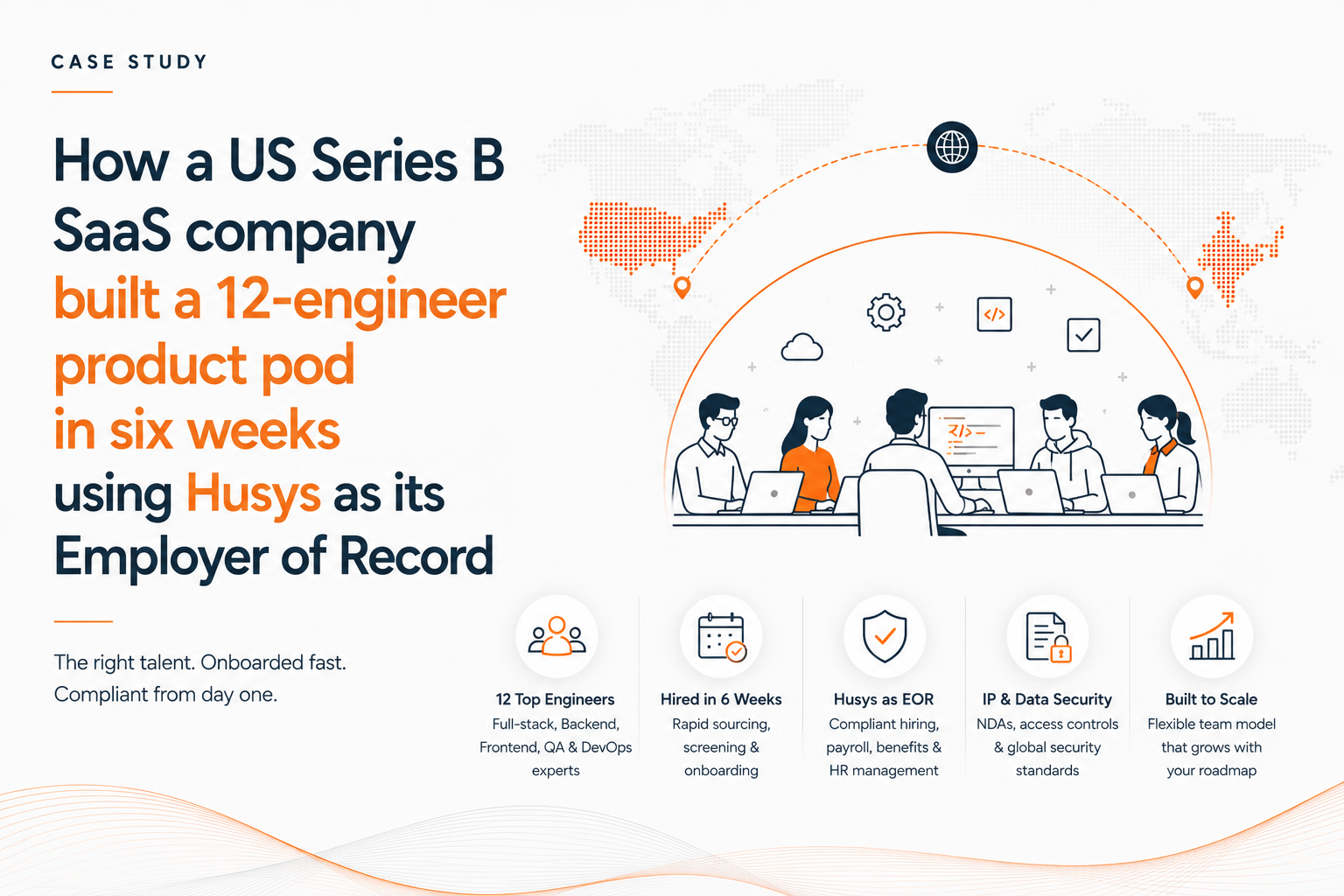
“Husys helped us hire our first three engineers in India in under two weeks, without forcing us to set up an entity or navigate local compliance ourselves. The onboarding was fast, and everything was handled correctly from day one.”
— CTO, Series B SaaS company, Seattle, USA
Ready to see exact pricing for your team size? Visit our EOR Services page for a full breakdown and to book a demo.
How to Hire Employees in India Through an Employer of Record
Hiring employees through an Employer of Record (EOR) in India follows a structured process designed to minimise compliance risks while enabling businesses to onboard talent quickly. Although the exact workflow may vary depending on the role and business requirements, the process generally includes the following stages.
Most US founders assume that India employer of record services involve weeks of back and forth. In practice, once you’ve picked your candidate, the sequence from paperwork to first payroll wraps up in two to three weeks.
That said, here’s how to hire employees through employer of record services in India:
- Finalize the role and location:
- Define the job title, responsibilities, compensation range, and start date. Confirm the employee’s city because payroll registrations and state-level rules vary across India.
- Once the role and location are clear, the EOR structures the employment correctly.
- Select the candidate internally:
- Run interviews as you normally would. Assess skills and culture fit. The hiring decision is yours.
- The EOR steps in only after you confirm the hire.
- Trigger onboarding through the EOR:
- After you confirm the candidate, the EOR begins background verification and prepares the employment agreement under Indian law.
- The contract reflects CTC structure, statutory benefits, notice period terms, and state-specific leave policy.
- Complete statutory registrations before payroll:
- The EOR enrolls the employee under EPF and ESI where applicable, sets up TDS deductions, and activates Professional Tax registration in the relevant state before the first payroll cycle.
- Confirm payroll readiness before Day One:
- Ensure the contract is signed, registrations are active, and payroll is configured.
- At this stage, the employee is legally employed through the EOR and ready to begin work.
With Husys, the compliance and onboarding side takes 8 working hours. Husys runs an in-house legal and compliance team that handles contract drafting, EPF enrollment, ESI registration, and TDS setup internally.
How Long Does It Take to Hire an Employee in India?
US founders are used to moving fast. Post on LinkedIn, run three rounds, send an offer, done in two to three weeks. India hiring moves at the same pace.
What slows things down is the employment infrastructure behind the offer, and that’s entirely dependent on which path you take.
Through an EOR
Using an employer of record in India is the fastest path.
Once you have selected a candidate, here is what the timeline typically looks like.
Stage | Timeline |
Sharing role details and compensation with the EOR | Day 1 |
Offer letter drafted and sent to the candidate(this usually happens within 8 hours, on the basis of document submission) | Day 2 to 3 |
Background verification | 5 to 7 business days |
Contract signed and statutory registrations initiated | Day 8 to 10 |
EPF and ESI enrollment confirmed | Day 10 to 14 |
Payroll setup and first day | Day 14 to 21 |
Note: Husys Onboards employees in 8 working hours.
- Most US companies using an employer of record in India get their first employee to Day One within two to three weeks from the moment a candidate accepts the offer.
- Some EOR providers with existing state-level registrations can compress this further.
- Husys maintains active registrations across all 28 Indian states and union territories.
- When you hire in Bengaluru and then add someone in Hyderabad two months later, the state-level registrations are already in place.
- Your second hire in a new city does not restart the compliance clock, which matters as your India team scales across multiple locations.
Through a Contractor Arrangement
- Faster on paper, Day One can happen in 48 hours if you are just sending a contract and wiring money.
- The risk is what accumulates underneath. Indian tax authorities have a three to seven-year lookback window on misclassified contractor relationships.
- The speed at the start often turns into a much longer and more expensive problem later.
Through an Indian Subsidiary
- This is where US founders lose months they did not plan to lose.
- Setting up a Private Limited Company in India involves the following sequence, and these stages do not always run in parallel.
Stage | Estimated Time |
Director Identification Number (DIN) for all directors | 1 to 2 weeks |
Digital Signature Certificates | 1 week |
Name reservation via the RUN application | 1 to 2 weeks |
Certificate of Incorporation from MCA | 2 to 4 weeks |
PAN and TAN registration | 2 to 3 weeks |
GST registration | 2 to 4 weeks |
Professional Tax registration (state-specific) | 1 to 3 weeks |
Shops and Establishments Act registration | 1 to 2 weeks |
Bank account opening for the entity | 2 to 4 weeks |
EPF and ESI registration | 2 to 3 weeks |
Total realistic timeline | 4 to 6 months |
And that is if nothing gets sent back for correction, which it often does on the first submission.
What Adds Time Even With an EOR
A few factors can extend the EOR timeline regardless of how efficient your provider is.
- Notice periods in India are long compared to US norms.
- Most mid to senior-level professionals are on a 30 to 90-day notice period with their current employer.
- Some companies, particularly large Indian IT firms and MNCs, enforce the full 90 days.
An Employer of Record is generally the most cost-effective hiring model when:
- Hiring fewer than 20–30 employees in India
- Testing the Indian market before long-term expansion
- Recruiting quickly without waiting for entity incorporation
- Building remote engineering or customer support teams
- Establishing a Mini GCC before investing in a full subsidiary
For larger, long-term operations with hundreds of employees, establishing a local entity may become more economical depending on operational requirements.
Frequently Asked Questions About Employer of Record Pricing
How much does an Employer of Record cost in India?
Employer of Record services in India typically start from USD 99 per employee per month, with pricing varying based on workforce size, payroll complexity, statutory requirements and additional HR services.
Does EOR pricing include payroll?
Yes. Most Employer of Record providers include payroll processing, salary disbursement, statutory deductions, tax compliance and employment administration within their monthly service fee.
Are there any hidden costs?
Reputable Employer of Record providers clearly define their pricing. Additional costs, where applicable, are usually limited to optional employee benefits, insurance, government fees or customised HR and legal services.
Planning your India hiring budget?
Remember that an Employer of Record fee is only one part of the total employment cost. Employers should also account for statutory contributions, employee benefits, bonuses and any optional insurance based on their hiring strategy.
Note:
- Background verification for certain roles, particularly those involving financial data or senior leadership, can take longer if the candidate has worked at companies that are slow to respond to verification requests.
- State-specific registrations also add a few days if your EOR does not already have an active presence in that state.
What Is the Real Cost of EOR in India?
| Cost Category | Contractor | Indian Subsidiary | EOR |
|---|---|---|---|
| Setup Cost | None | $8,000 to $15,000 one-time legal & registration fees | Minimal, usually first month fees only |
| Monthly Fee Structure | Contractor rate only, no overhead | Fixed infrastructure costs regardless of headcount | $99 per employee per month |
| Local HR & Payroll Manager | Not required | $12,000 to $20,000 per year | Included in EOR fee |
| Statutory Compliance & CA Retainer | Not applicable | $4,000 to $8,000 per year | Included in EOR fee |
| EPF & ESI Contributions | Not covered, creates backdated liability | 12% EPF + 3.25% ESI on gross salary | 12% EPF + 3.25% ESI, managed & filed by EOR |
| Gratuity Provisioning | Not covered | 4.81% of basic salary after 5 years | Managed by EOR |
| Annual MCA Filings & Audit | Not applicable | $2,000 to $5,000 per year | Not applicable |
| Registered Office Address | Not applicable | $1,500 to $3,000 per year | Not applicable |
| Misclassification Penalty Risk | High. Backdated liability 3 to 7 years | None | None |
| TDS Default Interest | 1.5% per month if missed, liability on US company | Subsidiary liable, manageable locally | Managed and filed by EOR |
| Estimated Total Annual Cost (5 Engineers) | Lower upfront, significant legal exposure | $19,500 to $36,000 fixed overhead before salaries | $5,940 EOR fees, no fixed overhead |
The cost of EOR in India stays efficient up to around 25 to 30 employees.
Beyond that, the fixed cost of your own Indian subsidiary starts to look more reasonable on paper. But that math only works if someone on your team has the bandwidth to own India payroll compliance, statutory filings, and local HR.
Read More: Minimum Wages in India (2026): A Guide for US Companies hiring in India
What You Avoid Paying With an EOR
This part rarely makes it into cost comparisons, but it is often the most significant number on the table.
- A single EPF non-compliance penalty in India can run between ₹5,000 ($55) and ₹15,000 ($165) per default, with criminal liability for repeat offenses under Section 14 of the EPF Act.
- TDS defaults attract interest at 1.5% per month from the date the deduction was due.
- A misclassified contractor relationship that gets reclassified by Indian tax authorities can result in backdated employer contributions, interest, and penalties going back three to seven years.
These are exactly the situations our India employer of record services are built to prevent.
When you look at the full risk picture, the cost of EOR in India at $99 a month is the most straightforward line item in your India hiring budget. If you’re evaluating which EOR provider to work with, here’s how the main options compare.
Compliance in India (EPF, ESI, Payroll Laws)
One of the biggest advantages of using an Employer of Record (EOR) in India is ensuring full compliance with local labor laws and statutory requirements.
A reliable EOR provider manages all critical compliance responsibilities, reducing legal and operational risks for global companies hiring in India.
- Provident Fund (PF): Mandatory retirement contribution for eligible employees
- Employee State Insurance (ESI): Health and social security coverage
- Gratuity: Statutory benefit for long-term employees
- Payroll taxes: Accurate calculation and filing of taxes
- Leave policies: Compliance with statutory leave requirements
- Employment contracts: Legally compliant documentation
Working with an experienced EOR provider ensures that your company remains compliant while focusing on scaling operations in India.
India Compliance: What US Companies Need to Know
What US Companies Get Wrong About India Payroll Compliance
If you run payroll in the US, you are used to federal withholding, state tax, Social Security, and a predictable year-end cycle. Most payroll tools handle the heavy lifting, and the IRS gives you grace periods when things slip.
India payroll compliance operates on a different framework, and US-based assumptions often lead to avoidable mistakes.
Here are the differences that matter most.
In the US | In India |
Employment is often at-will | Notice periods are written into the contract and are enforceable |
Social Security and Medicare apply uniformly | EPF and ESI depend on wage thresholds and structure |
Salary is a single gross figure | Salary components affect statutory calculations |
Payroll taxes follow quarterly schedules | TDS must be deposited monthly |
State payroll differences are manageable through systems | Each state has separate compliance obligations |
Contractor classification follows IRS control tests | Courts examine the actual working relationship |
Payroll vendors process salary | Legal liability remains with the employer |
Now, what does that mean in practice?
- Notice periods: If your contract says 60 days, you either let the employee serve it, or you pay 60 days’ salary. You cannot terminate immediately without financial consequences.
- EPF and ESI: Contributions are mandatory where applicable. Salary structure determines liability. You cannot redesign pay simply to avoid statutory contributions.
- Salary components: Provident Fund and gratuity are calculated on basic pay. If basic pay is set artificially low, authorities can reassess dues based on broader wage definitions.
- Monthly TDS deposits: Tax deducted at source must be deposited by the 7th of the following month. Late deposits show up in employee tax records and can trigger notices.
- State-level compliance: Professional Tax, Labour Welfare Fund, and local registrations differ by state. Hiring in two cities means tracking two compliance sets.
- Contractor classification: If the person works fixed hours under your supervision and depends economically on you, authorities may treat them as an employee regardless of the contract label.
- Principal employer liability: Even with a payroll vendor, your company remains legally responsible for compliance. A vendor processes payroll. It does not absorb statutory liability.
EOR in India for US companies solves this very specific problem. Husys conducts structured quarterly compliance reviews across all client accounts.
Gaps are identified, documented, and remediated on a defined schedule, ensuring statutory obligations are continuously aligned rather than reviewed once a year.
Note : Instead of adapting US systems to Indian law, you operate within a compliant framework from the start.
What are the Mandatory Employee Taxes and Statutory Benefits in India?
When you run payroll in India in 2026, you’re handling income tax, social security, state-level deductions, and statutory exit payments simultaneously.
Each one has its own law, portal, due date, and penalty for getting it wrong.
If you are used to US payroll, think of this as handling federal tax, Social Security, state unemployment insurance, and severance obligations simultaneously, but with separate authorities and filing systems.
Here’s what’s mandatory under current law:
| Component | Who Pays | Typical Rate | Applicability |
|---|---|---|---|
| Income Tax (TDS) | Employee (deducted by employer) | Slab-based rates + 4% cess | Salaried employees above exemption limit |
| EPF (Provident Fund) | Employer & Employee | 12% of basic + DA each | Establishments with 20+ employees |
| Employees’ Pension Scheme | Employer (from EPF portion) | 8.33% capped at ₹15,000 wages | EPF-covered employees |
| ESI | Employer & Employee | 3.25% employer, 0.75% employee | Employees earning up to ₹21,000/month |
| Professional Tax | Employee (deducted by employer) | Up to ₹2,500 per year | States that levy it |
| Gratuity | Employer | 15 days' wages per year of service | After 5 years of continuous service |
| Statutory Bonus | Employer | Minimum 8.33% of annual wages | Eligible employees under wage threshold |
| Labour Welfare Fund | Employer & Employee | Fixed nominal amount | Applicable states only |
The G4S Security Services case in India illustrates exactly how this plays out. The company split employee wages into multiple allowances to reduce their EPF contribution base.
The EPFO found the company had not paid full PF dues to more than 10,000 employees and directed it to deposit ₹133 crore in arrears.
Husys files each of these through the relevant government portals on their separate cycles:
- EPF by the 15th,
- TDS by the 7th,
- ESI on its own schedule, and
- Professional Tax by each applicable state’s deadline.
- These are separate authorities, separate portals, and separate filing calendars.
Husys’ in-house compliance team owns each one across every active client, every month.
How Do Leave and Holiday Policies Work in India?
In the US, PTO is a benefit you design. In India, minimum leave entitlements are set by law and vary by state. Even if your global policy offers unlimited PTO, every Indian employee is entitled to these floors by statute.
| Leave Type | Who It Applies To | How Many Days | What Happens If Unused |
|---|---|---|---|
| Earned Leave | All employees after completing minimum service (240 working days in most states) | 12 to 18 days per year | Can be carried forward up to a statutory cap. Paid out in cash at separation. |
| Sick Leave | All employees | 6 to 12 days per year | Generally lapses. A medical certificate may be required for longer absences. |
| Casual Leave | All employees | 6 to 12 days per year | Cannot be carried forward. Lapses at year's end if unused. |
| Maternity Leave | Women employees covered under the Maternity Benefit Act | 26 weeks for first two children, 12 weeks thereafter | Fully paid by employer unless employee qualifies for ESI benefits. |
| National Holidays | All employees | 3 national holidays plus state-declared festival holidays | Working on a national holiday requires compensatory leave or additional pay. |
One thing US employers consistently miss is the earned leave payout at exit.
Unlike PTO in the US, which many companies simply forfeit, unused earned leave in India is a cash liability that gets cleared during full and final settlement.
Husys builds this into every employment contract from the start, so there are no surprises at separation.
How Does Employee Termination Work in India?
If you are used to US employment law, termination in India will feel structured and procedural.
In most US states, employment is at will. In India, termination is driven by contract terms, employee classification, tenure, and statutory rules. Notice periods are enforceable. Compensation formulas are defined by law.
If termination is handled incorrectly, it can lead to formal labour disputes that take months to resolve.
- You cannot let someone go in two weeks:
- Notice periods in India are 30 to 90 days and written into the contract.
- If you need someone out faster, you pay out the remaining notice period in cash. There is no workaround.
- Firing for misconduct has a process:
- You cannot send a termination email and move on. Indian law requires a domestic enquiry before dismissal for misconduct.
- Skip that step, and the employee can challenge the termination in court, regardless of what they actually did.
- Laying someone off costs money:
- Employees classified as workmen under the Industrial Disputes Act are entitled to retrenchment compensation, calculated at 15 days of average pay per completed year of service.
- For larger teams, you may also need government approval before the layoff happens.
- Every separation has a checklist:
- Before you close out an employee, you owe them unpaid salary, earned leave encashment, applicable bonus, expense reimbursements, and gratuity if they have crossed five years.
- Miss any of these, and it comes back as a legal claim.
- Gratuity is not optional after five years:
- Any employee who completes five continuous years of service is entitled to gratuity by law.
- Layoffs and Closures:
- For larger establishments covered under Chapter V B of the Industrial Disputes Act, layoffs, retrenchments, or closures may require prior government approval depending on headcount thresholds and state amendments.
Data Security and Compliance Certifications
For a US company evaluating an EOR partner, data security usually isn’t the last question, it’s often the first one a legal or security team asks before a deal moves forward. Every employee record, payroll detail, and compliance document handled through an EOR passes through that provider’s systems, so it’s worth knowing exactly how that data is protected before you sign.
Husys is ISO 27001 certified for information security management and maintains a 99.9% compliance rate across its EOR and payroll operations, built over 24+ years of HR outsourcing experience.
What We Protect, and How
Data encryption: Employee and payroll data is encrypted at rest and in transit using AES-256 encryption.
Access controls: Access to client and employee data is governed by role-based IAM (Identity and Access Management) controls, with all access activity logged and monitored.
Data residency: Employee and client data is stored across data centers in both India and the United States.
Third-party audits: Husys undergoes SOC 2 audits and regular penetration testing to independently verify its security controls.
Why This Matters More for Some Industries Than Others
If you’re a SaaS or fintech company hiring engineers in India, or a healthcare business hiring clinical or research staff, your own customers and regulators expect you to vet every vendor that touches employee data, including your EOR.
Husys supports GDPR-aligned data handling with Data Processing Agreements (DPAs) available for clients with EU touchpoints, and maintains HIPAA-adjacent controls for healthcare and life sciences clients handling sensitive personnel data.
Who Owns the IP When You Hire in India Through an EOR?
If you hire directly in the US, IP ownership is usually handled through invention assignment clauses in the employment agreement. Once signed, ownership flows to the company.
When you hire through Husys, the structure requires one extra step because we’re the legal employer on record. IP must be explicitly assigned from the employee to us, and then from us to your company.
At Husys, we build this into every employment contract, so the chain is clean and enforceable from day one.
Here is how it typically works.
- IP assignment built into the employment contract:
- The employment agreement signed with the Indian employee includes clear assignment language stating that all intellectual property created in the course of employment belongs to your company.
- This covers code, product designs, documentation, inventions, and related works.
- Two-step assignment structure:
- In most EOR models, the employee assigns IP to the EOR as the legal employer.
- The EOR then assigns those rights to your company under the Master Services Agreement.
- The documents are structured so the transfer is automatic and continuous.
- Contractors vs employees distinction:
- This is also another reason why proper employment classification matters.
- Contractors in India can retain IP ownership by default.
- Employees can’t, if the assignment clause is drafted correctly.
- Compliance with the Indian Copyright Act and other IP statutes:
- Contracts should specify that the assignment applies worldwide and for the full term of protection.
- If not drafted properly, Indian law can impose default limitations.
- Moral rights waivers are also addressed where legally permissible.
- Confidentiality and restrictive covenants:
- One thing US founders often don’t expect is that post-termination non-competes are generally unenforceable in India.
- You can’t stop a former engineer from joining a competitor the way you might in a US contract.
- This makes confidentiality clauses and IP assignment language even more important.
What Are the Visa and Work Permit Rules for Foreign Employees in India?
Most of the time, your India team will be Indian nationals, and visas won’t be a factor. But if you want to send a US leader to India to set up operations or stabilize a new team, here’s how the rules work.
- Business Visa for short-term visits:
- A Business Visa is suitable for meetings, negotiations, training sessions, or exploratory setup discussions.
- It does not permit hands-on operational work in India.
- The individual cannot be on the Indian payroll under a Business Visa.
- Employment Visa for working in India:
- If the foreign national will work in India, manage teams, execute operations, or receive a salary in India, an Employment Visa is required.
- This requires a formal employment contract with an Indian entity or an EOR acting as the legal employer.
- Minimum salary threshold:
- India requires a minimum annual salary threshold for foreign nationals applying for an Employment Visa, generally around USD 25,000 per year, subject to limited exemptions for specific roles.
- This ensures Employment Visas are issued for skilled and senior positions.
- FRRO registration after arrival:
- If the visa validity exceeds 180 days, the foreign employee must register with the Foreigners Regional Registration Office within 14 days of arrival.
- Residential address and employment documentation are required.
- PAN and income tax compliance:
- A foreign employee working in India must obtain a Permanent Account Number for tax purposes.
- If their physical presence crosses Indian tax residency thresholds, Indian income tax obligations may apply based on duration of stay and treaty relief provisions.
- Dependent visas:
- Spouses and dependents can enter India on Entry visas.
- These visas allow residence but do not permit employment unless converted to an Employment Visa.
Note: If your US leader is only visiting for strategic meetings, a Business Visa may be sufficient. If they are running operations in India, even for a few months, an Employment Visa, payroll setup, and tax review are usually required.
What Is Permanent Establishment Risk and Why Should US Companies Care?
If you only operate in the US, your tax exposure is simple. You are taxed where you are incorporated. In India, you can create a taxable presence without incorporating anything. It is called Permanent Establishment. Once triggered, India has the right to tax the profits your Indian operations generate.
There are three ways it gets triggered.
Fixed Place PE
- When it applies: Your company has a physical location in India used continuously for business operations, an office, a branch, or any stable setup.
- How it is measured: Whether the location is at your company’s disposal and whether core business activity is conducted from it.
- Implication: India treats that location as a taxable business presence and can assess corporate tax on profits generated there.
Dependent Agent PE
- When it applies: Someone in India is habitually concluding contracts on behalf of your US company, or playing the lead role in deals that get approved without material changes.
- How it is measured: Pattern of conduct and actual authority, not job title.
- Implication: The person’s activity is treated as your company doing business in India, regardless of where your entity is incorporated.
Three Ways PE Gets Triggered
Fixed Place PE: You have a physical location in India used continuously for business
Dependent Agent PE: Someone in India is signing or finalising contracts on your company’s behalf
Service PE: Your employees provide services in India beyond the treaty threshold within a 12-month period
What Husys monitors: invoice activity, employee deliverables, contract authority levels
Service PE
- When it applies: Your employees or personnel are providing services in India continuously beyond a specified duration within a twelve-month period under the US-India tax treaty.
- How it is measured: Duration of services and continuity of presence in India.
- Implication: Sustained service delivery in India can constitute a taxable presence even without a physical office.
What happens if PE is triggered
- You must obtain a PAN in India
- File Indian corporate tax returns
- Pay tax on profits attributable to Indian operations
- Defend the method you used to allocate revenue and expenses to India
Hiring employees in India does not automatically create PE. The risk increases when Indian employees are signing contracts, generating revenue, or running operations out of a fixed office.
Husys monitors PE risk at the transaction level through its proprietary HRIS platform.
Each invoice is tracked against the employee’s actual deliverables to identify patterns that could indicate revenue-generating activity in India.
This is what managing India compliance looks like when it’s built into the system from day one, not patched together after the fact.
What Does Hiring Through an EOR Look Like for In-Demand Roles in India?
Here’s what it actually costs to hire three of the most common roles US companies bring to India through Husys, with real salary ranges, EOR fees, and a comparison to what the same hire would run you in the US.
| Aspect | Software Engineer | Finance Lead | Sales / GTM Manager |
|---|---|---|---|
| Location | Bengaluru | Mumbai | Delhi NCR |
| Experience | 4 to 6 years | 6 to 10 years | 5 to 8 years |
| India CTC (INR) | ₹15 to 25 lakhs | ₹12 to 20 lakhs | ₹10 to 18 lakhs base + variable |
| India Cost (USD / Year) | $18,000 to $30,000 | $14,400 to $24,000 | $12,000 to $21,600 base |
| US Equivalent Cost | $120,000 to $180,000 | $90,000 to $130,000 | $90,000 to $140,000 |
| Husys EOR Fee | $99 / month | $99 / month | $99 / month |
| Estimated Monthly Employer Cost (Salary + EOR) | $1,600 to $1,800 | $1,300 to $2,100 | $1,650 to $1,850 |
| Savings vs US Hiring | 70 to 85% | 70 to 80% | 70 to 80% |
The savings are real. But the more useful way to think about it is what your existing US hiring budget actually buys you in India.
| Your US Budget | What You Get in the US | What You Get in India via Husys |
|---|---|---|
| $180,000 | 1 mid-level engineer in Austin | 5 mid-level engineers in Bengaluru |
| $130,000 | 1 finance lead in New York | 4 finance leads in Mumbai |
| $140,000 | 1 sales manager in New York | 5 sales managers in Delhi NCR |
The savings on a single US hire fund your entire India team for the first year. You make the hire, we handle the compliance, and your team starts contributing in weeks.
Changes in India's Labor Law Should US Companies Know About in 2026?
India consolidated 29 labour laws into four codes, and in 2026, states are still rolling out implementation rules under each of them.
This means the India payroll compliance landscape is genuinely shifting in real time.
Here’s what’s changed or is changing now, and what it means for your India operations. As your employer of record in India, Husys tracks each of these updates so you don’t have to.
- Wage Definition, 50% Rule, and Overtime:
- Basic salary must be at least 50% of total remuneration for statutory calculations under the Wage Code.
- This increases the PF and gratuity contribution base for many salary structures.
- Also, overtime applies beyond 8 hours a day or 48 hours a week and must be paid at double the wage rate.
- Gratuity Changes:
- The gratuity ceiling has been revised upward, increasing maximum payout exposure.
- Fixed-term employees may qualify for gratuity after completing 1 year.
- Employers must provision higher exit liabilities for long-tenure and contract roles.
- Salary Timelines and F&F Settlement:
- Under the new wage framework, monthly salaries must be paid by the 7th of the following month.
- Full and final settlement is expected within 2 working days of an employee’s last working day.
- Delays can trigger penalties and employee disputes.
- ESIC Threshold Monitoring:
- The ESI wage ceiling is periodically revised by notification.
- If an employee’s gross wages fall within the threshold, both employer and employee contributions become mandatory.
- Coverage changes apply immediately once notified.
- Worker Classification and Social Security:
- Fixed-term, gig, and contract worker definitions are being enforced more strictly.
- If a worker meets employee criteria, PF and ESI obligations apply regardless of label.
- Misclassification can lead to retrospective contribution demands.
- Inspection and Digital Compliance Regime:
- Labour inspections are now system-triggered based on return filings and data analytics.
- EPF, ESI, TDS, and professional tax portals reject filings with PAN, UAN, or wage mismatches.
- Non-compliance is flagged automatically, not manually.
- State-Level Leave and Remote Work Updates:
- Shops and Establishments rules vary by state for leave accrual, carry-forward limits, and public holidays.
- Some states have issued formal guidance on remote work obligations.
- HR policy must align with the state where the employee is located.
These changes affect payroll, HR policy, and compliance.
This is exactly the kind of moving target that makes India compliance hard to manage from a US office.
Husys has an in-house legal and compliance team with over 250+ years of collective work experience, that tracks notifications from the Ministry of Labour, state labour departments, and social security authorities as they are issued.
When a state publishes a revised holiday list, updates its Professional Tax slab, or changes its Shops and Establishments Act filing requirement, the Husys compliance team interprets the change and updates the relevant payroll and HR processes before the effective date.
EOR in India vs Setting Up Your Own Entity: A Full Cost and Risk Comparison
If you’re still weighing global EOR India solutions against building your own Indian entity, here’s the full comparison.
| Factor | Employer of Record | Own Indian Entity |
|---|---|---|
| Legal Employer | EOR entity in India | Your Indian Private Limited Company |
| Setup Timeline | A few days to a couple of weeks | 2 to 6 weeks for incorporation, plus bank and tax registrations |
| Upfront Cost | No incorporation cost | Government fees and professional fees for incorporation |
| Monthly Cost Model | Per employee fee, typically 99 to 600 USD per month | Fixed compliance cost plus payroll provider and advisory fees |
| Payroll Compliance | Handled by EOR | Your responsibility through payroll and legal vendors |
| EPF, ESI, TDS Filings | Filed by EOR | Filed by your company |
| Corporate Tax Filing | No Indian corporate filing for you if structured properly | Mandatory corporate tax return and statutory audit |
| Permanent Establishment Risk | Structured to reduce risk if contract authority remains outside India | You have a clear taxable presence in India |
| Employment Liability | Lies with the EOR | Lies with your entity |
| Termination Compliance | Managed through the EOR framework | Direct exposure under Indian labour laws |
| Ability to Invoice Indian Clients | Limited unless structured separately | Full ability to contract and invoice locally |
| Exit Process | Terminate service agreement | Formal company strike off or liquidation required |
| Cost Efficiency at Small Headcount | Often more efficient for under 10 employees | Higher fixed costs at low headcount |
| Cost Efficiency at Scale | Per employee fee increases with headcount | Per employee cost reduces as the team scales |
For most US companies, the threshold at which running your own Indian subsidiary becomes cost-efficient is around 25 to 30 employees with long-term operational commitments.
Below that, the fixed overhead of incorporation, a local compliance team, a CA retainer, and annual MCA filings runs $19,500 to $36,000 per year before a single salary is paid.
Husys at $99 per employee per month covers all of that for a fraction of the cost, with an in-house team that already has the infrastructure in place.
Client Testimonial
We weren't ready to commit to a permanent Indian entity, but we needed to move fast on hiring. Husys let us scale from two to twelve engineers in under six months, fully compliant, with the option to reassess structure later. That flexibility was worth everything." —Head of Operations, Growth-stage Tech company, Amsterdam, NetherlandsClient name withheld due to NDA.
Client name withheld due to NDA.
Why Husys for US Companies Hiring in India
Frequently Asked Questions
➡️ What is an Employer of Record India?
Most providers added India employer of record services as an extension of their global offering. We built our entire business around it.
Husys has been running India payroll since 2001. We are ISO 9001 and ISO 27001 accredited, operate our own Indian entity, and maintain an in-house legal and compliance team across all 28 states.
We operate our own entity in India
- Some providers promoting global EOR India solutions don’t actually employ your workers directly.
- They route the relationship through a third-party entity you’ve never heard of and will never speak to.
- You think you’re working with one India EOR company, but your engineers are technically employed by someone else entirely.
At Husys, we hold our own Indian entity. We are the employer on record in India. That means when something needs to get resolved, there’s no middleman. We make the call, we handle the filing, and we own the outcome.
26% of our clients are Saas companies based in the US
US companies have specific expectations around speed, transparency, and communication style. We built our operations around that.
- Your employees work on your schedule.
- Payroll runs align with your fiscal calendar.
- Contracts are drafted in plain English with US founders in mind, not translated legal jargon.
- When you email us at 9 am Pacific, you get a response the same day, not three days later after it bounces through time zones.
Pricing is transparent and predictable
- The cost of EOR in India with Husys is $99 per employee per month.
- No percentage of salary.
- No surprise markups on benefits.
- No hidden FX fees.
- You know exactly what you’re paying before the first hire starts.
What working with Husys actually looks like
- You send us a candidate’s name and their offer details.
- We run background verification, draft the employment contract, and handle all the EPF and ESI enrollment.
- Your new hire gets onboarded in 8 working hours if they are immediately available, or 30-60 days if they are serving notice.
Every month, payroll runs on the schedule you set.
Statutory filings happen automatically.
If an employee has a question about their payslip or their PF balance, they reach out to our India team directly and get an answer the same day.
Our proprietary HRIS platform gives you a single view of your entire India headcount, including salary details, leave balances, and upcoming statutory deadlines. If you ever need to pull a report for your finance team or your auditors, it takes two clicks.
Clients stay with Husys for over four years on average, and most move to their own entity as they scale beyond 50 employees. That longevity reflects trust earned through consistent compliance execution and steady operational support.
Hire Employees in India Without Setting Up an Entity
Hiring in India doesn’t have to be complex. With the right Employer of Record, you can onboard employees quickly while staying fully compliant with local laws.
Whether you’re hiring your first employee or scaling a team, Husys helps you simplify payroll, compliance, and onboarding across India.
➡️ What is an Employer of Record in India?
- An Employer of Record in India is a local legal employer that puts your talent on its payroll while you stay in control of day‑to‑day work and outcomes.
- It signs compliant Indian employment contracts, runs payroll in INR, and handles PF, ESI, Professional Tax, TDS and all labour‑law obligations across 28 states and 6 union territories using an in‑house legal and compliance team.
➡️ Can I hire employees in India without a company?
Yes, you can hire employees in India without setting up a legal entity by using an Employer of Record (EOR).
➡️ How much does Employer of Record India cost?
Employer of Record India services typically cost between $199 and $699 per employee per month, depending on the provider and service level.
➡️ Can I hire employees in India without an entity?
Yes, companies can hire employees in India without setting up a legal entity by using an Employer of Record. The EOR becomes the legal employer while you manage the employee’s work.
➡️ Is Employer of Record legal in India?
Yes, Employer of Record services are legal in India and widely used by global companies to ensure compliance.
➡️ Can I hire employees in India without a company?
- Use an employer of record in India.
- Your US company does not need to register locally, open an Indian bank account, or build a compliance team.
- You select the candidate, and Husys will issue the employment contract, handle statutory enrollment under Indian law, and run payroll every month.
➡️ What is the cost of EOR in India per employee?
- Husys prices at a flat $99 per employee per month.
- The fee covers payroll processing, EPF and ESI filings, TDS management, and employment contract administration.
- For US finance teams building a headcount budget, this means a predictable, fixed line item per employee that does not fluctuate with salary increases, bonus cycles, or currency movements.
➡️ How long does it take to get someone onboarded in India?
- If your candidate is immediately available, Husys completes onboarding within 8 working hours.
- If they are serving a notice period, which is standard for mid to senior roles in India, the realistic start date is 30 to 60 days out.
- Husys has active registrations across all 28 states, so the compliance preparation happens in parallel with the notice period.
➡️ Can a US company pay Indian employees directly?
- Technically, you can wire money to an individual in India.
- What you can’t do is call that person an employee without creating tax, compliance, and permanent establishment exposure for your US company.
- Indian tax authorities have a lookback window of three to seven years on misclassified arrangements. EOR in India for US companies puts the relationship in the correct legal form from day one.
➡️ Do labor laws differ by state in India?
- Yes, meaningfully.
- Leave entitlements, professional tax rates, labour welfare fund contributions, and public holiday lists all vary by state.
- Hiring in Karnataka and Maharashtra at the same time means two separate compliance calendars.
- Husys manages state-level filings across all 28 states, so you don’t have to track any of it yourself.
➡️ Who owns the IP when my Indian team builds something?
- Ownership depends entirely on how the employment contract is drafted.
- Husys builds explicit IP assignment language into every employment agreement.
- The assignment covers code, product designs, documentation, and inventions created during employment, and flows directly to your US entity.
➡️ Is there a minimum salary requirement for hiring in India?
- For Indian nationals, there’s no general minimum beyond state-level statutory minimums tied to the role category.
- For foreign nationals applying for an Employment Visa to work in India, a minimum annual salary threshold of around USD 25,000 applies under immigration rules.
➡️ How does an employer of record in India handle employees across multiple cities?
- Each state has its own registrations, filings, and compliance calendar.
- Husys maintains active registrations across all major Indian states, so when you hire in Bengaluru and Hyderabad in the same month, there’s no delay waiting for new registrations to come through.
➡️ What is permanent establishment risk, and how do I avoid it?
- PE risk means India can tax your US company’s profits if your Indian operations look like a local business presence rather than just a support function.
- The biggest triggers are employees who sign contracts on behalf of your company or who are treated as running India-facing revenue operations.
- Husys structures the engagement to reduce this exposure.
➡️ When does it make more sense to set up an entity than use an employer of record in India?
- Once you’re consistently above 25 to 30 employees in India with long-term operational commitments, the fixed cost of running your own subsidiary starts to make more sense than a per-employee India employer of record services fee.
- If you’re still building toward that scale, or want to test the market before committing to permanent infrastructure, global EOR India solutions like Husys give you a faster and lower-risk path.
➡️ What is the best Employer of Record in India?
- The best Employer of Record provider in India depends on your hiring needs, budget, and compliance requirements.
- Companies like Husys, Deel, and Remote are commonly used based on different use cases.
➡️ How much does an Employer of Record cost in India?
- EOR services in India typically cost between $199 and $699 per employee per month. Some providers offer lower flat pricing depending on the service model and scope.
➡️ Which EOR is best for US companies hiring in India?
- Global EOR providers like Deel and Remote are commonly used, while India-focused providers like Husys offer deeper compliance expertise and cost advantages.
➡️ What compliance does an EOR handle in India?
- An EOR manages statutory compliance including Provident Fund (PF), Employee State Insurance (ESI), gratuity, payroll taxes, employment contracts, and labor law requirements.
➡️ Is an EOR cheaper than opening an entity in India?
- For small and mid-sized teams, using an EOR is generally more cost-effective and faster than setting up and maintaining a legal entity in India.
➡️ Do I need a local Indian bank account to run payroll
- Yes, if you operate your own entity.
- An EOR model removes that requirement because payroll is processed through the EOR’s registered Indian entity. Husys handles local banking and statutory payments on your behalf.
➡️ How long does it take to hire employees in India?
- Using an Employer of Record India, companies can typically hire employees within 7–10 days, depending on documentation and notice periods.
➡️ Why use an Employer of Record in India instead of opening an entity?
- For US founders, CFOs and COOs, setting up an Indian entity means months of delay, director requirements, ongoing filings, corporate tax, GST and Permanent Establishment risk.
- An EOR lets you hire in weeks, onboard within 8 working hours, and test India with predictable per‑employee costs, without committing capex or building local HR, payroll and legal infrastructure first.
➡️ Who should use Employer of Record services in India?
- EOR is ideal for small and mid‑market companies that want to hire 1–100 people in India for tech, SaaS, IT, cybersecurity, manufacturing or support functions.
- It’s especially useful for early‑stage and growth‑stage companies that need to enter India quickly, avoid misclassification and labour liability, and keep global expansion as an option rather than an irreversible decision.
➡️ What compliance does an Employer of Record handle in India?
- A qualified India EOR takes over end‑to‑end employment compliance: PF and ESI registrations and contributions, Professional Tax, TDS on salaries, gratuity, leave and holiday policies, notice periods, and all employment‑act related filings at central and state level.
- In Husys’s model, this is managed by an in‑house compliance and legal team backed by ISO 9001 and 27001 certified processes.