Every US founder expanding into India faces the same question.
Do I set up my own Indian entity?
Or do I hire through an Employer of Record, which allows companies to hire employees in India without setting up an entity?
If you have fewer than 25 employees in India, an EOR will almost always cost less, close faster, and carry less risk than setting up your own entity.
The debate around EOR vs setting up an entity in India is one of the most common strategic questions US founders run into, and the right answer depends on more than just cost.
On the surface, entity setup feels like a serious move. You incorporate, you control payroll, and you build something permanent.
In practice, it takes 10 to 16 weeks on average before a US-owned Indian entity is legally ready to run its first payroll, and that window only starts after incorporation, not before it.
- The moment you onboard your first employee under your own entity, you become fully responsible for statutory payroll compliance in India.
- That includes provident fund registration and contributions, employee state insurance where applicable, tax withholding, professional tax in certain states, gratuity accrual tracking, labour law registrations, and ongoing state-level filings.
With an EOR model, the employee is legally employed by the EOR’s Indian entity. Payroll, statutory contributions, and labour law compliance sit with that entity, while you control role, compensation, and performance.
So which structure is actually right for you?
That depends on how quickly you want to hire, how much operational complexity you are prepared to own in India, and whether this is your first hire or your fifteenth.
If your situation looks like this | The smarter starting point |
Hiring 1–25 employees | EOR |
Need to hire within weeks | EOR |
Not generating revenue in India | EOR |
Testing India as a talent market | EOR |
Hiring 30+ employees with long-term presence | Entity |
Billing Indian customers directly | Entity |
Building a permanent India office | Entity |
Let’s break down EOR vs entity in India and how your decision impacts cost, speed, and control.
Who is this guide for?
This guide is for US founders and operators looking to hire employees in India via EOR vs entity and need to decide which structure actually fits their business before they commit to either path.
You will find this useful if you are:
- Hiring your first employee or small team in India
- Expanding engineering, product, or go-to-market functions into India
- Comparing entity setup with an EOR model, and want a clear cost and compliance view
- Trying to understand what running payroll and statutory compliance in India actually involves
- Accountable for legal, finance, or operational outcomes tied to international hiring
First, let’s understand what an EOR is and what entity ownership in India actually involves.
What is an Employer of Record in India?
Most founders ask: “do I need an entity in India” to hire an engineer, and the short answer is no. For a foreign company evaluating entity setup in India alternatives, an EOR gives you a legal path to employ someone without incorporating anything yourself.
An Employer of Record is a company that legally employs workers on behalf of your business.
The EOR handles statutory registrations, runs payroll, files contributions, and stays current with Indian labour laws.
You control everything that matters to your business, which is the role, the compensation, the work, and the performance.
Here is what an EOR handles on your behalf:
- Drafting and issuing a compliant employment contract under Indian law
- PF (mandatory retirement contribution) registration and monthly contributions are India’s equivalent of a U.S. 401(k)
- ESI (Employee State Insurance – statutory health insurance for eligible employees) registration and insurance, where applicable, similar to employer-sponsored health coverage in the U.S.
- TDS calculation and deposit, which is India’s payroll tax withholding
- Professional tax filings across states
- Gratuity accrual tracking
- State-level labour law registrations and regular filings
- Payroll processing and payslip generation
- Managing notice periods and compliant offboarding
Note: Statutory rule most founders miss is that India requires PF registration the moment you have your first employee. There is no grace period. ESI registration kicks in once your headcount crosses 10 employees in most states. Both are mandatory employer contributions, not optional benefits, and non-registration triggers retrospective liability with interest.
Here are the core advantages and disadvantages of an employer of record in India:
Pros | Cons |
You can begin hiring without incorporating your Indian entity, opening a bank account, or obtaining tax registrations | Limited ability to design highly customized compensation or ESOP structures tied to an Indian entity |
Avoids upfront incorporation costs, local director requirements, and recurring secretarial filings | Per-employee pricing compounds as headcount increases |
Employment liability and statutory payroll compliance sit with an established Indian employer | Not structured for operating as a standalone revenue-generating Indian subsidiary |
Preserves leadership bandwidth by avoiding direct management of Indian payroll and labour filings | |
Useful for validating India as a hiring market before a long-term commitment | |
Allows structured hiring across multiple Indian states without separate registrations in each state | |
Key Takeaway – If you want to hire in India without building corporate infrastructure, an EOR provides speed and structural risk containment.
What Does it Mean to Set Up Your Own Entity in India?
When founders move past the EOR vs company registration debate, the commitment changes substantially.
You are committing capital, time, compliance infrastructure, and long-term operational responsibility in India. On paper, it gives you control.
In practice, you carry full employer liability across Indian corporate law, labour law, and tax law from the moment your entity is incorporated, before you have hired a single person.
Here is what it means to set up your own entity in India:
1. Setup Process
Setting up a private limited company in India requires multiple registrations across tax, corporate, and labour authorities.
The core steps include:
- Obtaining a Digital Signature Certificate and a Director Identification Number for each director
- Filing incorporation documents with the Ministry of Corporate Affairs
- Applying for PAN and TAN, which function as federal tax identifiers
- Registering for GST if applicable to your business model
- Opening a corporate bank account with an Indian bank
- Registering for Provident Fund and ESI with the relevant statutory bodies
- Obtaining Professional Tax registration in each state where you plan to hire
- Setting up a compliant payroll system that handles TDS, PF, ESI, and gratuity accrual
This is the administrative baseline before your first employee is onboarded.
2. Timeline
Incorporating an Indian subsidiary is not just about running payroll. It creates a permanent compliance structure that exists whether you have one employee or fifty.
From the moment your entity is registered, you inherit:
- Corporate governance obligations under the Ministry of Corporate Affairs
- Annual ROC filings and board documentation requirements
- GST registration and periodic filings if applicable
- Corporate income tax returns
- Transfer pricing compliance if billing your US parent
- Companies must also comply with state-level minimum wage regulations, which differ by role, skill category, and location. You can review the latest statutory thresholds in our guide to minimum wages in India.
- State-specific labour law registrations wherever employees are located
- Statutory audit requirements, even with minimal revenue
- Maintenance of statutory registers and inspection readiness
This compliance burden continues regardless of whether your India team grows or shrinks.
Control increases. But so does structural accountability.
3. Compliance Obligations
Once incorporated, the company must maintain ongoing compliance at both the central and state levels.
This includes:
- GST filings on a monthly or quarterly basis, depending on turnover
- Annual ROC filings to maintain good standing
- Corporate income tax returns filed with the Income Tax Department
- Payroll compliance across PF, ESI, TDS, and gratuity every month
- Professional tax filings in every state where employees are located
- Labour law audits triggered by headcount and state-specific thresholds
- Maintenance of statutory registers and employment records
These obligations continue regardless of revenue or headcount growth.
Statutory rules most founders learn too late:
- Professional tax is levied at the state level, and rates, slabs, and filing deadlines differ in every state.
- Karnataka, Maharashtra, and Telangana each have separate structures.
- A company with employees in all three is running three parallel compliance tracks every month, not one.
4. Operational Responsibility
This is the part many founders underestimate.
India has 28 states. Professional tax structures differ by state.
Labour enforcement practices vary by region. Thresholds change based on employee count.
Hiring in Mumbai, Bengaluru, and Hyderabad simultaneously means managing three separate state-level compliance tracks.
Your finance and legal teams become responsible for tracking deadlines, maintaining filings, coordinating with accountants, responding to notices, and ensuring payroll accuracy every month.
Control increases.
So does accountability.
Read More: How to Set Up a Private Limited Company in India: Guide for US Founders
And once the entity is live, your finance and legal team inherits a new set of recurring obligations, including:
- GST filings on a monthly or quarterly basis, depending on your turnover
- Annual ROC (Registrar of Companies) filings to keep your entity in good standing
- Corporate tax returns filed with the Income Tax Department
- Labour law audits that vary by state and headcount thresholds
- Professional tax filings in every state where your employees are located, each with its own rates, slabs, and schedules
- Payroll compliance across PF, ESI, TDS, and gratuity for every employee, every month
Note: India has 28 states, and each one can have its own professional tax structure. Hiring in Mumbai, Bengaluru, and Hyderabad at the same time means tracking three different state-level obligations simultaneously.
Key takeaway – Incorporating gives you control, but it also creates permanent compliance obligations that exist independent of headcount.
That said, here are the advantages and disadvantages of setting up your own entity in India.
Advantages | Disadvantages |
Full ownership and control of the employer entity | Takes 10 to 16 weeks to incorporate and register, plus additional time before the first payroll is legally possible |
Better suited if you are directly generating revenue in India | Requires ongoing corporate compliance beyond just employment |
Easier to build an India-registered brand and local presence | GST, ROC, and tax filings add overhead even with small teams |
Long-term cost efficiency at a very high headcount | Setup costs can run into tens of thousands of dollars |
Enables direct contracts with Indian clients | You carry full liability for any compliance gaps, including retrospective penalties, back contributions, and interest |
EOR vs Entity in India: Core Differences
When US founders compare an employer of record and setting up their own entity in India, most discussions stop at speed and cost.
However, the real differences show up in risk ownership, compliance responsibility, and what happens when something goes wrong.
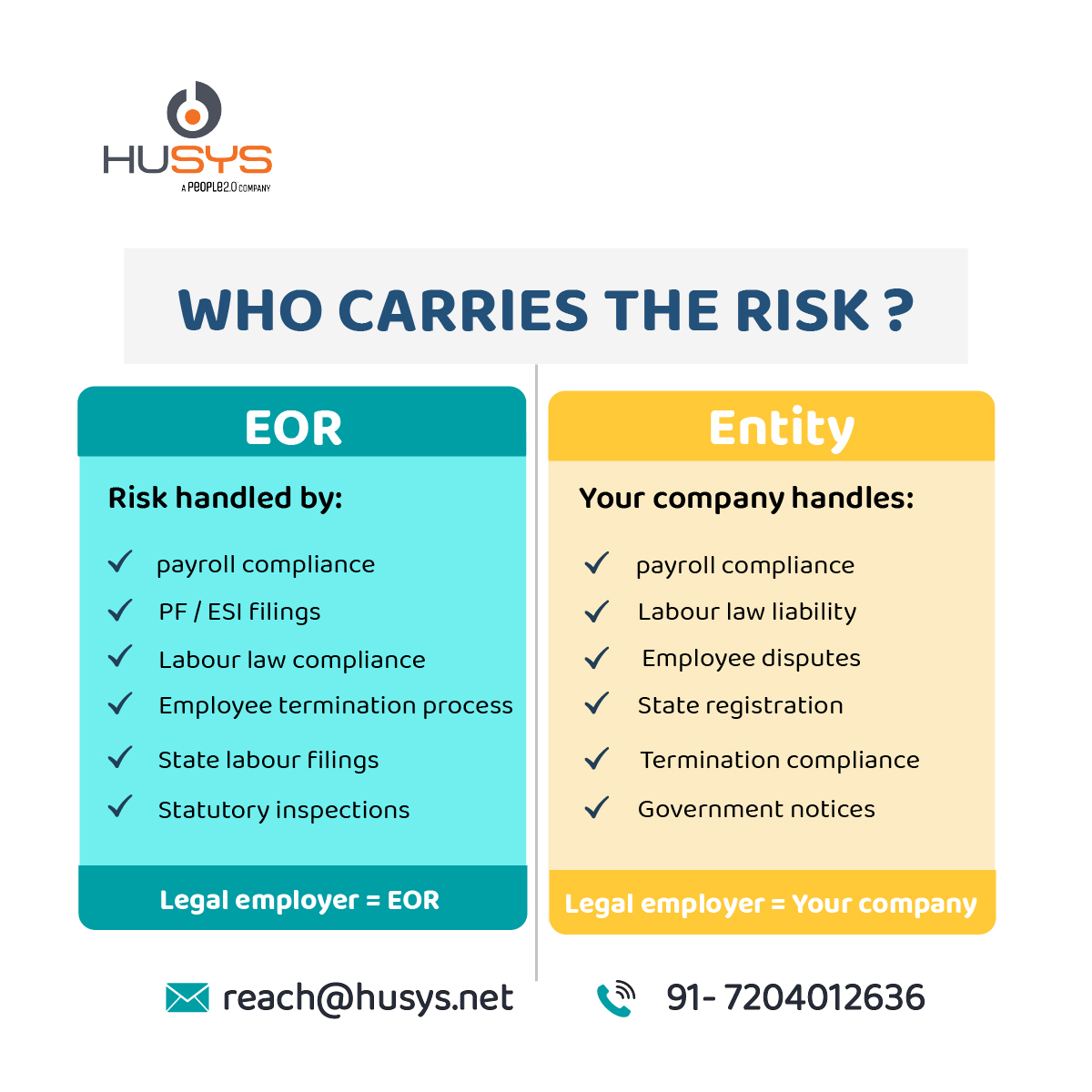
The biggest difference between EOR and entity structures is where compliance and employment liability sit.

The single most overlooked difference is exit cost.
Winding down an EOR engagement takes weeks. Deregistering an Indian entity takes 12 to 24 months and requires a clean compliance history before authorities approve the process.
That exit burden exists because an entity is a registered corporate structure. It requires incorporation, banking, tax registrations, labour compliance, accounting standards, audits, and ongoing filings from the moment it is formed.
An EOR works differently.
You operate through an existing local entity. You hire employees, but you do not inherit corporate infrastructure. If your hiring plan changes, you can disengage instantly.
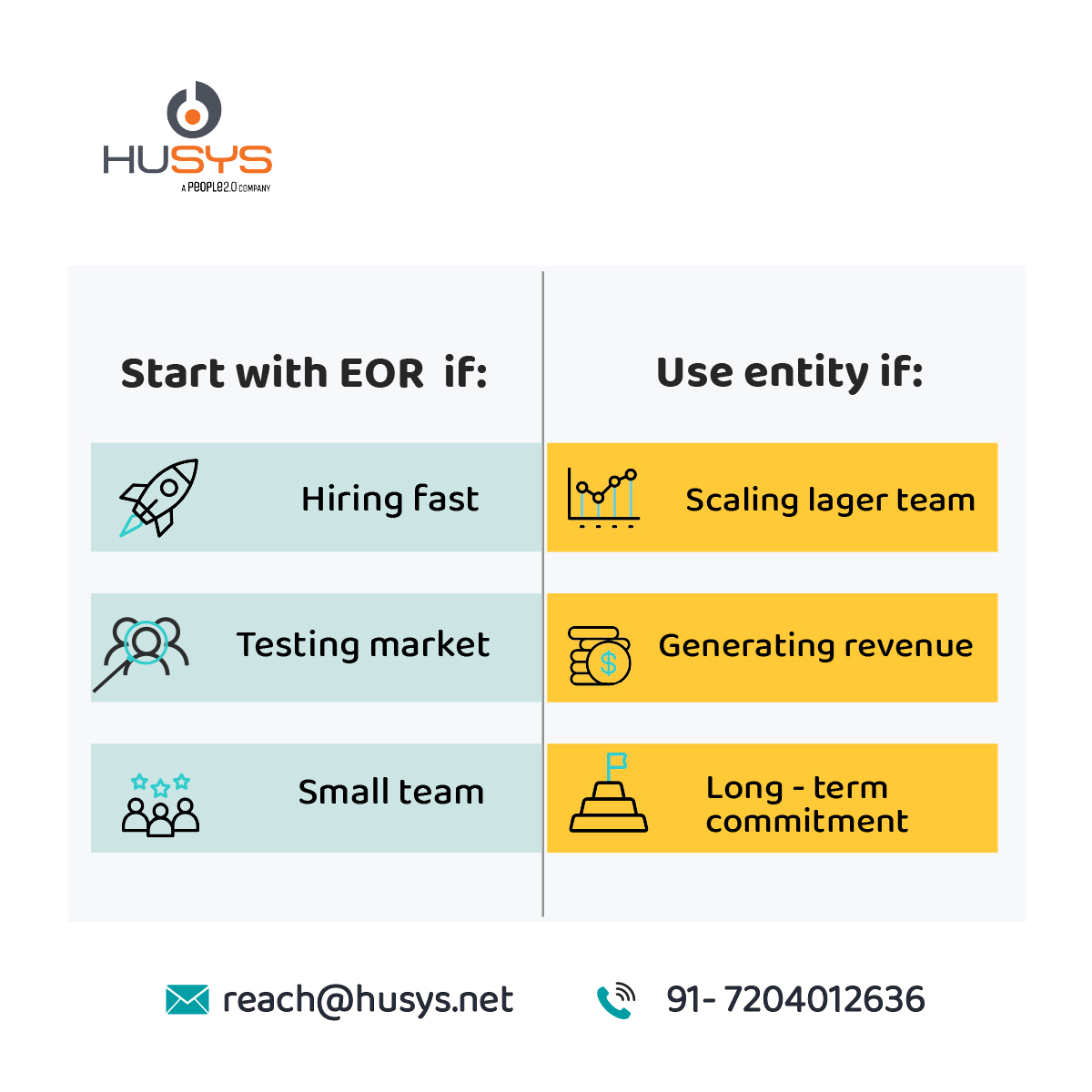
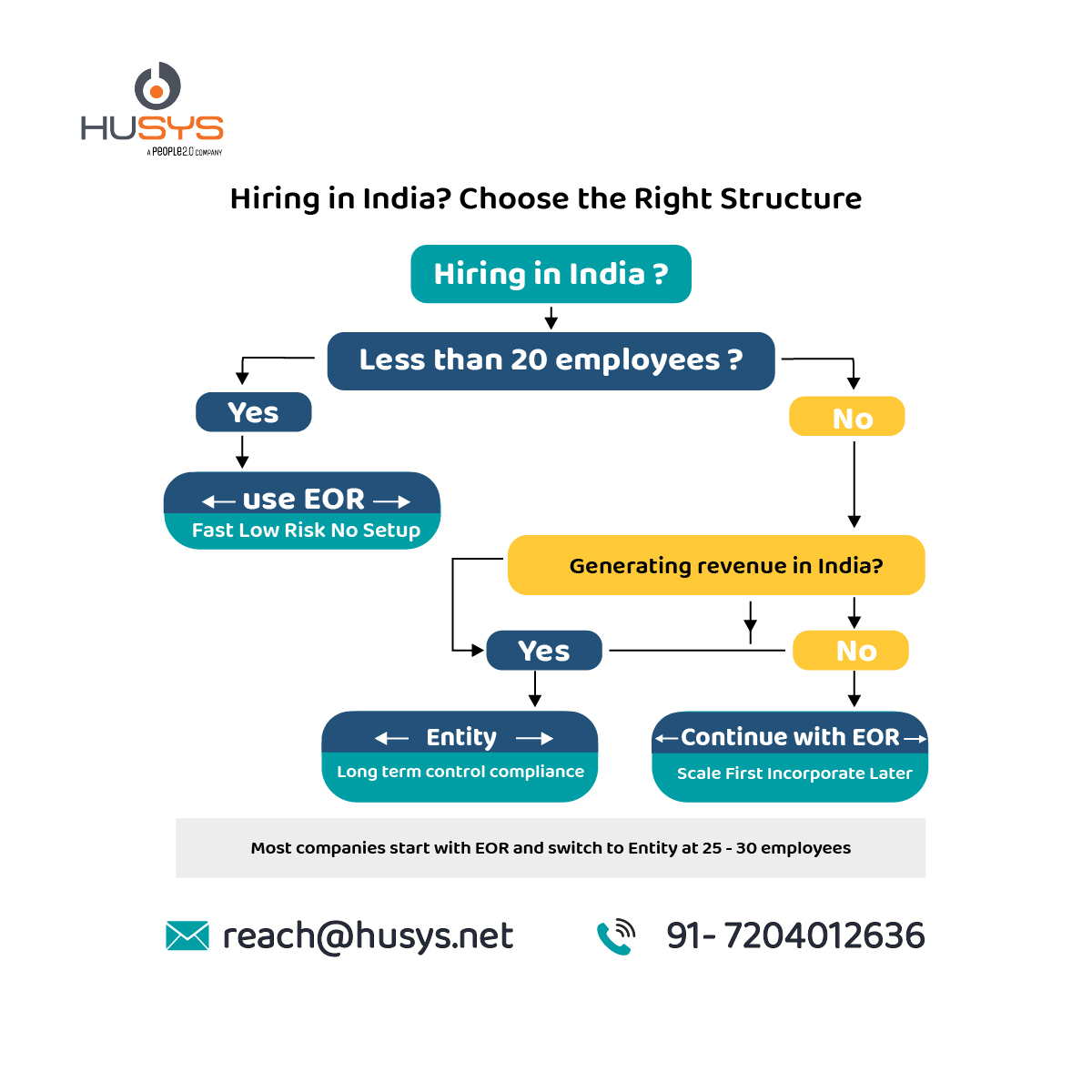
Before diving deeper, here is the fastest way to think about it.Use this as your starting point. Most US companies hiring in India follow this pattern before adjusting based on their specific revenue and compliance situation.
Now let’s simplify the operational contrast.
Aspect | EOR | Entity |
Time to first hire | Days | Months |
Incorporation | Not required | Required before hiring |
Legal employer | EOR’s Indian entity | Your Indian subsidiary |
Compliance responsibility | Managed by EOR | Fully owned by your company |
Permanent Establishment risk | Structurally managed | You monitor and mitigate |
Multi-state hiring | Single agreement across states | Separate state registrations are required |
Exit process | Wind down in weeks | 12 to 24 month deregistration |
Upfront investment | Low | High |
Termination Liability | With EOR | Your Indian subsidiary |
Ongoing overhead | Predictable service fee | Accounting, audit, filings, payroll teams |
- Most rows in that table are self-explanatory.
- PE risk and termination liability are not.
- Both are areas where US founders consistently underestimate their exposure, and both behave very differently depending on whether you are using an EOR or running your own entity.
Key Takeaway – EOR shifts employer liability outward. An entity internalizes it.
Quick snapshot of the operational differences between EOR and entity hiring models.
Permanent Establishment (PE) Risk
What it means: If your India team negotiates contracts, signs deals, or generates revenue, Indian tax authorities can treat you as having a taxable presence, even without incorporating locally.
Why it matters:
- PE can trigger corporate tax exposure in India on top of your US tax obligations, and it does not require you to have an entity.
- This usually surfaces during audits, diligence, or funding rounds, not immediately. Indian tax authorities can assert PE based on the nature of activities your India team performs, not just on whether you have incorporated locally.
How Husys handles it:
- Every client engagement is monitored at the invoice level.
- We track the nature of each deliverable to ensure activities do not cross into taxable India operations.
Termination Liability
What it means:
India does not have at-will employment. Employees carry procedural rights around notice periods, final settlements, and, in certain cases, retrenchment compensation.
Why it matters:
A misstep in the process can lead to formal labour claims, back wages, penalties, and reputational damage that affects future hiring in India.
How Husys handles it:
As the legal employer, Husys manages the termination process end-to-end, from issuing the correct notice to clearing the final settlement.
The procedural risk stays with Husys and off your books.
Confused, Which Structure Is Right for You? Find out which structure fits your headcount, your timeline, and your compliance appetite before spending a dollar on entity setup or an EOR engagement. Book a Free Call |
When EOR Is Better Than an Entity in India
- Early stage hiring: You are building a team of 1 to 20 employees and want to avoid incorporation overhead.
- Market testing: You are validating product, engineering velocity, or support capability before committing long-term capital. In fact, 67% of companies pursuing global expansion in emerging markets now use EORs to bypass lengthy entity setup and avoid regulatory missteps.
- Risk containment: You want labour law compliance, PF, ESI, professional tax, and payroll filings handled by a local employer. Surveys show Deloitte global workforce studies consistently show that international labour-law compliance is one of the most cited operational challenges for HR leaders managing distributed teams., and 65% of companies use EOR specifically to mitigate legal risks.
- Aon workforce risk research shows that regulatory compliance and employment liability remain among the most significant risks for companies expanding their workforce internationally.
- Urgent hiring needs: You need to onboard in days, not wait months for incorporation and banking. PwC Saratoga data shows that requisition to day-one can stretch close to 100 days when you factor in post-offer administration, entity readiness, and compliance requirements. For companies without an established local entity, that window only widens. An EOR compresses that timeline to days, not months, because the employment infrastructure is already in place.
- Exit flexibility: You want the ability to wind down quickly without a 12 to 24-month deregistration process.
When an Entity Is Better Than an EOR in India
- Headcount scaling:
- You are planning to grow beyond 30 to 40 employees and want structural cost efficiency. At scale, EOR fees add up fast.
- At $99 per employee per month, a team of 30 costs $2,970 per month or $35,640 annually in service fees alone.
- A wholly owned entity typically costs 30% less to operate at this headcount, making the setup investment worthwhile.
- This is the inflection point where we advise clients to evaluate the long-term economics.
- Local revenue generation:
- You are billing Indian customers directly and need a registered company for contracts and tax positioning.
- EORs employ people; they do not establish a commercial legal presence. If your India operations involve invoicing local customers, negotiating enterprise contracts, or managing GST positioning, you need a registered entity.
- It gives you the legal standing to transact, claim input tax credits, and handle the full complexity of commercial operations.
- A PEO can still manage employee payroll alongside your entity.
- Permanent India presence:
- You are building a long-term engineering, sales, or operations team in India.
- A registered entity makes you eligible for government schemes that an EOR cannot unlock: PLI incentives, GST refunds, state subsidies, and sector-specific benefits.
- The semiconductor industry is actively favoured by the Indian government, and global companies are establishing local entities to capture first-mover advantage.
- In defence manufacturing, Adani has partnered with Leonardo, Elbit, and Embraer through registered Indian entities specifically to qualify for government-backed development programmes.
- Direct IP ownership structure:
- You want employment contracts and intellectual property fully embedded within your corporate group.
- With an EOR, IP ownership can become ambiguous when the legal employer is a third party.
- In industries like cybersecurity and pharmaceuticals, patents and proprietary developments need to be unambiguously owned by your corporate group, not subject to consent clauses with an intermediary.
- An owned entity lets you embed IP assignment directly into your employment framework from day one.
- Internal compliance readiness:
- You are prepared to manage ROC filings, GST returns, audits, payroll compliance, and multi-state registrations.
- An entity comes with the full weight of Indian compliance: state-by-state GST returns, ROC filings, corporate tax, trade licences, and monthly, quarterly, and annual audits.
- For a team of 30, expect to need at least five compliance specialists, and most companies retain an external auditing firm to manage the risk.
- For employee payroll, a PEO can handle that function while your team focuses on entity-level obligations. [Learn more about our PEO services here.]
Entity Setup vs EOR Cost in India: How Much Are You Actually Signing Up to Spend?
The upfront registration fees for setting up an Indian Private Limited Company can look deceptively small. Government filing fees and basic incorporation costs can range from $500 to $2,000. That number is the smallest part of what you are actually committing to.
The real cost of running an Indian entity is the recurring overhead: CA retainers, ROC filings, audit fees, multi-state professional tax filings, and payroll compliance that continues every month regardless of whether your India team is three people or thirty.
Here is the full cost picture across both paths.
Entity Setup: One-Time Costs
Cost Item | Estimated Amount |
Company incorporation and professional fees | $1,000 to $3,000 |
Apostille and notarization for US-based directors | $300 to $600 |
PAN, TAN, and GST registration | $100 to $200 |
PF and ESI registration | $100 to $300 |
Legal review of MOA and AOA | $500 to $1,500 |
Total one-time cost | $2,000 to $5,600 |
And this is before you run a single payroll.
Entity Setup: Annual Recurring Costs
Cost Item | Estimated Amount |
CA retainer for payroll and compliance | $2,400 to $6,000 per year |
ROC annual filing and statutory audit | $800 to $2,000 per year |
Corporate tax return filing | $500 to $1,500 per year |
Labour law compliance and state filings | $500 to $1,200 per year |
Total annual overhead | $4,200 to $10,700 per year |
Key takeaway – For small teams, EOR is usually cheaper in year one. At scale, entity economics improve.
There is also a layer of cost that most entity setup India vs EOR comparisons never talk about. When you own an Indian subsidiary, two additional tax obligations kick in:
- Corporate tax: Your Indian subsidiary must price its services at arm’s length rates under Indian transfer pricing rules. That profit is then taxed at an effective rate of around 25%.
- Dividend withholding tax: When you move profits from your Indian subsidiary back to your US parent company, that repatriation attracts an additional withholding tax.
Also Read: Minimum Wages in India (2026): A Guide for US Companies hiring in India
Under an EOR, neither applies.
You are not running an Indian company, so there is no Indian profit and no Indian tax obligation.
- When it comes to the cost of EOR in India, Husys charges $99 per employee per month, and that covers everything from PF and ESI to TDS and Professional Tax.
- No setup fee.
- No onboarding charges.
- No hidden costs at the end of the month.
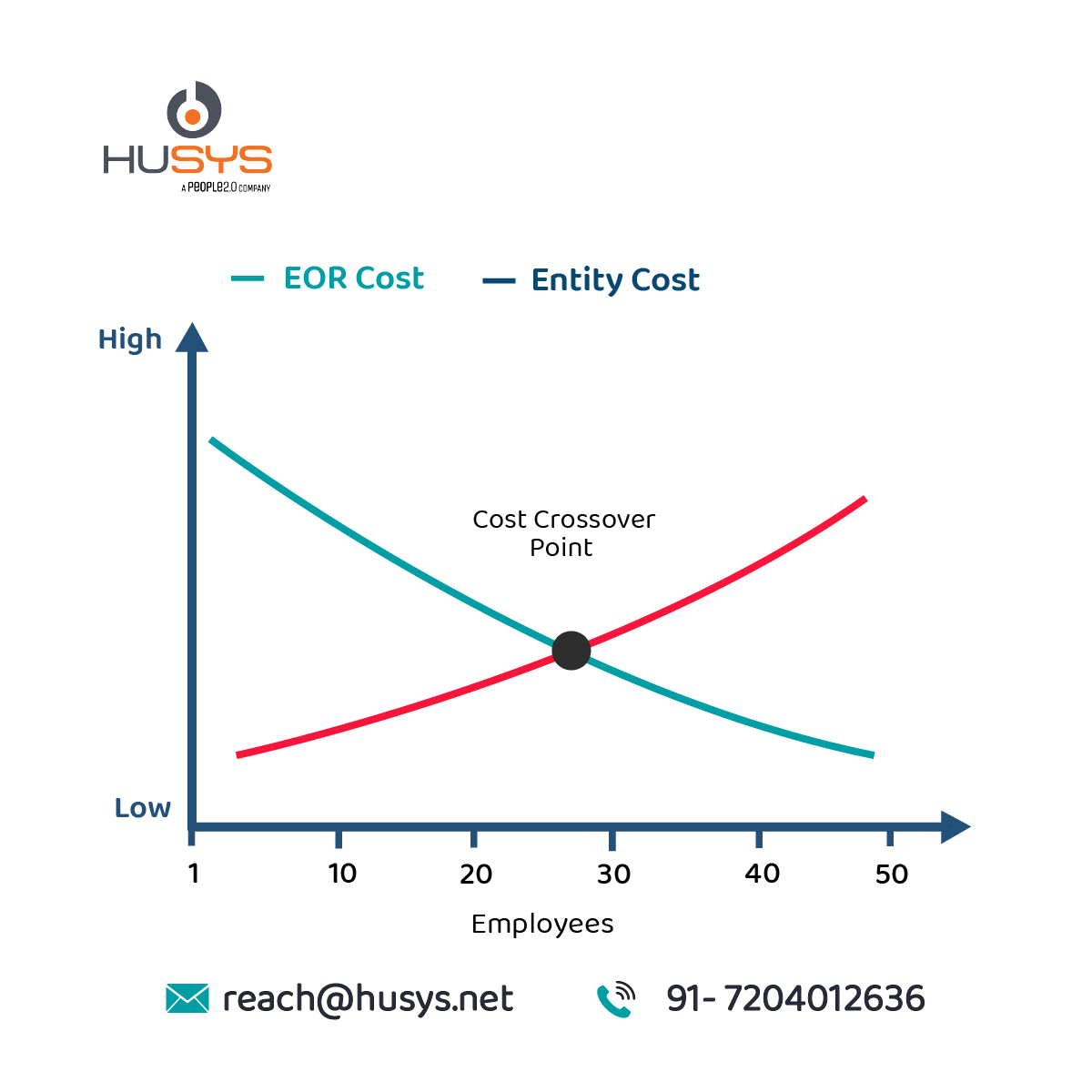
Cost comparison between EOR and entity setup in India, with the break-even point typically around 25–30 employees.
Now, let’s compare hiring employees in India via EOR vs entity in a real-world scenario.
Say you want to hire two back-end engineers in Bangalore and one AI expert in Hyderabad.
You need them onboarded fast because your product roadmap has a release locked for the next quarter, and engineering bandwidth is already stretched.
- If you go the entity route, you are looking at six to twelve months before you can legally run payroll.
- During that window, your hires are often forced to work as contractors, which creates significant contractor vs employee classification risk under Indian labour law.
- On top of that, you are paying a CA retainer, covering ROC filings, and managing Professional Tax separately in Karnataka and Telangana because your employees sit in two different states.
With an EOR model, onboarding can typically be completed within one business day once documentation is submitted.
| | Entity Setup | EOR with Husys |
Time before first payroll | 10-16 weeks | 8 working hours |
Year one total cost | $6,200 to $16,300* | $3,564 |
State registrations needed | Karnataka and Telangana separately | Covered under one engagement |
Compliance liability | On your Indian entity | On Husys |
*This is an estimated cost. Actual numbers may vary based on the role and experience.
Bottom line on cost:
For a team of three employees in their first year, EOR with Husys costs approximately $3,564. The equivalent entity path costs an estimated $6,200 to $16,300 after incorporation, registrations, CA retainer, and state filings.
Calculate Your India Hiring Costs Get a clear breakdown of your projected costs, compliance exposure, and break-even point before you choose between an entity and EOR Speak to an India Expansion Advisor |
India Subsidiary vs. EOR: When to Use Which?
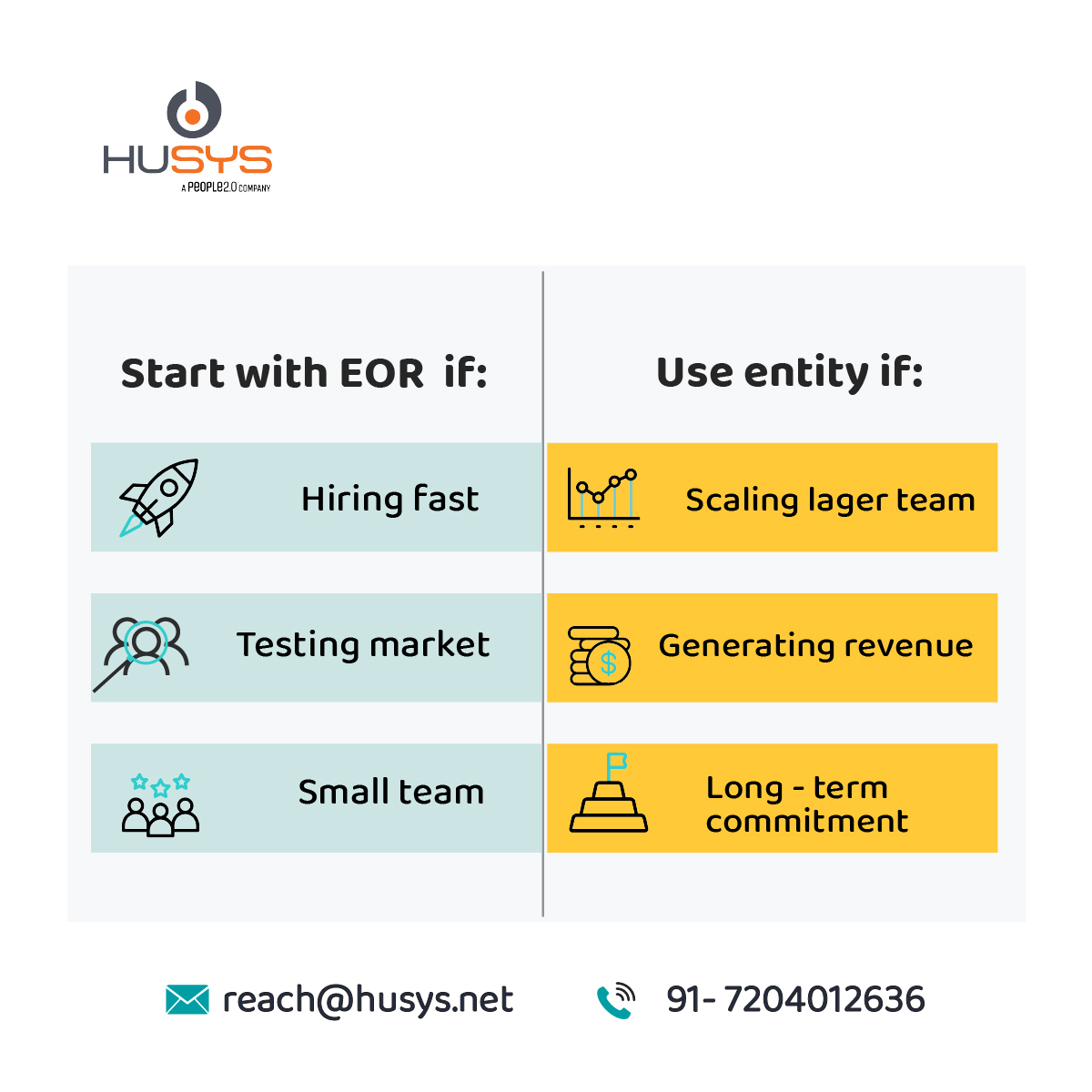
Decision framework for choosing between an Employer of Record (EOR) and setting up your own entity when hiring in India.
When weighing EOR vs subsidiary in India, there is no universal answer. The right structure depends on stage, headcount, and intent.
Here is a practical way to think about it.
Use an EOR when:
- You are hiring your first 1–10 employees in India
- Speed to onboarding matters
- India is still being validated as a long-term hiring market
- You want to avoid upfront compliance and governance overhead
- You are not yet generating direct revenue through an Indian entity
An EOR works well as an entry strategy. It lets you hire immediately while deferring infrastructure decisions.
Set Up an Indian Subsidiary when:
- India is a committed, long-term operating geography
- Headcount is scaling beyond early-stage hiring
- You plan to invoice Indian customers locally
- Transfer pricing and tax structuring need to sit within your corporate model
- You are prepared to run payroll, audits, and governance in-house
An entity makes sense when India is no longer an experiment. It is part of your core operating footprint.
Read More: How to Hire Employees in India: A US Company’s Decision Guide
The Practical Path Most Founders Take
Many US companies start with an EOR, build a team, validate delivery and retention, and then incorporate once scale justifies fixed infrastructure.
Can You Switch From EOR to Your Own Entity Later?
Yes, and it is more common than you might think.
Many US companies start with an EOR to hire their first few people in India quickly and then transition to their own entity once they have validated the market and grown their India team.
The transition itself involves a few moving parts.
What the switch looks like in practice:
- You incorporate your Indian Private Limited Company and complete all statutory registrations
- Your employees are issued new employment contracts under the new entity
- PF, ESI, and TDS accounts are transferred or reregistered under the new entity
- The EOR engagement is closed out with proper final settlements and compliance clearance
The most important thing to get right is the employee transition.
In India, a change of employer on paper is treated as a new employment relationship.
Notice periods, gratuity accrual and prior service continuity need to be handled carefully to avoid a dispute down the line.
When does switching make sense?
- Your India headcount is crossing 25 to 30 employees, and the per-head EOR cost is adding up
- India is becoming a core revenue market, and you need a local legal entity to sign contracts or raise invoices
- You are building a long-term India office with its own identity and leadership
What slows the switch down:
- An incomplete compliance history under the EOR that needs to be resolved before a clean transfer
- Employees who are mid-tenure with gratuity accruals that need to be carried forward correctly
- State-level registrations that take longer than expected
Husys has supported this transition for clients moving from EOR to their own entity. Because Husys maintains clean compliance records across the full engagement, the handover does not come with a backlog of unresolved filings or statutory gaps.
Start With EOR and Scale at Your Own Pace Most companies make the switch between 25 and 30 employees. Share your headcount and growth plan, and we’ll help you decide when to switch. Plan Your India Hiring Strategy |
Questions to Ask Before Choosing Between EOR and Your Own Entity
If you are asking yourself, should I set up an entity or use an EOR in India, the honest answer is that it depends.
There is no single right structure, and the decision looks different depending on your timeline, headcount, and how seriously you are committing to the market.
Run through these seven questions before you commit to either structure. The pattern of your answers will almost always point clearly in one direction.
- How fast do you need to hire?
- An EOR gets your first employee onboarded in days. Entity setup takes 10-16 weeks before you can run a single payroll.
- If speed matters, EOR wins.
- How long are you committing to India?
- Testing the market or running a lean remote team for the next one to two years? Start with an EOR.
- Building a permanent India office with a leadership team and local operations? An entity starts to make sense.
- What is your headcount plan?
- Most companies use an EOR for their first 20 to 25 employees and transition to their own entity once the fixed costs of running one are justified.
- Below that threshold, EOR is almost always more cost-effective.
- Will your India team generate direct revenue in India?
- If your employees are supporting your US business remotely, an EOR works well.
- If they are signing contracts, raising invoices, or selling directly to Indian clients, you will likely need your own entity at some point.
- What happens if India does not work out?
- With an EOR, you can wind down in weeks with minimal compliance exposure.
- Closing an Indian entity takes 12 to 24 months and requires a clean compliance history before authorities will approve deregistration.
- If any filings are outstanding or disputed, that timeline extends further.
- Do you need physical operations in India?
- Remote engineering or product teams work well under an EOR.
- If you are setting up a physical office, signing local vendor contracts, or need an Indian bank account for operational reasons, those requirements push you toward your own entity.
- Do you have someone internally who can own India compliance?
- PF, ESI, TDS, Professional Tax, and ROC filings do not manage themselves.
- If no one on your team has the bandwidth or the expertise to own this, an EOR removes that problem entirely.
If your answers point in different directions, that is normal.
Most companies start with an EOR because it is faster, lower risk, and cheaper to unwind, then reassess once they have proven the market and know what their India team actually needs to look like long term.
Why Trust Husys As Your India EOR Partner?
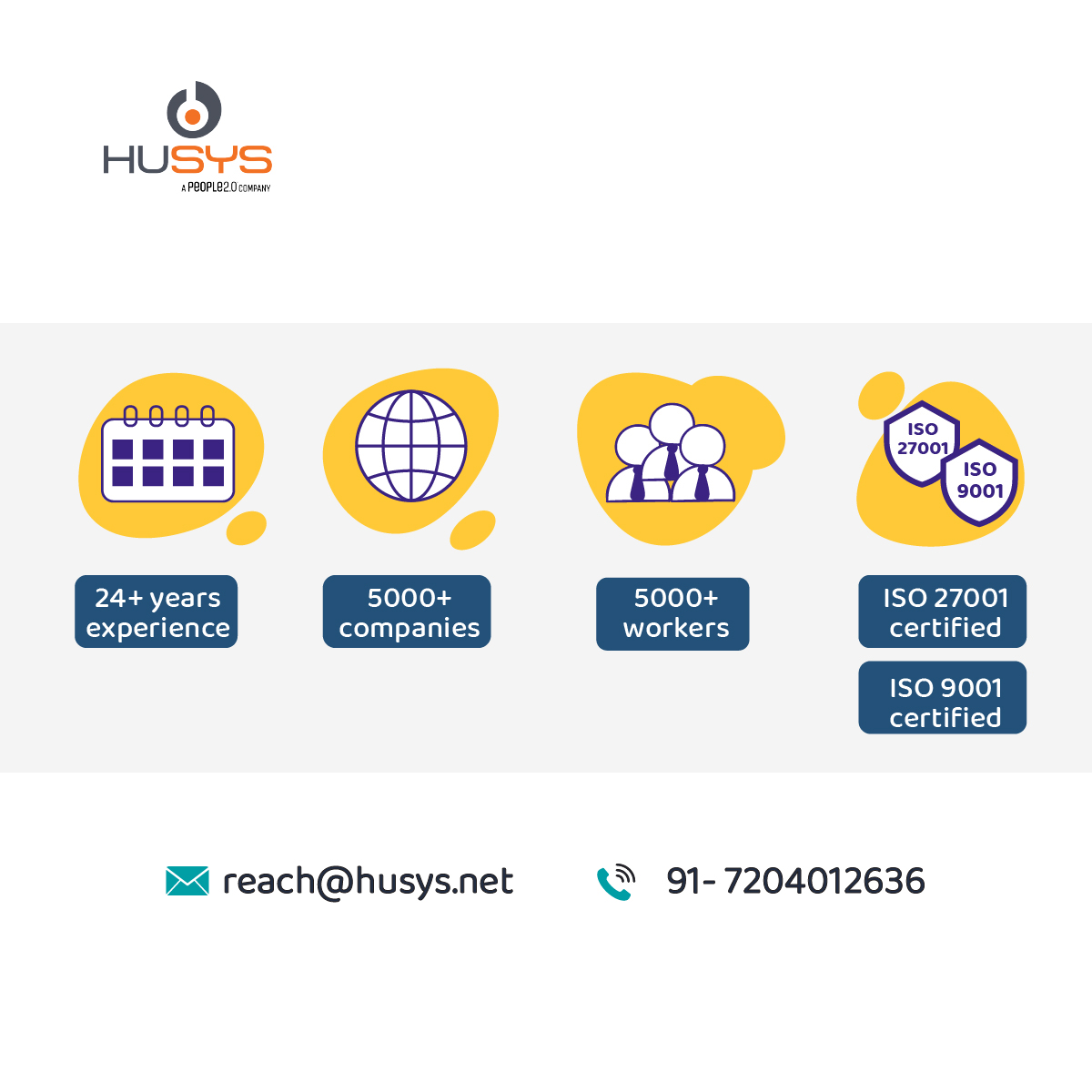
Husys has been operating since 2001.
Over two decades, our team has handled payroll audits, labour inspections, statutory registrations, cross-border hiring, exits, and compliance management across states for over 5,000 clients and 50,000+ employees.
Husys maintains structured internal compliance controls designed to prevent statutory gaps and inspection exposure.
That consistency explains the average client tenure of more than 4 years.
And when clients eventually transition, it is usually because they have outgrown the EOR structure. Many clients eventually transition to their own entity once India becomes a core operating geography.
What happens when you hire through Husys
- Onboarding is typically completed within one business day once documentation is received.
- All 28 states and 6 union territories are covered under one engagement.
- PF, ESI, TDS, Professional Tax, and other statutory requirements are handled by an in-house compliance and legal team.
- Permanent Establishment exposure is reviewed at the invoice level for every client engagement.
- ISO 9001 and ISO 27001 certifications cover process discipline and data security.
The operating track record
- 5,000+ global companies served.
- 50,000+ workers managed over the company’s history.
- 3000+ active clients today across IT, SaaS, manufacturing, retail, and cybersecurity.
- Average client relationship exceeds 4 years.
- Clients span more than 100+ countries.
Pricing
- $99 per employee per month.
- No setup fees.
- No hidden charges.
Explore What You Get With Husys Book a free 15-min call to understand how Husys ensures compliance for your US company in India. Speak With an Expert |
Conclusion
For most US founders hiring their first employee in India, the employer of record vs entity in India decision is simpler than it looks once you anchor it to three things: how fast you need to hire, how long you are committing to the market, and whether India will generate direct revenue for your business.
Use an EOR if you are hiring your first 25 employees, if India is still being validated, or if you cannot absorb 10 to 16 weeks of setup time before your first hire starts.
Set up your own entity once India is a committed operating geography, your headcount justifies the fixed overhead, and you have someone internally who can own the compliance.
If you are ready to hire in India and want a partner who has spent 23 years building the infrastructure so you do not have to, Husys is worth a conversation.
From onboarding your first hire within 8 working hours to managing compliance across every Indian state under one engagement, Husys handles the complexity that comes with India hiring so you can stay focused on building your product and your team.
Quick guide to deciding between using an EOR or setting up your own entity when hiring in India.
Frequently Asked Questions


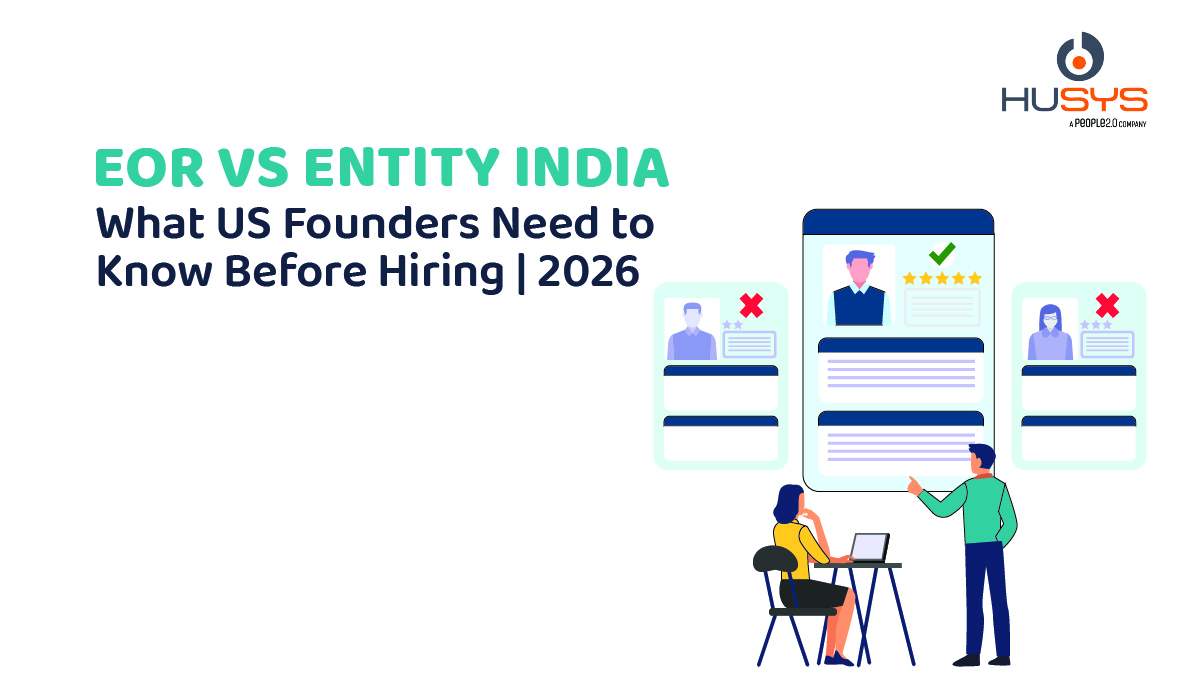
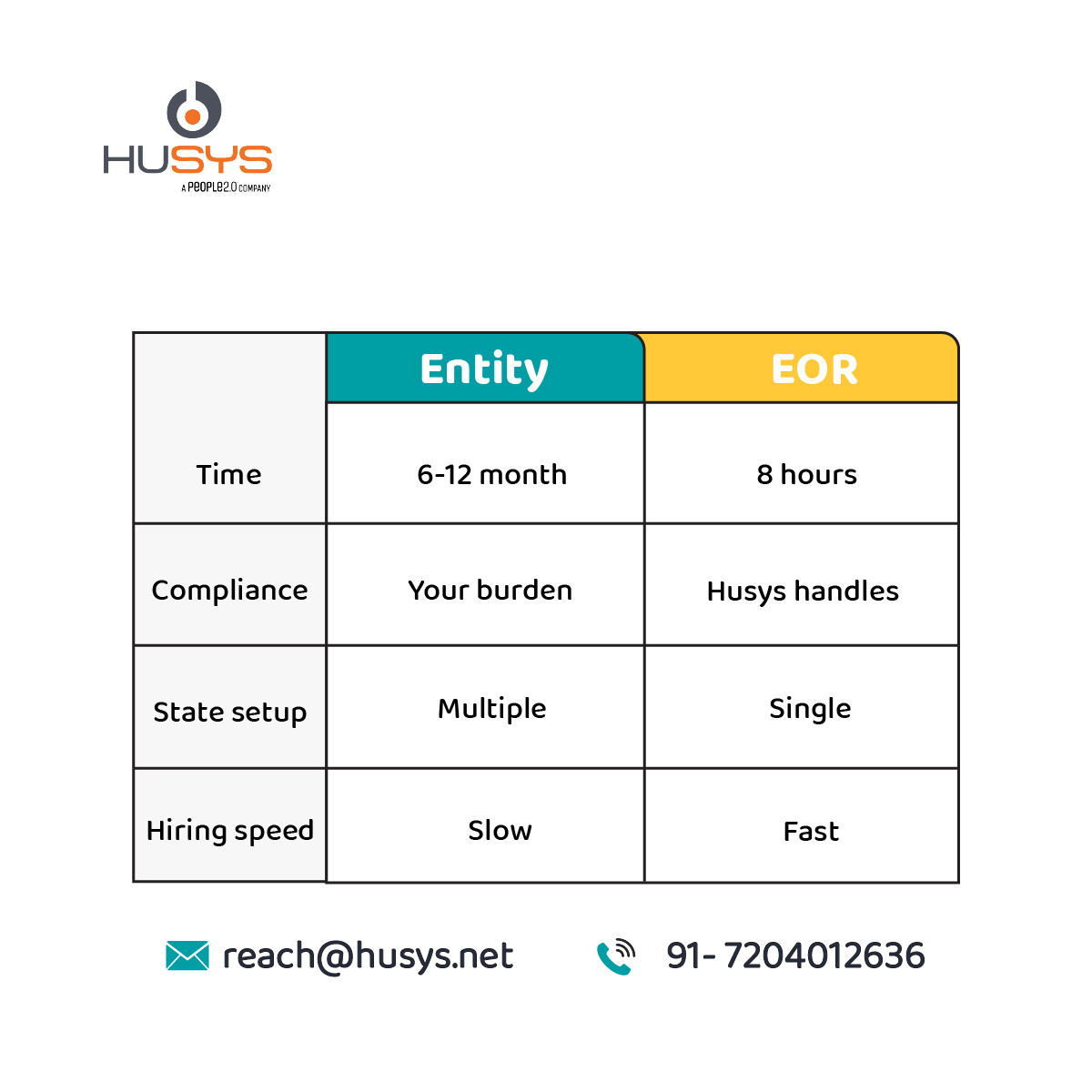
 Decision framework for choosing between an Employer of Record (EOR) and setting up your own entity when hiring in India.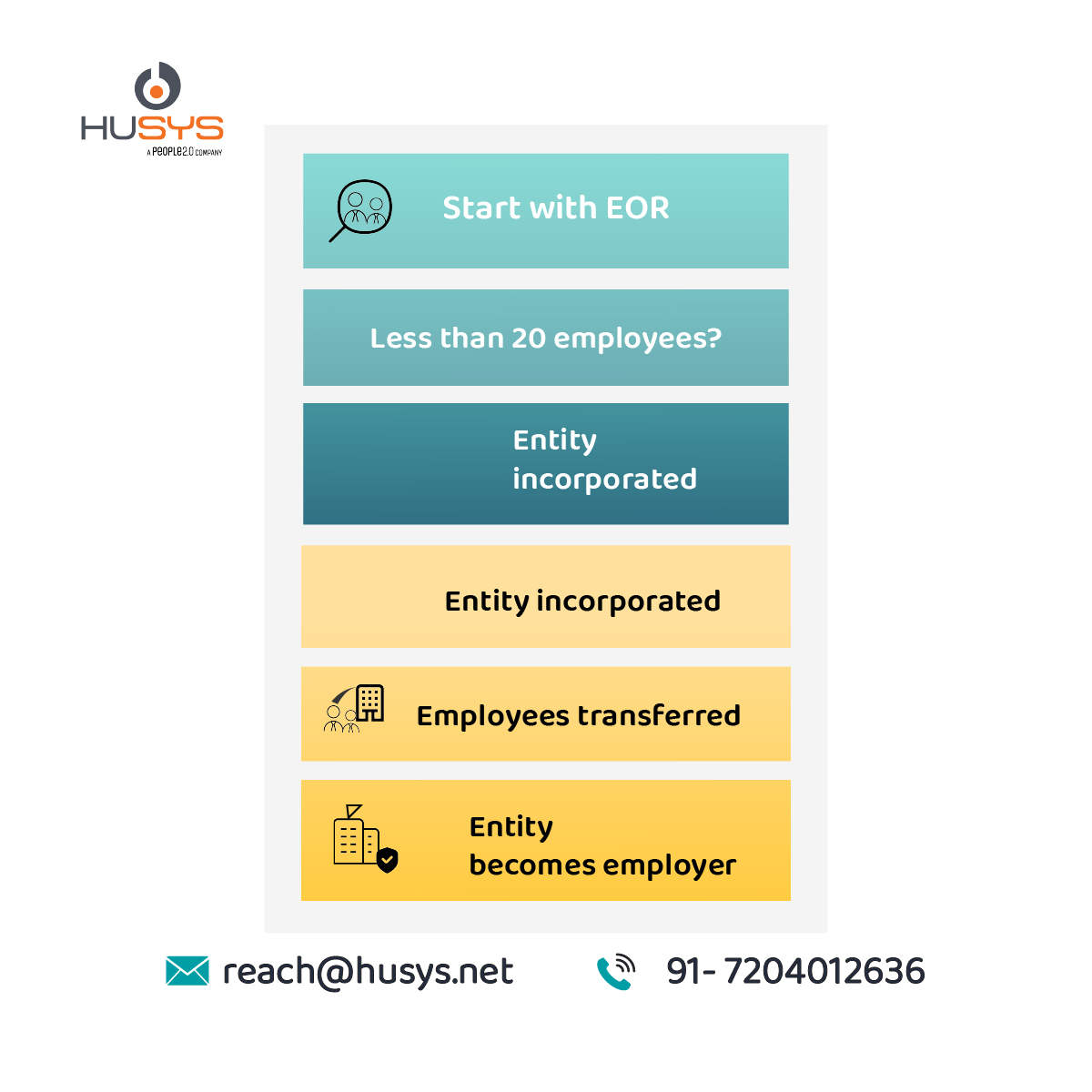
 Husys has been operating since 2001.