US companies expanding into India usually choose between three hiring models: contractors, an Employer of Record (EOR), or a wholly owned legal entity. This EOR vs Entity vs Contractor in India decision directly impacts cost, compliance risk, and operational complexity from day one.
US companies expanding into India usually choose between three hiring models. Many founders initially try to hire employees in India without setting up an entity, but quickly realize the compliance and tax implications involved.
Many companies start by looking at contractors. The cost of contractors in India appears low because there is no entity to maintain, and the setup is fast. However, if a contractor works only for your company, follows your internal processes, and operates on your schedule, Indian regulators can classify that relationship as employment.
Misclassification can lead to back payments of statutory benefits, tax liabilities, and financial penalties. Understanding the difference between a contractor and employee relationship is critical, especially when evaluating contractor vs employee classification in India.
An Employer of Record offers a compliant alternative without requiring your company to establish a local entity. The EOR legally employs the worker in India and manages payroll, benefits, and statutory compliance while the employee works for your team. This makes it possible to hire quickly and operate compliantly, although the per-employee cost can become significant as the team grows.
A wholly owned entity gives you full operational control in India, but many companies first evaluate EOR vs entity in India before committing to incorporation.
However, incorporation typically takes six to nine months and requires ongoing compliance, statutory filings, and local administrative support. For smaller teams, the fixed cost of maintaining an entity can outweigh the benefits.
This guide provides a complete EOR vs Entity vs Contractor in India comparison, breaking down expenses, setup timelines, and operational trade-offs.
Who is this guide for?
This guide is written for US-based founders, CFOs, and expansion leads who are past the “should we hire in India” question and now working through the “how.”
It is specifically built for decision-makers who are:
- Hiring their first few employees in India, and need to pick a structure before the first offer goes out
- Scaling an existing India team and questioning whether the model they started with still makes sense
- Responsible for signing off on the legal or financial structure of an international expansion
- Comparing EOR vs entity vs contractors, and need a cost and compliance breakdown that holds up in a CFO or board conversation
- Under timeline pressure and need to understand which model gets someone hired in weeks, not months
Before diving into the details, this decision framework shows when US companies typically choose contractors, EOR, or a local entity when hiring in India.

Not Sure Which Model Fits Your Stage?
Founders at different growth stages need different structures. Speak with our India compliance team before committing to a structure.
Hiring Contractors vs Employees in India: What US Founders Get Wrong
Most US founders start their India hiring the same way: find someone on LinkedIn or a referral, draw up a contractor agreement, and wire payment monthly. It feels straightforward. It is not, and the reasons go well beyond a generic “compliance risk” warning.
Here are the specific mistakes that create real liability.
Mistake 1: Assuming the contractor label holds up the way it does in the US
When US finance teams model contractor vs employee costs in India, they usually price in the invoice and nothing else. India uses a similar control-and-exclusivity logic to the US for classification, but enforcement is consistently more pro-worker, and the financial exposure when it goes wrong is retroactive.
Indian regulators and courts often adopt a pro-employee stance, meaning that even well-drafted contracts will not protect employers if the working relationship looks more like traditional employment.
If your Indian contractor works full-time for your company, takes direction from your managers, follows your processes, and has no other clients, Indian labor authorities are likely to view that person as an employee regardless of what the contract says.
The consequences are not abstract, and they are not capped. A misclassified worker triggers retrospective payment of all employment benefits from the start of the engagement, including paid leave, bonuses, and social security contributions, plus interest and penalties. The contractor misclassification cost in India accrues every month the arrangement continues.
Mistake 2: Not knowing that some contractor work is legally prohibited in India
This one surprises most US founders entirely. Under India’s Contract Labour (Regulation and Abolition) Act, contract labor should not be employed in activities that are perennial in nature and are ordinarily done through regular workmen. In plain terms: if the work is ongoing, core to your business, and the kind of work a permanent employee would typically do, you legally cannot staff it with contractors in India.
For a US software company hiring an engineer in Bangalore to build and maintain its core product, that work almost certainly qualifies as perennial. Engaging that person as a contractor is not just a gray area; it is a direct violation of the Act.
Running Indian Contractors on a Monthly Invoice?
Indian regulators look at the substance of the working relationship, not the contract label. Review your current setup under Indian law and see what a compliant employment structure would cost.
Mistake 3: Triggering a Permanent Establishment without knowing it
This is the mistake with the largest financial exposure, and the one US founders are least aware of.
Under Indian tax law, if your company is deemed to have a Permanent Establishment in India, it becomes liable to pay corporate taxes on income attributed to operations within the country. Hiring an independent contractor in India can unintentionally create a PE if the nature of the working relationship resembles full-time employment or shows significant control by the hiring company.
What makes this dangerous is the retroactive nature of the exposure. A Permanent Establishment is taxed at 42% of total attributed income, and the tax authorities calculate what is owed going back to the point the PE was established, including interest and fines. Some companies receive a bill that is three times what they earned in India over the entire period.
Mistake 4: Confusing "no entity" with "no liability."
A common assumption among US founders is that because they have no legal entity in India, they have no legal exposure in India. That assumption is wrong.
An employee or contractor working remotely in India may create a “business connection” under the Indian Income Tax Act. If Indian tax authorities establish that this business connection exists, the foreign employer will be deemed to have a Permanent Establishment in India, and revenue attributable to work carried out in India could be taxable.
No entity does not mean no presence. It means unstructured presence, which is often harder to defend.
What this means for your hiring decision
The contractor model is not inherently wrong for India. It works for genuinely project-based, time-limited, non-core work with someone who has multiple clients. What it does not work for is the way most US companies actually use it: a full-time engineer or operations hire on a monthly invoice to avoid the complexity of compliant employment.
Besides, the cost of contractors in India is not just the monthly invoice. It is the invoice plus the accruing liability of misclassification, backdated PF contributions, and PE exposure.
EOR vs Entity vs Contractor in india: What Each Model Actually Means
Now that you understand where contractor risk actually comes from, the question becomes: what are your compliant alternatives, and how do they actually work in practice?
Here is what each model means, not in theory but in operational terms, for a US company hiring in India.
The Contractor Model
A contractor in India is an individual or firm engaged for a defined scope of work under a service agreement. You pay an invoice, and they deliver work. No statutory benefits, no payroll, no long-term employment obligations on paper.
The gap between paper and practice is what the previous section covered. The contractor model works when the engagement is genuinely project-based, time-limited, and the individual has multiple clients. It breaks down when the work is ongoing, core to your product or operations, and the person functions like a full-time employee in everything except title.
The Wholly Owned Entity (Subsidiary) Model
A wholly owned subsidiary is a separate legal company incorporated in India with your US company as the 100% shareholder. It is a full Indian legal entity, subject to Indian corporate law, labor law, tax law, and regulatory reporting.
The entity structure requires a minimum of two directors, with at least one being a resident of India, and involves navigating multiple regulatory frameworks, including the Companies Act, 2013, and FEMA regulations.
The incorporation timeline runs approximately 15 to 20 working days for the incorporation certificate and PAN/TAN, 5 working days to open a bank account, and approximately 25 to 30 days for RBI compliance, and that is in a clean, well-documented scenario.
Delays in document processing, name availability, or state-specific registrations can push total setup time to 4 to 6 months before the entity is fully operational for payroll.
Once incorporated, the entity is responsible for its own payroll infrastructure, statutory registrations, annual filings, transfer pricing documentation (for transactions with the US parent), and a local compliance function. This is not a one-time setup cost. It is a recurring operational overhead.
The entity model gives you the most control, the cleanest IP ownership structure, and the ability for your India team to generate local revenue and enter contracts in India. It makes financial sense at scale. It does not make sense for a team of three.
Read More: How to Set Up a Private Limited Company in India: Guide for US Founders
The Employer of Record (EOR) Model
An Employer of Record is a third-party company that holds the legal employment relationship in India on your behalf. The EOR is the entity that signs the employment contract, runs payroll, files taxes, and manages statutory contributions like Provident Fund (PF) and Employee State Insurance (ESI). You retain full operational control: you manage the work, set the direction, and run the day-to-day relationship with your hire.
An EOR lets businesses hire full-time employees in India without a legal entity, enabling companies to build global teams and enter new markets without facing international legal issues.
In practice, this means your hire is a compliant employee from day one. The actual hiring process through an EOR takes 2 to 14 days, compared to 3 to 6 months for setting up a legal entity.
What the EOR handles on your behalf includes:
- Employment contracts drafted to Indian labor law standards
- Monthly payroll with TDS (India’s equivalent of federal income tax withholding) calculated and remitted
- Statutory contributions: EPF at 12% of basic salary as employer contribution (basic salary is typically 50% of gross CTC), ESI at 3.25% employer contribution for employees earning below approximately $250/month gross
- Gratuity accrual for employees who complete 5 years of service
- State-specific compliance, since India has 28 states with different Shops and Establishments Acts, professional tax rates, and local holiday schedules
- Termination process management, which in India requires contractual notice periods and statutory settlements, not at-will termination
What you retain: who you hire, what they work on, how they work, and when the relationship ends.
For a founder running an 11 to 50-person company, this structure works well operationally. At that stage, compliance infrastructure in a foreign market is not where founder time should go. We typically see US companies at this size use EOR to get their first 3 to 5 India hires onboarded quickly, then revisit the entity question once the team stabilizes.
For a VP of Finance at a 51 to 200-person software company, the math is different, but the conclusion is often the same. A full-stack developer costs roughly $120,000 per year in the US. The same profile in India runs approximately $20,000 per year on a fully compliant CTC basis. At $99 per employee per month in EOR fees, the total employer cost is still roughly 83% below the US equivalent.
The per-employee EOR fee typically ranges from $99 to $500 per employee per month, depending on the provider and services included, on top of the employee’s gross salary and statutory costs.
Know Exactly What Each Model Requires You to Manage
The compliance obligations across contractors, EOR, and the entity are not equal. Download this checklist to know what your team is responsible for under each structure.
US vs India Employment: What Finance Leaders Need to Know
For US founders expanding into India, the employment system works very differently. The comparison below highlights the key structural differences.
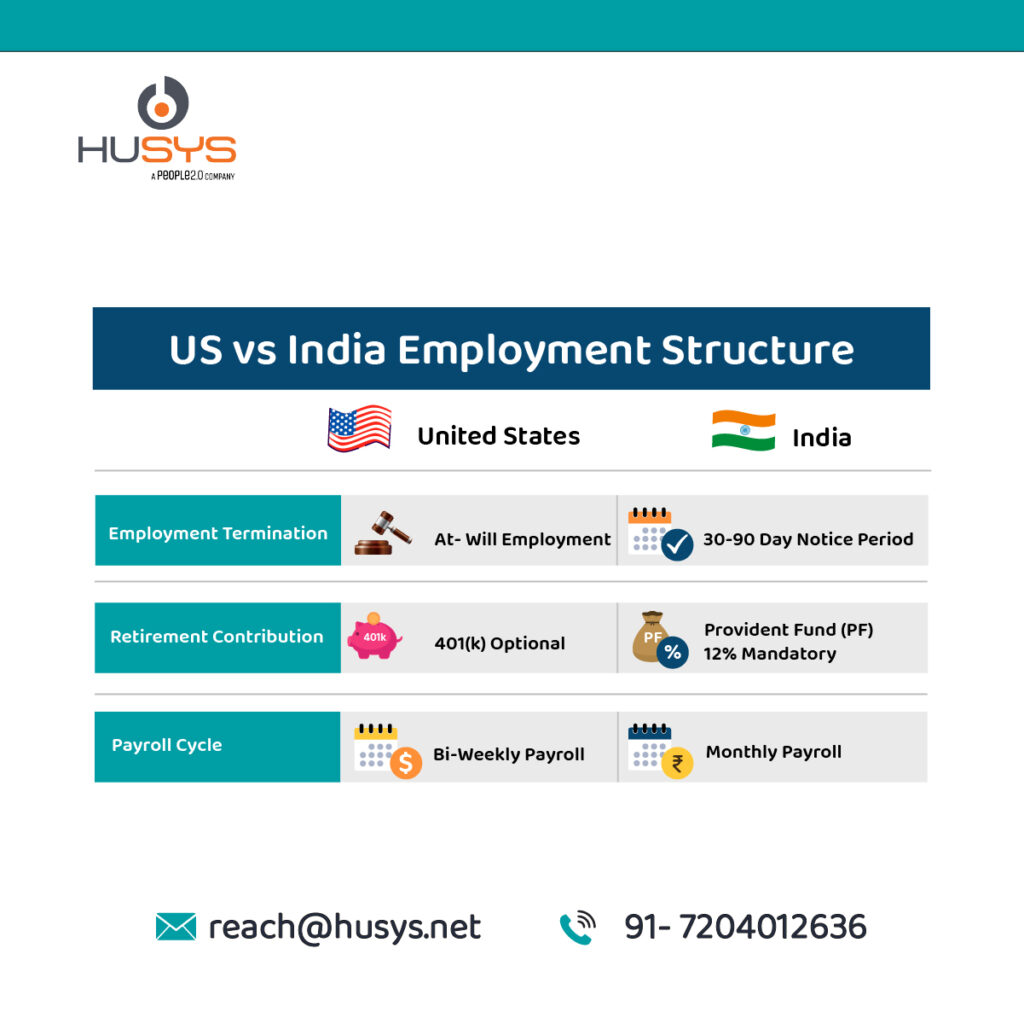
Key differences between the US and Indian employment systems, including termination rules, payroll cycles, and retirement contributions.
Every India-specific term in this guide maps to something US companies already understand. Here is the direct translation.
Aspect | US | India |
|---|---|---|
Employment type | At-will | Contractual with a notice period |
Payroll cycle | Bi-weekly | Monthly |
Benefits | Optional | Statutory (PF, ESI, Gratuity) |
Termination | Immediate | 30 to 90-day notice required |
Retirement contribution | 401(k), employer discretionary | Provident Fund, 12% employer mandatory |
Health coverage | Employer-sponsored, optional | ESI is mandatory below the salary threshold |
Contractor classification | IRS 20-factor test | Substance-based, pro-worker judicial standard |
Corporate tax trigger | Nexus-based | Permanent Establishment, triggered by control |
EOR vs Entity vs Contractors: At a Glance
Contractor | EOR | Wholly Owned Entity | |
Setup time | Days | 2-14 days | 4 to 6 months |
Legal employer | You (US entity) | EOR provider | Your India subsidiary |
Compliance responsibility | Yours (unmanaged) | EOR | Yours (fully managed in-house) |
Statutory benefits required | Yes, often missed | Handled by EOR | Handled in-house |
Misclassification risk | High | None | None |
Permanent Establishment risk | High | Low | Structured away |
IP ownership clarity | Weak | Moderate | Strong |
Local revenue generation | Not possible | Not possible | Possible |
Cost for 1 to 5 employees | Low (on paper) | Low | High |
Cost at 30+ employees | Risky | High | Lower per head |
Husys onboards within 8 working hours. Most EOR providers complete within 2 to 14 days.
What this means for US founders
If your India hire is ongoing, full-time, and core to your business, the contractor model is a liability you are accruing every month.
The EOR model exists precisely for this stage. Compliant employment, no entity required, operational in weeks. The per-employee cost is real, but so is the alternative.
The entity makes sense when your team size and business case justify the overhead. Most US founders get there eventually. Very few should start there.
Plan Your India Hiring Structure and Hire in India Compliantly
Get a practical view of timelines, compliance requirements, and costs across contractors, EOR, and entity hiring models.
Schedule a Free Hiring Consultation
EOR vs Entity vs Contractors in India: The 12-Month Cost Comparison
The previous sections established where each model carries legal risk. This section answers the question US finance leaders actually ask in budget conversations: what does each model cost, in real dollars, over the first 12 months?
Finance teams often start by analyzing the cost of hiring employees in India, comparing contractor payments, EOR fees, and entity setup costs.
This india hiring model cost comparison uses a single example throughout to keep the numbers honest: a US SaaS company hiring a software engineer in Bangalore at $24,000 per year (approximately INR 18 lakh, per Glassdoor data).
However, before running the eor vs entity vs contractors numbers, one term to understand is CTC. In India, salary is always quoted as CTC, Cost to Company. It is the total amount a company spends on an employee annually, including basic salary, allowances, EPF contributions, gratuity, and insurance.
Because CTC already reflects the full employer cost, the base salary expense remains the same whether you hire through an EOR or through your own Indian entity. The difference between models comes from compliance costs, setup costs, and administrative overhead.
With contractors, the situation looks cheaper at first. Companies typically pay only the agreed contract amount, without employer statutory contributions like EPF or gratuity. However, this model carries a misclassification risk under the Indian labour law. If a contractor relationship is later deemed employment, companies may face retroactive compliance costs, penalties, and tax liabilities.
That said, let’s compare the total cost of hiring in India over a 12-month period.
The Contractor Model: 12-Month Cost
Contractors in India typically bill above their equivalent employee CTC because they absorb their own taxes and receive no statutory benefits. For a comparable profile, expect a contractor rate of $22,000 to $24,000 annually.
Cost Item | Amount |
Contractor fees (12 months at $1,916/month) | $23,000 |
Service agreement drafting and legal review | $1,200 |
International payment processing and FX fees | $400 |
Year 1 Total (on paper) | $24,600 |
Misclassification liability if challenged | $5,000 to $8,000+ |
The $24,600 is what appears on your books. The $5,000 to $8,000 is what appears when the arrangement is challenged. If a court rules in favor of the contractor, the business becomes liable for retrospective payment of all employment benefits from the start of the engagement, including paid leave, bonuses, and social security contributions, plus interest charges and penalties for non-compliance with labor laws.
Indian courts routinely look beyond contract labels when deciding worker status. In Gain Financial Consultants Pvt. Ltd. v. Regional Provident Fund Commissioner, the Bombay High Court ruled that several professionals engaged as “consultants” were actually employees because they worked exclusively for the company, received fixed pay, and operated under company supervision.
The ruling made the company liable for retrospective Provident Fund contributions and compliance obligations. For global companies hiring full-time “contractors” in India, the same logic can apply.
The EOR Model: 12-Month Cost
Under the EOR model, the employee is on a fully compliant Indian employment contract from day one. You pay the employee’s CTC plus an EOR platform fee. Payroll, statutory filings, TDS remittance, and state-level compliance are handled by the EOR provider.
Husys, with 23 years of operating in the Indian EOR market and currently managing 3,000+ active employees across 28 states, prices its service at $99 per employee per month. Onboarding completes within 8 working hours.
Cost Item | Amount |
Employee CTC (12 months) | $20,000 |
EOR platform fee ($99 x 12) | $1,188 |
Year 1 Total | $21,188 |
Misclassification liability | None |
No setup fee. No statutory filings to manage internally. No compliance function to hire for.
The Entity Model: 12-Month Cost
The entity model gives you the most control over your India operation. It also carries the highest Year 1 cost, the longest setup timeline, and the most compliance surface area of the three models. Understanding what that actually means in dollar terms is what most cost comparisons skip.
Year 1 setup costs
Incorporating a wholly owned subsidiary in India involves registering with the Ministry of Corporate Affairs, obtaining a PAN and TAN, RBI reporting under FEMA, opening an Indian bank account, and setting up a registered office address. For a US company engaging legal counsel through this process, the total one-time setup cost typically runs $16,000 to $25,000, covering company registration, legal fees and documentation, registered office address, and bank account setup.
Recurring annual compliance obligations
Once the entity is live, it carries a set of mandatory annual obligations that run every year regardless of how many employees you have or whether your India operation is profitable yet.
Compliance Obligation | Annual Cost (USD) |
Payroll processing, monthly statutory filings, and CA firm retainer | $6,000 to $10,000 |
Statutory audit by a practicing Chartered Accountant | $1,500 to $2,500 |
Accounting and bookkeeping | $6,000 to $10,000 |
Annual ROC filings (financial statements + annual return) | $800 to $1,200 |
Registered office address | $600 to $1,200 |
Legal retainer for labour law | $4,000 to $8,000 |
Transfer pricing documentation (Form 3CEB) | $2,000 to $3,500 |
Total recurring compliance overhead | $20,900 to $36,400/year |
Transfer pricing documentation deserves a specific callout because it surprises most US founders. Any transaction between your US parent and your India subsidiary, including salary reimbursements, software licenses, or management fees, is treated as an international transaction under Indian tax law.
If the total value of these transactions exceeds INR 10 million (about $108,700) in a financial year, the company must maintain formal transfer pricing documentation under Indian rules. In addition, companies engaged in such related-party international transactions must obtain a Chartered Accountant report (Form 3CEB) and file it with their tax return each year.
For most US companies funding salaries or reimbursing operating costs to an India subsidiary, this threshold is crossed quickly.
And this recurring overhead is what you pay over and above the employee’s salary.
Read More: Cost of Hiring Employees in India for US Companies (2026 Guide)
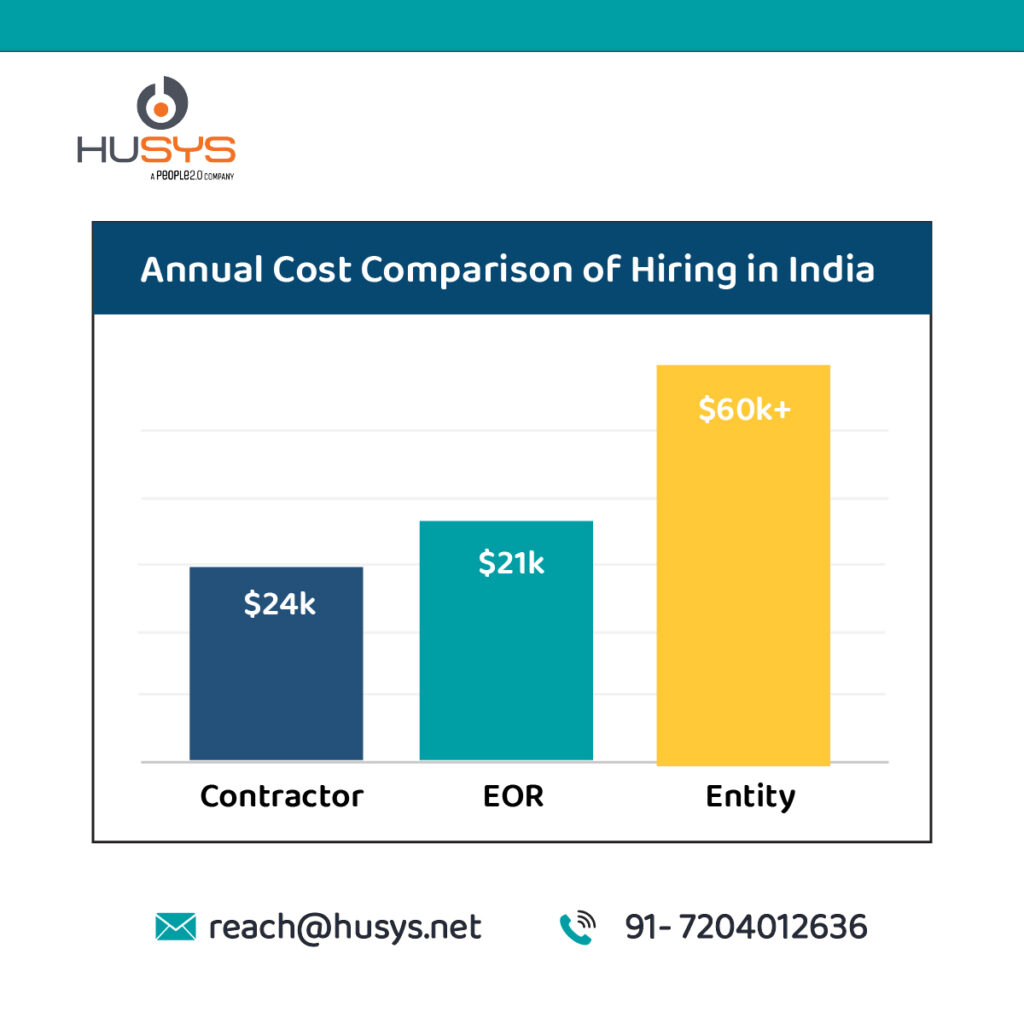
Approximate annual cost comparison of contractor hiring, EOR employment, and entity setup for a software engineer in India.
To make the comparison realistic, let’s return to the same example used earlier: a US SaaS company hiring a software engineer in Bangalore with a CTC of $20,000 per year (₹18 lakh).
Here is the india hiring model cost comparison your finance team needs before the first offer goes out. Same hire, same role, three structures.
Cost Component | Contractors | EOR | Entity |
Base salary / CTC (12 months) | $23,000 | $20,000 | $20,000 |
Statutory contributions (EPF, ESI) | Not paid (liability) | Included in CTC | Included in CTC |
EOR platform fee | None | $1,188 | None |
Setup cost (one-time, Year 1) | $1,600 | None | $16,000 to $25,000 |
Compliance overhead (annual) | None managed | None | $20,900 to $36,400 |
Year 1 stated total | $24,600 | $21,188 | $61,900 to $89,400 |
Legal risk exposure | $5,000 to $8,000+ backdated | None | ROC penalties up to $10,870 |
Real Year 1 cost if risk materializes | $29,600 to $32,600 | $21,188 | $73,000 to $105,000+ |
Time to first hire | Days | 8 working hours | 4 to 6 months |
When US finance teams ask whether EOR is cheaper than an entity in India, this table is the answer for below 20 employees. Above 25, the calculation shifts. The breakeven section covers exactly where that line falls.
Run the Numbers for Your Own Hire
The cost comparison here uses a single example. Actual costs vary by role, state, salary, and team size. Use our India hiring cost calculator for a 12-month estimate across all three models.
Calculate My India Hiring Cost
EOR vs Entity in India: The Breakeven Analysis (And Where Contractors Never Enter the Equation)
The cost tables above tell you what each model costs in Year 1. This section tells you when to switch.
Most US founders either set up an entity too early and spend $25,000 before they need to, or stay on EOR past the point where it stops making financial sense.
The core dynamic driving breakeven
EOR fees scale linearly. Every hire adds $99/month to your bill, forever. Entity compliance overhead does not scale the same way. Once you absorb the $20,900 to $36,400 in annual compliance costs, adding a 10th or 20th employee does not meaningfully increase that number.
At low headcount, entity overhead is too expensive to justify. At high headcount, EOR fees outgrow it.
Where the numbers actually cross
Team Size | Annual EOR Fees | Annual Entity Compliance | Cheaper Model |
5 employees | $5,940 | $20,900 to $36,400 | EOR by $15,000+ |
10 employees | $11,880 | $20,900 to $36,400 | EOR by $9,000+ |
15 employees | $17,820 | $20,900 to $36,400 | EOR, narrowing |
20 employees | $23,760 | $20,900 to $36,400 | Too close to call |
25 employees | $29,700 | $20,900 to $36,400 | Entity at the low end |
30 employees | $35,640 | $20,900 to $36,400 | Entity saves $300 to $15,500/year |
For US finance teams asking if EOR is cheaper than an entity in India, the answer is yes until your headcount crosses 20 to 25 people.
What This Means When Hiring Contractors vs Employees in India
- Under 15 employees: Stay on EOR. The entity math does not work yet.
- At 15 to 20 employees: Start the incorporation paperwork now. It takes 4 to 6 months, and your team will outpace it if you wait.
- Past 25 employees: At this stage, the EOR vs entity cost in India starts to favor a local entity. Fixed compliance overhead is now distributed across a larger team, reducing the per-employee cost.
The contractor model does not have a breakeven point
Back payments, penalties, and retrospective statutory contributions from a misclassification ruling can eliminate several years of apparent savings. These costs can quickly exceed the short-term savings associated with contractor hiring.
Still Running Indian Contractors on a Monthly Invoice?
Ongoing misclassification increases liability over time. Speak with our team to understand the cost of compliant employment versus the exposure in your current structure.
Get a Free Risk and Cost Assessment
When Each Model Makes Financial Sense
When US companies decide how to hire employees in India, EOR or contractors are usually the first fork in the road. The subheads below tell you which path fits your current situation.
You need someone onboarded this quarter
Go with EOR. Entity incorporation takes 4 to 6 months minimum. The contractor route creates misclassification exposure from day one. EOR gets a fully compliant employee onboarded in 8 working hours, with no entity required.
You are currently using contractors for full-time, ongoing work
This is the highest-risk position in the india hiring model cost comparison. If your contractors work exclusively for you, follow your processes, and have no other clients, you are not saving money on hiring. You are deferring a liability. Switch to EOR before the engagement gets long enough to make the retroactive exposure significant.
You're validating India before committing
EOR again. You are not ready to absorb $16,000 to $25,000 in setup costs and $20,900 to $36,400 in annual compliance overhead for a team that may not stay at its current size. EOR keeps your cost structure variable and your exit clean if the strategy changes.
You're building a team of 30+
Start on EOR, and begin entity paperwork when you approach 15 people. At 25 to 30 employees, your own entity becomes the cheaper option, and the compliance infrastructure you built through EOR makes the transition significantly smoother.
Your India team will generate local revenue
You need an entity. An EOR employee cannot sign contracts, raise invoices, or generate revenue on behalf of your company in India. If your India operation is a cost center, EOR works. If it is a revenue center, only an entity gives you the legal standing to operate that way.
You need full IP control from day one
An entity is the cleanest structure for IP ownership. EOR agreements include IP assignment clauses, but the ownership chain runs through a third-party employer, which can complicate things during due diligence or acquisition conversations. If IP clarity is non-negotiable from the start, build the entity first and absorb the setup cost as a business requirement, not a hiring cost.
Not Sure Which Model Fits Where You Are Right Now?
The framework above covers most scenarios. If your situation is more complex, use our India hiring compliance checklist to review the requirements under each model before committing.
Download the India Hiring Compliance Checklist
Conclusion
The India hiring model cost comparison across contractors, EOR, and entity comes down to a simple pattern. The contractor model works for genuinely project-based work, not for full-time hires doing core work. The entity makes sense at scale, not at three employees. EOR sits in the middle and handles the compliance layer that most US companies are not equipped to manage on their own.
For most US companies entering India for the first time, the decision between EOR vs contractors in India is not close once you account for misclassification exposure. Below 20 employees, EOR vs entity cost in India also favors EOR by a wide margin. The numbers and the risk profile point in the same direction.
Husys has been operating India’s employment infrastructure for 23 years, managing 3,000+ active employees across all 28 states at $99 per employee per month.
Frequently Asked Questions
1. Can a US company pay an Indian employee directly in USD instead of INR?
No. Indian employees must be paid in INR through an Indian payroll system. Paying in USD directly violates FEMA regulations. An EOR handles INR payroll and currency conversion on your behalf, removing this obligation entirely.
2. What happens to equity and stock options for Indian employees hired through an EOR?
Indian employees can receive US stock options, but grants to Indian residents must be reported to the RBI under FEMA guidelines. EORs do not manage equity administration, so you will need separate legal counsel or a cap table tool to handle this compliantly.
3. Can an Indian employee hired through an EOR be promoted into a leadership role that requires signing authority?
No. EOR employees have no legal standing to sign contracts or act as directors in India. If your hire needs formal signing or procurement authority, you need your own entity with that person appointed as an authorized signatory.
4. How does termination actually work in India?
India does not have at-will employment. Notice periods of 30 to 90 days must be honored, and gratuity is mandatory after 5 years of service. Termination is manageable when the employment contract is properly drafted from day one, which an EOR handles by default.
5. Does hiring through an EOR in India affect a US company's R&D tax credit eligibility?
Potentially. The US R&D tax credit generally requires research to be conducted within the United States. Work performed by Indian employees may not qualify regardless of the hiring model. Consult a US tax advisor before structuring your India engineering team if R&D credits matter to your strategy.
6. Our India hire will work from home. Does that reduce our compliance obligations?
All of them. Remote employees are covered by EPF, gratuity, the Shops and Establishments Act of their home state, and applicable leave entitlements. There is no remote work exemption, and compliance obligations vary by state.
7. If an Indian contractor invoices through their own company, does that eliminate misclassification risk?
Not reliably. Indian tax authorities assess the substance of the working relationship, not the invoicing structure. If the contractor works exclusively for you and follows your processes, the relationship can still be reclassified as employment regardless of the corporate wrapper.
8. Can a US company hire in India without a local bank account?
Through an EOR, yes. The EOR holds the banking relationship and disburses INR payroll directly. You fund the arrangement via USD wire transfers. A local bank account is only mandatory if you set up your own entity.
9. Can we protect our IP and client relationships if an India hire leaves? Do non-competes hold up?
Post-employment non-competes are largely unenforceable in India under the Indian Contract Act. Strong confidentiality agreements and reasonable notice periods are more reliable protections than restrictions on where someone can work after they leave.
10. Can frequent founder travel to India create tax exposure for the US company?
Yes. Extended business activity in India by a foreign national, including managing operations or negotiating contracts in person, can contribute to a Permanent Establishment determination. If you spend significant time in India managing your team, have a tax advisor review your travel pattern.
11. Is EOR cheaper than an entity in India?
Yes, below 20 employees. At 5 employees, EOR costs $5,940 annually in platform fees versus $20,900 to $36,400 in entity compliance overhead. The gap closes between 20 and 25 employees. Past 30, the entity typically wins on cost.