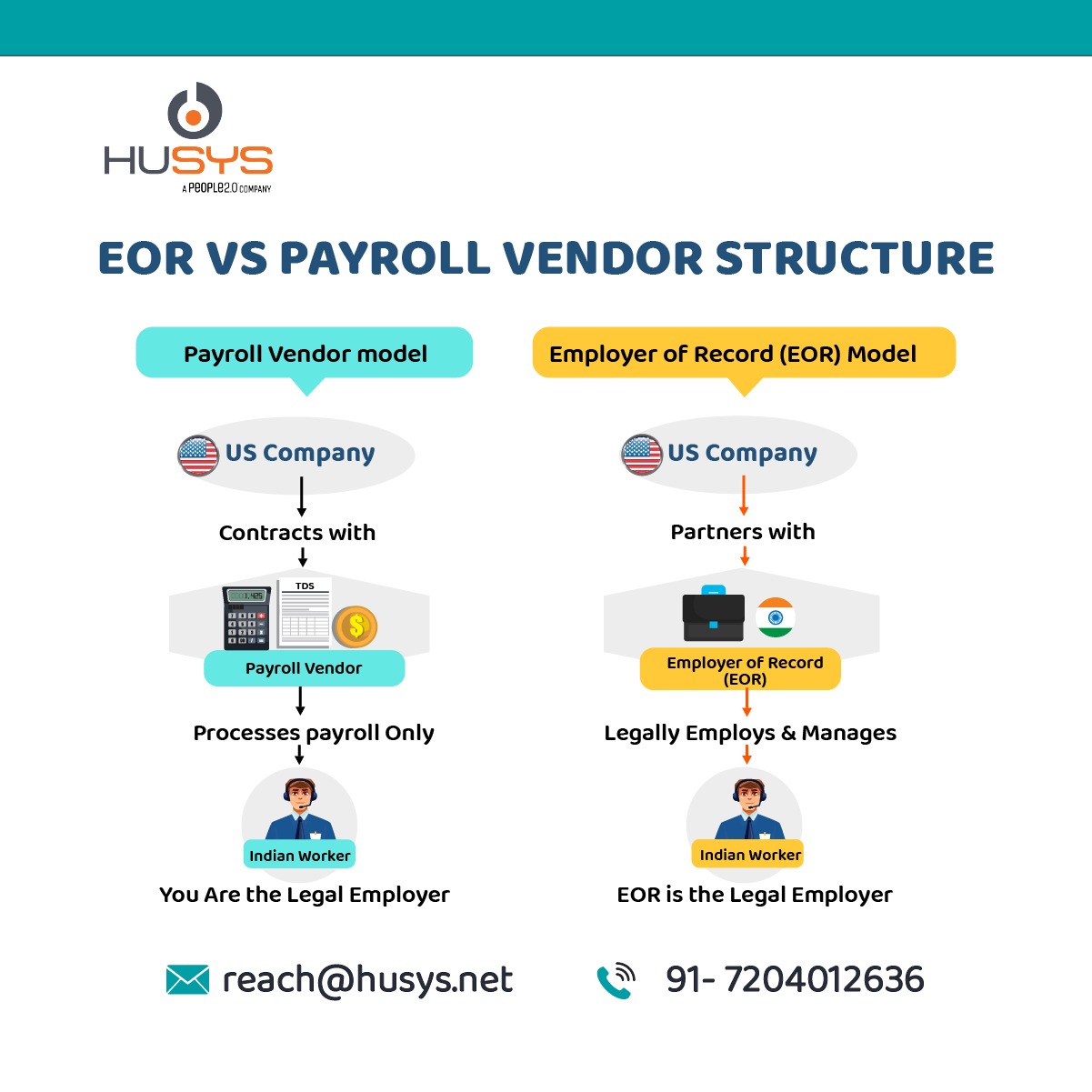
The easiest way to understand the difference is this: a local payroll vendor is a processing service. An Employer of Record is a compliance infrastructure.
When comparing EOR vs local payroll vendor India, most US companies underestimate compliance risk.

One executes transactions. The other holds legal responsibility.
Here is how the two models compare across every dimension that matters:
| | Local Payroll Vendor | Employer of Record |
Legal employer in India | You (or no one, if no entity exists) | The EOR |
Employment contracts | Your responsibility | Drafted and owned by the EOR |
Payroll processing | Yes | Yes |
TDS filing | Yes | Yes |
PF and ESI compliance | Yes | Yes |
Gratuity management | No | Yes |
Labor law compliance | No | Yes |
Termination support | No | Yes |
Permanent establishment risk management | No | Yes |
State-specific compliance | Partial | Yes |
Legal liability for employment | Yours | EOR’s |
Works without an Indian entity | No | Yes |
EOR vs Local Payroll Vendor India: Key Differences Summary
- Both a payroll vendor and an EOR deal with salaries and statutory filings in India. Most US companies assume they solve the same problem. They do not.
- Payroll vendors handle the mechanics of paying people correctly. The legal employment relationship, and everything that comes with it, stays with you.
- With only a payroll vendor and no Indian entity, you cannot legally hire employees at all. Everyone is engaged as a contractor, which creates real misclassification risk. An EOR lets you hire employees or contractors compliantly, without setting up your own Indian entity.
- When a gratuity dispute surfaces, a labor inspector shows up, or a termination goes wrong, a payroll vendor has no role. You are handling it, ideally with Indian legal counsel you have not yet hired.
- Indian penalties are structured to hurt. Missed ESIC thresholds attract backdated dues plus 100% penalty on unpaid contributions. Directors can be held personally liable under Indian labor law.
- An EOR shifts the legal employer status entirely. Compliance failures become the EOR’s problem to fix, not yours to discover.
- The price difference between a payroll vendor and an EOR looks obvious until you add entity setup, local legal fees, and HR policy drafting to the vendor side. At that point, the math often reverses.
The real gap in EOR vs local payroll vendor India comes down to legal employer responsibility.
If your India payroll vendor misses an ESIC threshold registration, the backdated dues and penalties land on you, not them. If a terminated employee files a wrongful dismissal claim, you manage it. If a labor inspector walks in and asks who the legal employer is, your name is on that answer.
While payroll outsourcing in India looks cheaper on paper, this is the part that never shows up in the quote. The vendor processes salaries. You carry the legal employer burden, the compliance exposure, and the audit risk.
This article breaks down exactly what each model covers, where the liability actually sits, and which structure makes sense depending on where you are in your India hiring journey.
Who Is This Guide For?
This guide is written for US-based founders, CFOs, and HR leaders who are already hiring or actively planning to hire in India and are trying to decide between a local payroll vendor and an Employer of Record.
It is specifically for you if:
- A local payroll vendor has quoted you and wants to understand what they actually cover
- You are evaluating EOR, but are not sure if the cost difference is justified
- You have contractors in India and are considering moving them to a compliant structure
- You are responsible for making sure your India hiring does not create legal or tax exposure back in the US
What Is a Local Payroll Vendor in India?
A local payroll vendor is a third-party service provider that processes employee salaries in India. They calculate salaries, deduct TDS, file provident fund and ESI returns, generate payslips, and handle the monthly mechanics of paying your India team correctly.
That is where their responsibility ends.
A local payroll vendor does not employ your workers. They do not hold any legal liability for your India hires. The employment relationship, every labor law obligation, every compliance risk, and every dispute that comes from how your people are hired, managed, or exited sits entirely with you.
This model works when a company already has a registered legal entity in India, a private limited company, branch office, or subsidiary, because the entity itself is the employer. The payroll vendor is just the operational layer executing the payments.
For US companies without an Indian entity, the model has a fundamental problem. There is no legal employer on record. Without that, a payroll vendor cannot create a compliant employment structure.
What typically happens instead is that workers get paid as contractors, which can create contractor vs employee misclassification risks in India if the working relationship resembles full-time employment.
Running payroll in India and being legally compliant in India are not the same thing. A local payroll vendor gives you the first. It does not give you the second.
Hiring in India Without an Entity?
Most US companies do not realize they are the legal employer by default. Understand what that means in practice.
Book a Free 15-Min Call
What Is an Employer of Record in India?
An Employer of Record is a company that legally employs workers in India on your behalf. You find the people, you direct the work, and the EOR takes on the legal employer role in India, handling everything that comes with it, see our guide to Employer of Record services in India
That means the EOR signs the employment contracts, runs compliant payroll, files all statutory returns, manages provident fund and ESI contributions, administers legally required benefits, and carries the liability for labor law compliance across every hire.
When you hire through an EOR in India, the structure looks like this:
- The EOR is the legal employer on record with Indian authorities
- Your worker receives a compliant employment contract under Indian law
- Statutory deductions, PF, ESI, TDS, and professional tax are handled and filed correctly
- Gratuity accrual, leave entitlements, and notice periods are built into the employment structure
- Any termination, dispute, or compliance audit is managed by the EOR, not by you
What you retain is full control over the work. You manage day-to-day responsibilities, performance, and output. The EOR manages the legal and compliance layer underneath.
For US companies that are not ready to incorporate in India, or do not want the overhead of running an Indian entity, an EOR is the only model that creates a fully compliant employment structure from day one.
How Fast Can You Hire in India Through an EOR?
Husys onboards new hires within 8 working hours. No entity setup, no legal retainer, no waiting.
See How Onboarding Works

Let’s take three situations that every US company hiring in India will eventually face to better understand the difference between EOR and local payroll vendors in India.
- Scenario 1: An employee resigns and claims unpaid gratuity
- Scenario 2: A state labor inspector audits your India operation
- Scenario 3: You need to let someone go
Let’s learn about each scenario in detail
Scenario 1: An employee resigns and claims unpaid gratuity
- With a payroll vendor:
- The claim lands on your desk. You need to engage Indian legal counsel you likely have not yet retained, verify whether gratuity was tracked correctly across the employee’s full tenure, and calculate a liability that may have been accruing for years without any provisioning.
- You are also doing this from the US, across time zones, under Indian statutory deadlines.
- With Husys as your EOR:
- We handle the calculation, the payout, and the documentation.
- Everything is our responsibility. Your operating relationship with the employee and your reputation with your India team stay intact.
Scenario 2: A state labor inspector audits your India operation
- With a payroll vendor:
- You are the employer on record. Every question about employment contracts, statutory filings, working conditions, and leave entitlements is yours to answer.
- The audit response requires Indian legal counsel, documentation that your vendor does not own, and time your team does not have.
- With Husys as your EOR:
- We are the entity being audited, not you. We respond, we document, and we resolve it.
- You do not hire India counsel. You do not pull in US leadership. You do not spend time managing a compliance issue that was never yours to carry.
Scenario 3: You need to let someone go
- With a payroll vendor:
- India has no at-will employment. Termination without documented cause, proper notice periods, and correct procedure under the Industrial Disputes Act can result in reinstatement orders or statutory compensation claims, both of which are significantly harder to resolve once filed.
- Your payroll vendor has no contractual role in any of this. You will have to manage an Indian labor law process from the US, without in-house counsel, in real time.
- With Husys as your EOR:
- We manage the entire exit, from documentation to final settlement, within what Indian law requires.
- If the employee disputes the termination, that dispute is ours to respond to, not yours.
Count the Real Cost Before You Decide
The $30 vs $99 comparison looks obvious until you add entity setup, legal fees, and contract drafting. Run the actual numbers here.
Use the India Hiring Cost Calculator
Who Is the Legal Employer When You Hire in India?
Under Indian law, the legal employer is the entity that signs the employment contract, makes statutory contributions, and holds the employment relationship. That entity carries all obligations under Indian labor law, including compliance, disputes, and exits.
For US companies, this question has three possible answers depending on how you have structured your India hiring.
You have an Indian entity:
- Your subsidiary or branch office is the legal employer.
- All labor law obligations sit with that entity, and by extension, with you.
You are using a local payroll vendor:
- You are the legal employer. The vendor handles processing, calculations, and filings, but every compliance obligation, every labor law requirement, and every dispute that arises from the employment is your responsibility.
- If the vendor makes an error or misses a filing, you are the one liable.
You are using an EOR:
- The EOR is the legal employer “on record”.
- Employment contracts are signed under the EOR’s entity, statutory filings go out under their PAN and registration numbers, and labor law compliance is their obligation, not yours.
See What a Compliant India Employment Contract Covers
Employment contracts under Indian law look very different from US offer letters. Here is what needs to be in them and who should be signing.
Download a Sample India Employment Contract
The PE Risk US Companies Consistently Underestimate
What Is Permanent Establishment (PE)?
Permanent Establishment (PE) is one of the most consequential and least discussed risks for US companies hiring in India.
If Indian tax authorities determine that your workers constitute a fixed business presence in India, your US entity can become liable for Indian corporate tax on the profits attributable to that presence.
What many companies underestimate is that this exposure is not forward-looking.
If authorities determine that a permanent establishment existed earlier, the tax liability is backdated to when the threshold was first crossed, potentially creating significant tax exposure for your company.
How PE Gets Triggered in India
Under Indian domestic tax law and the India–US tax treaty, permanent establishment is generally triggered in three situations.
- Fixed place of business
- A physical location in India that is at your disposal and through which business is conducted.
- This could include an office, co-working location, or any workspace effectively used to conduct core business activities.
- Dependent agent
- A person in India who habitually concludes contracts on your behalf or plays the principal role in securing those contracts for your company.
- Service duration threshold
- In certain treaty contexts, services performed in India for a specified duration of time can trigger PE even without a fixed office.
If any of these thresholds are met, India can tax the profits attributable to that Indian presence.
Why Payroll Vendors Do Not Monitor PE Risk
This is where many US companies miscalculate.
A payroll vendor processes salaries and statutory filings, but permanent establishment risk sits entirely outside their scope.
PE risk depends on factors such as:
- employee roles
- contract authority
- nature of business activities
- duration of services performed in India
These are tax and structural considerations, not payroll operations.
As a result, most payroll vendors do not analyze or flag PE risk. When it surfaces, it usually does so during a tax review or regulatory audit, often long after the threshold has already been crossed.
This is why many US companies only discover their PE exposure after they have already built a team in India, when restructuring becomes significantly more complex and expensive.
How an EOR Helps Avoid PE Exposure
An Employer of Record structures the employment relationship under its own registered Indian entity.
This means:
- Employment contracts are issued by the EOR
- Statutory registrations and filings are under the EOR’s entity
- Payroll and labor compliance sit with the EOR
Because the workers are legally employed by the EOR, the arrangement is designed to avoid creating a fixed place of business or dependent agent exposure for your US company.
A credible EOR also monitors how your India team is structured as it grows, helping ensure that your hiring model remains compliant and does not inadvertently trigger PE risk.
Your Payroll Vendor Is Not Monitoring This
PE risk assessment sits outside what any payroll vendor tracks or flags. Talk to our India tax specialists and find out if your current structure is creating exposure.
Speak With an Expert
Does Hiring Remote Employees in India Create Permanent Establishment Risk?
Hiring remote employees in India does not automatically create a permanent establishment for a US company. However, the risk depends on how those workers are engaged and what authority they hold within the business.
PE exposure becomes likely when:
- Employees negotiate or sign contracts on behalf of the US company
- The company maintains a fixed office or workspace in India
- Workers perform core revenue-generating activities
- Services are delivered in India beyond treaty thresholds
When these conditions exist, Indian tax authorities may determine that the US company has established a taxable business presence in India.
This is why the structure used to hire employees in India matters. When workers are engaged through an Employer of Record, the employment relationship sits under the EOR’s Indian entity rather than the US company’s presence.
What a Local Payroll Vendor Actually Covers in India
A local payroll vendor runs payroll.
They calculate salaries based on the data you provide. They deduct taxes. They file routine statutory returns linked directly to payroll. Their role begins with salary input and ends with statutory payroll filings.
Here is what that typically includes:
- Monthly gross-to-net salary calculations
- Payslip generation
- TDS deduction and quarterly filings under the Income Tax Act
- Provident Fund calculation and EPFO filings
- ESI calculation and ESIC filings, where applicable
- State-level professional tax deductions and filings
- Annual Form 16 issuance
It does not include drafting employment contracts. It does not include ensuring your compensation structure complies with Indian labor laws.
It does not include gratuity provisioning strategy, leave policy compliance, termination structuring, Shops and Establishments compliance, or handling labor disputes. It does not cover statutory audits beyond payroll return filings.
Running Payroll Without an Indian Entity?
Without a registered entity, your payroll vendor cannot give you a compliant employment structure. Let us review your current structure at no cost.
Book a Free Call
What an EOR Covers That a Payroll Vendor Does Not
An EOR does everything a payroll vendor does, and then carries the entire employment infrastructure that sits underneath it. The difference is not just additional services. It is a fundamentally different legal position.
When you hire through Husys, we become the legal employer in India. That means the compliance obligations, the statutory liabilities, and the legal exposure that would otherwise sit with you transfer to us.
What that covers in practice:
- Drafting and executing compliant employment contracts under Indian law
- Managing provident fund, ESI, TDS, professional tax, and gratuity from day one
- Tracking and provisioning gratuity accrual across each employee’s tenure
- Handling terminations within the framework of the Industrial Disputes Act and applicable state labor laws
- Managing statutory audits and labor inspections as the entity on record
- Advising on and structuring your India hiring to mitigate permanent establishment risk
- State-specific compliance across all major hiring locations, including Karnataka, Maharashtra, Telangana, and Tamil Nadu
The practical difference shows up when something goes wrong. A labor inspector audits your India operation, an employee raises a wrongful termination claim, or a gratuity dispute surfaces after five years of service. With a payroll vendor, those situations land on your desk. With Husys, they land on ours.
Can a Local Payroll Vendor Get US Companies Into Trouble in India
Not intentionally. But the way the model is structured, when something slips, the consequences land on you, not the vendor.
Here are two real-world examples.
A mid-sized Pune-based firm missed provident fund filings for three months because its outsourced payroll vendor did not flag a portal login issue or file on time. By the time it surfaced, the company owed Rs. 2.1 lakh ($2305) in unpaid PF contributions plus Rs. 47,000 ($516) in penalties, over 22% of the contribution amount, for a filing failure that originated entirely on the vendor’s side but was legally the employer’s liability.
A startup that crossed 100 employees never got flagged by the payroll vendor that they had crossed the ESIC threshold of 20 employees, which triggers mandatory registration and contributions. The gap only surfaced during an audit. The result was backdated ESIC dues plus a 100% penalty on the unpaid amount.
In both cases, the vendor processed payroll. In both cases, the compliance gap sat outside what the vendor tracked or flagged. And in both cases, the employer paid.
This is not exceptional. Under Indian law, the penalties for non-compliance are structured to be significant:
- PF damages under the EPF Act can reach up to 100% of the unpaid contributions
- Late TDS deposit attracts interest at 1.5% per month from the due date
- ESIC non-compliance carries backdated dues plus penalties up to 100% of the unpaid amount
- Directors and senior HR leaders can be held personally liable under Indian labor legislation
Check Whether Your India Hiring Model Creates PE Risk
Talk to our India tax and compliance team and understand whether your current structure creates permanent establishment exposure.
Book a Free PE Risk Review
When an EOR Is the Safer Choice for US Companies?
If you already have a registered Indian entity, a local legal function, and a compliance team tracking both central and state legislation, a payroll vendor is a reasonable processing layer.
But most US companies hiring in India go the EOR route because it is not only cheaper but safer.
An EOR is the safer structure when:
You are hiring without an Indian entity:
- Without a registered entity, you have no legal standing as an employer in India.
- An EOR brings its own entity to the structure, which means compliant employment contracts, registered statutory filings, and a recognized employer on record from day one.
- You are hiring your first one to five people in India:
- At this stage, building the compliance infrastructure yourself costs more than it saves.
- We typically see US founders spend three to four months on entity setup, local legal counsel, and HR policy drafting before a single hire is made.
- An EOR compresses that to days.
- You are in a fast-moving hiring phase:
- Every Indian state has its own labor regulations on top of central law.
- Karnataka, Maharashtra, Telangana, and Tamil Nadu each have different Shops and Establishments Act requirements.
- Tracking that across a growing team while running a business is not a practical task for a US operator.
- You have had contractors in India for more than six months:
- In our experience working with US companies, long-running contractor arrangements are almost always misclassification risks under Indian law.
- The longer the engagement, the larger the backdated statutory liability if it surfaces.
- An EOR restructures the arrangement compliantly without disrupting the working relationship.
Is a Local Payroll Vendor Actually Cheaper Than an EOR?
On the surface, yes.
A local payroll vendor charges anywhere between $4 to $30 per employee per month, depending on the scope of services. Husys EOR is $99 per employee per month.
The number looks higher, and most US companies stop the comparison there.
That comparison is incomplete.
A payroll vendor fee covers processing. It does not cover the infrastructure you still need to build around it to hire compliantly in India.
When you add those costs in, the picture changes significantly.
Cost Component | Local Payroll Vendor | Husys EOR |
Payroll processing | $4 to $30 per employee per month | Included |
Indian entity setup | $10,000 to $16,000 one time (if you want to hire full-time employees) | Not required |
Local legal counsel | $150 to $300 per hour | Included |
HR policy and contract drafting | $1,000 to $3,000 one time | Included |
State-specific compliance tracking | Additional or manual | Included |
Gratuity provisioning and management | Not covered | Included |
Termination support | Not covered | Included |
Statutory audit management | Not covered | Included |
For a US company hiring five employees in India, the true cost of the payroll vendor route before a single salary is processed typically looks like this:
- Indian entity setup: $10,000 to $16,000 one-time
- Local legal counsel: $150 to $300 per hour, with most companies spending $3,000 to $5,000 in year one
- HR policy and offer letter drafting: $1,000 to $3,000
Total setup and first-year advisory costs: $15,000 to $20,000
None of this appears in a payroll vendor’s quote.
Beyond setup, the ongoing liability exposure of the payroll vendor model carries its own financial risk. A single missed ESIC threshold registration, as we saw earlier, can result in backdated dues plus 100% penalty.
With EOR, the costs become predictable and operating, not structural. There is no entity setup. No separate legal retainer. No parallel compliance stack to build.
For instance, at 20 employees, Husys EOR at $99 per employee per month is $1,980 per month for a fully compliant, fully managed India employment infrastructure. Building and maintaining the equivalent in-house, with local legal, HR, and compliance overhead, typically costs significantly more.
The cheaper option is not always the one with the lower line-item fee.
Understand the Hidden Cost of the $30 Model
- Entity setup.
- Legal counsel.
- Compliant contracts.
- HR policies.
- Statutory registrations.
- Gratuity exposure.
Before you sign, understand what still sits on your balance sheet.
See the Full India Cost Breakdown
Which Structure Is Right for Your Situation
The right answer depends on where you are in your India hiring journey.
Use an EOR if any of these describe you:
- You are hiring in India without a registered Indian entity and need compliant employment contracts in place immediately
- You have one to ten India hires, and the cost of entity setup and local legal counsel outweighs the benefit of owning the structure yourself
- You have contractors who have been engaged for more than six months, and you want to move them to a compliant employment structure without disrupting the relationship
- You are growing your India headcount fast and cannot absorb the compliance overhead of tracking central and state labor law changes in real time
- You are concerned about whether your current structure creates permanent establishment exposure for your US entity
Use a local payroll vendor if all of these are true:
- You already have a registered Indian entity that is the legal employer on record
- You have in-house or retained Indian legal counsel handling employment contracts and labor disputes
- You have a compliance function tracking state-specific labor law changes across every state where you hire
- You are confident your current structure does not create PE risk
If you are reading this article, likely that at least one condition in the second list is not met. That is the gap an EOR closes.
Conclusion
A local payroll vendor and an Employer of Record are not two versions of the same solution.
One processes payroll.
The other holds the legal, statutory, and compliance infrastructure that makes hiring in India actually defensible.
For US companies that are the legal employer on record, every gap in that infrastructure is their liability to manage, their audit to respond to, and their dispute to resolve.
If you are evaluating India as a hiring destination and want a structure that is compliant from day one, Husys has been operating in the Indian market for over 24 years, supporting 150+ active clients across tech, SaaS, manufacturing, and beyond.
We have managed 50,000+ employees across all 28 Indian states, handle every statutory obligation from PF and ESI to gratuity and terminations, and onboard new hires within 8 working hours.
If you are unsure whether your current India hiring structure is creating compliance or tax exposure, that is the right question to start with. We will review your setup, including contractor arrangements, payroll structure, and PE risk, and tell you directly what needs to change and what does not.
Most US companies we work with have the answer within 24 hours of that first conversation.
Stop Carrying Liability That Should Not Be Yours
Husys onboards new hires across all 28 Indian states in 8 working hours. We take care of every statutory obligation, every dispute, and every audit.
Book a Free Call
Choosing between EOR vs local payroll vendor India is ultimately a risk decision, not just a cost decision.
Frequently Asked Questions
What is the difference between a payroll vendor and an Employer of Record in India?
- A payroll vendor processes salaries and files statutory returns. You remain the legal employer.
- An EOR becomes the legal employer in India, taking on employment contracts, labor law compliance, statutory benefits, and all associated liability.
- One is a processing service. The other is a legal structure.
Is EOR better than a local payroll vendor in India?
- A payroll vendor processes salaries and files statutory returns. You remain the legal employer.
- An EOR becomes the legal employer in India, taking on employment contracts, labor law compliance, statutory benefits, and all associated liability.
- One is a processing service. The other is a legal structure.
If my payroll vendor files PF and ESI correctly, am I fully compliant under Indian law?
- No. Payroll compliance and employment compliance are different things.
- A vendor handles statutory filings. Employment contracts, gratuity provisioning, termination procedures, state-specific labor laws, and permanent establishment risk sit entirely outside their scope.
- Filing PF on time is one piece. It is not the whole picture.
As a US company using a payroll vendor in India, what am I actually liable for if something goes wrong?
- Everything. The vendor processes payroll. You are the legal employer.
- Any compliance gap, missed filing, wrongful termination claim, or labor dispute is yours to resolve.
- The vendor’s contract does not transfer any of that liability to them.
What happens if my payroll vendor in India misses a statutory filing or crosses a compliance threshold without telling me?
- The penalties land on you, not the vendor.
- A missed ESIC threshold registration, for example, can result in backdated dues plus a 100% penalty on unpaid contributions.
- The vendor processed payroll.
- The compliance gap was yours to catch.
At what point does a payroll vendor in India stop being enough, and an EOR become necessary?
- The moment you need a compliant employment structure, not just payroll processing.
- If you have no Indian entity, are growing your India team, have contractors who should be employees, or are managing PE risk, a payroll vendor cannot give you what you need.
How does termination work in India, and who handles it under each model?
- India has no at-will employment.
- Termination requires documented cause, proper notice, and, in some cases, government approval under the Industrial Disputes Act.
- With a payroll vendor, you manage all of this yourself.
- With an EOR, the entire exit process is handled within what Indian law requires.
Can I move my existing India contractors or payroll vendor employees to an EOR structure?
- Yes. We do this regularly for US companies that have been running informal or payroll vendor arrangements and want to move to a compliant structure.
- The transition can typically be completed without disrupting the working relationship.
What is permanent establishment risk, and does my current India hiring structure create it?
- Permanent establishment is a tax concept.
- If Indian authorities determine your workers constitute a fixed business presence in India, your US company can be subject to Indian corporate tax on attributed profits.
- Whether your current structure creates that risk depends on how your workers are engaged, what they do, and how payments are structured.
Is $99 worth it vs a payroll vendor at $30?
- The $30 covers payroll processing.
- What it does not cover is entity setup, local legal counsel, employment contract drafting, gratuity management, termination support, and state-specific compliance tracking.
- When those costs are added in, most US companies spend $15,000 to $20,000 before a single salary is processed through a payroll vendor.
- At $99, all of that is included from day one.
- And it ensures that you never get notice from Indian authorities.
Our current payroll vendor is already set up and running. Is switching to an EOR worth the disruption?
- The transition is less disruptive than most companies expect.
- Husys onboards existing employees into the EOR structure, including compliant contracts and statutory registrations, without changing anything about their day-to-day experience.
- The more relevant question is whether the compliance exposure you are currently carrying is worth avoiding the switch.