Husys India EOR Payroll & Compliance Experts is the in-house team supporting Employer of Record (EOR) payroll operations and statutory compliance for US companies hiring in India. With 250+ years of collective compliance experience, the team has supported 50,000+ contractors to date and helps 5,000+ clients run compliant workforce operations across India.
Editorial note: This content is reviewed internally by payroll and compliance specialists and reflects standard statutory practices in India. For case-specific guidance, consult a qualified professional.
Facebook
X.com
LinkedIn
Email
WhatsApp
EOR vs PEO vs payroll outsourcing in India comes down to one question: who is the legal employer?
Employer of Record (EOR): The EOR is the legal employer and handles employment contracts, payroll, statutory compliance, and employee obligations. A US company can use an EOR to hire employees in India without setting up its own Indian entity.
Payroll outsourcing: Your Indian entity remains the legal employer. The payroll provider processes salaries and statutory filings, but employment liability remains with your company.
PEO-style services: A provider can support HR, payroll, and administrative operations for a company that already has an Indian entity, but it does not become a co-employer in the US PEO sense.
For a US company without an Indian entity, EOR is generally the relevant model for hiring employees in India. For a company that already has an Indian entity, payroll outsourcing or broader HR support may be appropriate depending on what the company wants to outsource.
This guide explains how EOR, PEO-style services, and payroll outsourcing work in India, where US companies commonly get confused, and how to choose the right model based on your hiring plan, team size, and India setup.
EOR, PEO and payroll outsourcing compared for US companies hiring and managing employees in India.
For most US companies hiring their first employees in India, the decision comes down to three models:EOR, an Indian entity, or an independent contractor. The right option depends on whether you need full-time employment, how quickly you need to hire, and whether you plan to build a long-term India operation.
Who Is Evaluating EOR, PEO, or Payroll Outsourcing in India?
A US-based founder or CTO in a 10–50 person SaaS company planning to hire 1–5 engineers in India and unsure whether to set up an entity or use EOR
A VP Finance or Controller at a 50–200 person company evaluating cost savings in India and needing clarity on who carries payroll and compliance liability
An HR or People leader at a US company comparing EOR vs payroll outsourcing in India and trying to understand what each model actually covers
TL;DR:
1. If you do not have an Indian entity and want to hire employees in India, EOR is generally the simplest structure because the EOR becomes the legal employer.
2. Payroll outsourcing does not remove employment liability. Your Indian entity remains the legal employer and is responsible for employment compliance.
3. PEO-style services can support HR and payroll operations, but they do not create US-style co-employment under Indian employment law.
4. EOR typically suits companies testing or building an initial India team without committing to entity setup and ongoing administration.
5. An Indian entity can make more sense as your team grows and you need greater control over employment, compensation, policies, and operations.
6. The right model depends on three factors: whether you have an Indian entity, how many people you plan to hire, and how much employment administration you want to own.
7. In simple terms: No Indian entity → consider EOR. Indian entity + payroll support → payroll outsourcing. Indian entity + broader HR/admin support → PEO-style services.
Can You Use a PEO in India? The Legal Reality
For US companies, aProfessional Employer Organization (PEO) typically refers to a co-employment model where the company and provider share certain employer responsibilities. India does not use the same co-employment structure.
For an Indian employee, there must be a clearly identified legal employer responsible for employment obligations, including contracts, payroll, statutory benefits, and applicable labour-law compliance.
For a US company, this means:
A PEO-style provider can support HR, payroll, and administrative operations.
Your Indian entity remains the legal employer when you use these services.
Employment contracts remain with your Indian entity.
Statutory obligations such as applicable PF, ESI, and TDS responsibilities remain tied to the legal employer.
Employee disputes, termination obligations, and regulatory matters ultimately involve the legal employer.
So, if your US company does not have an Indian entity, a PEO-style payroll or HR service does not by itself create an Indian employment structure.
An EOR is the model to evaluate when you want to hire employees in India without establishing your own entity.
What Payroll Outsourcing in India Actually Covers (and What It Does Not)
Payroll outsourcing in India means a third-party provider processes payroll and statutory filings while your Indian entity remains the legal employer and retains responsibility for employment compliance.
It is generally used after your India entity, registrations, employment structure, and payroll infrastructure are already in place. These obligations can include statutory payroll requirements administered through Indian authorities such as the Employees’ Provident Fund Organisation (EPFO).” The provider executes payroll based on the structure established by your company; it does not become the legal employer.
What payroll outsourcing actually does for you:
Runs monthly payroll based on your inputs, including fixed salary, bonuses, and leave data
Calculates and deducts TDS (income tax), PF (mandatory retirement contribution, similar to a forced 401k), and ESI (government health insurance for lower salary bands)
Files returns with Indian authorities, including TDS filings and PF/ESI submissions
Generates payslips and maintains payroll records required for audits
Flags obvious calculation errors, but does not redesign your compensation or compliance structure
Where US companies get exposed:
Salary structure decisions come from you. If PF is calculated incorrectly because your compensation is structured incorrectly, the liability sits with your entity.
Statutory benefits and notice period rules protect employees in India. If these are not handled correctly, disputes are raised against your entity, not the payroll provider.
Indian payroll is tightly linked to labor law. A payroll vendor will process what you give them, even if your employment contracts or policies are not compliant.
In an audit, authorities review your registrations, filings, and records. The vendor may support with data, but enforcement is against your company.
To use payroll outsourcing in India, your company must already be set up to run payroll locally.
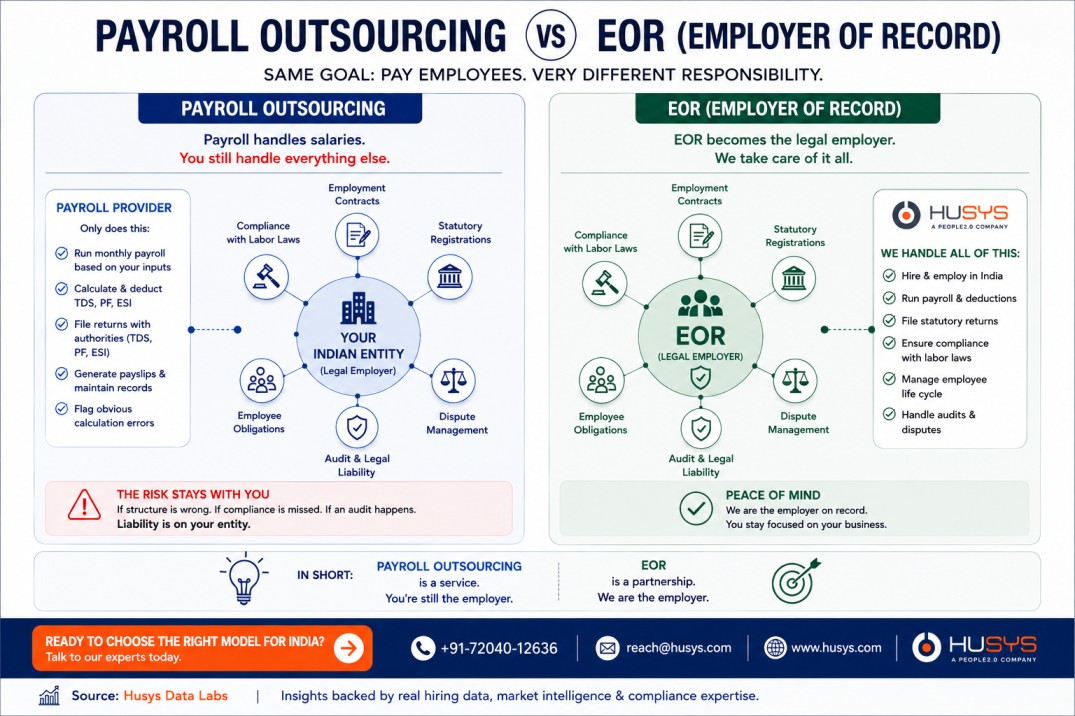
Payroll outsourcing processes payroll while your Indian entity remains the legal employer; an EOR becomes the legal employer and manages the broader employment lifecycle.
This includes having a registered Indian entity, tax registrations to deduct and file TDS, PF, and ESI registrations where applicable, and a local bank account to pay employees.
Without these, a payroll provider cannot process salaries or make statutory filings on your behalf.
AnEmployer of Record (EOR) in India is a local entity that legally employs workers on behalf of a foreign company. The EOR issues the employment contract, runs payroll, manages applicable statutory compliance, and handles employment administration, while the client company manages the employee’s day-to-day work and performance.
For a US company, the main advantage is that it can hire employees in India without establishing its own Indian legal entity.
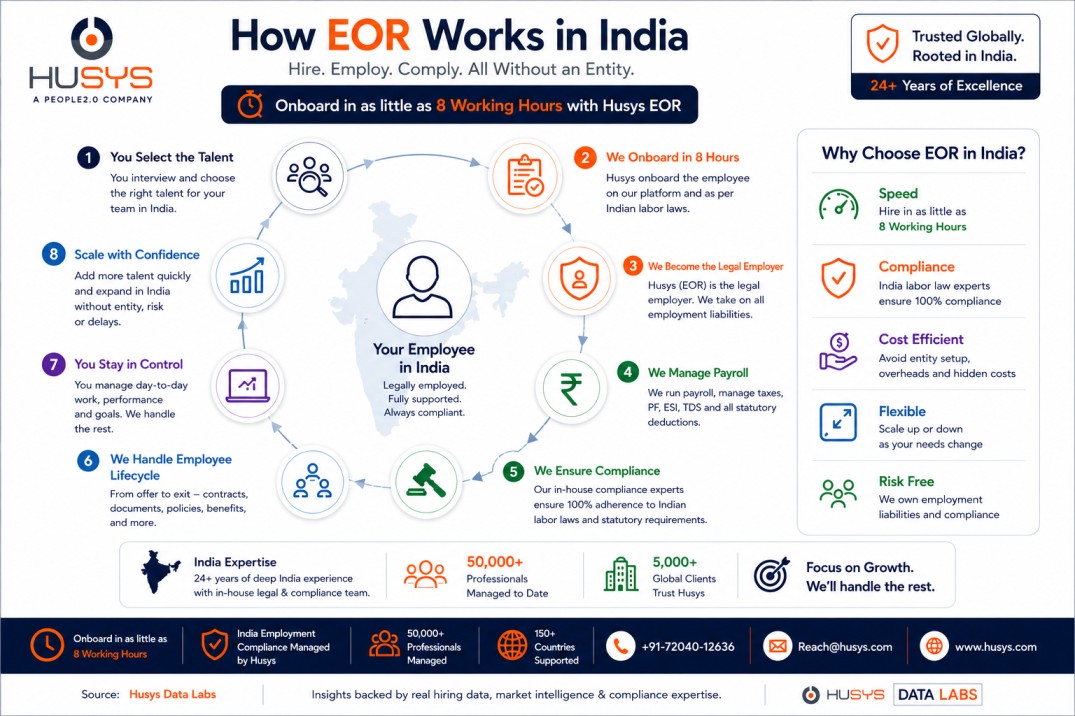
What the EOR handles:
Employment contracts aligned with Indian labor laws, including compensation structure and notice period terms
Monthly payroll, including TDS (income tax), PF (mandatory retirement contribution), and ESI (government health insurance where applicable)
Statutory registrations, filings, and ongoing compliance with Indian labor and tax laws
Onboarding, documentation, and local HR compliance requirements
Terminations, notice periods, and severance as per Indian regulations
How an Employer of Record manages onboarding, employment, payroll, compliance and employee lifecycle in India.
For example, Husys provides EOR and PEO services across India with an in-house legal and compliance team supporting applicable employment requirements across 28 states and 8 union territories.
What stays with your company:
You select the candidate and define the role
You manage day-to-day work, performance, and output
You decide compensation within compliant structures guided by the EOR
This allows a US company to hire in India without setting up an entity.
For example, a US-based SaaS company hiring its first engineer in India can onboard the employee through an EOR. The EOR becomes the legal employer, runs payroll locally, and handles compliance, while the company manages the employee as part of its team.
This means you can start hiring in India without setting up a company, opening a local bank account, or registering for tax and labor compliance.
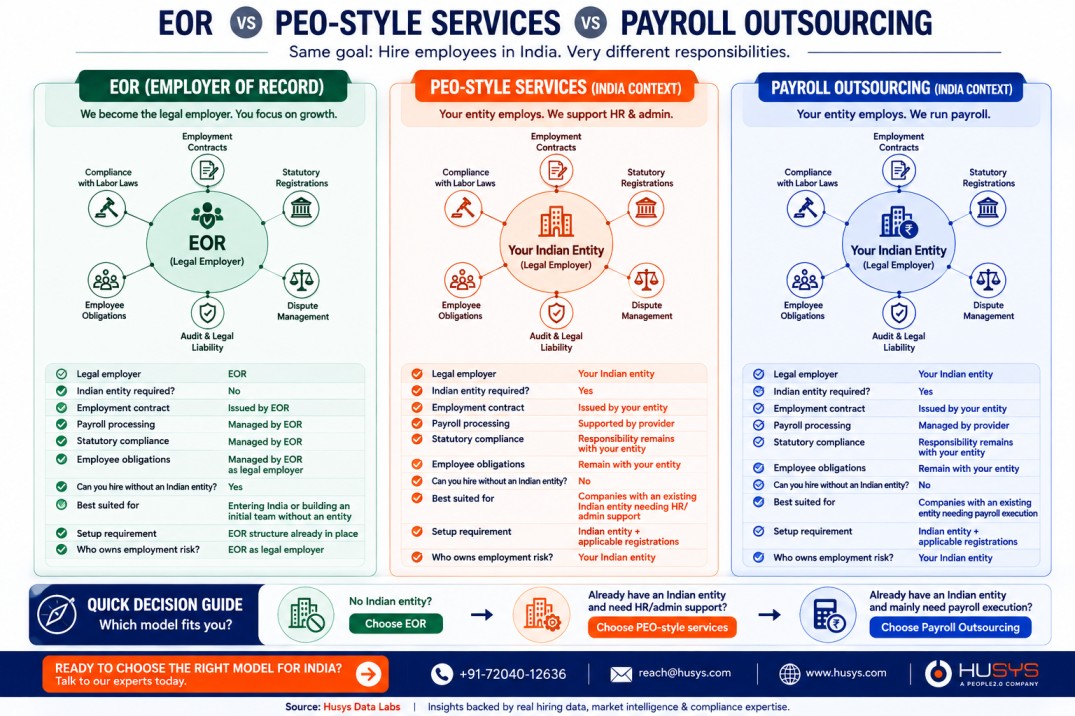
EOR vs PEO vs Payroll Outsourcing in India: Key Differences
These three models operate very differently in India because employment liability cannot be shared and must sit with a single legal employer. The choice affects how you hire, who holds compliance responsibility, and whether you need an entity in India.
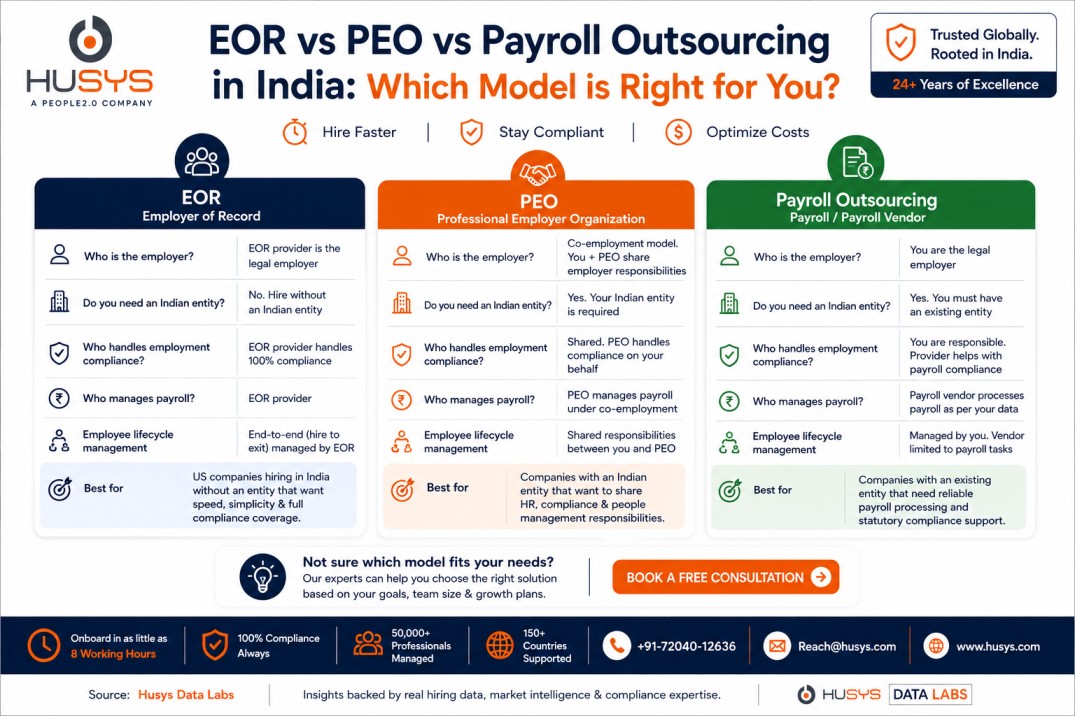
Here is a table that breaks down the differences between EOR, PEO, and payroll outsourcing from a US company’s perspective for India :
Factor
Employer of Record (EOR)
PEO-style services
(India Context)
Payroll Outsourcing
(India Context)
Legal employer
EOR
Your Indian entity
Your Indian entity
Indian entity required?
No
Yes
Yes
Employment contract
Issued by EOR
Issued by your entity
Issued by your entity
Payroll processing
Managed by EOR
Supported by provider
Managed by provider
Statutory compliance
Managed by EOR
Responsibility remains with your entity
Responsibility remains with your entity
Employee obligations
Managed by EOR as legal employer
Remain with your entity
Remain with your entity
Can you hire without an Indian entity?
Yes
No
No
Best suited for
Entering India or building an initial team without an entity
Companies with an existing Indian entity needing HR/admin support
Companies with an existing entity needing payroll execution
Setup requirement
EOR structure already in place
Indian entity + applicable registrations
Indian entity + applicable registrations
Who owns employment risk?
EOR as legal employer
Your Indian entity
Your Indian entity
EOR, PEO-style services, and payroll outsourcing have different responsibilities, legal employer structures, and compliance obligations in India.
When to use each:
Choose EOR when you want to hire employees in India without setting up your own Indian entity, particularly when you are testing the market or building an initial team.
Choose PEO-style HR support when you already have an Indian entity and want help with HR, payroll, or administrative operations.
Choose payroll outsourcing when your Indian entity and compliance structure are already established and you primarily need payroll processing and statutory filing support.
Why US Companies Use an India-Specialized EOR
Husys has 24+ years of experience in the Indian market, supports 8,000+ active employees across 450+ active clients, operates across 28 states and 8 union territories, and is ISO 9001 and ISO 27001 certified. Its India employment operations are supported by an in-house legal and compliance team and an employee self-service platform.
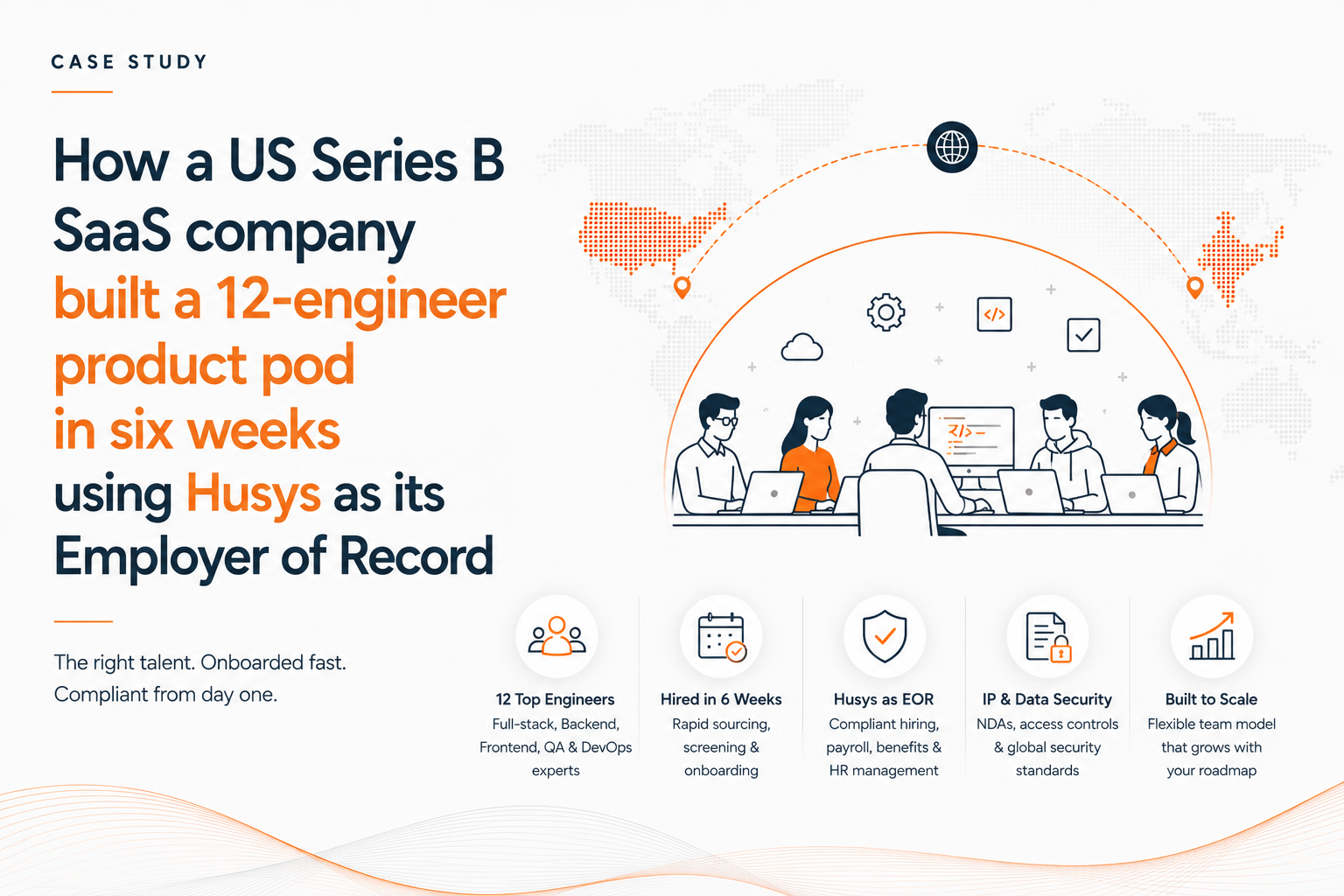
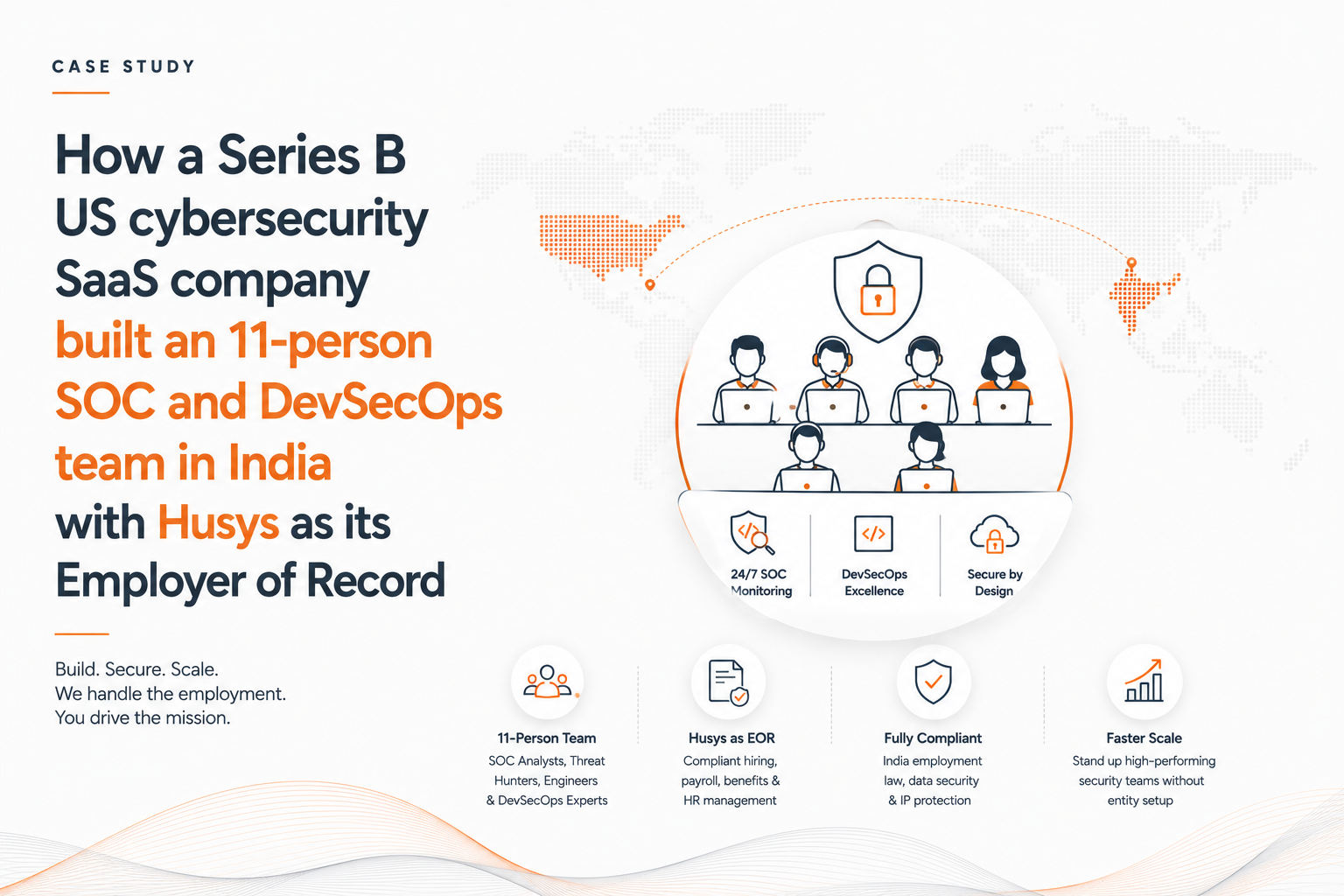
See how US companies have usedHusys EOR to build India teams, including a US cybersecurity startup that hired eight engineers in Pune and a SaaS company that used EOR to test the India market before transitioning to an entity.
For companies entering India, this matters because employment compliance can vary across states and employee lifecycle events such as onboarding, payroll, leave, and termination require local handling.
Payroll vs EOR in India: Who Holds Employment Liability
The legal employer is responsible for employment obligations in India, including applicable payroll compliance, statutory benefits, employee disputes, and regulatory requirements. The key difference between payroll outsourcing and EOR is therefore who the legal employer is.
With payroll outsourcing: Your Indian entity remains the legal employer. The provider processes payroll and supports filings, but your company retains responsibility for employment obligations.
With EOR: The EOR is the legal employer. The EOR manages employment contracts, payroll, statutory compliance, and employee lifecycle obligations within the EOR arrangement.
Labour or tax audit: The legal employer must maintain the required employment and compliance records and respond to applicable authorities.
Case Study
A Seattle-based Mid-Market SaaS company with 15 employees wants to hire its first engineer in India.
With payroll outsourcing:
The company first needs an Indian entity and the applicable registrations and payroll infrastructure. The payroll provider can then process payroll and filings.
With EOR:
The company can hire through the EOR’s existing Indian employment structure, without first establishing its own Indian entity. The EOR handles the employment, payroll, and applicable compliance administration.
Why PEO Models Do Not Apply to India Employment Laws
US PEOs are generally built around a co-employment model, where the company and provider share defined employer responsibilities. When a US company evaluates a PEO for India, the important question is whether the arrangement changes the identity of the legal employer.
For India hiring, a PEO-style service does not by itself make the provider the legal employer. If your Indian entity employs the worker, your entity remains responsible for the employment relationship and applicable statutory obligations.
This means:
Your Indian entity remains the employer when using PEO-style HR or payroll support.
Employment contracts remain with your entity.
Applicable PF, ESI, TDS and other statutory obligations remain connected to the legal employer.
Employee disputes, terminations and regulatory matters involve the legal employer.
For a US company without an Indian entity, the more relevant question is whether an EOR structure is appropriate.
An EOR changes the legal-employer arrangement by employing the worker through its own Indian entity.
Why PEO Models Do Not Apply to India Employment Laws
US PEOs are generally built around a co-employment model, where the company and provider share defined employer responsibilities. When a US company evaluates a PEO for India, the important question is whether the arrangement changes the identity of the legal employer.
For India hiring, a PEO-style service does not by itself make the provider the legal employer. If your Indian entity employs the worker, your entity remains responsible for the employment relationship and applicable statutory obligations.
This means:
Your Indian entity remains the employer when using PEO-style HR or payroll support.
Employment contracts remain with your entity.
Applicable PF, ESI, TDS and other statutory obligations remain connected to the legal employer.
Employee disputes, terminations and regulatory matters involve the legal employer.
For a US company without an Indian entity, the more relevant question is whether an EOR structure is appropriate.
An EOR changes the legal-employer arrangement by employing the worker through its own Indian entity.
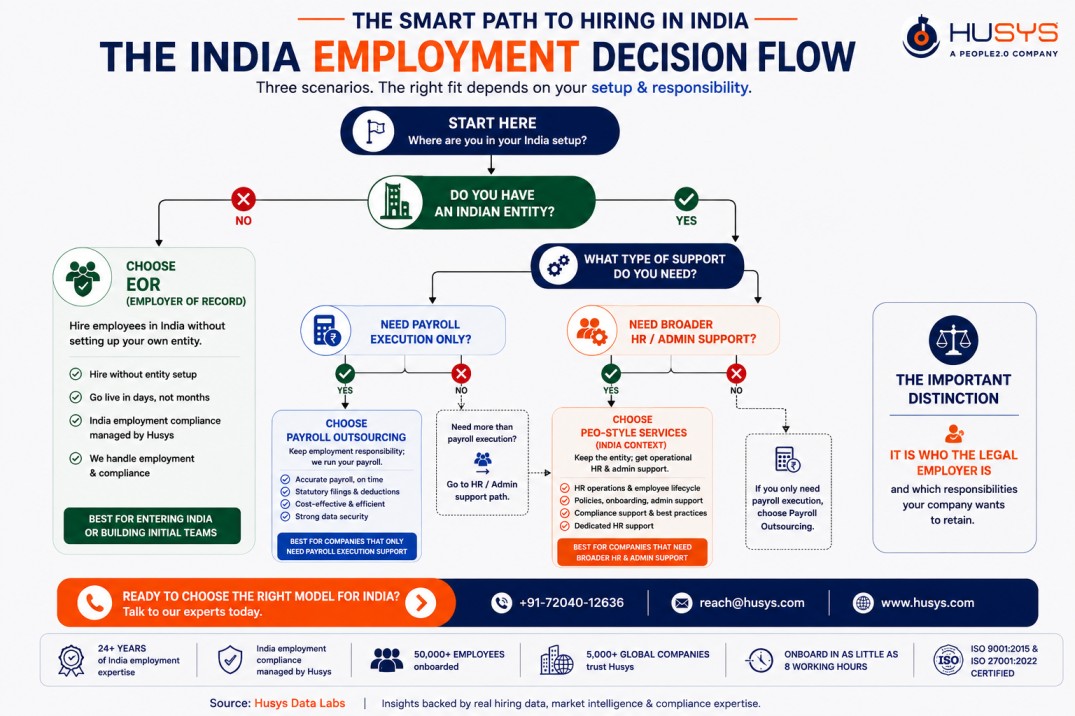
How US Companies Should Choose Between EOR, PEO, and Payroll Outsourcing in India
The right model depends on three questions:
Do you have an Indian entity?
How many people do you plan to hire?
How much employment and compliance responsibility do you want to manage internally?
Start with your India setup
No Indian entity → EOR
If you do not have an Indian entity and want to hire employees in India, an EOR allows you to employ the team through an existing local employment structure without establishing your own entity.
Indian entity already in place → Payroll or HR support
If you already have an Indian entity, you can retain employment responsibility and use payroll outsourcing for payroll execution or broader HR support for administrative operations.
Then consider your hiring plan
1–10 employees / testing India: EOR can avoid the fixed setup and administrative overhead of establishing an entity for a small initial team.
Growing India team: Compare the ongoing EOR cost against the cost and operational requirements of running your own entity.
Long-term India operation: An entity may make more sense when you need greater control over employment, compensation, policies, and local operations.
The simple decision
No entity + need to hire → EOR Entity + need payroll execution → Payroll outsourcing Entity + need broader HR/admin support → PEO-style services
A practical decision flow for companies choosing between EOR, payroll outsourcing, and PEO-style HR support in India based on entity status and the level of employment responsibility they want to retain.
The important distinction is not the service label. It is who the legal employer is and which responsibilities your company wants to retain.
When Payroll Outsourcing in India Actually Works
Payroll outsourcing in India works best when your company already has an Indian entity and wants to outsource payroll execution without changing who employs the workers.
Before using payroll outsourcing, your company should already have:
An Indian entity with the applicable registrations required to employ staff and run payroll.
A defined salary structure covering payroll, tax, statutory deductions, and benefits.
Employment contracts and HR policies owned by your company.
Internal ownership of employee lifecycle decisions, including onboarding, compensation changes, exits, and settlements.
A need for payroll execution and reporting, rather than a provider to become the legal employer.
Example
A US-based SaaS company has an Indian entity and around 80 employees. Its finance team has already established salary structures, registrations, and employment policies.
The company can use a payroll provider to run monthly payroll, process statutory filings, and generate reports while the Indian entity remains responsible for employment and compliance decisions.
In this situation, payroll outsourcing improves operational efficiency because the underlying employment structure is already established.
When You Need an Employer of Record in India
You typically need an Employer of Record in India when you want to hire employees without establishing and operating your own Indian entity.
An EOR is particularly relevant when:
You are hiring a small initial team, such as 1–10 employees, and do not want to take on the fixed cost and administration of an Indian entity.
You need to hire quickly and do not want entity registration, banking, tax, and labour-compliance setup to delay hiring.
You are testing the Indian market and are not yet ready to make a long-term commitment to an Indian entity.
You do not have an internal India HR, payroll, or compliance team to manage local employment requirements.
You want one provider to manage employment contracts, payroll, statutory compliance, onboarding, and exits.
When EOR may not be the right long-term model
EOR is not automatically the best option for every company. As your India team grows, compare the recurring EOR cost with the cost and operational requirements of maintaining your own entity.
EOR is not the right long-term model for every company. If you already have an Indian entity, need to directly generate revenue through your Indian operation, or are building a substantial long-term presence, anentity structure may be more appropriate.
An Indian entity may become more appropriate when you need greater control over compensation structures, benefits, equity, employment policies, or long-term India operations.
Example
A US-based SaaS company with 30 employees plans to hire three engineers in India. It does not yet have an Indian entity and wants to validate the India hiring strategy before committing to a permanent setup.
With an EOR, the company can hire the three engineers without first establishing its own Indian entity. The EOR manages the employment relationship, payroll, and applicable compliance administration while the US company manages the employees’ day-to-day work.
As the India team grows and the company’s long-term plans become clearer, it can reassess whether establishing its own entity makes financial and operational sense.
Husys can onboard employees within 8 working hours once the required information, approvals, and documentation are complete.
Avoid Compliance Headaches from Day One
PF, ESI, TDS, payroll processing, and monthly filings start with your first hire. EOR handles all of it, so you don’t have to.
Common Vendor Mistakes: Misleading PEO and Payroll Advice in India
Companies evaluating EOR, PEO-style services, and payroll outsourcing in India can run into problems when the provider’s service description is confused with the underlying employment structure.
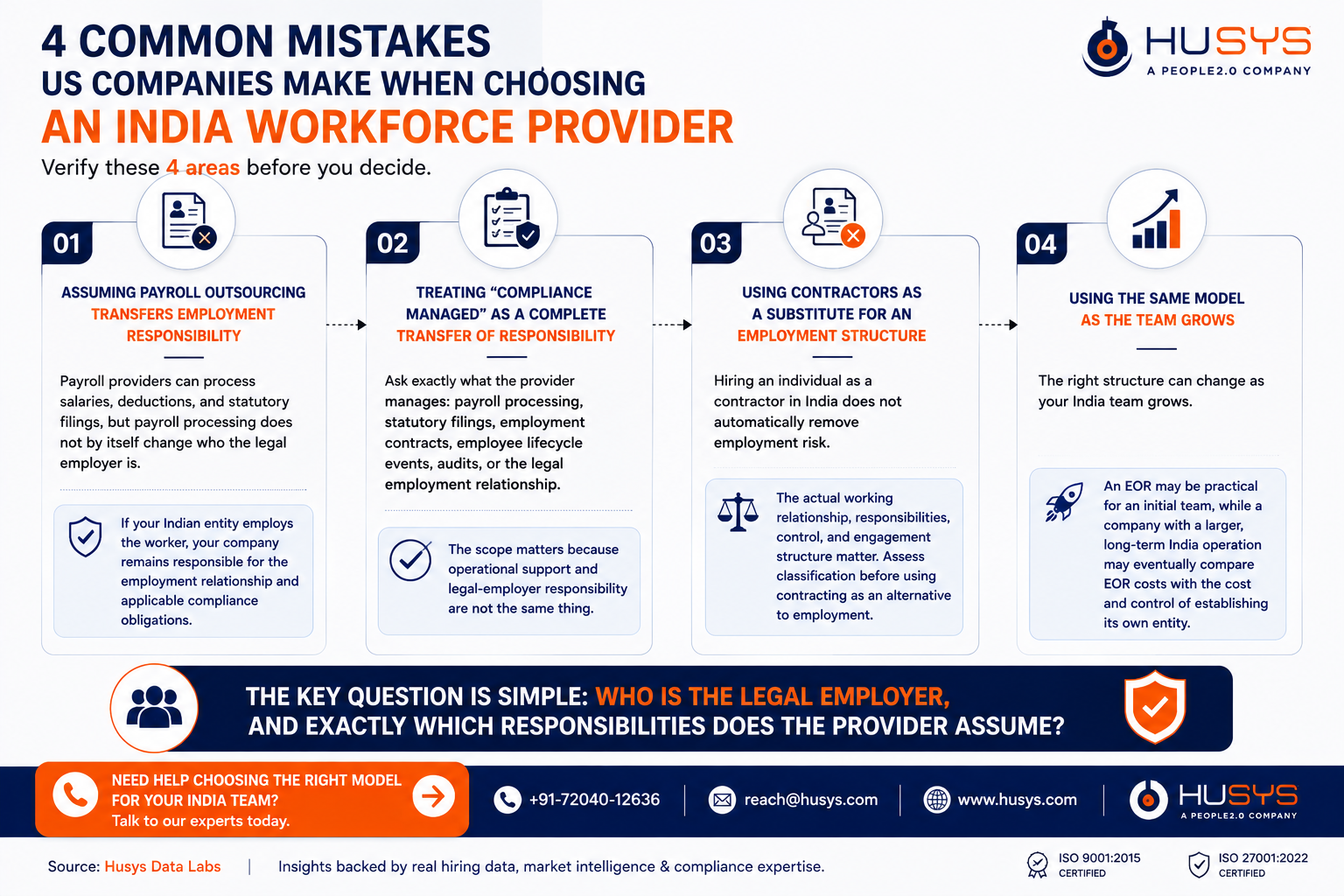
Here are four areas US companies should verify before choosing a provider:
Payroll providers can process salaries, deductions, and statutory filings, but payroll processing does not by itself change who the legal employer is. If your Indian entity employs the worker, your company remains responsible for the employment relationship and applicable compliance obligations.
Treating “compliance managed” as a complete transfer of responsibility
Ask exactly what the provider manages: payroll processing, statutory filings, employment contracts, employee lifecycle events, audits, or the legal employment relationship. The scope matters because operational support and legal-employer responsibility are not the same thing.
Using contractors as a substitute for an employment structure
Hiring an individual as acontractor in India does not automatically remove employment risk. The actual working relationship, responsibilities, control, and engagement structure matter. Companies should assess classification before using contracting as an alternative to employment.
Using the same model as the team grows
The right structure can change as your India team grows. An EOR may be practical for an initial team, while a company with a larger, long-term India operation may eventually compare EOR costs with the cost and control of establishing its own entity.
Four areas US companies should verify before choosing an India workforce provider: employment responsibility, compliance scope, contractor classification, and whether the model can support a growing India team.
The key question when evaluating an India workforce provider is simple: who is the legal employer, and exactly which responsibilities does the provider assume?
EOR vs Entity Setup in India: When Should You Switch
The decision to move from anEOR to your own Indian entity usually depends on team size, total operating cost, control requirements, and how committed you are to building a long-term India operation.
When an Indian entity may make more sense
Consider evaluating an entity when:
Your India team has grown enough that recurring EOR fees need to be compared with the cost of running your own entity.
You want greater control over compensation structures, benefits, ESOPs, employment policies, and employee operations.
India has become a long-term operating location rather than a market you are still testing.
You have the internal HR, finance, legal, or operations capability to manage employment and compliance responsibilities in India.
You are prepared to take responsibility for registrations, payroll, statutory filings, audits, and ongoing regulatory requirements.
What changes when you set up an entity
Your company becomes the legal employer for employees hired through the entity.
Your company becomes responsible for applicable PF, ESI, TDS, and other statutory employment requirements.
You manage employment contracts, policies, payroll, employee matters, and compliance directly or through vendors.
Your company assumes direct responsibility for audits, regulatory matters, and applicable penalties.
Example
A US-based SaaS company starts with four employees in India through an EOR. This allows the company to test its India hiring strategy without establishing its own entity.
Over the following year, the India team grows to 30 employees and India becomes a long-term operating location. The company now wants greater control over compensation, benefits, and employment policies.
At this stage, it can compare the economics and operational requirements of establishing its own Indian entity against continuing with an EOR.
The important point is that there is no universal headcount at which every company should switch. The right time depends on the company’s hiring trajectory, expected tenure in India, required level of control, and total cost of each model.
Evaluate the Cost and Control Trade-Off Between EOR and Entity Setup
As your team grows, the cost and control trade-offs between EOR and an entity start to change. Get a clear view of when the shift makes financial and operational sense based on your hiring plan.
Final Verdict: EOR vs PEO vs Payroll Outsourcing in India for US Companies - What to choose?
EOR, PEO-style services, and payroll outsourcing solve different India hiring needs. The right choice depends primarily on whether you already have an Indian entity and who you want to be the legal employer.
Your situation
Model to evaluate
Why
No Indian entity + want to hire employees
EOR
The EOR provides the local employment structure and becomes the legal employer.
Indian entity + need payroll execution
Payroll outsourcing
Your entity remains the employer while the provider manages payroll processing and filings.
Indian entity + need broader HR/admin support
PEO-style services
The provider supports HR and administration while your entity remains the employer.
India team growing + long-term commitment
Compare EOR vs entity setup
Evaluate recurring EOR costs against entity costs, control, and operational requirements.
The simplest way to decide
No Indian entity → EOR Indian entity + payroll support → Payroll outsourcing Indian entity + broader HR support → PEO-style services Growing long-term operation → Compare EOR vs entity
For most US companies entering India, the decision should start with the employment structure, not the vendor. Once you know who will be the legal employer and how much responsibility you want to retain, the right service model becomes much clearer.
Still Deciding Between EOR, Payroll, or Entity Setup?
Share your hiring plan and get a clear recommendation based on your team size, timeline, and structure.
Next Steps: Hiring in India Without Compliance Risk
Before choosing an EOR, payroll provider, or Indian entity structure, answer three questions:
How many people are you planning to hire? Define your expected India headcount for the next 3–6 months rather than evaluating the first hire in isolation.
How quickly do you need to hire? If hiring is time-sensitive, compare the time required for entity setup and registrations with the speed of an existing EOR employment structure.
Who will own India employment operations? Decide whether your internal team will manage contracts, payroll, statutory compliance, employee lifecycle events, and local employment requirements — or whether you want a provider to manage them.
These three answers will help determine whether EOR, payroll outsourcing, PEO-style HR support, or an Indian entity is the right structure for your company.
If you are still evaluating your options, speak with an India hiring expert before making your first offer. The goal is to choose the employment structure that fits your headcount, timeline, and long-term India plans, not simply the lowest-cost provider.
Husys offers flexible EOR pricing based on team size and engagement requirements.
Plans can start at $99 per employee per month, subject to the scope and commercial terms of the engagement.
Can a US company hire employees in India without setting up an Indian entity?
Yes. A US company can use an Employer of Record (EOR) to employ workers in India without establishing its own Indian entity. The EOR becomes the legal employer and manages the employment contract, payroll, and applicable statutory compliance.
What is the difference between EOR and payroll outsourcing in India?
EOR means the EOR is the legal employer. With payroll outsourcing, your Indian entity remains the legal employer and the provider primarily handles payroll processing and related filings.
Does payroll outsourcing transfer employment liability to the payroll provider?
No. Payroll outsourcing does not by itself change the legal employer. If your Indian entity employs the worker, your company retains responsibility for the employment relationship and applicable compliance obligations.
How quickly can a US company hire employees in India through an EOR?
The timeline depends on the EOR’s onboarding process, employee documentation, approvals, and the employment structure. An EOR can generally start onboarding faster than a company establishing its own Indian entity because the local employment infrastructure is already in place.
Can I hire contractors in India instead of using an EOR?
You can engage contractors, but the classification should match the actual working relationship. If the engagement operates like employment, using a contractor solely to avoid establishing an employment structure can create classification and compliance concerns.
What happens when an employee leaves or is terminated in India?
The employment relationship must be closed according to the applicable employment terms and Indian requirements, including notice periods, final settlement, documentation, and any applicable statutory obligations. Under an EOR arrangement, the EOR manages these employment processes as the legal employer.
Can a US company offer equity or ESOPs to employees in India through an EOR?
Potentially, but the structure needs to be reviewed for the specific employment and regulatory requirements involved. Companies should confirm how the equity arrangement will work with the EOR and the employee’s local employment terms before making an offer.
Do I need an Indian bank account to pay employees?
If you employ workers through your own Indian entity, you will need the appropriate local banking and payroll setup. With an EOR, the EOR handles local salary payments through its employment infrastructure.
Is hiring in India cheaper than hiring in the US?
Employee compensation in India can be lower than comparable US compensation, but the total cost should also include statutory contributions, benefits, payroll, compliance, entity costs, or EOR fees. The relevant comparison is total employment cost rather than salary alone.
When should a US company switch from EOR to its own Indian entity?
There is no universal headcount threshold. Companies typically evaluate the change when India becomes a long-term operation and the cost, control requirements, team size, and internal capability make running an entity worth comparing with the ongoing EOR model.
Empowering Your Workforce Journey with Trusted Insights
Find the latest industry trends, expert blogs, insightful case studies, and essential tools. Whether you’re expanding your team locally or globally, we’ve got the information you need to make informed decisions and stay ahead of the curve.