
How can US companies hire employees in India without setting up a local entity?
US companies can hire employees in India without setting up a local entity by using a Professional Employer Organization (PEO) or Employer of Record (EOR). These models handle compliance, payroll, and legal employment while allowing companies to retain full operational control.
However, hiring in India involves state-level labor laws, statutory benefits, and structured employment rules that differ significantly from the US, making the right setup critical for speed and compliance.
Most US companies don’t fail in India because of talent, they fail because of compliance and execution gaps.
How US Companies Can Hire Employees in India (Quick Answer)
The most effective way to hire employees in India depends on whether you use a PEO or EOR model.These models help manage compliance, payroll, and employment without operational complexity.
The right model depends on whether the company has a legal entity in India and the stage of expansion.
This model allows companies to:
- Hire employees legally under a local entity
- Manage payroll, taxes, and compliance
- Avoid entity setup delays (4–6 months)
- Scale teams quickly with full operational control
Most companies use this approach when hiring small to mid-sized teams or testing the India market.
What is an Employer of Record (EOR) in India?
With millennials expected to comprise 75% of the workforce by 2025 and 71% anticipating at least one international assignment, demand for going global is increasing. Businesses today need not limit themselves to hiring talent globally, even though it brings compliance challenges.
Professional employer organizations (PEOs) provide an optimal solution to all the global workforce management challenges. By serving as a legally recognized employerPEO service providers enable excellent talent acquisition across geographies while providing strategic expertise in HR, benefits, payroll, visa, and compliance. As demand increases for borderless talent pools, PEO partnerships will become ever more vital for organizational success.
Let’s understand how.
An Employer of Record (EOR) is a third-party service provider that legally employs workers on behalf of a company in India.
What it does:
- Acts as the legal employer in India
- Manages payroll, taxes, and statutory compliance
- Issues employment contracts aligned with Indian labor laws
What it does not do:
- Control the employee’s day-to-day work
- Replace your internal management or reporting structure
For US companies, this model enables hiring in India without setting up a local entity while ensuring full compliance.
Unlike a PEO, an EOR does not require the company to set up a local entity.
When to Use EOR vs PEO in India
The choice between EOR and PEO depends on your company’s structure and expansion stage.
– Use EOR (Employer of Record):
When you do not have a legal entity in India and want to hire quickly with full compliance.
– Use PEO (Professional Employer Organization):
When you already have an entity in India and need support with payroll, HR, and compliance management.
For most US companies entering India for the first time, EOR is the fastest way to start hiring. As teams scale, companies may transition to a PEO or set up their own entity.
How US Companies Hire Employees in India Using a PEO
Step 1:
Define the role and compensation
The company identifies the role, responsibilities, and salary based on market benchmarks in India.
Step 2:
Generate a compliant employment contract
The PEO creates an India-compliant employment agreement including statutory benefits, notice periods, and tax structure.
Step 3:
Employee onboarding under PEO entity
The employee is legally hired under the PEO’s Indian entity while working exclusively for the client company.
Step 4:
Payroll, taxes, and compliance management
The PEO handles monthly payroll, tax deductions (TDS), and statutory contributions such as PF and ESI.
Step 5:
Ongoing employee lifecycle management
Leave management, benefits administration, and compliance updates are managed by the PEO while the company retains full control over day-to-day work.
Typical timeline: 1–5 working days (compared to 4–6 months for setting up an entity)
Who This Guide Is For (and What You’ll Get)
What you’ll get:
A practical, execution-ready framework to hire and scale teams in India without entity setup delays, compliance risks, or operational inefficiencies.
Who this is for:
US-based founders, CFOs, and HR leaders at early-to-mid-stage companies who need to hire specialized talent in India but lack the infrastructure, legal expertise, or appetite for risk that comes with DIY international expansion.
If you’re evaluating whether to set up an entity, work with a PEO, or continue hiring contractors, this guide will give you a clear path forward.
Why Husys:
With 24 years of India-specific PEO/EOR experience, 5,000+ clients served, and a 100% compliance track record across 28 states and 6 union territories, we’ve navigated every regulatory shift and edge case that challenges US companies expanding into India.
We don’t just process payroll, we architect workforce strategies that scale.
Global Expansion Strategy for Entering India
Trends Shaping the Future of Global Workforce Management
Global workforce management in India has become a strategic priority for US companies expanding internationally.
Without the right setup, companies risk delays, penalties, and operational inefficiencies that slow down growth.However, global workforce management in India involves navigating compliance, payroll, and employment structures across multiple regulatory layers.
A strategic approach using PEO or EOR models enables companies to hire quickly, stay compliant across multiple states, and scale without setting up a local entity.
TLDR: Executive Summary
The landscape: 71% of millennials expect international assignments, yet 60% of many global employers expanding to India face compliance penalties within their first 18 months. The gap between talent ambition and operational readiness has never been wider.
The problem: Expanding into India through traditional models is slow, expensive, and high-risk. Setting up an entity costs $15,000–$50,000 and takes 4–6 months, delaying hiring and market entry.
Many companies attempt to bypass this by hiring contractors, but misclassification can trigger penalties of 20–40% of total compensation, along with compliance violations across multiple states.
The gap between access to talent and the ability to hire compliantly is where most companies fail.
The solution: Professional Employer Organizations (PEOs) act as your legal employer, managing payroll, compliance, and statutory requirements while you retain full operational control through PEO services in India.
This enables companies to onboard employees in days, not months, while staying compliant across multiple states without setting up a local entity.
Think of it as infrastructure-as-a-service for international hiring.
The Husys difference: We onboard employees in 8 working hours, manage compliance across all 28 Indian states, and charge $99/employee/month with zero hidden fees.
Our HR platform gives you real-time visibility into payroll, leave balances, and compliance status, no spreadsheets, no surprises.
Key Takeaways
- Expanding into India without the right structure can lead to delays, penalties, and compliance risks
- Setting up an entity takes 4–6 months and costs $15,000–$50,000
- Contractor misclassification can result in 20–40% penalties
- PEO/EOR models enable faster, compliant hiring without entity setup
- Companies that succeed focus on infrastructure, not just talent
Global Workforce Management in India: Why It Matters
Key Trends Shaping Global Hiring
Let’s start with what’s actually happening in the market, not what LinkedIn thought leaders claim:
Metric | 2024 Reality | Source |
Remote-first companies | 16% of global companies now fully remote | |
Cross-border hiring growth | 42% YoY increase in international hires by US tech companies | |
Compliance violations | $4.5M average penalty for misclassification in India | |
Time to entity setup (India) | 4–6 months average | |
Gen Z international work expectations | 78% expect to work across multiple countries in their career |
What’s Driving This Shift
- Talent Scarcity in Tier-1 Markets
A senior React developer in San Francisco costs $180,000–$220,000 annually. The same skill level in Bangalore? $35,000–$50,000. But here’s what most US founders miss: it’s not just about cost arbitrage anymore.
According to GitHub’s Octoverse Report 2024, India now has the second-largest developer community globally (13.2M developers), with specialized expertise in AI/ML, cloud infrastructure, and cybersecurity that’s increasingly hard to find domestically.
Why this matters for US companies:
Access to high-quality talent at lower costs is driving global hiring decisions.
- The “Work From Anywhere” Expectation
A Buffer State of Remote Work 2024 study found that 98% of workers want to work remotely at least some of the time. But here’s the kicker: 62% would consider leaving their current job if remote work was taken away.
For global employers, this means your talent pool is either global, or you’re competing with one hand tied behind your back.
- Regulatory Complexity Is Accelerating, Not Simplifying
India introduced new labor codes in 2023 that consolidated 29 central labor laws into 4 codes. Sounds simpler, right? Wrong.
Each of India’s 28 states can implement these codes differently. For example:
- Maharashtra requires monthly PF contributions for employees earning up to ₹15,000 (~$180/month)
- Karnataka extends this threshold to ₹21,000 (~$252/month)
- Tamil Nadu has different Professional Tax slabs than Gujarat
Without local expertise, you’re navigating a compliance minefield blindfolded.
The Millennial/Gen Z Factor
Here’s a stat that should terrify traditional HR leaders: according to Gallup’s Global Workforce Report, 60% of millennials are “open to a different job opportunity,” and 21% have changed jobs in the past year, three times the rate of non-millennials.
These workers expect:
- Flexibility in location and hours
- Transparent, digital-first HR processes
- Global career mobility
- Instant access to payroll/benefits information
Legacy HR systems built for 9-to-5 office workers can’t deliver this. PEOs with modern tech platforms (like our Husys HR platform) can.
India has one of the largest developer talent pools globally, with over 13 million developers, making it a key destination for global hiring.
Why Traditional Workforce Models Are Breaking Down
The Entity Setup Trap
Most companies expanding to India follow this playbook:
- Hire a law firm to set up a Private Limited Company (~$15K–$25K)
- Register for GST, PF, ESI, Professional Tax (~3–4 months)
- Hire a local HR manager (~$30K–$50K annually)
- Set up payroll systems (~$10K–$20K)
- Discover compliance gaps 12 months later (~$50K–$200K in penalties)
Total first-year cost: $120K–$350K before hiring a single employee.
Time to first hire: 5–7 months.
Risk exposure: Permanent Establishment (PE) triggers if your Indian entity generates revenue, potentially subjecting your entire US operation to Indian corporate tax (25–30%).
The Contractor Misclassification Crisis
Many global employers try to sidestep entity setup by hiring Indian contractors, but this approach carries significant risks as explained in contractor vs employee classification in India. This works, until it doesn’t.
India’s contractor vs. employee test (per the Industrial Disputes Act):
Factor | Contractor | Employee |
Control over work hours | Sets own schedule | Employer dictates hours |
Tools/equipment | Provides own | Employer provides |
Exclusivity | Works for multiple clients | Works exclusively for one company |
Integration | Peripheral to business | Integral to operations |
Payment structure | Project-based invoices | Regular salary |
If your “contractor” fails even 2–3 of these tests, Indian labor authorities can reclassify them as employees, triggering:
- Retroactive PF/ESI contributions (12% of salary + penalties)
- Gratuity payments (4.81% of salary for every year worked)
- Notice period violations (up to 3 months’ salary)
- Wrongful termination claims (reinstatement + back wages)
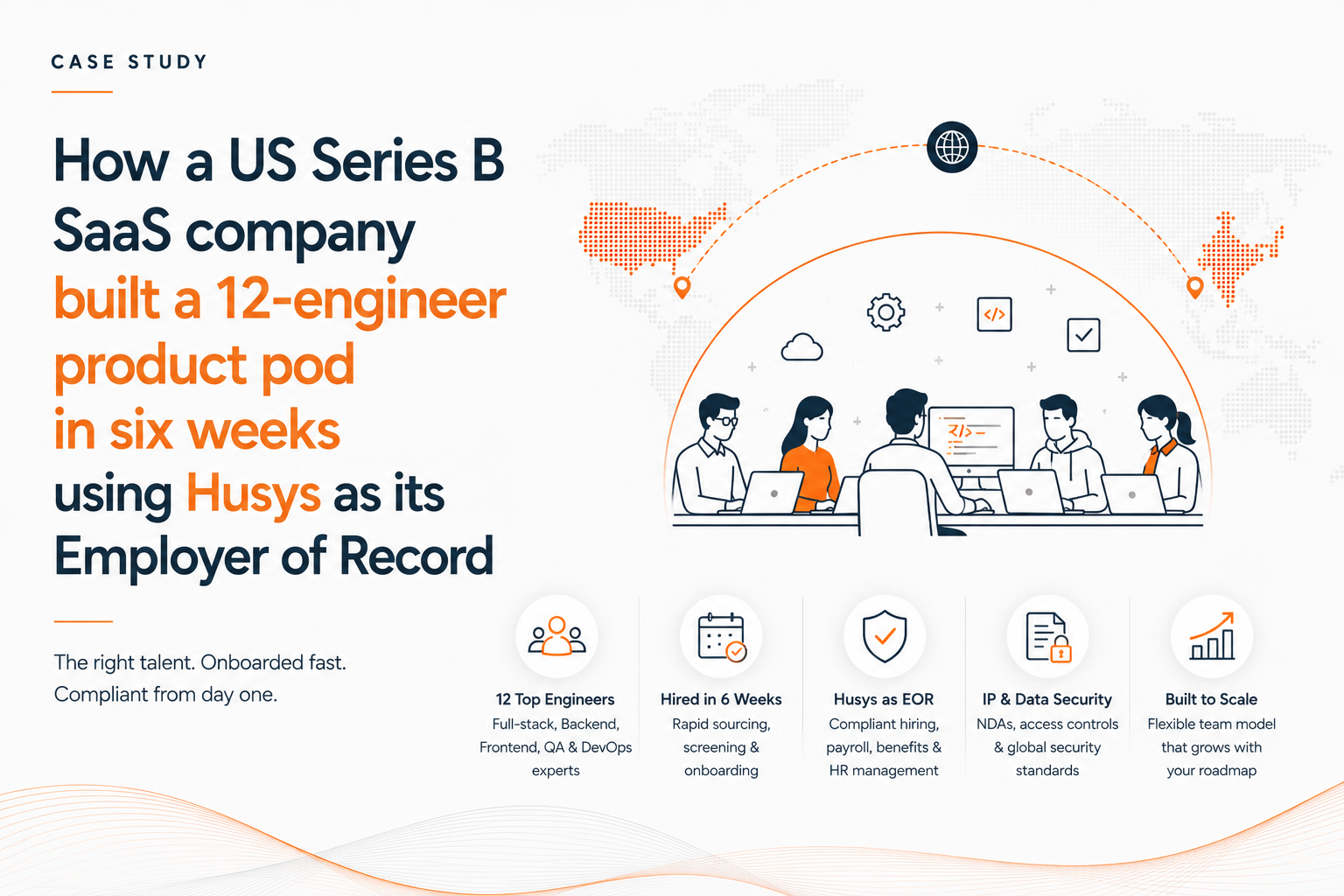
Real example: A US SaaS company we onboarded in 2023 had misclassified 12 Indian contractors for 18 months. Total liability: $127,000. They came to us after receiving a labor department notice.
The “We’ll Figure It Out” Approach
Some companies try to manage Indian employees through their US entity, paying them as international contractors via Wise or PayPal.
Why this fails:
- No local tax withholding → Employee faces 30% TDS penalty at year-end
- No statutory benefits → Violates PF Act, ESI Act (criminal liability for directors)
- No employment contract → Zero legal protection in disputes
- Currency risk → Employee bears forex fluctuation costs
- PE risk → Your US entity may be deemed to have a taxable presence in India
According to Deloitte’s 2024 Global Payroll Complexity Index, India ranks 7th globally for payroll complexity, ahead of China, Brazil, and Germany.
Operational Challenges in Global Workforce Management in India
The biggest challenge in global workforce management in India is not hiring talent, but setting up the right operational and compliance structure.
For US companies, what looks like a straightforward hiring decision quickly becomes a multi-layered problem involving labour laws, payroll systems, and employment classification.
Global workforce management in India requires navigating central and state-level regulations, each with its own requirements for employee benefits, registrations, and reporting. Without the right structure, even small teams can face compliance risks early.
Key challenges include:
- Statutory compliance: Managing PF, ESI, gratuity, and labour law registrations across states
- Payroll complexity: Handling tax deductions, filings, and monthly compliance timelines
- Employment classification: Deciding between contractors and full-time employees while staying compliant
- Multi-state regulations: Different rules depending on where employees are located
This is where global workforce management in India becomes complex for US companies without local expertise or infrastructure.
This is also why many companies look at structured solutions like PEO models to simplify global workforce management in India and ensure compliance from day one.
For US companies, getting global workforce management in India right early is the difference between smooth scaling and operational friction.
The Hidden Costs of Getting India Hiring Wrong
Direct Financial Penalties
Violation Type | Penalty Range (USD) | Legal Basis |
PF non-compliance | $1,200–$6,000 per employee + 12% interest | Employees’ Provident Funds Act, 1952 |
ESI non-registration | $600–$2,400 + damages | Employees’ State Insurance Act, 1948 |
Professional Tax lapses | $120–$600 per employee per state | State-specific PT Acts |
Gratuity non-payment | 4.81% of salary × years worked | Payment of Gratuity Act, 1972 |
Wrongful termination | 3–12 months’ salary + reinstatement | Industrial Disputes Act, 1947 |
Shops & Establishments violations | $300–$1,800 per location | State-specific S&E Acts |
Average total exposure for a 10-person team over 2 years: $45,000–$180,000.
Indirect Costs (The Real Killers)
- Opportunity Cost of Delayed Hiring
- Executive Time Drain
- Employee Experience Degradation
Lets explore these Costs in detail
- Opportunity Cost of Delayed Hiring
If entity setup takes 5 months, and you need a team of 5 engineers to launch your India product, you’re losing:
- 5 months of development time = ~$125K in delayed revenue (assuming $25K/month burn rate)
- Competitive advantage = Competitors with PEO partnerships hire in 8 days, not 5 months
- Executive Time Drain
We surveyed 47 US founders who set up Indian entities in 2022–2023. Average time spent on India compliance/HR issues:
- Founders: 8–12 hours/month
- CFOs: 15–20 hours/month
- General Counsel: 10–15 hours/month
At a blended rate of $200/hour, that’s $6,600–$9,400/month in opportunity cost, or $79,200–$112,800 annually.
- Employee Experience Degradation
When payroll is late, benefits are confusing, or tax filings are wrong, your best people leave.
LinkedIn’s 2024 Workforce Confidence Index found that 41% of Indian professionals cite “administrative chaos” as a top-3 reason for leaving employers.
Replacing a senior engineer in India costs 6–9 months’ salary in recruiting, onboarding, and lost productivity, roughly $18,000–$35,000 per departure.
The Permanent Establishment (PE) Nightmare
This is the risk that keeps CFOs up at night.
What triggers PE in India:
- Indian employees making sales to Indian customers
- Indian team members signing contracts on behalf of the US entity
- Indian office space used for client meetings
- Indian employees with authority to bind the company
Consequences of PE:
- Your US entity becomes subject to 30% Indian corporate tax on India-attributable income
- Transfer pricing audits (average cost: $50K–$150K)
- Mandatory Indian tax filings (ongoing cost: $15K–$30K/year)
- Potential double taxation if US-India tax treaty benefits are lost
Real case: A US fintech company we work with had 3 Indian contractors who started demoing products to Indian prospects. The Indian tax authority deemed this a PE. Settlement cost: $340,000 in back taxes + penalties.
With a PEO, this risk disappears, we’re the legal employer, and we structure operations to avoid PE triggers.
How PEOs Transform Global Workforce Management
What a PEO Actually Does (In Plain English)
Think of a PEO as your legal employer of record in India. Here’s the structure:
You control:
- Who to hire/fire
- Day-to-day work assignments
- Performance management
- Compensation levels
- Company culture
We handle:
- Employment contracts (India-compliant)
- Payroll processing (PF, ESI, PT, TDS)
- Benefits administration
- Visa/immigration (if needed)
- Compliance monitoring (28 states, 6 UTs)
- Termination procedures (notice periods, severance)
- Labor law updates
The 8-Hour Onboarding Reality
Here’s our actual process for onboarding a new employee in India:
Hour | Activity | Owner |
0–2 | Client submits employee details via Husys HR Portal portal | Client |
2–4 | We generate India-compliant employment contract | Husys Legal |
4–6 | Employee reviews/signs contract digitally | Employee |
6–7 | We register employee for PF, ESI, PT (as applicable) | Husys Compliance |
7–8 | Employee gains access to Husys HR platform self-service portal | Husys Tech |
Day 1: Employee can start work with full legal protection and benefits.
Compare this to entity setup:
- Company registration: 15–20 days
- PF/ESI registration: 10–15 days
- Professional Tax registration: 5–10 days
- Bank account setup: 10–15 days
- Payroll system configuration: 15–20 days
Total: 55–80 days minimum.
PEO models are most effective when a company has an existing entity and needs support with HR operations and compliance management.
The Husys HR Platform: Your Single Source of Truth
Most PEOs give you monthly PDF reports and a phone number. We give you a real-time platform:
Employee Self-Service:
- View payslips (with PF/ESI/TDS breakdowns)
- Apply for leave (synced with Indian holiday calendars)
- Download Form 16 (annual tax certificate)
- Update bank/address details
- Access benefits information
Client Dashboard:
- Real-time headcount by state/department
- Payroll forecasting (with statutory cost breakdowns)
- Compliance status (color-coded by risk level)
- Document repository (contracts, amendments, terminations)
- Invoice history and payment tracking
Why this matters: According to Gartner’s 2024 HR Tech Survey, 68% of HR leaders cite “lack of real-time workforce data” as their #1 barrier to strategic decision-making.
State-Level Compliance: The Devil in the Details
India isn’t one labor market, it’s 28 distinct regulatory environments.
Example: Professional Tax variations
State | Monthly PT (Employee earning ₹50,000) | Annual PT |
Maharashtra | ₹300 ($3.60) | ₹3,600 ($43) |
Karnataka | ₹200 ($2.40) | ₹2,400 ($29) |
West Bengal | ₹200 ($2.40) | ₹2,500 ($30) |
Tamil Nadu | ₹0 (exempt up to ₹21,000/month) | ₹0 |
Gujarat | ₹300 ($3.60) | ₹3,600 ($43) |
Our compliance team tracks:
- 28 state PT Acts
- 28 Shops & Establishments Acts
- 28 state-specific labor welfare funds
- 28 different holiday calendars
- 28 different minimum wage schedules
You track: Nothing. We handle it all.
The Termination Safety Net
This is where DIY approaches blow up spectacularly.
India’s notice period requirements:
Employee Tenure | Minimum Notice Period | Payment in Lieu |
< 1 year | 30 days | 1 month’s salary |
1–3 years | 60 days | 2 months’ salary |
3+ years | 90 days | 3 months’ salary |
But wait, there’s more:
- Gratuity: Mandatory for employees with 5+ years (4.81% of salary × years worked)
- Unused leave encashment: Must be paid out at termination
- PF settlement: Must be processed within 30 days
- Full & Final settlement: Must include all statutory dues
Common US mistakes:
- “At-will” terminations: Don’t exist in India. You need documented cause or proper notice.
- Immediate terminations: Even with cause, you need a show-cause notice and opportunity to respond.
- Skipping gratuity: Criminal offense under Payment of Gratuity Act.
Real example: A US e-commerce company terminated an Indian employee for poor performance without documentation. Employee filed a labor court case. Settlement: $28,000 + 18 months of legal fees.
With Husys: We document performance issues, issue proper notices, calculate all dues, and handle labor court representation if needed. Our 24-year track record: zero adverse labor court judgments.
We currently support companies hiring across 28 states and 6 union territories, ensuring compliance across diverse regulatory environments.
US vs India Employment: Key Differences for Employers
For US companies, hiring in India requires understanding how employment structures differ across both markets.
Aspect | United States | India |
Employment Type | At-will | Contract-based with notice periods |
Payroll Cycle | Bi-weekly | Monthly |
Benefits | Optional | Mandatory (PF, ESI, Gratuity) |
Termination | Immediate (at-will) | Notice period required (30–90 days) |
Compliance | Federal + state | Highly state-driven |
Tax Handling | Employer withholding | TDS + statutory contributions |
In the US, employment is flexible and termination is typically immediate. In India, employment is structured, compliance-driven, and requires advance notice, statutory benefits, and proper documentation.
The India-US Comparison: What US Leaders Misunderstand
Most US companies underestimate how fundamentally different employment in India is, not just legally, but operationally. What works in an at-will employment system does not translate to a compliance-driven, state-regulated environment like India.
For a deeper understanding, refer to EOR vs PEO models.
Employment Law: Two Different Planets
Aspect | United States | India | Why It Matters |
Employment default | At-will (49 states) | Cause-based termination only | You can’t fire without documented reason |
Notice periods | None (at-will) | 30–90 days mandatory | Budget 2–3 months’ salary for exits |
Severance | Not required (except WARN Act) | Gratuity mandatory after 5 years | 4.81% of salary × tenure |
Benefits mandates | ACA (50+ employees) | PF (20+ employees), ESI (10+ employees) | Kicks in much earlier |
Paid leave | 0 days federally mandated | 12 days earned leave + 12 casual/sick leave | 24 days minimum |
Maternity leave | 0 days federally (FMLA = unpaid) | 26 weeks paid (12 weeks pre-delivery) | Massive cost difference |
Overtime rules | FLSA exempt/non-exempt | Factories Act (2x pay after 9 hours) | Applies to tech workers in some states |
This is why simply applying US hiring practices in India often leads to compliance gaps, employee disputes, and operational inefficiencies.
Common Risks US Companies Face When Hiring in India
Hiring in India without the right structure often leads to compliance issues, delays, and unexpected costs.
- Contractor Misclassification
- Delay Due to Entity Set up
- Lack of State-Level Compliance Awareness
- Payroll & tax Errors
- Termination and Notice Period Issues
- Permanent Establishment
Let’s discuss this in detail
1. Contractor Misclassification
Many companies hire contractors to avoid entity setup, but if the working relationship resembles full-time employment, it can lead to penalties, backdated statutory payments, and legal disputes.
2. Delays Due to Entity Setup
Setting up a legal entity in India can take 4–6 months, delaying hiring, product timelines, and market entry.
3. Lack of State-Level Compliance Awareness
India has state-specific labor laws, professional tax rules, and compliance requirements that vary significantly across regions.
4. Payroll & Tax Errors
Incorrect handling of TDS, PF, ESI, and other statutory contributions can lead to penalties and compliance violations.
5. Termination & Notice Period Issues
Unlike the US, employment in India requires notice periods and structured exit processes, which can lead to disputes if not handled correctly.
6. Permanent Establishment (PE) Risk
Certain activities, such as revenue generation or contract signing in India, can expose US companies to tax liabilities under Indian law.
In our 24+years of experience, most of these risks arise when companies try to manage India hiring without local expertise or the right infrastructure.
Tax & Compliance: The Acronym Jungle
US employers deal with:
- Federal income tax withholding
- FICA (Social Security + Medicare)
- FUTA (unemployment)
- State income tax (if applicable)
Indian employers deal with:
Acronym | Full Name | Rate | Applies To |
PF | Provident Fund | 12% (employee) + 12% (employer) | Employees earning < ₹15,000/month |
ESI | Employee State Insurance | 0.75% (employee) + 3.25% (employer) | Employees earning < ₹21,000/month |
PT | Professional Tax | ₹200–₹300/month | All employees (state-specific) |
TDS | Tax Deducted at Source | 0–30% (progressive) | All employees |
LWF | Labour Welfare Fund | ₹20–₹100/year | Varies by state |
Gratuity | Gratuity contribution | 4.81% of salary | Employees with 5+ years tenure |
Total statutory cost: 15–20% on top of gross salary (vs. 7.65% FICA in US).
US founders’ reaction: “Wait, I’m paying 12% into a retirement fund I don’t control?”
Our response: “Yes, and if you don’t, you’re committing a criminal offense under the EPF Act. Also, employees love it, it’s their primary retirement vehicle.”
Holidays: The Cultural Adjustment
US federal holidays: 11 days
Indian national + state holidays: 18–25 days (varies by state)
But here’s the kicker: India has restricted holidays (employees choose 2–3 from a list of 10–15 religious/regional festivals).
Example holiday calendar (Maharashtra):
- Republic Day (Jan 26)
- Holi (March)
- Good Friday (April)
- Eid (varies)
- Independence Day (Aug 15)
- Ganesh Chaturthi (Sept)
- Dussehra (Oct)
- Diwali (Oct/Nov)
- Christmas (Dec 25)
10–12 restricted holidays
US founders’ reaction: “My team is off for 3 days during Diwali?”
Our response: “Yes, and if you schedule a critical launch during Diwali, you’ll lose your best people. Think of it like scheduling a US launch on Christmas Eve.”
Salary Structure: The CTC Confusion
In the US, you offer a gross salary + benefits.
In India, you offer a CTC (Cost to Company), which includes:
Sample CTC breakdown for ₹1,000,000 ($12,000) annual CTC:
Component | Amount (₹) | Amount ($) | % of CTC |
Basic Salary | 400,000 | 4,800 | 40% |
House Rent Allowance (HRA) | 200,000 | 2,400 | 20% |
Special Allowance | 250,000 | 3,000 | 25% |
Employer PF | 48,000 | 576 | 4.8% |
Employer ESI | 32,500 | 390 | 3.25% |
Gratuity provision | 19,240 | 231 | 1.92% |
Leave encashment | 20,000 | 240 | 2% |
Medical insurance | 15,000 | 180 | 1.5% |
Employee take-home | ~650,000 | ~7,800 | 65% |
US founders’ reaction: “Wait, the employee only gets 65% of what I’m paying?”
Our response: “Correct. The other 35% goes to statutory benefits, taxes, and employer contributions. This is why you can’t just convert a US salary to INR, you need to gross up for Indian costs.”
The Permanent Establishment (PE) Trap: A Comparison
Trigger | US (for foreign companies) | India (for US companies) |
Physical office | Yes (if > 183 days) | Yes (any duration) |
Dependent agent | Yes (if habitually exercises authority) | Yes (if any authority to bind) |
Service PE | Yes (if > 183 days in 12 months) | Yes (if > 90 days in 12 months) |
Digital presence | No (pre-OECD Pillar One) | Unclear (evolving) |
Why this matters: If your Indian team generates revenue from Indian customers, you likely have a PE, even without an office.
With a PEO: We structure operations to avoid PE triggers by ensuring:
- We’re the legal employer (not you)
- Employees don’t sign contracts on your behalf
- Revenue flows through your US entity
- No Indian office in your name
Strategic Implementation: Your 90-Day PEO Roadmap
Phase 1: Foundation (Days 1–30)
Week 1: Scoping & Strategy
- Define roles to hire (job descriptions, seniority levels)
- Determine salary ranges (use our India Salary Benchmarking Tool)
- Identify states for hiring (Bangalore, Hyderabad, Pune, Mumbai, NCR)
- Map reporting structures (who manages Indian team)
- Set budget (salary + 20% statutory costs + $99/employee/month PEO fee)
You can also explore a step-by-step approach in how to hire employees in India.
Week 2: PEO Partnership Setup
- Sign Master Services Agreement with Husys
- Complete client onboarding (company details, authorized signatories)
- Set up ApHusys client portal access
- Configure approval workflows (who approves hires, terminations, salary changes)
- Integrate with your HRIS (if applicable, we support BambooHR, Workday, ADP)
Week 3: Hiring Process Launch
- Post jobs on Indian platforms (Naukri, LinkedIn India, AngelList India)
- Screen candidates (we can provide pre-vetted talent pools)
- Conduct interviews (time zone tip: 8:30 AM PT = 9 PM IST)
- Make offers (we provide India-compliant offer letter templates)
Week 4: First Hires Onboarded
- Employees sign contracts via ApHusys
- We register employees for PF, ESI, PT
- Employees complete I-9 equivalent (Aadhaar, PAN, bank details)
- IT equipment shipped (we can handle procurement if needed)
- First day orientation (we provide India-specific onboarding checklist)
Phase 2: Optimization (Days 31–60)
Week 5–6: Process Refinement
- Review first payroll cycle (ensure accuracy)
- Gather employee feedback (ApHusys includes pulse survey tools)
- Adjust benefits (add health insurance, meal allowances, etc.)
- Set up performance review cadence (quarterly recommended for India)
Week 7–8: Scaling Preparation
- Document hiring playbook (interview questions, evaluation rubrics)
- Create India-specific employee handbook (we provide template)
- Set up cross-border collaboration norms (meeting times, communication tools)
- Plan next hiring wave (Q2 headcount targets)
Phase 3: Maturity (Days 61–90)
Week 9–10: Strategic Workforce Planning
- Analyze workforce data (ApHusys analytics: turnover, time-to-hire, cost-per-hire)
- Benchmark against market (we provide quarterly India compensation reports)
- Plan for annual events (Diwali bonuses, appraisal cycles)
- Evaluate expansion to new states (if needed)
Week 11–12: Continuous Improvement
- Conduct 90-day retrospective (what’s working, what’s not)
- Optimize cost structure (consolidate vendors, negotiate benefits rates)
- Plan for compliance audits (we conduct quarterly internal audits)
- Set 12-month workforce roadmap
The Husys Advantage: What We Do That Others Don’t
8-Hour Onboarding (Not 8 Days)
Most PEOs take 5–10 business days to onboard. We do it in 8 working hours because:
- Our compliance team pre-registers with all statutory authorities
- Husys HR platform auto-generates contracts from templates
- We have pre-negotiated benefits packages ready to activate
$99/Employee/Month (No Hidden Fees)
Our pricing includes:
- Employment contract drafting
- Payroll processing (monthly)
- PF, ESI, PT, TDS compliance
- Annual tax filings (Form 16, Form 24Q)
- Employee self-service portal access
- Client dashboard access
- Compliance monitoring
- Termination support
Not included (but available as add-ons):
- Background verification ($50/employee)
- Visa/immigration support ($500–$2,000 depending on visa type)
- Recruitment services (15% of annual salary)
- IT equipment procurement (cost + 10% handling fee)
28-State Coverage (Not Just Bangalore)
We’re registered in all 28 Indian states and 6 union territories. This matters because:
- You can hire remote workers anywhere in India
- We handle state-specific compliance (PT, S&E, LWF)
- No “sorry, we don’t operate there” surprises
24 Year Track Record (Not a 2023 Startup)
We’ve been doing this since 2002. We’ve seen:
- 4 major labor law reforms
- 3 economic crises
- 2 global pandemics
- Countless regulatory changes
Our 100% compliance record isn’t luck, it’s institutional knowledge.
Measuring Success Beyond Headcount
The Metrics That Actually Matter
Most companies track:
- Headcount
- Payroll cost
- Time-to-hire
We recommend tracking:
Metric | Why It Matters | Target Benchmark |
Compliance Risk Score | Proactive risk management | < 5% (ApHusys auto-calculates) |
Employee Net Promoter Score (eNPS) | Retention predictor | > +30 |
Cost-per-hire (India) | Efficiency measure | $2,500–$4,000 |
Time-to-productivity | Onboarding effectiveness | < 60 days |
Statutory cost as % of gross | Budget accuracy | 18–22% |
Turnover rate (India team) | Retention health | < 15% annually |
Cross-border collaboration score | Team cohesion | > 4.0/5.0 |
The ROI Calculation
Scenario: US SaaS company hiring 10 engineers in India, there are 2 options as below
- Option A : Set up an Indian Entity
- Option B: Partner with Husys PEO
Let’s explore these options in detail.
Option A: Set up Indian entity
Cost Item | Year 1 | Year 2 | Year 3 |
Entity setup | $25,000 | $0 | $0 |
Legal/accounting | $15,000 | $12,000 | $12,000 |
HR manager salary | $40,000 | $42,000 | $44,000 |
Payroll system | $15,000 | $8,000 | $8,000 |
Compliance penalties (risk) | $20,000 | $10,000 | $5,000 |
Total | $115,000 | $72,000 | $69,000 |
Option B: Partner with Husys PEO
Cost Item | Year 1 | Year 2 | Year 3 |
PEO fees ($99 × 10 × 12) | $11,880 | $11,880 | $11,880 |
Total | $11,880 | $11,880 | $11,880 |
3-Year Savings: $244,240
But wait, there’s more:
- Opportunity cost of 5-month setup delay: $125,000 (lost revenue)
- Executive time saved: $237,600 (3 years × $79,200/year)
- Risk mitigation value: $50,000–$200,000 (avoided penalties)
Total 3-year value: $656,840–$806,840
The Intangible Benefits
There are 4 intangible benefits with PEO
- Speed to Market
- Executive Focus
- Talent Access
- Risk Mitigation
- Speed to Market
Harvard Business Review research shows that companies with effective global teams launch products 40% faster than those with co-located teams.
With a PEO, you’re not waiting 5 months to hire, you’re onboarding in 8 hours. That velocity compounds across every sprint, every release, every customer win.
- Executive Focus
Your founders should be building product and closing deals, not deciphering Professional Tax regulations in Karnataka vs. Maharashtra.
Every hour spent on compliance is an hour not spent on strategy. PEOs give you that time back.
- Talent Access
India’s developer community is 13.2 million strong and growing 30% annually. But the best talent won’t work for companies with sketchy employment practices.
A proper PEO setup signals legitimacy. It tells candidates: “We’re serious about India, and we’ll treat you right.”
- Risk Mitigation
One labor court case can cost $50,000–$200,000 in legal fees alone, even if you win. One PE audit can trigger years of tax complications.
With 24 years and 5,000+ clients, we’ve seen every edge case. Our 100% compliance record isn’t marketing, it’s insurance.
When PEO Is (and Isn't) the Right Solution
PEO Makes Sense When:
- You’re hiring 1–50 employees in India (below this, entity setup costs don’t justify the overhead)
- You need to hire fast (weeks, not months)
- You lack India-specific HR/legal expertise
- You want to test the India market before committing to entity setup
- You’re hiring across multiple Indian states (compliance complexity multiplies)
- You want zero PE risk
- You value operational simplicity over total control
Entity Setup Makes Sense When:
- You’re hiring 100+ employees (economies of scale kick in)
- You’re generating revenue from Indian customers (PE is unavoidable anyway)
- You need a physical office/warehouse in India
- You’re raising India-specific funding
- You have 12+ months to set up properly
- You’re willing to hire a full India leadership team (CEO, CFO, HR Director)
The Hybrid Approach (What We Recommend)
Phase 1 (Months 0–12): Start with PEO
- Hire first 10–20 employees through Husys
- Test product-market fit in India
- Build institutional knowledge
- Validate hiring playbook
Phase 2 (Months 12–24): Evaluate entity setup
- If headcount exceeds 50, run cost-benefit analysis
- If generating India revenue, consult tax advisors on PE
- If expanding to physical operations, begin entity process
Phase 3 (Months 24+): Transition or scale with PEO
- Either transition employees to your entity (we help with this)
- Or continue scaling with PEO (many of our clients stay with us for 5+ years)
Real example: A US fintech client started with 5 employees through Husys in 2020. By 2023, they had 45 employees, still with us. Why? “The $53,460 annual PEO cost is a rounding error compared to the $200K+ we’d spend on entity overhead. Plus, we sleep better at night.”
The Future of Borderless Teams
What’s Coming in 2025–2027
- AI-Powered Compliance Monitoring
- Instant Cross-Border Payments
- Portable Benefits
- Expansion Beyond India
- AI-Powered Compliance Monitoring
We’re building AI agents into Husys HR platform that will:
- Auto-detect regulatory changes across 28 states
- Flag compliance risks before they become violations
- Recommend salary structure optimizations for tax efficiency
- Predict turnover risk based on engagement data
- Instant Cross-Border Payments
We’re partnering with blockchain payment providers to enable:
- Same-day salary disbursements (vs. current 2–3 day cycles)
- Stablecoin-based payments (eliminating forex volatility)
- Transparent fee structures (no hidden bank charges)
- Portable Benefits
Imagine employees moving between PEO clients without losing:
- Health insurance continuity
- PF account history
- Leave balances
We’re working with Indian regulators to make this a reality by 2026.
- Expansion Beyond India
Based on client demand, we’re launching PEO services in:
- Philippines (Q3 2025)
- Vietnam (Q4 2025)
- Mexico (Q1 2026)
Same model: 8-hour onboarding, $99/employee/month, 100% compliance.
The Bigger Trend: Work Without Borders
According to Gartner’s 2024 HR predictions, by 2028:
- 60% of knowledge workers will be fully remote
- 40% of companies will have employees in 5+ countries
- Global payroll complexity will be the #1 HR tech investment area
The companies that win won’t be the ones with the biggest offices, they’ll be the ones with the best global workforce infrastructure.
PEOs aren’t a temporary workaround. They’re the operating system for the future of work.
Lorem ipsum dolor sit amet, consectetur adipiscing elit. Ut elit tellus, luctus nec ullamcorper mattis, pulvinar dapibus leo.
Conclusion: Infrastructure Beats Intentions
Here’s what we’ve learned from 24 years and 5,000+ clients:
Good intentions don’t scale. Infrastructure does.
Every US founder expanding to India starts with the same optimism: “We’ll figure it out.” Then reality hits:
- Entity setup takes 6 months, not 6 weeks
- Contractors get reclassified, triggering $127K in penalties
- Your best engineer quits because payroll was late, again
- A labor court notice arrives, and you’re Googling “Industrial Disputes Act”
The companies that succeed in India don’t have better intentions, they have better infrastructure.
That’s what Husys provides:
- Speed: 8-hour onboarding vs. 5-month entity setup
- Certainty: 100% compliance record across 28 states
- Simplicity: $99/employee/month, no hidden fees
- Scalability: From 1 employee to 500+, same seamless experience
- Visibility: Real-time workforce data via Husys HR platform
We don’t just process payroll. We architect workforce strategies that scale.
Your Next Steps
If you’re ready to hire in India:
Start Hiring in India, Without Delays or Compliance Risk
Hire your first employee in India within days, not months. Avoid entity setup costs, eliminate compliance risks, and scale your team with full operational control.
Get clarity on the right hiring model before you commit time and capital.
👉 Book a 30-minute strategy call to get your customized India hiring plan.
Speak with an expert before making your India hiring decision.
Frequently Asked Questions - FAQs
Can US companies hire employees in India without setting up an entity?
Yes, US companies can hire employees in India using a Professional Employer Organization (PEO) or Employer of Record (EOR), which acts as the legal employer and manages compliance, payroll, and statutory requirements.
How long does it take to hire employees in India?
Using a PEO or EOR, hiring can be completed within a few days. Setting up a legal entity typically takes 4–6 months.
What is the difference between a contractor and an employee in India?
Employees are entitled to statutory benefits such as PF, ESI, and paid leave, while contractors are not. Misclassification can lead to penalties and legal issues.
Is hiring in India more cost-effective than the US?
Yes, hiring in India can reduce costs by 40–70% depending on the role, but compliance and employment structure must be handled correctly.