
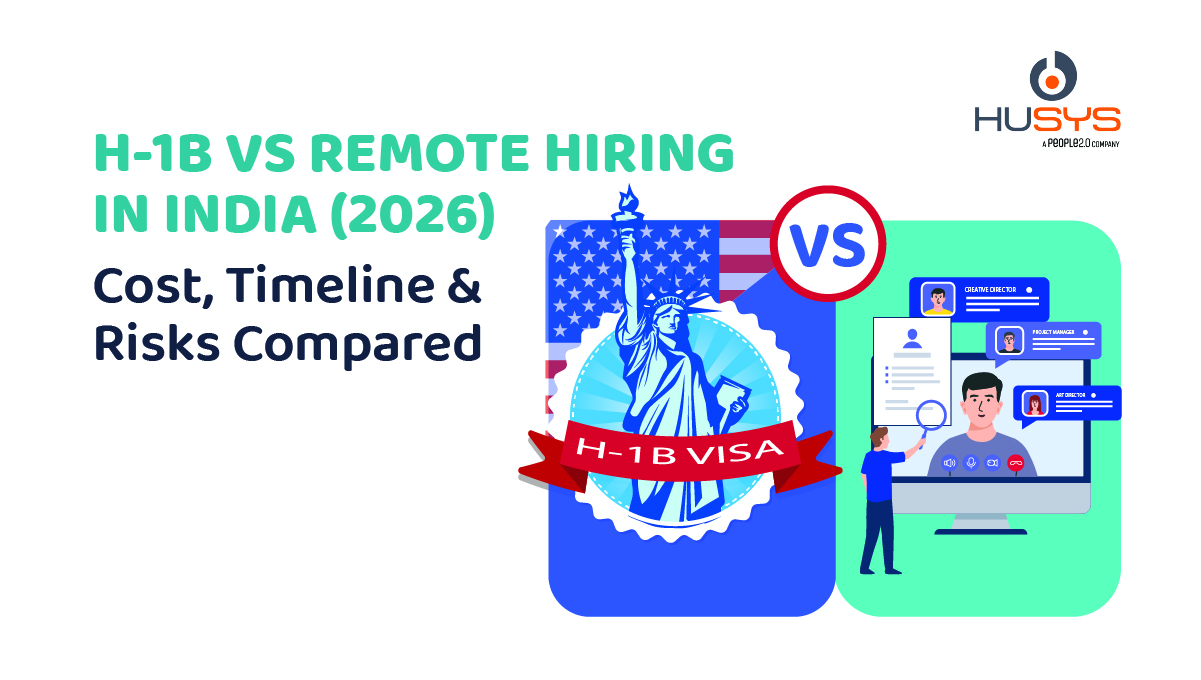
US startups evaluating H-1B vs remote hiring in India are increasingly choosing EOR-based hiring for its cost, speed, and compliance advantages.
In 2026, this has become a core hiring decision. Rising H-1B costs, lottery uncertainty, and long timelines are pushing founders to compare visa sponsorship with hiring engineers in India through an Employer of Record (EOR).
For years, the default path was clear: sponsor an H-1B, relocate the candidate, and rely on the lottery. That model still works but the economics and timelines have shifted.
More companies are now hiring remotely in India not because H-1B is broken, but because it is slower, more expensive, and less predictable.
This guide assumes familiarity with US employment. What it breaks down is how hiring in India actually works costs, compliance, and execution.
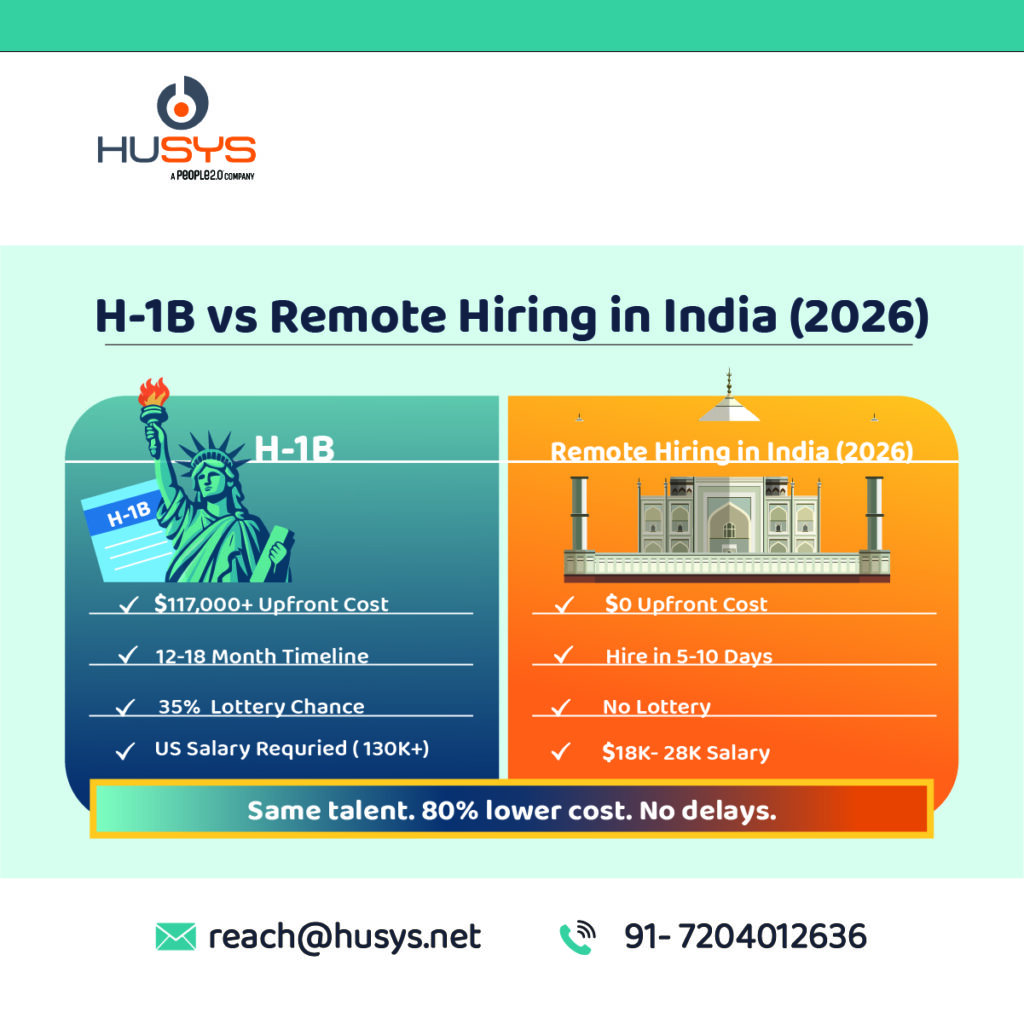
TL;DR: H-1B vs Remote Hiring in india 30 Seconds
- H-1B visa → Expensive ($117K+ upfront), slow (12–18 months), uncertain (35% lottery odds)
- Remote hiring in India (EOR) → Fast (5–10 days), cost-effective (80% lower), no lottery
- Best for:
- H-1B → Roles requiring physical presence in the US
- Remote hiring → Engineering, product, and operations roles
Who is this guide for?
This guide is written for US-based founders and finance leaders who are hiring or planning to hire technical talent, and are weighing whether H-1B sponsorship still makes sense in 2026.
It is Most relevant if you are:
- A founder (10–200 employees) whose hiring is blocked by H-1B caps, delays, or lottery risk and needs a more predictable path
- A CFO or finance leader comparing H-1B costs vs remote hiring, including fees, delays, and selection risk
- An HR or People leader losing strong candidates due to lottery outcomes and needing a faster, compliant alternative
- A founder hiring in India for the first time and looking to understand how compliant remote hiring actually works
H-1B Visa Costs in 2026: Is Sponsorship Still Worth It?
The H-1B has always had costs attached to it. In 2026, those costs look different from what they did a year ago.
The most significant change: a $100,000 H-1B fee now applies for beneficiaries who require consular processing, on top of standard filing fees. Consular processing is the standard path when a candidate is outside the US and needs their visa stamped at a US embassy in their home country.
Here is what the full cost picture looks like for a single sponsored hire.
| Cost component | Amount |
|---|---|
| New H-1B petition fee (Sept 2025 onwards) | $100,000 |
| Base filing fee (Form I-129) | $460 - $780 |
| ACWIA training fee | $750 - $1,500 |
| Fraud prevention fee | $500 |
| Premium processing (optional but common) | $2,965 |
| Attorney fees | $3,000 - $5,000 |
| Relocation package | $10,000 - $20,000+ |
| Total before salary | $117,000+ |
Then add a US market salary of $130,000-$150,000 annually for a senior engineer, health insurance, and 401k contributions.
For a company with fewer than 200 employees, committing $117,000 before a single line of code is written is a hiring decision that consumes a material portion of your annual people budget.
H-1B Lottery 2026: 85,000 Visas for 340,000 Applicants
Even after paying the fees, selection isn’t guaranteed. Most founders budget for cost not for the risk of spending it and not getting the hire.
According to USCIS FY2026 H-1B cap data, USCIS received 336,153 eligible registrations and selected 118,660 approximately 35.3% of these beneficiaries. Selections exceed the 85,000 cap to account for withdrawals and denials.
If a registration isn’t selected in the March 2025 draw, it cannot proceed for FY 2026. The next opportunity is March 2026 for the FY 2027 cap.
For founders weighing visa sponsorship vs remote hiring, a ~35% selection rate makes the trade-off clear.
H-1B vs Remote Hiring: Cost, Timeline, and Risk Compared
Most founders don’t treat visa sponsorship vs remote hiring as a deliberate choice. They default to H-1B then revisit it when a candidate isn’t selected and the role stays open for another year.
This section compares both paths with full context.
Consider a 20-person SaaS company hiring two senior engineers. After months of hiring in the US, they explore H-1B.
That’s ~$100,000 per hire upfront ($200,000 total) and 12–18 months of delay, assuming selection. If not, hiring resets to the next cycle.
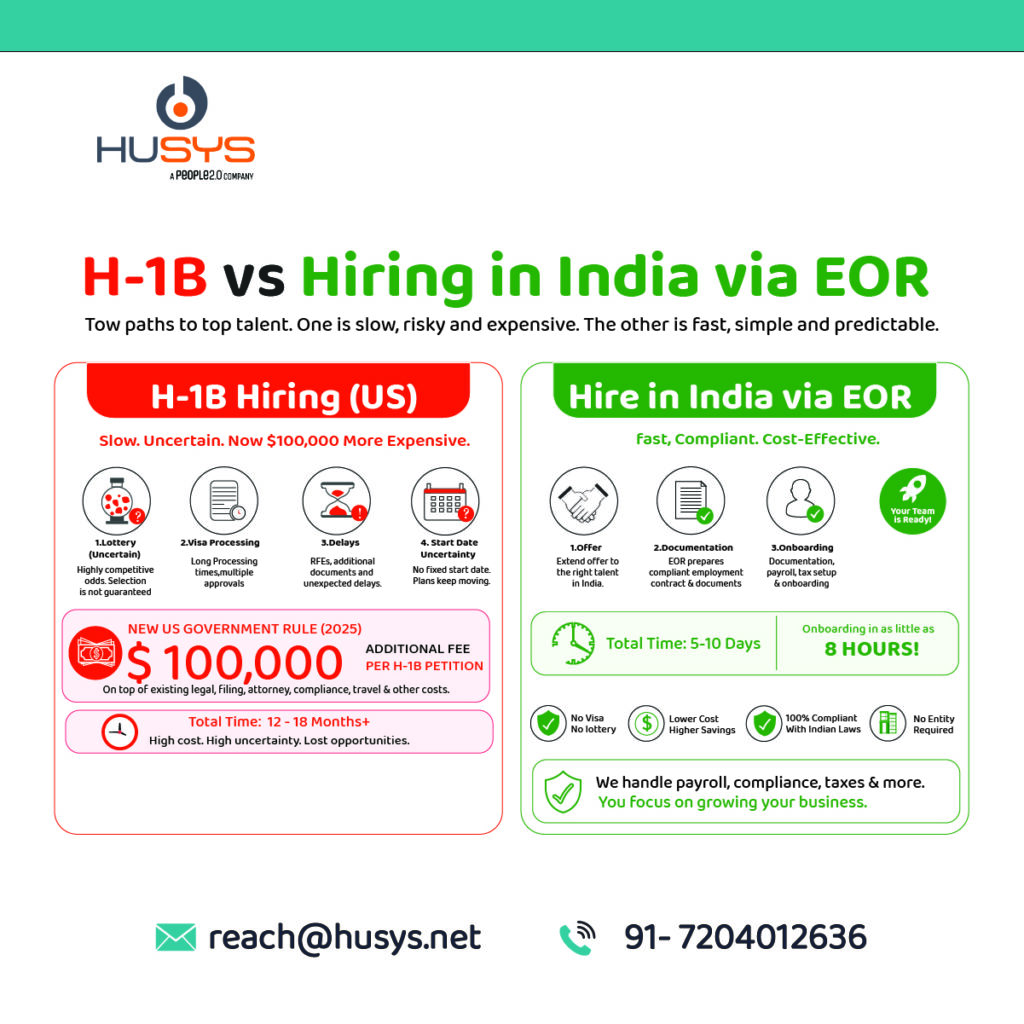
The same two engineers, hired in India through an Employer of Record (EOR), would cost $10,637-$23,000 annually. Both are onboarded within 8 working hours of paperwork being complete. Your US team is working with them within two weeks.
H-1B vs Remote Hiring: Key Differences
- Cost: H-1B requires $117K+ upfront vs remote hiring with minimal setup cost
- Timeline: H-1B takes 12–18 months vs remote hiring in days
- Risk: H-1B depends on lottery vs guaranteed hiring remotely
- Flexibility: Remote hiring allows scaling without visa constraints
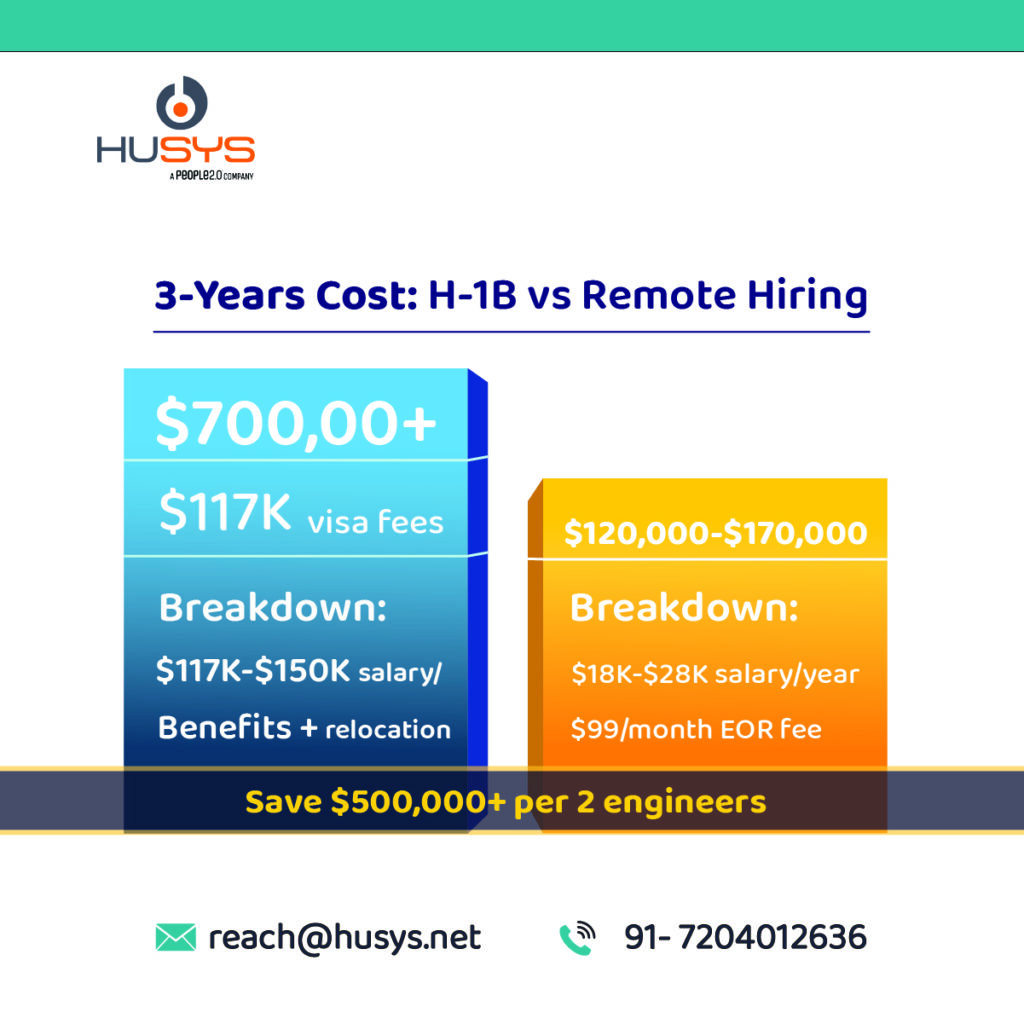
Here is how every dimension of that decision compares:
This is essentially an EOR vs H1B visa decision for most founders.
| Factor | H-1B Sponsorship | Remote Hiring via EOR in India |
|---|---|---|
| Upfront cost per hire | $117,000+ before salary | $99/month EOR fee, no upfront cost |
| Annual salary | $130,000-$150,000 | $18,000-$28,000 |
| Time to hire | 12-18 months | 5-10 business days |
| Lottery dependency | Yes, 35.3% selection rate in FY2026 | No lottery, no cap |
| If the candidate is not selected | Wait until March next year | Not applicable |
| Health insurance | Employer-sponsored, $500-$700/month | Statutory ESI covered by EOR |
| Exit process | Visa cancellation, immigration consequences for the employee | 30-90 day notice period, clean exit |
| Compliance responsibility | US immigration law, employer sponsorship obligations | Fully managed by EOR |
| Works across multiple roles | One petition per person | Hire as many as you need |
| 3-year total cost (2 engineers) | $700,000+ including salary and fees | $120,000-$170,000 including salary and EOR fees |
Skip the H-1B uncertainty. Hire your engineer in India in under 10 days.
That last row is the one most founders do not calculate until after the fact.

A US-based SaaS company (25 employees) spent 4 months trying to hire a senior backend engineer locally. Even offers above $140,000 didn’t close.
They considered H-1B sponsorship but faced 12+ month timelines and lottery uncertainty.
Instead, they hired two engineers in India via EOR within 10 days. The combined annual cost was lower than a single US hire, and both were contributing within two weeks.
This is where the remote vs relocation decision answers itself.
What this means for a founder (11–50 employees)
H-1B: $200K upfront + 12–18 months + lottery risk
EOR: <$200/month + 10 days + no risk
Same engineers. Different outcomes.
| Factor | H-1B Hiring | Hiring via EOR (India) |
|---|---|---|
| Upfront cost | ~$200,000 (2 hires) | ~$0 upfront |
| Time to hire | 12–18 months | 1–2 weeks |
| Selection risk | Yes (lottery) | No |
| Monthly cost | High (US salaries) | Low (India salaries + $99 fee) |
| Flexibility | Low | High |
Can H-1B Employees Work Remotely from India?
No. An H-1B visa is tied to a specific employer and US work location. If an employee works remotely from India long-term, they risk falling out of status and the employer risks compliance exposure.
More importantly, this is the wrong question. If your goal is to access talent in India at India market rates, H-1B is not the right path. H-1B brings talent to the US at US market rates.
When you hire remotely in India, you keep talent local, control costs, and operate compliantly through an EOR.
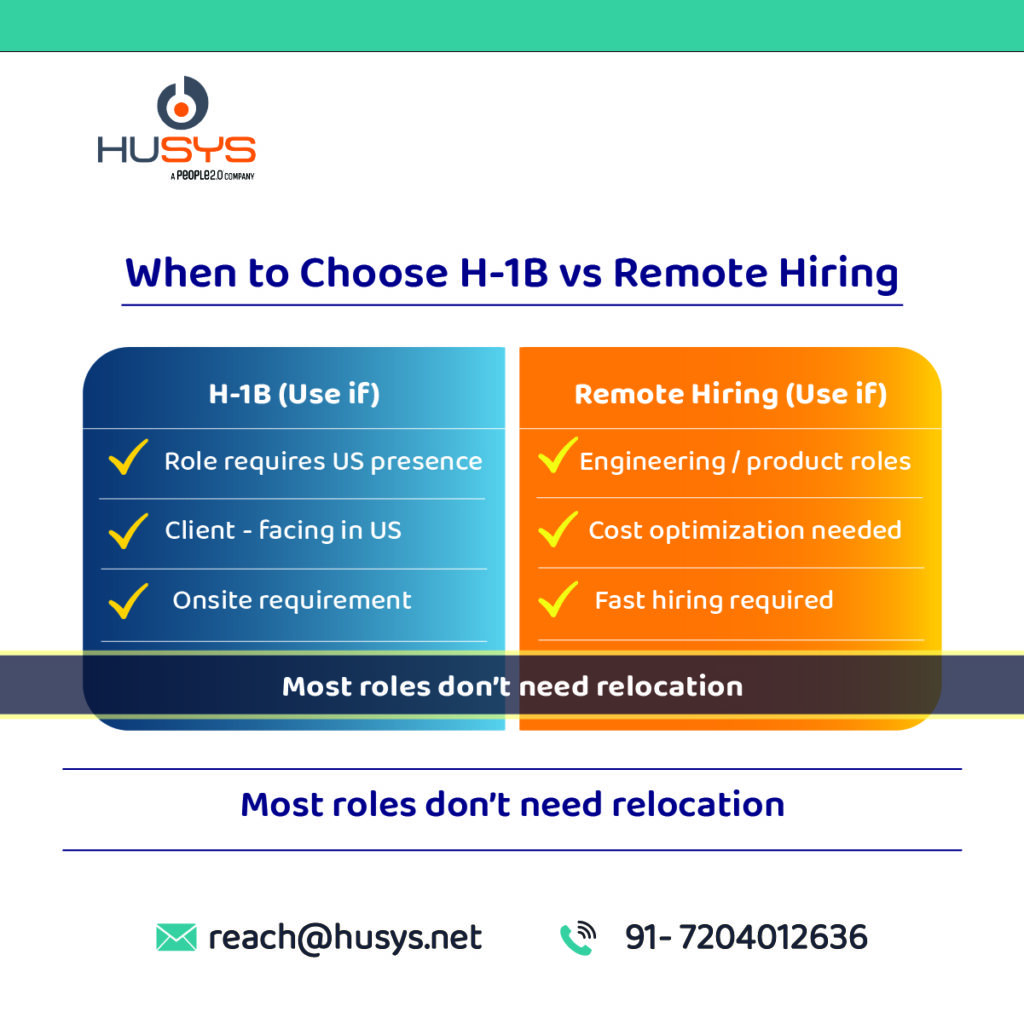
- Need someone physically in the US → H-1B
- Need scalable, cost-efficient hiring → Remote hiring via EOR
Best H-1B Alternatives for US Companies in 2026
The H-1B process involves petition filing, lottery selection, USCIS processing, and relocation typically taking 12–18 months.
For companies weighing visa sponsorship vs remote hiring, this timeline is often the deciding factor. A role needed last quarter, can’t wait another year.
In 2026, US companies rethinking global hiring vs H-1B have more structured alternatives than ever. Here’s what each involves.
Remote hiring through an Employer of Record
When you hire remote employees through an EOR, the employee stays in India and works as a full-time member of your team no visa, no lottery, no relocation.
The EOR becomes the legal employer, handling payroll and statutory compliance, while you manage the work directly.
A single H-1B hire costs $117,000+ upfront before day one. In comparison, a senior full-stack developer in India costs $12,700-$28,000 annually, with EOR pricing starting at $99 per employee per month. No petition, no lottery, no delay, you can hire in days, not months.
Husys has been managing India employment compliance since 2002 and supports 5,000+ global companies across payroll, PF, ESI, and statutory filings in all states.
Our in-house legal and compliance team handles PF, ESI, TDS, Professional Tax, and employment laws across 28 states and 6 union territories, ensuring nothing slips at payroll or exit.
Why Pay $100,000 in H-1B Fees When You Can Hire in India for $99/Month?
Hire engineers in India with the same skill set, and get them onboarded compliantly in 8 working hours. No visa lottery, no entity setup, no compliance headache.
Setting Up Your Own Indian Entity
Once you cross 20+ employees in India, the EOR cost advantage starts to narrow. At that scale, some companies consider setting up their own entity.
This means registering a Private Limited Company the closest equivalent to a US LLC or C-Corp.
A few realities most guides skip:
- At least one director must be an Indian resident, as required under the Companies Act, 2013. Without a local hire, you’ll need a nominee director adding cost before your first hire
- Missing filings with the Ministry of Corporate Affairs triggers per-day penalties, and repeated non-compliance can lead to director disqualification
- The EOR-to-entity break-even typically sits at 25–30 employees. Below that, $1,500–$3,000/month in compliance overhead often exceeds EOR costs
Bottom line: EOR works best below scale. Entity setup makes sense once headcount and long-term commitment justify it.
Independent Contractors
Contractors are the easiest starting point but only for short-term, defined work.
Where it breaks:
- Role starts looking like full-time
- Works exclusively for you
- Follows your schedule and direction
- No other clients
What authorities look at:
Actual working relationship—not the contract.
Risk if reclassified:
- Backdated PF contributions (24%)
- Tax liabilities
- Penalties from EPFO + income tax authorities
Example:
$2,000/month × 24 months → ~$11,500 in PF dues alone (excluding penalties)
Bottom line:
- Contractors → projects
- EOR → full-time roles
How to Decide the Right Hiring Model?
The right hiring model in India depends on two things: how many people you are hiring and how long you plan to stay.
- First 1-15 hires in India: EOR. No entity setup required, fast to start, and compliance sits with the provider.
- 20+ hires with a long-term India roadmap: incorporating your own entity starts to make financial sense.
- Short-term project work: contractors, reviewed carefully against misclassification risk before you sign anything.
Global Hiring vs H-1B: Where Does Each Model Win?
The H-1B vs remote hiring debate is often framed as a tactical choice cost, speed, or risk for a single hire. That misses the bigger shift in 2026.
More US companies are making a structural decision: building functions not just filling roles outside the US.
From sponsoring individuals to building functions
The H-1B model is person-centric: find, sponsor, relocate, and wait. Every hire becomes an immigration project.
Global hiring flips that. The question shifts from “How do we bring this person to the US?” to “Where should this function be built?”
For engineering, QA, DevOps, and operations, the answer is increasingly India not as a fallback, but as a deliberate org design choice.
Companies making this shift stop treating India as a backup when US hiring is hard. They treat it as a primary talent market for specific functions, with teams structured accordingly.
What that looks like in practice
Companies doing this well don’t bolt on contractors they build India-based pods with ownership across backend, QA, and DevOps.
The difference is accountability. When India engineers have the same scope, access, and responsibility as US teams, output is indistinguishable. Treat them as execution-only, and performance drops.
H-1B can’t replicate this. One sponsored hire isn’t a model a structured India team is.
The compounding advantage
The first India hire via EOR is the hardest new framework, onboarding, and time-zone setup.By the third, it’s standardized. Hiring gets faster, and cost per hire drops.
H-1B doesn’t compound each hire resets cost, time, and lottery risk.Global hiring does. EOR, onboarding, and team structure scale across hires.
Shift: companies that start in India scale it. Those sticking to H-1B for non-US roles fall behind.
How to Hire Developers in India Without H-1B Visa Sponsorship
This is the most common way US companies hire developers in India without visa requirements in 2026.
For most US companies, the visa sponsorship vs remote hiring decision is settled by this point. What this section covers is what execution actually looks like on the ground, and where companies run into trouble.
Choosing Your Employment Model
This is the first decision, and everything else follows from it. Your three options:
- EOR: A third party employs the developer legally in India while you direct their work
- Your own entity: You have incorporated an Indian company and are the employer directly
- Contractor: A services agreement with an individual for defined, time-bound work
For most US companies hiring their first developer in India, EOR is the starting point. No Indian entity to set up, no local compliance team to build, no delay waiting for registration to clear.
Structuring Compensation Correctly
US companies that hire remote employees instead of visa sponsorship often assume the compensation structure works the same way it does at home. It does not. In India, several components are mandatory regardless of what you negotiate.
The two that catch most US founders off guard:
Provident Fund: Works similarly to Social Security in the US, except it is mandatory for all salaried employees. Both the employer and the employee contribute 12% of the employee’s basic salary each month, filed with EPFO every month.
Gratuity: A lump-sum payment owed to any employee who completes five continuous years with your company. The formula is: (Last drawn monthly salary divided by 26) multiplied by 15, multiplied by years of service. For an engineer on $2,000 per month who completes five years, that is approximately $5,769 owed at exit. Not a discretionary bonus, a statutory obligation.
A US-style offer letter listing only a base salary is not a compliant employment document in India. The contract needs to reflect the full cost-to-company structure, including these components. This is one of the most common gaps that surfaces at appraisal or termination time, when it is harder to fix.
How Payroll Works in India
In the US, payroll runs bi-weekly through a platform like Gusto or Rippling. India works differently when it comes to India payroll compliance
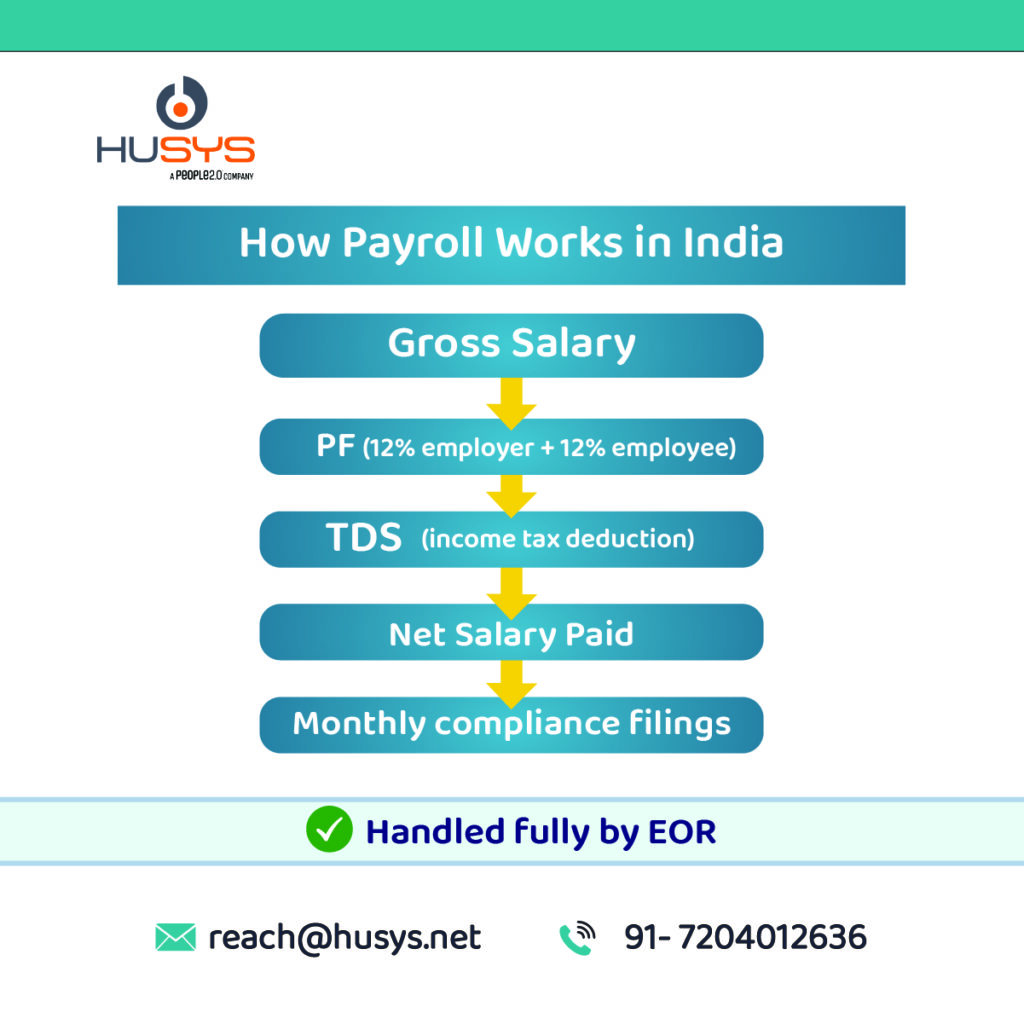
- Payroll runs monthly, processed at the end of the month
- Employer deducts income tax from each salary payment, called TDS, and remits it to India’s income tax authority
- PF contributions are filed monthly with EPFO
- A missed filing or incorrect TDS deduction means a notice from the respective government body, with backdated penalties from when the error occurred
If you are using an EOR, they handle every part of this. If you are running your own entity, you need either a dedicated payroll accountant or a compliance vendor set up for Indian statutory requirements.
How India employment works vs what US founders already know
| Concept | How it works in the US | How it works in India |
|---|---|---|
| Employment type | At-will, either party can exit anytime | Contractual, with a mandatory notice period (typically 30–90 days) |
| Payroll cycle | Bi-weekly via Gusto, Rippling, etc. | Monthly, processed at the end of the month |
| Benefits | Mostly optional (health, 401k) | Statutory: PF and ESI are mandatory for eligible employees |
| Retirement contribution | 401(k): voluntary, employer match varies | Provident Fund (PF): mandatory, 12% employer + 12% employee of basic salary |
| Health coverage | Employer-sponsored or marketplace | ESI (Employee State Insurance): mandatory for employees earning below a threshold |
| Severance | No statutory requirement | Gratuity: owed after 5 years of continuous service, calculated on tenure and final salary |
| Payroll tax | Employer withholds federal/state income tax | TDS (Tax Deducted at Source): the employer deducts income tax monthly and remits it to India's income tax authority |
| Termination | Immediate, no notice required | Notice period of 30–90 days, or pay in lieu of notice |
| HR compliance body | IRS, Department of Labor | EPFO (Provident Fund), ESIC (health insurance), and state labor departments |
Termination is Not At-Will
In the US, employment is at-will. In India, most contracts include a 30–90 day notice period.
If you terminate an employee, you either serve the notice or pay salary in lieu.
This often surprises US founders you can’t make immediate exits without cost or delay. A compliant EOR structures this correctly from day one.
What Onboarding Actually Requires
Once the contract is signed, three things need to happen before the first payroll run:
- Employee enrolled in PF and issued a compliant appointment letter with full salary structure
- Registration under the Shops and Establishments Act in most Indian states, which governs working hours and leave entitlements
- Payroll cycle set up with correct TDS configuration and a monthly filing schedule
Through an EOR, this is handled as part of standard onboarding. If you are setting up directly, budget 2-4 weeks before the first payroll run.
Through an EOR, this infrastructure is already in place. You are not building it from scratch for your first hire.
Employer of Record (EOR): The Fastest Way to Hire in India
By this point, you have seen what hiring in India actually involves. The compliance layer, the payroll structure, and the notice periods.

The question most founders land on after all of this is: Does it actually work as well as bringing someone to the US?
The cost case is far from close
One H-1B engineer costs $100,000 upfront, then $130,000–$150,000/year plus benefits ~$560,000–$610,000 over 3 years.
The same engineer in India via EOR costs $18,000–$28,000/year + ~$1,188 in annual fees ~$55,000–$85,000 over 3 years.
Savings: ~$500,000 per engineer (~$1M for two).
Same role. Same output. Radically different cost.
What about having them in the office?
Valid concern. If a role requires US presence, EOR in India isn’t the fit.
For most roles, the question is simple: office presence or reliable execution?
India teams run the same standups, tools, and workflows with 3–5 hours overlap.
In practice, the concern fades after the first hire.
What about work quality?
India has produced engineering talent at scale for decades building the same infrastructure behind products you already use.
The difference isn’t skill it’s execution: clear scope, ownership, and feedback.
Top teams treat India engineers like US engineers: direct communication, clear expectations, no ambiguity on “done.”
What if you need to scale down?
With H-1B, scaling down means visa cancellations, immigration risk, and complex exits.
With EOR, exits follow a 30–90 day notice period clean and predictable.
EOR also lets you start small and scale gradually.
Asymmetry: H-1B is disruptive to unwind; EOR is operational.
What different roles typically cost in India through an EOR
| Role | Approximate annual salary (India) | US equivalent | Savings vs US hire |
|---|---|---|---|
| Senior full-stack engineer | $18,000–$28,000 | $130,000–$150,000 | ~80% |
| QA/test automation engineer | $10,000–$18,000 | $90,000–$110,000 | ~83% |
| Customer success/account manager | $8,000–$14,000 | $60,000–$80,000 | ~82% |
| DevOps/cloud engineer | $16,000–$26,000 | $120,000–$140,000 | ~81% |
| Finance ops/accounting | $7,000–$12,000 | $55,000–$75,000 | ~83% |
(India salary ranges sourced from AmbitionBox. US ranges sourced from Glassdoor.)
EOR fees of $99 per employee per month apply on top of salary for all roles. The savings hold regardless of function.
Is this legally clean for a US company?
Yes.
When US companies hire in India instead of pursuing visas, an EOR is the standard compliant structure. 5,000+ global companies have hired through Husys under this model.
There is no PE risk as long as the India team isn’t generating revenue or signing contracts locally.
Husys monitors invoicing and employee scope to ensure the setup remains compliant and avoids permanent establishment exposure.
Conclusion: Should You Sponsor H1-B Visa or Hire Remotely?
If you need someone physically in the US, H-1B is the path—that’s the only case where this comparison doesn’t apply.
For most roles, the math is clear: $100,000 upfront + 35.3% lottery + 12–18 months
vs
Hiring in days in India at a fraction of the cost
That’s why more US companies in 2026 are building teams in India via EOR.
Husys supports 5,000+ global companies, from early-stage SaaS to 200+ employee India teams.
Every founder who has chosen to hire employees in India instead of pursuing visa sponsorship and gone through the process once rarely goes back. If you want to understand what hiring your first engineer in India actually involves, speak with our team before you make the first offer.
You’ve seen the cost, the timelines, and the risk. The only question left is how you want to hire.
Hire your engineer in India without relying on the lottery. Get a clear plan for timelines, costs, and compliance before you make the move.
Frequently Asked Questions About H-1B Alternatives and Remote Hiring
1. Is hiring through an EOR legal for a US company operating in India?
Yes. The EOR is the legal employer in India while you direct the work. This is a standard, compliant structure used by 5,000+ global companies when statutory obligations are handled correctly.
2. Can we hire in India without setting up an entity?
Yes. An EOR handles entity, payroll, and compliance. You can hire immediately without incorporating. Setting up your own entity typically makes sense at ~20–25 employees.
3. What happens if our H-1B candidate is not selected?
You can’t reapply in the same year. The next opportunity is the following March delaying hiring by 12+ months with no guarantee of selection.
4. How does the cost compare over time?
For two engineers over three years: H-1B: $700,000+, EOR (India): $120,000–$170,000 , Savings: ~$500,000+
5. Can we terminate quickly if needed?
No at-will employment. Contracts include 30–90 day notice periods or salary in lieu. EOR structures this upfront for predictable exits.
6. Why not just hire contractors instead?
Contractors work for short-term scope. If the role looks full-time, it risks misclassification, triggering backdated PF and penalties. For ongoing roles, EOR is the compliant path.
7. Is there permanent establishment (PE) risk?
Only if structured incorrectly e.g., employees generating revenue or signing contracts in India. A properly structured EOR avoids this. Husys monitors this exposure.
8. Do we need a local bank account or office in India?
No. The EOR’s infrastructure covers banking, payroll, and compliance. You pay in USD; everything else is handled locally.
9. How does management, performance, and exit work?
You manage hiring, performance, and decisions. The EOR handles payroll, compliance, notice periods, and final settlements ensuring clean execution under Indian law.