Husys India EOR Payroll & Compliance Experts is the in-house team supporting Employer of Record (EOR) payroll operations and statutory compliance for US companies hiring in India. With 250+ years of collective compliance experience, the team has supported 50,000+ contractors to date and helps 5,000+ clients run compliant workforce operations across India.
Editorial note: This content is reviewed internally by payroll and compliance specialists and reflects standard statutory practices in India. For case-specific guidance, consult a qualified professional.
Facebook
X.com
LinkedIn
Email
WhatsApp
What are the hidden compliance costs of hiring in India?
The hidden compliance costs of hiring in India go beyond salary and statutory contributions. US companies can face additional exposure from payroll errors, PF and ESI obligations, worker misclassification, gratuity, state-specific labour requirements, tax exposure and compliance gaps that surface during audits, fundraising or acquisitions.
Area
Where the hidden cost appears
Payroll & statutory filings
Errors, missed filings, interest and penalties
PF, ESI & gratuity
Retrospective liabilities and employee claims
Contractors
Misclassification and backdated obligations
State compliance
Different registrations and requirements
Tax & PE exposure
Potential assessments and additional tax liability
Fundraising / M&A
Due-diligence findings, valuation adjustments and deal delays
The hidden compliance costs of hiring in India rarely appear in the initial hiring budget.
When a US company hires in India, the salary shown in an offer letter is not always the full cost of employment, because the employer may also need to account for statutory contributions, benefits, payroll obligations, and other employment-related costs.
The gap can come from statutory contributions and employment-related costs that may apply from the start of employment, including EPF, applicable ESI, gratuity liabilities, and employer-provided benefits. Where an applicable statutory obligation is missed, the employer may face back payments, interest, penalties, or other consequences depending on the nature and duration of the default.
Most US companies we talk to discover this layer during a compliance audit, a funding round, or an acquisition review.
This guide breaks down the hidden compliance costs of hiring in India, including statutory obligations, payroll and tax exposure, enforcement risks, and the financial impact of compliance gaps during audits, fundraising, and acquisitions.
If you are a founder or CFO building a case for how to hire in India without absorbing unnecessary legal and financial risk, that is exactly what this covers.
Who Should Understand the Hidden Compliance Costs of Hiring in India?
This guide is written for US-based founders, CFOs, and finance or operations leaders who are hiring in India and want to understand the full compliance cost picture before it shows up on their P&L.
It is built for you if you are:
Running payroll in India for the first time, and uncertain whether your current structure is actually compliant
A CFO pressure-testing an India headcount plan before it goes to the board
A founder who has already hired one to five people in India through contractors or informal arrangements, and wants to know your exposure
A legal or operations leader responsible for international employment risk who needs to understand what Indian labour enforcement actually looks like in practice
Evaluating whether to absorb India compliance yourself through an entity or transfer it to a compliant employer structure
The India Hiring Math That Looks Right Until It Isn't
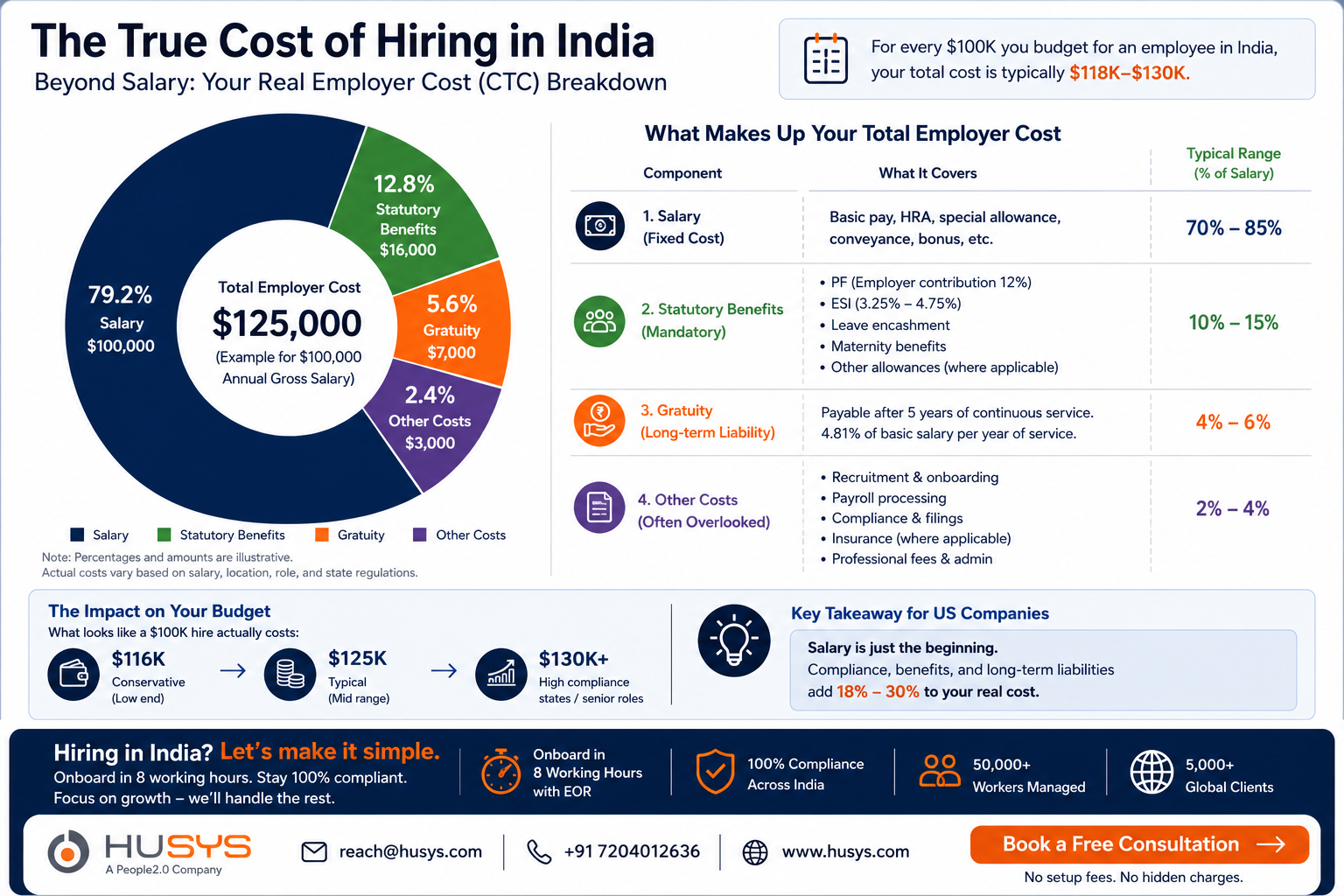
The real cost of an India hire extends beyond salary, with statutory benefits, gratuity, compliance, and other employer costs adding to the total employment cost.
The true cost of hiring employees in India is higher than the salary or CTC figure alone because statutory contributions, insurance and other employer obligations can sit outside the number US companies initially budget for.
Base salary, an optional 401(k) match, health insurance, and payroll taxes. India has a similar logic on paper, but the salary structure works differently, and most US companies misread it on the first pass.
In India, salaries are commonly quoted as CTC, or Cost to Company. For a US hiring team, the easiest way to think about CTC is as a broader compensation package rather than a direct equivalent of US base salary. CTC can include the employee’s salary components as well as employer-side statutory contributions such as EPF and gratuity, depending on how the compensation package is structured. That distinction matters when a US finance team converts an India offer into its actual employment budget.
When a candidate in Bangalore says their current CTC is ₹18,00,000 ($19,565), a US hiring team should not treat that figure as equivalent to a US employee’s base salary. CTC can include employer-side statutory contributions and other components that do not reach the employee’s bank account, so the finance team needs to understand the underlying salary structure before using the number for hiring or compensation benchmarking.
This creates two problems for US hiring teams.
First, a US hiring team may treat CTC like a US base salary and build its India hiring budget around that number without understanding what is actually included.
Second, the team may assume that the statutory contributions already included in CTC represent the entire employer cost.
The better approach is to break the CTC into its underlying salary, statutory, and benefit components before approving the hire, and then account separately for any employer costs that sit outside the package.
An EOR can simplify this process by providing a structured India employment and payroll model rather than requiring the US finance team to build its own local cost framework from scratch.
What does CTC mean for a US company hiring in India?
CTC is not the same as base salary or total cash compensation. A US company should review the salary structure, employer statutory contributions, and additional benefits separately before calculating the true cost of an India hire. An EOR can provide this cost structure upfront, so the US finance team can budget the hire without having to build an India-specific payroll model from scratch.
Here is what the actual employer cost looks like on a ₹18,00,000 CTC hire.
Component
Annual (INR)
Annual (USD)
Basic Salary (50% of CTC)
₹9,00,000
$9,782
HRA + Allowances
₹6,24,000
$6,782
EPF Employee Contribution (12% of Basic)
₹1,08,000
$1,173
EPF Employer Contribution (12% of Basic)
₹1,08,000
$1,173
Gratuity Provision (4.81% of Basic Salary)”
₹43,290
$470
Total CTC
₹18,00,000
$19,565
Group Health Insurance (outside CTC)
₹27,600
$300
Actual Total Employer Cost
₹18,27,600
$19,865
Considering $1= INR 92 (as of March, 2026)
Note: The 4.81% gratuity figure is an annual accrual used for employer cost estimation and budgeting; the actual gratuity payable is calculated according to the applicable statutory formula when the employee becomes eligible
The EPF employer contribution and gratuity provision may form part of CTC, while employees above the applicable ESI wage ceiling are generally outside ESI coverage; many employers nevertheless provide private group health insurance as an additional employee benefit, which is typically an employer cost outside CTC.
For a US company, this is similar in principle to managing payroll taxes and employee benefits at home, but the compliance infrastructure is different. In the US, employers already have systems for federal payroll taxes such as
Social Security,
Medicare,
federal income-tax withholding, and
unemployment taxes, along with state and local requirements.
In India, the employer may need to coordinate
EPF,
applicable ESI,
TDS,
gratuity,
professional tax, and
other state-specific employment requirements.
If these obligations are not handled correctly from the start, the company may face retrospective payments, interest, penalties, and remediation work.
An EOR such as Husys can take over the local employment, payroll, and applicable compliance administration, allowing the US company to manage the employee’s work while relying on an established India employment infrastructure for the local compliance layer.
That is where the India employment compliance costs move from a budgeting issue to a legal one.
Why Indian Employment Compliance Costs More Than US Founders Expect
The short answer is that India’s compliance structure is not built like the US system, and most of the assumptions US companies carry into their first India hire turn out to be wrong.
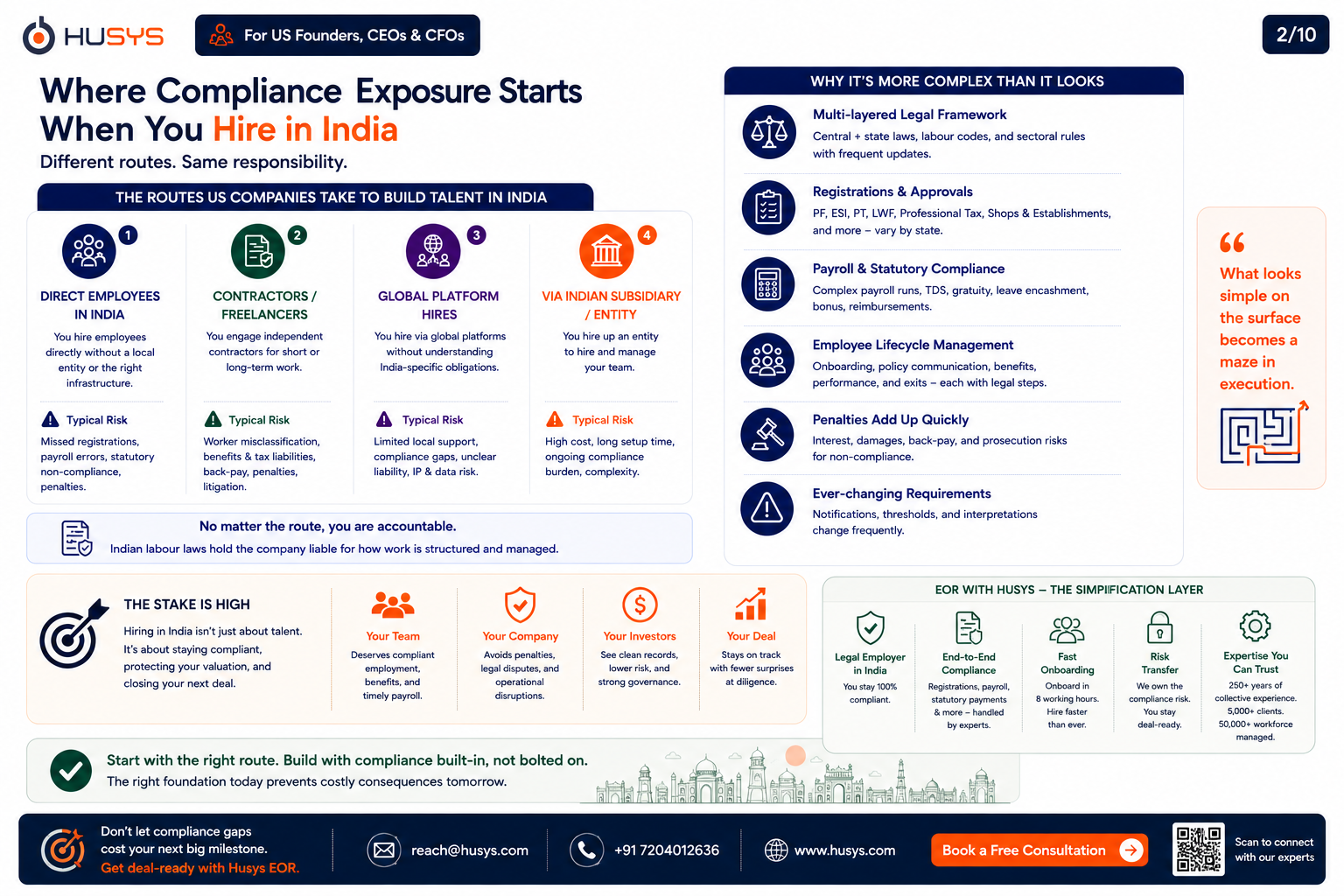
Different hiring routes can create different compliance risks in India. The right employment model can build compliance into your India expansion from day one.
For a US company, India payroll may initially look familiar because you are already accustomed to managing federal payroll taxes, state-level requirements, employee benefits, and recurring filings at home. The difference is that India adds a separate employment and statutory framework involving EPF, ESI, TDS, gratuity, professional tax, and state-specific labour requirements. For a startup hiring its first few employees in India, the challenge is therefore not simply adding another payroll location; it is establishing the local employment infrastructure needed to manage these requirements correctly.
For decades, India’s employment system was governed by 29 separate central labour laws covering wages, workplace safety, industrial relations, and social security. Between 2019 and 2020, the Indian Parliament consolidated these laws into four Labour Codes.
For a deeper look at how the 2026 Labour Codes affect payroll, worker classification, statutory benefits and employment contracts, see our India Labour Codes 2026 guide for US companies.
However, the new framework only became operational on November 21, 2025, when the government formally implemented the codes across the country.
For US companies hiring in India in 2026, the important point is that the Labour Codes have changed the regulatory framework, while compliance requirements can still vary based on the applicable central and state rules.
Employers should therefore assess their obligations based on the Labour Codes, applicable rules, and the specific state and employment circumstances of their workforce rather than assuming that one set of requirements applies uniformly across India.
What this means practically is that your India compliance obligations depend on which state your employees are in, what rules that state has notified, and which legacy laws still apply in the interim.
A company hiring in Bangalore, Hyderabad, and Pune at the same time is managing three separate state-level compliance environments, not one unified system.
What makes India payroll more complex for a US company?
The biggest difference is not one difficult filing. It is the number of payroll, tax, social-security, and state-level requirements that a US company may need to coordinate once it starts employing people in India. The exact requirements depend on the employee, compensation structure, state, and employment setup.
For a US startup with five or ten employees in India, building this infrastructure internally can mean managing multiple registrations, recurring filings, payroll calculations, statutory payments, and regulatory updates before the India team becomes large enough to justify the overhead.
Obligation
Frequency
Authority
TDS (Tax Deducted at Source)
Deduction and deposit generally monthly; return filing as prescribed
Income Tax Department
EPF Contributions
Monthly
EPFO
ESI Contributions
Monthly
ESIC
Professional Tax
Frequency varies by state and applicable requirements
State Government
EPF Returns
As prescribed under applicable EPF requirements
EPFO
ESI Returns
As prescribed under applicable ESI requirements
ESIC
Statutory Audit
As required under applicable corporate and statutory requirements
Relevant regulatory authorities i.e. Ministry of Corporate Affairs, india
Labour Law Registers
As required under applicable labour laws and rules
Relevant labour authorities , i.e. State Labour Department
In the US, payroll and employment compliance requirements generally operate through federal and state systems with established filing schedules. In India, employers may need to manage recurring PF, ESI, tax, professional tax, and labour-related requirements across multiple authorities and jurisdictions. Where a statutory payment or filing is missed, applicable interest, penalties, or other consequences can begin from the relevant due date or default period rather than waiting until an annual review.
This is why India employment compliance can be more complex for US companies than they initially expect. The challenge is not a single compliance obligation, but a combination of recurring payroll, tax, social-security, and state-level requirements that may operate on different schedules and vary depending on where employees are located.
What You're Legally Required to Pay Beyond the Salary
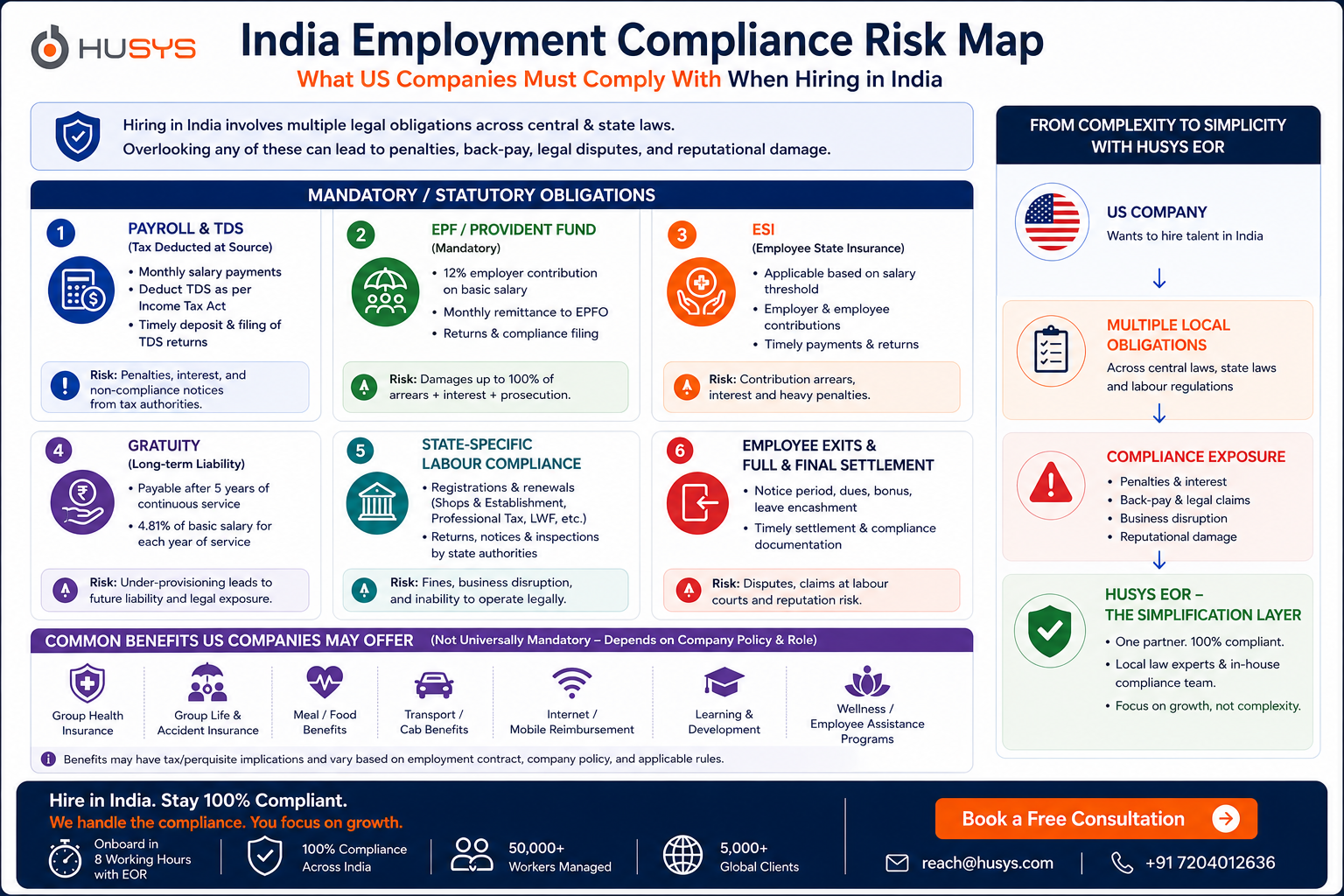
India employment compliance extends beyond salary: US companies must account for payroll, statutory contributions, state-specific requirements, and employee exits.
For a US company, the important distinction is between salary, statutory employer costs, and optional benefits. India has mandatory employment contributions that can apply based on the employee’s eligibility, alongside benefits that employers commonly provide as part of their compensation package.
The three major statutory areas to understand are EPF, ESI, and gratuity. The sections below explain when each applies, what it can cost the employer, and how the requirements compare with the payroll and benefits systems a US company already manages.
Provident Fund, Gratuity, and ESI: The Mandatory Employer Contributions US Teams Miscalculate
EPF: India’s Mandatory Retirement Contribution
EPF is India’s mandatory retirement savings system for covered employees, with contributions made by both the employer and employee according to the applicable statutory rules.
For employees covered under the applicable EPF provisions, the standard contribution is generally 12% of basic wages and dearness allowance from both the employer and employee, subject to the applicable statutory wage ceiling and other rules. The employee contribution is deducted from the employee’s wages, while the employer contribution is borne by the employer and may form part of the employee’s overall CTC.
For employees covered by the applicable EPF provisions, the employer’s contribution is generally allocated between the Employee Pension Scheme and the EPF account according to the applicable statutory rules, with the standard allocation commonly described as 8.33% toward EPS and 3.67% toward EPF, subject to the applicable wage ceiling and rules.
For a US company, the important point is that EPF is not simply another payroll tax that you can configure once and forget. The applicable wage base, employee coverage, contribution structure, and regulatory requirements need to be reviewed as the rules change. As of 2026, the statutory wage ceiling remains ₹15,000 per month, while a possible increase has been under consideration. An EOR such as Husys provides an ongoing local compliance layer so the US finance team does not have to independently track every change affecting India payroll.
As of 2026, the statutory EPF wage ceiling remains ₹15,000 per month, although the government has been reviewing a possible increase following aJanuary 2026 Supreme Court direction. The government has considered increasing the ceiling to ₹25,000 or higher, but the proposed increase should not be treated as effective until formally notified.
For a US company budgeting an India team, this is another example of why local payroll requirements need to be monitored continuously rather than treated as a one-time setup exercise. An EOR can manage these regulatory updates as part of its ongoing India payroll and compliance process.
EEPF coverage generally applies to establishments that meet the applicable statutory coverage requirements, including the 20-employee threshold, while certain employees and establishments may fall within EPF coverage under specific provisions even when the establishment does not otherwise meet that threshold.
But here is what most US companies miss: if you are using an EOR, EPF registration kicks in from day one under the EOR’s existing registration, with no threshold to wait for.
ESI: Government Health Insurance for Eligible Employees
ESI is India’s statutory social insurance program for eligible employees. For a US employer, the closest way to understand it is as a government-administered employee health and social-security benefit that provides medical care and certain cash benefits for covered workers and their families. Unlike a US employer-sponsored health plan, ESI is a statutory program with employer and employee contributions determined by applicable rules.
For employees covered by ESI, the standard contribution rates are generally3.25% of wages for the employer and 0.75% for the employee, subject to the applicable ESI rules and wage limits. Establishments with more than 10 employees whose gross salary is at or below ₹21,000 per month must register with ESIC within 15 days of becoming applicable.
Many professional roles that US companies hire for in India, such as engineers, product managers, and analysts, may fall above the applicable ESI wage threshold and therefore may not be covered by ESI. For these employees, a US employer may choose to provide private group health insurance, similar to the employer-sponsored health coverage commonly offered in the US. An EOR can determine ESI eligibility during onboarding and manage the applicable statutory contributions and payroll treatment without requiring the US HR or finance team to interpret the rules for each employee.
Group health insurance is a common employer-provided benefit for professional employees who are not covered by ESI, and the cost is typically treated separately from statutory ESI contributions and may be included inside or outside CTC depending on how the employer structures compensation.
Gratuity: The Liability That Accrues From Day One
Gratuity is a statutory end-of-service benefit in India. For a US employer, the closest way to think about it is as a statutory severance-style benefit that can create an accrued employment liability, although it is governed by Indian law and is not equivalent to US severance pay. The amount becomes payable when the employee meets the applicable eligibility conditions and leaves employment through a qualifying event under thePayment of Gratuity Act, 1972.
The statutory gratuity calculation for eligible employees is generally based on 15 days of wages for each completed year of service, with the applicable wage base and calculation method determined under the relevant gratuity provisions. The Payment of Gratuity Act generally applies to establishments meeting the applicable coverage threshold, including establishments with 10 or more employees, and the statutory gratuity amount is subject to the applicable maximum limit.
Under the Code on Social Security, fixed-term employees may become eligible for gratuity after completing one year of continuous service, subject to the applicable provisions and implementation rules. If you are hiring on fixed-term contracts, which many US companies do for their first India hires, this change directly increases your gratuity exposure.
Here is what these three obligations look like together on a single ₹18,00,000 CTC hire.
Employer Cost
Rate / Basis
Monthly (INR)
Monthly (USD)
EPF Employer Contribution
12% of Basic, subject to applicable EPF rules
₹4,500
$48.91
ESI Employer Contribution (if applicable)
3.25% of wages, subject to applicable ESI rules
₹4,875
$52.99
Gratuity Provision
4.81% of Basic Salary for budgeting purposes
₹1,804
$19.61
Group Health Insurance (if provided)
Employer-provided benefit; cost varies
₹2,300
$25.00
For a professional employee who is above the applicable ESI wage threshold, the employer would generally budget for EPF and gratuity along with any employer-provided health insurance, while ESI would apply only where the employee meets the applicable eligibility requirements.
A CFO at a 60-person US SaaS company is three weeks from closing a Series B. The acquirer’s legal team opens the India employment records.
A US SaaS company has been working with eight engineers in Bangalore for 18 months through contractor agreements without establishing the appropriate employment and statutory compliance structure. During a financing or acquisition review, the company’s legal team identifies potential gaps in EPF and other employment obligations. The company may then need to quantify the underlying statutory liability, applicable interest and penalties, and the professional cost of remediation before the transaction can proceed.
The immediate financial liability may not be large enough to derail a financing round on its own, but the bigger issue for a US startup is what the finding triggers. Investors or acquirers may expand their diligence to review the company’s India employment structure, payroll records, statutory filings, contractor classification, and IP documentation. That can create additional legal and accounting costs, delay the transaction, and force the company to remediate issues that could have been avoided by establishing a compliant employment structure from the beginning.
Professional Tax, TDS, and State-Level Filings: The Recurring Obligations That Don't Wait
Beyond EPF, ESI, and gratuity, there are two more obligations that run every single month: Professional Tax and TDS.
Professional Tax is a state-level tax deducted from the employee’s salary and remitted to the relevant state authority. Rates vary by state and are capped at ₹2,500 per year, but the filing deadlines, slabs, and procedures differ across Karnataka, Maharashtra, Telangana, and every other state where your employees sit. A company with engineers in Bangalore and Hyderabad is managing two separate professional tax filings every month under two different state systems.
TDS, or Tax Deducted at Source, is India’s payroll withholding mechanism. As an employer, you are required to calculate each employee’s estimated annual tax liability, deduct it proportionately from their monthly salary, and deposit it with the Income Tax Department by the 7th of the following month. Miss that deadline, and interest starts accruing immediately at 1.5% per month on the amount due.
These are not year-end obligations. They run monthly, they run in parallel, and the India employment compliance costs tied to getting them wrong are assessed from the date of the missed filing, not from the date of discovery.
The Real Cost of Non-Compliance in India: Penalties, Back-Pay, and Interest
The previous section covered what you owe as an employer from day one. This section examines the hidden compliance costs of hiring in India when those obligations are missed, and how quickly the numbers compound.
In India, a missed statutory payment does not just mean catching up on the contribution. It means paying the original amount, plus interest on that amount, plus penal damages on top of that, all calculated from the date the payment was originally due, not from the date anyone discovered the gap.
Here is what each major compliance failure actually costs.
1. EPF default
Effective June 14, 2024, the Central Government revised the EPF penalty structure. Employers who default on contributions now pay penal damages at a flat rate of 1% of arrears per month, capped at 12% annually.This replaced the earlier structure where damages could reach 25% per annum for defaults exceeding six months.
On top of the penal damages, Section 7Q of the EPF Act requires employers to pay simple interest at 12% per annum on the unpaid contribution amount, calculated from the due date until actual payment.
So, on a 10-person team where EPF contributions were missed for 12 months, here is what you actually owe.
Item
Calculation
Amount (USD)
Monthly EPF employer contribution per person
12% of Basic, subject to the applicable EPF wage ceiling and coverage rules
$120
Total missed contributions (10 people, 12 months)
$120 × 10 × 12
$14,400
Interest at 12% per annum (Section 7Q)
12% of $14,400
$1,728
Penal damages under Section 14B, calculated at 1% of arrears for each month of default
1% × 12 months × $14,400
$1,728
Total additional cost beyond what was already owed
$3,456
Total outflow
$17,856
You still owe the $14,400 regardless. The non-compliance would add approximately $3,456 in interest and penal damages to the $14,400 in missed employer contributions, assuming a full 12 months of default and the applicable statutory rates.
This is not a theoretical risk. It has already happened in real cases.
The Assistant Provident Fund Commissioner calculated the liability as follows:
₹2,04,440 ($2,222) in unpaid EPF contributions • ₹1,06,094 ($1,153) in interest • ₹3,28,083 ($3,566) in penalties under Section 14B
The company challenged the penalty. The Central Government Industrial Tribunal attempted to reduce it to ₹25,000 ($272).
However, in its February 2026 judgment, the Karnataka High Court held in that case that, because the EPF default had continued for more than two years, the damages should be 25% of the arrears including interest, resulting in damages of ₹77,633.
As a result, the company was still required to pay a minimum penalty of ₹77,633 ($844) on top of the full arrears and interest already owed.
The EPFO argued that companies were artificially splitting salaries into multiple allowances to reduce PF contributions. The court agreed.
Following the ruling, several companies were issued large PF reassessment notices. In one enforcement action involving a construction company, the EPFO assessed PF dues of ₹5.18 crore ($563,043) after reclassifying excluded allowances as part of basic wages.
The ruling confirmed that:
Allowances paid universally must be included in PF wage calculations
Employers cannot structure compensation solely to reduce PF liability
EPFO can reopen past records and recover unpaid contributions with interest and damages.
For some companies, retrospective PF reassessments can result in significant additional liabilities, particularly where previously excluded allowances are determined to form part of the PF wage base.
2. ESI default
For delayed ESI contributions, interest and damages may apply from the date of default, with the applicable amount depending on the period of delay and the circumstances of the case. Delayed or non-compliant registration can also result in additional damages and other consequences under the applicable ESI provisions.
For most professional roles that US companies hire, ESI does not apply because salaries sit above the ₹21,000 threshold. But for support, operations, or junior roles that fall within the ESI ceiling, missing registration is one of the more expensive mistakes to unwind retroactively.
In Ajay Raj Shetty v. Director, ESIC (2025), the Supreme Court examined whether a company manager could be personally liable for failing to deposit ESI contributions deducted from employees’ salaries.
During an inspection, authorities discovered that ₹8,26,696 ($8,985) had been deducted from employee wages as ESI contributions but was never deposited with the Employees’ State Insurance Corporation.
The company’s general manager argued that he was only a “technical coordinator” and therefore should not be treated as the responsible employer. The courts rejected that argument.
The trial court convicted him under Section 85 of the ESI Act and sentenced him to:
6 months’ imprisonment
₹5,000 fine ($54)
Both the Karnataka High Court and the Supreme Court upheld the conviction, confirming that individuals responsible for the supervision and control of a company can be treated as the “principal employer” for compliance purposes, regardless of their formal job title.
The case illustrates that, in certain circumstances, individuals responsible for the supervision and control of an establishment may face personal criminal liability for statutory payroll violations under applicable Indian law.
3. TDS default
TDS is India’s payroll withholding mechanism. As an employer, you calculate each employee’s estimated annual tax liability, deduct it monthly, and deposit it with the Income Tax Department by the 7th of the following month. Late deduction attracts interest at 1% per month.
Late deposit, meaning tax was deducted but not deposited within the prescribed period, generally attracts interest at 1.5% per month for the period of delay. Late filing of TDS statements can also attract a fee of ₹200 per day, subject to the applicable statutory limits, while additional penalties may apply for certain failures or inaccuracies in TDS compliance.
A well-known example of payroll compliance failure involves Kingfisher Airlines, where the company deducted Tax Deducted at Source (TDS) from employee salaries but failed to remit the deducted amounts to the government within the prescribed timelines, as documented by the Karnataka High Court. Karnataka High Court – Kingfisher Airlines TDS case
Between 2009 and 2012, the company deducted roughly ₹423 crore in TDS (about $45.98 million) but did not remit it to the tax authorities.
The issue eventually reached the Delhi High Court, where employees argued they should not be penalized for the company’s failure to deposit the tax that had already been deducted from their salaries.
The court agreed. It ruled that:
Employees were entitled to claim credit for the deducted tax
The liability to deposit the TDS remained with the employer
The tax department must pursue recovery from the company, not the employees.
The case highlighted how payroll compliance failures can create large tax liabilities and enforcement action against the employer, especially when statutory deductions are withheld but not deposited.
Employers in India are responsible for deducting Tax Deducted at Source (TDS) from applicable salary payments and depositing it with the Central Government within the prescribed timelines.Income Tax Department — TDS Compliance
The cascade problem
This is the part most US companies discover too late. Payroll errors in India can have a cascading effect across multiple payroll and statutory processes, because an incorrect compensation or wage calculation may affect the calculation of other applicable contributions, deductions, and tax withholdings.
These cases also highlight three enforcement realities that often surprise foreign companies:
Authorities may review past payroll records and, where permitted under the applicable law, assess or recover unpaid statutory contributions and other liabilities relating to earlier periods.
Using a contractor arrangement does not automatically eliminate statutory or employment-related obligations where the underlying working relationship is determined to be an employment relationship.
Penalties and interest can multiply the original liability several times.
In other words, what starts as a minor payroll miscalculation can turn into a multi-crore compliance exposure.
The penalty reference table
Violation
Interest
Penalty
EPF late contribution
12% per annum from the due date
Penal damages at 1% of arrears for each month of default, subject to the applicable statutory limits.
ESI late contribution
12% per annum from the due date
5% to 25% of arrears, depending on the delay period
ESI late registration
12% per annum
Damages up to 100% of the contribution amount
TDS late deduction
1% per month
₹10,000 to ₹1,00,000 for non-filing
TDS late deposit
1.5% per month
₹200 per day late filing fee
Gratuity non-payment
Interest may apply to delayed payment
Penalties and other consequences may apply under the applicable gratuity provisions.
Important: The cost of non-compliance in India employment is not a fixed number. It grows every month, the default continues, it spans multiple statutory authorities at once, and the enforcement mechanisms, including bank account freezes and criminal prosecution, are real and actively used.
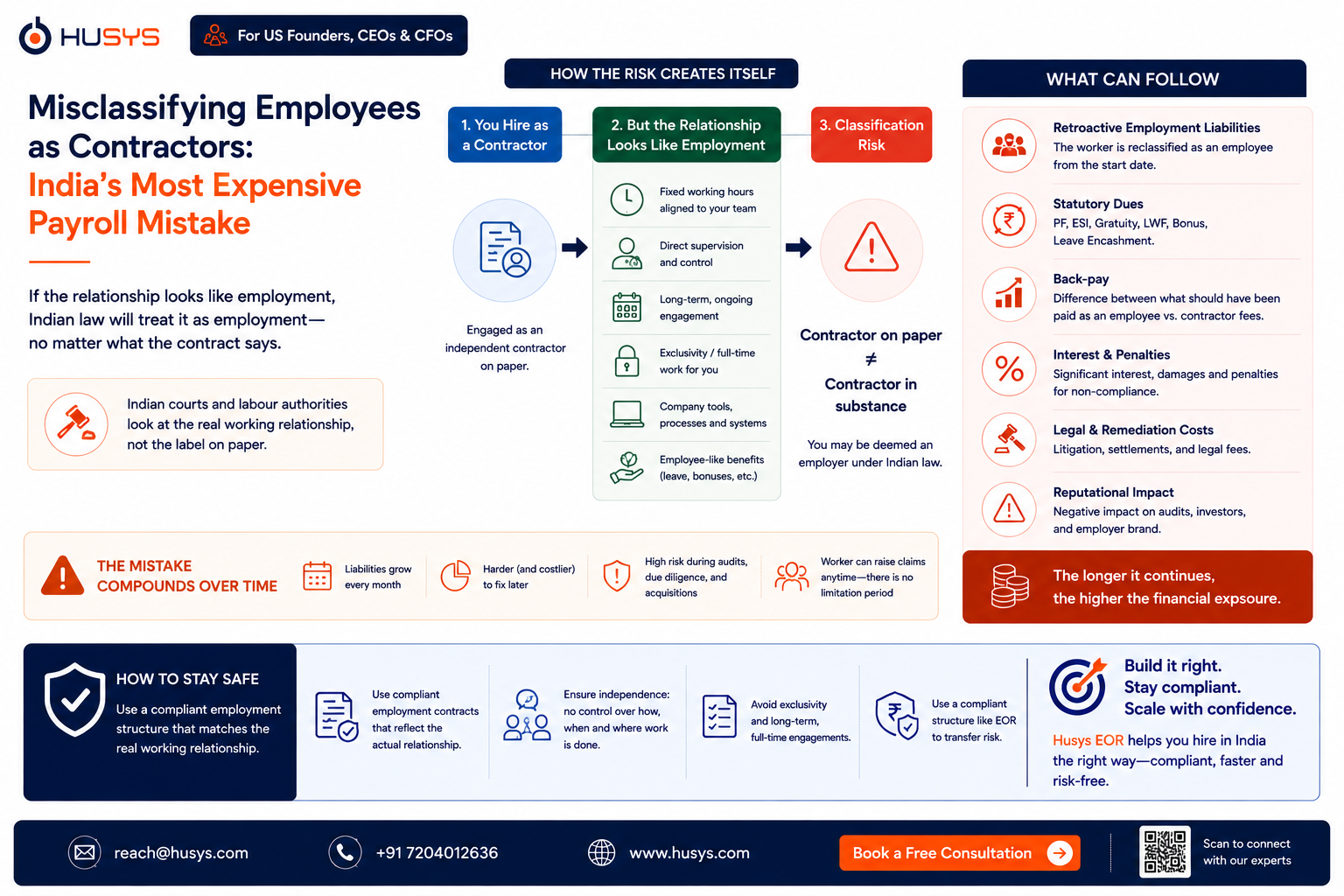
Misclassifying Employees as Contractors: India's Most Expensive Payroll Mistake
Many US companies start their India hiring the same way: find someone good on LinkedIn, draw up a contractor agreement, and wire them money monthly. No entity setup, no statutory filings, no payroll complexity. It looks clean on paper.
If you’re considering contractors for your India team, see our guide to Contractor vs Employee in India 2026 for the classification risks, costs and compliance implications.
A contractor agreement does not by itself determine worker status in India. The actual working relationship can create employment and statutory liabilities.
Indian courts look at the actual working relationship, not what the contract says. And when the substance of that relationship looks like employment, courts consistently treat it as employment, regardless of what the agreement calls the worker.
How Indian courts decide who an employee is
Indian courts and authorities may consider multiple factors when determining whether a worker is genuinely an independent contractor or is functioning as an employee, including the degree of control exercised by the company, the nature and continuity of the work, the level of integration into the business, and the overall substance of the working relationship.
If your “contractor” reports to a manager, works set hours, uses company-provided tools, and has been doing the same work for your company for 12 months or more, Indian courts have consistently found an employer-employee relationship, regardless of what the contract says.
What happens when a contractor is reclassified
If a contractor is determined to have an employment relationship, the company may become liable for applicable statutory benefits and employment obligations that should have applied during the relevant period, with the extent of any retrospective liability depending on the facts of the relationship, the applicable laws, and the findings of the relevant authority or court.
That retroactive liability is the part that most US companies do not model. It is not just the monthly statutory contributions going forward. It is everything you should have been paying since day one, with interest on each missed payment calculated from when it was originally due.
In litigation involving Pawan Hans Limited, a government-owned helicopter services company under the Ministry of Civil Aviation, the Bombay High Court examined claims brought by a union representing fixed-term contract employees.
The company employed about 275 regular employees and roughly 305 fixed-term contract employees, many of whom had worked for years on renewable contracts. After the company implemented wage revisions for regular employees but excluded contract workers, the union sought recovery of the unpaid wage differences.
The labour authority issued a Recovery Certificate for ₹5,80,75,659 ($6.31 million) with 10% annual interest, and the Bombay High Court ultimately refused to overturn the order, allowing recovery proceedings to continue.
In a separate case involving IIT Bombay, the Bombay High Court found that workers engaged through contractors to maintain IIT’s infrastructure had an employer-employee relationship directly with IIT, because IIT engineers exercised direct supervision and control over their work. The Court extended gratuity benefits under the Payment of Gratuity Act to these workers, even though they were formally employed by third-party contractors.
In Express Publications (Madurai) Ltd. v. Union of India (2004), newspaper publishers challenged a provision of the Employees’ Provident Funds Scheme that removed the wage ceiling for employees in the newspaper industry.
Unlike most sectors where employees earning above the statutory limit can be excluded from PF coverage, the rule required newspaper establishments to provide provident fund benefits to all employees regardless of salary level. The publishers argued that this created a disproportionate financial burden on the industry.
The Supreme Court rejected the challenge and upheld the rule, confirming that newspaper employees could be treated as a separate class for social-security protection. As a result, employers in the sector remained liable to contribute to PF for all eligible employees without any salary cap.
Cases like this highlight why employment structure matters from day one. When companies hire through an Employer of Record (EOR) such as Husys, employees are onboarded directly under the EOR’s compliant local entity. Statutory registrations, payroll deductions, and social security contributions are handled correctly from the start.
This employment structure substantially reduces the risk of contractor misclassification because workers are employed through the EOR from the start, while statutory payroll obligations and employment terms are managed under the applicable Indian framework.
Instead of discovering compliance gaps years down the line, the employment structure is set up correctly at the point of hiring.
Permanent Establishment Risk: The Hidden India Employment Law Penalty That Surfaces at Fundraising
According to Clark Armitage, international tax attorney at Caplin & Drysdale, “Any time a US company has employees working for it in India, a PE risk exists and should be evaluated.”
Permanent Establishment is a tax concept that determines whether a foreign company has a taxable presence in India. If Indian tax authorities determine that your company has a PE in India, your US parent company’s India-attributed income becomes subject to Indian corporate tax.
If Indian tax authorities determine that a foreign company has a taxable Permanent Establishment in India, the company may become subject to Indian corporate tax on the profits attributable to that PE, with the applicable tax rate depending on the company’s circumstances, applicable domestic law, and the relevant tax treaty. That is on top of whatever US tax obligations your company already carries.
Unlike a fixed compliance penalty, PE tax exposure scales with revenue. Here is what that looks like in practice.
A US SaaS company with $5 million in annual revenue hires a sales director in Bangalore to close enterprise deals with Indian clients. If Indian tax authorities determine that 20% of that revenue is attributable to India-based activities, the company faces PE tax on $1 million in attributed profit. At 35%, that is $350,000 in Indian corporate tax, assessed on income the company was already planning to report in the US.
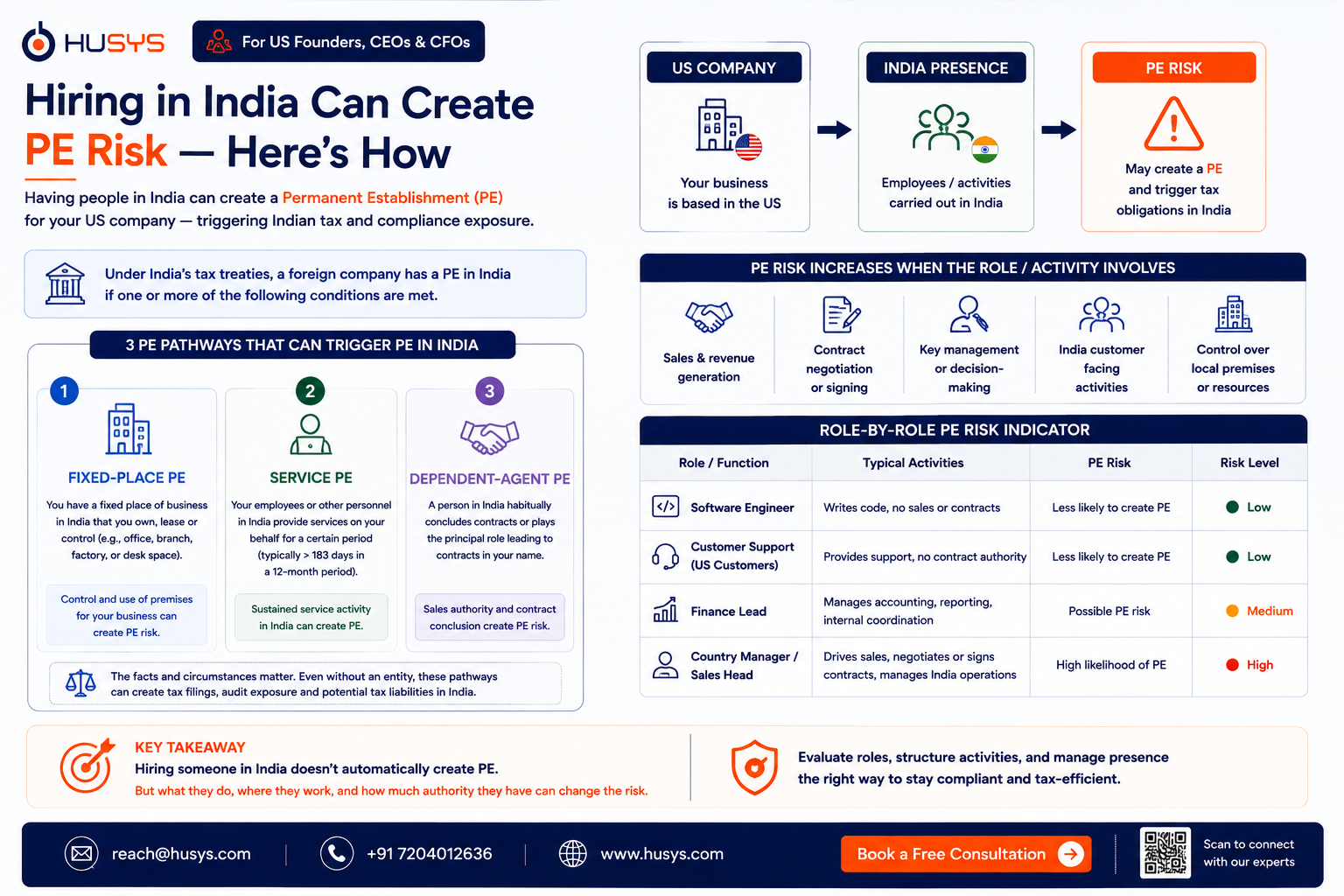
The three ways PE gets triggered when hiring in India
Fixed-place PE arises when a foreign enterprise has the right to use premises in India for its own business activities. India applies a “disposal test”: if your company has continuous and substantive control over a location in India, that can constitute a fixed-place PE even without a formal lease or exclusive office.
Service PE arises when a foreign company provides services in India through its personnel for more than a specified period under the applicable tax treaty.
Dependent agent PE arises when a person in India habitually concludes contracts or plays a principal role, leading to contract conclusions on behalf of the foreign company.
Hiring in India does not automatically create a permanent establishment. PE risk depends on the activities, authority, location and control associated with the India operation.
For a US company with an India-based sales head who is negotiating deals, closing contracts, or representing the company to Indian customers, all three tests are worth evaluating carefully.
Not Sure Whether Your India Team Creates PE Exposure?
Before hiring, let us assess the roles, authority and operating structure of your India team.
PE risk is significantly higher when the India-based employee is involved in taking key managerial decisions for the foreign company, or when they are rendering services to Indian clients of the foreign company from India.
In practice, this means:
Role Type
PE Risk Level
Reason
Software engineers building an internal product
Lower
Work is auxiliary to US operations, no India client interaction
Managerial decisions represents company to third parties
Customer support for US customers
Lower
Auxiliary service, not India-facing revenue
Finance lead managing India entity decisions
Medium to High
Key managerial decisions are being made in India
In Hyatt International Southwest Asia Ltd. v. Additional Director of Income Tax (Delhi High Court, 2024), the Supreme Court found that a Dubai-based hotel management company had a fixed-place PE in India because its personnel exercised continuous and substantive control over Indian hotel operations, even though the company had no formal lease and no exclusive office in India. The Court held that operational control over premises, not formal ownership, was sufficient to establish PE.
In Progress Rail India and Caterpillar vs. Indian Tax Authorities (Delhi High Court, May 2024), the Court ruled in favour of the companies and found no PE, specifically because Caterpillar’s India activities were preparatory and auxiliary in nature, and there was no evidence that Progress Rail’s premises were under Caterpillar’s control or at its disposal.The key factors that saved them were the nature of activities performed in India and the absence of control over local premises.
The contrast between these two cases tells you exactly what Indian courts look at: what your India team actually does, and whether your company controls how and where they do it.
Consider a US SaaS company that hires a sales director in Bangalore to expand into the Asia market. The employee works from a coworking space paid for by the company and negotiates enterprise contracts with Indian clients. From a tax authority’s perspective, the company now has revenue-generating activities and operational presence in India, which are classic indicators used to establish Permanent Establishment.
An Employer of Record structure can change the employment and operational risk profile, but it does not automatically eliminate Permanent Establishment exposure. When employees are hired through an EOR such as Husys, they are employed by the EOR’s local legal entity rather than the foreign parent company, while the foreign company continues to direct the employees’ day-to-day work. PE exposure should therefore be evaluated separately based on the nature of the employees’ activities, their authority, and the applicable tax treaty.
The result is a simpler structure: the EOR handles the employment relationship, payroll, and statutory compliance locally, while the foreign company avoids creating an operational footprint that could trigger taxable presenc
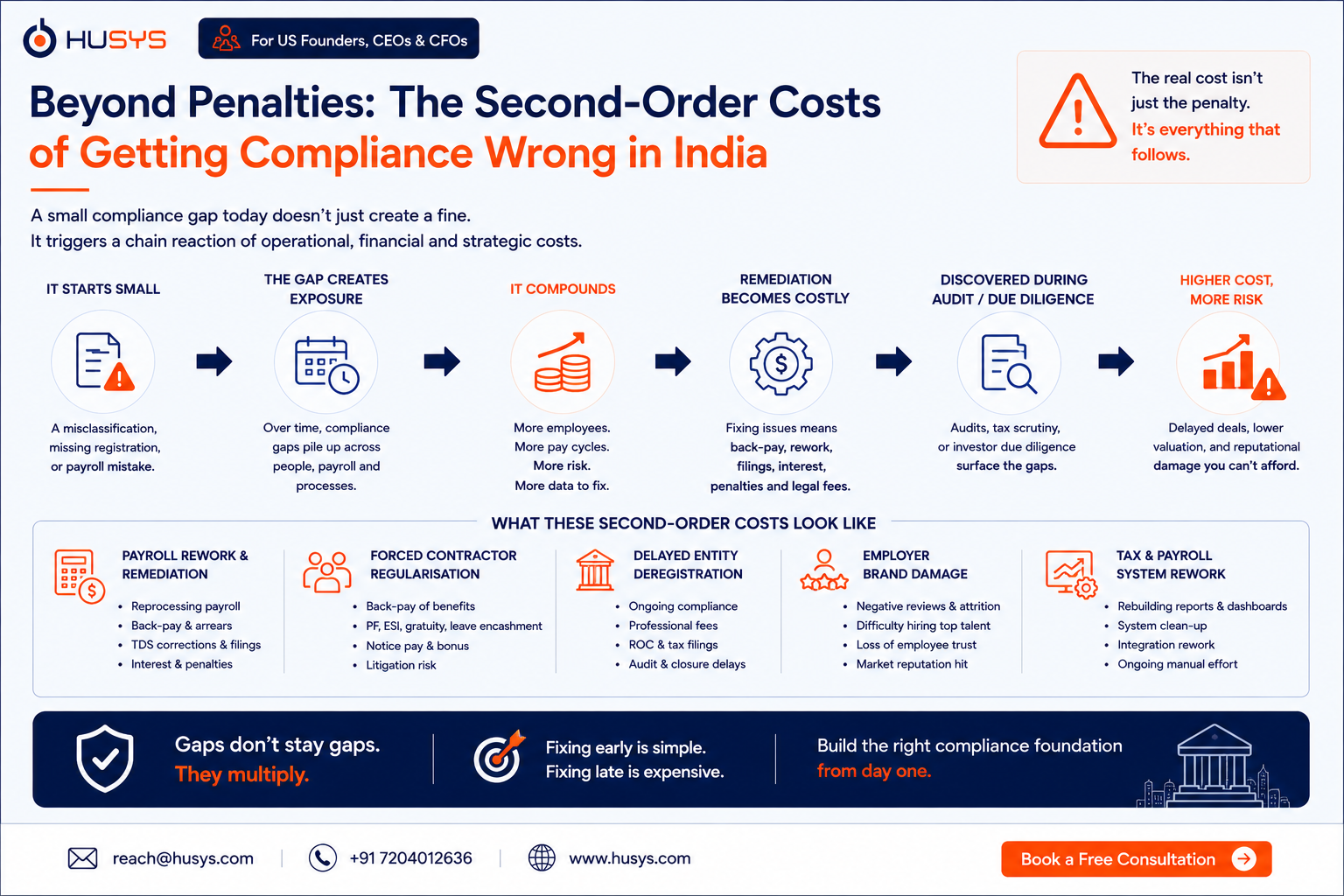
What Are the Second-Order Compliance Costs of Hiring in India?
Second-order compliance costs are the indirect costs that arise after a compliance failure, such as payroll rework, legal remediation, management time, delayed hiring, and transaction friction.
The penalties and interest covered in the previous section are the first-order costs. They are quantifiable, they show up on a balance sheet, and they can be calculated with reasonable precision.
The second-order costs are harder to put a number on, but in many cases, they end up costing more. These are the costs that show up after a compliance failure, not during one, and they are almost never in anyone’s first-year India budget.
Payroll rework across multiple employees
When a compliance gap is discovered, the fix is rarely limited to one employee or one filing period.
A mistake in EPF contributions rarely affects just one month. If PF is calculated incorrectly in the first payroll run, for example, using the capped ₹15,000 wage base when the employee’s actual basic salary should have been used, that same incorrect calculation typically continues in every payroll cycle until the error is discovered.
An error in payroll or EPF calculations can require related payroll components, statutory contributions, and tax withholdings to be reviewed and corrected, depending on how the original calculation affected the employee’s compensation and applicable statutory obligations.
Reworking 18 months of payroll across 12 employees means recalculating every component for every employee for every month, reissuing payslips, filing amended returns with EPFO, ESIC, and the Income Tax Department, and reconciling the differences across all statutory heads simultaneously.
Most US companies discover this during a compliance audit or a due diligence process, not proactively. At that point, the remediation typically requires an external CA firm, a labour law consultant, and several weeks of back-and-forth with multiple government authorities.
The administrative cost of that remediation, including chartered accountant fees, labour compliance consultants, and internal finance time, typically runs between $5,000 and $15,000 for a small team, before back payments and statutory penalties are even considered.
Forced employee regularisation
Indian regulators have increasingly scrutinised how companies classify workers and structure wages. The Employees’ Provident Fund Organisation (EPFO) has directed inspections of establishments where PF contributions are calculated on 50% or less of total wages, a common sign that salaries are being split into allowances to reduce statutory contributions.
Enforcement has also tightened after the 2019 Supreme Court judgment on provident fund wages, which clarified that many routine allowances must be included when calculating PF contributions if they are universally paid.
For a US company that built its India team quickly through contractor arrangements, forced regularisation of five contractors can instantly create five new formal employment relationships with full statutory protections, five gratuity accrual clocks running retroactively, and five notice period obligations that did not exist the day before.
The operational disruption from that is significant, particularly if any of those workers do not want to transition to regular employment on the new terms.
Delayed exits and the deregistration problem
For a US company, this is an important difference to understand when hiring in India. Under India’s new Labour Code framework, employers are required to pay due wages within the prescribed timeline after an employee’s exit, creating a much tighter payroll closeout process than many US companies may be accustomed to.
For a startup managing India payroll for the first time, this means every resignation or termination needs a compliant full-and-final settlement process covering salary, applicable benefits, deductions, and other outstanding dues. An EOR such as Husys can manage the India-specific payroll and exit process, reducing the need for the US HR or finance team to build and maintain this local infrastructure themselves.
The larger delayed-exit problem, however, appears when companies try to shut down an Indian entity. If you set up an Indian subsidiary and later decide to wind it down, the deregistration process requires a clean compliance history across every statutory head before authorities will approve the closure.
Outstanding EPF filings, unresolved ESI notices, or pending labour law requirements can extend the closure timeline. Closing or deregistering an Indian entity can take 12 to 24 months or longer depending on the entity structure, outstanding filings, tax matters, regulatory requirements, and other closure conditions. Where compliance gaps need to be resolved first, the process can take longer and the company may continue to incur compliance and professional costs during the closure period.
With compliance gaps to resolve first, that window extends further, and the entity continues to generate compliance obligations and costs throughout the entire deregistration period.
Employer brand damage in a tightly networked talent market
This is the cost that never appears in a spreadsheet but directly affects your ability to hire.
EPFO publishes information relating to certain defaulting employers, and publicly available compliance information can become a consideration for candidates, business partners, or investors conducting due diligence on a company.
India’s technology talent market is highly connected, particularly in hubs such as Bengaluru, Hyderabad, and Pune. For a US company hiring its first India team, employee experience is therefore part of the hiring strategy, not just an HR issue. Delayed salaries, incorrect statutory deductions, or poorly handled exits can affect how candidates perceive the company and make future hiring harder. An EOR can help the US company provide locally compliant payroll, benefits administration, and employee-exit processes from the start, without requiring the US team to build an India HR and payroll operation on its own.
For a US founder building a 20-person engineering team in Bangalore, losing access to the top third of candidates because of a compliance reputation problem is not a recoverable situation in the short term. Rebuilding an employer brand in a local talent market takes years, not months.
The income tax reform triggered by the new Income Tax Act
Effective April 1, 2026, the Income Tax Act, 2025 replaced the Income-tax Act, 1961, introducing a new legislative framework that requires employers and payroll providers to ensure their tax calculations, reporting processes, and payroll systems remain aligned with the applicable provisions.
Payroll systems must be updated for compatibility with new IT rules and forms, TDS calculation methods and reporting formats need realignment, and Form 24Q and Form 16 generation must adhere to revised formats.
For a US company, the practical issue is not simply that India changed its tax law; it is whether the payroll infrastructure supporting your India team is keeping pace with those changes. A startup that manages India payroll through spreadsheets, disconnected systems, or a provider without dedicated local tax expertise can end up correcting TDS calculations, employee tax documents, and filings after the fact. An EOR such as Husys provides an India payroll and compliance layer that can incorporate applicable regulatory changes without requiring the US finance team to rebuild its payroll process every time the rules change.
What these second-order costs look like together
Compliance gaps create costs beyond penalties — from payroll rework and contractor regularisation to operational disruption, audit exposure and delayed deals.
Second-Order Cost
Trigger
Estimated Cost Range
Payroll rework and remediation
Compliance gap discovered during audit or diligence
The payroll system is not updated for the new IT Act
TDS errors from April 2026, amended filing costs
Employee exits create another layer of cost and procedural risk that US companies often underestimate. Our Employee Termination in India: Legal Guide for US Companies breaks down notice periods, statutory payments, documentation requirements and the financial exposure associated with getting an India exit wrong.
For a US CFO, these are best viewed as the cost of not having the right India employment infrastructure from the start. A missed filing may begin as a small administrative issue, but remediation, professional fees, contractor regularisation, delayed exits, and diligence requests can turn it into a much larger operational cost. The question for a growing startup is therefore not simply, “What does India payroll cost?” but “What will it cost us if we have to fix the infrastructure later?”
An EOR shifts that responsibility from building and maintaining the India employment infrastructure internally to using an established local employment and compliance framework from the beginning.
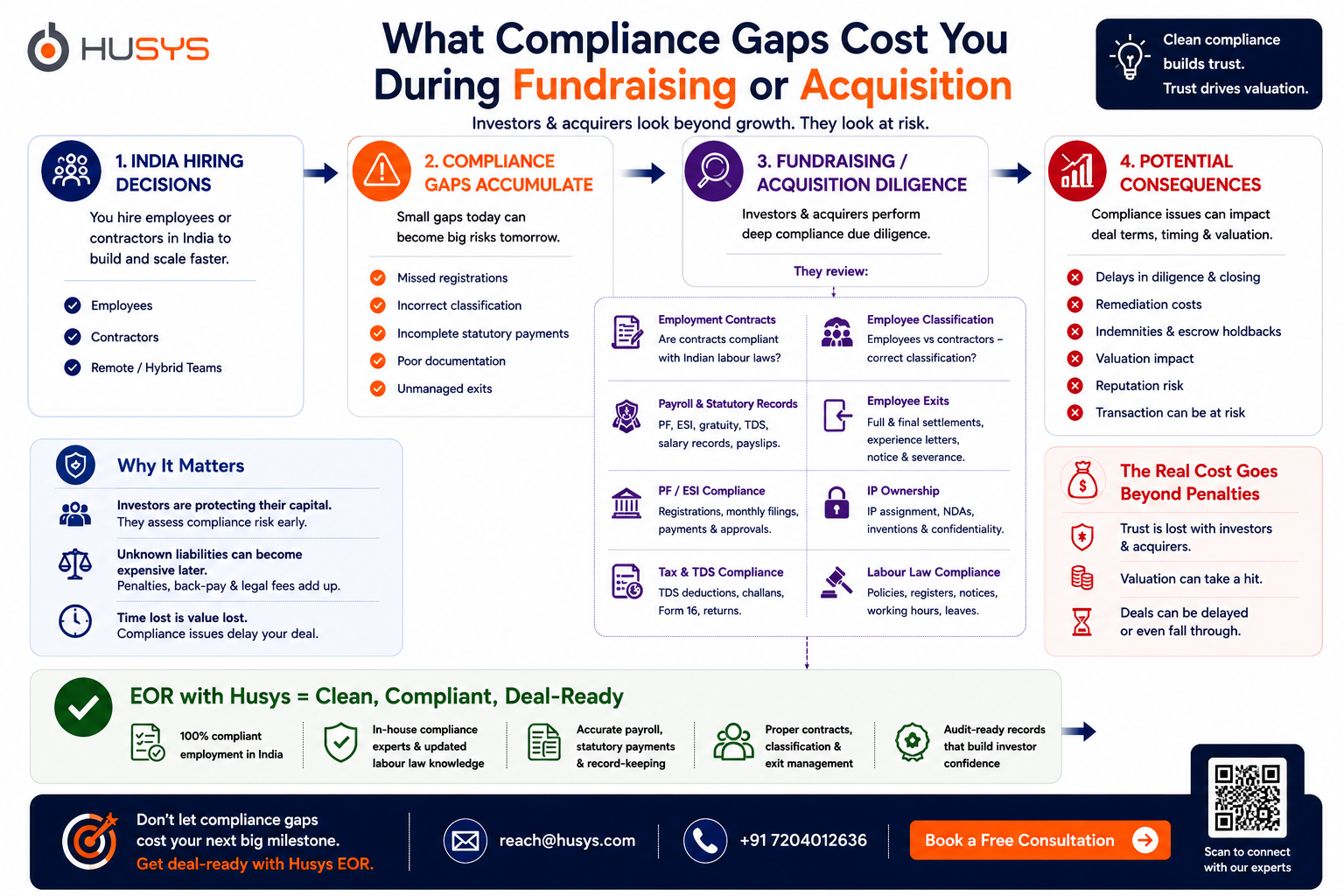
What Compliance Gaps Cost You at Exit or Acquisition
India employment compliance can become a diligence issue during fundraising or acquisition, affecting deal timelines, valuation, remediation costs, and investor confidence.
For a US founder, India employment compliance becomes especially important when the company is raising capital or preparing for an acquisition. What may have been a manageable payroll or contractor issue during day-to-day operations can become a documented liability once investors, acquirers, and their legal teams begin reviewing the India workforce. Missed statutory contributions, contractor classification issues, employment records, and other compliance gaps can therefore become more expensive to resolve precisely when the company needs a clean diligence process.
Both events trigger structured legal due diligence. For a US company with an India workforce, investors and acquirers will typically examine employment contracts, statutory contributions, payroll records, contractor classification, employee exits, and IP ownership.
Both events trigger structured legal due diligence. For a US company with an India workforce, investors and acquirers will typically examine employment contracts, statutory contributions, payroll records, contractor classification, employee exits, and IP ownership.
Preparing for a Fundraise or Acquisition?
Don’t wait for the data room to expose India employment gaps.
Get an India employment compliance readiness assessment before diligence begins.
What will a US investor or acquirer check in your India workforce?
The review typically goes beyond the employment contracts themselves. Investors and acquirers may examine statutory registrations and filings, payroll records, employee exits, gratuity and provident fund compliance, contractor arrangements, and the ownership of work created by India-based employees or contractors.
For a US startup, the practical takeaway is simple: your India workforce becomes part of the company’s diligence trail. Keeping employment and compliance records organized from the first hire can make a future financing or acquisition review significantly easier.
Then keep the existing detailed checklist below it:
Statutory compliance records and filings
Past industrial settlements and labour disputes
Retrenchments and employee terminations
Provident fund and gratuity scheme compliance
Contractor versus employee classification
Beyond statutory filings, diligence also examines operational employment records, including:
Statutory compliance records and filings
Past industrial settlements and labour disputes
Retrenchments and employee terminations
Provident fund and gratuity scheme compliance
Contractor versus employee classification
Legal and compliance issues can create significant risks during M&A due diligence, including delays, additional transaction costs, indemnity requirements, or changes to deal terms. For companies with employees or contractors in India, unresolved employment, payroll, tax, or intellectual property issues can become material diligence findings that require remediation before a transaction can close.
For cross-border transactions involving India teams, employment compliance gaps are among the most common red flags, because they are retroactive, compound with interest, and in some cases carry personal liability for directors.
IP ownership: the compliance gap that kills valuations
Under Indian law, ownership of employee-created intellectual property can depend on the applicable law, employment terms, contractual assignment provisions, and the nature of the work created. For US companies hiring developers, designers, or other knowledge workers in India, clearly drafted employment and IP assignment agreements are therefore important to establish and document the company’s rights to work product. During M&A due diligence, gaps in IP ownership, assignment, or enforceability can require remediation and may affect deal terms, valuation, or transaction timelines.
If you are a US startup raising a Series A or Series B, or preparing for an acquisition, your India workforce can become part of the legal and financial diligence process. Investors and acquirers may ask for employment contracts, payroll records, PF and ESI records, tax filings, contractor agreements, and IP assignment documents to understand whether the India workforce has been hired and managed under the appropriate structure. For a small India team, using an EOR from the beginning can help maintain an organized employment and payroll record without requiring the startup to build a separate India compliance function before it needs one.
For a US SaaS, AI, or cybersecurity company, this becomes particularly important when engineers or contractors in India have contributed to the company’s product, source code, or other intellectual property. A US company should be able to demonstrate a clear chain of IP ownership from the India worker to the company. If employment or contractor agreements do not properly assign the relevant IP rights, an investor or acquirer may require additional legal review, remediation, representations, or indemnities before completing the transaction.
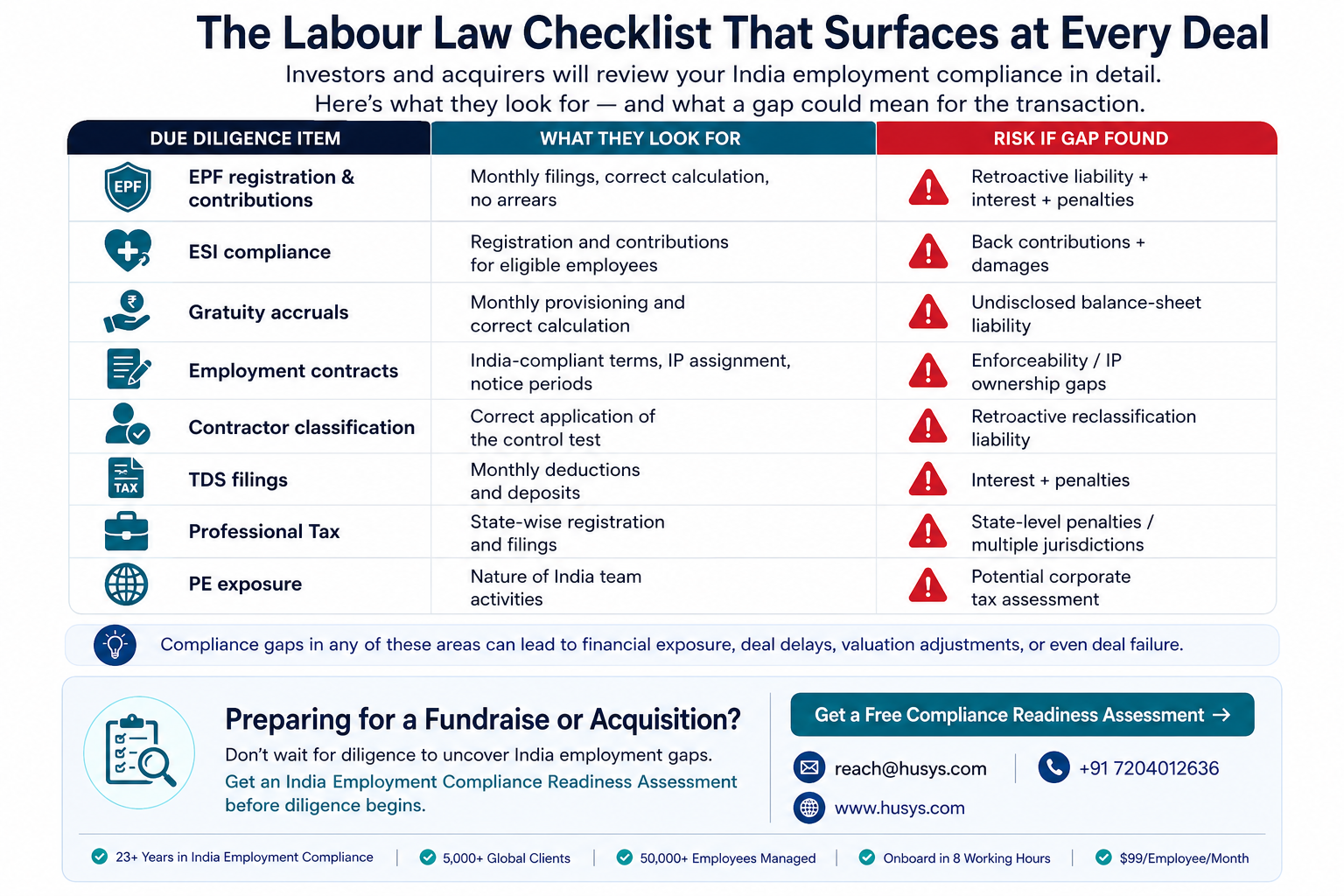
What will an acquirer check before buying a US company with an India team?
When a US company with employees or contractors in India enters acquisition diligence, the buyer’s legal and finance teams are likely to test whether the workforce has been employed, paid, and documented correctly. The most important checks include:
Due Diligence Item
What They Look For
Risk if Gap Found
EPF registration and contributions
Monthly filings, correct calculation, no arrears
Retroactive liability plus interest and penalties
ESI compliance
Registration, contributions for eligible employees
Back contributions, damages up to 25% of arrears
Gratuity accruals
Monthly provisioning, correct calculation
Undisclosed liability on the balance sheet
Employment contracts
India-compliant terms, IP assignment, notice periods
Potential contractual disputes, IP ownership gaps, or remediation requirements
Contractor classification
Control test applied correctly
Retroactive reclassification liability
TDS filings
Monthly deductions and deposits
Interest at 1.5% per month, penalties
Professional tax
State-wise registration and filings
State-level penalties, multiple jurisdictions
PE exposure
Nature of India team activities
Corporate tax assessment on attributed profits
Closing an Indian entity generally requires the company to address outstanding statutory filings, tax matters, regulatory requirements, and other compliance obligations before the applicable closure or deregistration process can be completed. Even under relatively straightforward conditions, the process can take several months and may extend to 12 to 24 months or longer depending on the entity structure and outstanding matters.
Outstanding EPF filings, unresolved labour registrations, or pending TDS notices extend that timeline further. During the entire period, the entity must continue filing returns, maintaining registrations, and paying compliance professionals.
Many US companies run into these problems because their India team was built informally during the early growth phase. Contractors are used where employees should have been hired, payroll filings are inconsistent, and statutory registrations are set up reactively.
An Employer of Record structure, such as Husys, changes how that compliance history is created.
Employees are hired under the EOR’s local legal entity, while applicable payroll obligations, statutory contributions, tax withholding, and employment-related filings are managed through the EOR’s established compliance and payroll processes. Employment agreements include enforceable IP assignment provisions and remain aligned with local labour requirements.
As a result, when diligence begins, the employment and payroll records are maintained through an established employment and compliance process, which can make it easier to provide organized documentation and address diligence requests without first having to remediate avoidable payroll and employment gaps.
How an EOR Absorbs Your India Compliance Risk
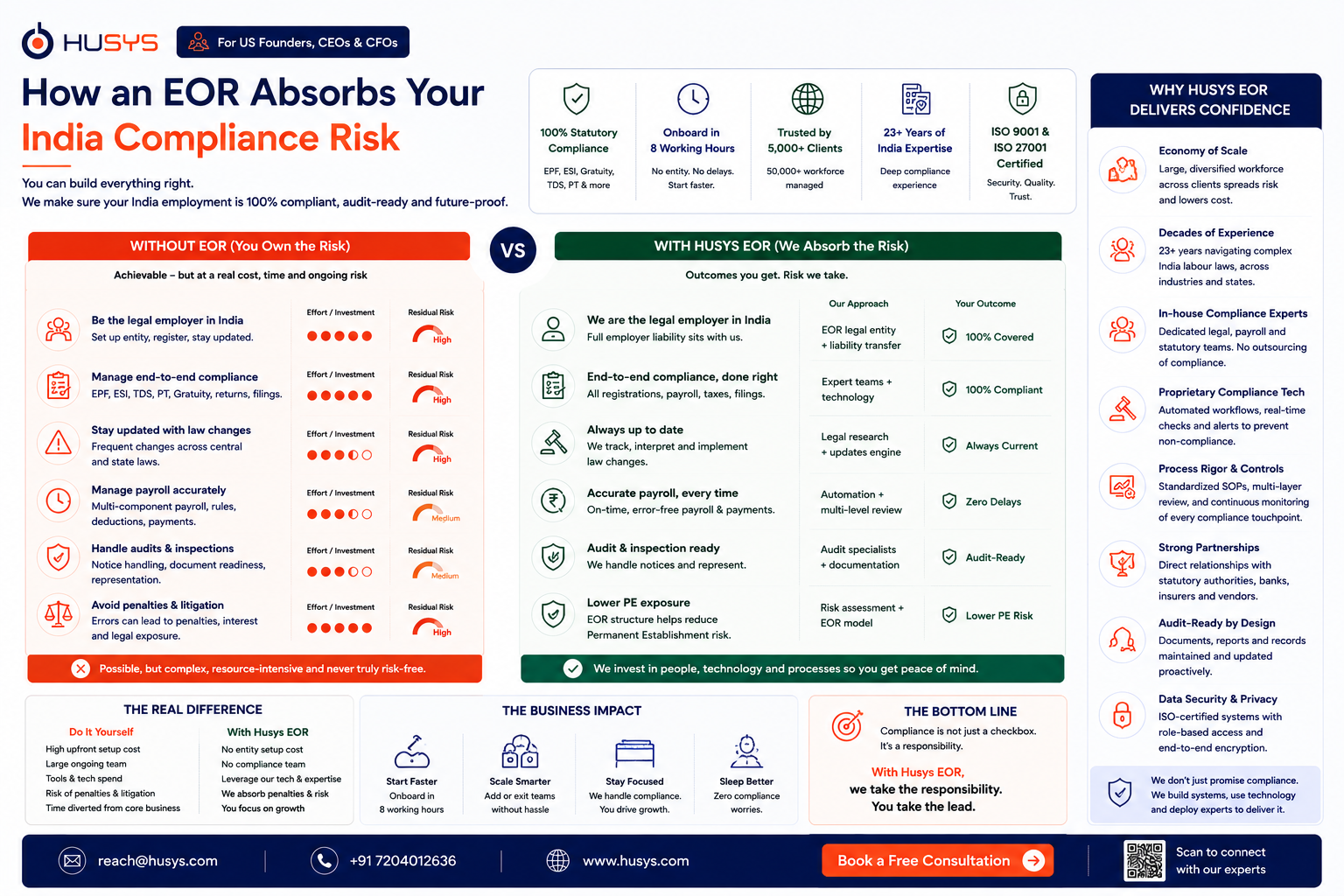
An EOR reduces the compliance burden for a US company by employing workers through its local India entity and managing employment administration, payroll, statutory contributions and required filings. The US company retains day-to-day control of the employee’s work while the EOR manages the local employment framework.
Every compliance risk covered in this article, missed EPF contributions, ESI defaults, contractor misclassification, PE exposure, and payroll rework, shares a common root cause. The US company may be directly responsible for managing Indian employment obligations when it hires employees through its own Indian entity or another direct employment structure without the appropriate local compliance infrastructure.
An EOR changes that structure entirely.
Want to Know Which Model Makes Financial Sense for You?
Compare the cost and operating burden of building an India entity versus hiring through an EOR based on your expected headcount and growth plans.
For a step-by-step look at how an EOR works in India—from compliant employment contracts and onboarding to payroll, statutory filings and ongoing compliance—see our EOR Guide for US Companies Expanding to India.
When you hire through an EOR like Husys, your India team members are employed by Husys’s Indian legal entity, not by your US company directly. The EOR assumes responsibility for employment contracts, payroll, tax withholding, statutory benefits, and labour law compliance.
You continue to manage the employee’s day-to-day responsibilities, performance expectations, and business outcomes.You keep full control over the work. The compliance layer sits with an entity that was built specifically to manage it.
An EOR does more than simplify hiring: it combines local expertise, compliance processes, technology and scale to manage India employment risk.
Here is how that maps against each risk category this article has covered.
Compliance Risk
Without EOR
With Husys EOR
EPF registration and contributions
The client is responsible for establishing and maintaining the applicable registrations, payroll processes, contributions, and filings required for its direct employment structure.
Handled under Husys’s existing EPFO registration
ESI enrollment and filings
Your responsibility, triggers at 10 employees
Managed by Husys based on each employee’s salary eligibility
Gratuity accrual and provisioning
Must be tracked and provisioned monthly
Calculated and provisioned by Husys every payroll cycle
TDS deduction and deposit
Must be filed by the 7th of every month
Filed by Husys under their TAN registration
Professional tax
Separate registration and filing per state
Covered under Husys’s multi-state registrations
Contractor misclassification
Full retroactive liability if reclassified
The contractor misclassification risk associated with the client directly engaging workers is substantially reduced because employees are hired and employed through Husys under the applicable local employment framework from day one.
PE risk
Accumulates based on the nature of the India team activities
PE exposure remains fact-specific and should be assessed based on the nature of the India-based employees’ activities, their authority, and the applicable tax treaty; Husys can help structure and monitor the employment arrangement, but the client remains responsible for obtaining appropriate tax advice on its PE position.
Multi-state compliance
Separate registrations are required per state
Husys can support employees across multiple Indian states and union territories under a single EOR engagement, with applicable state-specific payroll, professional tax, labour law, and employment requirements managed through the EOR structure.
Exit and wind-down
12 to 24-month deregistration process
Wind down in weeks with no deregistration required
For a US company managing India compliance directly, that means your finance or legal team is responsible for tracking every regulatory update, across every state where your employees sit, on every statutory head simultaneously.
What Husys specifically covers
Husys has been operating in India since 2001, supporting over 5,000 global companies and managing 50,000+ workers across India. At $99 per employee per month, the engagement covers:
Employment contracts drafted under Indian law with enforceable IP assignment clauses
EPF and ESI registration, monthly contributions, and quarterly returns
TDS deduction, monthly deposit, and Form 24Q filings
Gratuity accrual tracking and provisioning
Professional tax filings across all applicable states
Payroll processing in INR with payslip generation
Compliant notice period management and full and final settlement processing
ISO 9001 and ISO 27001 certified processes covering operational discipline and data security
Every client engagement at Husys is reviewed to help identify potential PE considerations arising from the nature of India-based activities, while the US parent company remains responsible for obtaining appropriate tax advice on its PE position.
The cost of transferring compliance vs. absorbing it
Running India compliance directly can involve approximately $3,600 to $9,600 or more per year in accounting, payroll, and compliance professional fees for a small team, depending on the service providers, locations, headcount, and scope of support, before considering any statutory penalties or remediation costs. Add one year of missed EPF contributions, and you are looking at $3,456 in penalties and interest on top of that. One misclassified contractor adds another $4,680 in retroactive liability. A payroll rework during due diligence runs $5,000 to $15,000 in professional fees.
Husys charges $99 per employee per month, which works out to $11,880 annually for a 10-person team, subject to the applicable commercial terms. The engagement covers the agreed employment administration, payroll processing, applicable statutory contributions and filings, and other compliance services required under the EOR arrangement from day one.
The India employment compliance costs you avoid by using a compliant EOR are not a soft benefit. They are a direct reduction in penalty exposure, remediation costs, brand reputation, and operational disruption that compounds every month if the right compliance infrastructure is not in place.
The CFO's Decision Framework: Own the Compliance Cost or Transfer It
Every US CFO approving India headcount is making a compliance and operating-model decision, whether they frame it that way or not.
The question is not whether India employment compliance exists. It is who owns the work, who carries the liability, and whether building that capability internally makes sense for your current headcount.
This could be a simple 0–10 score that a US founder/CFO can calculate in 60 seconds.
Factor
0 Points
1 Point
2 Points
India headcount
1–5
6–25
25+
Hiring urgency
Can wait 3–6 months
1–3 months
Need to hire now
India commitment
Testing
Likely long-term
Strategic market
Internal compliance capability
None
Shared resource
Dedicated team
India revenue activity
None
Possible
Already selling
Finance/legal bandwidth
Limited
Some capacity
Dedicated India capability
Score interpretation:
0–4 → EOR is usually the simplest starting point
5–8 → Compare EOR vs. entity economics
9–12 → Entity setup may make sense
For most US companies entering India with a small or growing team, there are two practical choices:
There are only two positions available to you.
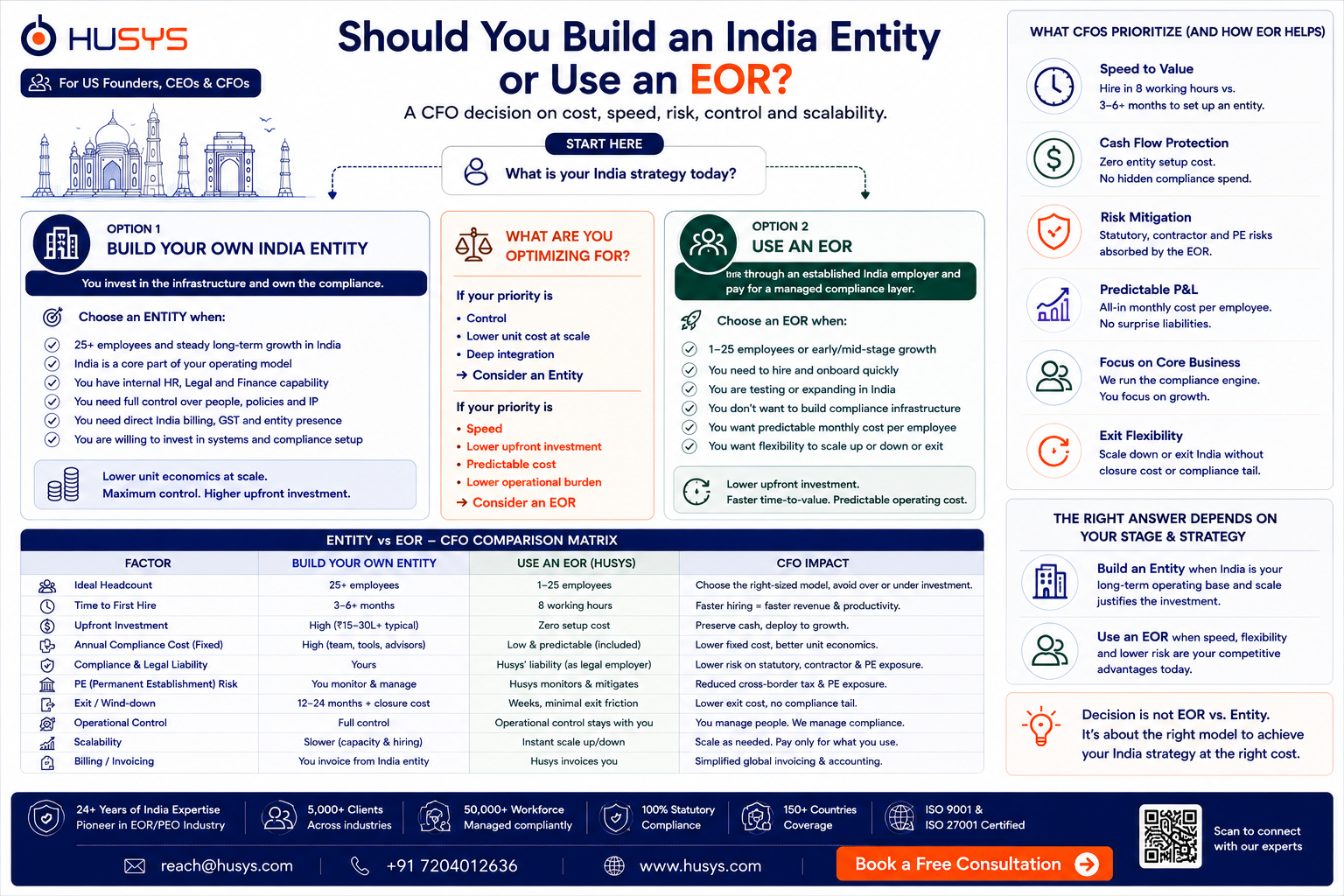
A CFO decision framework comparing an India entity and an EOR across cost, speed, compliance responsibility, risk, scalability and exit flexibility.
Position 1: Own the compliance
You set up your own India entity, hire employees directly, and build the local infrastructure needed to run payroll and maintain compliance. You retain complete control over the employment relationship, but your company also becomes responsible for the underlying statutory obligations — including registrations, payroll filings, employee benefits, tax withholding, and state-specific compliance.
If you’re considering the entity route, our Private Limited Company in India guide for US founders walks through the setup timeline, recurring compliance costs, director requirements and when an entity actually makes economic sense.
This position is often the practical choice when:
You are hiring your first 1–25 employees in India and do not yet have the scale to justify a dedicated India compliance function.
You need to hire and onboard quickly without waiting for entity setup and local registrations.
Your US HR, finance, and legal teams do not have the bandwidth to manage India-specific payroll, statutory filings, and employment administration.
You are testing India as a talent market before committing to a long-term entity.
You want to keep the option of transitioning to your own India entity later, once headcount and business activity justify the additional infrastructure.
Position 2: Transfer the compliance
You hire through an EOR. The employment relationship, statutory registrations, payroll filings, and labour law compliance sit with an established Indian employer. You manage the work. They manage the liability.
This position makes financial sense when:
You are hiring your first 1 to 25 employees in India
You need to move faster than entity setup allows
You do not have the internal capacity to manage India-specific statutory obligations
India is still being validated as a hiring market before a long-term commitment
You want the ability to exit quickly without a 12 to 24-month deregistration process
The decision matrix
Factor
Own the Compliance (Entity)
Transfer the Compliance (EOR)
Headcount
25+ employees
1 to 25 employees
Timeline to first hire
Typically several weeks to months, depending on entity setup and registrations
As fast as 8 working hours, subject to receiving the required employee and client information
Internal compliance capacity
Required
Not required
India’s revenue generation
Suits direct billing
Not structured for India-facing revenue
Exit flexibility
Requires entity closure or deregistration and continued compliance during the process in some cases it is 12-24 months
Employees can be offboarded through the EOR without requiring the client to deregister an Indian entity
Year 1 fixed setup and compliance costs
$25,000 to $40,000, depending on entity setup, professional fees, registrations, and ongoing compliance requirements
No separate India entity setup required under the EOR model
Per-employee monthly cost
Decreases at scale
$99 flat per employee
PE risk management
You monitor and mitigate
Monitored at the invoice level by EOR
Compliance liability
Primarily managed and borne by the client under its direct employment structure
Employment and statutory compliance responsibilities are handled by the EOR within the scope of the engagement
The $25,000 to $40,000 figure is an estimated first-year range for setting up and maintaining an India entity, including professional, registration, accounting, payroll, and compliance costs; actual costs vary based on the entity structure, headcount, locations, and operating requirements.
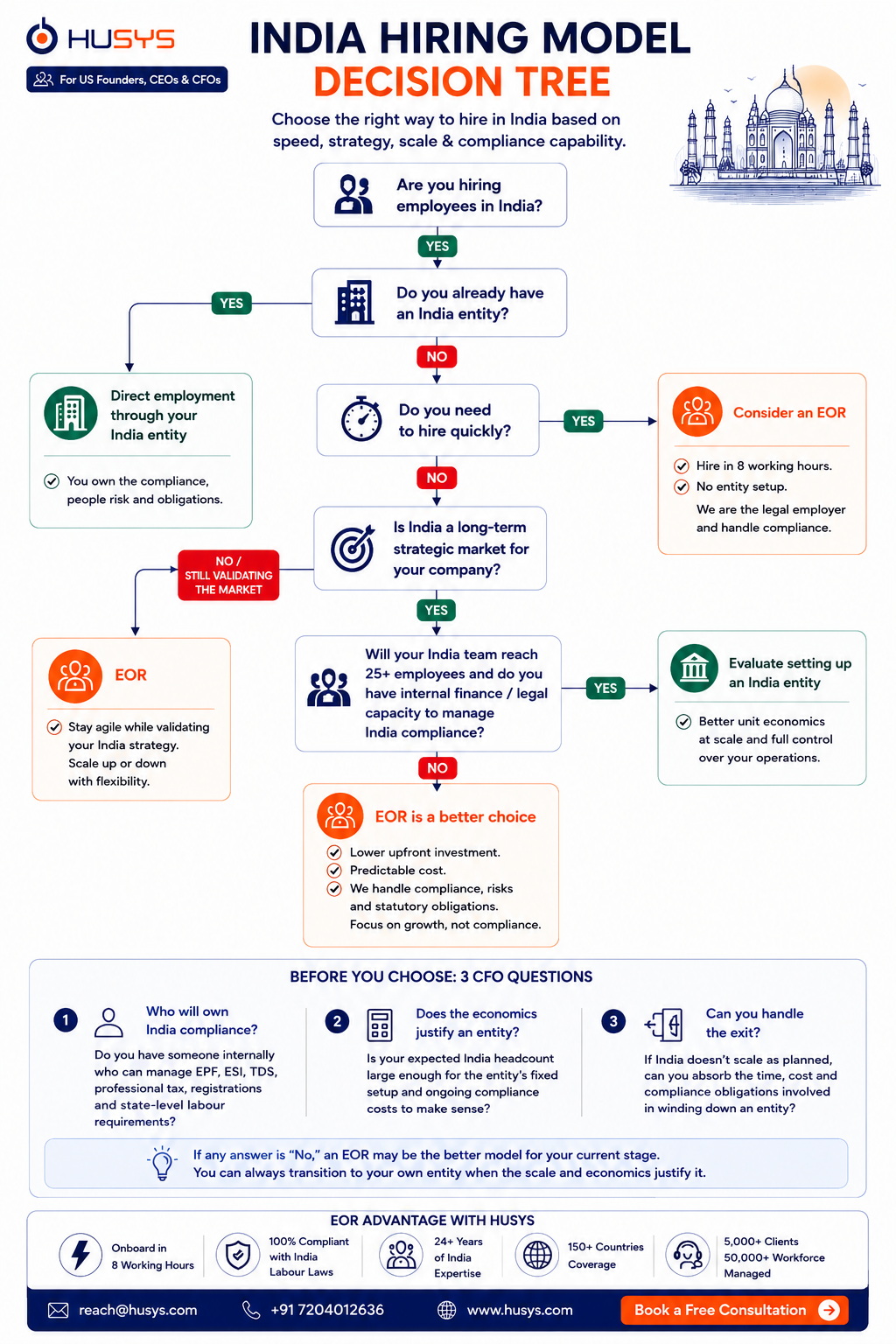
India Hiring Model Decision Tree
Which India hiring model fits your company? Use this decision tree to evaluate an India entity vs. EOR based on hiring speed, strategic commitment, scale, economics, and internal compliance capability.
Want to compare the three models in more detail? See our EOR vs Entity vs Contractor in India (2026) guide for a detailed comparison of cost, setup time, compliance responsibility and scalability.
According to the EY DNA of the CFO survey, 47% of CFOs say their current finance function does not have the right mix of capabilities to meet the demands of future strategic priorities. As a result, many organizations are re-evaluating which functions should remain in-house and which are better handled through outsourced operational support.
Ask three questions:
Do you have someone internally who can own India compliance, meaning monthly EPF filings, state-level professional tax, TDS deposits by the 7th of every month, and labour law registrations across every state where your employees sit?
Is your India headcount large enough that the fixed cost of running an entity, $25,000 to $40,000 annually before a single salary is paid, is justified by the per-employee savings over EOR fees?
If your India plans change in 12 months, can you absorb a 12 to 24-month entity deregistration process with active compliance costs throughout?
If you cannot confidently answer “yes” to all three questions, an EOR may be the more practical operating model for your current stage. It allows you to start hiring in India without committing immediately to the cost and administration of your own entity. As your India headcount and business activity grow, you can reassess whether establishing your own entity makes economic and operational sense.
Should we build India employment infrastructure or buy access to it?
Decision Factor
Build Internally
Use EOR
Entity setup
You build it
Already established
Payroll
Build/manage
Outsourced
Compliance
Internal responsibility
EOR-managed
State registrations
Your responsibility
Included
Speed
Slower
Faster
Fixed infrastructure cost
Higher
Lower initially
Control
Maximum
Employment administration shared
Best for
Long-term scale
Early/mid-stage expansion
Conclusion
Hiring in India is not inherently difficult. Building the employment infrastructure around that hiring is what requires local expertise.
For a US startup hiring its first few employees in India, the decision is usually not simply “EOR or entity?” It is:
How quickly do we need to hire?
Do we have someone who can own India payroll and compliance?
Are we ready to operate a local entity?
Is India a market we are testing or a long-term operating hub?
What happens to our compliance records when we raise funding or get acquired?
If you are still building the market, an EOR can give you a faster way to hire while keeping India employment administration with a local provider. Once your headcount and business activity justify it, you can reassess whether establishing your own entity makes sense.
For US companies that want to start with an EOR, Husys has been operating in India since 2001, supporting 5,000+ clients and 50,000+ workers across India. The service is priced at $99 per employee per month, with no setup fees and onboarding within 8 working hours.
Planning to Hire in India? Get the Structure Right Before the Costs Compound.
Whether you’re:
Hiring your first employee in India
Managing an existing contractor team
Evaluating an India entity
Preparing for fundraising or acquisition
Unsure whether EOR or an entity makes more financial sense
Talk to Husys about your India hiring structure.
Book a Free India Hiring & Compliance Consultation
How far back can Indian authorities audit my company’s payroll?
The EPFO may assess and recover unpaid contributions relating to earlier periods under Section 7A of the EPF Act, subject to the applicable legal provisions and circumstances of the case. Where fraud or misrepresentation is involved, different limitation considerations may apply.
Do India’s compliance rules apply to my company if we haven’t set up an Indian entity yet?
Yes. A foreign company’s employment, payroll, tax, and Permanent Establishment obligations can arise depending on the nature of its activities and working arrangements in India, even if it has not incorporated an Indian entity. Contractor classification and PE exposure should therefore be evaluated based on the actual relationship and activities rather than entity status alone.
What triggers a labour inspection in India?
Labour inspections or compliance reviews can arise from employee complaints, statutory requirements, routine or risk-based inspections, information received by authorities, or other circumstances specified under the applicable labour laws and rules. The notice and inspection process can vary depending on the applicable authority, state, establishment, and nature of the inspection.
How does the new Income Tax Act 2025 affect India payroll for US companies?
Effective April 1, 2026, payroll and TDS processes must align with the applicable provisions of the Income Tax Act, 2025 and related rules. Employers and payroll providers should ensure that their systems, calculations, reporting formats, and Form 24Q processes are updated for the applicable requirements from the beginning of the new financial year.
What happens to gratuity accruals if an employee leaves before five years?
Under the Code on Social Security, fixed-term employees may qualify for gratuity after completing one year of continuous service, subject to the applicable provisions and rules. For other employees, gratuity eligibility depends on the applicable statutory requirements and the circumstances of the employee’s separation from service.
Can Indian employees waive their statutory benefits in their employment contract?
Statutory benefits and protections that are mandatory under applicable Indian law generally cannot be waived through an employment contract. The enforceability of any contractual provision depends on the specific benefit, employment arrangement, and applicable legislation.
What is the difference between a PEO and an EOR in India?
An EOR becomes the employer of record for the employees and manages employment and statutory obligations within the scope of the engagement, while a PEO or co-employment arrangement generally works alongside the client’s own employing entity. If your company does not have an Indian entity and wants to hire employees locally, an EOR can provide the employment structure without requiring the client to establish its own Indian entity.
How does Husys handle compliance updates when Indian labour laws change?
Husys conducts a compliance review at onboarding for clients transitioning from direct hiring or contractor arrangements. Where gaps are identified, Husys works with the client to assess the relevant statutory obligations and structure an appropriate remediation plan before taking over ongoing compliance management.
Does Husys cover hiring across multiple Indian cities under one engagement?
Yes. Husys covers all 28 states and 6 union territories under a single engagement. State-specific professional tax filings, local labour law registrations, and holiday calendars are all managed internally without requiring separate contracts per location.
How quickly can Husys resolve a compliance gap inherited from a previous hiring arrangement?
Husys conducts a compliance review at onboarding for clients transitioning from direct hiring or contractor arrangements. Where gaps exist, Husys works with the client to structure remediation across the relevant statutory heads before taking over ongoing compliance management.
Empowering Your Workforce Journey with Trusted Insights
Find the latest industry trends, expert blogs, insightful case studies, and essential tools. Whether you’re expanding your team locally or globally, we’ve got the information you need to make informed decisions and stay ahead of the curve.