
Choosing an EOR provider in India is not a feature comparison. It is a liability-transfer decision, and you should score it like one. Run every provider on your shortlist through ten weighted criteria, demand documentary evidence instead of assurances, and treat a short list of failures as disqualifying regardless of the total score. That is the whole method, and the rest of this article is the detail behind it.
What is an employer of record in India? An employer of record (EOR) in India is a company that legally employs staff in India on your behalf. It holds the Indian registrations, issues the employment contract, runs payroll and pays statutory contributions, while the employee works for you day to day. It lets a foreign company hire in India without setting up its own Indian entity.
This is written for the moment you are probably in right now: two or three India EOR proposals open in front of you, no in-house Indian labour-law expertise, and no defensible way to compare them. Every proposal says “100% compliant”. None of them tells you what compliant means in a country where the entire statutory framework was replaced on 21 November 2025 and the Provident Fund wage ceiling moved again on 17 September 2026.
The scorecard below is free, ungated and usable today. You can score three providers side by side, re-weight it for your role, and print the result for your procurement file. Open the India EOR Buyer’s Scorecard free, no email required.
The short version, if you read nothing else 1. Score ten categories, weighted to 100. 2. Use a 0–4 scale that measures evidence, not confidence: a persuasive answer is a 1; a document plus a contract clause is a 4. 3. Apply eleven hard stops that override the total. 4. Re-weight for whoever is signing, a General Counsel and a Founder should not be scoring the same way. 5. Ask for the sixteen documents in the evidence pack before you sign, not after. And one thing no vendor will put at the top of its own page: an employer of record does not eliminate your Permanent Establishment risk in India, and if your India-based people will directly sell or directly generate revenue in India, an EOR is the wrong structure for you. We explain both below. |
What this article covers: the 12 sections, in order
- The scorecard: ten weighted criteria, the 0–4 evidence scale and the bands
- What changed in 2025–26, and why most EOR checklists are now out of date
- The ten categories in detail: what a 4 out of 4 answer looks like, and what a 0 looks like
- Is an EOR provider the right model for you at all?
- How hiring in India runs normally, and how it runs with an EOR
- How to check an EOR provider’s quote against the real cost
- Does your provider cover the state you are hiring in?
- What happens to your employees if you leave an EOR provider
- What documents to ask an EOR provider for, and the reference-check script
- What US buyers get wrong when choosing an EOR provider in India
- What this looks like at Husys
- Frequently asked questions
How the numbering works: the article has twelve sections, numbered 1 to 12. Section 1 sets out the scoring instrument ten weighted criteria and eleven hard stops. Section 3 then scores each of the ten criteria in turn, and calls them Category 1 to Category 10. So every reference to a “category” in this article points to section 3, and every reference to a “section” points to this list.
1 · The scorecard
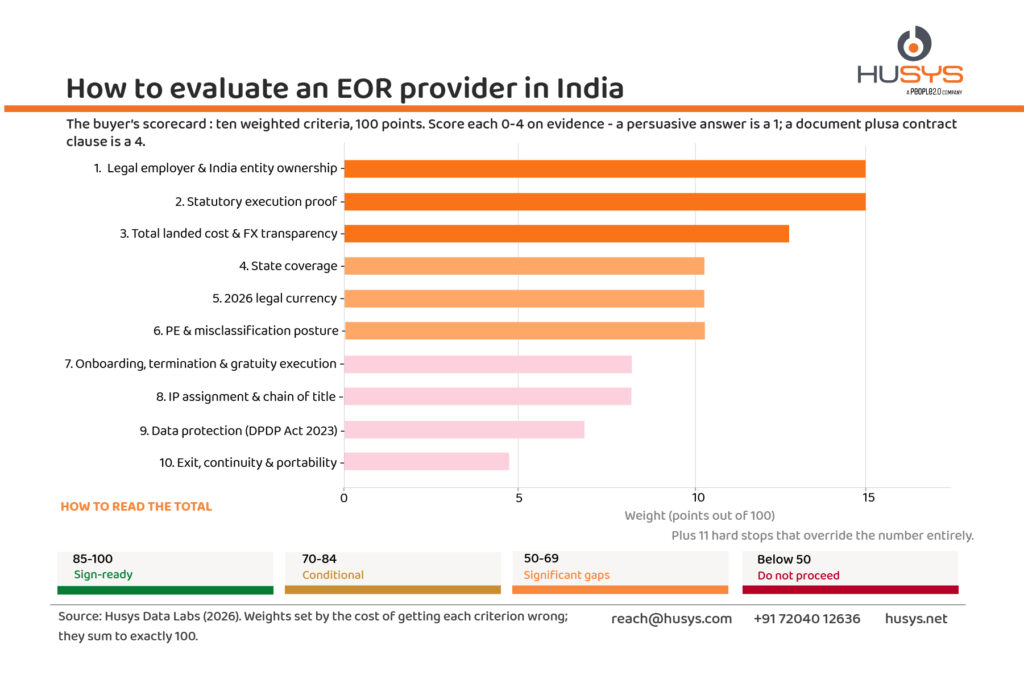
Score each category from 0 to 4. Multiply by the weight, divide by four, and add the ten results. The total is out of 100.
The ten weighted criteria to evaluate an EOR provider in India
# | Category | Weight | Ask for (full wording in the section below) |
|---|---|---|---|
1 | Legal employer & India entity ownership | 15 | The entity name, CIN and Certificate of Incorporation |
2 | Statutory execution proof | 15 | EPFO code, ESIC code, TAN, three months of challans |
3 | Total landed cost & FX transparency | 12 | An itemised quote at your CTC, gratuity included |
4 | State coverage | 10 | States registered in today, with certificate numbers |
5 | 2026 legal currency | 10 | Current contract template and the Sept 2026 PF note |
6 | PE & misclassification posture | 10 | What they will tell you NOT to do with an EOR hire |
7 | Onboarding, termination & gratuity execution | 8 | Onboarding SLA with a remedy, and how gratuity is funded |
8 | IP assignment & chain of title | 8 | IP assignment clauses from both agreements |
9 | Data protection (DPDP Act 2023) | 7 | A signed DPDP data processing addendum |
10 | Exit, continuity & portability | 5 | Exit clause: transfer, service continuity, data return |
Total: 100 points. The weights are ours, they are published, and they sum to exactly 100, which you should check on any scorecard you are handed, including this one.
The 0–4 evidence scale
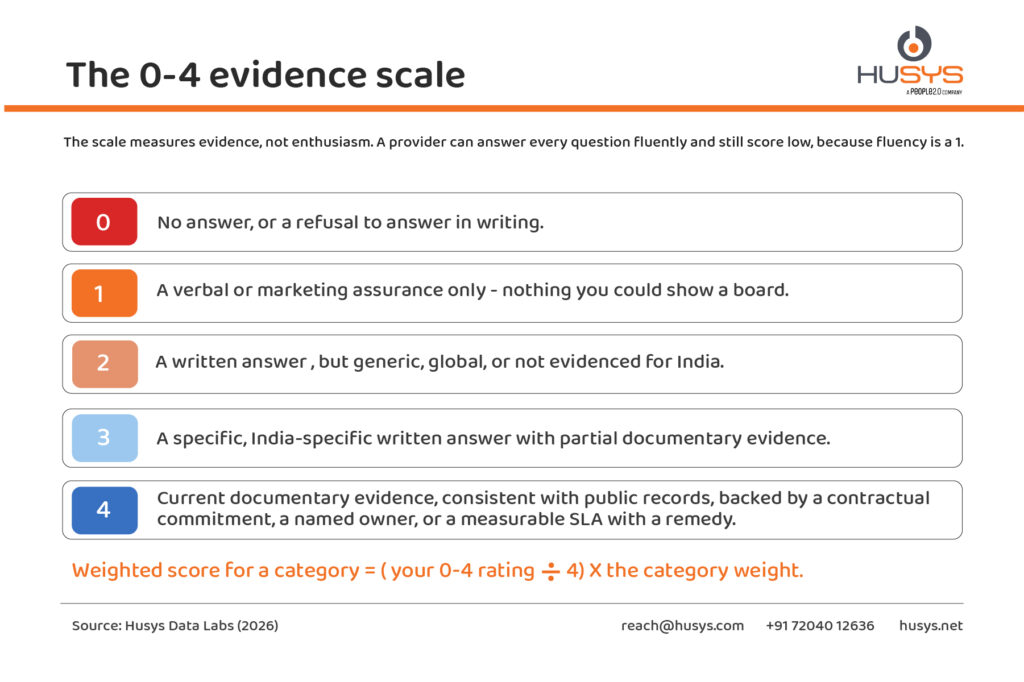
This scale is the mechanism. It measures evidence, not enthusiasm. A provider can answer every question in this article fluently and still score 10 out of 100, because fluency is a 1.
Score | What it requires |
|---|---|
0 | No answer, or a refusal to answer in writing. |
1 | A verbal or marketing assurance only, nothing you could show a board. |
2 | A written answer, but generic, global, or not evidenced for India. |
3 | A specific, India-specific written answer with partial documentary evidence. |
4 | Current documentary evidence, consistent with public records, backed by a contractual commitment, a named owner, or a measurable SLA with a remedy. |
Weighted score for a category = (score ÷ 4) × weight. So a 3 out of 4 on a 15-point category scores 11.25.
How to read your total
Score | Verdict | What to do |
|---|---|---|
85–100 | Sign-ready | Evidence is documentary and contractual. Proceed, and attach the scorecard to the file as your diligence record. |
70–84 | Conditional | Close the named gaps in the contract before you sign, not after. Re-score the gap categories once the clauses are agreed. |
50–69 | Significant gaps | Remediation required. Set a deadline, request the missing documents, and re-score. Do not let procurement treat the gap as a negotiating detail. |
Below 50 | Do not proceed | The provider cannot evidence what it is asking you to rely on. |
The eleven hard stops
These override the number. A provider can total 88 and still fail here, and you should treat any one of them as a reason to stop rather than negotiate. Each one is a thing a competent India EOR can resolve in a single afternoon, which is exactly why an inability to resolve it is informative.
- Cannot name the Indian legal entity that will appear on the employment contract.
- Cannot produce its own EPFO establishment code.
- Cannot produce its own ESIC code and TAN.
- Cannot produce PF, ESI or TDS challans and ECR acknowledgements for the last three months.
- Holds no Shops & Establishment registration in the state where you intend to hire, and will not commit to a registration lead time in writing.
- Its draft employment agreement still cites repealed statutes: the Industrial Disputes Act 1947, the Payment of Gratuity Act 1972 or the Payment of Bonus Act 1965, as live law.
- Will not put the named legal employer, the liability cap and the statutory indemnity into the contract.
- Claims that using its EOR eliminates your Permanent Establishment risk in India.
- Cannot explain the IP assignment chain from employee to its Indian entity to your company.
- Will not sign a DPDP-compliant data processing addendum, or asserts that the data-fiduciary obligation transfers away from you.
- Will not commit in writing to an exit process covering employee transfer, data return and continuity of service.
Why hard stops matter more than the score A purely numerical model lets a provider average its way past a fatal gap. In the India EOR category today you can find a published vendor ranking in which a provider scores above four out of five without the publisher ever establishing that it holds its own Indian employment registrations. A weighted score is a comparison tool. A hard stop is a safety check. You need both. Both are built into the interactive scorecard: tick a hard stop and it overrides the total. |
Re-weight it for whoever is signing
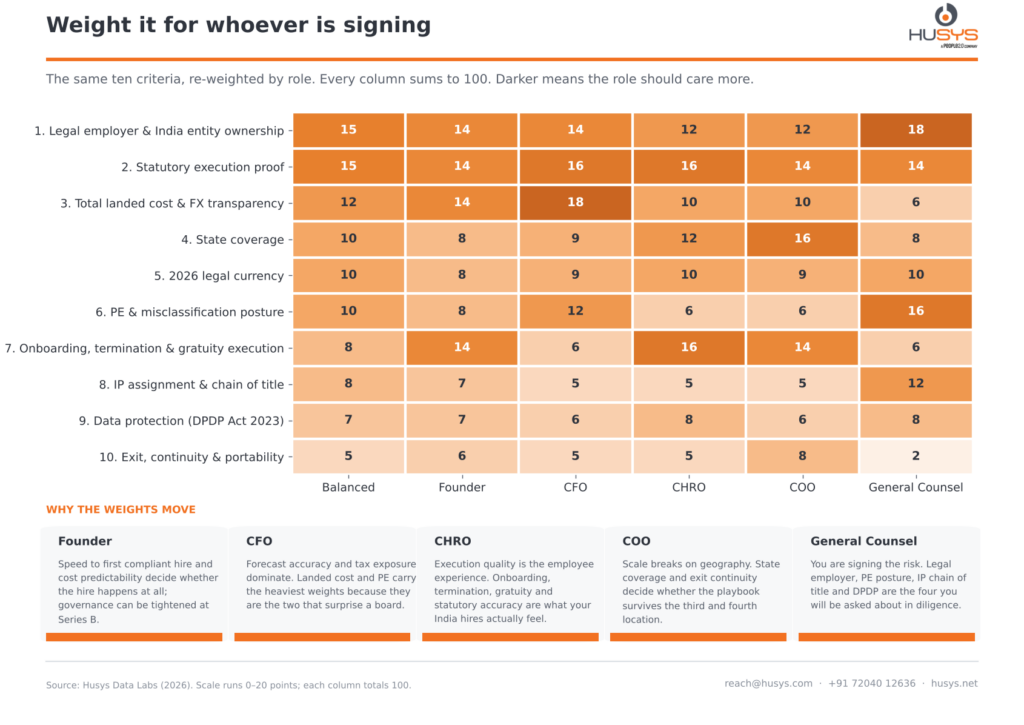
A Founder and a General Counsel are buying different things from the same contract. Use the preset that matches the person who will actually be accountable, or run two and compare where they disagree, which is usually the most useful conversation you will have internally.
Category | Balanced | Founder | CFO | CHRO | COO | General Counsel |
|---|---|---|---|---|---|---|
Legal employer & India entity ownership | 15 | 14 | 14 | 12 | 12 | 18 |
Statutory execution proof | 15 | 14 | 16 | 16 | 14 | 14 |
Total landed cost & FX transparency | 12 | 14 | 18 | 10 | 10 | 6 |
State coverage | 10 | 8 | 9 | 12 | 16 | 8 |
2026 legal currency | 10 | 8 | 9 | 10 | 9 | 10 |
PE & misclassification posture | 10 | 8 | 12 | 6 | 6 | 16 |
Onboarding, termination & gratuity execution | 8 | 14 | 6 | 16 | 14 | 6 |
IP assignment & chain of title | 8 | 7 | 5 | 5 | 5 | 12 |
Data protection (DPDP Act 2023) | 7 | 7 | 6 | 8 | 6 | 8 |
Exit, continuity & portability | 5 | 6 | 5 | 5 | 8 | 2 |
- Founder / CEO: Speed to first compliant hire and cost predictability decide whether the hire happens at all; governance can be tightened at Series B.
- CFO: Forecast accuracy and tax exposure dominate. Landed cost and PE carry the heaviest weights because they are the two that surprise a board.
- CHRO / Head of People: Execution quality is the employee experience. Onboarding, termination, gratuity and statutory accuracy are what your India hires actually feel.
- COO: Scale breaks on geography. State coverage and exit continuity decide whether the playbook survives the third and fourth location.
- General Counsel: You are signing the risk. Legal employer, PE posture, IP chain of title and DPDP are the four you will be asked about in diligence.
Your EOR provider runs these changes for you, so test that it has.
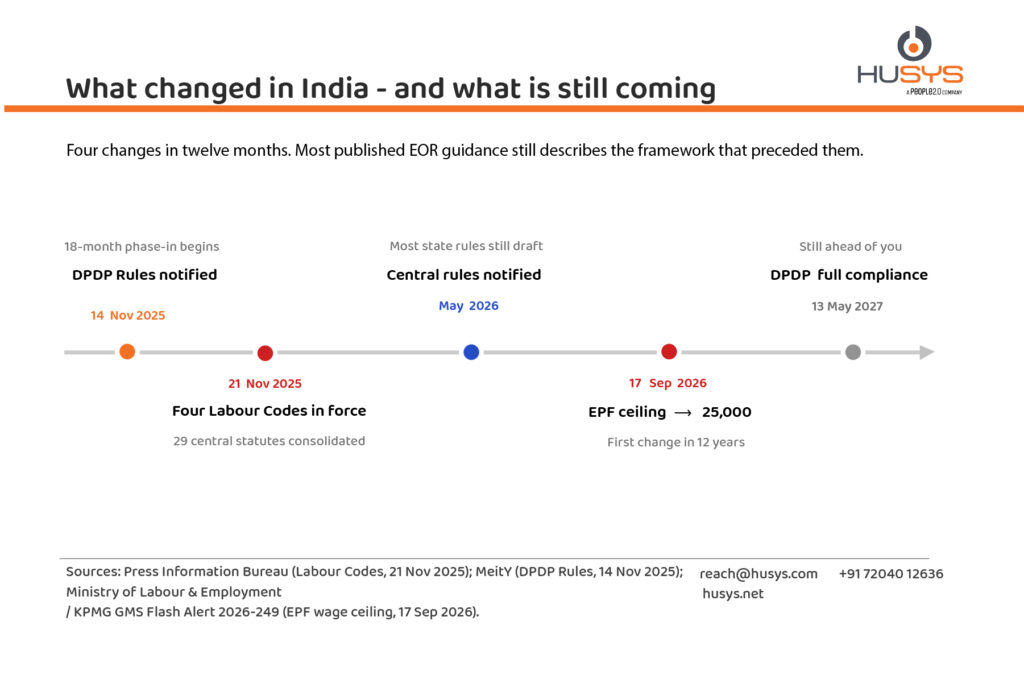
Three of the four raise employer costs, and a proposal built on 2024 assumptions will understate your invoice.
Has your EOR provider updated its contracts for the Labour Codes?
The four Codes replaced 29 central laws on 21 November 2025, and central rules followed in May 2026 (PIB). Most large states are still finalising their own rules.
The one-line test you can run today: ask for the provider’s current India employment agreement template. If it still names the Industrial Disputes Act 1947, the Payment of Gratuity Act 1972 or the Payment of Bonus Act 1965 as live law, it is citing a superseded statute. That is a document, not an opinion, and it takes ten seconds to check.
Read more: India Labour Codes 2026: a guide for US companies
Under section 2(y) of the Code on Wages, the allowances excluded from “wages” cannot exceed 50% of total remuneration. Anything above that is added back.
In practice the statutory wage base is now floored at roughly half of pay, which raises Provident Fund, gratuity and bonus simultaneously.
Ask the provider to show its salary structure for your hire with the 50% test applied.
Read more: Hidden compliance costs of hiring in India
What this does to one real number Take a senior India engineer on a cost-to-company of ₹36,00,000 a year (about $37,594 at ₹95.76 to the dollar, the rate quoted on 12 October 2026). Under a traditional 30%-basic structure, the gratuity accrual would be (₹90,000 ÷ 26) × 15 = ₹51,923 a year, about $542. With the statutory base floored at 50%, the same accrual becomes (₹1,50,000 ÷ 26) × 15 = ₹86,538 a year, about $904, a 67% increase in a cost line most EOR quotes do not show you at all. |
Has your EOR provider applied the ₹25,000 ($261) PF ceiling?
The EPF wage ceiling was raised from ₹15,000 to ₹25,000 a month (about $157 to $261) by Gazette notification, effective 17 September 2026, the first change in twelve years. The maximum employer statutory outgo per capped employee moved from ₹1,950 (about $20) to ₹3,250 (about $34) a month.
Component | Before 17 Sep 2026 (₹15,000 ≈ $157 ceiling) | From 17 Sep 2026 (₹25,000 ≈ $261 ceiling) |
|---|---|---|
Employer EPF + EPS (12%) | ₹1,800 (≈ $19) | ₹3,000 (≈ $31) |
EDLI (0.5%, employer only) | ₹75 (≈ $0.78) | ₹125 (≈ $1.31) |
Administrative charges (0.5%) | ₹75 (≈ $0.78) | ₹125 (≈ $1.31) |
Total per capped employee, per month | ₹1,950 (≈ $20) | ₹3,250 (≈ $34) |
Annualised | ₹23,400 (≈ $244) | ₹39,000 (≈ $407) |
Source: Gazette notification S.O. 5109(E), 17 September 2026; EPFO contribution structure. Conversions at ₹95.76/$1, 12 October 2026.
For anyone budgeting an employer of record in India, that is a 67% increase in the capped statutory floor, or about $163 per capped employee per year. For a twenty-person India team it is roughly $3,300 a year that was not in anyone’s 2025 model.
The test: ask how the provider prorated September 2026, when the ceiling changed mid-month. A documented answer tells you something real about its compliance function.
Read more: Provident Fund in India for US employers
Does your EOR provider’s quote include one-year gratuity?
Under the Code on Social Security, fixed-term employees earn pro-rata gratuity after one year of continuous service, down from five. For anyone hiring in India on fixed terms, which includes a great deal of EOR-placed headcount, this converts a liability most people never paid into one that accrues from month thirteen.
Ask whether gratuity is funded through insurance or an approved fund, or only provisioned (category 7).
Data protection rules landed, and the obligation does not transfer to your vendor
India’s Digital Personal Data Protection Rules, 2025 were notified by the Ministry of Electronics and Information Technology on 14 November 2025 (MeitY notification and rules text; PIB explainer, 17 November 2025), phased over eighteen months, with full compliance required by 13 May 2027. A US employer can be covered even without an Indian entity, and the employer remains the data fiduciary and stays responsible even where a vendor processes the data.
That last point is the one US counsel most needed. “We are GDPR compliant” is not an answer to a DPDP question; category 9 covers what to ask.
Also worth knowing, because it is open right now EPFO is running two relief windows. VISHWAS 2026 and AMNESTY 2026 both took effect on 29 June 2026 and run for six months, VISHWAS is a one-time dispute resolution for damages and penalties that covers even cases where no notice has yet been issued, though fraud is excluded (PIB, 24 July 2026). A separate Employees’ Enrolment Campaign is reported to close on 31 October 2026, waiving the employee’s past share for previously unenrolled staff. If you have been running Indian contractors who should have been employees, this is a materially better moment to regularise than next year. Confirm the current window directly with EPFO before acting; the official release does not state an exact closing date. |
Each of the ten categories below gives you the same five things for assessing an employer of record in India: what it is, why it matters to a US company specifically, what a 4-out-of-4 answer looks like, what a 0-to-1 answer looks like, and the document to demand.
Category 1 · Legal employer & India entity ownership: 15 points
Ask this, verbatim “Which Indian legal entity will appear as the employer on my employee’s contract, do you own it, and can you show me its Certificate of Incorporation and MCA master data?” |
Why does it matter to you? If the employing entity is a partner rather than the provider you are contracting with, your employee’s PF account, ESIC number and statutory record sit with a company you have no agreement with. Under the Labour Codes, contract labour is generally barred in core business activities, which sharpens this considerably.
There are two entity models for an employer of record in India, and the difference is not cosmetic. In an owned-entity model, the company you sign with is the company on your employee’s contract.
In a partner-network model, the provider contracts with a local firm, and that local firm, not your counterparty, becomes the registered employer, holds the EPFO and ESIC registrations, and appears on the payslip.
You have no agreement with them.
Many providers claim owned entities as a differentiator. Here is a test you can apply yourself: ask for the CIN, then look the company up yourself on the Ministry of Corporate Affairs master-data search. It takes two minutes, it is free, and it tells you the incorporation date, the registered office, the directors and whether the company is active.
If the entity was incorporated last year and the provider is selling you two decades of India experience, you have learned something a reference call would not have told you.
Ask the follow-ups that nobody asks:
- If the partner relationship ends, what happens to my employees’ Provident Fund accounts and Universal Account Numbers?
- Who holds the TAN under which tax is deducted from their salary?
- If the partner defaults on its own statutory obligations, does that attach to my employees?
- Three documents settle the entity question quickly, and a compliant provider has all three to hand.
- Certificate of Incorporation. It confirms the company exists, when it was incorporated and who its directors are. Cross-check the CIN yourself on the MCA master-data search.
- Udyam registration certificate. Udyam is India’s basic business registration. It matters here for one specific reason: it records how many people the business employs, so it is a fast, independent read on whether the entity you are being shown is the one actually running a workforce. GST and the other registrations follow from this base.
- Shops and Establishment registration. This one is state-level, issued by the state labour department, and it is what makes it lawful for that entity to employ someone in that state. You need one per state of hire, not one for India.
- Settle the contract question in the same conversation. Your employee signs an employment contract with the Indian entity, not with you; you sign a services agreement with the provider. Ask to see both together, and check that the entity named in the first is the entity named in the second.
What a 4 out of 4 looks like
A named Indian private limited company, its CIN, its Certificate of Incorporation, and MCA master data you can verify yourself in two minutes, plus a contractual commitment that this entity, and no other, is the employer.
What a 0 to 1 looks like
“We have entities in 150+ countries.” No entity named. Partner arrangements described as “our local presence”.
Score this | |
|---|---|
Document to demand | Certificate of Incorporation, MCA master data printout, the Udyam registration certificate, the Shops and Establishment registration for your state of hire, and the entity name written into the master services agreement. |
Statutory anchor | MCA company master data, mca.gov.in |
Weight | 15 of 100 · weighted score = (your 0–4 rating ÷ 4) × 15 |
Category 2 · Statutory execution proof: 15 points
Ask this, verbatim “Show me your EPFO establishment code, your ESIC code, your TAN, and the ECR acknowledgements and challans for the last three months.” |
Why it matters to you. This is the difference between a provider that says it is compliant and one that demonstrably files. Provident Fund must be deposited and the Electronic Challan-cum-Return filed within 15 days of month end; ESI by the 15th; TDS by the 7th.
A provider that files correctly can produce three months of proof in an afternoon.
The specific numbers behind the ask: employee contributes 12% of wages; employer contributes 12%, split 8.33% to the pension scheme and 3.67% to the Provident Fund; EDLI at 0.5% (employer-only, on top) and administrative charges at 0.5%, with a minimum of ₹500 (about $5) a month per establishment.
Employees’ State Insurance applies at gross wages up to ₹21,000 a month (about $219), employee 0.75%, employer 3.25%, and under the Code, ESIC coverage is now pan-India rather than limited to notified districts (PIB).
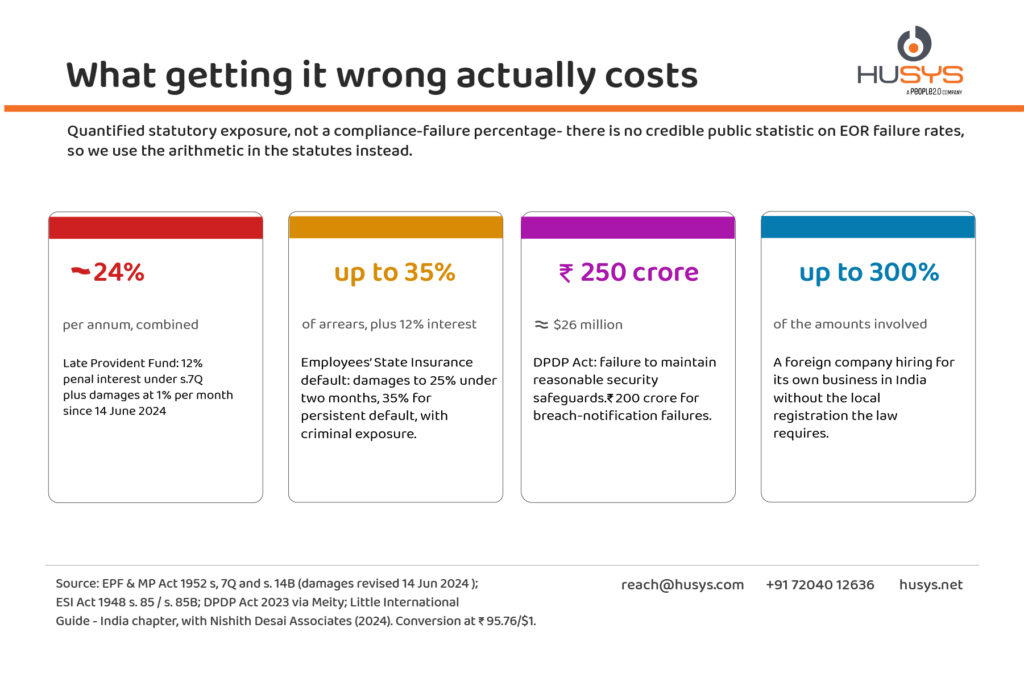
The cost of getting this wrong is arithmetic, not anxiety. Late Provident Fund attracts 12% per annum penal interest under section 7Q plus damages under section 14B, which since 14 June 2024 run at a flat 1% per month, a combined exposure of roughly 24% a year on the amount outstanding.
Employees’ State Insurance default carries 12% simple interest plus damages of up to 25% of arrears under two months and up to 35% for persistent default, with criminal exposure on top. These are the numbers to put in front of a board.
What a 4 out of 4 looks like
Codes supplied, challans and ECR acknowledgements for three consecutive months, a named compliance owner, and a written undertaking to indemnify statutory defaults.
What a 0 to 1 looks like
“Our compliance team handles all of that.” No codes, no challans, no named owner.
Score this | |
|---|---|
Document to demand | EPFO establishment code · ESIC code · TAN · three months of PF/ESI challans and ECR acknowledgements · a sample payslip · a sample Form 16. |
Statutory anchor | EPFO, epfindia.gov.in · ESIC, esic.gov.in · Income Tax Department, incometaxindia.gov.in |
Weight | 15 of 100 · weighted score = (your 0–4 rating ÷ 4) × 15 |
Category 3 · Total landed cost & FX transparency: 12 points
Ask this, verbatim “Give me the fully itemised monthly cost for one engineer at a stated CTC, including gratuity accrual, plus your FX method, your deposit terms, and every fee that is not in the headline rate.” |
Why it matters to you. The headline per-employee fee is the smallest variable. The statutory base moved twice in 2026, and most cost models omit gratuity accrual entirely, which, for an above-ceiling engineer, exceeds the Provident Fund cost.
Ask for the quote the way a CFO needs it: a single engineer, at a stated cost-to-company, itemised to the rupee. Then check it for the five things that leak.
- The FX method. What spread is applied converting your billing currency to rupees, and against which reference rate? “Market rate” is not an answer. A 2% spread on a $40,000 salary is $800 a year per head that appears nowhere in the fee.
- The deposit. How many months, when is it refunded, and does it sit on your balance sheet or theirs? A one-to-one-and-a-half-month deposit per employee is real working capital.
- Whether Provident Fund is computed on basic or on gross. This materially changes the bill and is a legitimate structuring choice, but it should be a disclosed one.
- Gratuity accrual. Is it billed monthly as it accrues, or does it arrive as a lump sum when someone leaves? The second is a nasty surprise and, worse, may mean nobody has funded it.
- The per-event fees. Onboarding, offboarding, equipment procurement, expense reimbursement handling, mid-cycle changes, and conversion to your own entity. Get them in an annexure.
Then ask the question that costs nothing and reveals everything: “Can you send me a specimen invoice for this exact hire?”
A provider with a clean, itemised invoice template will send it.
A provider whose invoice would raise questions will offer a call instead.
What a 4 out of 4 looks like
A line-by-line quote at a stated CTC, showing PF/EDLI/admin, gratuity accrual, professional tax by state, the provider fee, the FX spread against a named reference rate, the deposit amount and its refund trigger, and every onboarding, offboarding, equipment and reimbursement fee, with a commitment that nothing else will appear on the invoice.
What a 0 to 1 looks like
A single per-employee-per-month number and “statutory costs are passed through at actuals”.
Score this | |
|---|---|
Document to demand | A specimen itemised invoice at your actual CTC, plus the fee schedule as a contract annexure. |
Statutory anchor | Code on Wages s.2(y), the 50% wage rule · EPFO wage ceiling S.O. 5109(E), effective 17 Sep 2026 |
Weight | 12 of 100 · weighted score = (your 0–4 rating ÷ 4) × 12 |
Category 4 · State coverage: 10 points
Ask this, verbatim “In which specific Indian states do you hold Shops & Establishment registration and professional tax enrolment today, and what is your written lead time to register in one you do not?” |
Why it matters to you. There is no single “India registration”. India has 28 states and 8 union territories, and Shops & Establishment registration and professional tax are state-level, with roughly twenty states levying professional tax and several levying none.
A provider registered in Karnataka cannot lawfully onboard your Pune hire next week without a Maharashtra registration.
Professional tax is levied by roughly twenty states and union territories, with no national rate and a constitutional ceiling of ₹2,500 (about $26) per person per year under Article 276. Several states, Delhi, Uttar Pradesh, Haryana and Rajasthan among them, do not levy it at all. Slabs change, and published third-party slab tables are frequently out of date, so the only reliable source is the relevant state commercial-tax portal.
On that basis, “we cover all of India” is not a compliance statement. It is a marketing one.
So ask for the list, with certificate numbers, and then ask for the lead time in writing, in business days, for a state they do not currently hold, plus who bears the cost of the delay.
That second half is the part that makes it a commitment rather than a hope.
What a 4 out of 4 looks like
A state-by-state list of current registrations with certificate numbers, plus a contractual lead time (in business days) for a new state and who bears the cost of the delay.
What a 0 to 1 looks like
“We cover all of India.”
Score this | |
|---|---|
Document to demand | Shops & Establishment certificates for each state you intend to hire in; professional tax enrolment certificates. |
Statutory anchor | Government of India, states and union territories: knowindia.india.gov.in/states-uts |
Weight | 10 of 100 · weighted score = (your 0–4 rating ÷ 4) × 10 |
Category 5 · 2026 legal currency: 10 points
Ask this, verbatim “Send me your current India employment agreement template and your September 2026 payroll note on the EPF ceiling change.” |
Why it matters to you. India’s four Labour Codes came into force on 21 November 2025, consolidating 29 central statutes, and the EPF wage ceiling rose to ₹25,000 (about $261) on 17 September 2026, mid-wage-month, with proration guidance that was initially unclear. A provider’s own paperwork tells you whether it has kept up.
For an employer of record in India, regulatory currency is not an abstract virtue; it is a dated, checkable property of the provider’s own paperwork. Two documents settle it.
The employment agreement template. Drafted to the Codes, or still citing repealed Acts? This is binary and takes ten seconds.
The September 2026 payroll note. The Provident Fund wage ceiling changed mid-wage-month, and initial proration guidance was unclear. Every provider in India had to make a decision about how to handle that month. A good one documented it, told clients before it hit the invoice, and can send you the note. A weak one handled it silently and hopes you do not ask.
Then ask the forward-looking version: how do you track state rules as they are notified? Most major states had not finalised their rules as of the latest public tracking, which means the compliance picture will keep moving through 2026 and 2027. “We have an in-house legal and compliance team” is a 2. “Here is our regulatory-change log, here is who owns it, and here is the client note we sent when the ceiling changed” is a 4.
What a 4 out of 4 looks like
A template drafted to the Codes, a dated internal note on how it prorated September 2026, and a documented process for tracking state rules as they are notified.
What a 0 to 1 looks like
A template still naming the Industrial Disputes Act 1947, the Payment of Gratuity Act 1972 or the Payment of Bonus Act 1965 as live law, it is citing superseded statute.
Score this | |
|---|---|
Document to demand | The draft employment agreement · the September 2026 payroll/proration note · the regulatory-change log. |
Statutory anchor | PIB, Labour Codes in force 21 Nov 2025 |
Weight | 10 of 100 · weighted score = (your 0–4 rating ÷ 4) × 10 |
Category 6 · PE & misclassification posture: 10 points
Ask this, verbatim “What will you tell me NOT to do with an EOR employee, and how do you handle converting my existing Indian contractors?” |
Why it matters to you. Permanent Establishment risk turns on what your India-based person actually does, not whose payroll they sit on. Under the India–US tax treaty a service PE can arise at 90 days, and for services performed for a related enterprise there is no day-count test at all.
A provider that promises to remove your PE risk is either misinformed or selling.
This is the category where the sales process is least reliable, because the honest answer is less attractive than the one you want to hear.
Under Article 5 of the India–US tax treaty (full text, hosted by the IRS), a service permanent establishment can arise where activities continue more than 90 days in a twelve-month period, and where the services are performed for a related enterprise, there is no day-count test at all.
That exception is the single most consequential sentence in this article for a US parent putting engineers in India to work on the parent’s own product, and it is often missed. A dependent-agent permanent establishment arises separately where someone habitually exercises authority to conclude contracts, or habitually secures orders, for the foreign enterprise.
India’s courts apply substance over form. Analysing the Supreme Court’s approach to fixed-place permanent establishment, Nishith Desai Associates describes the test as “not merely physical access but whether the premises are operationally ‘at the disposal’ of a foreign enterprise,” decided on a “substance-over-form approach.”
You cannot paper around that with a vendor contract.
We should also be precise about what the case law does not say. The frequently cited Northern Operating Systems judgment is a service-tax secondment case, not an income-tax permanent-establishment case and not an EOR case, and the Central Board of Indirect Taxes and Customs has instructed field formations not to apply it mechanically to every secondment.
And our research found no Indian court or advance-ruling decision squarely holding that a third-party EOR arrangement creates a permanent establishment.
That is an honest gap, and we would rather state it than fill it.
The other half of this category is misclassification. India has no statutory definition of an independent contractor; courts apply control and integration tests and will look past a label. On reclassification the exposure is cumulative and retrospective (see the FAQ on contractors).
Read more: India contractor misclassification.
Ask the provider how it handles converting your existing Indian contractors, and whether it will indemnify historical misclassification. Most will not. The ones that will say so clearly, in a clause, are worth more than the ones that are vague about it.
What a 4 out of 4 looks like
A written statement of the activity boundary (no contract-signing authority, no habitual order-securing, no client-facing revenue generation in India), a documented contractor-conversion process addressing retrospective PF and ESI exposure, and a willingness to say “this role is not suitable for EOR”.
What a 0 to 1 looks like
“Using our EOR eliminates permanent establishment risk.” Treat this as a hard stop.
Score this | |
|---|---|
Document to demand | The provider’s written PE position · its contractor-conversion SOP · its misclassification indemnity clause. |
Statutory anchor | India–US tax treaty, Article 5 (IRS-hosted text) · Supreme Court substance-over-form standard, per Nishith Desai Associates |
Weight | 10 of 100 · weighted score = (your 0–4 rating ÷ 4) × 10 |
Category 7 · Onboarding, termination & gratuity execution: 8 points
Ask this, verbatim “What is your onboarding SLA in writing with a remedy, and show me a full-and-final settlement timeline and how gratuity is funded.” |
Why it matters to you. There is no at-will employment in India. Final wages are due within two working days of exit, fixed-term employees now accrue pro-rata gratuity after one year rather than five, and gratuity insurance or an approved fund is mandatory. A speed claim without a contractual remedy is marketing.
Protected “workers” are owed one month’s notice (or pay in lieu) plus retrenchment compensation of 15 days’ pay per completed year, and from 300 workers up you need prior government permission. Managerial staff follow their contract and the state Shops & Establishment Act, commonly 30 to 90 days’ notice.
Read more: Employee termination in India: a guide for US companies
Final wages are due within two working days of removal, retrenchment, dismissal or resignation (KPMG India). A US team used to a two-week notice and a final paycheck on the next cycle will break this without realising. Your provider is the one who has to not break it.
On speed: every provider in this market advertises an onboarding time. None of them, as far as we can find, publishes a way to verify it. So convert the claim into a contract. Ask what physically has to happen, identity and tax documents, Universal Account Number generation or transfer, Employees’ State Insurance number, bank account, the payroll cut-off calendar, and a state registration if this is a new state, then ask which of those steps sit outside the provider’s control, and then ask for an SLA with a remedy.
A speed claim with no remedy is marketing. A speed claim with a remedy is a product.
And ask the gratuity funding question, because it is where the balance-sheet risk hides: gratuity insurance or an approved fund is now mandatory for private employers.
Is your provider insured, holding an approved fund, or carrying a book provision?
If it is the third, you may be relying on a liability that is not funded, and on exit, continuity of service means it does not simply disappear.
What a 4 out of 4 looks like
A contractual onboarding SLA with a named remedy, a documented list of which steps sit outside the provider’s control, a sample full-and-final settlement, and evidence of how gratuity is funded, insured, held in an approved fund, or carried as a provision you may inherit.
What a 0 to 1 looks like
“We onboard in 24 hours.” No SLA, no remedy, no gratuity funding answer.
Score this | |
|---|---|
Document to demand | The SLA annexure · a sample full-and-final settlement · gratuity funding evidence. |
Statutory anchor | Code on Social Security 2020, s.53 · Industrial Relations Code 2020 · PIB explainer on the one-year fixed-term rule |
Weight | 8 of 100 · weighted score = (your 0–4 rating ÷ 4) × 8 |
Category 8 · IP assignment & chain of title: 8 points
Ask this, verbatim “Walk me through the assignment chain: employee → your Indian entity → my company. Show me the clauses.” |
Why it matters to you. Your employee signs a contract with the provider’s Indian entity, not with you. If IP vests there and no onward assignment exists, your chain of title has a gap that will surface in an acquirer’s diligence, and the gap is widest for work your contractors created before conversion.
So do not ask “is IP protected?” Ask to see the two clauses and follow the chain:
employee → the provider’s Indian entity → your company.
You want a present assignment in the employment agreement and an express onward assignment in the services agreement, not a best-efforts obligation to assign later.
Then ask the question that trips most companies up: what about the work your Indian contractors created before you converted them? That IP was created under a different contract, often a thin one, sometimes none, and it may never have transferred. Converting the person does not retroactively convert the IP.
A provider with a real conversion process will have a remediation step for this. Most do not, because most have never been asked.
What a 4 out of 4 looks like
A present assignment in the employment agreement, an express onward assignment to your company in the services agreement, treatment of pre-existing contractor-created IP, and a confidentiality regime you can show an acquirer’s diligence team.
What a 0 to 1 looks like
“Standard IP protection is included.” No clause shown.
Score this | |
|---|---|
Document to demand | The IP clauses from both agreements, redacted if necessary · the contractor-conversion IP remediation process. |
Statutory anchor | Littler International Guide, India chapter (with Nishith Desai Associates) |
Weight | 8 of 100 · weighted score = (your 0–4 rating ÷ 4) × 8 |
Category 9 · Data protection (DPDP Act 2023): 7 points
Ask this, verbatim “Will you sign a DPDP-compliant data processing addendum, and who is the data fiduciary for my employees’ data?” |
Why it matters to you. India’s Digital Personal Data Protection Rules, 2025 were notified by MeitY on 14 November 2025 (MeitY notification and rules text) with full compliance due on 13 May 2027. A US employer can be covered even without an Indian entity, and the employer remains the data fiduciary and stays responsible even where a vendor processes the data.
Penalties reach ₹250 crore (about $26 million) for failing to maintain reasonable security safeguards.
Ask this of every employer of record in India you are considering, because the reflex answer from a US buyer is “we are SOC 2, so we are fine.” The Digital Personal Data Protection Act is a different regime with different roles and much larger numbers, and it can reach a US employer even without an Indian entity.
You cannot contract the data-fiduciary obligation away to your EOR. What you can do is contract for the cooperation you will need to discharge it.
Practical obligations to get into the addendum: a plain-language consent notice stating purpose, data categories, retention period and how to withdraw consent; a published contact point; a commitment to respond to access, correction and erasure requests within the statutory window; and breach notification to the Data Protection Board and to affected individuals.
Also ask where the data physically lives, who in India can access payroll records, and what happens to that data on exit, which connects directly to category 10.
What a 4 out of 4 looks like
A signed DPDP addendum, a named grievance contact, documented consent-notice practice, a breach-notification commitment with a timeline, data-residency disclosure, and ISO 27001 or SOC 2 evidence.
What a 0 to 1 looks like
“We are GDPR compliant” offered as the answer to a DPDP question, or a claim that the obligation transfers away from you.
Score this | |
|---|---|
Document to demand | The DPDP data processing addendum · the ISO 27001 or SOC 2 report · the breach-notification policy. |
Statutory anchor | MeitY, DPDP Rules 2025 · Fisher Phillips analysis, Feb 2026 |
Weight | 7 of 100 · weighted score = (your 0–4 rating ÷ 4) × 7 |
Category 10 · Exit, continuity & portability: 5 points
Ask this, verbatim “If I leave in eighteen months, exactly what happens to my people, and what does it cost?” |
Why it matters to you. Almost nobody asks this before signing, and it is where the money is. Transferor and transferee are jointly liable for unpaid social-security dues on a business transfer, so an exit from a provider with arrears can follow you.
Six things need answers: PF/UAN transfer, ESI continuity, gratuity continuity of service, Form 16 across a split year, DPDP data return and deletion, and the conversion fee if you move people onto your own entity. Section 8 sets out what should happen for each.
What a 4 out of 4 looks like
A contractual exit and transition window, written confirmation of UAN and PF portability and ESIC continuity, treatment of gratuity service continuity, Form 16 across a split financial year, data return and deletion under DPDP, and a stated conversion fee for moving employees onto your own entity.
What a 0 to 1 looks like
“We would handle that at the time.”
Score this | |
|---|---|
Document to demand | The exit/transition clause · the conversion fee schedule · the data return and deletion commitment. |
Statutory anchor | Fisher Phillips, joint transferor/transferee liability under the Codes |
Weight | 5 of 100 · weighted score = (your 0–4 rating ÷ 4) × 5 |
4 · Is an EOR provider the right model for you at all?
You can incorporate your own Indian company, use an employer of record in India, or engage contractors.
- The first gives you maximum control and maximum administrative load.
- The second transfers employment-law execution and takes days rather than months.
- The third looks least expensive on paper and carries the exposure that most often turns into a bill.
Your own Indian entity | Employer of record | Contractors | |
|---|---|---|---|
Who is the legal employer | Your Indian subsidiary | The EOR’s Indian entity | Nobody, which is the problem |
Time to first compliant hire | 10–20 working days to incorporate, then EPFO, ESIC, TAN, GSTIN, state Shops & Establishment and professional tax registrations on top | Hours to days, registrations already exist | Immediate |
Who carries statutory liability | You, directly, 12% penal interest plus 1%/month damages on PF default, ESI interest and damages, DPDP exposure to ₹250 crore (about $26 million) | The EOR operationally; you retain data-fiduciary duties and PE exposure | You, retrospectively, if reclassified |
Corporate tax position | A domestic company, can access the ~25.17% effective concessional regime | No Indian taxable presence created by the employment itself | Risk of creating a PE taxed at 35% (38.22% max effective) |
Cost shape | Incorporation + statutory audit + transfer pricing + RBI filings + payroll retainer + compliance headcount, variable | Flat per-employee fee plus pass-through statutory cost, predictable | Invoice only, until it is not |
Exit | Winding up a company, closing registrations, clearing dues, slow and costly | Offboard under a contractual exit SLA | Stop paying, but the exposure does not stop |
When it is right | You are generating revenue in India, need an Indian balance sheet, or are past the point where per-head fees exceed the running cost of an entity | You need people in India quickly, want employment liability executed by a specialist, and are not selling in India | Genuinely independent, project-based specialists with their own tools, clients and risk |
Sources: MCA incorporation process and timelines; Code on Social Security 2020; Deloitte, India Tax Highlights 2025 on corporate rates; India–US tax treaty Article 5.
One correction worth making, because it appears in a lot of published EOR content A US-owned Indian subsidiary is a domestic company, incorporated in India, and can therefore access the concessional corporate regime at roughly 25.17% effective. The 35% rate (38.22% maximum effective) applies to a branch or a permanent establishment of the US entity, not to your subsidiary. And it is no longer 40%; that rate was superseded on 1 April 2024. If a provider’s business case for EOR rests on telling you an Indian subsidiary pays 40% tax, the business case is wrong even where the conclusion might not be. |
Is an employer of record in India legal?
Yes. The India chapter of the Littler International Guide, published by the world’s largest employment-law firm, with the India chapter contributed by Nishith Desai Associates, states that EOR, PEO and staffing arrangements are not subject to particular legal restrictions, provided the provider complies with applicable law. We cite that rather than our own assurance deliberately: it is a question you should not take a vendor’s word on.
Read more: Hire employees in India without an entity
When should you outgrow your EOR provider?
There is no fixed headcount. You outgrow an EOR provider when running your own compliance function costs less than the per-head fees, and when you need an Indian balance sheet, usually because you start selling in India. A good provider will tell you when you reach that point, and will quote a conversion fee up front.
Cost line (own Indian entity, year one) | Range | Basis |
|---|---|---|
Incorporation, SPICe+ filing, digital signatures, stamp duty, professional fees | ₹10,000–25,000 (≈ $105–260) | Sourced. MCA fee nil up to ₹15 lakh (about $15,660) authorised capital; stamp duty is state-dependent |
Statutory audit, MGT-7, AOC-4, ITR-6, DIR-3 KYC | ₹15,000–50,000 (≈ $155–520) | Sourced, but this is a domestic-startup floor |
Transfer-pricing study and Form 3CEB | ₹75,000–3,00,000 (≈ $780–3,130) | Sourced. Mandatory for every international related-party transaction, i.e. unavoidable for a US-owned subsidiary |
RBI filings, FC-GPR within 30 days of share allotment, annual FLA return | Estimate, plug your own | Required; professional fees vary |
Payroll and labour-compliance retainer, per state | Estimate, plug your own | Scales with states, not with headcount |
Resident director | Estimate, plug your own | At least one director must have stayed in India for 182+ days in the financial year (Companies Act 2013, s.149(3)) |
Your own team’s supervision time | Estimate, plug your own | Usually the largest line, and the one nobody budgets |
Wind-down, if it does not work | Estimate, plug your own | Closing a company and its registrations is slow |
Read more: EOR vs own entity in India (2026) · EOR vs entity vs contractor · How to set up a private limited company in India
When an EOR is the wrong answer, and we will tell you so If your India-based people will directly sell or directly generate revenue in India, an EOR is not the right structure. You likely need your own entity. This is not a technicality: under Article 5(4) of the India–US tax treaty, someone who habitually exercises authority to conclude contracts, or habitually secures orders, for your company can create a dependent-agent permanent establishment regardless of whose payroll they are on. And if you are hiring across several countries at once, you should not have to trade depth for breadth. Husys is part of the People2.0 network, which processes around 50,000 workers on monthly payroll across 130+ countries through specialist regional brands, among them Brookson in the United Kingdom, Dutch Umbrella Company in the Netherlands and The Payroll Edge in Canada. That is the combination worth asking any provider for. In India you get a specialist that employs on its own registrations and knows the Labour Codes, the PF ceiling and the state filings first-hand. Across your other markets you get one network behind you, rather than a different vendor in every country or a global platform running India from a generalist desk. |
5 · How it happens normally vs. with an employer of record in India
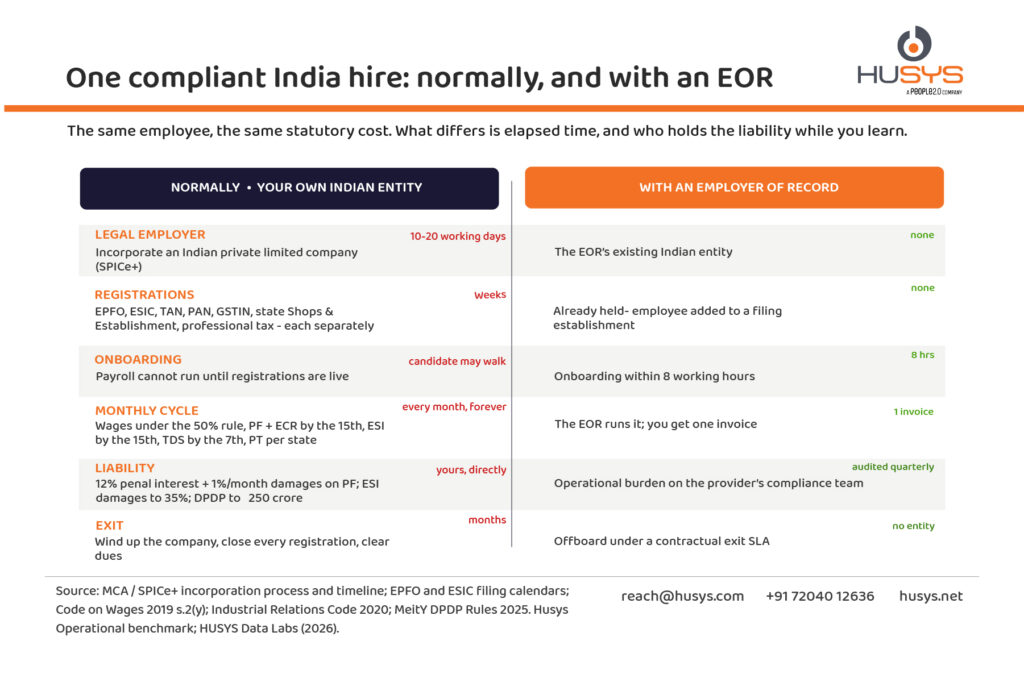
Doing it yourself means incorporating a company, obtaining six or more registrations, and then running a monthly statutory cycle correctly, forever. Doing it through an employer of record in India means adding a person to an establishment that already exists and already files. The difference is not effort. It is who carries the liability while you learn.
Step in the hire lifecycle | How it happens normally (own entity / DIY) | How it happens with an EOR |
|---|---|---|
Legal employer | Incorporate an Indian private limited company via SPICe+, around 7 days with clean submission and Aadhaar authentication, 10–20 working days typically, 25+ if the Registrar raises queries. Nothing else can begin until this is done. | The EOR’s existing Indian entity is the legal employer. No incorporation. |
Statutory registrations | EPFO establishment code, ESIC code, TAN, PAN, GSTIN, state Shops & Establishment registration and professional tax enrolment, each obtained separately, and the last two separately per state. | Already held. Your employee is added to an establishment that is already filing. |
Onboarding | Payroll cannot run until registrations are live. Candidates with competing offers do not wait. | Onboarding within 8 working hours (Husys benchmark). |
The monthly cycle | Compute wages under the new 50% rule · deduct and match PF · file the ECR and deposit by the 15th · file ESI by the 15th · deposit TDS by the 7th · file the quarterly TDS return · remit professional tax per state · issue payslips · issue Form 16 annually. Every month. Correctly. | The EOR runs the full cycle. You receive one invoice. |
When the law changes | You find out when your consultant tells you, or when the invoice changes. In the last twelve months that would have been four times. | The provider absorbs the change and should notify you before it reaches your invoice. Ask for the September 2026 note as proof. |
Compliance liability | Yours, directly: 12% penal interest and 1%/month damages on PF default, ESI interest and damages up to 35%, TDS default exposure, DPDP penalties to ₹250 crore (about $26 million). | Operational burden sits with the provider’s in-house compliance team. At Husys, internal and external audits run quarterly. |
Cost predictability | Entity + audit + transfer pricing + RBI filings + payroll retainer per state + compliance headcount. Variable, and it moves when the law moves. | Flat $99/employee/month. No setup fee, no minimum. |
Termination | You must get notice, retrenchment compensation, government notification and the two-working-day final settlement right, first time. | Executed by people who do it weekly, within the limits of what Indian law permits either of you to do. |
Exit | Wind up the company, close every registration, clear dues. Months. | Offboard under a contractual exit SLA. No entity to dissolve. |
Sources: MCA/SPICe+ incorporation process; EPFO and ESIC filing calendars; Code on Wages 2019 s.2(y); Industrial Relations Code 2020; MeitY DPDP Rules 2025. Husys operational benchmarks from Husys Data Labs (2026).
On price, stated carefully India EOR pricing falls into three broad tiers. Global multi-country platforms publish list rates in the $500 to $700 per employee per month band. Mid-market and regional providers generally sit between $200 and $450. India-focused specialists price lowest, because they run one country properly rather than a hundred thinly. These are published list bands, not what any particular buyer actually pays: volume deals are negotiated below list, and every tier quotes the provider fee only, excluding pass-through statutory contributions. Husys sits at the specialist end of that range, at a flat $99 per employee per month, with no setup fee and no minimum. Against the published global-platform band, that is roughly 80 to 85% lower on the provider fee, which is the only part of the bill a provider actually controls. The statutory cost is the statutory cost, whoever files it. Price is the easiest thing to compare and the least useful. Ask the harder question instead: can this provider put three months of PF, ESI and TDS challans in front of you this afternoon? That is what separates a provider that files from one that promises to. |
Four buyers, four versions of the same decision
The scorecard is the same instrument for everyone evaluating an employer of record in India. What changes is which rows you lose sleep over. These are the four conversations we have most often.
The YC-incubated founder, Seed stage, 5–20 people
You have eight weeks of post-Demo-Day runway and a senior backend engineer in Bengaluru who will take another offer if you make her wait. Standing up an Indian company first means roughly ten to twenty working days to incorporate, before you can begin the EPFO, ESIC, TAN and state registrations that actually let you pay her.
An employer of record in India makes it a same-week decision at a flat $99 per employee per month, which protects runway and keeps you out of a compliance function you have no business building at twelve people.
Weight onboarding (category 7) and landed cost (category 3) heavily, and do not skip legal employer (category 1). It is the one thing that is expensive to fix later.
The CFO of a growing drone-tech startup, Series A–B
You are modelling burn against a hardware roadmap, so a variable India cost stack wrecks the forecast, and your board asks about it every quarter. Last year’s model is already out of date: the statutory base moved twice in 2026 (section 2).
Then compare the provider fee itself: on published global-platform list prices of $599–$699 per employee per month against a flat $99, a ten-person India team is a difference of roughly $60,000 a year in fees alone, before a single rupee of statutory cost, which is identical whoever files it.
Weight landed cost (category 3), statutory execution (category 2) and PE posture (category 6).
The General Counsel of a growth-stage SaaS company
You are the one signing, so you need four answers you can defend in diligence.
- First, who is the legal employer: named entity and CIN, verified on the MCA portal yourself.
- Second, the IP chain of title: present assignment to the provider’s Indian entity, express onward assignment to you, and a remediation step for anything your contractors created before conversion.
- Third, a DPDP data processing addendum, with the understanding that you remain the data fiduciary regardless. Fourth, permanent establishment, which is your judgement call, not the vendor’s.
An EOR does not take that risk off you. What your India-based person does determines it, and services performed for a related enterprise carry no day-count safe harbour at all under Article 5 of the India–US treaty.
Weight legal employer (category 1), PE and misclassification (category 6), IP (category 8) and data protection (category 9). Read more: Employer of record in India for SaaS companies
The CHRO scaling an India team past twenty, Series B–D
Your attrition problem starts at onboarding, and in India it is mostly a documents problem.
Ask for three things and you will learn more than any demo will tell you:
- a sample payslip,
- a sample Form 16, and
- a full-and-final settlement timeline.
Under the Codes, final wages are due within two working days of exit, and fixed-term employees become eligible for gratuity after one year. If the provider’s answer to “how is gratuity funded?” is a book provision rather than insurance or an approved fund, you are carrying a liability you did not price. Weight onboarding, termination and gratuity (category 7), statutory execution (category 2) and state coverage (category 4).
6 · How do you check an EOR provider’s quote against the real cost?
The fee your employer of record in India quotes is not the cost.
The cost is gross salary, plus employer statutory contributions, plus gratuity accrual, plus state professional tax, plus the provider fee, plus the foreign-exchange spread, plus whatever sits in a deposit.
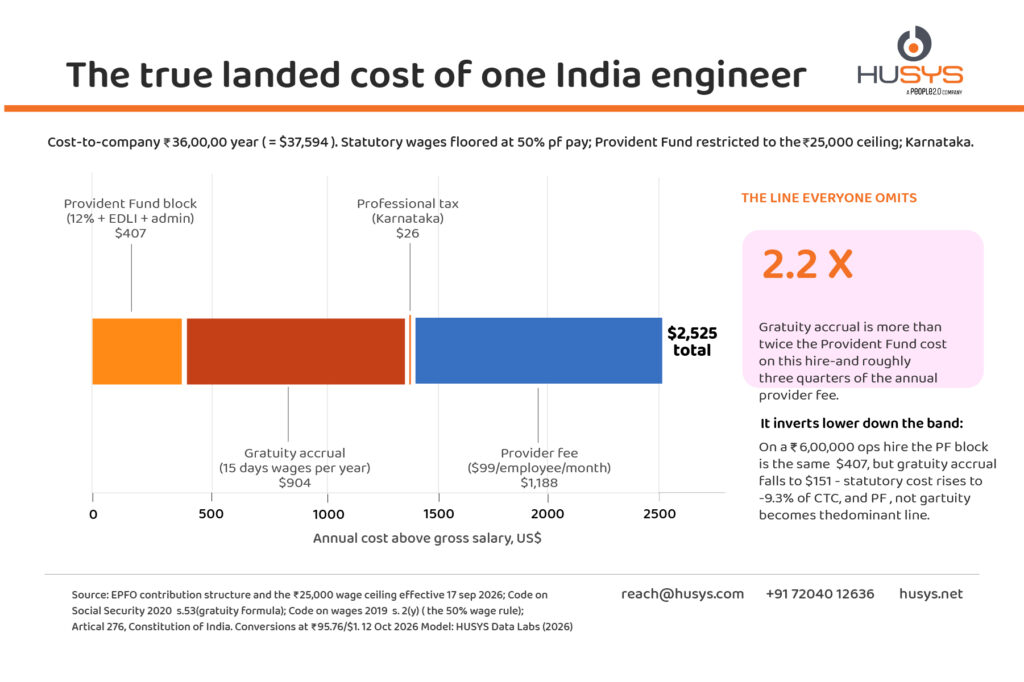
For an above-ceiling engineer the gratuity accrual is more than twice the Provident Fund cost, and it is the line many EOR quotes leave out.
Worked example: one senior engineer
Assumptions, stated so you can argue with them: cost-to-company ₹36,00,000 a year (₹3,00,000 or about $3,133 a month; $37,594 a year at ₹95.76 to the dollar on 12 October 2026); statutory wages floored at 50% of remuneration under the Code on Wages; Provident Fund restricted to the ₹25,000 (about $261) statutory ceiling; employee based in Karnataka; one completed year of service.
Line | Monthly (₹) | Annual (₹) | Annual ($) | Note |
Employer PF + EPS (12% of the ₹25,000 / $261 ceiling) | 3,000 | 36,000 | 376 | 8.33% to pension, 3.67% to PF |
EDLI (0.5%, employer only) | 125 | 1,500 | 16 | Life cover, max benefit ₹7 lakh (about $7,310) |
Administrative charges (0.5%) | 125 | 1,500 | 16 | Minimum ₹500 (about $5)/month per establishment |
Provident Fund block, subtotal | 3,250 | 39,000 | $407 |
|
Employees’ State Insurance | n/a | n/a | n/a | Not applicable, gross above the ₹21,000 (about $219) threshold |
Gratuity accrual, (₹1,50,000 ÷ 26) × 15 | 7,212 | 86,538 | $904 | 2.2× the PF cost. Usually missing from the quote. |
Professional tax (Karnataka) | ~208 | 2,500 | $26 | State-level; capped at ₹2,500 (about $26)/yr by Article 276 |
Total employer statutory, on top of salary |
| 1,28,038 | $1,337 | ≈ 3.6% of cost-to-company |
Provider fee at $99/employee/month |
|
| $1,188 | Flat; no setup fee, no minimum |
Total on-cost above salary |
|
| $2,525 | ≈ 6.7% of cost-to-company |
Sources: EPFO contribution structure and the ₹25,000 (about $261) wage ceiling effective 17 September 2026; Code on Social Security 2020 s.53 (gratuity formula); Code on Wages 2019 s.2(y) (the 50% wage rule); Article 276 of the Constitution (professional tax cap). Conversions at ₹95.76/$1, 12 October 2026, approximate. Model: Husys Data Labs (2026).
The finding worth taking to your CFO On this hire, gratuity accrual ($904) is more than double the entire Provident Fund cost ($407), and equals roughly three quarters of the annual provider fee. It is an accruing, funded-or-unfunded liability that vests, for fixed-term employees, after one year. If it does not appear on the quote you have been given, the quote is not a cost model. It is a price. |
And it inverts at the other end of the salary band
Run the same arithmetic on an operations hire at ₹6,00,000 a year (₹50,000 a month, about $6,266). Statutory wages floor at ₹25,000, so the Provident Fund block is the same ₹39,000 a year ($407), but gratuity accrual is only (₹25,000 ÷ 26) × 15 = ₹14,423 ($151).
Statutory cost rises to about 9.3% of cost-to-company rather than 3.6%, and Provident Fund, not gratuity, is now the dominant line.
A single blended “statutory is about X%” figure is wrong at both ends of your org chart. Ask the provider for the model, not the percentage.
Read more: True cost of hiring employees in India (2026) · Hidden compliance costs of hiring in India
How to check your EOR provider in India’s first invoice
When your first invoice arrives, confirm these eight lines. If any of them cannot be traced to a rate, a document or a contract clause, you have found the thing to ask about.
- Gross salary matches the employment agreement.
- Provident Fund: confirm whether it is computed on the ₹25,000 (about $261) ceiling or on full wages, and that it matches whichever the contract says.
- EDLI and administrative charges appear separately, not folded silently into “PF”.
- Gratuity accrual appears as a line, and you know whether it is funded or provisioned.
- Professional tax matches the state the employee actually works in: not the state the provider is headquartered in.
- Provider fee matches the contract, with no per-event fee you were not told about.
- Foreign-exchange conversion: check the applied rate against the reference rate on the invoice date and compute the spread. Do this once; if it is wider than you were told, it will be wide every month.
- Deposit movements are shown, with the refund trigger stated.
7 · Does your employer of record in India cover the state you are hiring in?
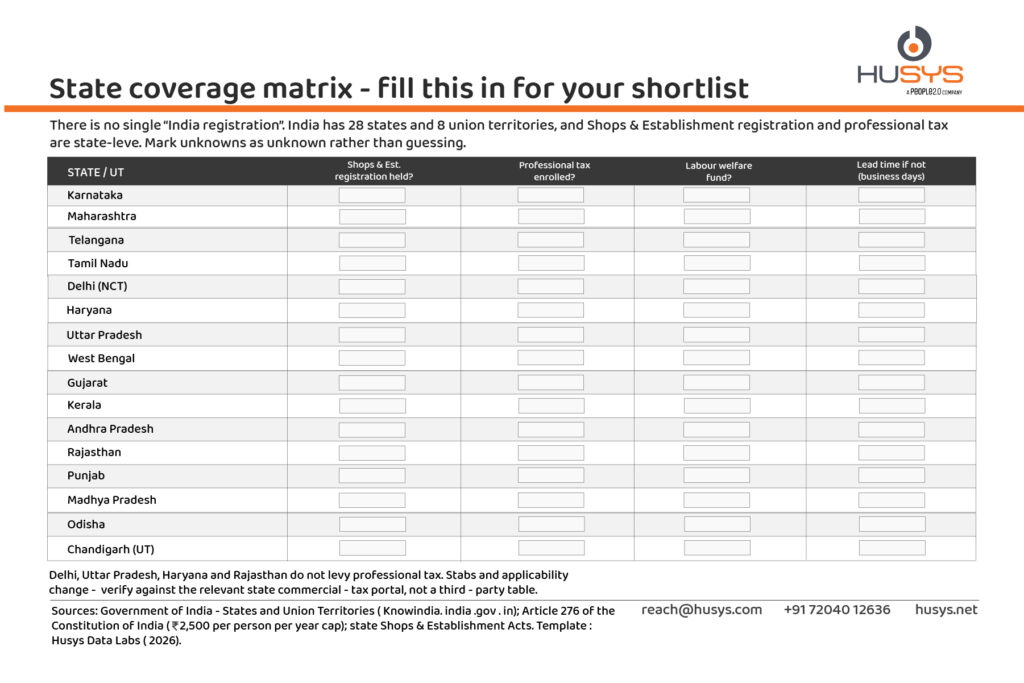
India has 28 states and 8 union territories, and two of the registrations that decide whether you can lawfully onboard someone are state-level, the applicable Shops & Establishment Act registration and professional tax enrolment.
The question is not whether a provider covers India. It is which states it holds registrations in today, and how fast it can add one.
What varies by state | What that means for you |
Shops & Establishment Act registration | A separate registration in each state where you have an establishment or employees. Rules, forms, renewal cycles and notice-period provisions differ. |
Professional tax | Levied by roughly twenty states and union territories; several levy none at all. Slabs and payment frequency differ. Constitutional maximum ₹2,500 (about $26) per person per year (Article 276). |
Labour welfare fund | Applies in some states only, with its own contribution and cycle. |
Labour Code rules | Labour is a Concurrent List subject. Most major states had not finalised their own rules under the Codes as of the latest public tracking, so central rules and legacy state rules currently run side by side. |
Minimum wages | Set state by state and by scheduled employment, under a national floor wage that states cannot undercut. |
Sources: Government of India, States and Union Territories; Article 276 of the Constitution of India; Code on Wages 2019. Professional tax slabs change, verify against the relevant state commercial-tax portal rather than any third-party table, including ours.
Ask for the matrix. A provider that files in your states will send you a list with certificate numbers. A provider that does not will send you a paragraph. Then get the lead time in business days for a state they do not hold, in writing, with a statement of who bears the cost if your start date slips.
Read more: Minimum wages in India (2026) · Payroll in India
Where this actually bites The common failure is not dramatic. You hire in Pune, the provider is registered in Karnataka and Telangana because that is where its book sits, and your start date moves by three weeks while a Maharashtra registration is obtained. Nobody misled you. Nobody asked. |
8 · What happens to your employees if you leave an employer of record in India?
Your employees’ Provident Fund balances and Universal Account Numbers are portable, their Employees’ State Insurance record can carry across, and their gratuity service clock should continue, but none of that happens automatically. It happens because somebody executes it, under a clause you negotiated before you signed. Almost nobody negotiates that clause.
What is at stake on exit | What should happen | What goes wrong if nobody planned it |
Provident Fund and UAN | The Universal Account Number is portable; balances transfer to the new employer’s establishment. | The transfer is never initiated and the employee discovers it at retirement, or when applying for a loan. |
Employees’ State Insurance | The insured-person number carries across without a coverage gap. | A gap in coverage during the transition month, discovered when someone makes a claim. |
Gratuity, continuity of service | Service is treated as continuous across the transfer, preserving accrued entitlement. | The transition is executed as resignation plus fresh hire, the clock resets, and accrued entitlement is written off. With fixed-term gratuity now vesting at one year, this is real money. |
Form 16 | Two employers in one financial year means two certificates, planned for in advance. | Your India team has a messy tax-filing season and you find out in June. |
Employee data | Returned and deleted under the DPDP regime, on a stated timeline. | Payroll records sit indefinitely with a vendor you no longer have a contract with. |
Unpaid statutory dues | The outgoing provider’s account is clean and evidenced. | Transferor and transferee are jointly liable for unpaid social-security dues on a business transfer, so the arrears follow you. |
Sources: Code on Social Security 2020; EPFO Universal Account Number framework; MeitY DPDP Rules 2025; Fisher Phillips on joint transferor/transferee liability.
Ask the question in its blunt form, in the first meeting: “If I leave in eighteen months, exactly what happens to my people, how long does it take, and what does it cost?” You are not being difficult.
You are establishing whether there is a process or an improvisation.
Read more: Exit planning in India
9 · What documents should you ask an EOR provider in India for?
Request these from every employer of record in India on your shortlist, before you sign. Every one is a document a compliant provider already has. Copy this list into your email.
- Certificate of Incorporation, Udyam registration certificate and MCA master data for the Indian employing entity
- EPFO establishment code · ESIC code · TAN · PAN · GSTIN
- PF and ESI challans plus ECR acknowledgements for the last three consecutive months
- Shops & Establishment registration certificate for every state you intend to hire in
- Professional tax enrolment certificate for every applicable state
- A redacted sample India employment agreement, current to the Labour Codes
- A sample payslip and a sample Form 16
- A specimen itemised invoice at your actual cost-to-company, including gratuity accrual
- The fee schedule, FX method and deposit terms as a contract annexure
- The onboarding SLA, with its remedy
- A sample full-and-final settlement, and evidence of how gratuity is funded
- The IP assignment clauses from both agreements
- A DPDP-compliant data processing addendum
- ISO 27001 and/or SOC 2 report
- The exit, transition and data-return clause
- Proof of professional indemnity and cyber insurance, with the limits stated
The reference-check script
When you call an employer of record in India’s references, these seven questions get you past the testimonial.
- “Has a payroll ever been late or wrong? What was the remedy, and how long did it take?”
- “Have you terminated anyone through them? What did it actually cost, and how long did the full-and-final settlement take?”
- “What appeared on an invoice that you did not expect?”
- “Did you ever need to hire in a state they were not already registered in? How long did that take?”
- “When the Provident Fund ceiling changed in September 2026, did they tell you before or after it hit your invoice?”
- “Is your arrangement full-time EOR employment, or contractor engagement?”: references are sometimes drawn from a different product line.
- “If you were signing again tomorrow, what would you put in the contract that is not in it now?”
10 · What do US buyers get wrong when choosing an EOR provider in India?
The assumption | What is actually true |
“An employer of record in India takes on my permanent establishment risk.” | It does not. PE turns on what your India-based person does. Services for a related enterprise carry no day-count safe harbour under Article 5 of the India–US treaty, and India’s courts apply substance over form. A provider that tells you otherwise has just failed a hard stop. |
“India is basically at-will if the contract says so.” | It is not. Protected “workers” get notice plus 15 days’ pay per year of service; above 300 workers you need prior government permission. Final wages are due within two working days. A contract cannot override the Code. |
“A flat fee means a flat total cost.” | The fee is the provider’s charge. Statutory contributions, gratuity accrual, professional tax, FX spread and deposits sit on top, and three of those moved in 2026. |
“We can put everyone on contract and sort it out later.” | Reclassification is retrospective. Both the employer and the employee Provident Fund shares become recoverable from you, with 12% penal interest and damages, plus ESI, gratuity, bonus and tax shortfalls. If this describes you, note that EPFO relief windows are open right now, so it is a better moment to regularise than next year. |
“Whichever proposal quotes the smallest number is the least expensive outcome.” | The provider fee is the only part of the bill a provider controls, and it is usually the smallest part. The expensive variables are a missing state registration, an unfunded gratuity liability, a broken IP chain and a transition that resets continuity of service. |
“Our SOC 2 covers us for India.” | The DPDP Act is a separate regime with its own roles, timelines and penalties up to ₹250 crore (about $26 million), and the employer remains the data fiduciary. A GDPR or SOC 2 answer to a DPDP question scores a 1. |
“Gratuity only matters after five years.” | Not any more. Fixed-term employees accrue pro-rata gratuity after one year under the Code on Social Security, and gratuity insurance or an approved fund is now mandatory for private employers. |
“An Indian subsidiary pays 40% corporate tax, so EOR is obviously cheaper.” | A US-owned Indian subsidiary is a domestic company and can access roughly 25.17% effective. The 35% / 38.22% rate applies to a branch or a permanent establishment. The 40% figure has been superseded since 1 April 2024 and still circulates widely. |
11 · What this looks like at Husys
We publish this scorecard knowing you will point it at us, which is the only reason it is worth publishing. Here is what we would put in the evidence column, stated as facts rather than claims.
- 24+ years operating as a PEO/EOR exclusively in India. Not a country on a list of 150: the only country we do this in.
- 450+ active clients and 8,000+ employees currently under management, with average client tenure of more than four years.
- Operations across all 28 states and the union territories, with an in-house legal and compliance team rather than outsourced counsel.
- ISO 9001 and ISO 27001 certified, with internal and external audits every quarter: which is how we can produce three months of filings on request rather than after a search.
- Onboarding within 8 working hours once documentation is complete. Ask us for the SLA and the remedy; that is the only version of that claim worth anything.
- A flat $99 per employee per month. No setup fee, no minimum, no volume tier.
- ApHusys, our platform, runs end-to-end HR operations with an employee self-service portal.
- And the limit, stated plainly: where a US company is directly selling or directly generating revenue in India, we will tell you an EOR is not the right structure and that you likely need your own entity. We would rather lose that deal than sell you a structure that will not survive a tax review.
Source: Husys operational data, October 2026. We will evidence any figure above on request, which is, after all, the standard this article argues for.
See: Husys EOR pricing · Employer of record services · Case studies
Use it on us Open the India EOR Buyer’s Scorecard, put Husys in column one and your other two shortlisted providers in columns two and three, and score all three on the same evidence standard. If we do not come out well, you have learned something useful for free. You can also ask us for the evidence pack directly. |
12 · Frequently asked questions
Is it legal to hire in India through an Employer of Record?
Yes. The India chapter of the Littler International Guide, contributed by Nishith Desai Associates, states that EOR, PEO and staffing arrangements are not subject to particular legal restrictions in India, provided the provider complies with applicable law. The qualification is the important part: the provider must hold its own Indian registrations, EPFO establishment code, ESIC code, TAN and state Shops & Establishment registration, and be able to show you they are current.
Do I need an Indian entity to hire employees in India?
No, if you use an employer of record, the provider’s Indian entity is the legal employer and you do not incorporate anything. You do need an entity if you intend to sell or directly generate revenue in India. What you cannot do is employ people for your own business in India without the registration the law requires.
Does an EOR eliminate permanent establishment risk in India?
No. Permanent establishment turns on what your India-based person actually does, not on whose payroll they sit. Under Article 5 of the India–US tax treaty, a service permanent establishment can arise after 90 days, and where the services are performed for a related enterprise, there is no day-count test at all. A dependent-agent permanent establishment arises separately where someone habitually concludes contracts or secures orders for your company. India’s courts apply substance over form. An EOR handles employment-law compliance; it does not make this question go away.
What is the difference between an EOR and a PEO in India?
An employer of record is the legal employer of your India staff, which is what lets you hire without an Indian entity. A professional employer organisation co-employs alongside an entity you already have, handling payroll and compliance while you remain the employer of record. The practical dividing line in India is simply whether you have an Indian company. If you do not, you need an EOR.
How much does an EOR cost in India per employee per month?
Published list prices on two major global platforms’ own pricing pages were $599 and $699 per employee per month when we checked on 12 October 2026; negotiated rates run below list. Husys is a flat $99 per employee per month. In every case the fee is only the provider’s charge. It does not include gross salary, employer Provident Fund, EDLI and administrative charges, gratuity accrual, professional tax, or the foreign-exchange spread. Ask for a fully itemised quote at a stated cost-to-company before comparing anything.
At what headcount does setting up my own India entity beat using an EOR?
There is no reliable single number, and three widely-read sources assert three different ones with no model behind them. The crossover is reached when the running cost of the India compliance function you must build, statutory audit, a mandatory transfer-pricing study and Form 3CEB, RBI filings, a payroll retainer per state, a resident director and your own team’s supervision time, falls below the per-head fee you are paying. Most companies reach the point of wanting an Indian balance sheet before they reach the point where the arithmetic flips.
Who owns the IP my India-based EOR employee creates?
It depends entirely on the assignment chain, which you should read rather than assume. Your employee signs with the provider’s Indian entity, so you want a present assignment in that employment agreement and an express onward assignment to your company in the services agreement. The gap most companies miss is work created by Indian contractors before conversion: converting the person does not retroactively convert the IP, and that chain may never have been completed.
What happens to my India team if I switch EOR providers: do they lose tenure and gratuity?
It depends on how the transition is executed. The Universal Account Number is portable and Provident Fund balances transfer, but the transfer has to actually be processed. The expensive risk is continuity of service for gratuity: if the move is handled as a resignation and a fresh hire, the service clock resets, and with fixed-term gratuity now vesting at one year, that can write off real entitlement. Get the exit and transition process, including continuity of service, into the contract before you sign the first one.
Can I move EOR employees onto my own Indian entity later?
Yes, through a documented transfer, and it is a normal step rather than an exceptional one. Settle three things in advance: the conversion fee, continuity of service for gratuity and leave, and the notice required. Note also that transferor and transferee are jointly liable for unpaid social-security dues on a business transfer, so a provider carrying arrears is a problem you can inherit.
Can I just hire Indian contractors instead, and what is the misclassification risk?
You can, where the person is genuinely independent, their own tools, their own clients, their own commercial risk. India has no statutory definition of an independent contractor; courts apply control and integration tests and will look past a label. If the engagement is reclassified, the exposure is cumulative: back Provident Fund with both shares recoverable from the employer, 12% penal interest plus damages, back Employees’ State Insurance with interest and damages, gratuity, bonus, tax-deduction shortfalls, and prosecution exposure.
How do notice periods, gratuity and termination actually work in India?
There is no at-will employment. For protected “workers” in an establishment below 300, termination requires one month’s notice or wages in lieu plus retrenchment compensation of 15 days’ average pay per completed year of service; at 300 or more workers, prior government permission is mandatory. Managerial staff are governed by contract and the state Shops & Establishment Act, commonly 30 to 90 days. Final wages are due within two working days of exit, and fixed-term employees now accrue pro-rata gratuity after one year rather than five.
Does India’s DPDP Act apply to my US company, and does the EOR handle it?
It can apply even if you have no Indian entity, and the obligation does not transfer to your vendor. Employees, applicants and contractors are all data principals, and the employer remains the data fiduciary and stays responsible even where a vendor processes the data. The rules were notified in November 2025 and full compliance is required by 13 May 2027. Penalties reach ₹250 crore (about $26 million) for failing to maintain reasonable security safeguards. Get a DPDP-specific data processing addendum. A GDPR clause is not a substitute.
Before you sign
If you are evaluating an employer of record in India right now, the least expensive insurance you will buy is a short conversation with someone who runs India compliance for a living, before the contract, not after the first invoice. Score your shortlist first, then bring it. Bring the two proposals you are stuck between. We will tell you what we would ask them, including the questions that are awkward for us.
Talk to a compliance expert · reach@husys.com · +91 72040 12636
Methodology, sources and corrections
How this scorecard was built
The ten categories for scoring an employer of record in India were derived from the obligations an India employer must actually discharge, Provident Fund, Employees’ State Insurance, tax deduction, professional tax, gratuity, termination and data protection, cross-referenced against the evaluation criteria that appear across published EOR buyer guidance, and then weighted by the cost of getting each one wrong rather than by how often it is discussed. Weights sum to exactly 100; the arithmetic in the interactive tool is the same arithmetic published here. The 0–4 scale deliberately measures documentary evidence rather than the quality of an answer, because in our experience the correlation between the two is weak.
Husys published this and sells the service it describes. We have not scored ourselves inside the article. We have not named any competitor, and we have stated three places where an employer of record, including ours, is the wrong answer. Where we could not verify something, we have said so rather than filling the gap.