

📌 Quick Answer:
What is the best way for a US company to hire in India?
There are three primary routes: set up an Indian entity, use an Employer of Record (EOR), or engage independent contractors for genuine project-based work.
For companies testing India or hiring a small initial team, an EOR can provide a faster route without establishing a local entity. Companies planning a permanent operating presence may eventually choose their own entity.
The right model depends on headcount, business activity, compliance requirements, speed, and long-term plans for India.
Hiring employees in India is straightforward once a US company chooses the right employment model and understands who owns the local employment, payroll and compliance responsibilities.
This India expansion checklist breaks down the three primary routes for hiring in India: set up an Indian entity, use an Employer of Record (EOR), or engage independent contractors for genuine project-based work.
An EOR can be the practical option when a company wants to hire employees in India without immediately establishing its own entity, particularly when it is testing the market or building an initial team. A company planning a long-term operating presence may eventually choose its own entity.
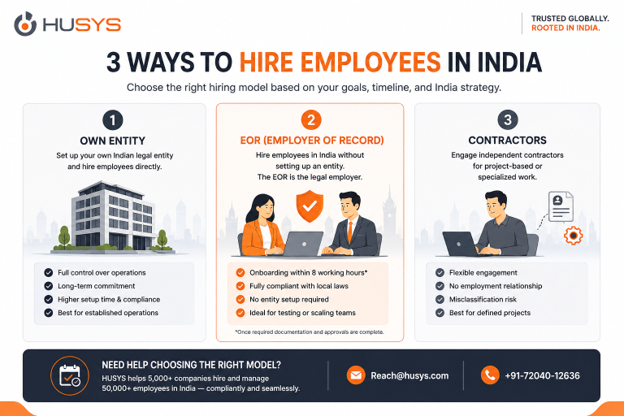
The right decision depends on what the company will do in India, how quickly it needs to hire, expected workforce size, compliance requirements and its long-term India strategy.
This checklist breaks down the decisions US founders, CFOs, CHROs, COOs, General Counsel and technology leaders should make before their first India hire.
This isn’t a country overview. It’s a decision document built around what actually happens when a US company starts hiring in India.
Husys has been working across India’s HR, payroll and employment ecosystem for 24+ years, and we’ve seen where India hiring plans typically get complicated — from state-level compliance and payroll to employment contracts, notice periods, terminations and employee documentation.
Use this checklist to align your team on the entity-vs-EOR-vs-contractor decision, the real timeline, who owns which cost, and the compliance responsibilities that continue after the first hire.
Who should use this checklist?
This India expansion checklist is designed for US founders, CFOs, CHROs, COOs, General Counsel and technology leaders evaluating their first India hires, expanding an existing India team, or deciding whether to move from an EOR to their own Indian entity.
If you already run US payroll (W-2/1099), understand at-will employment, and are used to fast hiring and termination, this checklist translates every India-specific concept back to that frame of reference.
India does not work like the US labor market employment is contractual rather than at-will, benefits are statutory rather than optional, and payroll runs monthly rather than bi-weekly.
Every section below flags where that difference actually changes your plan.
The 4 Decisions You Must Make Before You Hire
Every India hiring plan, regardless of company size, comes down to four decisions. Make these first — everything else (vendor selection, offer letters, payroll setup) is execution.
Decision 1: Entity vs. EOR vs. Contractor
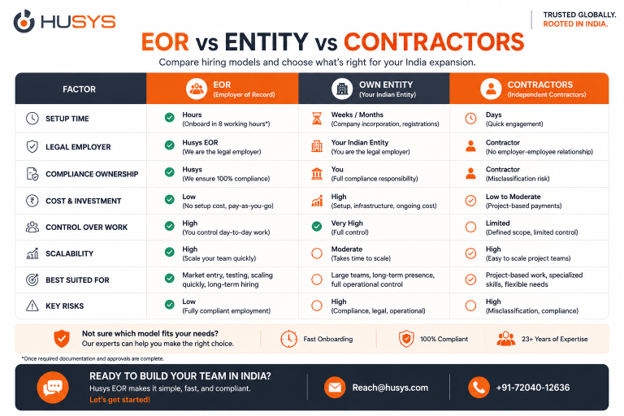
This is the decision that determines your timeline, your cost structure, and your compliance exposure. If you’re comparing the three models in detail, see our EOR vs Entity vs Contractor in India comparison.
| Model | What it means | Cost / commercial model | Time to start employment | Best for |
|---|---|---|---|---|
| Independent contractor | You engage an individual directly as an independent contractor rather than as an employee. | No standard employment cost; commercial terms are agreed directly with the contractor. | Potentially days, depending on contracting and onboarding. | Short-term or genuinely independent work where the relationship does not operate like employment. |
| Employer of Record (EOR) | A third party becomes the legal employer in India while your company manages the employee's day-to-day work. | Husys: from $99/employee/month, with pricing depending on scope and deal structure. | Husys: within 8 working hours once required documentation and approvals are complete. | Testing the market, making initial hires, or building an India team without immediately establishing an entity. |
| Wholly owned Indian entity | You establish an Indian company and become the direct legal employer. For a detailed look at the setup process, see our Private Limited Company setup guide for US founders . | Incorporation, professional setup, banking, payroll, statutory filings, accounting, audits and ongoing entity-maintenance costs. | No single statutory “ready-to-hire” timeline. Incorporation is only one step; banking, registrations and payroll readiness must also be completed. | Companies with a committed long-term India operation, significant headcount, or business activity that requires their own Indian entity. |
There is no universal EOR-to-entity breakeven headcount.
The right point depends on salary levels, headcount, hiring locations, expected growth and the fixed cost of maintaining an Indian entity.
For a US company entering India for the first time, the more useful question is not simply “When is an entity cheaper?”
but
“When does our expected India operation justify taking on the fixed infrastructure and compliance responsibilities of our own entity?”
For companies that want to start hiring without taking on that infrastructure immediately, Husys can onboard employees within 8 working hours once the required documentation and approvals are complete.
Where the breakeven usually sits:
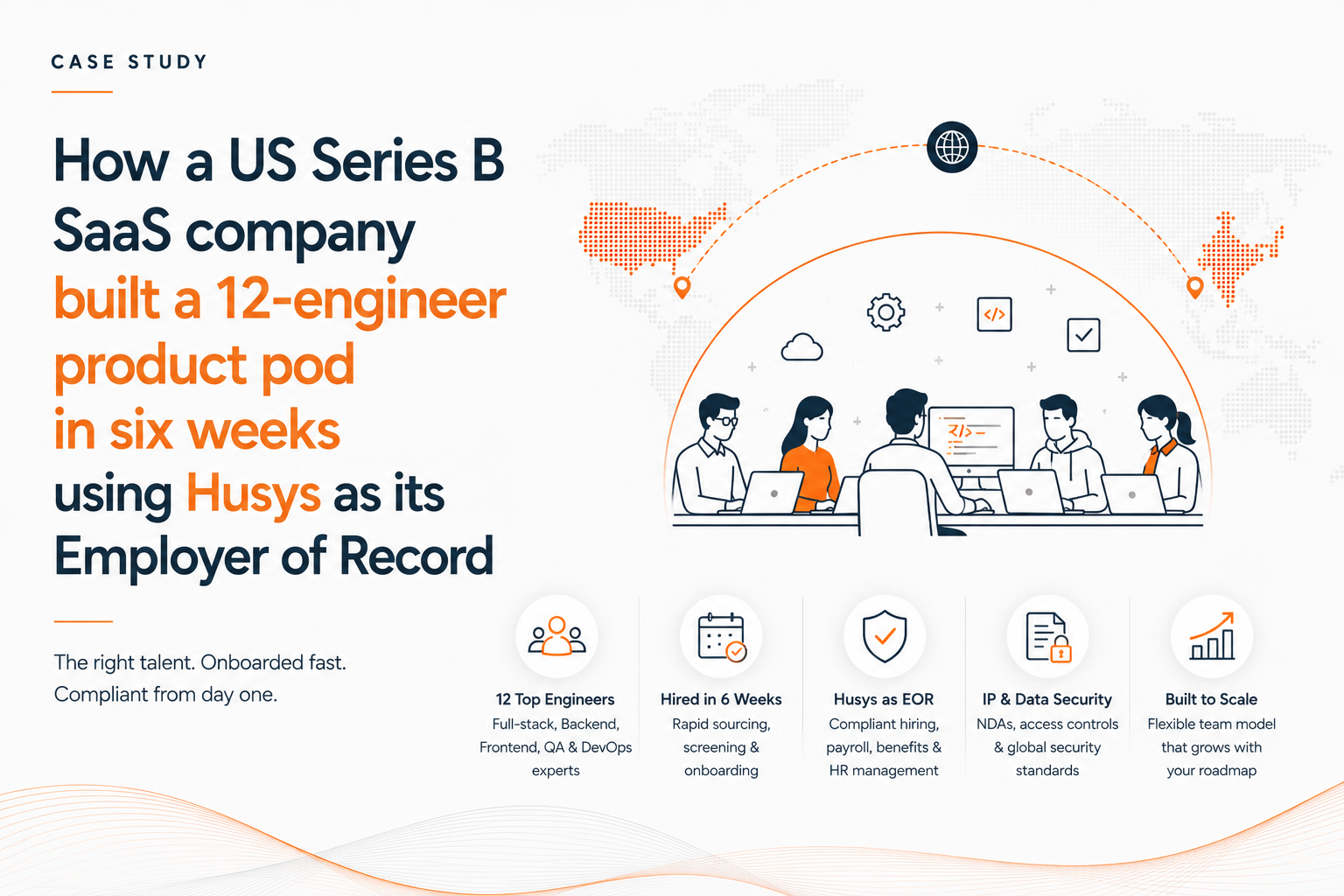
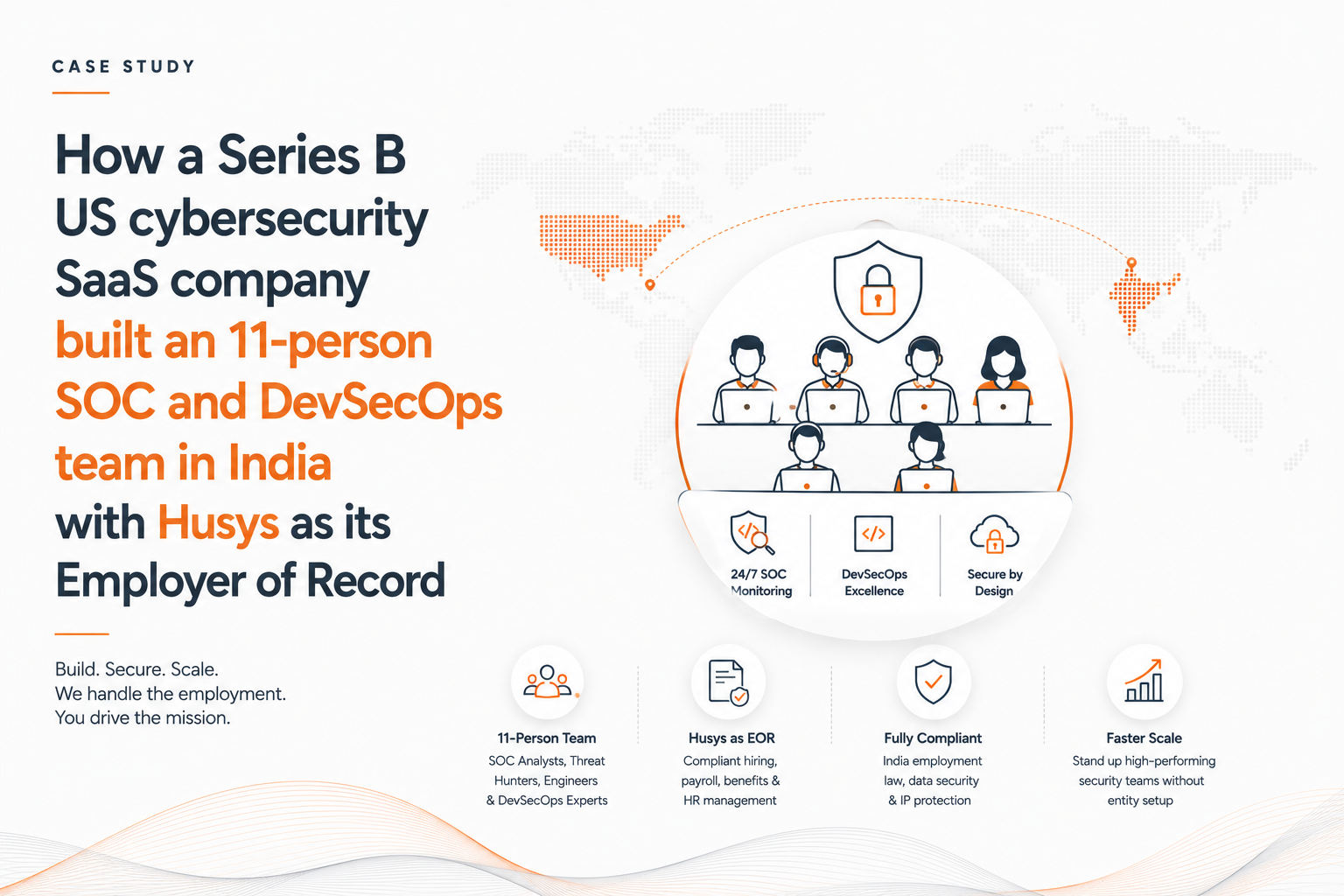
- Most cost models put the EOR-to-entity crossover somewhere between 10 and 25 employees, depending on salary levels and which cities you’re hiring in. Below that, the fixed cost of running an entity filings, a resident director, statutory audits usually outweighs the per-employee premium of an EOR, which is the calculation behind a Series B SaaS company that stayed on EOR rather than incorporating for a 12-engineer team.
- Above it, many companies still keep the EOR relationship for the compliance coverage, even after the pure cost math tips toward incorporation.
What most guides don’t tell you:
- The contractor route is where most first-time US employers start, and it’s also where most misclassification risk sits.
- If you’re considering contractors for an India team, see our Contractor vs. Employee in India guide for a detailed look at classification risk, statutory exposure and the situations where a contractor arrangement can become an employment relationship.
- If the person works exclusively for you, follows your schedule, uses your tools, and reports to your manager, Indian authorities can treat that as disguised employment regardless of what the contract says.
- That exposure doesn’t show up until an audit or a dispute, which is exactly when it’s most expensive to fix.
Before you make your first hire, decide who will legally employ the person in India. If you’re comparing the three models in detail, see our EOR vs. Entity vs. Contractor guide.
Not sure which hiring model fits your India expansion?
Compare the costs, timelines, compliance responsibilities and long-term implications before you commit. Talk to the Husys India employment team.
Decision 2: Timeline Expectations
Set the real timeline before you commit to a hiring date internally.
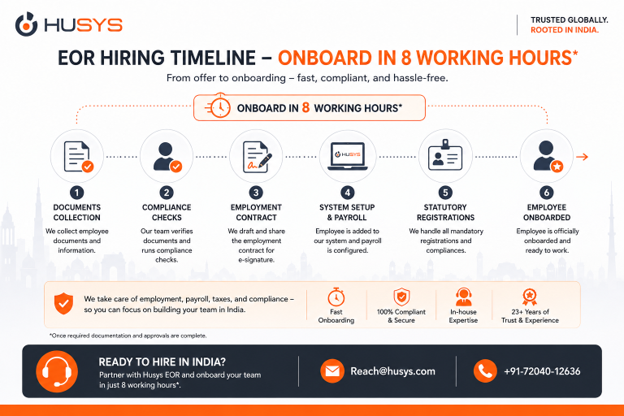
The biggest delays are often not the employment contract itself, but the steps around it: client approval of the employment terms, employee documentation, KYC and bank details, and coordination between the employer, employee and EOR.
With Husys, the onboarding process can be completed within 8 working hours once the required documentation and approvals are complete.
| Model | Timeline |
|---|---|
| Independent contractor | Potentially days, depending on contract execution, documentation and onboarding. |
| EOR | Husys: within 8 working hours once required documentation and approvals are complete. |
| Wholly owned entity | No single fixed timeline. Incorporation, banking, registrations and payroll readiness must all be completed before the company can operate its own employment infrastructure. |
Decision 3: Cost Ownership
Decide, in writing, who owns which line before you sign anything:
- Recruiting and offer costs – usually Ops/HR
- EOR or entity fees – usually Finance, but budgeted per-headcount by the hiring manager
- Statutory contributions (PF, ESI, gratuity) – always employer-funded in India; there is no “optional benefits” equivalent to decide around
- Entity maintenance (filings, audits, resident director) – a fixed cost that exists whether or not you’re actively hiring, and it’s easy for this to fall through the cracks between Finance and Legal
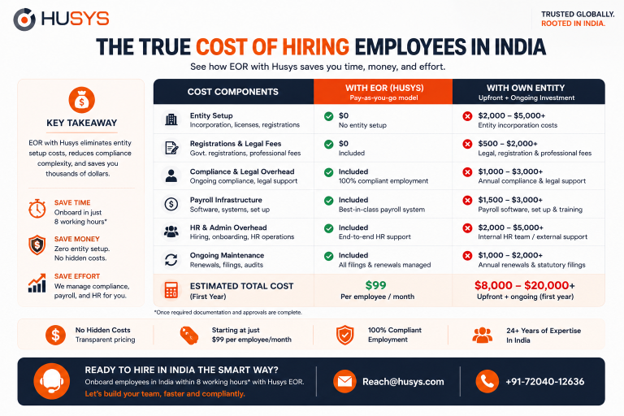
Don’t compare EOR fees with salary alone.
For a US company operating through its own Indian entity, the employment cost also includes payroll administration, statutory compliance, accounting, filings, audits, banking and the internal or external resources required to manage them.
With an EOR, these employment-related operational responsibilities are handled within the service, giving Finance a more predictable cost structure.
The right comparison is therefore total cost of employment infrastructure, not just the monthly EOR fee the same comparison behind how three portfolio companies compared EOR fees against entity setup and maintenance before committing.
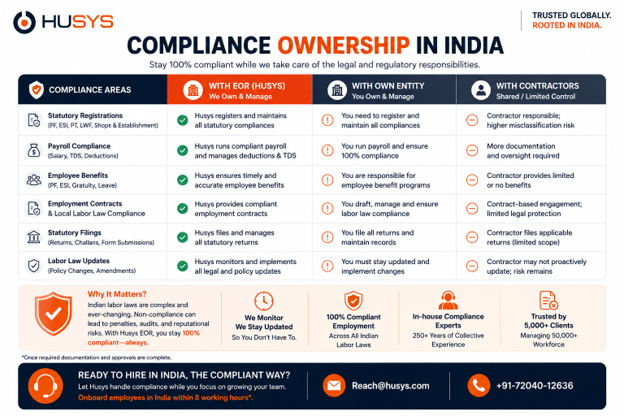
Decision 4: Compliance Ownership
Compliance cannot be an assumption. It needs a clearly identified owner. In India, employment compliance can include PF, ESI, Professional Tax, TDS, labour-law requirements and state-specific employment registrations. If you operate through your own entity, your company is responsible for managing these obligations. With an EOR, the employment-related compliance responsibility sits with the EOR as the legal employer, supported by its local compliance and legal teams. See our India employment compliance guide.
Which Hiring Model Should You Choose?
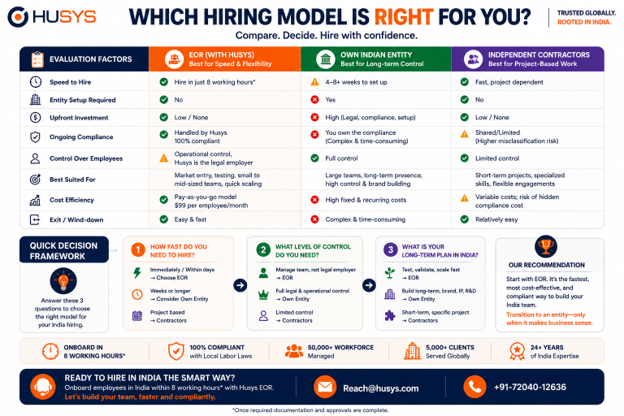
Choose an EOR if:
You want to hire employees in India quickly, are testing the market, or are building an initial team without committing to an Indian entity.
Consider your own Indian entity if:
You expect a long-term operating presence, plan to build substantial local operations, or your India activities go beyond employment and involve directly generating revenue in India.
Consider contractors only if:
The relationship genuinely fits an independent contractor model project-based work, appropriate independence and without creating an employee-like relationship.
The key question is not simply “Which option is cheapest?” It is which model matches your India business activity, hiring plans, compliance exposure and expected scale.
5 Questions to Ask Before Choosing an EOR in India
- Who is the legal employer?
Make sure the EOR structure clearly identifies who employs the worker and who is responsible for employment obligations. - Who owns local compliance?
Ask how PF, ESI, Professional Tax, TDS, labour-law requirements and state-level obligations are managed. - What happens when an employee leaves?
Understand the process for notice periods, final settlement, statutory payments and termination documentation before you hire. - What is included in the fee?
Confirm whether payroll, employment administration and statutory compliance are included, and which services such as hiring, BGV or visa support are additional. - What happens if your India operation grows?
Ask whether the provider can support the workforce as it scales and what happens if you eventually decide to establish your own Indian entity.
The lowest monthly fee is not necessarily the lowest-cost option. Compare the scope of service, compliance ownership, employee lifecycle support and the provider’s ability to support your India plans.
EOR Due-Diligence Checklist
Before signing an EOR agreement, confirm these points in writing:
- Legal employer: Who is the legal employer of record?
- Compliance: Who is responsible for statutory employment compliance?
- Payroll: Who calculates and processes payroll and statutory deductions?
- Employee lifecycle: Who handles onboarding, changes, leave, payroll queries and exits?
- Termination: What process applies when employment needs to end?
- Pricing: What is included in the monthly fee and what is charged separately?
- Additional services: Are hiring, BGV, visa support, equipment or IT services included or separate?
- Data: How are employee records and payroll information handled?
- Audit: What documentation can the client receive for its internal finance, legal or audit requirements?
- Exit: What happens if the company later establishes its own Indian entity?
The objective is not simply to find the lowest EOR fee. It is to understand exactly what you are buying, who owns each responsibility, and what happens as your India operation grows.
India Expansion Checklist by Business Size
The right answer to “entity, EOR, or contractor” changes with headcount and commitment level. Use this as your starting filter.
Startup (1–10 employees, first India hire)
- Confirm the role is genuinely full-time, ongoing work (if not, contractor risk applies see Decision 1)
- Default to EOR unless you already have a confirmed 25+ headcount plan for India
- Get a written cost-per-employee quote that includes PF, ESI, gratuity accrual, and any platform fee not just base salary
- Confirm onboarding timeline in writing (7–10 days is standard; anything longer should be explained)
- Decide who internally owns the India relationship usually the founder or a single Ops lead, not a committee
Mid-market (10–100 employees, scaling an India team)
- Model the EOR-vs-entity breakeven explicitly using your actual salary bands and expected 18-month headcount
- If nearing the 15–25 headcount range, start entity paperwork in parallel with EOR hiring rather than waiting for a hard cutover
- Standardize offer letters, notice periods, and termination language across all India hires — inconsistency here is what creates disputes later
- Confirm which Indian states you’re hiring in; compliance requirements (Shops & Establishment Act, professional tax) vary by state
- Assign compliance ownership to a named person, not “HR” generically
Enterprise (100+ employees, or an established India presence)
- Audit Permanent Establishment (PE) risk if you have India-based staff influencing sales, contracts, or revenue generation in-country
- Confirm whether your current setup (entity, EOR, or hybrid) still matches your actual headcount economics — many enterprises overpay by staying on EOR well past the point it made sense, or underinvest in compliance after incorporating
- Review termination and severance exposure across your full India headcount, not just new hires — Indian notice periods and severance obligations apply to your existing team too
- Confirm audit cadence (internal and external) for payroll and statutory filings
- Build a documented exit plan for the India entity if market conditions change — winding down a registered Indian company typically takes 12–24 months and $10,000–$20,000 in legal and accounting fees, so this needs to be planned for, not improvised
How Your India Hiring Strategy Changes as You Scale
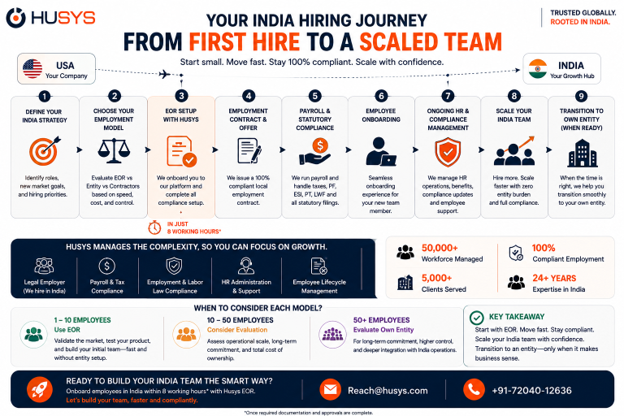
First 1–10 employees: Focus on getting the employment model, contracts, payroll and statutory compliance right. An EOR can provide a practical way to establish the team without creating an Indian employment infrastructure immediately.
10–50 employees: Start evaluating whether the operating model still makes sense as the India team grows. Review workforce costs, compliance processes, employee experience and the company’s longer-term plans for India.
50+ employees: The decision becomes less about the first hire and more about the economics and operating model of the India workforce. At this stage, companies should evaluate whether continuing with an EOR or establishing their own entity better fits their business activity, scale and long-term India strategy.
There is no universal employee-count threshold at which an EOR should be replaced by an entity. The right point depends on what the company is doing in India, how large the workforce becomes, and what it plans to build there.
Checklist by Role (Same Company, Different Priorities)
The same India expansion decision looks different depending on which chair you’re sitting in. This is what each function is typically optimizing for, at each company stage use it to get everyone in the room aligned before the go/no-go call.
| Role | Early-stage (0–50 employees) | Growth / Mid-market (50–500) | Large Enterprise (500+) |
|---|---|---|---|
| Founder / CEO | Enter India without setting up an entity; hire fast without legal distraction; reduce personal liability risk. | Scale globally without slowing go-to-market; avoid fragmented, one-off country setups; de-risk the expansion decision. |
Test India before committing capex; control compliance
and geopolitical risk. See how a company used Husys to accelerate its India market entry in our India market expansion case study . |
| COO | One operational workflow instead of building HR/payroll infrastructure from scratch. | Standardized onboarding, payroll, and exits across countries; fewer operational fire drills. | Centralized global workforce operations with SLA-driven delivery. |
| CFO | Predictable people costs; no entity setup or maintenance cost. | Cost control across multiple vendors; FX, tax, and payroll compliance handled. | Audit-ready payroll data; reduced legal and compliance exposure. |
| CHRO / Head of People | Hire globally without building India-specific HR policy from scratch. | Consistent employee lifecycle management across geographies; faster hiring without policy lag. | Workforce governance with local compliance alignment at scale. |
| General Counsel / Legal | Offload employment law risk rather than building India legal expertise in-house. | Reduce exposure from misclassification and evolving local labour law. | Maintain compliance without expanding legal headcount for every new market. |
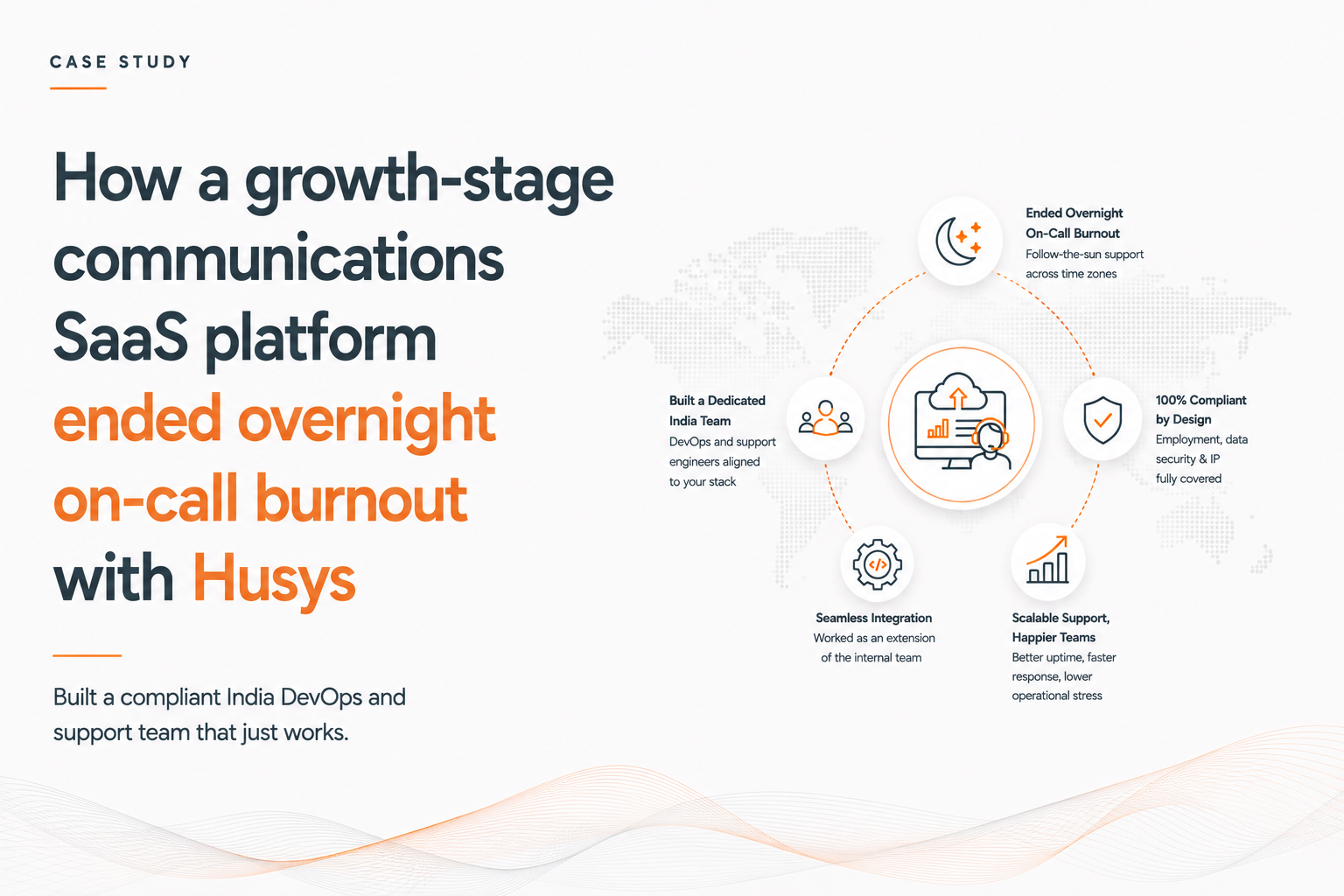
| CTO / Head of Engineering | Build distributed teams without ops bottlenecks. | Faster team ramp-up. | For SaaS companies building engineering, DevOps or R&D teams in India, see our EOR for SaaS companies in India . |
India-Specific Realities Most Checklists Skip
1. Banking delays are a planning risk, not a footnote
These are the areas where India hiring experience matters most. After 24+ years working across India’s HR, payroll and employment ecosystem, we’ve seen that the biggest problems rarely come from the headline rule itself they come from how that rule plays out in day-to-day employment.
- If you incorporate your own entity, opening a compliant corporate bank account is a separate, sequential step not something that happens automatically at incorporation.
- For a foreign-owned entity, expect 1–4 weeks with clean, pre-apostilled documentation, and up to 8–10 weeks if beneficial-ownership declarations or embassy attestation get flagged.
- Since payroll can’t legally run without a funded local account, this single step is the most common reason “we’ll be hiring next month” turns into a full quarter’s delay.
2. The 2025 labor code overhaul changes the ground under existing assumptions
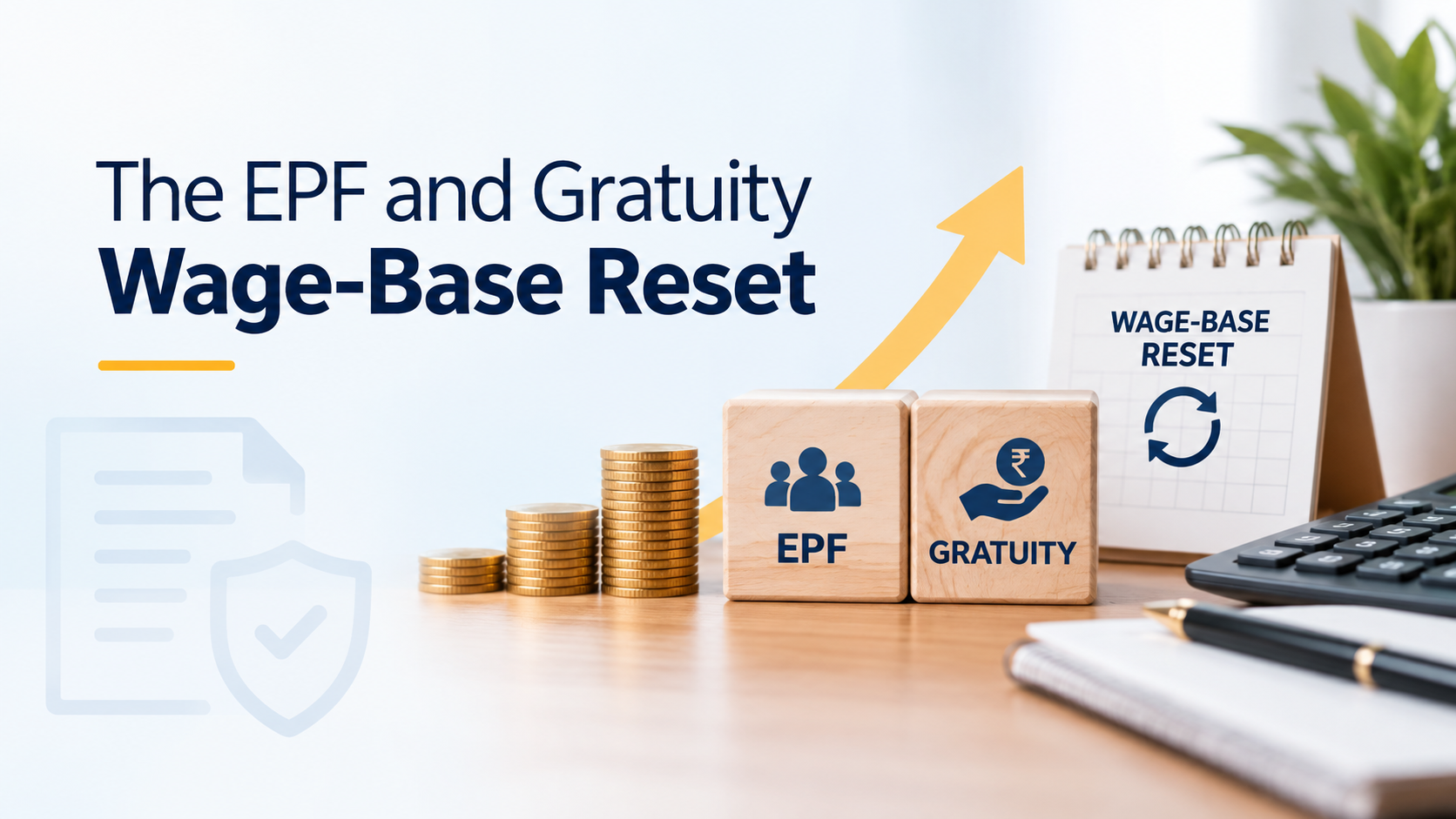
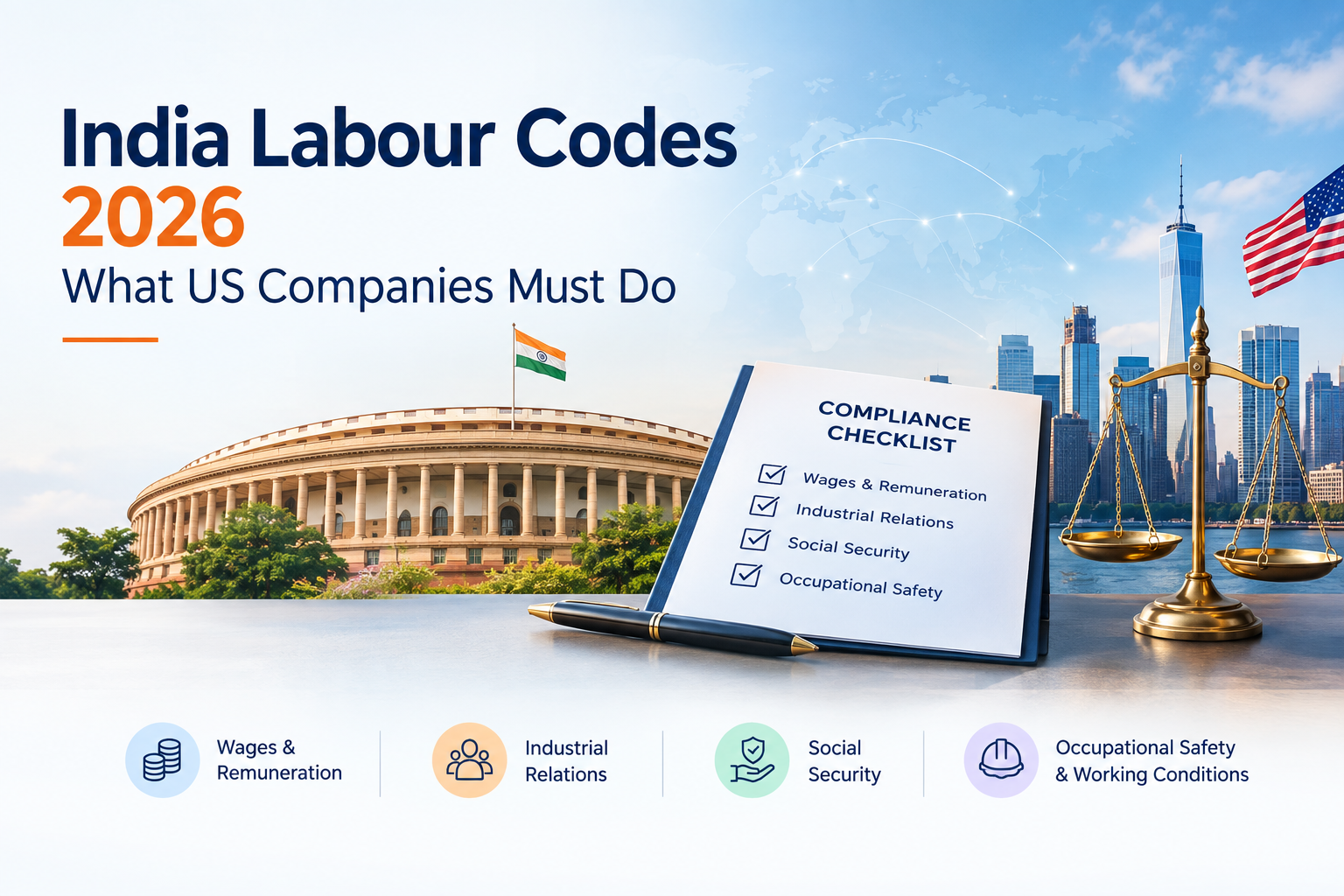
- As of November 21, 2025, India brought Four new national labor codes into force the Code on Wages, the Industrial Relations Code, the Code on Social Security, and the Occupational Safety, Health and Working Conditions Code replacing 29 older labor statutes.
- The headline change for payroll: a standardized definition of “wages” that generally requires basic pay to be at least 50% of total compensation, which affects how provident fund, gratuity, and other statutory benefits are calculated.
- Central and state-level implementing rules were still being finalized into 2026, meaning employers are operating in a transition period where existing rules continue to apply until the new ones are formally notified.
- If your compliance provider or in-house team isn’t actively tracking this rollout state by state, your payroll structuring is at risk of falling out of date without anyone noticing until an audit.
For the detailed implications for US companies hiring in India, see our India Labour Codes 2026 guide
3. Termination is notice-based, not at-will and it’s easy to underestimate
- There’s no US-style at-will employment equivalent in India. Depending on role, seniority, and state, standard notice periods run 30–90 days, and for IT roles specifically, 90-day (three-month) notice periods are common among the longest globally.
- Immediate termination without notice generally requires documented cause.
- Skipping or shortening this process is one of the most common and most expensive mistakes US companies make when they apply US termination instincts to an India-based employee.
- For the practical requirements around notice periods, termination procedures and statutory obligations, see our Employee Termination in India guide
4. Compliance overhead doesn’t disappear once you’re set up it recurs monthly and quarterly
- PF (Provident Fund), ESI (state-run health insurance), professional tax, and TDS (tax deducted at source) filings run on their own monthly and quarterly cadences, on top of statutory audits.
- This is ongoing operational load, not a one-time setup task and it’s the piece that’s easiest to under budget for when a company builds its India cost model around salary alone.
US → India Translation Table
If you already run US payroll, this is the fastest way to map what’s different.
| Aspect | United States | India |
|---|---|---|
| Employment relationship | At-will | Contractual, with mandatory notice periods |
| Payroll cycle | Typically bi-weekly | Monthly |
| Benefits | Largely optional / employer-choice | Statutory PF, ESI, gratuity are legally required, not optional perks |
| Termination | Often immediate, "at-will" | Notice-based; 30–90 days depending on role and state; cause required for immediate termination |
| Retirement-style benefit | 401(k) optional, employee-elected | Provident Fund (PF) mandatory employer and employee contribution, closest US analogue is a mandatory 401(k) |
| Health coverage | Employer-sponsored, optional plan design | ESI government-run scheme, mandatory below a wage threshold |
| Business bank account setup | Typically 1–2 weeks for a domestic entity | 1–10 weeks for a foreign-owned entity, depending on documentation and KYC review |
Real Example: How This Plays Out by Company Profile
A VP of Finance at a 51–200 person software company is usually optimizing for cost predictability at scale. India’s cost advantage here is significant: a full-stack developer role that runs roughly $120,000/year in the US commonly costs in the range of $20,000/year in India for a comparable skill set, based on published salary-benchmarking data — which is a large part of why mid-market software companies report saving on the order of 60–70% for equivalent roles when hiring in India rather than the US.
If you’re evaluating India specifically for a SaaS workforce, see our EOR guide for SaaS companies in India.
What Most Companies Forget
After 24+ years of working with companies hiring and employing people in India, these are some of the issues we see teams underestimate most often:
- That the entity decision is not permanent, and staying too long on the “wrong” model is common. Companies frequently stay on EOR well past the headcount where an entity would be cheaper, or incorporate too early and carry fixed compliance costs against a team that never scaled.
- That Permanent Establishment (PE) risk is a live issue, especially once India-based staff start influencing sales, signing contracts, or generating revenue in-country — at that point, “we don’t have an entity” doesn’t fully protect you from Indian tax exposure.
- That winding down is a real cost, not a hypothetical. If a company decides to exit India, formally closing a registered entity typically takes 12–24 months and $10,000–$20,000 in fees — a number that should factor into the initial entity-vs-EOR decision, not just the entry cost.
- That compliance is state-specific, not just national. India has 28 states and 6 union territories, each with its own Shops & Establishment Act requirements and enforcement style. A national compliance policy that ignores state-level variation will eventually produce a filing gap.
Why does 24+ years of India employment experience matter?
Because India hiring is not simply about getting an employee onto payroll. It involves managing the employment lifecycle across contracts, payroll, statutory compliance, employee changes, audits and exits. Husys has been working across India’s HR and employment ecosystem for 24+ years, supporting 5,000+ companies and 50,000+ workers over that journey. Today, Husys supports 150+ active clients and 3,000+ active employees across India.
Risks, Edge Cases & Misconceptions
“We’ll just use contractors until we’re sure.” This is the most common starting point for US companies, and also the most common source of misclassification exposure.If the relationship looks like employment set hours, direct supervision, exclusivity, use of company tools Indian authorities can reclassify it regardless of contract language, exposing the company to back-payment of statutory benefits and penalties, which is why some companies
choose to act first: see how one company transitioned 18 contractor and informal arrangements into compliant employment.
“An EOR means we have no compliance responsibility.” Not quite. An EOR absorbs the legal employer role and the associated filings, but you’re still responsible for how the relationship is managed day to day scope of work, performance management, and avoiding the appearance of misclassification within the EOR structure itself.
“Termination works the same everywhere in India.” It doesn’t. Notice periods and severance expectations vary by state, by role seniority, and by whether the termination is for cause or for convenience. A single national termination policy without state-level review is a common gap.
“Once we’re set up, compliance is a solved problem.” Compliance in India is recurring, not one-time monthly PF/ESI filings, quarterly returns, annual audits, and now a live transition period as the new national labor codes get implemented state by state through 2026.
Planning Your First India Hire?
Before you incorporate, engage contractors, or choose an EOR, make the decision based on your headcount, hiring timeline, business activity and long-term India plans.
Husys has 24+ years of India employment experience and supports companies with EOR, PEO, payroll and employment operations across India.
Frequently Asked Questions
1. How long has Husys been providing HR and employment services in India?
Husys has been operating in India's HR and employment ecosystem for 24+ years, supporting companies across payroll, PEO/EOR and employment services. Over that period, Husys has supported 5,000+ companies and 50,000+ workers, giving the team practical experience across the employee lifecycle, including onboarding, payroll, compliance and exits.
2. Can a US company legally hire employees in India without setting up an entity?
Yes. Using an Employer of Record (EOR) is a legally recognized way to employ workers in India without registering a local entity. The EOR is the legal employer of record; your company directs the day-to-day work.
3. How long does it take for a US company to hire an employee in India through an EOR?
With Husys, an employee can be onboarded within 8 working hours once the required documentation and approvals are complete.Husys can onboard employees within 8 working hours once the required documentation and approvals are complete.Setting up your own Indian entity takes significantly longer because incorporation, banking and payroll readiness all have to be completed before the first employee can be paid.
4. What does an EOR handle in India?
An EOR handles the employment administration and statutory compliance required to employ workers in India, including payroll, PF, ESI, Professional Tax, TDS and applicable labour-law requirements.
5. Can a US company hire contractors in India?
Yes, a US company can engage contractors in India, but the relationship must genuinely meet the requirements of an independent contractor arrangement.
6. When should a company establish its own Indian entity?
A company should consider establishing its own Indian entity when it expects a long-term operating presence in India or when its activities go beyond simply employing people.
7. Is an EOR cheaper than setting up an entity in India?
It depends on headcount and how long you plan to operate in India. An EOR avoids the upfront incorporation and ongoing entity-maintenance costs, while an Indian entity can become more economical as your team grows. The right comparison should include payroll, statutory compliance, filings, audits, banking and other ongoing costs not just the EOR fee. For companies still testing the India market or building an initial team, an EOR can provide a more predictable way to start without committing to the fixed costs of an entity.
8. Can a US company hire contractors in India instead of employees?
Yes. A US company can hire employees in India without establishing its own Indian entity by using an Employer of Record (EOR).If the individual works like an employee for example, under the company's direction and as part of an ongoing employment relationship contractor classification can create compliance and misclassification risk.The contract label alone does not determine how the relationship is treated.
9. How does employee termination in India differ from US at-will employment?
India does not follow the US-style at-will employment model. Termination is generally governed by the employment contract and applicable local requirements, including notice periods and, depending on the circumstances, statutory payments or other obligations. For US companies, the key point is that termination terms should be reviewed and built into the employment agreement before the employee joins.
10. What is Permanent Establishment (PE) risk, and does it apply to EOR hiring?
PE risk is the possibility that your India-based activity especially sales, contract execution, or revenue generation creates a taxable presence in India even without a formal entity. It's a real consideration for any company with India-based staff influencing revenue, and it should be reviewed regardless of whether you use an EOR or an entity.
11. What are PF, ESI, and TDS, in US terms?
PF (Provident Fund) is closest to a mandatory 401(k) both employer and employee contribute, and it's not optional. ESI is a government-run health insurance scheme, roughly analogous to a mandatory public health benefit, required below a wage threshold. TDS (Tax Deducted at Source) is India's payroll withholding tax mechanism, similar in function to US federal/state withholding.
12. Do the new 2025 Indian labor codes change how we should structure India payroll now?
Yes, directionally. The codes, in force since November 21, 2025, introduce a standardized wage definition generally requiring basic pay to be at least 50% of total compensation, which affects PF and gratuity calculations. Central and state implementing rules were still being finalized into 2026, so this is an active compliance area to monitor rather than a settled one.
13. At what headcount does it make sense to switch from EOR to our own entity?
Most cost models put the breakeven somewhere between 10 and 25 employees, depending on salary levels and city. Many companies begin entity paperwork around the 15-employee mark so the transition is ready by the time headcount justifies it, rather than waiting for a hard cutover.
14. What happens if we want to exit the Indian market later?
If you've registered your own entity, formally winding it down typically takes 12–24 months and $10,000–$20,000 in legal and accounting fees. This is worth factoring into the entity-vs-EOR decision up front, not just the cost of entering.
15. Which Indian states have different compliance requirements?
Compliance varies across India's 28 states and 6 union territories — particularly around the state-specific Shops & Establishment Acts and professional tax. A company hiring across multiple states needs state-level compliance tracking, not a single national policy.
16. What should be on an India expansion checklist for US companies?
At minimum: the entity-vs-EOR-vs-contractor decision, a realistic hiring timeline, who owns cost, who owns compliance, state-specific labor law exposure, and a termination/exit plan. This page covers all six in detail above.
Where This Leaves You
If you’re at the point of evaluating this for your own team, speaking with a compliance expert early before the first offer letter goes out can prevent the timeline and cost surprises this checklist is built to flag.
Husys has been working in India’s HR and employment ecosystem for 24+ years, supporting 5,000+ companies and managing 50,000+ workers across employment, payroll and compliance.
That experience matters because the difficult part of India hiring is rarely sending the offer letter it is getting the employment, payroll, compliance and employee lifecycle right after the hire.
For companies planning a broader India expansion, our India market entry guide for US companies can help you evaluate the wider setup beyond the first hire.
For companies that choose an EOR, the provider’s India experience matters just as much as the commercial model. Husys has been operating in India’s HR and employment ecosystem for 24+ years, with experience across payroll, PEO/EOR, employment compliance and the wider employee lifecycle. That depth of operating experience is particularly important when the issues that matter most compliance, contracts, employee changes and exits arise after the initial hiring decision.
What tends to go wrong isn’t the decision itself it’s making it without getting Founder, Finance, and HR aligned on the same page first, and finding out three months into hiring that everyone assumed someone else owned compliance.
If you’re at the point of evaluating this for your own team, speaking with a compliance expert early before the first offer letter goes out can prevent the timeline and cost surprises this checklist is built to flag. In our experience working with US companies hiring in India, the businesses that plan the entity/EOR decision, the realistic timeline, and compliance ownership before their first hire spend far less time firefighting in year one than those who work it out as they go.