Husys India EOR Payroll & Compliance Experts is the in-house team supporting Employer of Record (EOR) payroll operations and statutory compliance for US companies hiring in India. With 250+ years of collective compliance experience, the team has supported 50,000+ contractors to date and helps 5,000+ clients run compliant workforce operations across India.
Editorial note: This content is reviewed internally by payroll and compliance specialists and reflects standard statutory practices in India. For case-specific guidance, consult a qualified professional.
Facebook
X.com
LinkedIn
Email
WhatsApp
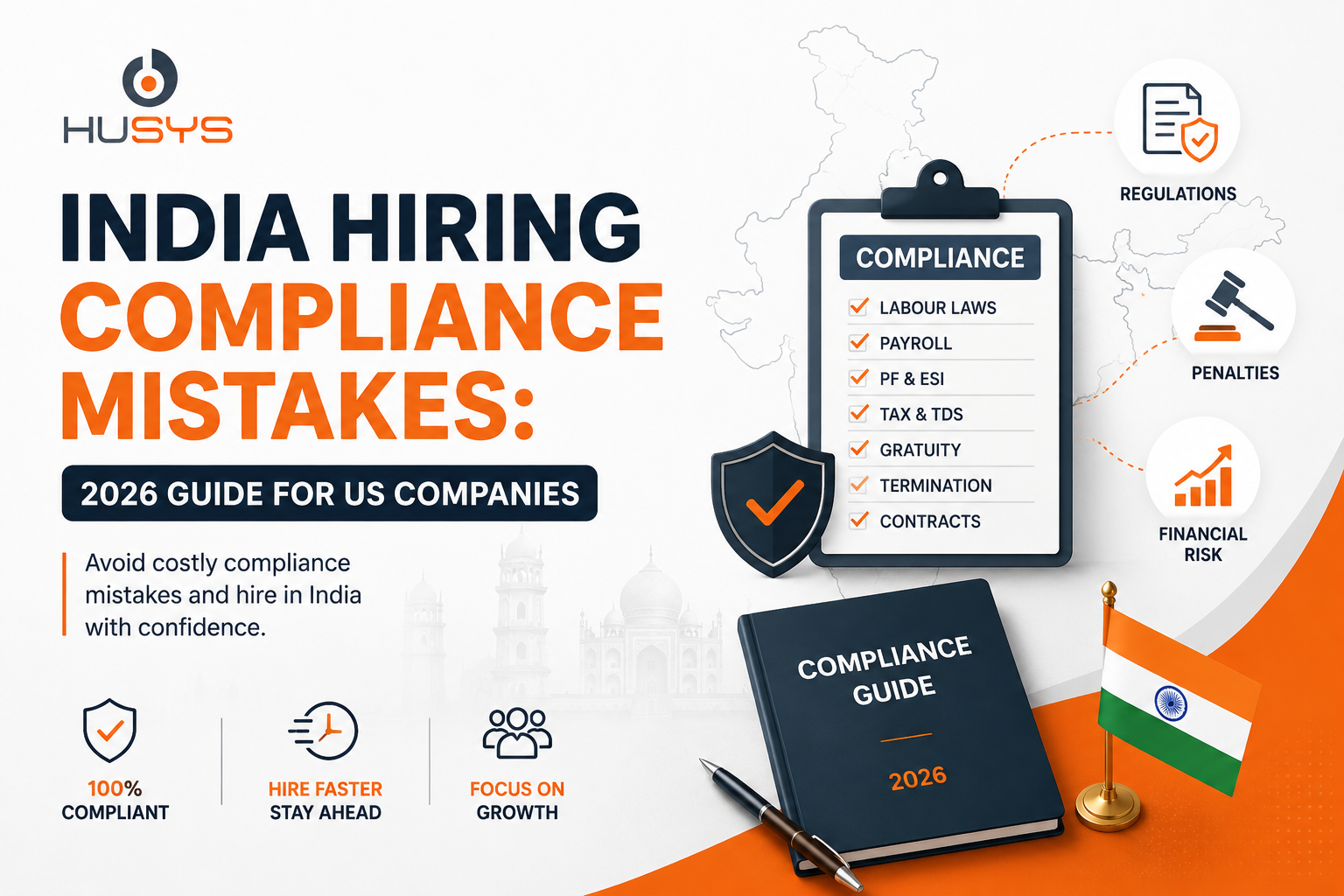
The biggest India hiring compliance risks for US companies are choosing the wrong hiring model, using non-compliant employment terms, getting payroll and statutory filings wrong, mismanaging leave and benefits, and making errors during termination and final settlement. These risks can arise at every stage of employment because Indian requirements can vary by state, establishment and employee category.
The most common compliance mistakes US companies make when hiring in India are misclassifying employees as contractors, missing PF/ESI and state registrations, applying US-style termination practices, overlooking India’s statutory employment requirements, and failing to assess Permanent Establishment exposure. The consequences can include backdated statutory dues, interest, penalties, employee disputes, tax exposure and regulatory scrutiny.
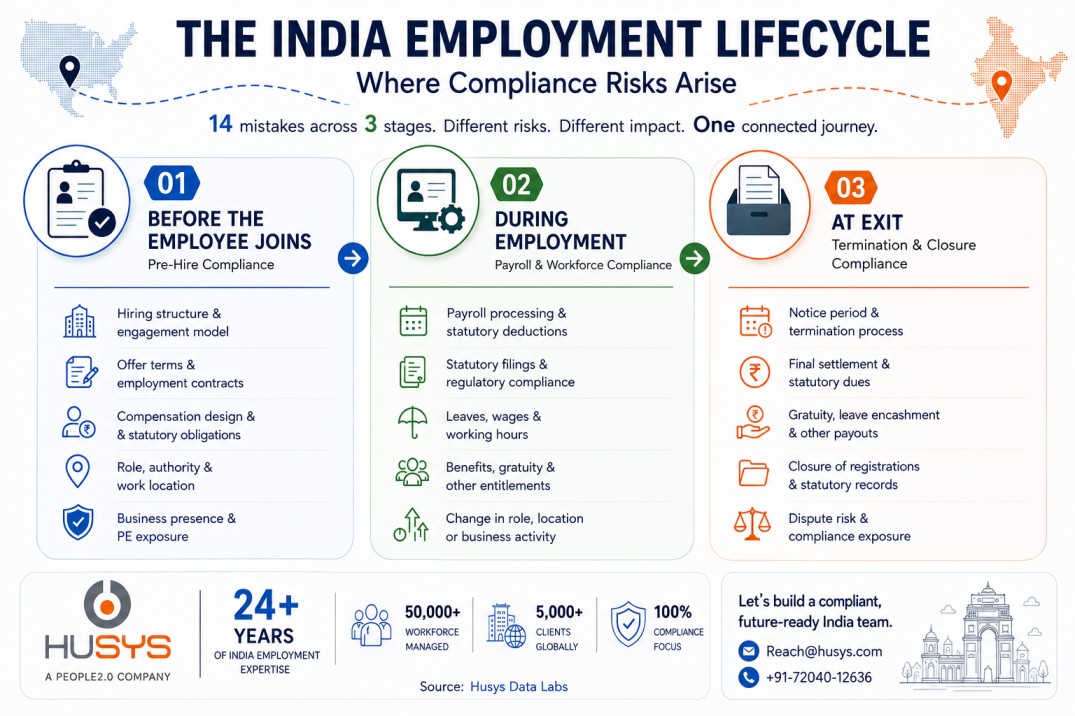
Husys has spent 24+ years operating in India’s employment and compliance environment. From our experience supporting companies hiring and managing employees in India, the recurring problems are usually concentrated at three stages: before the employee joins, throughout employment and payroll, and when the employment relationship ends.
This guide explains what goes wrong at each stage, what the consequences can be, how companies can reduce the risk, and when an EOR may be more appropriate than establishing and operating an Indian entity.
Who Needs to Understand India Hiring Compliance?
This is for founders, HR leaders, and finance or legal teams at US companies hiring their first employees in India, or already running a small India team and unsure whether it would survive a labour inspection. If your company runs on at-will employment, optional benefits, and biweekly payroll, nearly everything below applies to you directly, because India works on notice-based termination, statutory (not optional) benefits, and monthly payroll cycles.
What 24+ Years of India Operations Has Taught Us
Husys has spent more than 2.5 decades operating in India’s employment and compliance environment, working with 5,000+ global companies and managing 50,000+ workers over that period. Today, Husys supports 1000+ active clients and 8,000+ active employees, with employment operations supported across 28 states and 8 union territories.
Across that experience, the compliance problems that repeatedly require the most attention are rarely obscure legal provisions. They are practical operating failures: using the wrong employment structure, missing statutory requirements, overlooking state-level differences, relying on US-style termination practices, delaying employee documentation, or discovering too late that the employment terms do not match what the business actually agreed with the employee.
That distinction matters: knowing what the law says is only one part of India employment compliance. The other part is building processes that consistently apply those requirements throughout hiring, payroll, employment changes and termination.
Before You Read the Mistakes: Translate India Into US Employment Terms
The easiest way for a US company to understand India employment compliance is not to learn a completely new vocabulary. It is to understand where familiar US employment concepts stop working.
If you’re used to this in the US
In India, think about this instead
At-will employment
Contractual terms + applicable notice and statutory requirements
401(k) and optional benefits
Statutory contributions such as PF, ESI and gratuity where applicable
Weekly or biweekly payroll
Monthly payroll and recurring statutory filings
Company-defined PTO
Statutory leave requirements + company policy
Federal + state compliance
Central + state-level employment requirements
1099 contractor arrangements
Actual working relationship and classification
Simple employee exit
Notice, applicable process and full-and-final statutory settlement
US-only employment policy
India-specific contracts, policies and state requirements
The important distinction: these are not one-to-one legal equivalents. They are a practical translation for US teams evaluating their India employment setup.
What It Actually Costs When Compliance Breaks
Before the mistake-by-mistake breakdown, it helps to see the shape of the consequences, because the same handful of outcomes show up again and again across pre-hire, during-employment, and exit mistakes.
For a US company, an India hiring compliance failure can turn a simple employment decision into backdated statutory dues, interest, penalties, disputes or corrective action.
Backdated statutory dues: Missed PF, ESI or other statutory obligations can become retrospective liabilities rather than simply future compliance costs.
Interest and additional financial exposure: Delayed statutory payments can create interest, damages or other costs on top of the original obligation.
Employee claims and disputes: Incorrect employment terms, leave treatment or termination processes can result in employee grievances, conciliation proceedings or other disputes.
Misclassification exposure: Treating someone as a contractor when the working relationship functions as employment can create downstream exposure for statutory benefits and employment obligations.
Tax and Permanent Establishment exposure: The activities and authority of India-based personnel can create tax questions that sit separately from ordinary payroll compliance.
Operational and regulatory exposure: Missing registrations, filings or closure procedures can leave a company dealing with notices, audits or unresolved obligations after it believes the issue has already been closed.
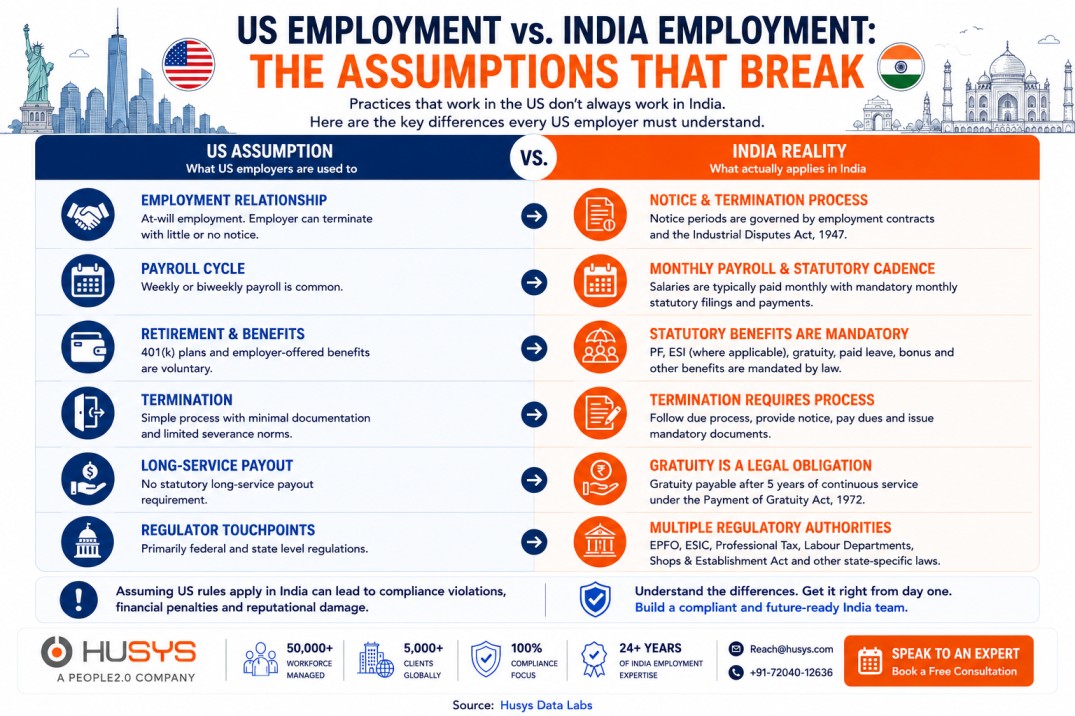
US Employment Assumptions That Break in India
concepts it already knows. The comparison below is a practical translation, not a one-to-one legal equivalence. India’s employment framework has its own statutory requirements, and the applicable rules can vary by employee category, location and circumstance.
If you’re used to this in the US
What you need to understand in India
Why it matters
At-will employment
Employment terms, applicable law and notice requirements need to be considered when ending employment.
A US termination process should not simply be copied into an India employment contract.
Weekly or biweekly payroll
Monthly payroll is the standard operating cycle, with recurring statutory calculations and filings.
Payroll teams need an India-specific compliance calendar.
401(k) and employer-sponsored benefits
Statutory social-security and employment benefits such as PF, ESI and gratuity apply where their respective conditions are met.
These are not simply optional benefits that can be removed from the employment package.
Company-defined PTO policies
Leave requirements can include statutory and state-level minimums in addition to company policy.
A US leave policy may not provide the required India entitlement by itself.
Federal + state employment compliance
India also combines central requirements with state-specific employment rules and registrations.
A policy that works in one Indian state may need adjustment in another.
1099 contractor arrangements
Worker classification depends on the actual nature of the relationship, not simply what the contract calls the individual.
Treating a full-time employee as a contractor can create retrospective statutory exposure.
Simple employee exit
Notice, applicable termination requirements, statutory dues and full-and-final settlement need to be addressed.
Getting the termination decision right is only part of getting the exit right.
A US employment template
Employment contracts need to reflect the applicable Indian employment framework and the employee’s location.
A US template can leave important India-specific obligations unaddressed.
The practical takeaway for a US employer: don’t ask whether India has an exact equivalent of every US employment concept. Ask which part of your existing US process needs to be adapted before it is used for an India employee.
India’s current Labour Code framework also reinforces why this translation matters. The Ministry of Labour publishes the four Labour Codes, 2026 Central Rules and current FAQs, including guidance on wage definitions, social security and gratuity.
Husys Data Labs: 5 India Hiring Risks US Companies Should Know
Husys Data Labs draws on more than 24 years of operating experience in India’s employment and compliance environment. Across that experience, five recurring risks deserve particular attention when US companies build and manage an India workforce:
Using contractors for roles that function like employment: The contract label does not determine the nature of the working relationship.
Transferring US compensation structures directly to India: Salary structures need to account for India’s statutory wage and contribution requirements.
Treating India as one uniform employment market: State-level requirements can affect employment, payroll and registrations.
Missing recurring statutory compliance: PF, ESI, Professional Tax, TDS and other applicable employment requirements need to be built into the operating process.
Applying US-style termination practices: Notice, contractual terms, documentation, settlement and applicable statutory requirements need to be considered before an employee exits.
These are not five isolated legal issues. They represent five points where a US company’s existing employment model can fail when it is transferred to India without local adaptation.
The detailed sections below break down the full lifecycle, including additional risks that become relevant as the India operation grows.
Husys Data Labs | Insights from 24+ years of India employment operations
Planning Your First India Hire?
The biggest compliance problems are usually created before the employee joins, by choosing the wrong hiring structure, salary setup or employment terms.
If You’re Hiring in India Now, Check These 5 Things First
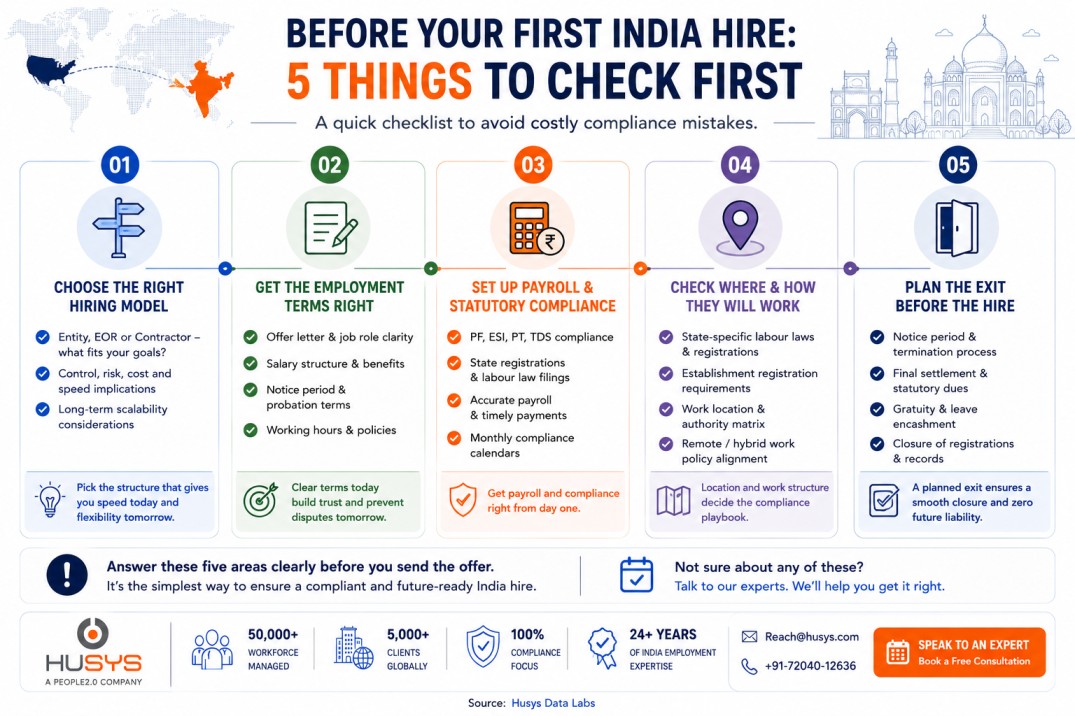
Before making an India hire, check the hiring model, employment terms, payroll compliance, work structure and exit process.
You do not need to solve every India employment question on day one. If you’re preparing to hire your first employees, start with these five checks:
Hiring structure: Are you hiring through your own India entity, an EOR, or as a contractor and does that structure match how the person will actually work?
Employment terms: Does the offer letter reflect India-specific requirements rather than simply adapting a US template?
Compensation structure: Has salary and statutory compensation been structured against the applicable wage rules and contribution requirements?
State-level compliance: Which Shops & Establishments, Professional Tax, leave and other requirements apply in the employee’s state?
Exit before entry: Have you already understood notice, termination, final settlement and statutory obligations before making the hire?
A good India hiring setup is not just about getting someone onto payroll. It is about making sure the structure, employment terms, payroll and eventual exit all work together from day one.
5 Signs Your India Hiring Setup Needs a Compliance Review
You should pause and review your setup if:
You have employees working in India but no clear employment structure, entity, EOR or contractor.
You are using a US employment agreement or contractor agreement with minimal India-specific changes.
Payroll is being managed using US cycles or assumptions rather than India-specific statutory calendars.
An employee’s role, location or authority has changed since they were hired, particularly if they work remotely from India or interact with customers.
You have never reviewed your termination, final-settlement or statutory-closure process before needing to use it.
If any of these sound familiar, don’t wait for an employee exit, payroll review or government inquiry to expose the gap. Review the structure while it is still easy to correct.
India employment compliance is a lifecycle: risks can arise before hiring, during employment and at exit.
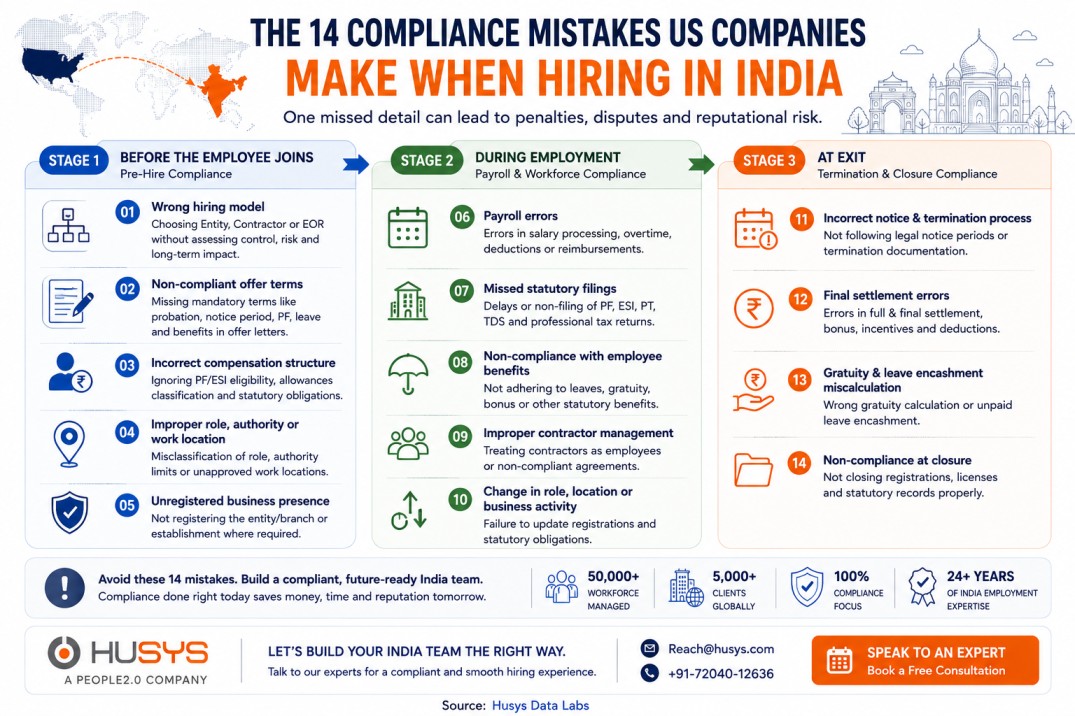
At a Glance: 14 Compliance Mistakes US Companies Make When Hiring in India
Before anyone is hired
Hiring a full-time worker on a contractor agreement
Assuming a small team is too small to register
Structuring salary the old way and ignoring the 50% wage rule
Using a US-style offer letter without adapting it to India
Ignoring Permanent Establishment (PE) risk
During employment
Missing monthly PF, ESI, and Professional Tax filing deadlines
Applying US-style flexible PTO without meeting statutory leave floors
Not provisioning for gratuity as it accrues
Letting a stranded or long-remote employee work from India without reassessing PE
Assuming the new Labour Codes “aren’t really in force yet”
At exit and termination
Terminating like it’s at-will employment
Missing the gratuity payment deadline and retrenchment compensation
Assuming a signed release closes out all statutory liability
Not properly closing statutory registrations when winding down India operations
Use this as your quick-preparation checklist. Then read the sections below to understand what each mistake can cost and how to avoid it.
Stage
What can go wrong
What to check first
Before hiring
Wrong employment structure, offer terms, wage design or PE exposure
Hiring model, contract, compensation and role authority
During employment
Missed statutory filings, incorrect leave treatment, gratuity exposure or changing PE risk
Payroll, statutory filings, leave, wages and employee location
At exit
Incorrect notice, termination process, final settlement or statutory closure
Notice, documentation, statutory dues and registrations
What These Mistakes Have in Common
Across all three stages, the underlying problem is usually the same: a US employment practice is carried into India without checking whether the Indian employment relationship works the same way.
The issue may begin with the hiring structure, show up later in payroll or leave administration, and only become visible when an employee exits or an authority reviews the records.
That is why India hiring compliance should not be treated as a checklist completed once at onboarding. The structure, employee terms, statutory obligations and business activities need to remain aligned as the India team grows.
For a US company, the practical question is therefore not simply “Are we compliant today?” but:
“Would the way we have structured and operated this India team still hold up if someone reviewed it tomorrow?”
US employment practices do not always translate directly to India. These differences can create compliance gaps from the first hire through exit.
Part 1: Mistakes Made Before Anyone Is Hired
The first compliance mistakes are often made before the employee’s first day. The hiring structure, offer letter, salary design, statutory registrations and even the scope of the employee’s role can determine what obligations the US company carries once the person starts working in India.
These decisions can look administrative at the time, but they are often the ones that create backdated liability later. Here are the five pre-hire mistakes we see most often when US companies build their first India team.
Mistake 1: Hiring a full-time worker on a contractor agreement
It’s tempting to treat the first India hire like aUS 1099 contractor: send a services agreement, pay an invoice, skip payroll entirely. Indian authorities don’t look at what the contract is called, they look at how the relationship actually works. If the person keeps fixed hours, uses company equipment, reports to a manager, and works exclusively for one company, that’s an employment relationship regardless of the label on the document.
What we see in practice:
One of the recurring risks for companies entering India is treating a full-time role as a contractor arrangement simply because the team is small or the company does not yet have an Indian entity. The issue is not the size of the India team; it is whether the actual working relationship matches the structure being used.
For a US finance team, the important distinction is between the cost of a contractor arrangement and the cost of getting the classification wrong. A contractor may appear simpler because the company avoids setting up an employment structure, but if the working relationship functions as employment, the potential exposure can extend beyond the original compensation arrangement to statutory benefits, employment obligations and related costs.
The decision should therefore not be based only on the contractor’s quoted rate. It should be based on whether the engagement model matches the actual relationship and the company’s intended level of control.
What it costs: reclassification exposure, back-payment of PF, ESI, gratuity, and leave as if the person had been an employee since day one, plus penalties for the missed registrations that should have existed the whole time.
How it’s avoided: hire through a compliant structure from the first day, either a registered entity or anEmployer of Record (EOR), so the working relationship and the paperwork match from the start.
Mistake 2: Assuming a small team is too small to register
PF registration becomes mandatory once an establishment crosses 20 employees (voluntary below that), and ESI registration is typically mandatory at 10 employees in most states. Founders hiring their first 3-5 people in India often assume statutory registration is a later-stage problem. It isn’t, it’s a threshold problem, and once you’re over it, the obligation is retrospective to the date you crossed it, not the date you noticed.
What it costs: a compressed compliance sprint once headcount crosses the threshold, often discovered during fundraising due diligence or an audit rather than proactively.
How it’s avoided: track headcount against PF/ESI thresholds as part of hiring planning, not after the fact, or route early hires through anEOR that already carries these registrations.
Mistake 3: Structuring salary the old way and ignoring the 50% wage rule
India’s Labour Codes are an important 2026 consideration for employers reviewing salary structures. The Codes came into effect on 21 November 2025, and the Ministry of Labour’s current guidance addresses the revised definition of “wages”, including the treatment of allowances when determining the statutory wage base. For employers, this means an existing CTC structure should not be assumed to produce the same statutory calculations under the current framework.
For a US company, the practical issue is straightforward: don’t treat the salary structure as only a compensation-design decision. The way basic pay and allowances are structured can affect statutory employment costs and calculations, so the India payroll structure should be reviewed before scaling the workforce.
What we see in practice: Salary structure is one of the areas where a US company’s existing compensation model can create confusion when it is transferred directly to India. The issue is not simply the headline salary; the structure of that compensation can affect statutory calculations and the employer’s actual cost.
What it costs: understated PF and gratuity provisioning, higher-than-budgeted employer costs once restructured, and retrospective exposure if payroll wasn’t rebuilt around the new wage definition.
How it’s avoided: rebuild CTC structures around the 50% rule now rather than waiting for every state to finish notifying its rules, since the codes are already legally in force.
Mistake 4: Skipping Shops & Establishment registration before day one
Most Indian states require a Shops and Establishment Act registration before an office (including a registered address used for a remote team) can legally employ people, and it sets baseline rules on working hours, holidays, and termination notice for that state. It’s easy to miss because it’s a state-level filing, not a central one, and requirements vary by state.
What it costs: the establishment technically operates outside its own state’s baseline labour rules, which surfaces during any state labour department inquiry.
How it’s avoided: confirm state-specific registration before the first offer letter goes out, especially if hiring across more than one state.
Mistake 5: Not documenting who has authority to sign or negotiate
Permanent Establishment (PE) risk is separate from ordinary employment compliance. It concerns whether the activities of a foreign company’s India-based personnel or other presence could create a taxable presence in India under applicable tax law and treaty provisions. The risk is therefore driven by facts such as what the India-based person does, the authority they exercise, the nature of their activities and the contractual arrangements involved.
For a US company, the practical lesson is that putting someone on an India payroll does not by itself answer the PE question. Employment structure and tax exposure are related but separate questions, and the role and authority of India-based employees should be assessed as part of the expansion plan.
What we see in practice: The important question is not simply whether a company has employees in India. It is what those employees are authorised to do. For US companies building an India team, documenting role boundaries and decision-making authority early is therefore part of the operating setup, not something to revisit only after the team has grown.
What it costs: a portion of global profits becomes taxable in India, with compliance and reporting obligations layered on top; Indian tribunals have actively litigated this in 2025-26, including a widely covered case that set aside a roughly $475 million PE tax demand on procedural and substantive grounds.
How it’s avoided: keep contract-signing authority with the US entity, define India-based roles as execution rather than deal-closing where possible, and document that decision chain from the first hire.
US employment practices do not always translate directly to India. These differences can create compliance gaps from the first hire through exit.
Part 2: Mistakes Made During Employment
Once the employee is on payroll, the risk shifts from choosing the right hiring structure to actually running the employment relationship correctly. This is where US companies often carry over familiar payroll cycles, leave policies and employment practices that do not map cleanly to India’s statutory requirements.
The mistakes in this stage are usually operational rather than obvious at the time. A missed monthly filing, an incorrectly structured leave policy, an unplanned gratuity liability or a change in where an employee works can create exposure that surfaces months later.
Mistake 6: Missing monthly PF, ESI, and Professional Tax filing deadlines
For a US employer, the important difference is the cadence. Indian employment compliance involves recurring monthly statutory processes, including applicable PF and ESI contributions and state-specific Professional Tax requirements. This is different from thinking about payroll primarily through a US quarterly tax calendar.Husys’ third-party payroll services can manage payroll processing, statutory calculations and compliance requirements for businesses operating in India.
The practical risk is operational rather than theoretical: when an India team is small, these filings can be easy to treat as something to handle later. Once payroll is running, however, the compliance calendar needs to operate every month, with responsibility clearly assigned for calculations, filings, payments and records.
What we see in practice: The challenge for a US company is often not understanding that payroll exists; it is building an operating cadence around India’s recurring statutory requirements. Once payroll, state-level filings and employee changes start moving at the same time, compliance becomes a process-management issue as much as a payroll issue.
What it costs: interest on delayed contributions, damages under Section 14B for repeated defaults, and a compliance history that gets noticed the first time EPFO or ESIC opens a file on the company.
How it’s avoided: a payroll calendar built around India’s filing deadlines, not the US calendar, run either by an in-house compliance hire or anEOR/payroll partner that owns the filing cadence.
For a US employer, this is another area where a familiar policy can create an India compliance gap.US companies may offer PTO or flexible leave through a company-wide policy, but India does not have one uniform national leave framework that can simply be copied across every employee. Applicable leave requirements can depend on the state, establishment and employee category, including statutory requirements around earned leave, sick leave and holidays.
The practical approach is to establish the applicable statutory floor first and then layer the company’s own leave policy on top. A policy can be more generous than the statutory requirement, but it should not unintentionally provide less than what applies to the employee. Leave balances and applicable encashment requirements should also be considered when an employee exits.
What it costs: leave-encashment shortfalls at the time of exit, and a policy that doesn’t hold up if challenged, since statutory minimums override company policy regardless of what the handbook says.
How it’s avoided: build the India leave policy against the specific state’s Shops and Establishment Act minimums first, then layer any additional flexibility on top.
Mistake 8: Not provisioning for gratuity as it accrues
Gratuity is a statutory employment benefit that US finance teams need to account for when modelling the full cost of an India employee. For eligible employees, gratuity generally becomes payable on separation after the applicable continuous-service requirement is met, subject to statutory exceptions and conditions. The calculation is linked to the employee’s eligible wages and length of service, so it should be considered as part of the employment cost rather than treated as an unexpected exit expense.
The statutory framework for gratuity is set out in the Payment of Gratuity provisions; the official India Code text provides the applicable statutory requirements. Payment of Gratuity Act, 1972 — India Code
For a US finance team, the important distinction is that there is no direct US equivalent that makes this cost disappear from the employment model. The practical approach is to understand the applicable gratuity liability when designing compensation, budgeting the workforce and forecasting future exits. Salary restructuring should also trigger a review of the resulting statutory calculations.
What it costs: a lump-sum liability that lands all at once when long-tenured employees exit, unbudgeted, at the exact moment cash planning matters most.
How it’s avoided: treat gratuity as an accruing cost from year one, not year five, and revisit the provisioning model after any salary restructuring under the new wage rules.
Mistake 9: Letting a stranded or long-remote employee work from India without reassessing PE
This is a genuinely new 2026 problem. Extended US visa-stamping delays have left a number ofH-1B holders working remotely from India for months at a stretch while waiting on appointments. Under the India-US tax treaty, a service PE can trigger in as little as 30 days for associated enterprises, and continuous, undocumented remote work from India is exactly the fact pattern Indian tribunals have been scrutinizing most closely over the past year.
What it costs: unplanned Indian corporate tax exposure on profits attributed to the India-based work, plus payroll and filing obligations that weren’t part of the original plan.
How it’s avoided: treat any extended remote-from-India arrangement as a compliance event that needs review, not a temporary inconvenience, and document the arrangement, duration, and role scope as it happens.
Mistake 10: Assuming the new Labour Codes "aren't really in force yet"
India’s four Labour Codes came into force on 21 November 2025, replacing and consolidating provisions from 29 central labour laws.
The Ministry of Labour has subsequently published 2026 materials relating to the Codes, including Central Rules and employer guidance.
For a US company hiring in India, the important distinction is between the law taking effect and the detailed implementation process continuing to develop. Employers should therefore not treat the Labour Codes as a future compliance project simply because some rules, procedures or state-level implementation details may still require attention. The practical approach is to review current employment contracts, wage structures, payroll calculations and compliance processes against the framework now in effect.
Husys’ recommendation is to treat Labour Code compliance as an active payroll and employment review, rather than waiting for a single “full rollout” date.
What it costs: a payroll and CTC structure that’s out of step with current law for months, discovered either at the next audit or when a departing employee’s gratuity is calculated on the old, understated wage base.
How it’s avoided: review payroll and CTC structures against the Labour Codes currently in force, including the applicable wage definition and statutory calculations, and keep monitoring relevant Central and state-level implementation requirements.
Part 3: Mistakes Made at Exit and Termination
The final stage is where earlier compliance decisions are often tested. Termination in India is not simply the reverse of hiring: notice requirements, statutory dues, gratuity, retrenchment compensation, leave encashment and required documentation can all affect how an employee’s exit must be handled.
This is also where a mistake that seemed minor during employment can become a direct financial or legal issue. A poorly documented termination, an incomplete final settlement or an improperly closed registration can leave obligations open even after the employee or the company has moved on.
Mistake 11: Terminating like it's at-will employment
US managers are used to ending employment with little notice and minimal documentation. In India, notice periods (commonly around 30 days for employees covered by a state’s Shops and Establishment Act, though it varies by state and tenure) or pay in lieu of notice generally apply unless the termination is for proven misconduct, and even misconduct terminations typically require a documented process, not just a decision.Employee termination in India requires the employer to follow the applicable notice, documentation and statutory requirements.
The practical issue is often not the decision to terminate itself, but the process around it: what the employment letter promised, what notice applies, what payments are due, what documentation is required and whether the employee’s expectations match the terms that were actually agreed.
What we see in practice:
Termination is one of the areas where US employment assumptions create the most friction. At Husys, termination clauses and the handling of employee exits are among the recurring areas that require careful attention, particularly when the employee’s expectations, the employment letter and the client’s intended action are not aligned.
What it costs: wrongful termination claims, conciliation proceedings before the labour commissioner, and in the worst cases, reinstatement orders or back-pay awards.
How it’s avoided: use India-specific employment contracts and termination processes, review the applicable requirements before initiating an exit, document the decision and process, and complete the required final settlement and records.
Mistake 12: Missing the gratuity payment deadline and retrenchment compensation
For an India employee who is entitled to gratuity, the employer is required to determine and pay the amount within the applicable statutory period. The current gratuity framework provides for payment within 30 days from the date the gratuity becomes payable, with interest potentially applying to delayed payment subject to the statutory conditions.
Retrenchment compensation is a separate obligation and should not be treated as automatically applicable to every termination. Whether it applies depends on the nature of the separation, the employee’s status and the applicable provisions. For a US employer, the practical lesson is to assess gratuity, notice, leave-related payments and any applicable retrenchment compensation as separate components of the India exit calculation rather than treating the final payroll payment as a single US-style termination settlement.
What we see in practice:
Exit problems often begin before the termination date. Compensation commitments, notice terms, leave balances and other employment terms need to be clear before the final settlement is calculated. When what the employee expects differs from what was documented, the exit can become significantly more complicated.
What it costs: interest accruing on an unpaid gratuity balance, plus a departing employee with a clear, documentable statutory grievance if retrenchment pay was skipped.
How it’s avoided: build a standard exit checklist that calculates gratuity, retrenchment pay (where applicable), and leave encashment before the last working day, not after.
Mistake 13: Assuming a signed release closes out all statutory liability
For a US employer, a signed separation or full-and-final settlement document should not be treated as a substitute for completing the underlying statutory obligations. Contractual claims and statutory employment dues are separate questions. If PF, gratuity, leave-related payments or another applicable statutory obligation has been calculated incorrectly or not completed, a signed release does not necessarily remove that underlying obligation.
The practical lesson is simple: close the statutory requirements first and use the separation documentation to record the settlement, rather than relying on the employee’s signature to make an incomplete compliance process final.
What it costs: a dispute resurfacing months after the employee has left, often with interest that’s grown in the meantime.
How it’s avoided: get the underlying calculation right at the time of exit rather than relying on the release itself to close the risk.
Mistake 14: Not properly closing statutory registrations when winding down India operations
For a US company, leaving India is not simply the reverse of hiring. If the India operation has created registrations, payroll obligations or a legal entity, those obligations need to be formally closed or otherwise dealt with through the applicable process. Simply stopping payroll or leaving registrations inactive does not necessarily close the company’s compliance obligations.
The same principle applies to an India entity. If the company has incorporated locally, winding down may involve separate corporate, tax, payroll and employment-related closure requirements. The exit plan should therefore be treated as a formal compliance workstream, with evidence of closure retained for each applicable registration and obligation.
What we see in practice: Leaving India is also an employment and compliance process. If a company has created its own Indian registrations, stopping payroll does not by itself close the obligations created during the operation. The closure needs to be planned alongside the workforce exit and the company’s wider India structure.
What it costs: unresolved statutory filings and notices that keep accumulating against a company that thinks it has already left India.
How it’s avoided: treat India exit as a formal closure process across every registration that was opened, with confirmation from each authority, not an assumption that stopping payroll is enough.
Seen One of These Compliance Risks in Your India Hiring?
The cost of an India hiring mistake rarely appears when the first employee joins. It usually surfaces later, through a payroll discrepancy, termination dispute, statutory filing, audit or tax review.
If you’re hiring or already managing a team in India,talk to Husys about your current setup and understand where your compliance exposure may be before it becomes expensive to fix.
24+ years of India employment experience. 5,000+ global companies supported.
How Does India Hiring Compliance Change as Your Team Grows?
India hiring compliance priorities change as your team grows: a first hire needs the right employment structure and statutory setup, a small team needs consistent payroll and policy processes, and a larger team needs stronger compliance controls, registrations and ongoing oversight.
Early-stage founder (11-50 employees, first India hires):
At this stage, most founders are focused on company survival and growth, not building an in-house compliance function.
At this stage, the case for India is usually cost-driven as much as talent-driven.
A US full-stack developer typically earns in the range of $95,000-$135,000 a year; the India-market equivalent for comparable experience runs roughly $10,000-$26,000 a year (about ₹8-22 lakh per annum), based on current salary-benchmarking data.
That gap is real, but it only holds if the India hire is fully compliant, since backdated PF, gratuity, and penalty exposure can erode the savings quickly if the compliance side is handled informally.
What Happens When a Company Violates Employment Rules in India?
India employment compliance is enforced through labour authorities, statutory bodies and inspection or dispute processes, depending on the type of obligation involved.
Non-compliance can surface through employee complaints, statutory reviews, labour inspections, or disputes and may result in backdated dues, interest, penalties or other corrective action.
US companies sometimes assume Indian compliance risk is theoretical until it isn’t. In practice, exposure tends to surface through a few specific channels:
EPFO inquiries under Section 7A. Triggered by a complaint, a routine review, or an inconsistency in filings, these can result in a retrospective assessment covering years, not months.
ESIC inspections. Similar in structure to EPFO inquiries, focused on wage records and coverage of eligible employees.
Labour commissioner conciliation. The most common entry point is a single termination dispute; once a company is in front of the labour commissioner for one employee, its broader India setup tends to get a closer look.
Tax tribunal scrutiny on Permanent Establishment. Between mid-2025 and early 2026, Indian tribunals and the Supreme Court issued a string of PE-related rulings, including a case that set aside a roughly $475 million tax demand, that collectively show authorities are actively re-testing where the PE line sits, not just applying old precedent.
India’s social-security framework is governed through statutory provisions covering areas such as employee social security and gratuity, with implementation supported by the relevant authorities. Code on Social Security, 2020 — India Code
Husys follows a similar preventive approach through internal and external audits conducted quarterly.
The objective is not simply to respond when a regulator asks questions, but to identify payroll, employment and documentation gaps before they become an employee dispute, statutory inquiry or audit finding.
First-90-Days Compliance Checklist, by Company Stage
Most compliance content stops at explaining the laws. In practice, what a founder with one India hire needs to check is different from what a 200-person company scaling a second India team needs to check. Here’s the breakdown by stage:
Company stage
First 90 days must-check
Early-stage (first 1-10 India hires)
Compliant hiring structure in place (entity or EOR); Shops & Establishment registration for the state of hire; offer letters aligned to the 50% wage rule; contract-signing authority kept with the US entity
Growth (10-50 India employees)
PF/ESI registration thresholds tracked as headcount grows; monthly filing calendar in place; leave policy benchmarked against the specific state’s statutory minimums; gratuity accrual built into financial provisioning
Scaling (50-200+ India employees)
Quarterly internal and external compliance audits; documented termination process by state; PE risk review for any India-based staff with client-facing or deal-closing authority; formal exit/closure playbook if any entity or registration is being wound down
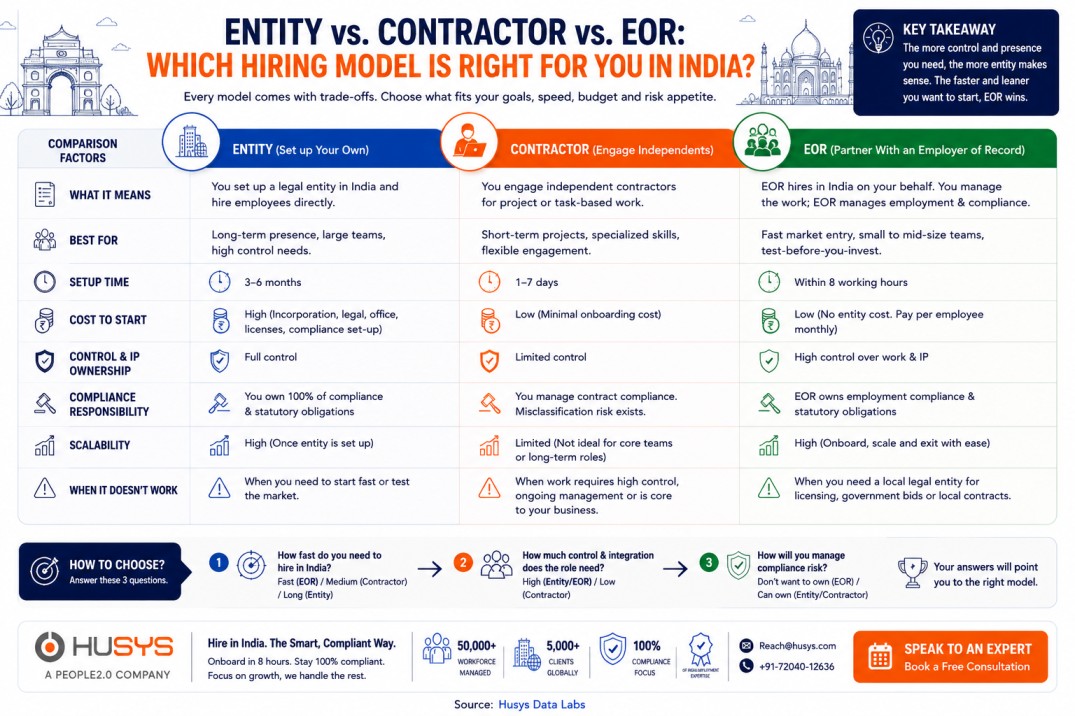
Build an Entity, Hire Contractors, or Use an EOR?
Most of the mistakes above stem from picking the wrong structure for the company’s current stage, not from bad intentions once the structure is in place.
Choosing the right model is therefore a core part of India hiring compliance.
Here’s how the three common paths compare on the risks this guide has covered:
Structure
Compliance ownership
Best for
Main trade-off
Own India entity
Fully on the US company; needs in-house or outsourced compliance team
The EOR is the legal employer for the employment relationship and handles the applicable employer-side employment compliance
First hires, market validation, or building an India team before establishing a dedicated entity
Per-employee fee, with employment administration and applicable statutory compliance handled through the EOR
Choosing an India hiring model comes down to the level of control, speed, scale and compliance responsibility your business is prepared to manage.
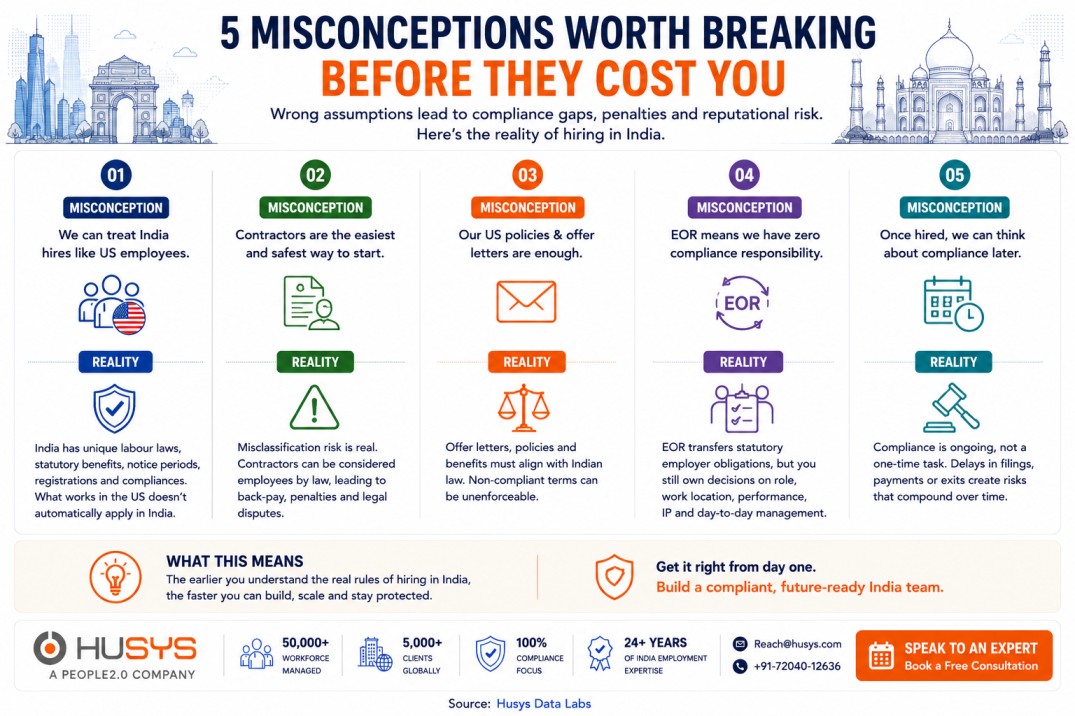
What Are the Most Common India Hiring Compliance Misconceptions?
The most common misconceptions are assuming US employment practices can be copied in India, treating contractors as a simple alternative to employees, using a US-style offer letter or policy, assuming an EOR removes every compliance responsibility, and treating compliance as a one-time setup rather than an ongoing obligation.
These assumptions can create India hiring compliance gaps before the employer realizes there is a problem.
“We don’t have an entity in India, so Indian labour law doesn’t apply to us.”
It applies to the working relationship, not the corporate structure. A misclassified contractor is still a misclassified contractor with no entity in the picture.
“Our offer letter says at-will, so that overrides Indian notice rules.”
Statutory notice and termination protections are a floor the contract can’t waive down, no matter what the offer letter says.
“PE risk only applies if we open an office in India.”
A dependent agent with authority to negotiate or conclude contracts can create PE with no office and no fixed address involved.
“The new Labour Codes aren’t enforceable yet, so we have time.”
The codes are legally in force from 21 November 2025; what’s pending is procedural rule detail, not the underlying obligation.
“An EOR removes all our compliance responsibility.”
An EOR takes on the statutory employer obligations that sit with the legal employer, but it does not remove every responsibility from the US company. The client still needs to provide accurate employee and business information, make appropriate decisions about the employee’s role and activities, and ensure that its India operating model does not create separate tax or business risks.
Many India hiring problems start with familiar US employment assumptions that do not translate directly to India.
Hiring in India? Check Your Compliance Before It Becomes a Cost.
If you already have employees in India or are preparing to hire your first team Husys can help you assess the employment structure, payroll, statutory compliance and state-level requirements before they become expensive problems.
With 24+ years of experience in India, in-house legal and compliance teams, and experience supporting 5,000+ global companies, we help US companies build and manage compliant teams in India.
Before hiring in India, make sure your India hiring compliance structure covers the employment model, employment terms, payroll and statutory requirements, applicable state requirements, and the exit process.
If you are not ready to manage these obligations internally, an EOR can provide the local employment infrastructure and compliance support needed to hire without setting up your own entity.
None of the mistakes above are exotic; they are predictable results of running an India team on US assumptions. Most are also avoidable when India hiring compliance is built into the right structure before the first offer letter goes out, not after the first inspection notice arrives.
We’ve worked as a PEO/EOR provider in India for more than 24 years, currently supporting around 1000+ active US and global clients across 8,000+ employees, with in-house legal and compliance teams handling PF, ESI, Professional Tax, and state-specific filings across 28 states and 6 union territories. Onboarding typically completes within 8 working hours once documentation is in, and our internal and external compliance audits run every quarter, so issues get caught before an inspector finds them.
If you’re evaluatinghow to hire in India, or already have a small team and aren’t fully sure your current setup would survive a labour inspection, talking to a compliance specialist before the next hiring decision is usually cheaper than fixing a mistake after it’s made.
Frequently Asked Questions
(FAQs)
Is using an Employer of Record legal for US companies hiring in India?
Yes. EOR arrangements are a widely used, legal hiring structure in India. The EOR is the legal employer on paper, the US company directs the work, provided the EOR itself is properly registered and handling PF, ESI, and other statutory obligations.
Can a US company hire employees in India without registering an entity?
Yes, through an EOR. This is typically the fastest and lowest-risk way to hire a first employee or a small team in India without going through the entity-setup process, which usually takes weeks and comes with its own ongoing compliance obligations.
What is the single most common compliance mistake US companies make in India?
Misclassifying an employee as a contractor. It’s the mistake that creates the widest downstream exposure, back-payment of PF, ESI, gratuity, and leave, because it means every other statutory obligation was skipped from day one, not just missed once.
How is Provident Fund (PF) calculated, and who pays it?
PF is calculated at 12% of basic pay plus dearness allowance from both employee and employer, with the mandatory contribution capped at a ₹15,000/month wage ceiling per side. Both contributions are filed monthly through the EPFO’s ECR system.
Do we still need to give notice if our offer letter says the role is at-will?
Generally yes. Indian notice-period requirements, commonly around 30 days depending on the state and tenure, function as a statutory floor. An at-will clause borrowed from a US template doesn’t override that floor.
What happens if we misclassify an employee as a contractor in India?
If authorities or a labour forum determines the relationship was functionally employment, the worker can be reclassified as an employee retroactively, entitling them to back-paid PF, ESI, gratuity, and leave from the actual start date, plus applicable penalties.
Does using an EOR eliminate Permanent Establishment risk?
It reduces it but doesn’t automatically eliminate it. PE risk is driven mainly by what the India-based person does, especially whether they can negotiate or conclude contracts, not just by who issues their paycheck. Authority and role scope still need to be managed deliberately.
How much does statutory compliance actually add to payroll cost in India?
As a rough planning range, employer-side PF, ESI (where applicable), and related statutory costs commonly add somewhere in the order of 13-20% on top of gross wages, depending on wage levels and which schemes apply, before factoring in accruing gratuity liability.
Are India’s new Labour Codes actually in effect in 2026?
Yes. All four Labour Codes became legally effective on 21 November 2025, with central rules notified in May 2026 and state-level rules continuing to roll out through the year. The underlying obligations, including the 50% wage rule, already apply.
What happens if a US company wants to exit India after using an EOR?
Exiting an EOR arrangement is generally straightforward, since the EOR holds the statutory registrations, not the US company. If the US company also has its own registered entity, that entity needs to be formally wound down and deregistered, not simply left dormant.
Empowering Your Workforce Journey with Trusted Insights
Find the latest industry trends, expert blogs, insightful case studies, and essential tools. Whether you’re expanding your team locally or globally, we’ve got the information you need to make informed decisions and stay ahead of the curve.