

Since November 21, 2025, all of this sits under four consolidated Labour Codes that replaced 29 older laws. For a US company, payroll in India is not a smaller version of US payroll; it is a different system with monthly statutory filings, mandatory benefits that aren’t optional like in the US, and rules that vary by state.
Over 24+ years, we have run India payroll and compliance for some of the fastest-growing US-listed companies, including clients from the Fortune 1000, Y Combinator-backed startups, and the most ambitious names on lists like the Inc. 5000 and Deloitte Fast 500.
Across every stage, from a founder placing their first India hire to a VP of Finance scaling a 200-person engineering hub, the questions are fundamentally the same.
This guide walks through exactly how payroll processing in India works in 2026, what changed under the new Labour Codes, what it actually costs to employ someone in India versus the US, and where US founders, CFOs, and HR leads most often get it wrong.
Quick answer for US decision-makers You cannot run payroll in India without either (a) a registered Indian entity, or (b) an Employer of Record (EOR). India has no concept of paying a full-time hire as a 1099-style contractor without misclassification risk. Statutory deductions (PF, ESI, PT, TDS) are mandatory, payroll runs monthly, and as of November 2025, basic pay below 50% of total CTC gets treated as 50% for PF and gratuity calculations under the new wage definition. |
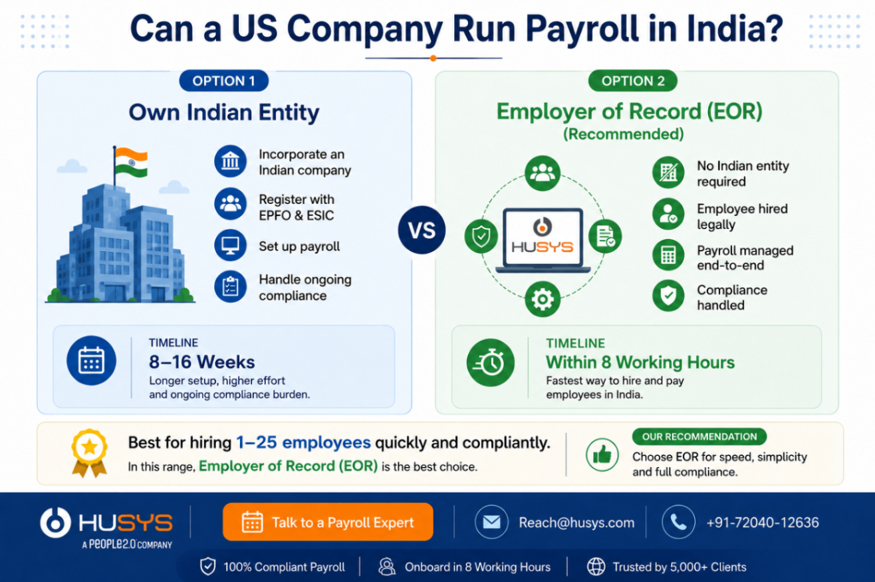
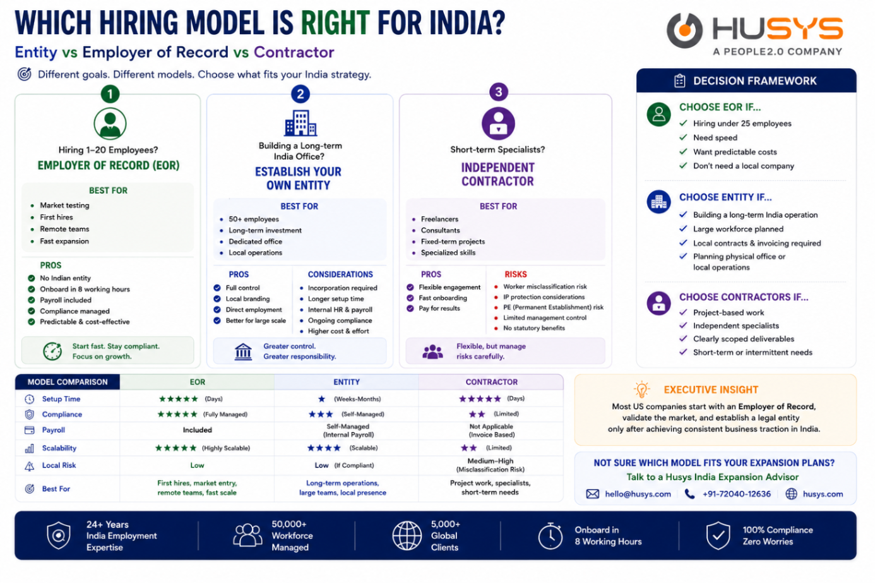
There are only two compliant ways for a US company to run payroll in India: establish your own Indian legal entity or partner with an Employer of Record (EOR). The infographic below compares both approaches at a glance.
If you run payroll in the US, you already think in terms of W-2 employees, at-will employment, bi-weekly pay cycles, and optional benefits. Payroll in India flips almost every one of those assumptions. The table below is the fastest way to recalibrate before you read further.
Before running payroll in India, it’s important to understand how the Indian payroll system differs from the United States. While both aim to ensure employees are paid accurately, India’s payroll framework includes mandatory statutory contributions, state-specific regulations, and significantly different employment laws. The infographic below summarizes the key differences.
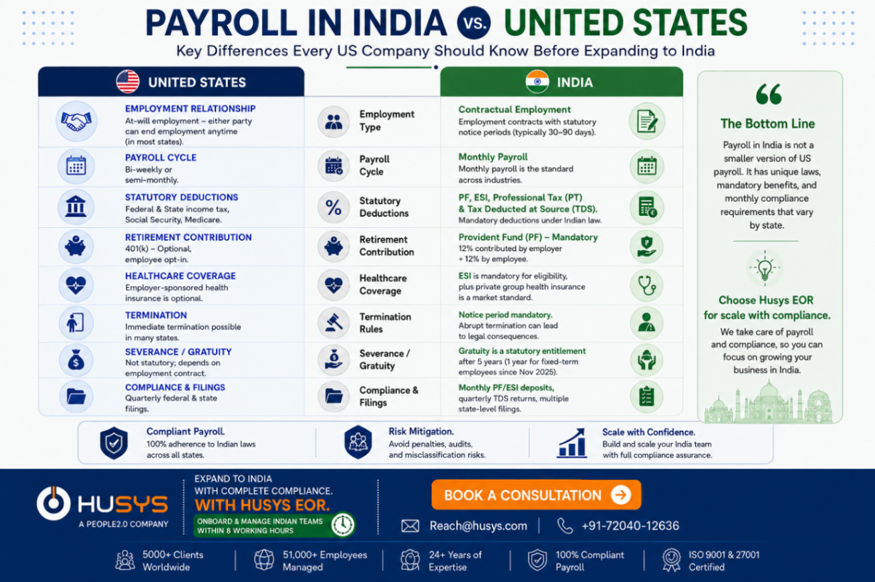
Shown above, payroll in India extends far beyond salary processing. Employers must manage statutory deductions, labour law compliance, and recurring government filings, making payroll administration considerably more complex than in the United States.
Aspect | United States | India |
Employment relationship | At-will (either party can end employment anytime, in most states) | Contractual, with statutory notice periods (typically 30-90 days) |
Payroll cycle | Bi-weekly or semi-monthly | Monthly, almost universally |
Core statutory deductions | Federal/state income tax, Social Security, Medicare | TDS (income tax), Provident Fund, ESI, Professional Tax |
Retirement contribution | 401(k) — optional, employee opt-in | Provident Fund (PF) — mandatory, 12% employer + 12% employee |
Health coverage | Employer-sponsored, optional in most cases | ESI is mandatory below a wage threshold; private group health is a market-standard add-on |
Termination | Immediate, generally no notice required | Notice-based; abrupt termination invites legal exposure |
Severance / gratuity | Not statutory; discretionary | Gratuity is a statutory entitlement after 5 years (1 year for fixed-term hires since Nov 2025) |
Compliance filings | Quarterly federal/state filings | Monthly PF/ESI deposits, quarterly TDS returns, multiple state-level filings |
The single most important mental shift: in the US, statutory deductions are largely federal and fairly uniform. In India, Professional Tax and Labour Welfare Fund rules differ by state, which means a company with employees in Karnataka, Maharashtra, and Telangana is effectively running three slightly different payroll configurations every month.
If you’re asking how to do payroll in India correctly, the honest answer is that it runs on a monthly cycle with three phases: pre-payroll, processing, and post-payroll. Here is the execution-level breakdown a US finance or HR lead actually needs.
Payroll processing in India follows a structured monthly workflow, from employee onboarding and document collection to salary calculation, statutory deductions, salary disbursement, and government filings. The infographic below illustrates the complete payroll lifecycle. 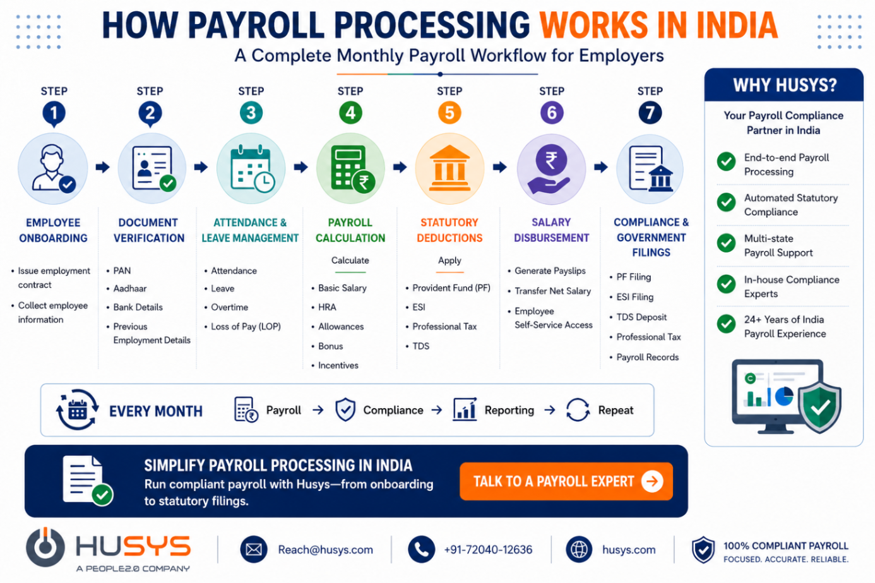
If you’re asking how to do payroll in India correctly, the honest answer is: it’s a seven-step monthly cycle, every single month, without exception. The infographic above maps the full flow. Here’s what US finance and HR leads actually need to know at each stage.
Phase 1: Pre-payroll (Days 1–20)
Before a single number gets calculated, you need four things from every employee: PAN, Aadhaar, bank details, and prior employment records. Simultaneously, register under EPFO and ESIC, finalize the CTC structure against the 50% wage-base rule, and lock attendance and loss-of-pay data from your HRMS.
Phase 2: Payroll Calculation (Days 20–25)
Compute gross salary, apply statutory deductions (PF, ESI, Professional Tax, TDS), layer in employer-side contributions, then run a pre-payroll validation — duplicate entries, mismatched bank details, mid-cycle ESI threshold crossings. Fix errors here, not after disbursement.
Phase 3: Post-Payroll (Day 25 onward)
Disburse net salary by the 1st–7th, issue digital payslips, deposit TDS by the 7th and PF/ESI by the 15th of the following month, file statutory returns, and retain digital records — now a Labour Code requirement.
Where US companies most often slip: Phase 1. Document collection sounds simple until your new hire is simultaneously serving a 60-day notice at their previous employer and chasing a relieving letter. That alone can push your first payroll run back by 5–10 days. Build the buffer in before you commit to a start date.
This is the single most important update to payroll in India in over a decade, and it’s the part most generic payroll guides still haven’t caught up with.
On November 21, 2025, the Indian government brought into force four consolidated Labour Codes, replacing 29 separate central labour laws with a single, more uniform framework. If a payroll guide you’re reading doesn’t mention this, it’s already out of date.
The Codes are in force, but the rulebook is still being written This is the nuance that’s easy to miss: the four Labour Codes themselves are legally in effect, but the detailed Central and State implementing rules, schemes, and digital compliance systems behind them are still being finalized. Draft Central Rules were published for public comment in late December 2025, and the Ministry of Labour has continued issuing clarificatory FAQs as recently as March 2026. In practice, this means existing state-level rules and registrations continue to apply during the transition, and payroll teams should expect further clarifications to keep arriving through 2026 rather than treating this as a fully settled framework. |
Labour Code | What it replaces | Why it matters for payroll |
Code on Wages, 2019 | Payment of Wages Act, Minimum Wages Act, Payment of Bonus Act, and the Equal Remuneration Act | Introduces a single, uniform definition of “wages” and the new 50% basic-pay rule |
Code on Social Security, 2020 | 9 laws including the EPF Act, ESI Act, Maternity Benefit Act, and Payment of Gratuity Act | Extends gratuity, PF, and ESI eligibility to gig workers and fixed-term employees |
Industrial Relations Code, 2020 | Trade Unions Act, Industrial Employment (Standing Orders) Act, Industrial Disputes Act | Formally recognizes “Fixed-Term Employment” (FTE) as a category with statutory parity to permanent staff |
Occupational Safety, Health and Working Conditions Code, 2020 | 13 laws including the Factories Act and the Contract Labour Act | Standardizes working-hour caps (8-12 hrs/day, 48 hrs/week) and mandates annual health check-ups for staff above 40 |
The change with the biggest payroll impact: the 50% wage rule
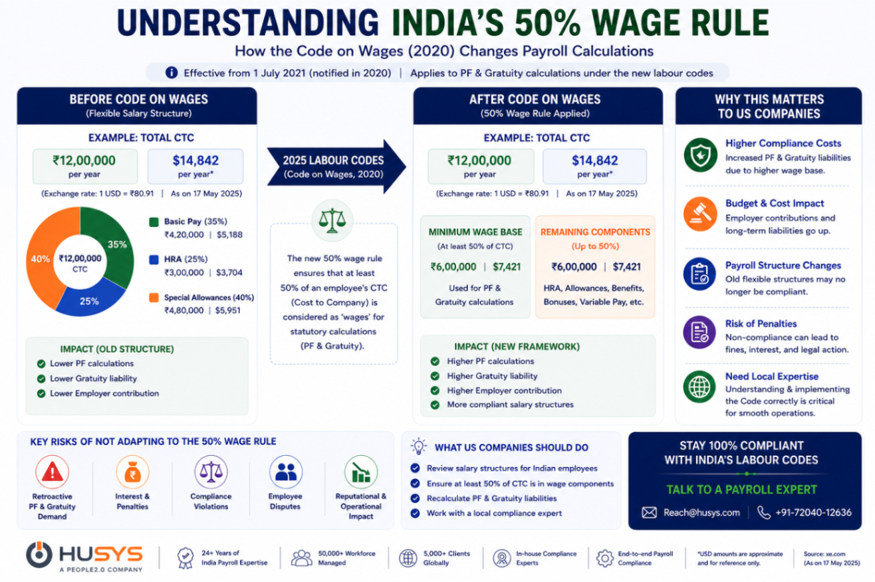
For US employers, the 50% wage rule is one of the most important payroll changes introduced under India’s Labour Codes. It doesn’t necessarily increase an employee’s salary, but it can increase employer obligations for Provident Fund (PF), gratuity, and other statutory benefits. The infographic above explains why this matters when budgeting for India-based employees.
India Wage Base Rule (Code on Wages, 2019, effective November 21, 2025)
If Basic Pay + Dearness Allowance < 50% of total CTC,
then the statutory wage base = 50% of total CTC
This wage base governs Provident Fund (PF) contributions, gratuity, retrenchment compensation, overtime, and notice pay calculations for all employees in India.
Source: Code on Wages, 2019, Section 2(y) — Ministry of Labour & Employment, Government of India
Before this rule, many Indian employers (and EOR providers) kept basic pay artificially low, often 30–35% of CTC, to reduce PF and gratuity outflow. That approach no longer produces the intended outcome: if excluded components (HRA, special allowances, employer PF) exceed 50% of total remuneration, the excess is added back into the wage base automatically.
A point worth being precise about: this is a deeming provision for statutory computation, not a blanket mandate to physically rewrite every salary structure to a literal 50/50 split. The 50% threshold governs how wages are computed for PF, gratuity, and retrenchment purposes, not the contractual breakup itself. In practice, since the Ministry confirms “total remuneration” means full CTC, most companies restructure anyway to avoid a mismatch between contractual CTC and statutory wage base.
What this means in dollar terms For US finance teams: this typically increases employer PF and gratuity liability by 2-5% of CTC for employees whose basic pay was previously structured well below 50%. Husys reviews every new client’s salary templates against the current wage-base rules and the Ministry’s clarificatory FAQs, so there’s no retroactive correction needed later. |
Gratuity eligibility dropped from 5 years to 1 year for fixed-term hires
This is the change most US companies miss entirely.
Previously, gratuity, a lump-sum payout (roughly 15 days’ wages per year of service), was owed only after 5 years of continuous service.
Under the Code on Social Security, fixed-term employees now qualify for pro-rata gratuity after just 1 year. If your India team includes project-based or contract-length hires, this directly changes your cost-per-hire math, even for short engagements.
Statutory Payroll Deductions in India: PF, ESI, PT, and TDS Explained
These four deductions form the backbone of payroll compliance in India. Every one of them has a US-equivalent concept, but none of them work quite the same way.
While each statutory deduction has a rough equivalent in the United States, payroll compliance in India combines multiple labour laws, social security contributions, tax deductions, and recurring statutory filings into a much more regulated framework. The comparison below highlights why payroll administration in India requires a different compliance approach than payroll in the US.
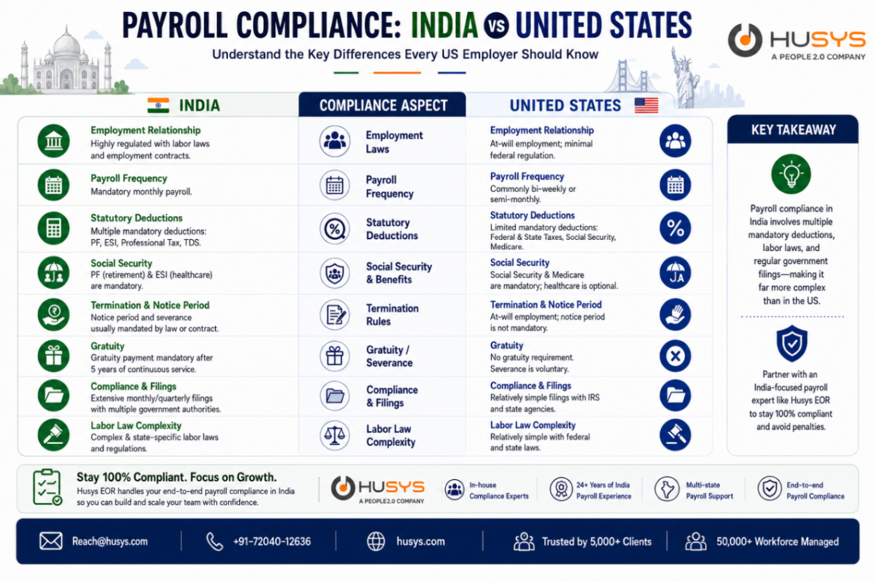
For US employers, the biggest shift is that payroll in India is not just about paying employees. It also requires continuous compliance with labour laws, statutory deductions, employee benefits, and government filing obligations throughout the employment lifecycle.
Provident Fund (PF) — India’smandatory 401(k)
PF approximates a 401(k), except it isn’t optional.
- Under the Employees’ Provident Fund scheme, both employer and employee contribute 12% of basic salary plus dearness allowance each month into a retirement fund managed by the Employees’ Provident Fund Organisation (EPFO).
- The employer’s share splits into 3.67% toward the EPF account and 8.33% toward the Employee Pension Scheme (EPS).
- PF registration is mandatory for any establishment with 20 or more employees.
Employees’ State Insurance (ESI) — closer to subsidized national healthcare
ESI approximates a government health insurance scheme.
- It applies to employees earning at or below the statutory wage ceiling and is funded by a 3.25% employer contribution and 0.75% employee contribution on gross wages.
- ESI covers medical care, maternity, and disability benefits through ESIC-run hospitals and dispensaries.
- Most software, IT services, and knowledge-work hires earn above the ESI ceiling and won’t be covered by it, which is why most US companies hiring engineers and senior professionals add private group health insurance as a market-standard benefit instead.
Professional Tax (PT) — a state-level tax with no US parallel
PT has no real US equivalent; it’s the closest thing India has to a state income surcharge, but it’s a flat or slab-based monthly deduction rather than a percentage of income.
It is levied by individual state governments, typically ₹150 to ₹300 per month, and not every state charges it, states like Delhi and Haryana levy no Professional Tax at all, meaning an employee there owes zero PT regardless of salary.
This is the deduction that most often trips up US companies with employees spread across multiple Indian states, because the rate, slab, and filing frequency genuinely differ state by state.
Tax Deducted at Source (TDS) — India’s withholding tax
- TDS approximates US federal income tax withholding.
- The employer withholds income tax monthly based on the employee’s projected annual income and declared exemptions, then deposits it with the Income Tax Department.
- Employees choose between the old tax regime (more exemptions, higher slab rates) and the new regime (fewer exemptions, lower slab rates) each year, and the employer must apply whichever the employee has declared.
Deduction | Employer Contribution | Employee Contribution | Filing Deadline |
Provident Fund (PF) | 12% of basic + DA | 12% of basic + DA | 15th of following month |
ESI | 3.25% of gross wages | 0.75% of gross wages | 15th of following month |
Professional Tax (PT) | None (employee-borne) | ₹150-₹300/month (varies by state) | Varies by state |
TDS | None (withheld from employee) | Per income tax slab | 7th of following month |
Form 16 Is Becoming Form 130: The Income Tax Act 2025 Renumbering
This is a detail almost no payroll guide currently covers, and it will affect every payslip and tax certificate issued from Tax Year 2026-27 onward (income earned from April 1, 2026).
The Income-tax Act, 2025 replaced the 60-year-old Income-tax Act, 1961, effective April 1, 2026, and as part of that transition, the government renumbered the TDS forms every payroll team has used for decades.
Important timing distinction For FY 2025-26 (salary paid between April 2025 and March 2026), employers still issue the certificate as Form 16, and the quarterly return stays Form 24Q. The new Form 130 / Form 138 numbering applies starting Tax Year 2026-27. Don’t let a vendor or template that has already switched to “Form 130” for FY 2025-26 filings confuse your team; for this year’s certificates, Form 16 is still correct. |
Here’s the form mapping that will take effect once Tax Year 2026-27 filings begin:
Form under the 1961 Act (used through FY 2025-26) | Form under the 2025 Act (from Tax Year 2026-27) | Purpose |
Form 16 | Form 130 | Annual TDS certificate for salary, issued to every employee |
Form 16A | Form 131 | TDS certificate for non-salary payments |
Form 24Q | Form 138 | Quarterly TDS return for salary payments |
Form 26Q | Form 140 | Quarterly TDS return for resident non-salary payments |
Form 15G / 15H | Form 121 | Merged into a single nil/lower-TDS declaration form |
Why this matters even if you outsource payroll The underlying tax computation hasn’t changed; this is a renumbering exercise, not a policy shift. But payroll providers and HR teams need to track the transition year carefully. Issuing FY 2025-26 certificates as “Form 130” would be premature, and continuing to issue Tax Year 2026-27 certificates as “Form 16” would be outdated. Husys payroll templates are tracking both the current Form 16/24Q requirements for FY 2025-26 and the upcoming Form 130/138 requirements for Tax Year 2026-27, so the transition won’t catch our clients off guard either way. |
Salary Structure in India: How CTC Actually Breaks Down
One of the biggest misconceptions US employers have is comparing a US base salary with an Indian Cost to Company (CTC). These are not equivalent. In the US, compensation is typically presented as base salary with benefits listed separately. In India, CTC represents the employer’s total annual cost and includes several statutory and employer-paid components. Understanding this difference is essential for accurate budgeting and salary benchmarking.
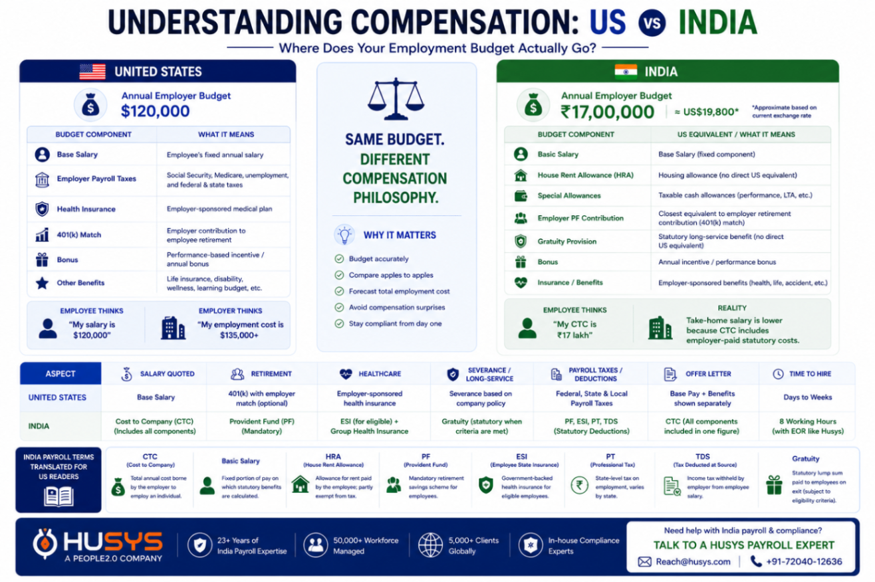
The comparison above shows why CTC should be viewed as the total employer investment rather than an employee’s take-home salary. Components such as Provident Fund, gratuity, and statutory benefits are built into the employer’s annual cost in India, whereas similar costs are often budgeted separately in the United States. This distinction helps US finance and HR teams compare employment costs on an equivalent basis and avoid underestimating payroll budgets.
Indian employers quote compensation as Cost-to-Company (CTC), a single number that bundles in every cost the employer bears, not just take-home pay.
This differs from a US offer letter, which typically states only base salary and lists benefits separately.
A US founder seeing an India offer for the first time often assumes CTC is take-home pay; it isn’t, take-home is meaningfully lower once statutory deductions and PF are applied.
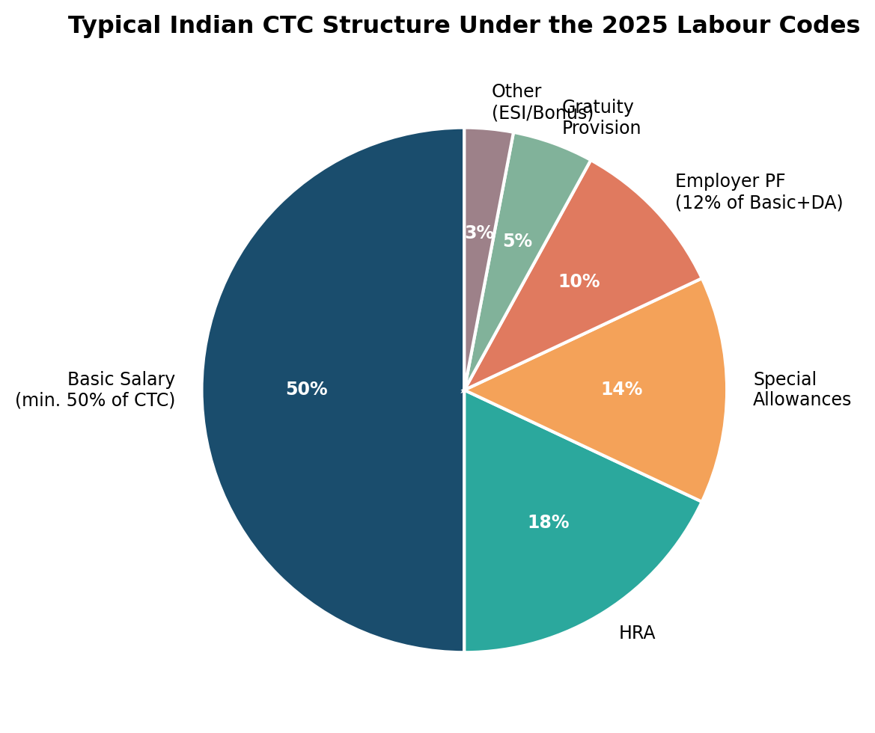
Typical Indian CTC structure under the post-November 2025 wage rules. Source: Husys client salary structuring data, 2026, cross-checked against the Code on Wages, 2019 50% basic-pay provision.
Component | Typical % of CTC | Tax Treatment |
Basic Salary | Minimum 50% (post-Nov 2025 rule) | Fully taxable; base for PF and gratuity |
House Rent Allowance (HRA) | 15-20% | Partially tax-exempt if renting and proof submitted |
Special Allowances | 10-15% | Fully taxable |
Employer PF Contribution | ~10% (calculated on basic+DA) | Not taxable to employee |
Gratuity Provision | ~5% (accrued, not paid monthly) | Tax-exempt up to ₹20 lakh on payout |
Other (Bonus, ESI if applicable) | 3-5% | Bonus is taxable in year received |
Once you understand how payroll works in India and how compensation is structured, the next question is financial: What will it actually cost to hire employees in India? While salaries are significantly lower than in the United States, the real comparison should include statutory employer contributions, payroll administration, compliance obligations, and hiring infrastructure. The dashboard below compares the total employer cost for common roles, helping finance leaders evaluate the business case for expanding into India.
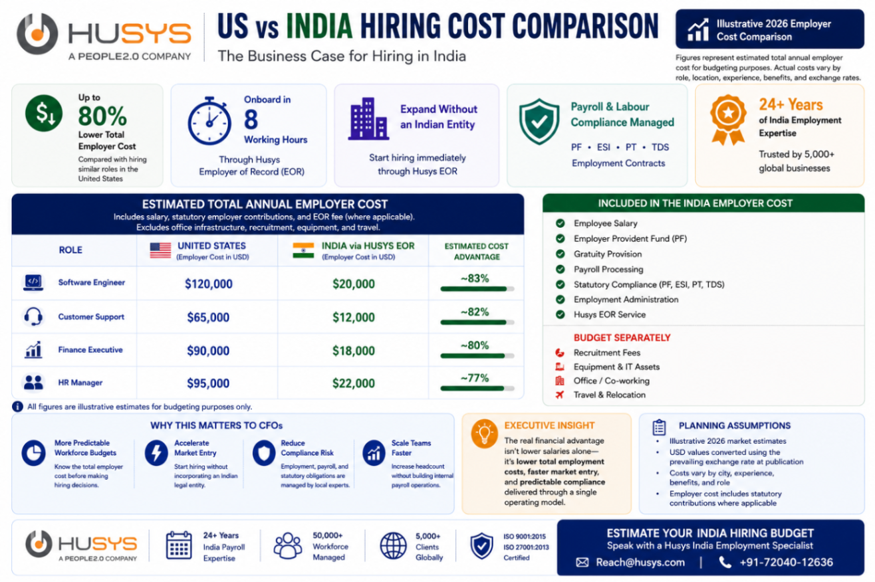
Comparison highlights that the advantage of hiring in India extends beyond lower salaries. US companies also benefit from lower statutory employment costs, faster onboarding through an Employer of Record (EOR), and reduced administrative overhead. Evaluating the total employer cost, not just base salary, provides a more accurate foundation for workforce planning and expansion decisions.
What Hiring in India Actually Costs vs. the US
This is the number every US CFO actually wants. Below is a direct comparison using Glassdoor’s 2026 US averages against typical India compensation for the same roles, delivered through an EOR model (salary plus statutory employer cost plus EOR platform fee).
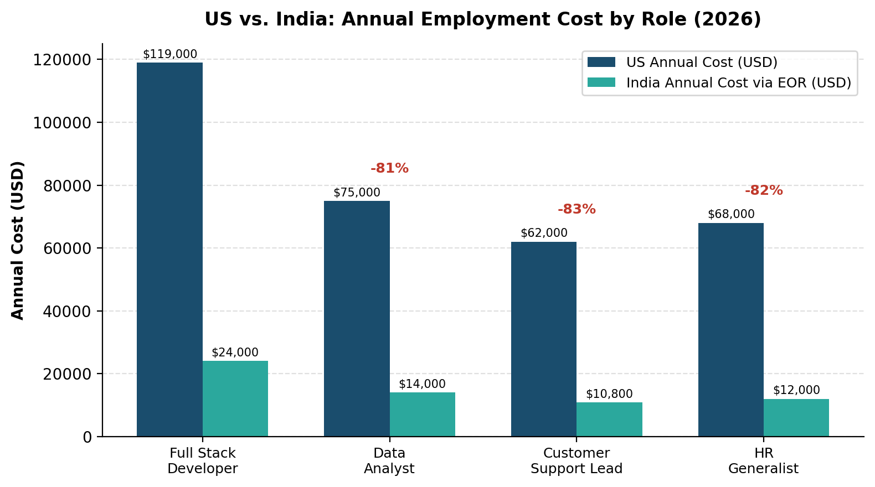
Glassdoor US salary data (2026); Husys client compensation benchmarking, cross-referenced with AmbitionBox and Naukri India salary data.
Take the full stack developer line specifically, since it’s the comparison US founders ask about most. According to Glassdoor’s 2026 US salary data, the average US full stack developer salary sits at roughly $118,868 per year, with a typical range of $92,000 to $155,000.
The same skill set in India, hired through an EOR with full statutory compliance built in, typically lands between $18,000 and $28,000 in total annual employer cost depending on experience level and city, a reduction in the 70-80% range, even after adding PF, gratuity, ESI where applicable, and the EOR’s platform fee.
A note on how to read this responsibly These are not like-for-like in every dimension; cost of living, time-to-productivity, and management overhead all factor into a real hiring decision. But the absolute gap is large enough that for most non-customer-facing engineering, support, and operations roles, India hiring changes the unit economics of a US company’s headcount plan, not just the line-item cost. |
Payroll in India by Company Stage: Two Real Scenarios
Scenario 1: An early-stage founder (11-50 employees)
- For a founder running an 11-50 person SaaS, fintech, or health-tech startup, payroll in India is rarely worth building in-house expertise for.
- At this stage, most founders are optimizing for survival and product velocity, not for owning every HR function.
- Outsourcing India payroll to an EOR like Husys removes a function that has no strategic upside for a 15-person team and would otherwise consume founder or early-ops-hire time every single month on filings most founders have never seen before.
Scenario 2: A VP of Finance at a mid-size software company (51-200 employees)
- For a VP of Finance evaluating India as an engineering hub for a 51-200 person B2B SaaS or enterprise software company, the EOR model at $99 per employee per month becomes a budgeting-line decision rather than a strategic one.
- The math is straightforward: a full stack developer with comparable experience costs roughly $120,000 per year in the US versus roughly $20,000 in India for the same skill set, a savings most mid-size companies report in the 65-70% range once total employer cost is compared like-for-like.
- At this team size, predictable per-employee pricing with no hidden setup fees matters more than at the founder stage, because the finance team is now forecasting India headcount cost across budget cycles, not just approving a single hire.
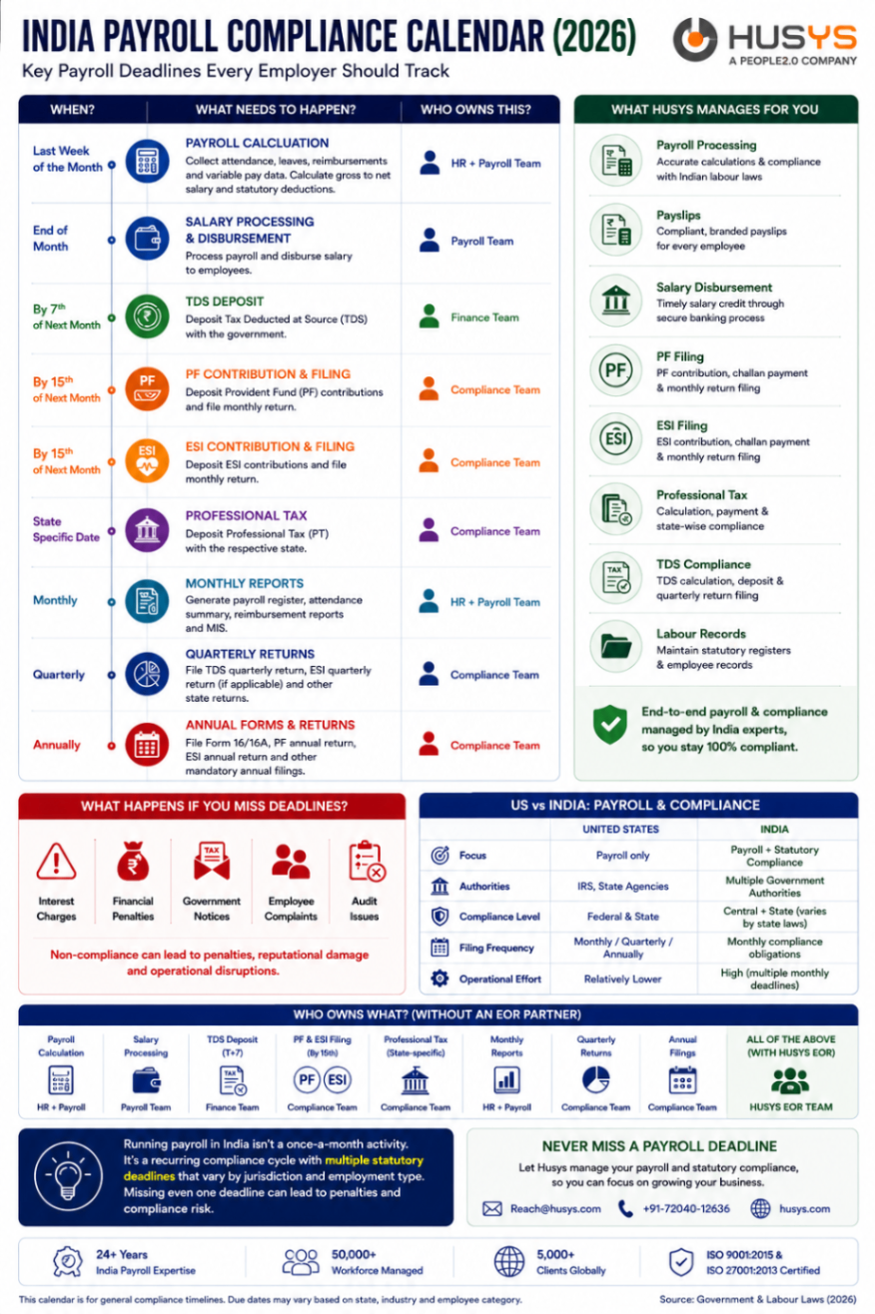
Unlike the US, where most payroll compliance work clusters around quarterly and annual deadlines, India runs on a monthly compliance cycle. Missing any one of these dates triggers interest and penalties, not just a warning.
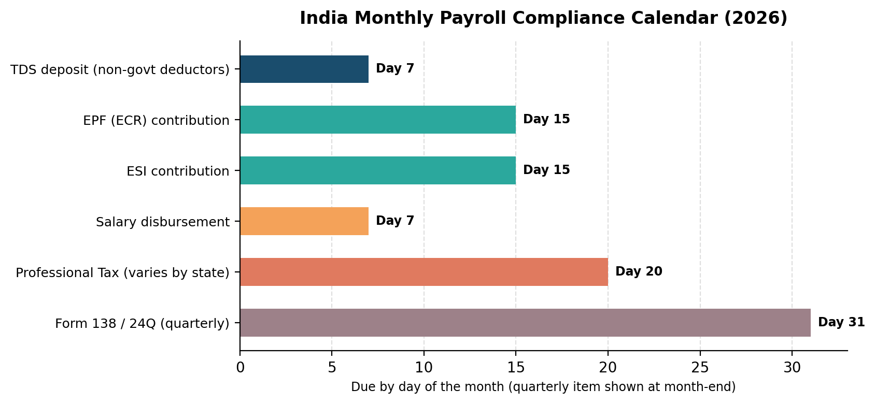
Monthly statutory payroll compliance calendar for India, 2026. Source: EPFO, ESIC, and Income Tax Department filing schedules, compiled by Husys compliance team.
Filing | Frequency | Authority |
TDS deposit | Monthly (by the 7th) | Income Tax Department |
PF (ECR filing) | Monthly (by the 15th) | EPFO |
ESI contribution | Monthly (by the 15th) | ESIC |
Professional Tax | Monthly/quarterly (state-specific) | State commercial tax department |
Form 138 (formerly Form 24Q) | Quarterly | Income Tax Department |
Form 130 (formerly Form 16) | Annual, by June 15 | Issued to each employee |
There isn’t a single right answer here; the right model depends on headcount, timeline, and how long-term your India plans are.
Most US companies land on one of four paths: an EOR, a third-party payroll arrangement layered on top of their own entity, independent contractors, or a fully in-house team.
Here’s the practical comparison.
Model | Setup Time | Best For | Key Risk |
Employer of Record (EOR) | Within hours to a few days | Most US companies hiring 1-25 employees, or testing the India market | Recurring per-employee fee scales with headcount |
Own legal entity | 8-16 weeks | Companies with 25+ employees, or needing to invoice Indian customers directly | High fixed compliance cost even at zero employees; 12-24 month wind-down if you exit |
Independent contractors | Immediate | Genuinely short-term, project-based, non-core work | Misclassification risk if the person works full-time, exclusively, on your schedule |
In-house payroll team (with entity) | Only after entity setup | Large, India-committed operations (typically 100+ employees) | Requires dedicated compliance expertise; errors are entirely your liability |
For US companies hiring their first 1-25 employees in India, an EOR is almost always the faster, lower-risk starting point. Husys onboards new hires within 8 working hours of receiving documentation, compared to the 10-16 week average timeline most US-owned Indian entities need before they can run their first compliant payroll cycle.
Permanent Establishment (PE) Risk: The Question Most US Companies Don’t Know to Ask
This is the single biggest blind spot for US companies hiring in India without local legal counsel, and it’s a tax question, not an HR one. Under India’s tax treaties, if your India-based hire habitually negotiates or concludes contracts on your company’s behalf, or if your company maintains a fixed place of business in India, Indian tax authorities can treat your company as having a Permanent Establishment (PE) and tax a portion of your global profits, even without a registered entity.
Using an EOR reduces this risk significantly, since the EOR, not your company, is the legal employer with the local presence.
However, PE risk follows the substance of activity, not just who signs the employment contract, which means if your India-based hire is the one closing deals or binding your company legally, authorities can look past the EOR structure entirely and treat your company as the one with the local presence.
If your India-based hire has signing authority, negotiates client contracts, or represents your company at government meetings, PE exposure can still apply regardless of who issues the paycheck.
The safest approach: keep India-based roles to engineering, product, operations, and support functions without contract-signing authority, and have your home entity retain authority over anything that legally binds the company.
How Husys mitigates this for clients We monitor invoicing and deliverables tied to each client engagement to flag activity patterns that could create PE exposure, and we structure employment contracts so that contract-concluding authority stays with the client’s home entity, not the India-based hire. |
Common Mistakes, Misconceptions, and Edge Cases
Misconception 1: “We can just pay someone as a 1099-style contractor.”
- India has no direct equivalent of the US 1099 contractor classification for what is functionally full-time employment.
- If a person works exclusively for your company, follows your schedule and internal processes, and the relationship looks like employment in substance, Indian labour authorities can reclassify it, regardless of what the contract is titled.
Misclassification triggers retroactive PF, ESI, and gratuity liability, plus penalties.
Misconception 2: “CTC is the same as take-home pay.”
- It isn’t. CTC includes employer PF contributions, gratuity provisioning, and other employer-side costs that never reach the employee’s bank account.
- A ₹12 lakh CTC offer does not mean ₹1 lakh per month in hand; after statutory deductions, take-home is typically 75-85% of gross monthly salary depending on the basic-pay structure.
Misconception 3: “Termination works like at-will employment.”
- It does not. India requires statutory notice periods (commonly 30-90 days, defined in the employment contract and applicable state Shops and Establishments Act), and abrupt termination without cause and notice invites legal disputes.
- What surprises most US founders is less the notice period itself and more the leave and holiday norms layered on top, India typically mandates 12-20 public holidays per year plus earned leave, on top of any termination notice.
Misconception 4: “Professional Tax is the same everywhere.”
It isn’t; PT is a state subject. Maharashtra, Karnataka, West Bengal, and Tamil Nadu levy it; Delhi and Haryana don’t.
A company with a distributed India team needs to track PT slabs per state, not apply one blanket rule.
Edge case: When EOR is NOT the right solution
If your company plans to directly invoice Indian customers, sign local commercial contracts, or generate revenue in India (not just employ people there), an EOR isn’t built for that. At that point, a registered entity becomes necessary, since only an entity, not an EOR, can transact commercially in India, claim input tax credits, or access government incentive schemes.
Use this before your first payroll run in India, whether you’re working with an EOR or setting up your own entity.
- Register with EPFO and ESIC (or confirm your EOR has active registrations covering your employees)
- Confirm the salary structure meets the 50% basic-pay minimum under the Code on Wages
- Identify Professional Tax obligations for every state where you have employees
- Collect PAN, Aadhaar, and bank details for every employee before the first payroll cycle
- Set up TDS deposit by the 7th and PF/ESI deposit by the 15th of every month as recurring obligations
- Confirm gratuity provisioning covers fixed-term hires after 1 year, not just permanent staff after 5
- Issue Form 130 (formerly Form 16) to every employee by June 15 each year
- Review contract-signing authority for India-based hires to manage Permanent Establishment exposure
- Maintain digital wage registers and payroll records for at least 7 years, a Labour Code requirement
How Husys Handles Payroll in India for US Companies
We’ve run India payroll and compliance for 24+ years, longer than most EOR brands currently marketing to US companies have existed. A few specifics that matter operationally:
- Onboarding within 8 working hours of receiving employee documentation
- Coverage across all 28 states and 6 union territories, so state-specific Professional Tax and Shops & Establishments rules are handled without you tracking them separately
- An in-house legal and compliance team, not outsourced, managing PF, ESI, Professional Tax, TDS, and the new Labour Code requirements
- ISO 9001 and ISO 27001 certification covering process discipline and data security
- 150+ active clients and 3,000+ employees currently managed, with average client relationships exceeding 4 years
- Transparent pricing starting around $99 per employee per month, with no hidden setup fees
- For US companies unfamiliar with Indian compliance, our HRIS platform combines payroll software with end-to-end HR operations and an employee self-service portal, so you get the technology of a SaaS tool with the accountability of a full-service payroll service provider in India, and your team isn’t reconciling spreadsheets every month to figure out what was deducted and why.
- Choosing the right hiring model is only part of the equation. The next decision is operational: should you manage payroll and compliance internally, or work with an Employer of Record (EOR)? For many US companies, the challenge isn’t paying employees, it’s staying compliant with India’s labour laws, statutory filings, and ongoing regulatory requirements. The comparison below highlights the operational differences.
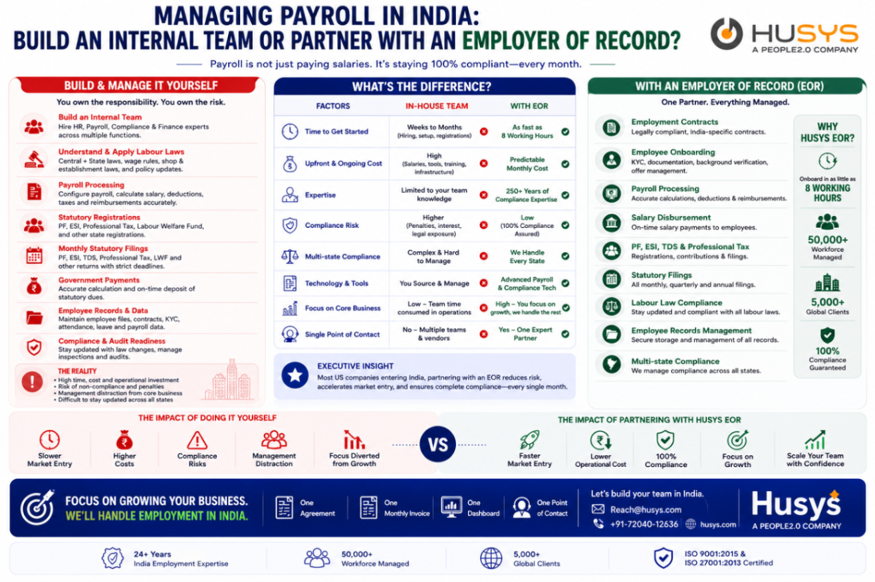
For companies hiring their first employees in India, an Employer of Record often reduces administrative overhead, accelerates market entry, and centralizes payroll, employment, and compliance under a single operating model. As teams grow and long-term business needs evolve, organizations can reassess whether transitioning to their own legal entity makes strategic and financial sense.