

Quick answer: The EPF rules changes India payroll teams need to track come down to one number: 50%. Basic pay, dearness allowance and retaining allowance must together equal at least half of total remuneration; anything excluded above that is deemed to be wages. The EPF, EPS and EDLI Schemes 2026, notified 29 June 2026, switched the contribution base from “basic wages” under the 1952 Scheme to “wages” as defined in the Code on Social Security which carries that 50% rule. The EPF wage ceiling is unchanged at ₹15,000 per month. ₹21,000 is the ESI ceiling. ₹25,000 is a proposal that has not been notified.
This sits inside the Code on Wages, but it earns its own page for two reasons. It is the change with the most direct monthly cash impact on a US P&L. And it moved again in June 2026, after most commentary had stopped watching.
When Did the EPF and Gratuity Wage-Base Change Take Effect?
21 November 2025 for legal commencement, alongside the rest of the Labour Codes. Most payroll systems aligned from the 1 April 2026 financial-year boundary, which is when the effect first showed up on payslips.
Then on 29 June 2026 the Employees’ Provident Fund Scheme, 2026, the Employees’ Pension Scheme, 2026 and the EDLI Scheme, 2026 were notified under the Code on Social Security, replacing the 1952, 1995 and 1976 schemes respectively. That notification is the one that formally switched the contribution base and it is widely under-reported.
What Is India’s 50% Wage Rule?
Basic pay, dearness allowance and retaining allowance must together equal at least half of an employee’s total remuneration. If excluded components HRA, conveyance, bonus, commission push past 50%, the excess is automatically reclassified as wages for statutory calculation. The statutory hook is Section 2(y) of the Code on Wages, 2019.
Two clarifications from the Ministry’s March 2026 Additional FAQs are widely missed, and both work in the employer’s favour:
- It is a cap on exclusions, not a mandate. You are not required to set basic pay at exactly 50%. You are required to ensure that what you exclude does not exceed half.
- Only statutory components count toward the computation employer provident fund and pension contributions, and statutory bonus. Gratuity, ESI and other retirement benefits are excluded from the 50% calculation itself.
What the EPF Scheme 2026 added on 29 June 2026 is the plumbing: the 12% is now applied to “wages” as defined in the Code on Social Security rather than “basic wages” under the 1952 Act. Same rate, re-based denominator. It also made employer matching of voluntary employee contributions expressly discretionary.
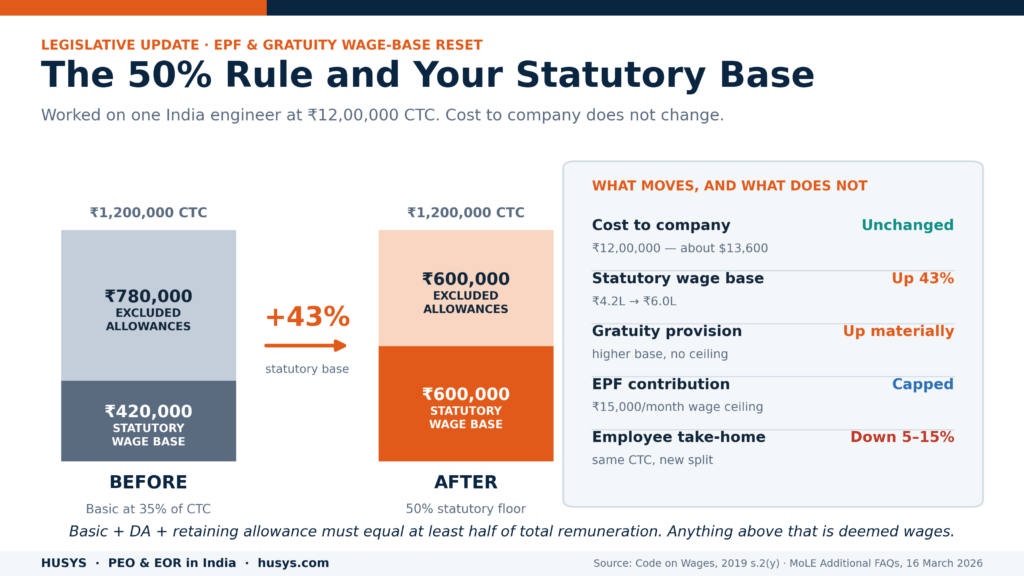
Figure: What the 50% rule does to the statutory base on a ₹12,00,000 CTC cost to company unchanged.
Is the EPF Wage Ceiling ₹15,000, ₹21,000 or ₹25,000?
₹15,000. This is the single most confused point in coverage of the wage rule, and getting it wrong changes your cost model materially. Three different numbers circulate and they are three different things.
- ₹15,000 the EPF wage ceiling. In force, and unchanged since September 2014. It caps the mandatory 12% + 12% contribution. The EPF Scheme 2026 changed the base, not the ceiling.
- ₹21,000 the ESI ceiling. A different scheme entirely, covering medical and cash benefits. It has nothing to do with provident fund, and it is the most common substitution error in published articles.
- ₹25,000 a proposal. Not notified. No Cabinet approval, no gazette. The Supreme Court directed the Centre and EPFO to decide on revision within four months in January 2026; the Department of Expenditure had cleared a ₹15,000 → ₹25,000 proposal by August 2026. Neither is a notification.
What to do with this. Model ₹15,000 as your base case and ₹25,000 as a 2027 sensitivity. If the ceiling does rise, the PF effect stops being capped for exactly the population that currently sits above it which is most engineering staff at a US-funded company. That is the scenario worth costing now, while costing it is cheap.
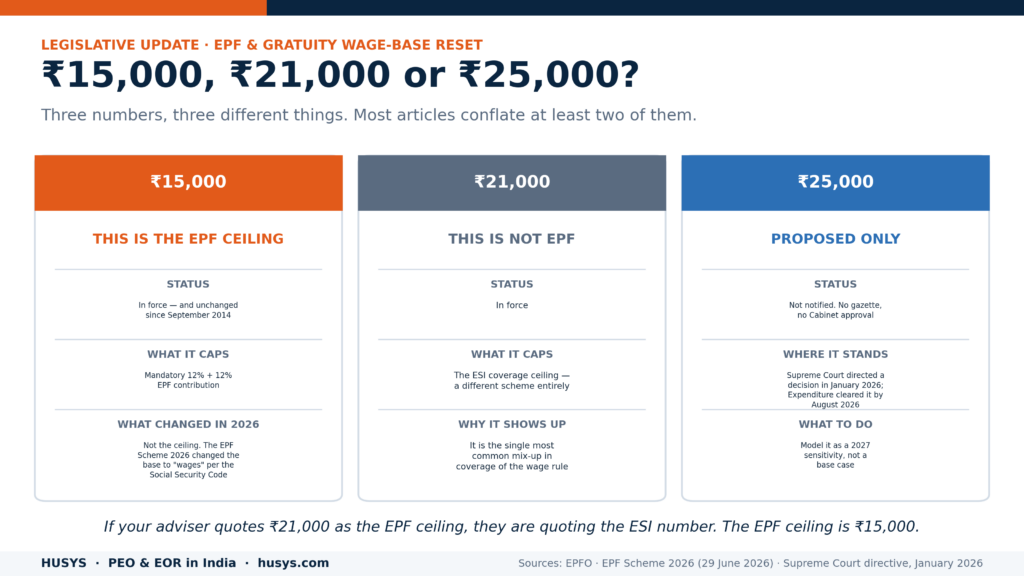
Figure: Three numbers, three different things most coverage conflates at least two of them.
Who Does the EPF and Gratuity Wage Rule Apply To?
- Every employer running India payroll where basic pay was historically set below 50% of CTC which is the default structure across India’s IT, SaaS and services sector, and therefore the default for almost every US-founded India team.
- Employees below the ₹15,000 wage ceiling feel the full provident fund effect.
- Employees above the ceiling most engineering staff at a US-funded company see limited incremental PF, because PF is capped, but a materially larger gratuity provision, because gratuity is not.
- Fixed-term and contract staff are where the balance-sheet effect appears fastest, since their gratuity now vests at one year rather than five.
- Companies hiring through an EOR are covered in the same way. The EOR makes the contributions, but the economics land on your invoice.
What Is the US Equivalent of EPF and Gratuity?
There is no clean equivalent, and the reason matters: India fuses into one mandatory line item what the US splits into a payroll tax and a voluntary benefit.
The issue | United States (2026) | India (2026) | What it means for you |
|---|---|---|---|
Is it mandatory? | 401(k): no. Employer match is discretionary. OASDI: yes. ERISA sets standards for plans you choose to sponsor it does not require you to sponsor one. | Yes. EPF is compulsory for both employee and employer. No opt-out. | There is no Indian equivalent of “we don’t offer a match.” Your India offer letters cannot trade this away. |
Employee rate | 401(k): voluntary, to a $24,500 elective deferral limit. OASDI 6.2%. | 12% of wages. | A fixed, non-negotiable deduction that shows on every Indian payslip. |
Employer rate | Match optional. OASDI 6.2%. Medicare 1.45%, uncapped. | 12%, split 8.33% to the pension scheme and 3.67% to EPF, plus 0.5% EDLI and 0.5% administration. | Budget 13% employer-side, not 12%. The half-point items are easy to miss in a model. |
Ceiling | OASDI wage base $184,500. 401(k) total annual additions limit $72,000. | ₹15,000 per month about $170. Low, and under review. | Most US-funded engineering staff sit far above it, so PF is effectively capped while gratuity is not. |
Severance side | None statutory. Not accrued unless a plan exists. | Gratuity accrues from year one (fixed-term) or year five, on the revised, higher wage base. | This is the line a US-built India budget almost always misses entirely. |
Tax treatment | 401(k) deferrals pre-tax; employer match deductible. | EPF employee contribution qualifies for deduction; employer contribution is a business expense. | Broadly similar logic the difference is compulsion, not tax design. |
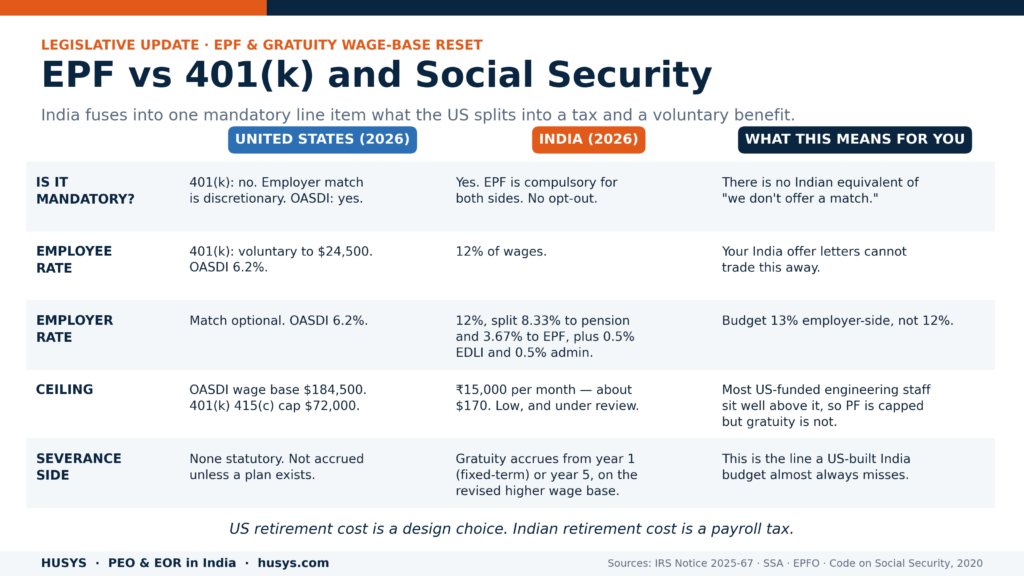
Figure: EPF versus 401(k) and Social Security: mandatory versus designed.
What Changed Compared With the Old EPF Rules?
Aspect | Old practice | New rule |
|---|---|---|
Basic pay ratio | Commonly 30–40% of CTC, structured to minimise deductions | Excluded allowances capped at 50% of total remuneration; the excess is deemed wages |
Contribution base definition | “Basic wages + DA + retaining allowance” under the EPF Scheme, 1952 | “Wages” as defined in the Code on Social Security the 50% deeming rule applies per the EPF Scheme, 2026 (notified 29 June 2026) |
Take-home pay | Higher, because less was routed to mandatory PF and gratuity | May fall 5–15% as more is redirected, while CTC stays identical |
Gratuity liability | Calculated on a lower basic pay figure, vesting at 5 years | Calculated on the revised, higher wage base, vesting at 1 year for fixed-term staff |
Employer match on voluntary contributions | Practice varied | Expressly discretionary under the EPF Scheme, 2026 |
Wage ceiling | ₹15,000 per month | ₹15,000 per month, unchanged under Supreme Court-directed review since January 2026, with ₹25,000 the live proposal |
Schemes in force | EPF 1952 · EPS 1995 · EDLI 1976 | EPF 2026 · EPS 2026 · EDLI 2026, notified 29 June 2026 |
How Much Does the 50% Wage Rule Cost a US Employer?
Work a single example. An India engineer on a ₹12,00,000 CTC roughly $13,600 structured at 35% basic carries a statutory wage base of ₹4,20,000. Re-based to the 50% floor, that becomes ₹6,00,000: a 43% increase in the base on which gratuity is computed, with no change in cost to company.
Scaled up, the honest headline for a US-funded team is this: provident fund barely moves, gratuity moves a lot, and take-home moves enough that employees will notice.
- Provident fund is capped. Above the ₹15,000 monthly wage ceiling, the incremental PF cost of the wage-base change is limited. That is why the change looks small in a payroll report and large in a provisions schedule.
- Gratuity has no ceiling. At a ₹12,00,000 CTC on the revised base, annual gratuity accrual is roughly $330 per employee. Across a fifty-person India team at that average, about $16,500 a year landing on the balance sheet.
- Take-home falls 5–15% on allowance-heavy structures. The money is not lost it moves into statutory savings but that is not how it reads on a payslip.
If the ceiling does rise to ₹25,000, the first bullet stops being true and provident fund stops being capped for the population it currently protects. That is the sensitivity worth building now.
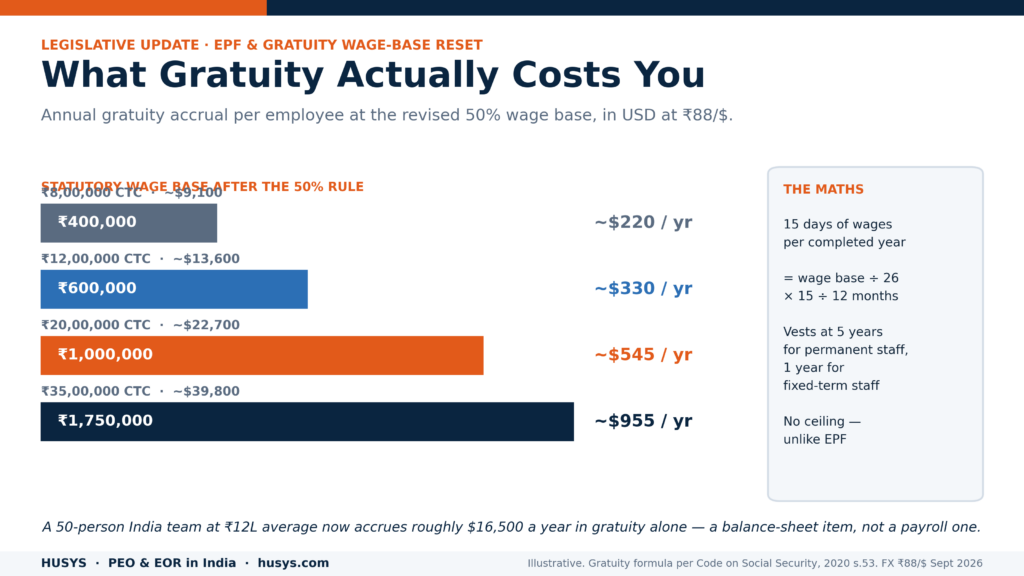
Figure: Annual gratuity accrual per employee at the revised wage base, in USD.
How Should You Prepare for the EPF and Gratuity Change?
Do this | Why | Owner |
|---|---|---|
Run a basic-pay ratio audit across the whole India payroll | You need the list of employees below the 50% floor and the delta on each before you can cost anything | Payroll or your EOR |
Model the gratuity provision for everyone approaching one year (fixed-term) or five years (permanent) | It is a balance-sheet item, not a payroll one, and your auditors will ask for it | Finance |
Build a ₹25,000 ceiling scenario as a sensitivity | If it is notified, PF stops being capped for your highest-paid India staff | FP&A |
Check whether your payroll provider has moved to the EPF Scheme 2026 base | Some systems still compute on “basic wages” under the 1952 Scheme | Payroll or your EOR |
Communicate before the first affected payslip | Employees who learn this from a payslip rather than from you will read it as a pay cut | HR |
Re-run the EOR-versus-entity break-even | A higher per-head statutory cost moves the crossover point | Finance |
When Should You Fix Your India Salary Structure?
Before your first India hire, if you can. At your next appraisal cycle, if you cannot.
If you are a CFO, VP Finance, Controller or FP&A lead at a US-headquartered company between $5M and $250M in revenue Series A through pre-IPO, in SaaS, fintech, healthtech, engineering services, or running a Global Capability Centre with 10 to 500 India-based employees, this is the line item that turns an abstract legal update into a budgeting exercise you actually have to do.
Hardware and drone-tech companies scaling engineering and test headcount feel it earliest, because their India teams tend to be tenured and fixed-term-heavy exactly the profile where gratuity re-basing bites hardest.
Getting the structure right at the first hire avoids a disruptive restructuring once headcount grows. Every month you run the old structure adds another cohort of employees whose take-home you will eventually have to change, and whose consent you will need to change it.
Want the number for your own payroll? Send us your India salary structures and we will tell you who sits below the 50% floor, what your gratuity provision looks like on the revised base, and what a ₹25,000 ceiling would do to it. You get the spreadsheet either way. Talk to an India compliance specialist · Get a free cost and compliance assessment · or read the full Labour Codes update that this sits inside.
Frequently Asked Questions
What is the 50% wage rule in India?
Basic pay, dearness allowance and retaining allowance must together be at least 50% of total remuneration. If excluded allowances exceed half, the excess is deemed to be wages for statutory calculation of provident fund, gratuity and bonus. It caps what you can exclude; it does not mandate a particular basic pay figure.
Will my take-home salary decrease under the new wage rules?
It may fall 5–15% if your structure was allowance-heavy. Cost to company is unchanged the same total is being split differently, with more going into provident fund and gratuity. The money moves into statutory savings rather than disappearing.
What is the EPF wage ceiling in 2026?
₹15,000 per month, unchanged since September 2014. The EPF Scheme 2026, notified on 29 June 2026, changed the contribution base but not the ceiling.
Has the EPF ceiling been raised to ₹25,000?
No. It is a proposal. The Supreme Court directed a decision within four months in January 2026 and the Department of Expenditure cleared the proposal by August 2026, but there is no Cabinet approval and no gazette notification. Treat it as a live risk for 2027, not as current law.
Is ₹21,000 the EPF ceiling?
No ₹21,000 is the ESI ceiling, a different scheme covering medical and cash benefits. Confusing the two is the most common error in published coverage of the wage rule.
What changed in the EPF Scheme 2026?
Notified 29 June 2026, it replaced the EPF Scheme 1952 and switched the contribution base from “basic wages” to “wages” as defined in the Code on Social Security which incorporates the 50% deeming rule. It also made employer matching of voluntary employee contributions expressly discretionary. The rate (12%) and ceiling (₹15,000) were unchanged.
How does the new wage definition affect gratuity?
Gratuity is calculated on the revised, higher wage base, and it has no ceiling. On a ₹12,00,000 CTC structured at 35% basic, the gratuity base rises about 43%. For fixed-term employees the vesting period also fell from five years to one, so the provision starts accruing much earlier.
Is a fixed-term employee eligible for gratuity after one year?
Yes. Section 53 of the Code on Social Security provides that a fixed-term employee is eligible for gratuity after rendering one year of service, on a proportionate basis. Permanent employees continue to vest at five years.
How is gratuity calculated in India?
The standard formula is fifteen days of wages for each completed year of service, computed as last-drawn wages ÷ 26 × 15 × years of service. Under the Codes, “wages” now means the revised statutory base, which raises the result for anyone whose basic pay was below the 50% floor.
What is the total employer-side cost of EPF?
About 13% of wages up to the ceiling: 12% provident fund (8.33% to the pension scheme, 3.67% to EPF), plus 0.5% EDLI and 0.5% administration charges. Gratuity accrues on top, uncapped.
Does the 50% rule apply if we hire through an Employer of Record?
Yes. The EOR is the legal employer and makes the contributions, so the compliance sits with them but the economics reach you through the invoice. Ask your EOR to show you the structure they are applying and confirm it clears the 50% floor.
What is the US equivalent of India’s EPF?
There is no exact equivalent. EPF performs the combined job of a 401(k) and the employer side of Social Security, but it is mandatory on both sides at 12% each with no opt-out and no discretionary match. The closest US comparison is OASDI at 6.2% each on a $184,500 wage base in 2026, plus a 401(k) the employer chooses to sponsor.
Where Can You Read the Official EPF Notifications?
- EPFO Present rates of contribution (PDF)
- EPFO Frequently Asked Questions
- Code on Wages, 2019, Section 2(y) statutory text
- Additional FAQs on Labour Codes (as on 16.03.2026) Ministry of Labour & Employment (PDF)
- Code on Social Security, 2020 India Code (PDF)
- Code on Social Security, 2020, Section 53 (gratuity) PIB factsheet
- US comparison: IRS Notice 2025-67 2026 retirement plan limits (PDF) · IRS 401(k) limits for 2026 · SSA contribution and benefit base · DOL ERISA
Sourcing standard. Every statutory rate, ceiling, date and section number above is hyperlinked to EPFO, a ministry circular, a PIB release, or the text of the Act. Where a figure is proposed rather than notified the ₹25,000 ceiling we say so in the same sentence. Worked examples use ₹88 to the dollar as at September 2026 and are illustrative. Interpretation and preparation guidance are ours. This is not legal or tax advice.