

Quick answer: No, in almost every case. Money a US company pays to an Indian vendor, subsidiary or Employer of Record for goods sold or services rendered is expressly excluded from “foreign contribution” by Explanation 3 to Section 2(1)(h) of FCRA the Ministry of Home Affairs says so in its own FAQ. The FCRA amendment 2026 rules, in force since 22 June 2026, tighten renewal and donor disclosure for Indian nonprofits. FCRA reaches a US company only where it funds an Indian nonprofit or runs a CSR foundation with an Indian arm and even then, routing through a FEMA-compliant Indian subsidiary usually keeps it outside the regime.
This is the most misread item on our tracker. It generates more unnecessary legal spend among US companies hiring in India than any other, because the name sounds like it ought to apply and the available writing is aimed at NGO trustees rather than at you.
Does FCRA Apply to Money a US Company Sends to India?
Start with the answer, then the three routes.
Route one you pay an Indian vendor, subsidiary or EOR for goods or services. Not foreign contribution. Explanation 3 to Section 2(1)(h) of FCRA excludes “any amount received … by way of fee … or towards cost in lieu of goods or services rendered by such person in the ordinary course of his business, trade or commerce.” The MHA’s own FAQ puts the question and answers it in one word: “Whether earnings from foreign client(s) by a person in lieu of goods sold or services rendered by it is treated as foreign contribution? No.” Paying your EOR invoice is a commercial transaction, and that is the end of it.
Route two your FEMA-compliant Indian subsidiary donates to an Indian NGO or funds its own CSR programme. Not foreign contribution. Section 2(1)(j)(vi) does make a company a “foreign source” where more than half its share capital is foreign-held but a proviso inserted by the Finance Act 2016, retrospective to 26 September 2010, reverses that for companies within FEMA sectoral limits. A lawfully incorporated, FEMA-compliant Indian subsidiary in a 100%-FDI sector is therefore not a foreign source, and the NGO it funds does not need FCRA registration for that money.
Route three your US parent funds an Indian NGO or trust directly. This is foreign contribution. The US parent is a foreign company under Section 2(1)(j); the FEMA proviso does not help it. The recipient needs FCRA registration or prior permission under Section 11, must receive into the designated FCRA account at State Bank of India, New Delhi Main Branch, and cannot transfer the money onward to any other person.
The practical rule that follows: route philanthropy through the Indian subsidiary, not from the US parent. Same money, same beneficiary, entirely different regulatory regime and a recipient pool ten times larger, because you are no longer limited to FCRA-registered organisations.
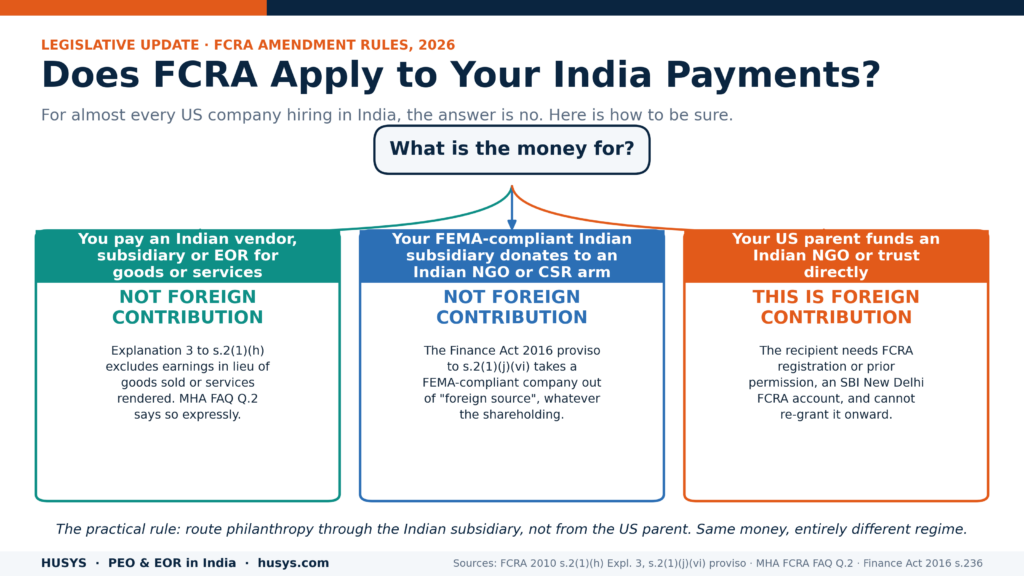
Figure: Three routes money takes into India, and which one triggers FCRA.
When Did the FCRA Amendment Rules 2026 Take Effect?
The Foreign Contribution (Regulation) Amendment Rules, 2026 were notified on 22 June 2026 vide S.O. 3272(E) and took effect on publication.
The Foreign Contribution (Regulation) Amendment Bill, 2026 is a separate instrument and is not law. It was introduced in the Lok Sabha on 25 March 2026 and, on 13 August 2026, was referred to a 31-member Joint Parliamentary Committee (21 Lok Sabha members, 10 Rajya Sabha), with its report due by the last day of the first week of the Winter Session.
Why this distinction matters more than usual. Several provisions widely reported as “in force” most prominently the Designated Authority regime for taking over assets sit in the Bill, not the Rules. If a summary tells you the Designated Authority is operating, it has merged the two instruments. It has not been enacted.
What Changed Under the FCRA Amendment Rules 2026?
In force now, under the Rules:
- A ₹10 lakh utilisation floor for renewal. An organisation is deemed to have undertaken reasonable activity if it has utilised at least ₹10 lakh of foreign contribution across the preceding two financial years. Below that, renewal is at risk.
- Ultimate-donor disclosure. Form FC-4 now requires identification of the ultimate donor behind contributions routed through donor-advised funds, intermediaries or aggregators.
- Tighter reporting and registration mechanics across the annual return framework.
Proposed in the Bill, not yet law:
- A Designated Authority empowered to take over, manage and dispose of assets where registration is cancelled, surrendered, or lapses on non-renewal with provisional vesting, restoration rights, and a safeguard preserving the religious character of places of worship.
- Deemed cessation of registration if it is not renewed before expiry (proposed Section 14B).
- Maximum imprisonment reduced from five years to one.
- New revision (90 days) and District Court appeal routes.
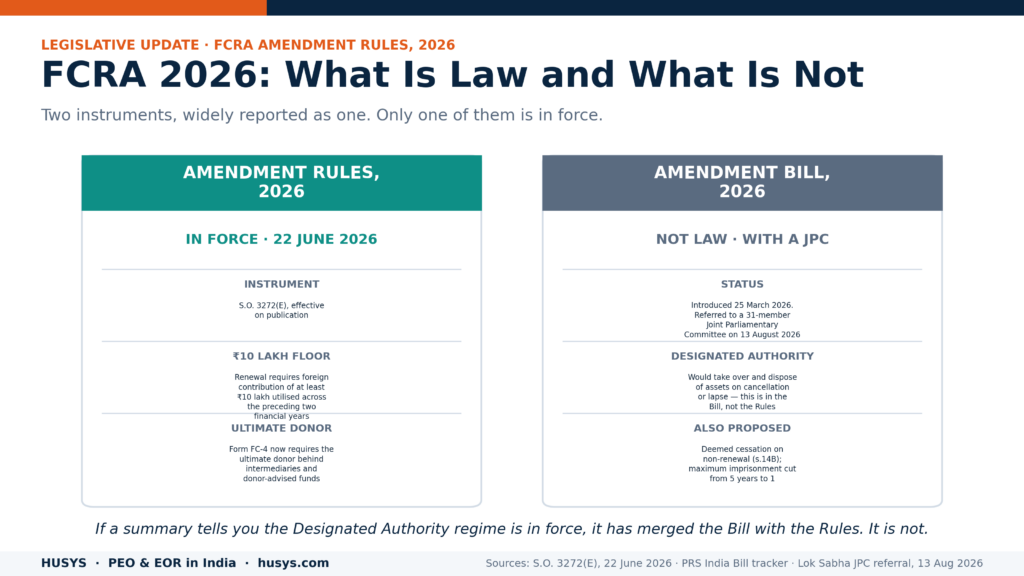
Figure: Two instruments, widely reported as one. Only the Rules are in force.
Who Does FCRA Actually Apply To?
- Indian-registered NGOs, trusts and societies receiving foreign funds including the Indian arm of a US parent’s CSR programme, where the money comes from the parent rather than the Indian subsidiary.
- Not applicable to standard EOR-based hiring, to a for-profit Indian subsidiary, or to any commercial payment for goods or services.
- A live edge case worth knowing about: the MHA FAQ states that infusion of foreign share capital into a Section 8 company (formerly Section 25) is treated as foreign contribution. That position is contested by practitioners — the argument being that a share subscription is not a contribution, since the investor receives transferable securities and the FAQ appears to have been dropped from later MHA guidance without replacement. If your structure involves a Section 8 company with foreign capital, take advice; do not rely on either side of that argument from a blog.
What Is the US Equivalent of FCRA?
There isn’t one, and saying so plainly to a US board saves a great deal of time. This is a categorical difference, not a difference of degree: the US model is disclose and proceed. India’s is ask, and you may be refused.
The issue | United States | India | Where the analogy breaks |
|---|---|---|---|
Receiving foreign money | No restriction, no cap, no approval. FARA requires registration and disclosure within 10 days of agreeing to act as an agent of a foreign principal, with semi-annual supplemental statements. Form 990 Schedule F requires tax reporting of foreign grants above thresholds. | Prior authorisation. Registration under Section 11 (requires three years’ existence) or project-specific prior permission. | FARA is a transparency statute. FCRA is a licensing regime. One tells the public what you did; the other decides whether you may do it. |
Can you be stopped? | No. Neither FARA nor Schedule B/F caps or approves foreign money. | Yes. Registration is valid five years, renewable, and can be suspended or cancelled which ends the funding. | The existential risk in India is administrative, not criminal. |
Where the money lands | Any account. | A single designated FCRA account at State Bank of India, New Delhi Main Branch, with administrative expenses capped at 20%. | Centralised visibility by design. There is no US analogue. |
Onward granting | Permitted, with reporting. | Prohibited. Section 7 bars transfer to any other person. | Pass-through, regranting and intermediary models simply do not work in India. |
Penalty | Willful FARA violation: up to 5 years and/or $250,000, enforced by DOJ National Security Division. | Suspension or cancellation of registration. The pending Bill would cut maximum imprisonment from 5 years to 1. | US exposure is criminal and rare. Indian exposure is administrative and, for the recipient, terminal. |
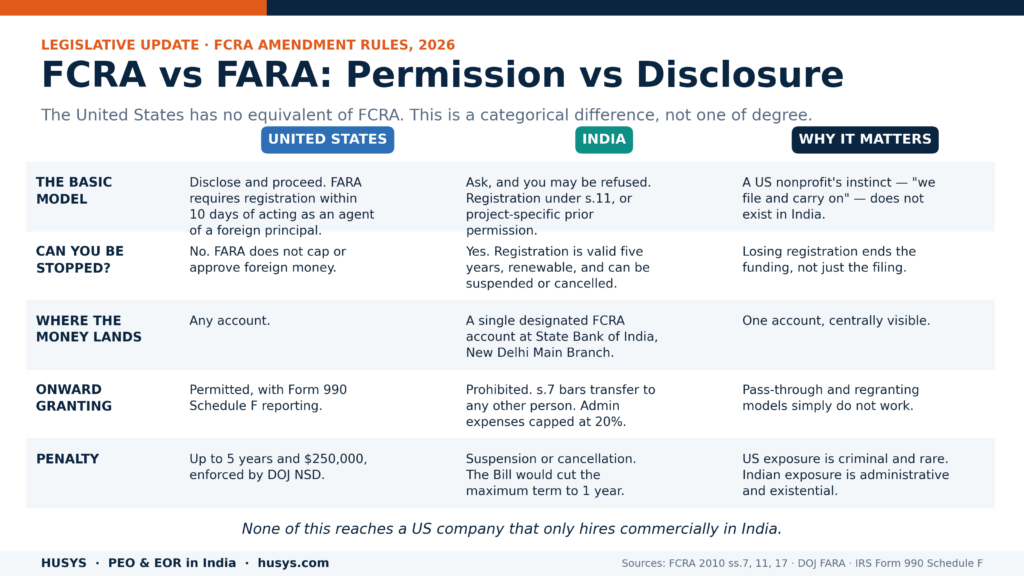
Figure: FCRA versus FARA: permission versus disclosure.
What Changed Compared With Before?
Aspect | Before | Now (Rules, 22 June 2026) |
|---|---|---|
Renewal test | No explicit utilisation floor | ₹10 lakh utilised across the preceding two financial years |
Donor disclosure | Immediate donor only | Ultimate donor must be identified where funds are routed through intermediaries or pooled vehicles, via amended Form FC-4 |
Assets on cancellation | No dedicated mechanism | Proposed Designated Authority regime in the Bill, before a JPC since 13 August 2026, not yet enacted |
Registration lapse | Cancellation required a process | Proposed deemed cessation on non-renewal (s.14B) in the Bill |
Maximum imprisonment | 5 years | Proposed reduction to 1 year in the Bill |
How Does FCRA Affect a US Company With an Indian Subsidiary or CSR Arm?
For the overwhelming majority of US companies reading this those whose India footprint is a payroll the impact is zero, and the correct action is to confirm that once, in writing, and stop revisiting it.
For the remainder, three things actually matter:
- The ₹10 lakh floor is the operative number. A dormant or low-activity Indian entity kept alive for optionality is now at renewal risk. The fix takes a full financial year to execute, because the test looks backwards over two years.
- The funding route decides the regime. Funding an Indian NGO from the US parent makes it foreign contribution and limits you to FCRA-registered recipients. Funding the same NGO through your FEMA-compliant Indian subsidiary generally does not, and opens the whole domestic sector to you. Under Section 135 of the Companies Act 2013, the CSR obligation itself is triggered by the Indian company’s own financial thresholds, not by who owns it.
- Watch the FEMA cap, not the shareholding percentage. The proviso protects companies whose foreign holding is within the applicable sectoral limit. In a 100%-FDI sector that is straightforward. In a capped sector, a subsidiary above the cap would be a foreign source, and the analysis changes.
Candid scoping note. The FCRA/foreign-owned-company/CSR interaction is described by practitioners as open-ended, and the MHA FAQ has not been updated to reflect the 2016 proviso. Nothing on this page is a substitute for structure-specific advice. What it should do is stop you paying for two quarters of advice to establish that FCRA does not apply to you at all.
FORMAT SLOT 8 of 9 · Role in your India expansion journey
Where Does FCRA Sit in Your India Expansion?
It is a gate you either pass through or walk past, and the only expensive mistake is not knowing which. Determine it early, document it in one memo, and move on.
The companies that get hurt here are not the ones that had to comply. They are the ones that spent two quarters and a law firm retainer establishing that they did not — usually because somebody saw the word “foreign” in a statute name and escalated.
If you later add a CSR programme, a foundation, or a grant relationship with an Indian nonprofit, revisit it then. Until that happens, this page is background reading.
Want a straight answer on your own structure? Send us how your India presence is set up entity or EOR, who pays whom, and whether anything charitable is involved and we will tell you whether FCRA reaches you. In most cases the answer is a single paragraph saying it does not, which is a reasonable thing to have in writing. Ask an India compliance specialist · or go back to the India Legislative Updates hub to see which of the other three laws do apply to you.
Frequently Asked Questions
Does FCRA apply to a US company hiring employees in India?
No. FCRA governs foreign contributions to Indian nonprofits, trusts and societies. Commercial employment, EOR arrangements and payments to a for-profit Indian subsidiary fall outside it entirely.
Is payment to an Indian vendor or EOR treated as foreign contribution?
No. Explanation 3 to Section 2(1)(h) of FCRA excludes amounts received by way of fee, or towards cost in lieu of goods sold or services rendered in the ordinary course of business. The Ministry of Home Affairs answers this question directly in its own FAQ with a one-word “No”.
Is a US-owned Indian subsidiary a “foreign source” under FCRA?
Usually not. Section 2(1)(j)(vi) treats a company as a foreign source where more than half its share capital is foreign-held, but a proviso added by the Finance Act 2016 reverses that where the shareholding is within the limits permitted under FEMA. A FEMA-compliant subsidiary in a 100%-FDI sector is therefore not a foreign source.
Can our Indian subsidiary donate to an Indian NGO without FCRA registration on the recipient’s side?
Generally yes, provided the subsidiary is FEMA-compliant. Because it is not a foreign source, the donation is domestic money and the recipient does not need FCRA registration for it. This is the single most useful structural point on this page.
What if our US parent funds an Indian NGO directly?
That is foreign contribution. The recipient must hold FCRA registration or prior permission, receive the funds into the designated FCRA account at State Bank of India, New Delhi Main Branch, and may not transfer the money onward to any other organisation.
Has the FCRA Amendment Bill 2026 become law?
No. It was introduced in the Lok Sabha on 25 March 2026 and referred to a 31-member Joint Parliamentary Committee on 13 August 2026, with a report due by the first week of the Winter Session. Until it passes, the Designated Authority provisions and the deemed-cessation rule have no legal effect.
What is the ₹10 lakh rule in the FCRA Amendment Rules 2026?
An organisation is deemed to have undertaken reasonable activity and so qualifies for renewal if it has utilised at least ₹10 lakh of foreign contribution across the preceding two financial years. Organisations below that threshold face renewal risk.
What is “ultimate donor” disclosure?
Form FC-4 now requires the recipient to identify the ultimate source behind contributions routed through donor-advised funds, intermediaries or aggregators, rather than only the immediate remitter.
Does FCRA affect our CSR spending in India?
Only if the money comes from outside India. The CSR obligation under Section 135 of the Companies Act 2013 is triggered by the Indian company’s own financial thresholds, not by its ownership. If your FEMA-compliant Indian subsidiary funds its CSR from Indian earnings, FCRA does not engage.
What is the US equivalent of FCRA?
There isn’t one. FARA requires registration and disclosure when acting as an agent of a foreign principal, and Form 990 Schedule F requires tax reporting of foreign grants but neither caps, restricts or approves the receipt of foreign money. FCRA is a licensing regime; FARA is a transparency statute.
FORMAT SLOT 9 of 9 · Further reading
Where Can You Read the Official FCRA Notifications?
- MHA FCRA Frequently Asked Questions (PDF)
- Foreign Contribution (Regulation) Act, 2010 official text (PDF)
- FCRA Online the government portal and FAQ
- Foreign Contribution (Regulation) Amendment Rules, 2026 PRS Legislative Research
- The Foreign Contribution (Regulation) Amendment Bill, 2026 PRS Legislative Research (status tracker)
- FCRA Amendment Bill referred to a Joint Parliamentary Committee Akashvani News, 13 August 2026
- FCRA factsheet Press Information Bureau
- US comparison: DOJ FARA · DOJ FARA FAQ · IRS Instructions for Form 990 Schedule F
Sourcing standard. Every statutory provision, threshold and date above is hyperlinked to the Act, the MHA FAQ, a gazette reference, or PRS India’s Bill tracker. Where the MHA FAQ has been overtaken by statute as with the Finance Act 2016 proviso to Section 2(1)(j)(vi) we cite the proviso and say so. Where a provision sits in the pending Bill rather than the Rules, we label it in the same sentence. Interpretation is ours. This is not legal advice, and structure-specific FCRA questions warrant structure-specific counsel.