

KEY TAKEAWAYS
|
WHO THIS IS FOR (define-the-reader per Husys content SOP) Primary reader: A US-based Founder, CFO, Head of People/HR, or General Counsel evaluating how to hire in India and weighing global platforms like Deel against an India specialist. What they already know: US payroll (W-2 / 1099), at-will employment, optional benefits, fast hiring and termination. What they don’t know yet: Indian labour law, statutory benefits (PF, ESI, gratuity), monthly payroll and TDS withholding, notice-period rules, and Permanent Establishment risk. Primary question this answers: “Is Husys a credible Deel alternative for hiring in India, and which is the safer, more cost-predictable choice for my company?” |
Looking for a Deel alternative for India? Here’s the short answer: Deel is an excellent broad, multi-country platform, but if your near-term goal is to hire and stay compliant in India specifically, an India-specialist employer of record (EOR) in India such as Husys will usually be more cost-predictable, faster to onboard, and deeper on local compliance. Husys lists $99 per employee per month for India EOR versus Deel’s public list price of $599 per employee per month, roughly 83% lower on the management fee, and completes onboarding in as little as 8 working hours on its own India entity. This guide compares Husys vs Deel on pricing, compliance depth, speed, and risk, so a US decision-maker can choose without needing another source.
We’ll be specific and we’ll show our work. Every compliance claim links to the primary source (EPFO, ESIC, the Income Tax Department, the Ministry of Labour). Every competitor figure is Deel’s own public data or a neutral third party, and where a fact isn’t publicly verifiable we say so rather than guess. Prices and legal facts were checked in September 2026; verify current figures before you sign.
WHAT THIS GUIDE COVERS
|
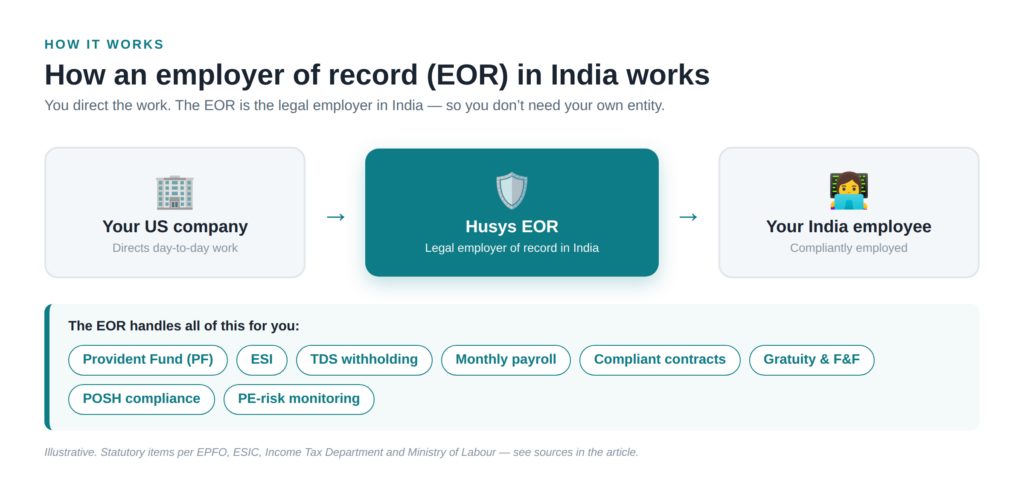
How an EOR works: you direct the work; the EOR is the legal employer in India, so you don’t need your own entity.
One more point worth knowing before you read this as “narrow India specialist vs. global platform”: Husys also covers multi-country payroll and hiring through an exclusive global partnership with People2.0, so India-first teams that later need a second or third country are not boxed in, they simply extend the same relationship rather than switching providers. Learn more about Husys global coverage via People2.0.
Husys vs Deel at a glance
Here’s the like-for-like comparison for a US company hiring in India. Where a Deel figure isn’t publicly disclosed for India specifically, we mark it honestly rather than fill the cell.
Factor | Husys | Deel |
|---|---|---|
India EOR list price | $99 / employee / month | $599 / employee / month (global EOR list price) |
Years operating in India | 24+ years (since 2002) | Founded 2019 (global); India via owned entity |
India footprint | 28 states + 8 union territories; in-house India team with 250+ yrs of collective experience | Owns an India entity; India is 1 of 130+ payroll countries |
Stated onboarding speed | As fast as 8 working hours | “48-hour” / “onboard in days” (Deel’s stated claim) |
Compliance model | In-house India compliance team; 99.9% on-time payroll | In-house entity + platform; local-country payroll is often subcontracted to in-market processing partners |
Certifications | ISO 9001 + ISO 27001 | Multiple (SOC 2 etc.) at the platform level; local payroll-partner certifications often undisclosed |
Setup / hidden fees | No setup fee, no minimums | No setup fee (list); confirm minimums for your plan |
Scale | 5,100+ clients; 11,000+ employees managed | 35,000+ customers; 150+ countries; ~$1B ARR (2025) |
Best suited for | India-first hiring, cost & compliance depth | Multi-country hiring from one platform |
Two honest caveats before we go deeper. First, $99 vs $599 is a management-fee comparison, it excludes the employee’s salary and statutory contributions, which both providers pass through. Second, Deel’s India onboarding and certification details should be confirmed on Deel’s own site at publish time; we’ve cited Deel’s public claims, not ours.
Third: platforms that operate across 100+ countries typically run local-country payroll through in-market processing partners rather than a single in-house team everywhere; Deel does not always name that partner or its certifications publicly, which is worth asking about if compliance chain-of-custody matters to you.
Also read: Local EOR vs Global EOR India: Which Employer of Record Is Best in 2026?
Who Deel is (and where Deel genuinely wins)
Credibility requires honesty about the competition, so let’s be fair to Deel. Deel was founded in 2019, is headquartered in San Francisco, and by October 2025 was valued at about $17.3 billion with roughly $1 billion in annual recurring revenue. It serves 35,000+ customers, runs in-house payroll in 130+ countries, and operates ~250 owned entities. For a US company standing up teams in ten countries at once, that breadth is a real advantage.
Where Deel genuinely wins: multi-country coverage from a single dashboard; strong brand recognition (helpful when your board already knows the name); a broad, polished self-serve product (contractor management from $49/mo, global payroll, immigration support, HRIS); and a large integration ecosystem. If “one platform for 20 countries” is the job to be done, Deel is built for exactly that.
One thing to weigh on the vendor-risk side, stated neutrally and from the public record: Deel has been in significant litigation a corporate-espionage lawsuit filed by Rippling in March 2025, and a reported US Department of Justice criminal investigation disclosed in January 2026. These are allegations and ongoing matters, not findings of wrongdoing, and they don’t affect Deel’s ability to run payroll today but vendor continuity and governance are legitimate procurement questions, so we mention them factually with a source and move on.
Who Husys is
Husys is an India-headquartered PEO/EOR that has operated in India since 2002 – 24+ years, making it one of the market’s longest-running specialists. It reports 5,100+ clients, 11,000+ employees managed, coverage across 28 Indian states and union territories, ISO 9001 and ISO 27001 certification, and 99.9% on-time payroll. Its wedge is simple: go deep on India rather than wide on the world. Husys also offers global coverage where clients need it (through its People2.0 partnership), but its centre of gravity and its pricing is built around India.
Internally, Husys reports ~450 active clients averaging 4+ years of tenure and a cumulative 50,000+ workers managed over its history. (Figures marked “Husys reports” are company data; treat client-count and tenure as internal metrics rather than third-party-audited numbers.) Know more: Husys case studies and India track record.
How hiring in India normally happens, and why an EOR is the safer bet
This is the part most comparison posts skip. Before you can decide between Husys vs Deel, you need to understand what you’re actually buying: an EOR is the legal employer of your India team on paper, so you don’t have to become one. To see why that matters, compare the “normal” path (set up your own India entity) against the EOR path, task by task.
The two ways to legally employ someone in India
Approach | What it involves | Risk / time |
|---|---|---|
Set up your own India entity | Incorporate a subsidiary, register with EPFO/ESIC, open bank + tax accounts, run monthly payroll and statutory filings, draft compliant contracts, manage terminations under Indian law. | Highest control, highest burden. Weeks to months to set up; ongoing corporate tax, GST, audit and compliance overhead. |
Use an Employer of Record (EOR) | The EOR’s existing India entity legally employs your worker; you direct their day-to-day work. Payroll, PF, ESI, TDS, contracts and compliance are handled for you. | Lowest burden, fast. Onboard in hours-to-days; predictable per-head fee; India-specific legal risk sits with a specialist. |
Engage them as a contractor | Pay an individual on a 1099-style basis with no statutory benefits. | Cheapest up front but highest misclassification + Permanent Establishment risk — often the costliest mistake. |
Learn more: EOR vs PEO vs setting up your own India entity
Task by task: how it happens normally vs. with an EOR
The value of an EOR shows up in the day-to-day. Here’s the same work done both ways, the “normal” DIY path and the EOR path, so you can see where the time and risk actually go.
The job to be done | How it happens normally (DIY entity) | How it happens with an EOR (e.g. Husys) |
|---|---|---|
Make your first India hire | Incorporate an entity, register PF/ESI/PT, set up payroll, draft a compliant offer letter, weeks to months before the person can legally start. | Candidate onboarded in ~8 working hours on the EOR’s entity; compliant contract issued for you. |
Run monthly payroll | Compute and deposit PF, ESI, professional tax and TDS; file each challan by its own statutory deadline; reconcile every cycle. | You approve one invoice. The EOR files every statutory return on time (Husys reports 99.9% on-time payroll). |
Stay compliant as laws change | Track changes across central labour codes and 28 states’ rules yourself, or pay outside counsel per question. | In-house India compliance team monitors and applies changes across states as part of the fee. |
Terminate correctly | Navigate notice periods, full-and-final settlement, gratuity and dispute risk, India is not at-will. | EOR manages notice, F&F and gratuity per Indian law, reducing dispute risk. |
Avoid Permanent Establishment risk | Hiring directly or via contractors can create a taxable presence (PE) and corporate-tax exposure. | Employment sits on the EOR’s entity; Husys monitors invoices/activities to help manage PE exposure. |
What this does to first-year cost
Stacking the pieces makes the trade-off concrete. Salary is roughly the same either way, the difference is the entity setup, legal, and ongoing compliance overhead you avoid with an EOR. The chart below is a modeled illustration (salary from Glassdoor India; setup/compliance figures are directional placeholders): swap in Husys Data Labs figures before publishing.
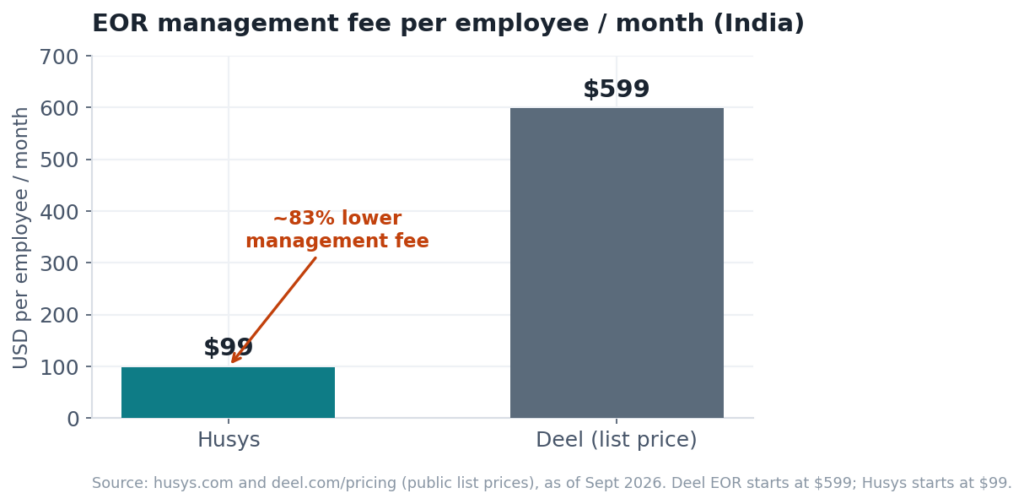
How to talk about the savings honestly. The clean, defensible statement is: “Husys’ India EOR fee is up to ~80% lower than the public list price of global EOR platforms such as Deel.” We frame it as a list-price comparison of the management fee, not a total-cost guarantee, because salary and statutory contributions are passed through by both providers and negotiated enterprise pricing can differ. Per Husys’ own content SOP, we avoid words like “cheap” or “lowest” and let the modeled numbers carry the point.
METHODOLOGY (published for transparency — the exact math behind the 83% figure) Savings = (Deel list EOR fee − Husys list EOR fee) ÷ Deel list EOR fee = ($599 − $99) ÷ $599 ≈ 83%. Figures are public list prices as of Sept 2026 and exclude employee salary and statutory contributions, which both providers pass through. Enterprise/volume pricing is negotiated separately and may differ. |
Why predictable beats cheap. For a CFO budgeting India headcount, the win isn’t just the lower number, it’s that Husys quotes a single flat fee with no setup charges and no minimums, which is far easier to forecast for the board than a variable stack of entity, legal and filing costs. Predictability is the product.
See your exact India cost before you commit. Get a free, no-obligation cost breakdown comparing a Husys EOR against setting up your own India entity, tailored to your headcount and role mix. → Get my India cost breakdown. |
India compliance: the real difference between a global platform and a specialist
This is where India EOR compliance depth earns its keep. US employment runs on at-will hiring and optional benefits; India runs on contractual employment and mandatory statutory benefits with monthly filing deadlines. Here’s the translation for a US reader, with each obligation linked to its primary government source.
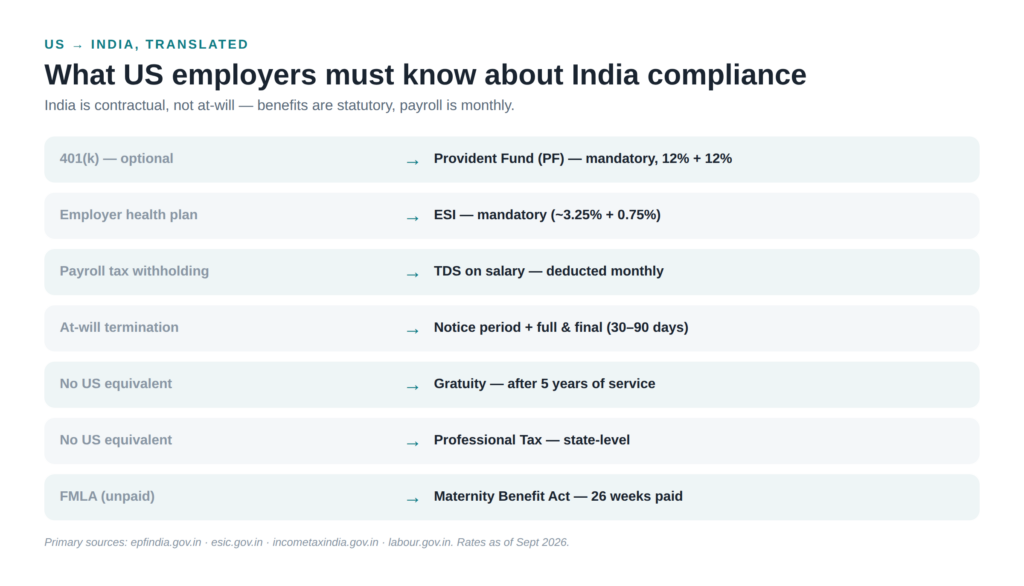
US → India: the same concept, translated
US concept | India equivalent | What changes for you |
|---|---|---|
401(k) (optional) | Provident Fund (PF) mandatory. Employers and employees each contribute 12% of basic wages. | Not optional. Filed monthly with EPFO. |
Employer health plan | ESI mandatory for lower-wage staff. ~3.25% employer + 0.75% employee, up to ₹21,000/mo wages. | Statutory, not a perk you design. |
Payroll tax withholding | TDS on salary income tax deducted at source every month per slab. | Monthly, not per paycheck. |
At-will termination | Notice periods + full-and-final settlement. Typically 30–90 days; no at-will. | You can’t fire same-day. |
(No US equivalent) | Gratuity 15 days’ wages per year of service, after 5 years (Payment of Gratuity Act, 1972). | A real long-tenure liability to accrue. |
(No US equivalent) | Professional Tax a state-level tax, capped ~₹2,500/year. | Varies by state. |
FMLA (unpaid) | Maternity Benefit Act 26 weeks paid. | Far more generous than US federal law. |
Cite the primary source every time. Provident Fund: epfindia.gov.in · ESI: esic.gov.in · TDS / income tax: incometaxindia.gov.in · Labour codes, gratuity, bonus, POSH: labour.gov.in · Employee data protection (DPDP Act, 2023): meity.gov.in.
Where a specialist pulls ahead. Deel does own an India entity and handles PF, ESI, professional tax and gratuity, that’s table stakes for a serious EOR, and Deel clears it. The differences show up at the edges India is famous for: state-by-state variation (Shops & Establishment Acts differ across all 28 states), termination and full-and-final disputes, POSH Act committees, and industry-specific vetting (fintech KYC, IP assignment for AI/ML hires). A provider that has done only India for 24+ years, across 28 states, tends to have seen more of these edge cases than a platform for which India is 1 of 130+ countries. That’s the honest version of the claim, experience density, not a blanket “we’re better.”
Not sure if you need a specialist or a global platform? Talk to the Husys compliance team for 15 minutes — we’ll tell you honestly whether an India specialist or a multi-country platform like Deel fits your situation better, even if that means we’re not the right fit. → Book a free India hiring consultation. |
Onboarding speed: 8 working hours vs 48 hours
Both providers compete on speed, and both numbers are marketing claims worth verifying against your own contract. Husys states onboarding in as little as 8 working hours; Deel states “48-hour” onboarding / “onboard in days.” For a US team that has just verbally offered a role to a candidate in Bengaluru who has three other offers, the difference between “today” and “this week” is the difference between closing and losing them. When a specific candidate is ready to start, speed is the whole game.
How an EOR accelerates real roles (four buyer scenarios)
Abstract comparisons don’t close decisions; role-specific ones do. Here are four buyers from the Husys ICP, each with the same structure: their trigger, how the work happens normally, and how an EOR like Husys accelerates it. Numbers marked Husys Data Labs are placeholders for you to replace with verified figures.
1) YC-incubated startup founder the first India hire Trigger: You found one exceptional engineer in India you can’t get anywhere else, but you’re pre-Series A and can’t justify incorporating a company abroad. How it happens normally: Incorporate an India subsidiary, register with EPFO/ESIC, set up payroll and a bank account, and draft a compliant contract, weeks of legal spend and founder attention before the person can legally start, burning runway you don’t have. How Husys EOR accelerates it: Onboard the hire in ~8 working hours on Husys’ India entity at a flat $99/employee/month, no entity, no setup fee. You look capital-efficient to investors, not reckless, and you keep building. [HUSYS DATA LABS: avg. days-to-productive-hire for seed-stage clients]. |
2) CFO of a growing drone-tech startup predictable cost, board-defensible Trigger: The board approved an India engineering team this quarter; you own the budget and the compliance risk, and you hate surprises. How it happens normally: Model an unpredictable stack, entity setup, legal, corporate tax, GST, payroll admin, statutory filings, that’s hard to forecast and easy to blow past, with Permanent Establishment risk sitting on your balance sheet. How Husys EOR accelerates it: Quote the board a single flat $99/employee/month, up to ~80% below global-EOR list pricing such as Deel’s $599, with 100% statutory compliance and no hidden fees. India becomes a clean, forecastable line item. [HUSYS DATA LABS: modeled first-year savings for a 10-person drone-tech team]. |
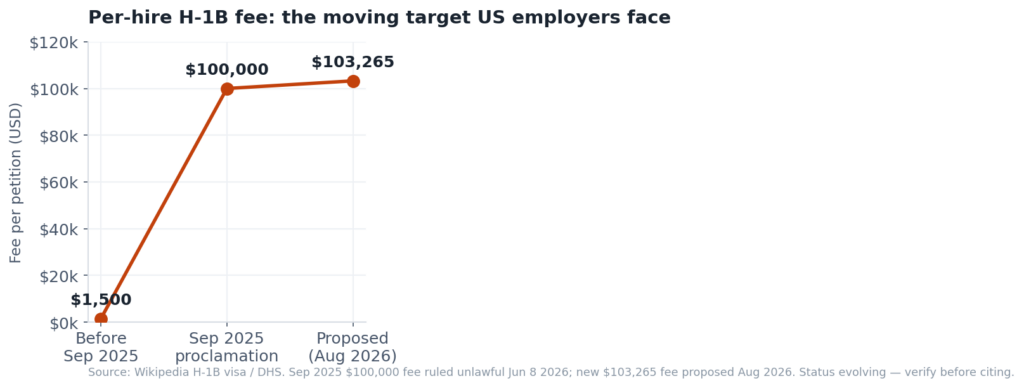
3) CTO of a US SaaS startup the H-1B alternative Trigger: H-1B sponsorship has become prohibitively expensive, and you can’t relocate the senior engineers you need without a six-figure visa bill per hire. How it happens normally: Sponsor an H-1B and absorb a per-petition fee that has swung wildly, about $1,500 historically, then a $100,000 proclamation in Sept 2025 (ruled unlawful in June 2026), then a proposed $103,265 fee in Aug 2026, an unstable, budget-breaking path. How Husys EOR accelerates it: Hire the same calibre of engineer in India via Husys EOR at India-market comp, onboarded in hours, with IP-assignment and confidentiality handled in the contract. You keep your roadmap on track without betting it on visa policy. [HUSYS DATA LABS: avg. cost-per-engineer, India pod vs. US + H-1B]. |
4) General Counsel of a Series-C fintech sign-off without exposure Trigger: You’re expanding a regulated fintech ops team into India and need to sign off that you’re not creating misclassification or Permanent Establishment risk. How it happens normally: Vet local counsel, design background-verification and KYC-grade vetting, confirm data-handling meets your own audit bar, and personally own the risk that a generic provider misses a fintech-specific nuance. How Husys EOR accelerates it: Lean on an India specialist with an in-house compliance team, ISO 9001/27001 certification, and 24+ years of India-only track record, so you can document compliance and close the review without flagging India. [HUSYS DATA LABS: certifications list + sample compliance attestation]. |
The cost logic underneath all four scenarios
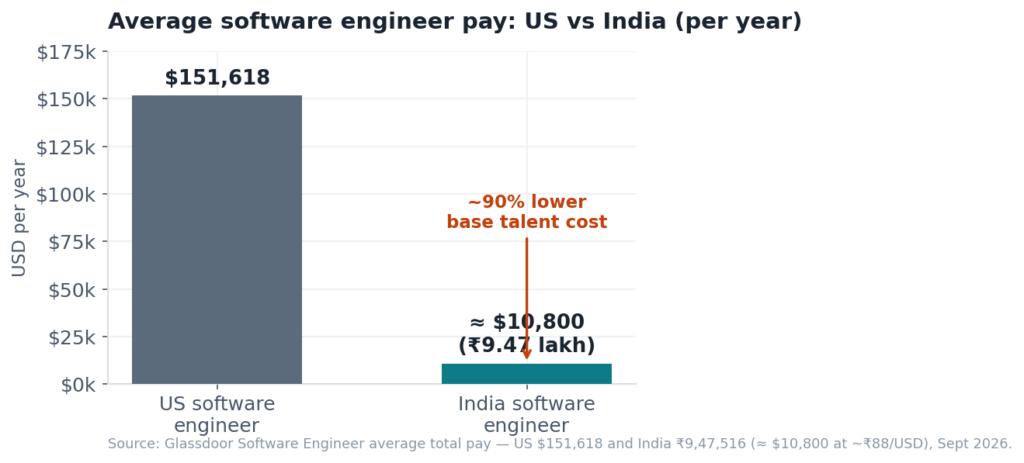
Every one of those roles is ultimately acting on the same arbitrage: comparable engineering talent costs a fraction in India. On a like-for-like Glassdoor basis, the average US software engineer earns about $151,618/year, versus roughly ₹9.47 lakh (≈ $10,800) in India, before you factor in the EOR fee, which is a rounding error next to the salary delta.
Put in annual terms, the arbitrage gets sharper. Deel’s $599/month management fee alone totals $7,188/year, close to a full year’s salary for a mid-level Indian software engineer. For a US-based hire earning ~$151,618/year, a $599/month EOR fee is under 5% of salary, a rounding error. Applied to an India-based hire earning ~$10,800/year, that same fee equals roughly 67% of the employee’s own salary as a surcharge. Husys’ $99/month fee ($1,188/year) works out to about 11% of the India salary instead, a materially different cost structure for a market where talent cost, not platform breadth, is the deciding variable. This is the core reason global-platform EOR pricing, calibrated to US/EU salary bands, is often mismatched to India economics.
Modeled 3-year cost projection: 10 India hires
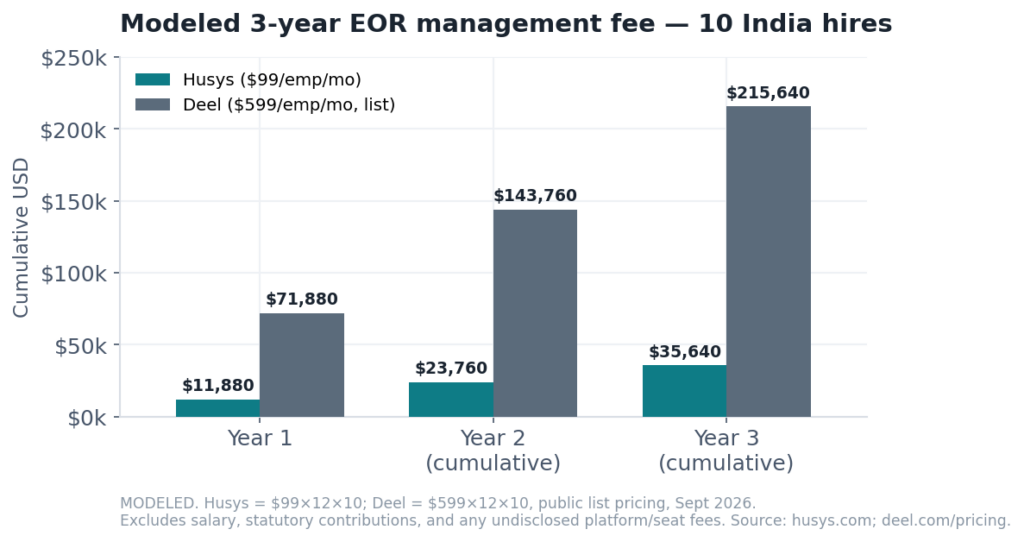
Same management-fee-only basis as above, scaled to a 10-person India team, the size most Series A/B US companies actually hire in year one. Salary and statutory pass-through costs are excluded because they are materially the same for both providers.
Period (10 India hires) | Husys EOR fee ($99/emp/mo) | Deel EOR fee ($599/emp/mo, list) | Modeled gap |
|---|---|---|---|
Year 1 | $11,880 | $71,880 | $60,000 |
Year 2 (cumulative) | $23,760 | $143,760 | $120,000 |
Year 3 (cumulative) | $35,640 | $215,640 | $180,000 |
A note on completeness: additional Deel fees (platform/seat minimums, implementation) are not itemized on its public pricing page as of September 2026; treat any such figure from third-party or community sources as unverified until confirmed directly with Deel sales, and swap in Husys Data Labs verified figures before publishing.
Where Husys wins, where Deel wins
A comparison you can trust doesn’t claim one tool wins everything. Here’s the honest split.
Dimension | Advantage | Why |
|---|---|---|
India cost predictability | Husys | $99 flat vs $599 list; no setup, no minimums. |
India compliance depth | Husys | 24+ yrs India-only, 28 states, in-house compliance team. |
Onboarding speed (India) | Husys | 8 working hours vs Deel’s stated 48 hours. |
Multi-country coverage | Deel | 130+ in-house payroll countries; 150+ total. |
Self-serve product & integrations | Deel | Broad platform, large integrations ecosystem. |
Brand recognition with boards | Deel | Widely known; $17.3B valuation, ~$1B ARR. |
Contractor management at scale | Deel | Contractor tooling from $49/mo, global. |
Long India track record | Husys | Operating in India since 2002. |
Note: Husys’ own multi-country reach, delivered through its exclusive global partnership with People2.0, narrows this gap. Deel still leads on breadth of in-house-owned entities, but a client only needing India plus a handful of additional markets can now get that from Husys too, without giving up India-specialist depth. Learn more about Husys + People2.0 global coverage.
Risks, edge cases, and misconceptions US companies get wrong
These are the misconceptions that most often trip up US buyers evaluating Husys vs Deel, or any EOR, for India specifically. The underlying compliance landscape is the same regardless of which provider you choose; what differs is how much of it each one has actually handled before.
“An EOR removes all my risk.” Mostly, but not entirely. An EOR removes the burden of being the legal employer and handles statutory compliance, but you still direct the work, and you must still avoid activities that create Permanent Establishment on your own account. Ask any provider how they monitor PE exposure, Husys reports monitoring invoices and deliverables to help manage it.
“Contractors are cheaper, so I’ll just use contractors.” This is the most expensive mistake in the guide. Long-term, full-time contractors in India carry misclassification and PE risk that can dwarf the savings. If someone works like an employee, treat them like one.
“India labour law is one law.” It isn’t. Shops & Establishment Acts, professional tax, and leave rules vary across all 28 states, which is exactly the kind of state-by-state nuance a single-country specialist handles daily.
When an EOR is NOT the right fit. Per Husys’ own guidance: if your company is directly selling or directly generating revenue in India (not just employing a support/engineering team), an EOR structure may not be appropriate, you likely need your own entity. A good specialist will tell you this rather than sell you the wrong structure.
On vendor risk, both directions. Deel’s ongoing litigation (Rippling suit; reported DOJ investigation) is a fair procurement question; so is an India specialist’s global breadth if you later expand beyond India. Choose for the job you actually have now, and revisit if the job changes.
A simple way to decide if Husys is your Deel alternative for India
Answer three questions:
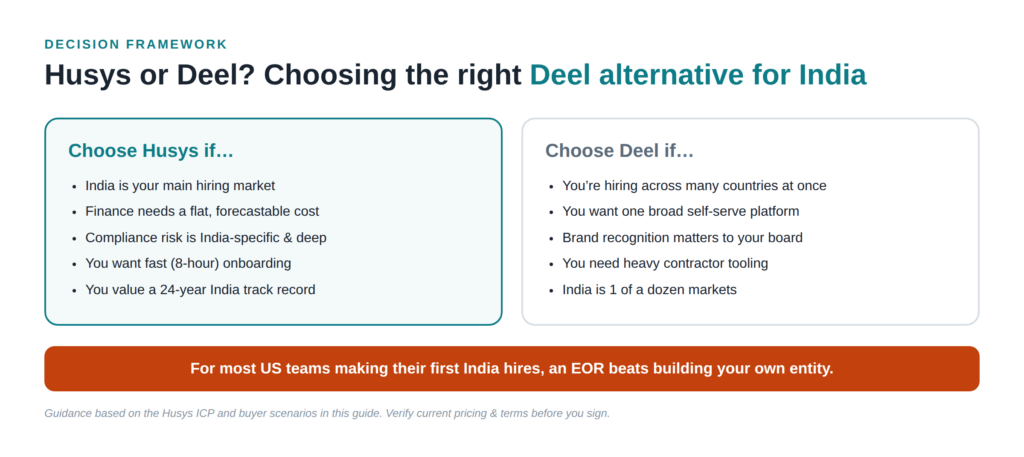
- Is India your main hiring market for the next 12 months? If yes, weight toward an India specialist (Husys). If India is one of many, weight toward breadth (Deel).
- Does finance need a flat, forecastable per-head cost? If yes, the $99 flat fee with no minimums is easier to defend to a board.
- How India-specific is your compliance risk (fintech KYC, IP for AI, multi-state)? The higher it is, the more a 24-year India specialist earns its place.
Frequently asked questions (Husys vs Deel for India)
Is Husys a good Deel alternative for hiring in India?
Yes for India specifically. Husys is an India-focused EOR with 24+ years in the market (since 2002), $99/employee/month list pricing, and in-house India compliance. Deel is stronger if you need many countries from one platform. If India is your priority, Husys is a strong Deel alternative for India.
How much does Deel cost vs Husys for India employees?
On public list pricing, Husys India EOR starts at $99 per employee per month and Deel’s EOR starts at $599 per employee per month about an 83% difference on the management fee. Both pass through salary and statutory contributions. Verify current pricing on each provider’s site.
Can a US company hire in India without setting up an entity?
Yes. That’s exactly what an employer of record (EOR) is for: the EOR’s India entity legally employs the worker, so you can hire in India without incorporating your own subsidiary.
Does Deel have its own entity in India?
Yes, Deel states it employs people in India through its own wholly-owned India entity and handles PF, ESI, professional tax and gratuity. The main differences vs. an India specialist are pricing, onboarding speed, and depth of state-by-state and industry-specific experience.
Is using an EOR in India legal for US companies?
Yes. Using an EOR is a legal, widely used way for US companies to employ people in India compliantly without their own entity. The EOR is the legal employer of record and manages statutory compliance.
What is Permanent Establishment (PE) risk, and does an EOR remove it?
PE risk is the danger that your activity in India creates a taxable corporate presence, triggering Indian corporate tax. A well-run EOR reduces PE risk by employing staff on its own entity and monitoring activities, but it doesn’t eliminate every scenario, confirm how your provider manages it.
How fast can I onboard an employee in India?
Husys states onboarding in as little as 8 working hours; Deel states “48-hour” onboarding. Real timelines depend on how fast the employee submits documents and how fast you approve the contract.
What statutory contributions are required for India employees?
The main ones are Provident Fund (PF, 12% each from employer and employee), ESI (~3.25% employer + 0.75% employee for eligible wages), TDS (monthly income-tax withholding), professional tax (state-level), and gratuity (after 5 years). See EPFO, ESIC and the Income Tax Department for current rates.
What’s the difference between EOR and PEO in India?
An EOR is the legal employer of your India staff (you don’t need an entity). A PEO co-employs alongside your own entity. If you don’t have an India entity and don’t want one, you want an EOR.
How do Indian employment laws differ from US at-will employment?
India is contractual, not at-will: payroll is monthly, benefits are statutory (not optional), and termination requires notice periods and full-and-final settlement. You generally can’t terminate same-day the way you can in most US states.
When is an EOR not the right choice for India?
If your company directly sells or directly generates revenue in India (rather than employing a support or engineering team), an EOR structure may not fit, you likely need your own entity. A reputable specialist will flag this.
Is Deel safe to use given its recent legal issues?
Deel continues to operate and serve 35,000+ customers. It has faced significant litigation (a Rippling corporate-espionage suit and a reported DOJ investigation), these are allegations/ongoing matters, not findings. Treat vendor governance and continuity as normal procurement diligence for any provider you choose.
The bottom line: is Husys the right Deel alternative for India?
If your company is hiring across many countries at once and wants one self-serve platform, Deel is a strong, well-funded choice and its breadth is real. But if India is the market that matters for the next year, Husys is a credible Deel alternative for India that tends to win on the three things US buyers tell us they care about most: a lower, flatter cost ($99 vs $599 per employee/month), deeper India-specific compliance (24+ years, 28 states, in-house team), and faster onboarding (as little as 8 working hours). For most US teams making their first India hires, an EOR beats standing up your own entity and for India specifically, an India specialist removes the most India-specific risk. That’s the honest case, backed by the numbers above.
Evaluating India expansion? Speaking with a compliance expert early is the cheapest way to avoid a costly India mistake. If you’re weighing a Deel alternative for India, a short call will tell you whether an India-specialist EOR fits your team no entity required, onboarding in as little as 8 working hours, flat $99/employee/month. → Book a 20-minute India compliance consult. |