


1. Executive answer: Deel alternatives for India hiring at a glance
Deel is not the only way to hire in India, and its $599 per month EOR list price is not the only number you should compare. If India is becoming a meaningful hiring market for your company, the more important questions are: Who is the legal employer? Is the India operation owned or partner-operated? What does the quoted fee actually include? What statutory obligations are covered? And can the provider explain India-specific compliance without sending you to a generic global compliance page?
Published EOR management fees for India range from $99 to $699 per employee per month across the providers reviewed. That is a substantial spread in the provider fee alone. It does not mean the total cost of employing the worker differs by the same amount: salary, statutory employer contributions and other employment costs sit outside the management fee and can vary based on the employee and circumstances.
Published EOR management fees for India range from $99 to $699 per employee per month across the providers reviewed. That is a substantial spread in the provider fee alone. It does not mean the total cost of employing the worker differs by the same amount: salary, statutory employer contributions, deposits, FX costs and other variable charges sit outside the management fee. This guide compares Deel and 12 alternatives for India hiring using published pricing, employment structure, India-specific compliance evidence, certifications and disclosed additional charges. It also gives you the questions to put to every provider before you sign.
Key takeaways
- Published EOR management fees for India range from $99 to $699 per employee per month. Deel publishes $599; the lowest published rates in this comparison are $99.
- The management fee is the only variable between providers. Salary and statutory employer contributions are identical whoever you use, so a $500 fee gap is roughly 16% of total monthly employer cost, not a $500 difference in the cost of employing the person.
- Deposits are real and material. Deel (1–1.5× total monthly charges), Oyster (1 month) and Remote (~1 month) all publicly require one. Most other providers do not disclose a policy.
- Only four of 13 providers state on their own website whether they own an Indian entity. Four disclose nothing at all. Ask for the entity name and verify it on the MCA register.
- India’s statutory framework changed twice in the last year: the four Labour Codes came into force on 21 November 2025, and the Provident Fund wage ceiling rose from ₹15,000 to ₹25,000 on 17 September 2026. Ask any provider how they are handling both.
- An EOR does not by itself settle permanent establishment risk. That depends on what your India team actually does, not on who signs the payslip.
What you will get from this page: the true cost stack behind a Deel India hire, an evidence-graded table of which providers actually hold an Indian entity, the three statutory changes that reset India compliance in 2025–26, a 30-day migration playbook, four role-specific decision frameworks, and an honest section on when Deel is still the right choice.
What this page covers
1. Executive answer · 2. Who should be comparing Deel alternatives for India hiring · 3. How this comparison was built · 4. Deel vs the alternatives: the comparison table · 5. What the headline price does not tell you · 6. Who actually employs your India workers · 7. India payroll compliance in 2026 8. The 12 questions to ask every provider · 9. When Deel's breadth may matter more · 10. Permanent establishment and tax risk · 11. Risks and edge cases · 12. Switching from Deel · 13. Role-specific scenarios · 14. Where Husys fits · 15. FAQs · 16. Where to go from here
2. Who should be comparing Deel alternatives for India hiring
This guide to Deel alternatives for India hiring assumes you understand US employment. You hire W-2 employees and 1099 contractors, you operate at-will, benefits are largely discretionary, and you can terminate on Friday and close the file on Monday.
None of that is true in India.
India’s employment framework is materially different from the US model. Statutory benefits and employer obligations apply across a range of employment situations, payroll and statutory filings follow India-specific requirements, and termination obligations depend on the worker’s status, applicable law and, in some cases, establishment headcount.
And as of 21 November 2025, the four Labour Codes were brought into force, beginning the transition from the previous framework. Existing rules and notifications continue to operate where applicable during the transition.
This page assumes you are a Founder, CFO, CTO or General Counsel at a US-headquartered company, somewhere between your first India hire and your two-hundredth, and that you are looking at Deel alternatives for India hiring because something about the current arrangement, cost, compliance depth, service, or all three, is not working. It also assumes you would rather read one page with sources than five vendor listicles without them.
3. How this comparison of Deel alternatives was built
Methodology matters more than most comparison pages admit, and most pages ranking for Deel alternatives for India hiring do not publish one at all. Here is exactly what was done.
Step | What we did |
|---|---|
Pricing | Taken from each provider’s own public pricing page, accessed 18 September 2026. Where a provider does not publish an EOR price, the cell reads “not published” rather than an estimate. |
Entity ownership | Graded by evidence quality. Grade A = an explicit statement on the provider’s own website. Grade B = a registered Indian subsidiary or strong implication without an explicit EOR-employer statement. Grade C = a third-party claim only. “Not disclosed” = neither the provider nor a credible third party states it. |
Certifications | Taken from each provider’s own security or trust page. Claims we could not locate are marked “not verified,” not “none.” |
Extra fees | Taken from each provider’s own help centre and support documentation, not from marketing pages. This is where the gap between headline price and real price appears. |
Statutory facts | Sourced to Indian government primary sources — PIB, Ministry of Labour & Employment, EPFO, ESIC, the Income Tax Department, MeitY, and linked inline every time. |
Ratings | G2 and Capterra, as displayed on 18 September 2026, with review counts, because a 5.0 from one review and a 4.5 from 5,000 are not comparable facts. |
What we excluded | Competitor-published comparison pages. Almost every “best EOR for India” listicle on the first page of Google is written by an EOR vendor that ranks itself first. This page is published by Husys, which is one of the providers compared, and we flag that rather than hiding it. Husys is listed in the tables on the same published-price basis as everyone else, and we do not rank ourselves first. |
Disclosure. Husys is an India-focused EOR/PEO provider and is included in the comparison below. Where we make a claim about Husys, it is labelled as such. Where another provider has stronger publicly documented evidence on a particular criterion, we identify that difference. see §10, When Deel is still the right choice.
4. Deel vs the alternatives: the India EOR comparison table
4.1 Published prices across the Deel alternatives
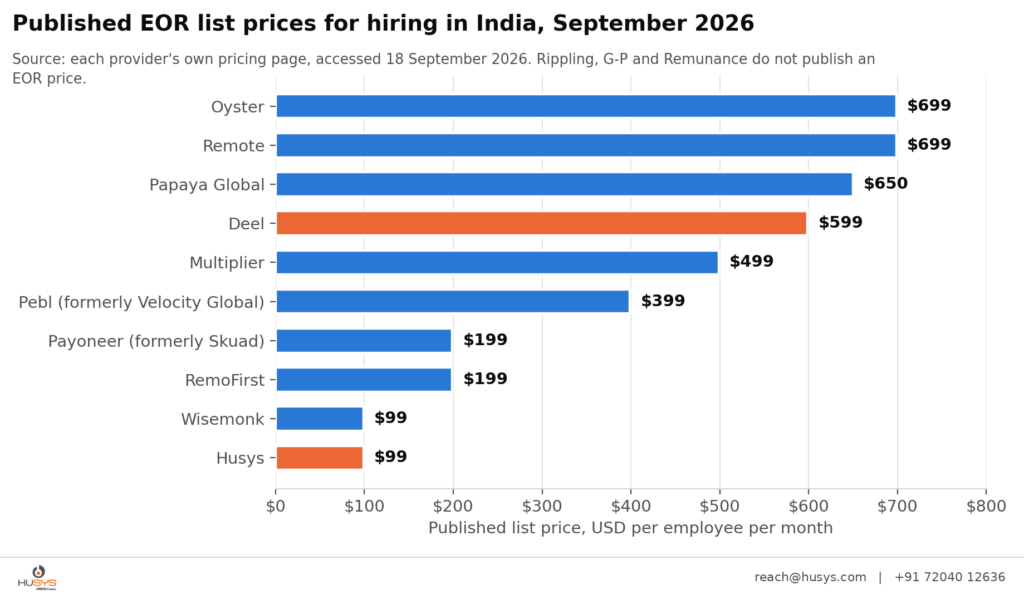
Chart: Published EOR list prices per employee per month. Source: each provider’s own pricing page, accessed 18 September 2026.
Chart data (per employee per month, USD): Husys $99 · Wisemonk $99 · RemoFirst $199 · Payoneer $199 · Pebl $399 · Multiplier $459–$499 · Deel $599 · Papaya Global $650 · Remote $699 · Oyster $699. Rippling, G-P and Remunance do not publish an EOR price. – ( Not important for posting, can be ignored)
4.2 The full table of Deel alternatives for India hiring
No provider in this set publishes an India-specific rate. Every price below is the global EOR list price, though Papaya prices in euros in Europe and Multiplier notes that roughly 11% of supported countries carry adjusted rates, neither says whether India is among them.
The comparison isolates the provider fee so buyers can see the difference in the quoted management charge before evaluating the rest of the cost stack
12 Deel Alternatives + Deel: India EOR Comparison
Provider | Price /emp/mo | India entity | Countries | Certifications | G2 | Capterra |
|---|---|---|---|---|---|---|
Husys | From $99 | Grade A — Indian company, 28 states + 6 of 8 UTs | 100+ | ISO 9001, ISO 27001 | not listed | not listed |
Wisemonk | From $99 published; custom/enterprise pricing above | Grade B — India-founded; role not stated | 30+ | SOC 2; “ISO-aligned” only | 4.8 (209) | 5.0 (1 review) |
RemoFirst | $199 | Grade A — partner model, stated | 185+ | ISO 27001, SOC 2 Type II | 4.5 (407) | not verified |
Payoneer (ex-Skuad) | $199 | Not disclosed | 160+ | Not verified | 4.6 (359) | not verified |
Pebl (ex-Velocity Global) | $399 | Grade C — 90% owned globally; India not stated | 185+ | Not verified | 4.6 (603) | 0 reviews |
Multiplier | $459 annual / $499 monthly | Grade B — Multiplier Technologies India Pvt Ltd | 160+ | ISO 27001:2022, SOC 2 Type 2 | 4.7 (1,482) | 4.4 (44) |
Deel | $599 | Grade A — India named as owned | 130+ | ISO 27001, SOC 1/2/3 | 4.7 (6,979)* | 4.9 (4,311) |
Papaya Global | $650 | Not disclosed | 160+ | ISO 27001 (2018), 27701, SOC 1 & 2 | 4.5 (55) | 4.5 (43) |
Remote | $699 | Grade A — owns India entity | 90+ EOR | Not verified | 4.5 (5,002) | 4.3 (101) |
Oyster | $699 | Not disclosed | 120+ EOR (180+ contractor) | SOC 2 Type II only | 4.4 (1,592) | 4.6 (91) |
Rippling | Not published | Not disclosed | not verified | Not verified | 4.8 (11,760)† | not verified |
G-P | Not published ($39/mo contractors) | Grade C — third-party claim only | 180+ | ISO 27001/27017/27018/42001, SOC 2 | 4.4 (1,065) | not verified |
Remunance | Not published | Grade B — Remunance Services Pvt Ltd | 16 or 22 (site conflicts) | ISO 27001:2022 | not displayed | not found |
A note on “from” pricing. Papaya (“starting from $650”), RemoFirst (“starts at $199”), Payoneer (“starting from $199”) and Wisemonk (“starting from $99”) all publish their figures as starting prices, and Multiplier’s $459 is the lowest of three tiers (Growth is $519 annual / $559 monthly). Deel’s $599, Remote’s $699 and Oyster’s $699 are published as firm rates. Husys publishes $99 as a starting rate with flexible pricing by deal size. Read every figure in this table as a floor unless noted.
* Deel maintains multiple G2 product listings with different scores; this is the “Deel Payroll” listing. † Second-hand from a G2 comparison module, not Rippling’s own listing page.
5. What the headline price does not tell you: Deel India pricing in full
Deel India pricing starts at a published $599 per employee per month. That pricing page also states there are “no surprise fees” and that “all costs are included in your quoted price.”
Deel’s own help centre documents four things that sit outside that number. We are citing Deel’s documentation against Deel’s marketing, not a competitor’s characterisation.
5.1 What deposit will an India EOR ask you to put down?
“The standard deposit is between 1 – 1.5 all monthly charges, including employee salary, employer costs, fixed allowances, and management fees.” Deel Help Center, About EOR Deposit Calculations
Deposits of two months or more are triggered by removing probation, granting PTO more than 8 days above the legal minimum, notice periods beyond one month, transferring employees with accrued benefits, variable compensation above $100k, or a salary increase over 20%. Refunds are processed after termination is finalised and invoices settle — up to 60 days.
This is a cash-flow item, not a cost — you get it back. But on a 10-person India team at a $2,000 monthly salary plus employer statutory cost and the $599 fee, Deel’s 1–1.5× formula puts roughly $29,000–$43,000 of your cash with a vendor.
10 employees × (salary + employer costs + management fee) × 1–1.5 months
Deel is not alone. Oyster requires “a 1-month fully-refundable deposit upfront for your new hire” (Oyster support). Remote collects reserves calculated as the employee’s estimated monthly gross plus mandatory employer costs, more for extended notice periods or guaranteed severance (Remote support). Most other providers do not publicly disclose a deposit policy either way.
5.2 Does the fee include India severance and gratuity accrual?
Deel accrues severance monthly, and states plainly that “This Severance Accrual is separate from the EOR Deposit.” India is explicitly named among the 65 countries requiring accrual (Deel Help Center). It is refunded on resignation or where accrual exceeds statutory entitlement.
This is a legitimate practice, India’s gratuity liability is real and accruing for it is prudent. But it is a recurring monthly charge above the $599 headline, and at India’s 15/26-days-per-year gratuity formula it runs to roughly 4.8% of salary.
5.3 What does an off-cycle payroll run cost?
Deel charges $29 USD per employee impacted by an on-demand payroll request, waivable for compliance-driven payments or Deel-caused errors (Deel Help Center).
5.4 What FX spread do EOR providers charge on India salaries?
Deel states it “uses institutional forward rates from its banking partner” and contrasts this with “the 4-5% markup charged by many retail banks” — without disclosing its own markup (Deel Help Center). Payment processing fees are disclosed: cards at 2.9% + $0.30 (US/EU) or 3.9% + $0.30 (outside US/EU), ACH/SEPA/BACS $5, PAD/BECS $10.
To be fair to Deel: not one provider in this comparison publishes a numeric FX markup. Oyster confirms FX fees apply without stating a percentage. This is an industry-wide gap, and on an India hire where every rupee of salary crosses a currency boundary every month, a 1% difference on a $24,000 annual salary is $240 a year per employee, comparable to two months of a $99 management fee. Ask for the FX spread in writing during procurement. If a provider will not put a number in the contract, that is information.
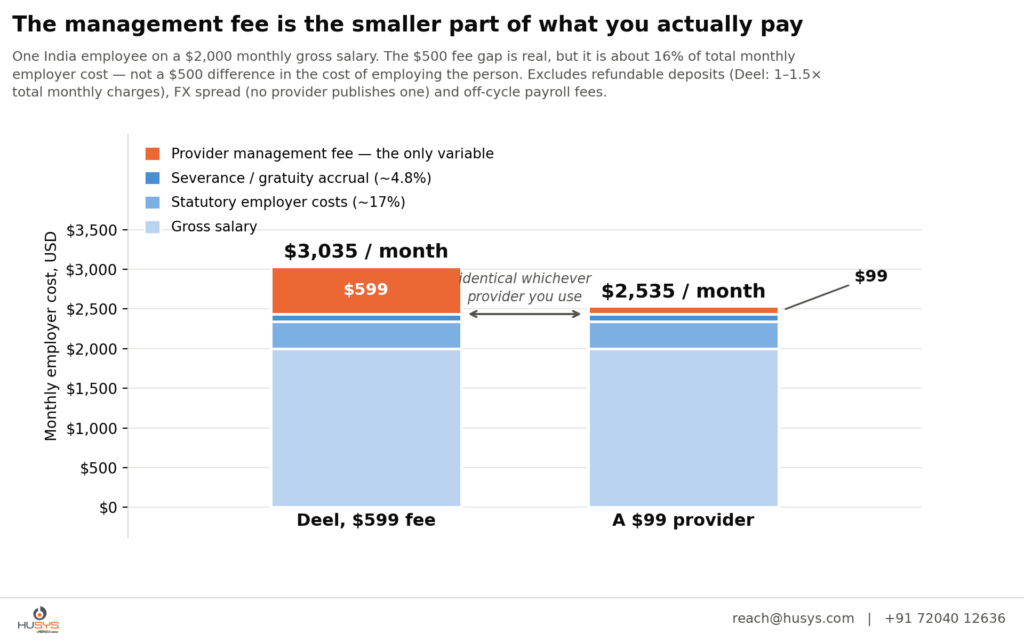
Figure. The management fee is the only variable between providers. On a $2,000 monthly salary the $500 gap between a $599 and a $99 fee is about 16% of total monthly employer cost, not a $500 difference in the cost of employing the person. Excludes refundable deposits, FX spread and off-cycle payroll fees.
5.5 How much does the fee difference actually amount to?
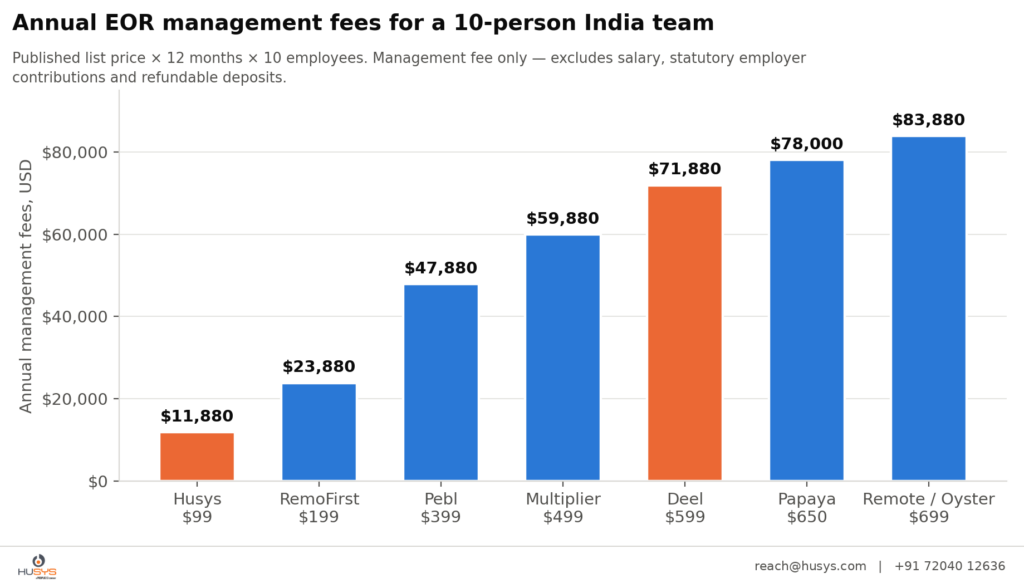
Chart: Annual EOR management fees for a 10-person India team, at each provider’s published list price. Sources: each provider’s own pricing page, accessed 18 September 2026.
Chart data (annual management fees, 10 employees, USD): Husys $11,880 · RemoFirst $23,880 · Pebl $47,880 · Multiplier $59,880 · Deel $71,880 · Papaya Global $78,000 · Remote and Oyster $83,880. – Not important for posting
On management fees alone, a 10-person India team costs $71,880 a year at Deel’s $599 and $11,880 a year at a $99 flat rate, a difference of $60,000 per year, roughly the fully loaded annual cost of five additional India engineers at the national average salary used in §13.3 (about $12,090 each, all-in). Salary and statutory employer contributions are identical either way; this is purely the management fee line.
The statutory obligation is the same; the provider’s invoiced cost and treatment of those obligations may differ.
What the headline EOR price does and does not include
For a US company budgeting an India hire, the provider’s monthly EOR fee is only one component of the cost.
Total employment cost =
Gross salary
- Employer statutory contributions
- EOR management fee
- Benefits or allowances, where applicable
- Deposits/reserves, where applicable
- FX and payment charges, where applicable
- Off-cycle payroll, amendments or other additional service fees, where applicable
That is why a $99 versus $599 comparison should be read as a management-fee comparison, not as a $500 difference in the total cost of employing the same person.
Salary + statutory employer costs + provider management fee + variable/additional charges = total employer cost
For procurement, ask every provider to quote the same hypothetical employee using the same salary, location, benefits and employment assumptions. Then compare the resulting all-in monthly and annual cost.
6. Who actually employs your India workers?
Most people searching for Deel alternatives for India hiring have already decided to use an employer of record India provider. It is worth spending ninety seconds on why, because the alternative paths carry risks that are invisible from the US.
For most US companies hiring individual workers in India, there are three common structures to evaluate:
- contractor engagement,
- employing through your own Indian entity, or
- using an Employer of Record in India,
and which one you are on determines whether Deel alternatives for India hiring is even the right question to be asking.
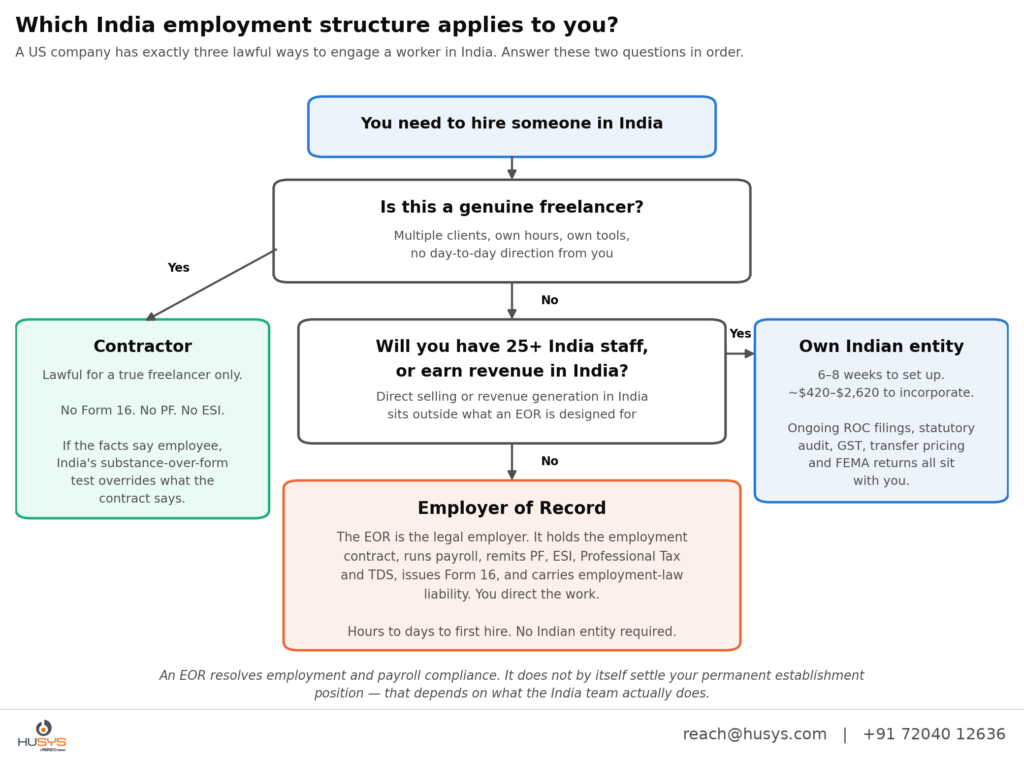
Figure. Which India employment structure applies to you. An EOR resolves employment and payroll compliance; it does not by itself settle your permanent establishment position.
Path 1 – Pay them as a contractor (what normally happens)
This is what almost every US company does first. You find an engineer in Bengaluru, agree on a monthly figure, and wire it. No entity, no paperwork, no HR.
What happens normally: it works for six months. Then one of these things happens. The engineer asks for a Form 16, the Indian equivalent of a W-2, and you do not have one to give, because you never withheld tax. Or they ask why they have no Provident Fund account while their friends do. Or they leave and file a claim asserting they were an employee all along.
Indian classification is a substance-over-form judicial test. The Supreme Court of India has consolidated the position around control plus integration plus a multi-factor analysis, what the contract is titled is close to irrelevant if the person works fixed hours, uses your systems, reports to your managers, and has no other clients. A worker engaged through a contractor also falls under the contract labour regime now consolidated into the Occupational Safety, Health and Working Conditions Code, 2020, under which the principal employer carries registration duties and residual liability for wages.
Contractor misclassification in India is not a theoretical risk. It is the single most common reason US companies end up shopping for an EOR in the first place.
Learn more about contractor misclassification- Converting India Contractors to EOR Employees: A Step-by-Step Guide
Path 2 – Set up your own Indian subsidiary
Legitimate, and the right answer eventually. Just not at employee number three.
Incorporation itself is cheaper than most US founders expect, the Ministry of Corporate Affairs charges no registration fee for a private limited company with authorised capital up to ₹15 lakh and up to 20 members, under the Companies (Incorporation) Second Amendment Rules, 2019. Indian law firms quote all-in incorporation between ₹40,000 and ₹2,50,000 (roughly $420–$2,620 at ₹95.55/USD) depending on structure and sector. Statutory timelines run 15–25 business days on the automatic route and 35–45 business days where government approval is required, but one of those firms puts the realistic end-to-end timeline at six to eight weeks (Ahlawat & Associates; Startup Solicitors).
The cost is not the setup. It is the permanent operating overhead: AOC-4 and MGT-7 annual filings, ADT-1 auditor appointment, DIR-3 KYC per director, DPT-3, Form 3CEB transfer pricing certification once international transactions exceed ₹1 crore, ITR-6, the RBI FLA return under FEMA by 15 July each year, FC-GPR within 30 days of any share allotment, and monthly GST returns. Late filing attracts ₹100 per day, per form, with no cap.
And the liability. With your own entity, every one of the statutory obligations in §7 sits on you. So does every termination dispute.
Path 3 – Employer of Record
An employer of record India provider becomes the legal employer of your India team. They hold the employment contract, run payroll, remit PF, ESI, Professional Tax and TDS, issue Form 16, manage statutory leave, and assume the employment-law responsibilities assigned to the legal employer. You direct the employee’s day-to-day work. For companies that do not have an Indian entity, an EOR is one established structure to evaluate for employing workers in India.
The three paths, side by side
Contractor | Own entity | Employer of Record | |
|---|---|---|---|
Time to first hire | Days | 6–8 weeks typical | Hours to days |
Setup cost | $0 | ~$420–$2,620 | $0 at providers with no setup fee |
Ongoing admin cost | $0 | ~$3,000–$6,500/yr plus audit | Per-employee monthly fee |
Who holds employment liability | You, if reclassified | You | The EOR |
Statutory benefits handled | No | By you | By the EOR |
Form 16 issued to worker | No | By you | By the EOR |
Misclassification exposure | High | Low | Low |
Permanent establishment exposure | Fact-Dependent | Requires separate PE/tax analysis | Not eliminated; depends on activities and structure |
Sensible at | Genuine project-based freelancers | 25–50+ India staff, or India revenue | 1–50 India staff |
Confused , which path to choose – Employer of Record vs. PEO vs. Setting Up Your Own India Entity: A Decision Framework
A note on EOR vs PEO in India: a PEO is a co-employment model that requires you to already have an Indian entity. An EOR does not. If you do not have an Indian entity, an EOR and a direct PEO/co-employment arrangement are not equivalent structures; an EOR is generally the model used where the provider becomes the legal employer.
Learn More: PEO vs EOR in India: Hiring Without an Entity
6.1 Which India EOR providers actually own their Indian entity?
This is the criterion that separates the Deel alternatives for India hiring that can prove their structure from the ones that cannot, and it is the thing buyers care about most and can verify least. An owned entity can simplify accountability and reduce reliance on an intermediary employer, but it does not by itself establish lower pricing, and it does not remove the India tax and compliance obligations that attach to the work itself. A partner model means a third party you did not choose, and cannot audit, is the actual employer of your engineer.
Of the 13 providers, entity ownership in India is explicitly stated by four:
Evidence grade | Provider | What they actually say |
|---|---|---|
A explicit | Remote | “It’s also crucial to note that, at Remote, we own our own legal entity in India.” (remote.com) |
A — explicit | Deel | “we now have Deel-owned infrastructure and entities in 100+ countries, including Spain, Germany, Australia, Canada, India, and more” (Deel). One third-party review site, SelectSoftwareReviews, states Deel uses local partnership arrangements in India. We could not resolve the contradiction and report both; Deel’s own statement is the better evidence |
A — explicit | RemoFirst | Acts as legal employer through “a network of local payroll and compliance partners” (remofirst.com) — the clearest partner-model disclosure in the set, though it is a global statement rather than an India-specific one |
A — explicit | Husys | An Indian company operating in India since 2002, across 28 states and 6 of India’s 8 union territories (Husys) |
B | Multiplier, Remunance, Wisemonk | Registered Indian entity exists; EOR-employer role not explicitly stated |
C | Pebl, G-P | 90% global claim with India unstated; third-party claim only |
Not disclosed | Papaya, Skuad/Payoneer, Rippling, Oyster | Neither the provider nor a credible third party states it |
That opacity is itself the finding. When you cannot tell who employs your engineer, you cannot tell who is liable when a termination goes wrong. Put it in the RFP: “Name the legal entity that will appear as employer on our India employment contracts, and confirm whether you own it.”
6.2 Which EOR providers have changed ownership or name recently?
Two of the Deel alternatives for India hiring in the table above have changed name or ownership recently. Worth knowing before you sign a three-year agreement.
- Velocity Global is now Pebl. velocityglobal.com redirects to hellopebl.com, and velocityglobal.com/pricing now returns a 404. Pebl’s own site claims a 4.7 G2 rating; G2 currently displays 4.6 across 603 reviews, and Pebl’s Capterra listing shows zero reviews under the new name.
- Skuad was acquired by Payoneer in August 2024 for $61 million cash, up to $81M total, and is now Payoneer Workforce Management (Finovate).
6.3 Does Deel’s litigation affect its India EOR service?
- Deel is involved in ongoing litigation with competitor Rippling. Rippling filed a federal lawsuit in March 2025 alleging trade-secret theft and violations of RICO. In February 2026, Judge Charles Breyer allowed most of Rippling’s claims, including its RICO and trade-secret claims, to proceed after ruling on Deel’s motions to dismiss. The ruling allows those claims to continue; it does not establish that the allegations are true. (Bloomberg Law) (N.D. Cal. court order)
- The litigation remained active in September 2026, with the Northern District of California issuing additional discovery-related orders. (September 2026 court order) (September 2026 protective order)
- The Wall Street Journal also reported in January 2026 that the US Department of Justice had opened a criminal investigation relating to allegations arising from the dispute. Deel said it was not aware of such an investigation but would cooperate with authorities. No DOJ announcement establishing wrongdoing is cited here. (Wall Street Journal) (Ogletree — reported DOJ corporate espionage probe)
- These matters are not India-specific employment or regulatory proceedings, so they should not be treated as evidence of Deel’s India compliance performance. For procurement purposes, they are part of the broader vendor-diligence record.
- What to do with this information: if your legal or procurement team requires litigation and regulatory due diligence, review the current court record and obtain the provider’s representations and warranties directly rather than treating either party’s public statements as established fact. Deel has also publicly described its own litigation against Rippling, so both sides’ filings should be considered when conducting diligence. (Deel — court dismisses Rippling claims) (Deel — files lawsuit against Rippling)
Deel also faces ongoing litigation and reported regulatory scrutiny unrelated to its India EOR offering. Because these matters do not concern India employment compliance directly, they are not included in our provider assessment. For completeness: we also searched Reddit, Trustpilot and G2 for India-specific service complaints about Deel and found none we could source, so no such claim is made anywhere in this comparison.
7. India payroll compliance in 2026: what changed, and why most comparison pages are out of date
This is the section no other page comparing Deel alternatives for India hiring currently covers properly, and it is the single best test of whether a provider actually knows India.
Three things changed in the last ten months, and they are the sharpest test you can apply to any of the Deel alternatives for India hiring on your shortlist. If a provider’s India content still describes the Industrial Disputes Act 1947 as live law and the PF wage ceiling as ₹15,000, their India knowledge is at least a year stale.
7.1 What changed when India’s four Labour Codes came into force?
India consolidated 29 existing labour laws into four Codes — the Code on Wages 2019, the Industrial Relations Code 2020, the Code on Social Security 2020, and the Occupational Safety, Health and Working Conditions Code 2020, all brought into force on 21 November 2025 (PIB; DD News). Central Rules under all four Codes were published in May 2026, as reported in alerts from EY, KPMG and JSA; we were not able to retrieve the gazette notification itself.
What actually changed for a US employer:
- Appointment letters are now mandatory for all workers. Not best practice, required.
- Gratuity now vests at one year for fixed-term employees, down from five. A 12-month India contract now carries a gratuity liability (Ministry of Labour & Employment Compliance Handbook).
- The retrenchment permission threshold rose from 100 to 300 workers. At 300+ workers you need prior government permission and three months’ notice. Retrenchment compensation is 15 days’ average pay per completed year of service. Below 300, notice periods follow the contract and the applicable state Shops & Establishments Act, commonly 30 days, rather than the Code’s 300+ regime.
- A Worker Re-Skilling Fund contribution of 15 days’ last drawn wages per retrenched worker.
- Women may work night shifts across all establishments with consent and safety measures.
Note the transition rule: existing Acts, rules and notifications remain in force during the transition, and state rules are still patchy, Arunachal Pradesh and Gujarat have notified in full, Uttar Pradesh and Punjab partially, West Bengal is still at draft stage. Anyone telling you India labour law is now simple and uniform has not read the state position.
Read in details: India’s Four Labour Codes: What Changed for US Employers
7.2 What happened to the Provident Fund wage ceiling in September 2026?
This is the freshest and most expensive change on this page, and it happened yesterday relative to this article’s publication.
The EPF wage ceiling, unchanged since September 2014 at ₹15,000 per month, was raised to ₹25,000 per month effective 17 September 2026. The change is expected to bring more than 51 lakh additional employees into mandatory EPFO coverage, and raise central budgetary support from ₹10,250 crore to ₹11,339 crore per year (PIB PRID 2310973; PIB PRID 2310811).
What this can cost employers. Where PF contributions are restricted to the statutory ceiling, the employer’s 12% contribution rises from ₹1,800 per month at the old ₹15,000 ceiling to ₹3,000 at the new ₹25,000 ceiling, an increase of up to ₹1,200 (approximately $12.56) per employee per month, or $151 per employee per year, using an illustrative exchange rate of ₹95.55/USD. The actual impact depends on the employee’s PF membership status and whether the employer already contributes to higher actual wages.
For a 20-person India team, that is about $3,000 a year in new statutory costs that appeared with one day’s notice. Ask any provider you are evaluating what their ₹25,000-ceiling handling is. If they have not heard of it, that is your answer.
7.3 What do the DPDP Rules mean for a US employer’s India data?
India’s Digital Personal Data Protection Act now has operative Rules, notified 14 November 2025 with an 18-month phased compliance period (PIB). Consent Manager registration bites 14 November 2026; notice and consent, breach reporting, security safeguards, data principal rights and cross-border transfer restrictions bite 14 May 2027.
Two points that matter to a US company specifically. First, the Act is extraterritorial, it applies to processing outside India connected to offering goods or services to data principals in India, so it can reach you without an Indian entity (DPDP Act 2023, MeitY). Second, there is an employment legitimate-use ground, so you generally do not need employee consent to process HR data for employment purposes, but notice, security safeguards and breach reporting still apply from May 2027. Penalties run to ₹250 crore for a security safeguards failure.
Learn more: India’s DPDP Act 2023: What It Means for Employee Data
7.4 What are the India statutory obligations, in full?
Whatever provider you choose, these are the obligations somebody has to discharge every month.
Obligation | Current rate / threshold | Primary source |
|---|---|---|
Provident Fund (PF) | 12% employee + 12% employer; wage ceiling ₹25,000/month from 17 Sept 2026; applies at 20+ employees; no ceiling at all for international workers | |
ESI | 3.25% employer + 0.75% employee; wage threshold ₹21,000/month; applies at 10+ persons; currently notified in 668 districts, with the Social Security Code providing for pan-India extension | |
Gratuity | 15 days’ wages per completed year; vests at 5 years — or 1 year for fixed-term employees; ceiling ₹20 lakh | |
Statutory bonus | 8.33% minimum to 20% maximum; eligibility ceiling ₹21,000/month; calculation ceiling ₹7,000 or minimum wage, whichever is higher | |
Maternity benefit | 26 weeks paid; crèche mandatory at 50+ employees; qualifying service 80 days | |
POSH | Internal Committee mandatory at 10+ employees; annual report; ₹50,000 first-offence penalty, doubled on repeat, licence cancellation possible | |
Professional Tax | State-levied under Article 276; constitutional cap ₹2,500 per person per year; not levied by every state | |
TDS on salary | New regime: nil to ₹4L, then 5/10/15/20/25/30% bands to ₹24L+; standard deduction ₹75,000; effectively ₹12.75 lakh tax-free for salaried. Confirm the FY 2026-27 position against the current Finance Act before relying on it | |
Form 24Q | Quarterly: 31 July, 31 Oct, 31 Jan, 31 May | |
Form 16 | To employees by 15 June following the financial year | |
Notice & severance | Retrenchment compensation 15 days’ average pay per completed year; at 300+ workers, 3 months’ notice plus prior government permission. Below 300, notice follows contract and state S&E Act | |
Annual leave | Eligibility at 180 days worked; state Shops & Establishments Acts add more (Delhi: 15 days privilege + 12 days sick/casual) |
Also Read:
PF, ESI and TDS Explained for US Employers
Termination and Notice Periods in India
7.5 How do India’s statutory benefits map to US equivalents?
India | Closest US analogue | Where the analogy breaks |
|---|---|---|
Provident Fund | 401(k) | Mandatory, employer-matched at 12%, no opt-out |
ESI | Government health insurance | Employer pays 3.25%, applies below a wage threshold |
Gratuity | Severance | Statutory, accrues from year one, vests at five (or one for fixed-term) |
Form 16 | W-2 | Issued by 15 June, not 31 January |
Notice period | At-will | There is no at-will. Notice is contractual and statutory |
Payroll cycle | Bi-weekly | Monthly, universally |
Professional Tax | State income tax | Capped at ₹2,500/year, and not every state levies it |
8. 12 questions to ask every provider before you sign
A table only helps if you know what each column means. These twelve questions work across every provider in the comparison and on Deel itself. They separate providers that know India from providers that have a page about India.
# | Ask this | Why it matters | What a good answer sounds like |
|---|---|---|---|
1 | Name the legal entity that will appear as an employer on our contracts. Do you own it? | Determines who is liable and whether there is margin stacking | A named Indian company, with CIN, that they own |
2 | What deposit or reserve will you require, in months, and when is it refunded? | It is your cash, sometimes for 60 days past termination | A specific multiple and a stated refund window |
3 | What is your FX spread, as a number, and will you contract to it? | Nobody publishes it; it can exceed the management fee | A number in the MSA |
4 | How are you handling the ₹25,000 PF ceiling effective 17 Sept 2026? | Tests whether their India knowledge is current to this month | They know it happened and have repriced |
5 | Which of the four Labour Codes’ state rules have been notified in the states we are hiring in? | Tests real depth, most state rules are still pending | Named states, current status |
6 | Is your India compliance team in-house or outsourced counsel? | Determines response time when something goes wrong | In-house, named, with qualifications |
7 | Which Indian states and union territories can you actually employ in? | India is 28 states + 8 UTs with different S&E Acts and PT regimes | A specific list, not “all of India” |
8 | What is your contracted onboarding SLA, in hours, and what is the penalty if you miss it? | “Fast onboarding” is a claim until it is an SLA | Hours, in the contract, with a remedy |
9 | Walk me through your termination process under the Industrial Relations Code 2020 | The most common failure point — see §11 | They cite the Code, not the ID Act |
10 | Who issues Form 16, and by what date? | Statutory: 15 June. A missed Form 16 is your employee’s tax problem | 15 June, by them, every year |
11 | What are your ISO and SOC certifications, and can I see the reports? | Varies enormously see the table in §7.2 | Certificates and a SOC report under NDA |
12 | What is your offboarding process and what does exit cost? | Switching cost is the real lock-in | No termination fee; documented handover |
9. When Deel’s global platform breadth may matter more
A comparison page that concludes the publisher wins every scenario is not a comparison, it is an advertisement. There are several situations in which you should stop evaluating Deel alternatives for India hiring and simply stay with Deel, because its global platform breadth outweighs what an India-focused provider can offer, particularly when your requirements extend well beyond India.
Choose Deel or another global platform when | Why |
|---|---|
You are hiring across many countries simultaneously | 130+ country coverage on one contract and one invoice is genuinely valuable, and an India specialist cannot give you that |
Your priority is one consolidated global platform | Deel’s product breadth, contractor management, global payroll, equity, immigration, device management, is wider than any India specialist’s |
Procurement requires deep third-party review corroboration | ~7,000 G2 reviews and 4,311 Capterra reviews are a substantive trust signal. India specialists, Husys included, do not have that volume |
You need contractor management across dozens of markets | Deel publishes $49/contractor/month. Several providers publish lower contractor rates, Payoneer $19, RemoFirst $25, Remote and Oyster $29, G-P $39, so the case for Deel here is breadth and a single contract, not unit price |
Your India headcount is one or two people and consolidation matters more than unit cost | “At two employees, the difference in published management fees is approximately $12,000 per year before taxes, statutory costs, deposits and other provider charges.” |
You need US PEO alongside global EOR | Deel offers US PEO at $125/employee/month; India specialists do not |
The inverse is the actual thesis of this page. If India is your primary hiring market, if you are scaling past a handful of people there, and if India-specific statutory depth matters more to you than multi-country breadth, then you are paying a global platform premium for a single-country problem, and the 83% fee difference between $599 and $99 is the price of that mismatch.
10. Permanent establishment and India tax risk: the honest answer
EOR marketing pages frequently state or imply that using an EOR eliminates permanent establishment risk in India. We went looking for a Big Four or law-firm source that says so. We could not find one. Every source asserting it was an EOR vendor, which is a self-interested class of source, ours included.
Here is what the primary sources actually say.
Under Article 5 of the India–US Double Taxation Avoidance Agreement (treaty text):
- Fixed place PE — a fixed place of business through which business is wholly or partly carried on.
- Service PE — services furnished through employees or personnel for more than 90 days in any 12-month period, or any duration at all where the services are for a related enterprise.
- Dependent agent PE — an agent who habitually exercises authority to conclude contracts, maintains stock for delivery, or habitually secures orders wholly or almost wholly for the enterprise.
Indian domestic law goes further. “Business connection” under section 9(1)(i) of the Income-tax Act is “much wider in connotation” than treaty PE and has been “very effectively used by the revenue authorities to tax the income of non-residents.” Secondment analysis turns on control: where the foreign company retains control over deputed personnel, a business connection typically arises (Nishith Desai Associates).
The honest conclusion. The dependent-agent test looks at what the worker does, not at whose name is on the payslip. If your EOR-employed employee in India habitually concludes contracts or secures orders wholly or almost wholly for your US company, Article 5(4) is available to the Indian revenue authorities regardless of who the legal employer is. An EOR genuinely resolves employment-law and payroll compliance. It does not, by itself, neutralise PE exposure where you direct the work and the worker is customer-facing or contract-concluding.
What this means practically:
Role you are hiring in India | PE risk profile via EOR |
|---|---|
Software engineer, internal product work | Low |
Designer, QA, internal operations | Low |
Support engineer serving your global customers | Low to moderate — get advice |
Sales rep negotiating with Indian customers | High — dependent agent PE is squarely in play |
Country manager with signing authority | High — this is the textbook case |
Any role where services are for an Indian affiliate | The 90-day threshold does not apply — PE can arise immediately |
There is also a category where an EOR should not be treated as the complete answer. If your India team is directly selling, negotiating contracts, delivering services to customers, or otherwise carrying out core revenue-generating activities for the US business, the employment structure should be assessed alongside the company’s India tax, PE and corporate-presence position.
An EOR can solve the employment and payroll layer. It does not, by itself, determine whether the US company has a permanent establishment or other taxable presence in India. That assessment depends on the actual activities, authority exercised by personnel, contractual arrangements and applicable tax rules.
The question is not simply “Who signs the employment contract?” It is “What is the India team actually doing for the business?” Any provider that tells you the EOR structure alone settles it is selling you a problem.
Get Indian tax advice on the specific roles — not from your EOR, but from a tax adviser with no commercial interest in the answer. We would rather you did that and came back than signed on the strength of a marketing claim.
Consult an India EOR expert now → A 30-minute call with our in-house compliance team will tell you which of your India roles carry PE exposure, and whether an EOR is the right structure at all. [INTERNAL LINK → Contact / book a consultation — https://husys.com/contact-us/]
[INTERNAL LINK → Permanent Establishment Risk: 5 Questions to Ask Any EOR Before You Sign — TO BE PUBLISHED, keep placeholder]
11. Risks, edge cases and what US companies get wrong about India hiring
Whichever of the Deel alternatives for India hiring you choose, these are the failure modes we see repeatedly. They are not hypothetical, and none of them are solved by picking a different vendor alone.
Why do India terminations go wrong over the offer letter?
The single most common cause of a disputed India termination is a mismatch between what the offer letter promised and what the employee actually received, or a client refusing to honour committed terms at exit. Indian employment contracts are enforceable and specific. Do not put anything in an India offer letter you would not honour in court.
Can you terminate an Indian employee the way you would in the US?
There is no at-will employment in India. Notice is mandatory, severance at 15 days’ pay per completed year is statutory for workers, and above 300 workers you need prior government permission before you retrench anyone. A US manager who ends an India employment relationship on a Friday call has created a dispute, not a departure.
Why does appraisal and termination timing matter in India?
Both catch US companies out. Indian appraisal cycles, notice periods and gratuity vesting dates interact. Terminating an employee at four years and eleven months is legally permissible and reputationally expensive; terminating a fixed-term employee at eleven months now avoids a gratuity liability that vests at twelve. Know the dates before you plan the conversation.
How much statutory leave do India employees actually get?
US companies routinely underestimate India leave. Beyond the OSH Code baseline, state Shops & Establishments Acts add their own: Delhi mandates not less than 15 days’ privilege leave after 12 months plus not less than 12 days’ sick and casual leave, with privilege leave accumulating to three times the annual entitlement (Delhi Labour Department). Add national and festival holidays on top. Build it into the plan, not the surprise.
Is “India labour law” one law, or does it vary by state?
It is a central framework plus 28 states and 8 union territories with their own Shops & Establishments Acts, Professional Tax regimes, and, under the new Codes, their own rules, most of which are still not notified. A provider that says “we cover all of India” without naming states is telling you something about their depth.
Do US nationals seconded to India get PF or totalisation relief?
PF contributions for international workers are payable on full salary, with no wage ceiling at all. And India has no Social Security Agreement with the United States, the operational SSA list includes Belgium, Germany, Japan, Canada and others, but not the US (EPFO). A US national seconded to India gets no Certificate of Coverage relief and faces contributions on both sides. (Note: the Karnataka High Court struck down the special international-worker provisions as unconstitutional in April 2024; the position is under challenge and EPFO continues to enforce. Take current advice.)
What breaks when you switch India EOR providers mid-year?
Switching EOR providers mid-financial-year is where continuity breaks. The 30-day playbook in §12 sets out how to do it without resetting gratuity vesting or orphaning PF history.
12. Switching from Deel, or choosing Deel: a 30-day migration playbook
This is the gap in every competing page about Deel alternatives for India hiring. Everyone lists “how hard is it to switch?” as an FAQ; nobody answers it operationally.
The hard constraint: India’s financial year runs 1 April to 31 March, and a mid-year employer change means two Form 16s, two TDS trials, and a UAN transfer. Plan around it, this applies whichever of the Deel alternatives for India hiring you move to.
Days | What happens | Who owns it | The trap |
|---|---|---|---|
1–5 | Confirm new provider’s entity, states covered, SLA, indemnity, liability cap. Get the FX spread in writing | You + new provider | Signing before the entity name is confirmed |
1–5 | Read your current contract’s termination clause, notice period and deposit refund terms | You | Deposit refunds can take up to 60 days post-termination |
6–10 | Collect from the outgoing provider: employment contracts, UAN numbers, PF/ESI registration details, YTD TDS, salary structure, leave balances, gratuity accrual | Outgoing provider | Ask for gratuity accrual in writing. If severance was accrued, establish who refunds it |
6–10 | Brief the employees. Personally | You | Silence during a transition is the #1 attrition driver |
11–18 | New provider issues fresh employment contracts preserving date of joining, salary, leave balance and notice period | New provider | Continuity of service date — break it and gratuity vesting resets |
11–18 | UAN transfer initiated so PF history follows the employee | New provider | A new UAN instead of a transfer orphans the employee’s PF |
19–25 | Parallel-run one payroll cycle if timing allows; reconcile net pay to the rupee | Both | Any change in net-in-hand will be read as a pay cut |
26–30 | Old provider issues Form 16 Part A/B for the period employed; new provider picks up TDS from transfer date | Both | Two Form 16s is normal — tell the employees so, in writing |
30+ | Chase the deposit refund. Confirm final invoices settled | You | It will not arrive unless you chase it |
Three rules. Never let continuity of service break. Never let a payroll cycle be missed, one missed salary date destroys more goodwill than the entire saving is worth. And migrate at a quarter boundary, ideally 1 April, if you possibly can.
13. Role-specific scenarios: how this plays out by job title
The decision changes with the buyer.
- A seed-stage founder is optimizing for speed and runway;
- a CFO is focused on forecastability and total cost;
- a CTO is focused on access to talent and hiring continuity; and
- a General Counsel is focused on compliance, liability and structural risk.
The same EOR comparison therefore produces different questions depending on who is signing off.
13.1 The YC-backed founder, 11–50 people, hiring engineer #1 in India
The job to be done: When I find one exceptional engineer in India I can’t get anywhere else, I want to hire them without incorporating a company, so I can keep building without burning the runway on legal setup.
How it normally happens. You find the engineer and start with a contractor arrangement because it is faster than setting up an Indian entity. The arrangement works while you have one person. The problem surfaces when the relationship starts looking like employment in practice — fixed working hours, ongoing supervision, company equipment, leave expectations and a long-term role inside the engineering team. At that point, the question is no longer simply how to pay the engineer; it is whether the structure you started with still reflects the relationship you are actually operating.
How it happens with an EOR. The employment structure is established from the start, with an Indian employment contract and the applicable payroll and statutory processes handled through the EOR. The founder gets the speed of hiring without making a contractor arrangement carry the weight of a long-term employee relationship.
The framework:
Contractor route | EOR route | |
|---|---|---|
Time to start | 2 days | Same day to 8 working hours |
Cost above salary | $0 | $99/month |
Diligence risk at Series A | Reclassification finding in the data room | Clean |
Form 16 / PF for the employee | None | Issued |
Your time spent | 0 hours, then 40 hours of cleanup | ~2 hours |
Cost of getting it wrong | Back-contributions, penalties, a disputed termination | — |
The number that matters at this stage: at a $99 monthly management fee, the provider fee is $1,188 a year per employee.
At $599, it is $7,188 — a $6,000 annual difference per employee before salary, statutory employer costs, deposits, FX and other charges.
On a seed budget, that can represent a meaningful amount of runway.
Also Read → A Founder’s Guide to Your First India Hire (Seed–Series A)
13.2 The CFO of a Series B SaaS company, forecasting a 25-person India team
The job to be done: When we add another country to our hiring plan, I want a fixed, all-in cost per employee with no hidden fees, so I can forecast international headcount spend accurately for the board.
How it normally happens. You budget 25 × $599 × 12 = $179,700 in annual EOR management fees and present it to the board. Then the deposits land — 1 to 1.5 months of total monthly charges per employee.
On a $2,500 monthly salary with roughly 13% employer statutory cost on top, that can put approximately $86,000–$129,000 of working capital into deposits in the first quarter, depending on the provider’s deposit requirements.
That is not the same as an expense: it is cash tied up under the provider’s terms. Then severance accrual, FX and off-cycle charges can create additional lines that were not included in the original management-fee calculation.
The result is a forecast that may look very different from the headline EOR fee.
How it happens with a flat-fee India specialist. One number, multiplied by headcount, multiplied by twelve. No setup fee, no minimum, no per-location charge.
The framework — 25-person India team, annual:
Line item | At $599/employee/month | At $99/employee/month |
|---|---|---|
Management fees | $179,700 | $29,700 |
Deposit (working capital, refundable) | ~$86,000–$129,000 at 1–1.5× | Provider-dependent — ask |
Severance accrual (~4.8% of salary, refundable) | Charged separately | Statutory gratuity, same either way |
Off-cycle payroll | $29 per employee per event | Ask |
FX spread | Not disclosed | Not disclosed — get it in the MSA |
Forecastable management fee line | $179,700 | $29,700 |
Annual difference | — | $150,000 |
The CFO-specific point: a $150,000 annual difference in published management fees at 25 employees is material at almost any company stage.
It can fund additional headcount, extend runway, improve operating margin or simply reduce recurring vendor spend. But model it correctly: the $150,000 is the difference in provider management fees, not necessarily the difference in total employment cost.
Salary, statutory employer costs, deposits, FX and other variable charges still need to be modelled separately.
The CFO-specific point: forecast the provider fee separately from salary, statutory costs, deposits, FX and other variable charges. Ask every provider to quote the same employee assumptions so the comparison is genuinely like-for-like.
A flat, published, all-in per-employee rate with no minimums and no setup fees is forecastable. A quote-based enterprise rate with undisclosed FX and location surcharges is not. Ask for both the rate and the deposit multiple and the FX spread before you model anything.
That is $60,000 of annual management-fee difference before considering salary, statutory contributions or FX
Also read:
A CFO’s Guide to Budgeting for India EOR Costs
Hidden Costs of Setting Up Your Own India Entity vs. EOR
13.3 The CTO / Head of Engineering at a hardware or drone-tech startup, priced out of H-1B
The job to be done: When H-1B sponsorship has become prohibitively expensive and unpredictable, I want to build an India engineering team as a viable alternative, so I can keep hiring senior engineers without a six-figure visa cost per hire.
The live trigger, and it is genuinely live. A $100,000 per-petition H-1B fee took effect by proclamation on 21 September 2025. On 8 June 2026 the US District Court for the District of Massachusetts vacated it in State of California et al. v. Mullin, holding it an unconstitutional tax plus three APA violations; on 24 July 2026 the First Circuit declined to stay that vacatur, so the fee currently cannot be collected (Barnes & Thornburg; Littler). The merits appeal is pending, a parallel case reached the opposite conclusion and is on appeal to the D.C. Circuit, and DHS has separately proposed a $103,265 per-petition fee under different statutory authority (DHS Docket No. USCIS-2026-0298, comment period open) (Federal Register).
Verify the status on the day you read this. This has flipped three times in twelve months. The underlying proclamation was scheduled to expire on 20 September 2026.
The point for a CTO is not the fee. It is the volatility. Standard government fees for a new cap-subject H-1B petition at a large employer are $3,595 including the $215 registration, $780 Form I-129, $1,500 ACWIA, $500 fraud prevention, $600 asylum program fee (8 CFR Part 106), before premium processing and before counsel. Layer a contested six-figure fee on top and you cannot plan a hiring roadmap around it and you still face a lottery you might lose.
How it normally happens. You identify a senior engineer, sponsor, wait for the March lottery, lose the lottery, and lose the engineer. Or you win, budget an unpredictable fee, and wait months for approval. Either way your sprint planning is hostage to an immigration docket.
How it happens with an EOR. You hire the same engineer, in India, this week.
The framework:
H-1B sponsorship | India hire via EOR | |
|---|---|---|
Government fees | $3,595, plus premium processing if used, plus a contested six-figure fee in litigation | $0 |
Legal fees | $1,500–$4,000+ | $0 |
Time to start | 6–12 months, lottery-dependent | 8 working hours to a few days |
Hiring dependency | Subject to immigration process | Not dependent on H-1B sponsorship |
Annual cost of the engineer | US market rate | See chart below |
Roadmap predictability | Hostage to policy | Planned |
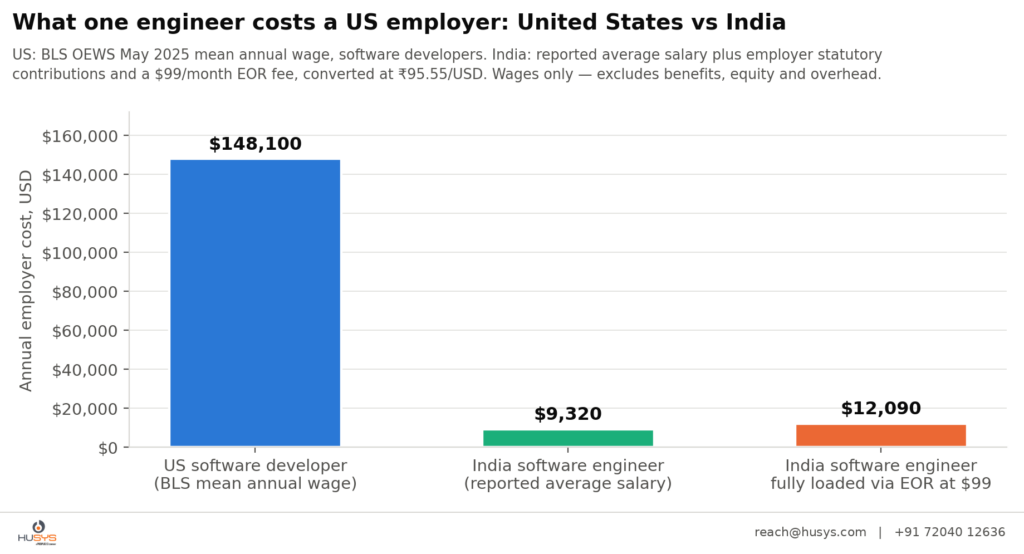
Chart: US mean annual wage for software developers from BLS OEWS, May 2025. India figure is reported average salary from Indeed India (updated 31 August 2026, n=13,200), converted at ₹95.55/USD (Federal Reserve H.10, 11 September 2026), plus employer statutory contributions and a $99/month EOR fee. Wages only — excludes benefits, equity and overhead.
Read this chart honestly. The gap is real but the roles are not identical — the US figure is a broad-market mean across all employers; India averages are dragged down by a very large services sector. A senior engineer in Bengaluru at a well-funded startup commands far more than the national average: Indeed India puts senior software engineers at about ₹13.2 lakh (~$13,780) and principal software engineers at ₹16.3 lakh (~$17,050), with Bengaluru at a premium. Budget for the role you are actually hiring, not the national mean.
The talent pool is not the constraint. India hosts 2,117 GCCs employing 2.36 million people, generating $98.4 billion in revenue, with 506 Forbes Global 2000 companies operating centres there, and India ranks #1 globally for AI hiring (Zinnov–NASSCOM India GCC Landscape 2026).
One caveat specific to hardware and deep-tech. If your India engineers touch defence, aerospace, drone or export-controlled technology, an EOR handles employment compliance — it does not handle ITAR/EAR export control, which remains entirely your obligation and is unaffected by who employs the engineer. Get export-control counsel separately.
13.4 The General Counsel signing off on hiring without an entity
The job to be done: When we hire in India without a local entity, I want clear assurance we’re not creating Permanent Establishment or misclassification risk, so I can sign off without exposing the company.
How it normally happens. Engineering has already hired three contractors in India. Finance has been wiring them for eight months. You find out when someone asks whether the contractor agreements assign IP under Indian law. You discover the IP provisions have not been reviewed against the Indian-law requirements relevant to the engagement.
One of the three is also introducing the company to prospective Indian customers, creating a separate PE question.
“How it happens with an EOR. Employment contracts are governed by Indian law with the relevant IP provisions documented, while the EOR handles the employment and payroll layer. The US company still needs a separate PE analysis based on what the India team actually does.
The GC framework:
Risk | Contractor arrangement | EOR arrangement | Your residual obligation |
|---|---|---|---|
Misclassification | High — substance-over-form test | Low — genuine employment | Ensure the EOR is the real employer in substance |
IP assignment | Often defective under Indian law | Contractual, Indian-law governed | Review the IP clause yourself |
Statutory benefits arrears | Accruing silently | Discharged monthly | Audit remittance proofs quarterly |
Termination dispute | Yours | The EOR’s, contractually | Check the indemnity and liability cap |
Permanent establishment | Present | Reduced, not eliminated | See §10 — this one stays with you |
DPDP compliance | Unaddressed | Partly addressed | Notice and breach reporting from 14 May 2027 |
14. Where Husys fits among the Deel alternatives, stated factually
We publish this page, so here is our position among the Deel alternatives in plain terms rather than as a claim about being best.
Husys is an India-focused EOR and PEO provider that has operated in the India market since 2002, 24 years, which predates every global platform in the comparison above: by roughly seventeen years in the case of Deel and Remote, both founded in 2019, and by a decade or more in the case of G-P, Papaya and Pebl. Operationally, as at 1 September 2026: 450 active clients (companies with at least one employee currently under management), 8,000+ employees currently under management, an average client tenure of over four years, coverage across 28 states and 6 of India’s 8 union territories, ISO 9001 and ISO 27001 certified, a qualified in-house compliance team rather than outsourced counsel, employee onboarding completed within 8 working hours, and pricing starting at $99 per employee per month with no setup fees, no onboarding fees and no minimums (Husys).
The same standard we applied to everyone else, applied to us: these are self-reported operating figures and are not independently audited. Every competitor figure in this page comes from that competitor’s own published documentation or from a named third party. Ours come from our own records. Weigh them accordingly.
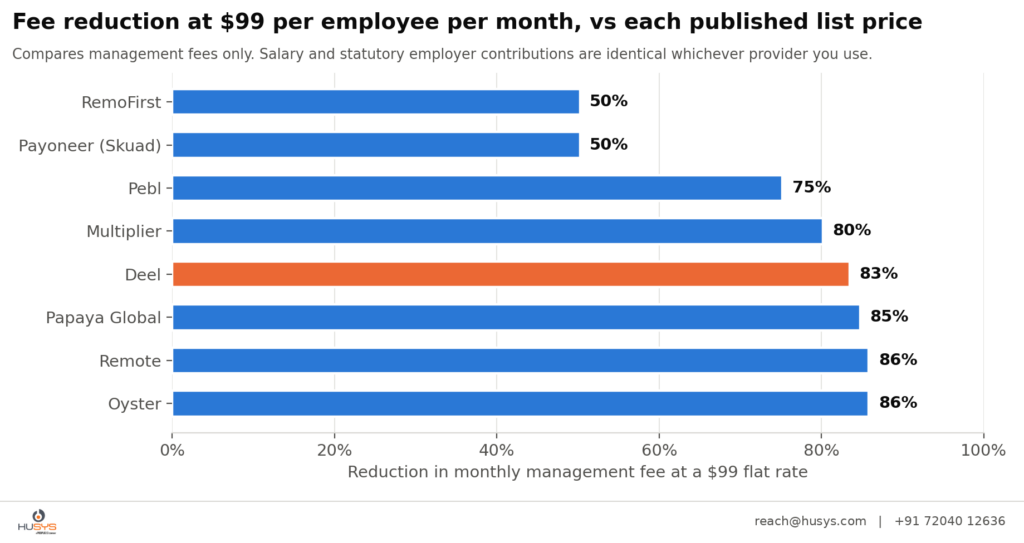
Chart: Reduction in monthly management fee at a $99 flat rate, against each provider’s published list price. Sources: each provider’s own pricing page, accessed 18 September 2026.Compares published management fees only. Salary and statutory employer costs are outside the provider fee comparison and should be modelled separately using the same employee assumptions.
Chart data (fee reduction at $99 vs each published list price): Oyster 86% · Remote 86% · Papaya Global 85% · Deel 83% · Multiplier 80% · Pebl 75% · Payoneer 50% · RemoFirst 50%.
Against Deel’s published $599, a $99 flat rate is an 83% reduction in the management fee. Against Remote’s and Oyster’s $699 it is 86%. Against RemoFirst’s and Payoneer’s $199 it is 50%. Those are arithmetic on published list prices, not negotiated rates, and we would rather show the whole range than quote the most flattering number.
Where another provider may suit you better. We would rather say this plainly than have you discover it after signing:
- Multi-country breadth. Husys is a People2.0 company, and People2.0 operates across 130+ countries (People2.0), which is how we support hiring beyond India. If your requirement is genuinely multi-country from day one and India is incidental to it, compare that capability directly against Deel’s rather than taking either description on trust.
- Platform feature depth. Our own HRIS covers end-to-end India HR operations with an employee self-service portal, and the People2.0 platform adds workflow and integration depth across its network. Global platforms have nonetheless invested heavily in product surface, device management, equity administration, a large integration marketplace. Compare feature lists against the workflows you will actually use, not against the longest list.
The People2.0 relationship. Husys is a People2.0 company — People2.0 acquired Husys in August 2022 (Business Wire), and the relationship added Agent of Record (AOR) capability alongside our EOR and PEO services (Husys). People2.0 was founded in 2001, operates across 130+ countries, is majority-owned by TPG Growth, and holds ISO/IEC 27001:2022 certification at five entities globally including India (People2.0 Trust Center). For a US buyer, the practical effect is that India depth does not have to be traded against reach beyond India.
What we would put weight on: 24 years of India-only operating history, an in-house compliance team, and the fact that when the PF ceiling moved to ₹25,000 on 17 September 2026, it was an operational task rather than a discovery.
Frequently asked questions
What are the best Deel alternatives for India hiring?
The realistic shortlist of Deel alternatives depends on what you are optimising for. For India-specific compliance depth at the lowest published price, Husys and Wisemonk both publish $99 per employee per month. For a verified owned India entity with a global platform, Remote explicitly states it owns its Indian entity. For maximum country breadth, RemoFirst and Pebl publish 185+ countries and G-P 180+. For mid-priced global coverage, Multiplier at $459–$499 and RemoFirst at $199. Compare the published price, entity ownership and India compliance depth, not on platform features you will not use.
How much does Deel cost for India, exactly?
Deel publishes $599 per employee per month for EOR. That is a global list price; Deel does not publish an India-specific rate. Above it sit a deposit of 1 — 1.5× total monthly charges, monthly severance accrual (India is explicitly on Deel’s accrual list), $29 per employee for off-cycle payroll, and an undisclosed FX spread. All four are documented in Deel’s own help centre.
Is there a cheaper alternative to Deel for hiring in India?
Published management fees vary substantially across providers. Deel publishes $599 per employee per month for EOR, while providers in this comparison publish rates as low as $99 per employee per month.
At $99, the published management fee is 83% lower than Deel’s $599.
These figures compare provider fees only; salary, statutory employer contributions, deposits, FX costs, payroll adjustments and other additional charges can affect the total cost of employment.
Can a US company hire employees in India without setting up a company?
Yes. An employer of record becomes the legal employer of your India team and handles payroll, PF, ESI, Professional Tax, TDS, Form 16 and statutory leave, while you direct the work. This is the standard lawful route for hiring employees in India without an entity.
Is using an EOR legal in India?
EOR structures can be used to employ workers in India, provided the employment arrangement, contracts, statutory registrations and contributions comply with the applicable Indian employment framework and the underlying facts support the structure. The EOR relationship does not, by itself, determine the US company’s tax or permanent-establishment position. If India personnel perform customer-facing, revenue-generating or other activities that could create tax or corporate-presence exposure, obtain India-specific legal and tax advice before relying on an EOR structure.
Learn More→ EOR vs entity vs contractor in India
An EOR should not be treated as a substitute for an India entity or tax analysis when your India operation is conducting revenue-generating or customer-facing activities. Depending on what the India team does, the company may need an Indian entity or another appropriate structure. Get India-specific tax and legal advice based on the actual activities before choosing the employment structure.
Does an EOR eliminate permanent establishment risk in India?
No. An EOR does not automatically eliminate PE exposure. The India–US tax treaty contains PE rules that can depend on factors including the activities performed in India and, in relevant circumstances, whether a person habitually concludes contracts or plays the principal role leading to contracts being concluded. The fact that an EOR is the legal employer does not by itself settle the US company’s PE position.
For example, an employee performing internal product-development work raises a different PE question from a person routinely negotiating or concluding customer contracts on behalf of the US business. The precise facts matter, so obtain India-specific tax advice for customer-facing, sales, services or other revenue-generating roles.
Take Indian tax advice on the specific roles.
Can I just pay someone in India as a contractor?
For a genuine freelancer with multiple clients, control over their own hours and their own tools — yes. For someone who works your hours, on your systems, reporting to your managers, with no other clients, that is an employment relationship under India’s substance-over-form test, whatever the contract says, and the contract’s title will not protect you.
What does an Indian employee actually cost above salary?
Employer PF at 12% up to a ₹25,000 wage ceiling (from 17 September 2026), ESI at 3.25% where wages are under ₹21,000/month, gratuity accruing at roughly 4.8% of salary, statutory bonus of 8.33%–20% where the employee earns under ₹21,000/month, Professional Tax capped at ₹2,500 per year where the state levies it, plus the EOR management fee. Broadly, plan for 15–20% above gross salary in statutory employer cost, plus the fee.
How quickly can I onboard an employee in India through an EOR?
Providers advertise anywhere from 8 working hours to several days. The gating factor is usually not the provider — it is your approval of the draft employment contract and the employee submitting KYC and bank details. Put the SLA in the contract with a remedy attached, then resource your own side of it.
Which is better for India, a PEO or an EOR?
If you have no Indian entity, only an EOR is available, a PEO is a co-employment model that requires you to already have one. If you do have an entity and want to retain it while outsourcing HR operations, a PEO is the right structure.
Do I need to worry about India’s new labour codes?
Yes. The four Codes came into force on 21 November 2025, replacing 29 laws, with Central Rules notified 8 May 2026. Appointment letters are now mandatory, gratuity vests at one year for fixed-term employees, and the retrenchment permission threshold moved from 100 to 300 workers. State rules are still being notified, so the position varies by state.
What changed with the Provident Fund in September 2026?
The EPF wage ceiling rose from ₹15,000 to ₹25,000 per month effective 17 September 2026, the first change since 2014, bringing about 51 lakh additional employees into mandatory coverage. Maximum employer PF liability per employee rises from ₹1,800 to ₹3,000 a month, roughly $150 per employee per year.
Do I need an EOR deposit, and do I get it back?
Deel, Oyster and Remote all publicly require one. Deel runs 1–1.5× total monthly charges and can exceed two months in defined circumstances, refunded up to 60 days after termination. Oyster requires one fully refundable month. Remote collects reserves of roughly one month’s gross plus employer costs. Most other providers do not publicly disclose a policy, so ask, and get the refund window in writing.
How hard is it to switch from Deel to another India EOR?
Operationally it is a 30-day project. The three things that break it are a broken continuity-of-service date (which resets gratuity vesting), a failed UAN transfer (which orphans the employee’s PF history), and a missed payroll cycle. Mid-financial-year switches generate two Form 16s, which is normal but must be explained to employees in advance. Full playbook in §12.
Does my EOR own its Indian entity, and how do I check?
Ask them to name the legal entity that will appear on the employment contract and confirm whether they own it, then verify it on the Ministry of Corporate Affairs register. Of the 13 providers reviewed, only four state their India position explicitly on their own website. Four do not disclose it at all.
Who issues Form 16 to my India employees?
Your EOR, as the legal employer, by 15 June following the end of the financial year, under Rule 31. If you are paying people as contractors, nobody issues it — which is usually how the problem surfaces.
Where to go from here
It is sending the twelve questions in §8 to every provider
If it would help to have those answers from someone who has been operating only in India since 2002, book a 30-minute India compliance review with our in-house compliance team, no demo, no pitch deck. Bring your role list and the states you are hiring in, and you will leave with a written view on statutory cost per head, PE exposure by role, and whether an EOR is even the right structure for what you are doing. If it is not, we will tell you that.
Book an India compliance review → Contact / Book a consultation
Or start with the underlying material: → Hiring Employees in India as a US Company: The Complete Compliance Guide (2026) ·
Best EOR & PEO Providers for Hiring in India (2026)
Evaluating India expansion? Speaking with a compliance expert early is considerably cheaper than unwinding a misclassification finding later.