
Companies expanding into India often use an Employer of Record (EOR) to hire employees without opening a legal entity.
In this guide, we compare the top Employer of Record providers in India for 2026, including pricing models, compliance coverage, and ideal use cases for startups and mid-market companies.
Whether you’re a US-based company hiring in India or a startup scaling quickly, this comparison will help you choose the right EOR partner.
Thinking of hiring in India? India’s new labor codes just changed how wages are calculated, increased mandatory provident fund contributions, and introduced stricter termination procedures.
Unlike US at-will employment, India requires 30-90 day notice periods, severance calculations, and extensive payroll compliance. That’s why most US companies start with an Employer of Record, a company that legally employs your India-based team on your behalf while you retain day-to-day control over their work.
In this guide, we break down what an Employer of Record actually does in India, why US companies use them, and compare the top 10 providers operating in the country.
| EOR Provider | Best For | Starting Cost | India Compliance | Global Coverage |
|---|---|---|---|---|
| Husys | India-focused companies | $99 | Full statutory compliance | India |
| Deel | Global startups | $599+ | Yes | 150+ countries |
| Remote | Distributed teams | $599+ | Yes | 80+ countries |
| Rippling | HR stack | Custom | Yes | 50+ countries |
| Oyster | Remote teams | $599+ | Yes | 130+ countries |
TL;DR
- India’s 2025 Labour Codes, rolling into full effect in 2026, tighten wage definitions, expand statutory benefits, and make terminations and compliance stricter for employers.
- US-style at-will employment does not exist in India. Expect 30–90 day notice periods, mandated severance, monthly payroll cycles, and strict filing deadlines.
- List Item #3An Employer of Record (EOR) legally employs your India-based team on its payroll while you manage their day-to-day work. This lets US companies hire in India without setting up a local entity.
- EORs handle Indian-compliant contracts, payroll, tax deductions, PF, ESI, gratuity, bonus, and state-level labor law compliance.
- Compared to entity setup or contractors, EORs offer the fastest and lowest-risk way to hire compliantly in India, especially for early and mid-stage expansion.
- True employment cost in India is typically 20–30% above base salary once statutory contributions are included.
- Key mistakes US companies make include ignoring notice periods, misstructuring compensation, misclassifying contractors, and underestimating state-level compliance.
What is an Employer of Record (EOR) in India?
An Employer of Record is a company that becomes the legal employer of your workers in India. You source the talent, run interviews, and make the hiring decisions. The EOR hires the employee on its payroll, issues an Indian-compliant employment contract, and takes responsibility for all statutory paperwork.
You continue to manage the employee’s day-to-day work, performance, promotions, and compensation decisions. The EOR handles compliance, including monthly payroll processing, tax deductions, and mandatory contributions under Indian labor laws.
For US companies, this means you can hire in India without setting up a local entity, opening an Indian bank account, or building an in-house HR and payroll function.
Why US Companies Are Hiring in India in 2026
India offers access to a large, English-speaking talent pool at a fraction of US hiring costs. Combined with workable time zone overlap and a fast-maturing startup ecosystem, it has become a practical expansion market for US companies.
Key reasons driving hiring in India:
- Engineering cost arbitrage: Senior software engineers in India typically earn $25,000–$40,000 per year, compared to $120,000-$180,000 in the US, based on data from the 2024 Stack Overflow Developer Survey.
- Depth of technical talent: India produces over 1.5 million engineering graduates annually, according to the All India Council for Technical Education’s 2023–24 data.
- High English proficiency: India ranks 6th globally among non-native English-speaking countries, per the 2023 EF English Proficiency Index.
- Time zone overlap: Indian Standard Time (IST) provides 3-4 hours of daily overlap with US East Coast working hours, enabling real-time collaboration.
- Startup operating maturity: India had more than 111,000 recognized startups as of 2024, according to the Department for Promotion of Industry and Internal Trade.
EOR vs Entity Setup vs Contractors:
Cost and Risk Comparison
US companies expanding into India typically choose between three models: Employer of Record, local entity setup, or independent contractors. Each option differs significantly in cost, speed, compliance risk, and long-term scalability.
| Factor | Employer of Record (EOR) | Local Entity Setup | Independent Contractors |
|---|---|---|---|
Time to hire | 1-2 days | 3–6 months | 1–2 weeks |
Upfront cost | Low | High (legal, tax, setup) | Very low |
Ongoing cost | Per-employee EOR fee | Payroll, compliance, admin | Lower, but unstable |
Compliance risk | Low (EOR assumes liability) | High (company liable) | High (misclassification risk) |
Payroll & tax handling | Fully managed | Company-managed | Contractor-managed |
Indian labor law coverage | Yes | Yes | No |
Termination complexity | Managed by EOR | High | Legally risky |
Permanent establishment risk | Low | High | High |
Best suited for | Fast, compliant entry | Large, long-term teams | Short-term, non-core work |
Is Using an EOR Legal in India
Yes. Using an Employer of Record in India is legal when the EOR is a registered Indian entity and acts as the formal employer under Indian labor laws. The EOR issues compliant employment contracts, runs payroll, and fulfills statutory obligations such as PF, ESI, TDS, gratuity, and labor law filings.
However, an EOR does not eliminate all risk by default. US companies must ensure the EOR has real on-ground operations in India, properly structures employment relationships, and avoids arrangements that resemble labor-only contracting. When implemented correctly, an EOR is a legally accepted way for foreign companies to hire in India without setting up a local entity.
How to Evaluate EOR Providers: 7 Decision Criteria
Here’s what actually matters when choosing an Top EOR providers in India:
- Compliance isn’t negotiable. Ask how they handle local labor law changes. If the answer is vague, walk away.
- Speed kills deals. Top talent won’t wait 3 weeks for onboarding. If they can’t move fast, you’ll lose people to competitors.
- Own entities or partnerships? Companies with their own local entities take accountability. Third-party networks play pass-the-blame when things break.
- Your team deals with them, not you. Slow payroll support or terrible HR experience? People quit. Test their employee-facing service before signing anything.
- Transparent pricing or surprise fees? Get every cost in writing. “Administrative fees” that appear later aren’t administrative, they’re profit.
- Contract flexibility matters. Markets change. Can you scale down without penalties? What are the actual exit terms?
- Support responsiveness. Email them a question before you buy. If they’re slow now, imagine during a crisis.
Where EOR Services Are Commonly Used in India
EOR services are widely used in major hiring hubs such as
- Bengaluru,
- Hyderabad,
- Pune,
- Mumbai, and
- GIFT City
for global companies expanding into India.
Top EOR Providers in India (2026 Comparison)
Choosing the right EOR provider depends on your hiring scale, compliance needs, and whether you require global or India-specific expertise.
Best Employer of Record Companies in India
Here are some of the best EOR providers in India based on compliance expertise, pricing, and suitability for global companies.
| Provider | India Model | India Focus Depth | Payroll & Compliance Execution | Onboarding Speed | India Advisory Support | Best For | Pricing (Per Employee / Month) |
|---|---|---|---|---|---|---|---|
Husys (People2.0 Company) | Direct employer via own Indian entity | India-specialist (since 2001) | Fully in-house PF, ESI, TDS, gratuity, bonus | Within 8 working hours | Dedicated 24×7 India team, US-hour overlap | US companies scaling long-term in India | $99 |
Deel | Global EOR via multi-country model | Multi-country focus | Statutory compliance handled within global framework | Standard global timelines | High-level, non state-specific | Companies hiring across multiple countries | $599 |
Remunance | India-based entity | India-focused | Local payroll & statutory compliance | Standard onboarding | Traditional compliance support | Companies needing basic India EOR | Not publicly disclosed |
Remote | Global platform with partner model | Multi-country | Often partner-executed India payroll | 2–3 weeks (peak periods) | Limited high-touch local support | Startups hiring 3–5 global employees | $699 |
Multiplier | Multi-country platform | Asia-Pacific focused | Core statutory execution | Standard global timelines | Limited advisory depth | Mid-sized APAC hiring teams | $400 |
Rippling | Global HR + EOR add-on | Multi-country | Payroll integrated into broader system | Standard global timelines | Routed through global support queues | Existing Rippling users | $499–$599 |
Skuad | Global emerging market model | Multi-country | Payroll & statutory handling | Payroll & statutory handling | Ticket-based support | Cost-sensitive global teams | $199 |
Asanify | India payroll-first platform | India-focused | Payroll strong; EOR layered | Standard | Limited maturity in complex cases | India teams needing payroll tooling | $199 |
Papaya Global | Global payroll visibility platform | Multi-country | Often partner-network based | Slower during documentation-heavy hires | Escalation via centralized system | Finance-led global teams | $599 |
Wisemonk | India-focused EOR | India-focused | Local payroll & compliance | Standard | Limited scale infrastructure | Early-stage India hiring | $99–$500 |
1. Husys - a People2.0 Company

Husys is an India-specialist Employer of Record operating since 2001, focused exclusively on helping US and global companies hire and manage employees in India. With over two decades of operating history and more than 3,000 active employees on its payroll, Husys runs end-to-end employment, payroll, and statutory compliance under Indian labor law.
What US employers get
- Legal employment through Husys’ own Indian entity
- Payroll processing compliant with PF, ESI, TDS, gratuity, and statutory bonus rules
- Employment contracts drafted under the Indian labor law
- Employee onboarding completed within 8 working hours
- Dedicated account manager for payroll, compliance, and HR coordination
- Ongoing HR support for leave management, documentation, and employee lifecycle events
Why do US companies use Husys as their EOR
- Direct employer model: Husys employs workers through its own Indian legal entity, reducing dependency on third-party payroll partners and minimizing compliance handoffs.
- India-first compliance depth: The team manages Indian labor law execution in-house, including terminations, notice periods, statutory filings, and inspections.
- Experienced compliance leadership: Backed by a team bringing more than 250 years of combined hands-on experience across Indian employment and statutory frameworks.
- Operational scale in India: With thousands of employees already on payroll, Husys operates mature payroll and compliance workflows rather than ad hoc processes.
- US-aligned operating hours: Support coverage is structured to overlap with US business hours, which matters during payroll cycles, onboarding, and exits.
- Round-the-clock support: 24×7 access to a dedicated English-speaking relationship manager, with average issue resolution within 45–50 minutes.
Husys’s India operational footprint
- Operating in India since 2001, well before the EOR category existed
- 3,500+ active client employees on payroll at any time
- 50,000+ contractors engaged for clients under Indian labor laws
- Operations across 28 Indian states and 8 Union Territories, including Karnataka, Maharashtra, Telangana, Tamil Nadu, NCR- National Capital Region, and West Bengal
- Deep exposure to SaaS, IT services, product engineering, fintech, and US startup India GCC teams
- Was the first HR services company listed on the Indian Stock Exchange before the People2.0 partnership.
Note: Most global EORs entered India post-2020 using partner networks. Husys built its payroll, compliance, and labor law operations during multiple regulatory cycles, inspections, and state-level changes. That operating history reduces risk when issues arise around audits, terminations, or state-specific compliance. |
- $99 per employee per month
- No setup fees
- No long-term contractual lock-ins
- No termination fees
Best for: US companies planning serious India scale-up who need long-term compliance certainty, not just fast hiring.
Trusted by US businesses building teams in India 53% of companies using Husys come from the US. Scale your India team with the same confidence. |
In India, a solid engineer for global teams often costs between USD 500 and 1,000 a month in salary. When your EOR partner charges USD 599 per employee per month, you’re effectively paying for a second engineer on every single hire – but that second engineer doesn’t write a single line of code for you.
At that point, whether you’re a 10‑person startup or a 10,000‑person enterprise, the economics start to look the same: you’re bleeding margin in India for convenience you could get at a fraction of the price.
At Husys, we chose a different path. Our India EOR starts at USD 99 per employee per month, because we believe EOR should be an enabler of growth, not an invisible second salary on every role.
2. Deel
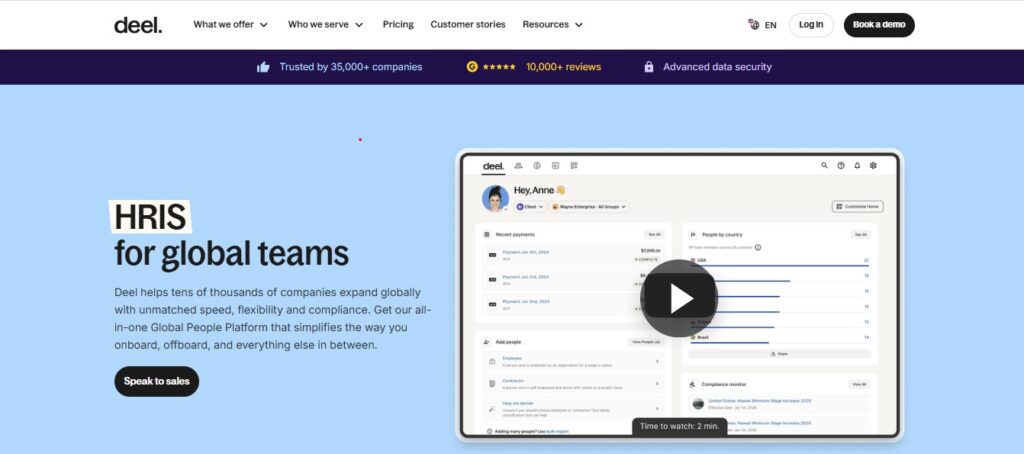
Deel is a global payroll and Employer of Record platform that supports hiring across multiple countries, including India. Its EOR offering in India is part of a broader international model designed for companies managing distributed teams across several regions rather than operating in a single country.
What US employers get
- Employer of Record hiring support across multiple countries, including India
- Centralized onboarding and payroll workflows through a single platform
- Payroll processing with multi-currency payment support
- Handling of statutory benefits and tax-related compliance requirements
- Immigration and visa assistance in select markets
- Employee self-service access for contracts, payslips, and documentation
What US employers do not get
- India-dedicated advisory teams for state-specific labor law interpretation
- Proactive guidance on India compliance beyond standardized global frameworks
- Fast, local escalation for payroll issues
Best for: Companies hiring across many countries at once, where India is one of several locations.
Pricing: EOR services start at $599 per employee per month.
G2 reviews flag: Slower India-specific support responses, compliance guidance that remains high-level rather than state-specific, and longer escalation timelines when payroll issues arise in single-country setups. |
Community discussions (Reddit):
Here is what employers and contractors have shared in independent Reddit discussions about Deel:
- People have shared experiences of a Deel-hosted hiring event promoted as interactive with guaranteed interviews, but delivered mainly as a large webinar and partner-led assessment process.
- Some contractors have faced lower net payouts under Deel’s Contractor of Record setup, with limited clarity on deductions and fees.
- Others have shared experiences of delayed fund withdrawals due to repeated identity verification requests and slow support responses.
3. Remunance

Remunance is an India-focused Employer of Record provider that helps foreign companies hire employees in India without establishing a local entity. Its services are centered on Indian payroll execution, statutory compliance, and employee lifecycle management under Indian labor laws.
What US employers get
- Employment of India-based workers through a local Indian entity
- Payroll processing is aligned with Indian statutory requirements
- Indian-compliant employment contracts and documentation
- Management of PF, ESI, gratuity, and other mandated contributions
- Support for employee onboarding and offboarding processes
- Ongoing coordination for payroll and compliance-related queries
What US employers do not get
- Automated workflows for exits or payroll adjustments
- Proactive compliance planning ahead of regulatory or labor law changes
- Rapid turnaround during complex terminations or restructuring events
Best for: Companies looking for a traditional India EOR with basic compliance coverage.
Pricing: Remuneration has not shared pricing details publicly.
G2 reviews flag: Manual-heavy processes that can extend exit timelines, and limited proactive guidance during regulatory or labor law changes. |
4. Remote
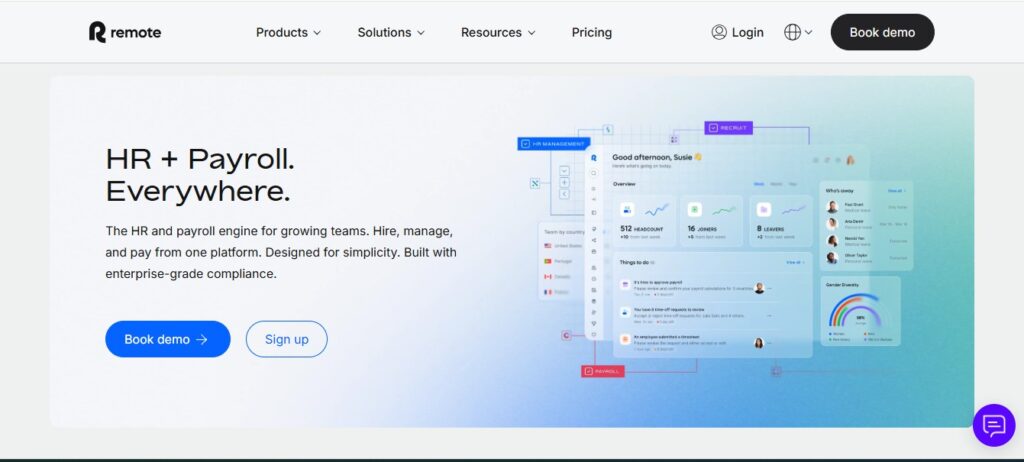
Remote provides Employer of Record and payroll services across multiple countries, including India, as part of its global workforce management platform. Its India offering is integrated into a broader system designed to centralize employment operations for distributed teams.
What US employers get
- Employer of Record support across a wide range of countries, including India
- Centralized management of employment contracts and payroll
- Handling of statutory benefits and compliance processes
- Payroll reporting and documentation through a unified platform
- Employee self-service tools for payroll and employment records
- Integration with other HR and workforce management systems
What US employers do not get
- Guaranteed fast onboarding timelines for India hires
- One-pass contract finalization without review or iteration
- High-touch local support during India-specific employment edge cases
- End-to-end in-house execution of India payroll, tax, and PF processing, as these functions are typically handled through local processing partners rather than directly by the platform
Best for: Startups hiring their first 3–5 international employees across multiple regions
Pricing: EOR services start at $699 per employee per month.
Trustpilot reviews note: India onboarding timelines can extend to 2–3 weeks during peak periods, and employment contracts may require multiple revision cycles before finalization. |
5. Multiplier

Multiplier is a global employment platform that offers Employer of Record services across multiple countries, including India. Its India EOR capability is part of a broader international hiring model designed for companies managing employees in several jurisdictions.
What US employers get
- Employer of Record hiring support in India as part of a multi-country platform
- Centralized onboarding and employment documentation
- Payroll processing aligned with local statutory requirements
- Management of mandatory benefits and tax-related deductions
- Employment lifecycle support through a single dashboard
- Employee self-service access for payroll and documents
What US employers do not get
- Deep advisory support on India labor code changes or wage restructuring
- Fully hands-off payroll operations without occasional follow-up
- Country-specific compliance strategy beyond core statutory execution
Best for: Mid-sized companies (20–100 employees) hiring across Asia-Pacific with centralized billing
Pricing: EOR services start at $400 per employee per month.
Capterra feedback highlights: Occasional payroll adjustments requiring follow-up, and limited depth of advisory support on India labor code changes beyond core statutory compliance. |
Community discussions (Reddit):
An employee working via Multiplier EOR in Brazil posted about serious benefit administration issues, including life insurance coverage lapsing for an extended period and slow, email-only support during resolution attempts.
While this experience relates to Brazil, it highlights risks around benefit handling and support responsiveness that employers often consider when evaluating EOR partners in other markets, including India.
6. Rippling

Rippling is a workforce management platform that combines HR, payroll, IT, and finance tools, with Employer of Record services available for international hiring, including in India. Its EOR functionality is integrated into a broader system used to manage global employees.
What US employers get
- Employer of Record support for hiring employees in India
- Centralized management of payroll, employment records, and compliance tasks
- Handling of statutory benefits and tax deductions
- Integration with HR, IT provisioning, and finance workflows
- Employee self-service tools for payroll and documentation
What US employers do not get
- India-dedicated EOR teams with local decision-making authority
- Immediate resolution for payroll exceptions requiring manual intervention
- Hands-on advisory support for complex India labor law scenarios
Best for: Companies already using Rippling for HR and IT who want EOR as an add-on.
Pricing: EOR per employee per month averages $499 to $599 based on publicly available sources.
G2 reviews flag: India EOR support is routed through global queues, resulting in slower resolution for payroll exceptions and limited hands-on guidance for complex local labor law scenarios. |
Community discussions (Reddit):
An employer posted about their experience with Rippling on Reddit, saying the payroll implementation fell apart early due to repeated system issues and workarounds that failed in live runs. They also flagged delays in account closure, missing quarterly tax filings, and slow support responses, which blocked their move to a new payroll provider and raised compliance concerns.
7. Skuad
Skuad provides Employer of Record services across multiple countries, including India, supporting companies that hire internationally without setting up local entities. Its India offering operates within a global platform designed for distributed workforce management.
What US employers get
- Employer of Record hiring capability in India
- Support for employment contracts and payroll execution
- Handling of statutory benefits and compliance requirements
- Centralized workforce management through an online platform
- Employee access to payroll and employment documentation
What US employers do not get
- Predictable payroll timelines during high-volume processing periods
- High-touch support outside standard ticket-based workflows
- Guided handling of complex exits or statutory change management
Best for: Cost-sensitive teams hiring in multiple emerging markets simultaneously.
Pricing: EOR services start at $199 per employee per month.
G2 reviews flag: India payroll timelines can vary during peak cycles, with support primarily managed through ticketing systems and less clarity during statutory changes or employee exits. |
8. Asanify
Asanify is an India-based HR and payroll platform that also supports Employer of Record-style hiring for foreign companies. Its services are centered on Indian payroll execution, statutory compliance, and employee documentation, with EOR capabilities layered onto its core HR infrastructure.
What US employers get
- Support for hiring employees in India without setting up a local entity
- Payroll processing aligned with Indian statutory requirements
- Management of mandatory contributions such as PF, ESI, and tax deductions
- Employment documentation and record-keeping under Indian labor laws
- HR tools for leave management and employee records
- Employee self-service access for payslips and documents
What US employers do not get
- Fully mature EOR workflows for complex terminations or disputes
- Deep experience managing compliance-heavy employment scenarios
- Fast escalation when payroll and labor law issues intersect
Best for: India-based teams that want payroll tooling with light EOR support.
Pricing: EOR services start at $199 per employee per month.
Capterra reviews flag: EOR workflows are less mature than the core payroll offering, with limited experience handling complex terminations and slower escalation during compliance-heavy cases. |
9. Papaya Global
Papaya Global is a global payroll and workforce management platform that provides Employer of Record services across multiple countries, including India. Its India EOR offering is part of a centralized model focused on payroll visibility and compliance reporting across regions.
What US employers get
- Employer of Record support in India within a multi-country payroll platform
- Centralized payroll processing and reporting across jurisdictions
- Handling of statutory benefits and tax-related compliance requirements
- Workforce data consolidation for global teams
- Employee access to payroll records and documentation
What US employers do not get
- Direct, in-house execution of India payroll and compliance activities
- Rapid onboarding for India hires requiring extensive local documentation
- Immediate local escalation during payroll discrepancies
Best for: Finance-led organizations prioritizing global payroll visibility and reporting.
Pricing: EOR services start at $599 per employee per month.
G2 reviews flag: India onboarding can take longer than expected, payroll discrepancy resolution may involve extended response cycles, and local compliance execution often relies on partner networks. |
Community discussions (Reddit):
A user shared concerns about Papaya Global, saying the platform does not take direct payroll liability and relies heavily on local partners for payroll processing. They noted that when payroll accuracy issues arise, Papaya pushes responsibility to its partners instead of owning the issue end to end, which can create accountability gaps for customers.
10. Wisemonk
Wisemonk is an India-focused Employer of Record provider that supports foreign companies hiring employees in India without establishing a local entity. Its services focus on employment contracts, payroll processing, and statutory compliance under Indian labor laws.
What US employers get
- Employment of India-based workers through an Indian entity
- Payroll processing and statutory compliance management
- Handling of mandatory contributions and labor law documentation
- Support for onboarding and employee lifecycle processes
- Coordination for payroll and compliance-related queries
What US employers do not get
- Proven scalability for large or rapidly growing India teams
- Consistent processing speed during peak payroll cycles
- Deep support infrastructure as headcount increases
Best for: Early-stage companies hiring their first few employees in India.
Pricing: EOR per employee, per month (range): $99 – $500.
G2 reviews flag: Processes are well-suited for small teams but can slow down during peak payroll cycles, with reduced support depth as headcount scales. |
How to Choose the Best EOR in India
- Check compliance coverage (PF, ESI, gratuity)
- Understand pricing structure (flat vs % model)
- Evaluate onboarding timelines
- Look for experience with US companies hiring in India
- Assess support and responsiveness
Husys EOR Pricing: Transparent and Cost-Effective Flat $99 per Employee per Month
Husys offers one of the most cost-effective Employer of Record (EOR) pricing models in India.
At just $99 per employee per month, it is up to 80% more affordable than most global EOR providers,
which typically charge between $199–$699 per employee
With a transparent pricing approach and no hidden charges, Husys helps companies scale their teams in India without unexpected costs.
💰 No onboarding fee
📤 No offboarding fee
⚙️ No setup fee
🏦 No deposit required
📄 No contract fee
💻 No technology platform fee
This makes Husys an ideal choice for startups and mid-market companies looking for predictable, compliant, and scalable hiring in India. Book a Demo
Compliance Coverage: What the Best EOR Providers Handle
- Provident Fund (PF)
- Employee State Insurance (ESI)
- Gratuity
- Payroll taxes
- Leave policies and statutory benefits
What US Employers Get Wrong About Indian Labour Laws
Hiring in India isn’t just “find talent, send an offer, start work.” The legal framework is fundamentally different from the US, and mistakes get expensive fast.
Here’s what catches most US companies off guard:
- Notice periods are real and enforced: In India, notice periods are typically 60–90 days and actively enforced. Immediate start dates are rare, so plan for a 2–3 month gap between offer acceptance and start date.
- At-will employment doesn’t exist: Terminations require documented performance issues, formal notice, and severance calculations based on years of service. Fire someone wrong, and you’re facing legal disputes.
- Statutory benefits aren’t optional: Provident Fund, Employees’ State Insurance, gratuity, and paid leave are mandated by law with fixed contribution rules. Get them wrong, and you’re liable for penalties plus back payments.
- Contracts must be in local format: US employment agreements are not enforceable in India. Contracts must include India-specific clauses covering probation, notice periods, and termination.
- Payroll follows different timelines: Salary is paid monthly, not bi-weekly. Statutory deductions go to government portals with strict deadlines. Miss a PF filing deadline, and penalties start immediately.
- Leave policies are mandated: Most Indian states require 15–30 days of earned leave, 7–12 sick leave days, and 7–10 casual leave days annually. These are statutory minimums, not optional benefits.
- Compliance varies by state: India has central labor laws, but states add their own rules. What’s compliant in Karnataka might not work in Maharashtra.
- The true cost exceeds base salary: Between statutory contributions, benefits, and compliance overhead, budget an additional 20–30% on top of base salary for the true cost per employee.
Let’s take an example of an employee with a base annual salary of ₹25,00,000 in India.
| Component | Amount (INR) | Amount (USD, approx.) |
|---|---|---|
| Base Salary | ₹25,00,000 | $27,250 |
| Provident Fund (12%) | ₹3,00,000 | $3,270 |
| ESI (3.25%) | ₹81,250 | $887 |
| Gratuity Provision (4.81%) | ₹1,20,250 | $1,311 |
| Professional Tax | ₹2,400 | $26 |
| Total Employer Cost | ₹30,03,900 | $32,744 |
This represents an actual cost increase of almost 20% over the base salary. This calculation excludes bonuses, leave encashment, and any state-specific labor cess.attis, pulvinar dapibus leo.
EOR vs Payroll Software in India
While payroll software helps process salaries, an Employer of Record (EOR) acts as the legal employer and manages compliance, contracts, and statutory obligations.
The 2025 Labour Code Reforms Explained for US Companies
The table below summarizes the key shifts for US companies. It shows how the 2025 Labour Codes (being implemented in 2026) differ from the old 2024–25 regime on wages, contracts, gig workers, and compliance.
| Factor | India Labour Law (2024–25) | India Labour Codes (2025–26) |
|---|---|---|
| Governing Framework | 29 separate central labour laws with overlapping provisions and state-specific variations | Four consolidated Labour Codes covering wages, industrial relations, social security, and workplace safety |
| Definition of Wages | Different wage definitions with many allowances excluded | Single wage definition with excess allowances added for statutory calculations |
| Minimum Wage Coverage | Applicable only to scheduled employments | Applies to all workers with national floor wage |
| Gratuity Eligibility | Fixed-term employees require 5 years | Eligible after 1 year on pro-rata basis |
| Gig & Platform Workers | No formal recognition | Recognized with social security provisions |
| Layoff Approval | Required for 100+ employees | Required for 300+ employees |
| Work From Home | No explicit recognition | Explicitly permitted for service sector |
| Equal Pay | Limited enforcement across genders | Extended across genders including transgender employees |
| Overtime Pay | Varies by state | Minimum 2x wage across sectors |
| Leave Entitlement | After 240 days | After 180 days |
| Women Night Shifts | Restricted in most sectors | Allowed with consent & safety measures |
| Compliance Regime | Multiple registrations & heavy paperwork | Single registration with digital compliance |
Here’s what each of these statutory contributions (EPF, ESI, gratuity, etc.) actually means for employers in India.
- Employees’ Provident Fund (EPF): A mandatory retirement contribution where employers contribute a fixed percentage of wages each month for eligible employees.
- Employees’ State Insurance (ESI): A statutory health insurance scheme applicable to employees below a defined wage threshold, funded through employer and employee contributions.
- Gratuity: A statutory severance payment calculated based on tenure. Under the new labour codes, fixed-term employees become eligible after one year of service.
- Professional Tax (PT): A state-level tax deducted from employee salaries, with rates varying by location.
- Statutory Bonus: Mandatory bonus payments applicable to eligible employers and employees based on salary limits and company size under Payment of Bonus Act.
Check out the frequently asked questions on the new labour codes as answered by the Government. |
Common Mistakes US Companies Make When Hiring in India
rom what we’ve seen over the last 23 years working with US employers hiring in India, most issues come from applying US hiring assumptions to Indian labour law and payroll execution.
Common mistakes include:
- Issuing offer letters without accounting for 60–90 day notice periods, pushing start dates out by months.
- Terminating employees without documented cause, notice, or severance can quickly escalate into labor disputes.
- Structuring compensation with low base pay and high allowances, increasing PF and gratuity exposure under the new wage definition.
- Engaging long-term contractors who operate like employees creates misclassification and social security liability.
- Missing monthly PF or ESI filing deadlines, triggering penalties, and retrospective interest.
- Applying a single compliance approach across states despite state-level labor law differences.
- Budgeting only for base salary and underestimating total employment costs by 20–30%.
Not sure if your India hiring plan accounts for these risks? Book a 15-minute compliance review with Husys. We’ll flag the gaps in your contracts, payroll structure, and termination clauses before they become expensive problems. |
Conclusion
Hiring in India works well for US companies when payroll, compliance, and employment structure are treated as first-order decisions, not afterthoughts. The 2025 labour reforms have raised the cost of mistakes by tightening wage definitions, expanding statutory coverage, and reducing flexibility around contracts and exits.
This is where an Employer of Record can help. They employ your team locally in India, run payroll and statutory compliance, and let you hire without setting up an Indian entity upfront.
Husys enables US companies to hire employees in India while managing Indian payroll, statutory contributions, employment contracts, and labour law compliance end-to-end.
Cut India Expansion costs by 80%. Speak to an Expert.
Run monthly payroll, deposit PF, ESI, and TDS, and meet statutory deadlines from day one. |
Frequently Asked Questions (FAQ's)
1. How much does an EOR cost in India?
Most EOR providers in India charge a per-employee monthly fee, typically ranging from $80 to $300 per employee, depending on service scope. This is in addition to the employee’s salary and statutory contributions, which usually add 20–30% to base pay.
2. Can I convert EOR employees to my own entity later?
Yes. Many US companies start with an EOR and later transition employees to their own Indian entity once headcount justifies it. The transition involves issuing new employment contracts and transferring payroll registrations, which the EOR usually supports.
3. What happens if the EOR shuts down?
Legally, employees remain employed by the EOR. If an EOR ceases operations, employees must be transitioned to another EOR or your own entity to avoid payroll disruption. This is why evaluating the provider’s operating history and financial stability matters.
4. How long does termination take in India?
Termination timelines depend on contract terms and state laws, but 30–90 days of notice is standard. Immediate termination is rare and usually requires documented misconduct. Severance and statutory payouts may also apply.
5. Do I need a business license to use an EOR?
No. You do not need to register an Indian entity, obtain local licenses, or open an Indian bank account to hire through an EOR. The EOR acts as the legal employer and fulfills all local compliance requirements.
6. What is the best employer of record in India?
The best EOR provider depends on your hiring needs, budget, and compliance requirements. Companies like Husys, Deel, and Remote are commonly used.
7. How much does an EOR cost in India?
EOR services in India typically cost between $199 and $699 per employee per month.
8. Which EOR is best for US companies hiring in India?
Global platforms like Deel and Remote are popular, while India-focused providers like Husys offer deeper compliance expertise.
9. What compliance does an EOR handle in India?
EOR providers manage PF, ESI, payroll taxes, gratuity, and statutory labor law compliance.
10. Is an EOR cheaper than opening an entity?
Yes, for small and mid-sized teams, EOR is often more cost-effective than setting up and maintaining a legal entity in India.